What Are AAA Games? A Clear Definition, Real Examples, and What It Takes to Build One
For studios and curious players alike: what is aaa games in plain terms, where the line sits between AAA, AA and indie, and which side of it your next project belongs on.
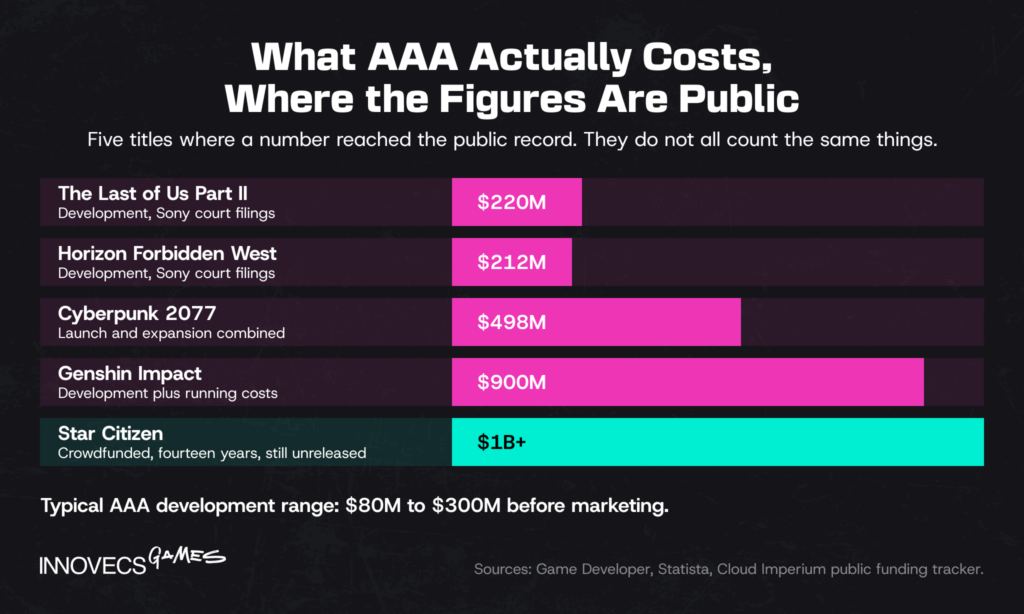
Fourteen years into development, Star Citizen has taken more than $1 billion from players and shipped nothing. Ten figures, counted on the studio’s own public funding tracker. There is still no release date, which at this point reads less like a schedule than a business model. That is the outer edge of what this tier makes possible, and of what it quietly makes normal.
Closer to the middle, the picture is stranger. GDC’s 2026 State of the Game Industry survey reached more than 2,300 professionals. Two-thirds of the ones working at AAA studios said their company had run layoffs; half of everyone surveyed said their employer had done it inside the past year. Over on Steam, meanwhile, Valve counted 5,863 titles earning over $100,000, roughly double the 2020 figure, and hardly any of those came from teams of hundreds. Top of the market shrinking, everything underneath it growing.
The reason is arithmetic rather than mismanagement. Sony’s own court filings put The Last of Us Part II at $220 million and Horizon Forbidden West at $212 million, reported by Game Developer after an unredacted document reached the FTC case file. Raph Koster’s analysis of the cost of games tracked AAA console and PC budgets rising roughly tenfold every decade since 1995, adjusted for inflation, and nothing about that curve flattened when studios started cutting staff. At those budgets a game needs several million full-price sales before it returns a cent.
So when someone asks what are aaa games, the honest answer isn’t a genre or a quality rating. It’s a production scale, with a budget, a headcount, and a risk profile attached. Treat it as a funding and staffing model instead of a badge and it turns into something you can use. What follows: the definition, the five traits a title has to clear, real triple a games with the reason each one counts, cost and timeline in outline. Then the part most articles skip, which is how you tell whether AAA is the right tier for the project sitting on your desk right now.
What Is a AAA Game, Exactly?
A AAA game is one built at the highest production scale the industry supports. In practice that means budgets in the tens or hundreds of millions, teams running to the hundreds and occasionally past a thousand, and a marketing spend that usually rivals the build itself. The term comes from bond ratings, where AAA marks the top grade. It says nothing about whether the game is good, only what it cost to make and what it now has to earn back.
That definition has one useful property. It’s measurable. Count the credits, read the filings, check what went into the campaign. Everything else people attach to the label falls out of the money rather than defining it, cinematic storytelling and open worlds and famous voice actors included.
It also leaves out most of what a player actually cares about:
- Whether the game is any good. Review scores at this tier run the full range, same as everywhere else.
- Whether it made money. Several nine-figure titles have shipped to strong reviews and still lost their publisher a fortune.
- Whether it is original. The break-even math pushes hard toward sequels, and the slate reflects that.
- Whether it is finished. Day-one patches at this scale are a production reality, not an accident.
Nobody polices the term, which is why it drifts. Ubisoft’s CEO once defended a $70 price tag by calling Skull and Bones a quadruple-A game, a tier that exists nowhere outside that sentence, and triple-A gets applied just as freely by the people paying for it. The difference is that a AAA claim can be checked against a credits list and a set of filings, and quadruple-A cannot be checked against anything at all.
The distinction matters on both sides of the screen. For a player, it sets expectations about polish and scope. For a Head of Production, it sets the funding model, the staffing plan, and the number of copies the game has to sell before anyone breathes out. If you’re weighing whether your studio can support that scale, our AAA game development services page covers how these projects are staffed and run in practice.
What Makes a Game AAA? Five Defining Traits
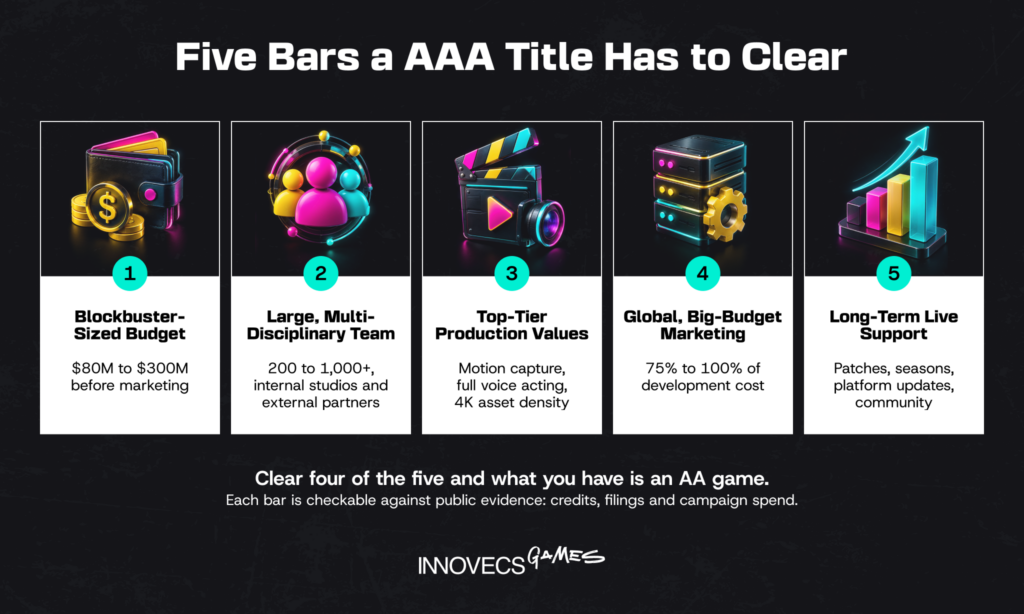
No committee awards the label. In practice a title earns it by clearing five bars at once, and clearing four out of five is what an AA game looks like. Budget is the trait everyone names first, but it’s the combination that holds: a $200 million budget with a 40-person team isn’t a AAA project, it’s a procurement scandal.
A Blockbuster-Sized Budget
In our scoping work, most modern AAA productions run between $80 million and $300 million before marketing, and the ceiling keeps moving. Statista’s ranking of the most expensive games ever developed puts Cyberpunk 2077 at $498 million across its launch and its expansion, and Genshin Impact at $900 million once running costs are counted. The number that matters to a producer isn’t the headline figure though, it’s the break-even, and that is what quietly decides a slate: when a green light commits several million full-price sales, sequels and licensed properties win the meeting and original IP loses it.
A Large, Multi-Disciplinary Team
Rockstar put roughly 2,000 employees on Red Dead Redemption 2 across eight years, 1,600 of them working on it directly, which holds the Guinness World Record for the largest development team ever assembled. That’s the extreme. More typical AAA development team size is a couple of hundred people rising well past a thousand at the top end, and it is never one building: internal studios, external partners and outsourcing vendors, covering engineering, animation, technical art, audio, narrative, QA and the production layer holding them together. Past roughly 150 people, coordination stops being an overhead line on the budget and becomes a discipline of its own. Somebody’s whole job turns into keeping the departments from building against each other.
Top-Tier Production Values
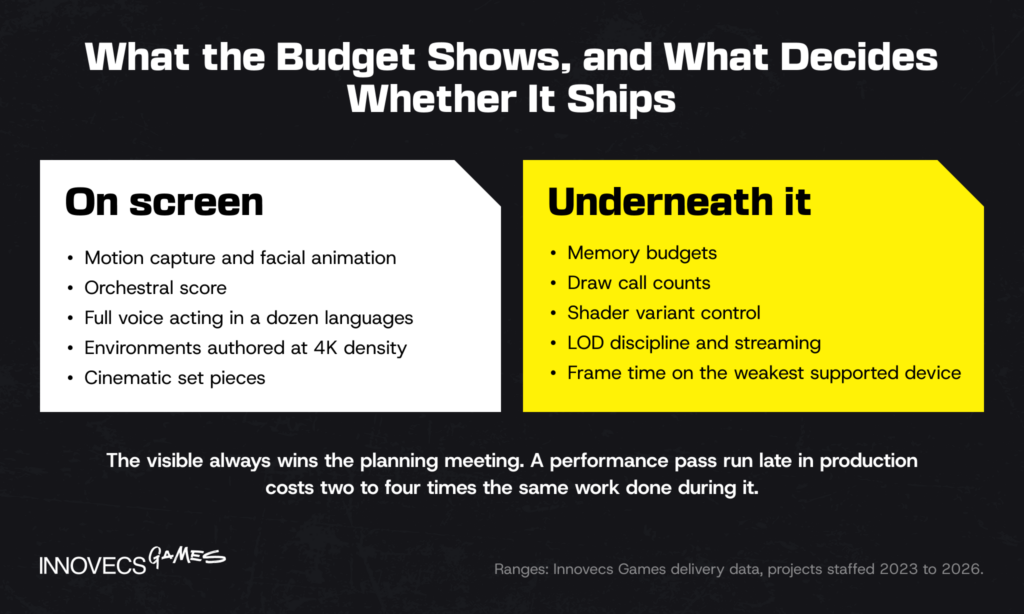
Production values are where the budget becomes visible. Motion capture, facial animation, orchestral scores, full voice acting in a dozen languages, environments authored at a density that survives a 4K screenshot. The cost curve here is brutal and well documented: Steve Theodore’s estimate, collected in that same Game Developer analysis, put a single game character at ten working days of art in 1997, thirty-five a decade later, and roughly a hundred by 2017, and nobody has reported the number falling since. It’s what happens when one 256-pixel texture becomes a stack of 4K maps and somebody still has to author every one of them.
Most of that spend is invisible in a screenshot. Memory budgets, draw call counts, shader variant explosion, LOD discipline, streaming, and frame time on the weakest device you promised to support: technical art is what decides whether the art department’s work survives contact with the hardware. It is also the first thing deprioritized when a milestone gets close, because the visible always beats the invisible in a planning meeting. That isn’t a process failure so much as an incentive problem, and the bill arrives later with interest. A performance pass run late in production costs two to four times the same work done during it, since by then you’re changing systems that months of content have already been built on top of.
Global, Big-Budget Marketing
Marketing at this tier typically runs 75% to 100% of development cost, on Koster’s numbers, which means total spend roughly doubles what you saw in the greenlight deck. Trailers cut like film campaigns, storefront placement, influencer programs, physical advertising, and a launch window defended against every other major publisher’s calendar. Everyone’s fourth quarter looks the same, which is how three nine-figure games end up sharing a Tuesday. This is the line item indie teams underestimate most, and the one that makes AAA economics work only at volume.
Long-Term Live Support
The ship date used to be the end. For most modern blockbusters it’s the start of a second budget, and a second staffing plan: patches, seasonal content, balance passes, platform certification updates, and a community team that stays on the payroll for as long as the game keeps earning, which in the successful cases means the game is never actually finished and in the unsuccessful ones means the servers close inside a year. Through Fortnite’s ecosystem alone, Epic has now paid creators past the billion-dollar mark. That is what sustained live investment can return, and almost nothing else ever gets near that altitude.
AAA vs. AA vs. Indie Games: What’s the Real Difference
Those five traits sit at one end of a range. The range itself is what most studios are choosing between. The tiers describe scale of production, not quality of outcome. Balatro was built by one person and sold five million copies; several $200 million titles in the same period failed to return their budget. What the tiers reliably predict is team size, funding structure, and how much a mistake costs to fix. The aa vs aaa games question usually comes down to whether you need a global marketing campaign to make the model work.
| Indie | AA | AAA | |
|---|---|---|---|
| Typical budget | Under $1 million | $1 million to $30 million | $80 million to $300 million+ |
| Team size | 1 to 20 | 30 to 150 | 200 to 1,000+ |
| Development time | 6 months to 3 years | 2 to 4 years | 4 to 7 years |
| Marketing spend | Community and organic | Modest paid campaign | 75% to 100% of dev cost |
| Funding | Self, grants, small publisher | Mid-size publisher or platform deal | Major publisher or first party |
| Failure tolerance | Survivable | Painful | Studio-ending |
Source: Innovecs Games delivery data, projects staffed 2023 to 2026, combined with publicly reported budgets.
Read the bottom row first. It explains most of the behavior in the other five, including why AAA sequels outnumber AAA original IP by such a wide margin.
AAA Games
Funded by a major publisher or a platform holder, staffed in the hundreds, built over four to seven years, and marketed globally against a launch calendar that every other major publisher is also trying to defend. The defining constraint is that the sales target gets set before the design is finished. Everything downstream, the scope, the platforms, the live plan, gets shaped to hit a number somebody committed to in a boardroom. Nobody publishes a reliable count of how many titles ship at this tier in a year, which tells you something on its own: the industry tracks them by name rather than by number. Set a few dozen nine-figure productions against the Steam figure above and you have the real shape of the market.
AA Games
The most interesting tier commercially, and the least discussed. Budgets of $1 million to $30 million, teams of 30 to 150, and a deliberate trade of breadth for focus: tighter world, fewer systems, one thing done exceptionally well. Ninja Theory and Warhorse built their reputations on precisely that. A mid-size game studio holding one strong idea competes far better here than it ever would two tiers up. The trade-off is that AA has no cushion. A AAA game can absorb a bad department; a mid-core game with a weak combat system has nothing else to sell.
Indie Games
One to twenty people, self-funded or backed by a small publisher, shipping in months rather than years. Indie games win on originality and on cost structure rather than on production values, and the best of them make the tier distinction look silly for a season. What indie cannot do is guarantee anything. That Valve figure, 5,863 titles clearing $100,000, sounds generous until you put it beside the tens of thousands that launched in the same twelve months. No process closes that gap.
Examples of AAA Games (and What Makes Each One AAA)
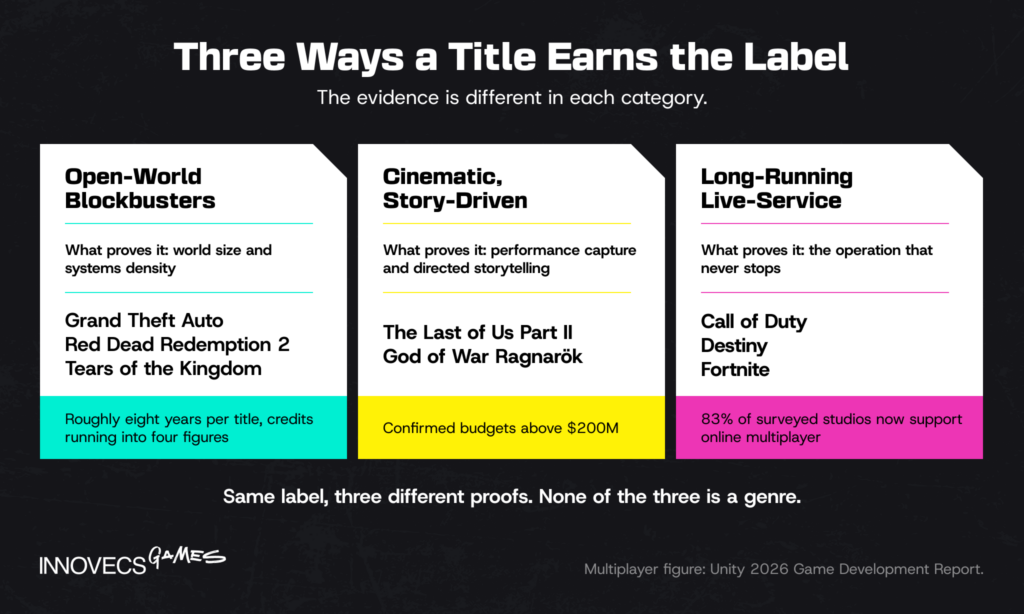
Naming triple a games is easy. Explaining why each one qualifies is the useful part, and the evidence shifts by category. World size and systems density in the first. Cinematic craft and performance capture in the second. In the third, the sheer size of the operation still running years after the launch trailer stopped playing.
Open-World Blockbusters
Grand Theft Auto and Red Dead Redemption 2 are the reference cases. Rockstar spent roughly eight years on each, with credits running into four figures. Grand Theft Auto VI, delayed to November 19, 2026, lands thirteen years behind its predecessor. That’s a production cycle stretched to its limit. The Legend of Zelda: Tears of the Kingdom qualifies on a different axis entirely: smaller team by Western standards, first-party budget, and six years spent making a systems density stable enough to ship.
Cinematic, Story-Driven AAA
The Last of Us Part II and God of War Ragnarök are what the nine-figure budgets above actually buy when a studio commits to performance capture and directed storytelling. Full-body capture, months of ADR, an animation team larger than most indie studios, and a narrative department that ships a script the length of a season of television. Final Fantasy VII belongs in this lineage too. In 1997 it spent more on production and advertising than any game before it, and it proved a game could be sold to the general public the way a studio sells a film.
Long-Running Live-Service AAA
Call of Duty, Destiny and Fortnite qualify twice over, once for the build and once for the operation that never stops. After launch, a live-service game at this tier employs more people than most studios employ at all: seasonal content, live economy tuning, anti-cheat, and cross-platform development running across five or six storefronts simultaneously. Unity’s 2026 Game Development Report found 83% of surveyed studios supporting online multiplayer and 72% prioritizing cross-play, which is how a live plan stopped being a launch decision and became an architecture decision made in year one. Genshin Impact’s running costs, per the Statista figures above, are estimated at roughly $200 million a year, which is more than most AAA titles cost to build in the first place.
What AAA Really Costs and How Long It Takes
Two numbers decide whether a project at this tier is viable, and neither of them is the one in the press release. What follows is the outline. The split by discipline and the costs that surface after the build is locked live in our dedicated AAA game development cost article.
Typical AAA Budgets
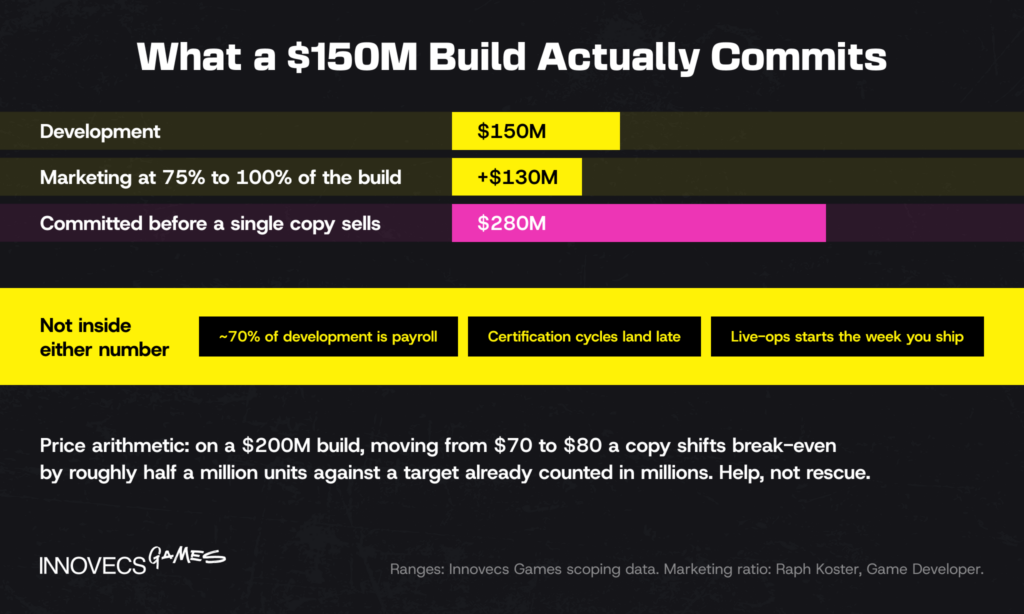
Development sits in the band above for most modern releases. What gets left off the slide is everything stacked on top of it: apply the marketing ratio and a $150 million build becomes a $280 million commitment before a single copy sells. Roughly 70% of the development half is payroll, which is why a schedule slip and a budget overrun are the same event described two ways. Two more pressures arrive late and almost never appear in the original plan: platform certification cycles, and the live-ops budget that starts running the week you ship.
The other side of that equation finally moved in 2026. Rockstar priced Grand Theft Auto VI at $79.99 standard and $99.99 for the Ultimate Edition, after Nintendo had already taken Mario Kart World to $80 at the Switch 2 launch. Publishers are trying to close a gap that inflation opened while the sticker sat at $60 for most of two console generations and budgets followed the tenfold curve above. Ten dollars a copy doesn’t close it. On a $200 million build, moving from $70 to $80 shifts break-even by something like half a million units, against a target already counted in millions, which is help rather than rescue.
Typical AAA Development Timelines
Current normal is four to seven years, and at the top end eight-year cycles have stopped being remarkable. Twelve to eighteen months of that goes to preproduction and the vertical slice, full production takes the middle, and the last year belongs to certification, optimization and the hardening pass nobody ever budgets enough for. Our breakdown of how long AAA games take to build covers the phase-by-phase view. The practical consequence is worth planning for: next-gen consoles can arrive mid-project, so a game started on one hardware generation can quite easily ship on the next one. Somebody goes through this every generation, and it is never the team that planned for it. GDC’s 2026 survey already has 39% of developers interested in Nintendo Switch 2 and 28% building or optimizing for Steam Deck, and neither was a target when most of today’s AAA projects entered production.
Is AAA the Right Tier for Your Next Project?
Most studios asking this question already have a team, a roadmap, and an ambition that doesn’t fit inside either. The decision isn’t really about ambition. It’s about whether you have the funding structure and the distribution to survive the failure case, because at this tier the failure case takes the studio with it.
| Signal | Points to AAA | Points to AA or indie |
|---|---|---|
| Funding | Publisher or platform commitment secured | Self-funded or single-round |
| Sales required to break even | Several million units | Tens to hundreds of thousands |
| Team | 200+ available or contractable | Under 150 |
| Core hook | Needs scale to work at all | Works at small scope |
| Timeline pressure | Can absorb 5+ years | Needs revenue inside 24 months |
| Marketing | Global campaign funded | Community and organic reach |
Source: Innovecs Games delivery data, projects staffed 2023 to 2026.
If your row-by-row answers are split down the middle, that’s the honest signal that this is a co-development conversation rather than a tier decision.
When AAA Makes Sense
Three conditions, and they have to hold together. The core experience genuinely requires scale. A major publisher or platform holder has committed the funding. And your studio survives the project running two years past its planned date, because a fair number of them do. Established franchises, licensed properties with an audience already attached, technically ambitious open worlds: that’s where the model still works. If your pitch would be a better game at a tenth of the budget, the tier is wrong and no amount of production value will fix it.
When AA or Indie Is the Smarter Bet
A AA budget buys you something AAA cannot: the ability to be wrong. Kingdom Come Deliverance and Hellblade found audiences by doing one thing at a standard nobody expected at that price. New IP in particular belongs here, because the market data on original AAA IP is grim and the break-even math is unforgiving. Our position, after a decade of scoping these projects: most studios that talk themselves into AAA needed a well-funded AA project and a marketing partner instead.
Why Studios Co-Develop or Outsource AAA Work
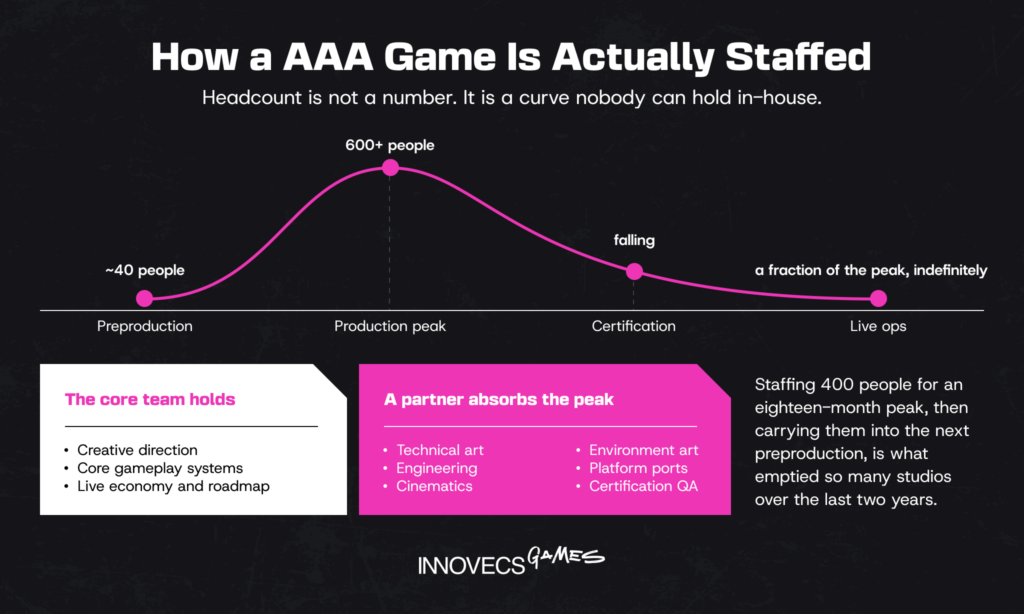
Almost no AAA game is built by one studio anymore, and the credits are where you can see it. When Activision laid out its Call of Duty pipeline in 2021, eight of its ten core studios were working on that one annual franchise, with Infinity Ward on the following entry and a new internal team on the mobile version. That is an entire publisher’s internal capacity spent on a single title, before the support section of the credits begins and the external names start scrolling: environment art, cinematics, animation, engineering, localization, QA. The reason is capacity rather than cost. Staffing 400 people for a peak that lasts eighteen months, then carrying them through the next preproduction, is what emptied so many studios in the last two years. Game co-development and game development outsourcing let a core team hold the creative direction while a partner absorbs the peak, whether that’s a dedicated team on a feature area, staff augmentation for a specific discipline, or full-cycle development of a platform version. The honest downside: a co-development partner costs more per month than contractors, and it only pays back when the slice you hand over is genuinely hard.
What to Check Before You Hand Over a Slice
Vendor selection at this tier fails in a small number of predictable places, and an external development director who has been burned once already knows most of them. Five things worth confirming before a piece of your game leaves the building:
- Platform licensing and devkit access. A partner without an approved developer account and devkits for your target console adds weeks before the first line of code gets written. Ask which platforms they are licensed for, not which ones they have worked on.
- Technical art depth, not headcount. Plenty of studios can supply artists. Far fewer can supply someone who will hold your frame budget while the artists work.
- Acceptance criteria per milestone, written before the work starts. Nearly every dispute we have seen was about whether something was in scope, not about the rate.
- Who actually appears in the credits. It tells you whether the team you met in the pitch is the team you get in month three, and it is the fastest reference check available.
- A paid pilot on real backlog. Four to six weeks on something that genuinely matters prices a partner better than any proposal document, and either side can walk away at the end of it.
That list reads like procurement paperwork right up until the first milestone, at which point it turns out to have been the whole game.
Not Sure Which Tier Fits Your Project? Let’s Talk
Send us the scope you’re aiming at, whatever funding sits behind it, and the date it has to ship. We’ll come back with the tier that combination actually supports and what a realistic team looks like at each one. If the answer is that you should build a smaller game, we’ll say so.
How AI Is Changing AAA Game Development
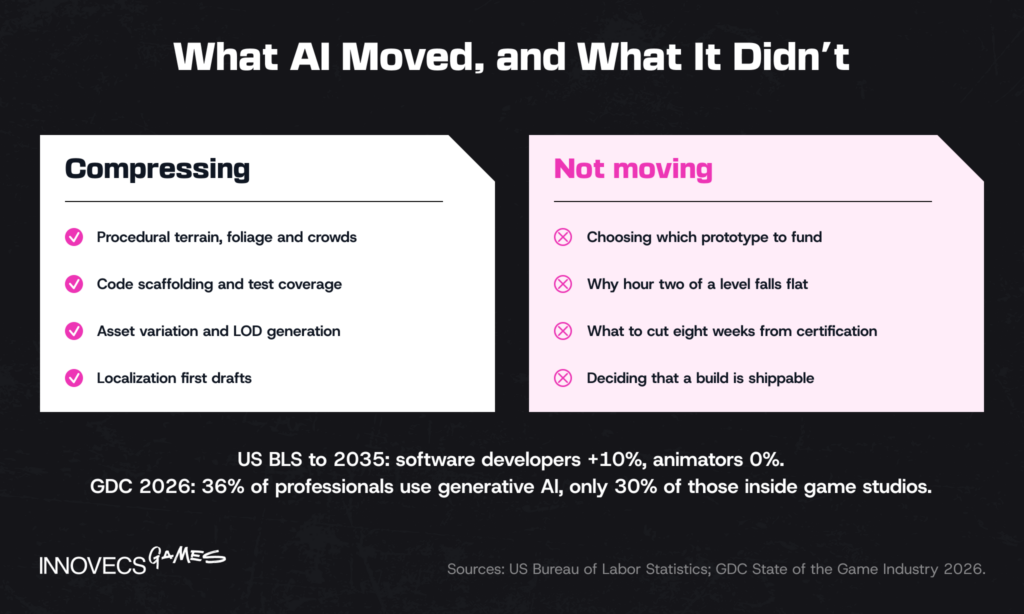
One question turns up in nearly every one of those scoping calls: has AI changed the arithmetic enough to move a project down a tier? It deserves a straight answer, and the honest one is that the data pulls both ways at once. Any article reporting only one of those directions is selling something. In GDC’s 2026 survey, 36% of professionals reported using generative AI tools, but only 30% of those working inside game studios, against 58% at publishers, support companies, and marketing firms. Sentiment runs the other way: 52% think the effect on the industry is negative, up from 30% a year earlier. Over in Unity’s 2026 report, 62% use AI for coding tasks and 73% report efficiency gains. All of it holds at once, because the surveys put different questions to different people. Short version: the industry is adopting these tools and resenting them simultaneously, and nobody has to resolve that before Monday.
At this scale, AI in game development has moved the needle on production plumbing, and the gains cluster in four places:
- Procedural generation for terrain, foliage and crowd systems, work that used to eat months of environment art.
- Code scaffolding and test coverage, which shortens QA cycles rather than replacing them.
- Asset variation and LOD generation, increasingly machine-first with a human review gate.
- Localization drafts, where the machine pass is now the starting point and the LQA pass still isn’t.
Epic shipped a Model Context Protocol plugin in Unreal Engine 5.8 that puts a model inside the editor with access to the actual project, and has diffusion-based media workflows landing in early 2027. That’s a real change in how a game engine is operated, not a demo.
What hasn’t moved is judgment. Nobody has automated deciding which of three prototypes to fund, why the second hour of a level feels flat, or what to cut eight weeks before certification. The US Bureau of Labor Statistics projects software developers growing 10% from 2025 to 2035 while animators sit at zero growth, with AI named explicitly as a reason demand may soften. That divergence is the clearest available signal about which parts of a AAA pipeline are compressing and which are not. Our read: the price of a first draft has fallen close to zero, and the price of the person who decides which draft ships hasn’t moved at all.
How Innovecs Games Helps Studios Build AAA Projects
If tooling isn’t what closes the gap between your team and AAA-level output, staffing is. Very few studios can carry 400 specialists through a peak and keep them busy afterward, which is exactly the trap that produced the layoff numbers at the top of this article. The model that works instead is a core team that owns the creative direction and a partner that carries the load-bearing slices.
Over more than a decade, Innovecs Games has delivered 300+ games with 200+ developers and artists working out of the US, UK, EU, Israel and Ukraine, and a place on IAOP’s Global Outsourcing 100. As a AAA game development company we come in as co-developer, dedicated team or full-cycle partner, usually on the workstreams that are hardest to staff internally: technical art, engineering, cinematics, platform ports, certification QA. Most engagements open with a paid pilot on real backlog instead of a proposal document, because that prices the work honestly for both sides. Shipped titles are in our portfolio.
FAQ
What is AAA games?
AAA games are the industry’s top production tier: development costs that typically land between $80 million and $300 million, teams of 200 to 1,000 people. The label was borrowed from bond credit ratings, where AAA is the top grade, and what it measures is production scale rather than quality. Expect high production values, a global marketing campaign, a simultaneous multi-platform release. Expect nothing at all about whether the game is fun, because plenty of AAA titles are mediocre and plenty of indie games are better.
What does AAA stand for in games?
Nothing, technically. The three As aren’t an acronym; the term was borrowed from bond credit ratings in the mid-1990s, where AAA denotes the highest grade of security. US developers picked it up at industry conferences as shorthand for the most expensive, highest-profile productions on a publisher’s slate. Since then the aaa games meaning has barely shifted: top-tier budget, top-tier expectations, top-tier risk.
What’s the difference between AAA, AA, and indie games?
Three things separate them: scale, funding, and how much a mistake costs. Indie means one to twenty people, usually self-funded, shipping inside three years. AA covers $1 million to $30 million with teams of 30 to 150 and normally a mid-size publisher attached. AAA starts around $80 million, runs to hundreds of people, and has a major publisher or platform holder behind it. Quality doesn’t track those tiers at all. Risk does: an indie failure costs somebody a year, and a AAA failure can close the studio.
How much does it cost to make a AAA game?
Most modern releases land between $80 million and $300 million in development cost, with outliers well above. Court filings from Sony confirmed $220 million for The Last of Us Part II and $212 million for Horizon Forbidden West. On top of the build, marketing usually adds another 75% to 100%. And since roughly 70% of a AAA game development budget is payroll, the total comes down to team size multiplied by months rather than anything more exotic.
How long does it take to develop a AAA game?
Plan for four to seven years. Eight-year cycles are no longer unusual at the top end. The first twelve to eighteen months go to preproduction and a playable vertical slice, production eats the middle three to four years, and the last year belongs to certification, optimization and bug fixing. Grand Theft Auto VI will land thirteen years after Grand Theft Auto V, which is the outer edge rather than the average.
What are some well-known examples of AAA games?
Grand Theft Auto V, Red Dead Redemption 2, The Last of Us Part II, God of War Ragnarök, Elden Ring, Call of Duty, Cyberpunk 2077. All of them clear the same bars: nine-figure budget, hundreds of names in the credits, cinematic storytelling with full voice acting, a simultaneous multi-platform release, and a marketing campaign you saw whether or not you read gaming media. Franchise sequels dominate that list, which is the break-even math showing through.
How big is a typical AAA game development team?
At peak, between 200 and 1,000 people, external partners included. The record belongs to Red Dead Redemption 2, with 1,600 working on it directly according to Guinness World Records. A first-party cinematic title tends to run 300 to 500 internally and then adds outsourcing partners for environment art, cinematics, animation and QA. Phase matters more than the headline number: preproduction might be 40 people, and eighteen months later the same project is carrying 600.
Is a bigger budget always better than going AA or indie?
No, and the last three years are the evidence. A larger budget buys production values and marketing reach; it also pushes break-even up to several million units and takes away the freedom to be wrong. Teams at AA and indie scale can iterate, cancel and pivot at a cost that doesn’t threaten the company. So the useful question isn’t which tier is better. It’s which tier your funding, your distribution and your appetite for risk can actually support.
How is AI changing AAA game development?
Mostly in production throughput, not in creative direction. Terrain, foliage and crowds come out of procedural generation now; AI-assisted tooling speeds up code scaffolding, test coverage, asset variation and localization drafts. Adoption is uneven, though. GDC’s 2026 survey has 36% of industry professionals using generative AI but only 30% of those inside game studios, and 52% think the overall effect on the industry is negative. Epic’s Unreal Engine now supports Model Context Protocol integrations that give a model direct access to the project, and that is where the practical gains sit.
Could AI let smaller studios build AAA-quality games?
Partly, and mostly on the asset side. Placeholder art, variation passes, technical content that would have taken a dedicated department five years ago: a ten-person team can generate all of it now, and the visual gap narrows accordingly. What none of it supplies is the thing AAA budgets actually buy, which is hundreds of people making thousands of coordinated judgment calls over five years. So expect smaller teams to reach AAA-looking rather than AAA-scale. For a lot of games that turns out to be enough.
Ready to Explore What AAA-Level Development Looks Like for Your Game?
You’ve now got a working answer to what is aaa games and, more usefully, a way to test whether your own project belongs in that tier. Send us the scope, the platforms and the ship date. We’ll come back with a team composition and a first workstream you can start on.