How Video Game Co-Development Works for Game Studios
Two-thirds of AAA studios cut staff last year. Their roadmaps didn’t shrink to match. Video game co-development exists for exactly that gap, fewer hands, same ambition, often closed within weeks. Whether the problem is a missing discipline, a slipping milestone, or a live-ops backlog nobody has time to clear, the fix looks the same: a vetted team that plugs straight into your pipeline instead of a hiring cycle you don’t have months to run.
What Is Video Game Co-Development?
Video game co-development is a shared production model. Two studios, one team, one release. Nobody hands off a spec and disappears for six weeks. Instead, both sides split ownership of a feature, a discipline, or an entire production phase, and the partner studio actually shows up for it: sitting in your standups, working inside your pipeline, and answering for milestones the same way your own people do.
That’s the real difference from solo development or full outsourcing. Build everything in-house, and every capacity gap becomes your problem, permanently. Full outsourcing fixes the capacity issue, but at a distance: the vendor delivers, you review, and everyone moves on, with little real collaboration in between. Co-development sits in the middle, keeping creative and strategic control with you while a partner studio brings the extra hands, or the specialized skill, that gets you to your dates.
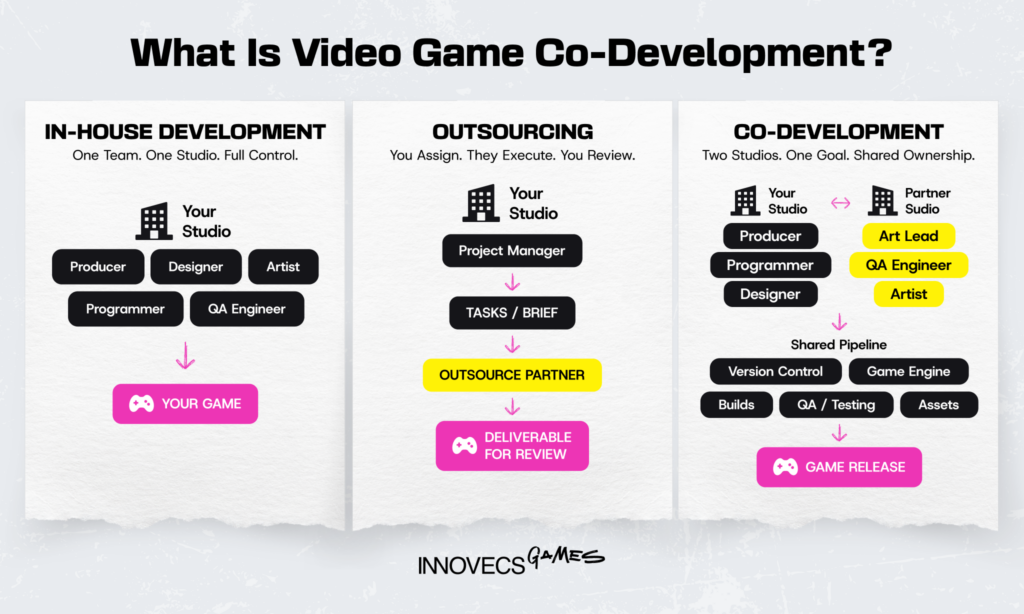
In practice, the split usually follows a natural seam in the project. One studio might own core gameplay and combat systems while the partner runs the entire platform port. Another arrangement has one team building the campaign while the other stands up live-ops content drops for after launch. Either way, neither side is just executing tasks handed down from the other. Both studios show up to sprint planning with real opinions about scope, and both sign off on what actually ships.
Think of it less like hiring a contractor to frame one wall. It’s more like bringing in a second construction crew: same blueprint, same site, same move-in date.
And the numbers back this up. Nearly 70% of game developers now use some form of outsourcing, according to Research and Markets’ 2026 game outsourcing services analysis. The broader outsourcing and co-dev market is projected to grow at a double-digit CAGR through the early 2030s, per Market.us. Studios reach for co-dev specifically when nothing else adds up: a live-ops title needs a permanent second shift, technical art capacity is running short on a AAA production, or hiring would simply take too long to save a milestone at risk. That’s exactly the gap full video game co-development services are built to close, covering everything from art and engineering to QA and live-ops support, in weeks rather than the months a full hiring cycle demands.
Need an Extra Team on Your Game Right Now?
Already know you need a co-dev partner? Don’t wait for the rest of this guide. Innovecs Games plugs into existing production pipelines and can staff a working team on your title fast, covering everything from art and engineering to QA and live-ops support. Tell us the gap and the timeline, and we’ll scope a team.
[Talk to Innovecs Games about your project →]
How Does the Co-Development Process Work?
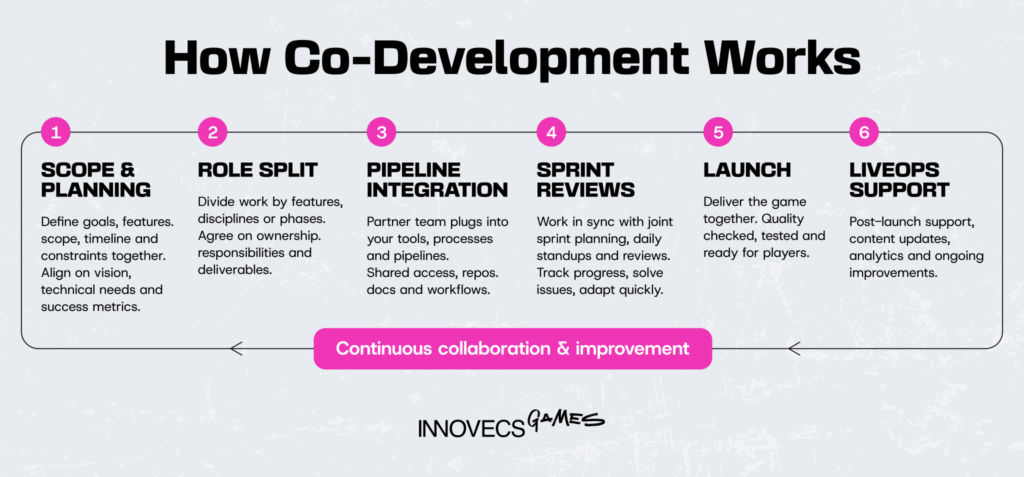
Four stages, and both studios own a piece of each one. Weeks 1 and 2: scoping and role split. Week 3: the partner team gets plugged into your build pipeline. By week 4, you’re running joint milestone reviews like the team had always been in-house.
Scoping and Role Split
Everything starts with a scoping session. Both teams map out exactly who owns what: features, disciplines, or a whole production phase like porting or live-ops. Nail the capacity constraints and project scope here, and nothing falls into the gap between two teams later. The output is usually a lightweight production bible: shared vision, an ownership map, the technical constraints both sides build against. Skip this step, or rush it, and you’ll be untangling ownership confusion three sprints in instead.
Shared Pipelines and Tools
Once roles are set, the partner team plugs straight into your existing build pipeline: same version control, same engine, whether that’s Unity, Unreal Engine, or something proprietary. No separate branch to reconcile six weeks later. Need Unity engineering capacity specifically? It’s usually faster to bring in specialists through a co-dev partner than to hire Unity developers directly. Cross-platform work adds its own coordination layer too. Builds need to stay consistent across target platforms. And technical art usually runs through that same shared pipeline. A commit from the partner should look like a commit from your own team. If it doesn’t, fix that in week one, not week twelve.
Milestones, Reviews, and Communication
Trust doesn’t show up on day one. It gets built one check-in at a time. Both studios track progress against the same milestone delivery schedule: shared standups, sprint reviews, milestone demos. Who signs off on what, how blockers get escalated, and how often leads actually sync all get defined early. Consistent check-ins do more for a co-development video game studio partnership than any single deliverable ever will.
Handover and Live Support
Not every co-dev engagement ends when the credits roll. Some wrap cleanly: documentation, source control, build pipelines, all handed back to the primary studio. Others turn into something longer, live-ops support, technical art maintenance, ongoing QA after launch. Figure out which one you’re in during scoping, not during the wrap party.
When Should You Use Co-Development?
Co-development isn’t the right call for every project. It earns its cost in a few specific situations.
Picture a 45-person mobile studio, six weeks out from a live-ops content drop, watching two QA engineers try to cover ground that used to take five. A job posting won’t fix that in time, but a partner team can.
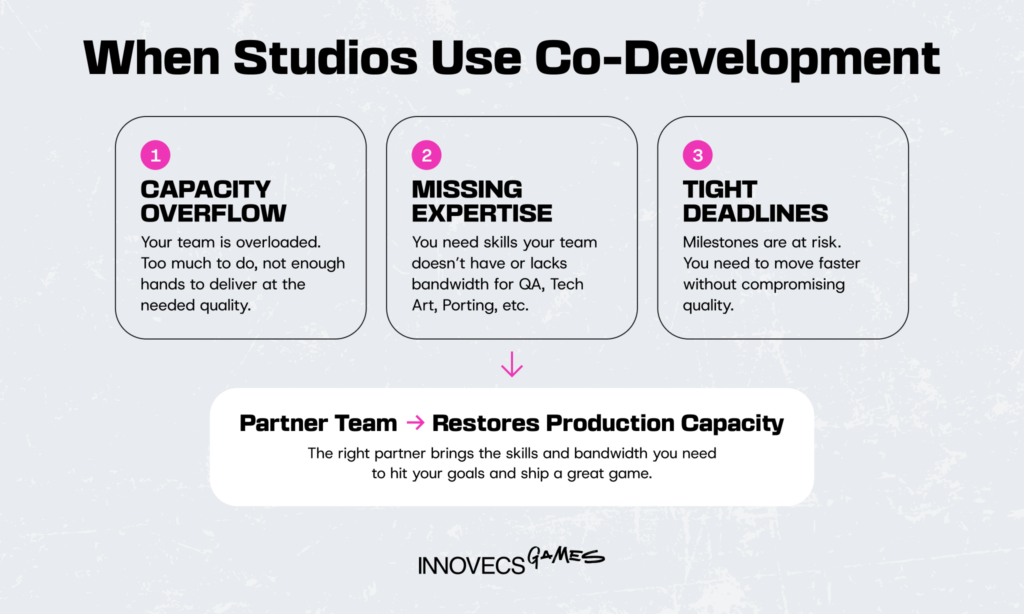
Capacity Overflow on an Existing Team
Most studios are living this one right now, indie teams and publisher-backed AAA studios alike. GDC’s 2026 State of the Game Industry survey found that half of studios went through layoffs in the past year, and that same survey put the figure at roughly a third of US industry workers laid off somewhere in the last two. Teams got leaner. The games people want to play did not get any smaller. Co-development adds a dedicated team without the six-to-nine-month cycle of hiring and ramping full-time staff. Headcount stays flexible, tied to a title or a milestone instead of becoming a permanent line item.
Missing a Specialized Discipline (Art, Porting, QA)
Not every studio has deep bench strength in every discipline. Technical art, platform porting, and structured QA and testing are common gaps, expensive to build from scratch for a single project but straightforward to bring in through a partner studio that already has them. Co-development gets you senior specialists in exactly the discipline you’re short on, and you don’t carry that headcount once the project wraps.
Tight Deadlines or Live-Ops Pressure
A slipping milestone and a live-service title that needs a permanent second shift are really the same problem in different clothes. Both mean more work than your team can absorb in the time left. Bringing in a co-dev partner absorbs that overflow immediately, using a production pipeline that already exists, so your team doesn’t have to build one from zero under deadline pressure. Something has to give: scope, date, or headcount. Co-development protects your time-to-market without forcing that choice.
What’s the Difference Between Co-Development, Outsourcing, and In-House Development?
Three models, three different trade-offs. The debate around game co-development vs outsourcing usually comes down to one question: how much control are you willing to trade for speed? Double-digit annual growth in the gaming outsourcing and co-dev market means that question isn’t going away. For most studios, the real question isn’t whether to bring in outside help. It’s which model actually fits the gap you have.
| Co-Development | Full Outsourcing | In-House Development | |
|---|---|---|---|
| Who owns creative decisions | Shared, ongoing collaboration | Primary studio, vendor executes to spec | Primary studio only |
| How engagement works | Embedded team, shared pipeline | Task or milestone handoff | Internal team only |
| Speed to staff | Weeks | Weeks to months, scope-dependent | Months (hiring cycle) |
| Best for | Capacity gaps, missing disciplines, tight deadlines | Well-defined, self-contained deliverables | Core IP, long-term strategic work |
Co-Development
The partner studio is embedded in your pipeline and owns outcomes, not tasks. This works best when scope is fluid, or the missing piece is a whole discipline rather than one deliverable. It also fits when the timeline can’t survive a slow handoff-and-review cycle.
Full Outsourcing
You define the deliverable: an art package, a porting job, a QA pass. The vendor executes to spec with minimal creative input. Good fit when the work is well-scoped and self-contained, and you mainly need execution capacity, not a production partner.
In-House Development
Everything stays inside your existing team, giving you maximum control and making it usually the right call for core systems and IP-defining work. But every capacity constraint, skill gap, or deadline crunch gets absorbed internally, with no external release valve.
How Do You Choose the Right Co-Development Partner?
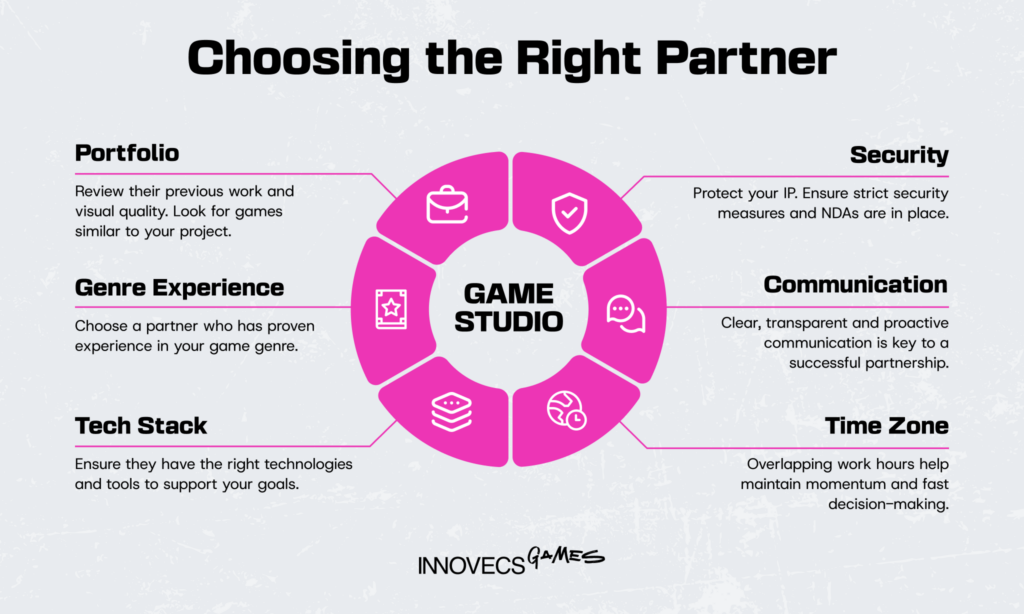
Picking a co-dev partner is closer to hiring a department than signing a vendor contract. A few things are worth checking before you commit.
Portfolio and Genre Fit
Look for shipped titles in your genre, on your target platform. A broad portfolio alone tells you very little, since a studio with strong console shooter credits might be the wrong co-dev partner for a mobile puzzle title, no matter how good their engineering is. If the gap is art-heavy, dig into a partner’s game art services portfolio specifically, since art style fit matters just as much as genre fit. Ask what role they actually played on comparable projects: co-dev partner, dedicated team, or work-for-hire. The depth of involvement varies a lot between those three.
Technical and Pipeline Compatibility
Check that the partner studio’s engine expertise, build pipeline, and source control conventions match yours, whether you run Unity, Unreal Engine, or a custom game engine. A mismatch won’t kill the partnership, but it adds ramp-up time nobody budgeted for. Ask how they’ve integrated with an external studio’s pipeline before. Running their own internal setup well is a completely different skill.
IP, Contracts, and Data Security
Get clear, written terms on IP ownership and any IP licensing arrangements before work starts. Who owns what gets built during the engagement? What happens to shared assets if the partnership ends? Data security matters just as much. A co-dev partner touches your build, your source, often unreleased content. Their security practices belong in the vetting process, not bolted onto the contract as an afterthought.
Communication and Time Zone Overlap
A partner studio with several working hours of overlap is simply easier to run day to day than one on the opposite side of the clock. Ask about their standard communication cadence, their English proficiency where it matters, and how they’ve handled blockers or scope changes on past engagements. The answer tells you more about fit than any polished case study will.
A few questions worth asking on that first call:
- Which titles have they actually shipped in your genre and on your platform?
- How do they typically split ownership and decision-making with a partner studio?
- What’s their standard IP and confidentiality agreement, and will they walk you through it before anyone signs?
- How many hours of working-day overlap will your two teams really have?
- What happens to the engagement if scope changes three months in?
Common Co-Development Mistakes to Avoid
Even well-intentioned partnerships stumble in predictable places.
- Vague role split. Two teams build the same feature, or nobody owns a mechanic, and it doesn’t surface until a milestone review flags the overlap.
- No shared cadence. A partner team working a week ahead of check-ins looks efficient. Then you realize they built on a spec that went stale five days ago.
- IP left to a boilerplate contract. Assuming a standard template covers a fast-moving live-ops title is exactly how disputes start after launch.
- Treating it like outsourcing. Weekly status calls without daily standups defeat the whole point of an embedded team. If the partner isn’t in your stand-up, they’re not really co-developing.
- No handover plan. The engagement ends, and nobody owns the documentation or build knowledge the partner team built up along the way.
Most of these trace back to one root cause: treating co-dev like a bigger version of outsourcing instead of what it actually is, a shared team. Get that part right, and the next question studios usually ask is budget.
How Much Does Video Game Co-Development Cost?
There’s no single number here. Cost depends on discipline, seniority, and region, so it’s worth thinking in ranges rather than a fixed price.
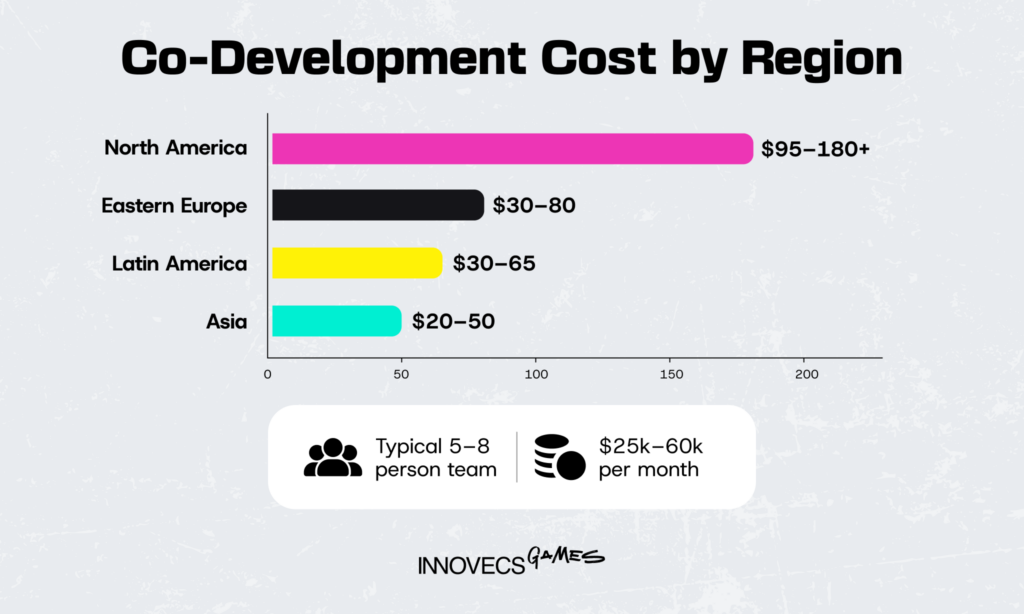
Based on current market conditions across the regions where co-dev teams typically get sourced, hourly rates for game development talent in 2026 vary a lot:
- North America: roughly $95 to $180+ per hour
- Eastern Europe (Ukraine, Poland, Romania): $30 to $80 per hour
- Latin America: $30 to $65 per hour
- Asia: $20 to $50 per hour
Within Ukraine specifically, junior roles run $25 to $30 an hour, mid-level runs $35 to $45, and senior specialists run $45 to $65. That price-to-experience balance is a big part of why nearshore and offshore development in the region has stayed popular.
By discipline, engineering and technical art sit toward the higher end, while QA, testing, and production support usually cost less. A mid-size co-dev team of five to eight specialists in Eastern Europe typically runs $25,000 to $60,000 a month, depending on discipline mix, seniority, and how much of the team is dedicated full-time.
Three factors move that number most: team size and seniority mix, project scope, engagement length. A short sprint to cover one deadline costs very differently than a multi-year live-ops partnership. Want a real number? Scope the actual gap first. Most co-dev partners, Innovecs Games included, build a quote around your specific roadmap, not a generic package. One thing that’s starting to move that math: how much of the work AI can already handle before a person touches it.
📌Read also: AAA Game Development Cost: What It Really Takes to Build a Blockbuster
How Is AI Changing Co-Development in Game Studios?
AI moved from experimental to standard tooling fast, faster than most production pipelines caught up. GDC’s 2026 State of the Game Industry survey found that over a third of game industry professionals now use generative AI directly in their work. That share has climbed every year the survey has run. Co-dev pipelines are adopting it on both sides of the partnership, not just internally.
In practice: AI-assisted tools support first-pass concept art and asset variation. They handle code review and static analysis, catching issues before a human reviewer even sees them. Automated QA runs the repetitive regression tests and flags anomalies faster than any manual pass could. AI literacy speeds up onboarding too. Shared AI-assisted documentation and code-review tooling gives a new partner team a faster read on a codebase they’ve never touched.
None of that replaces the judgment a co-dev partner brings. AI can generate variations, flag bugs, or draft a first pass, but decisions about art direction and gameplay feel, and calls on what actually ships, still come down to experienced production teams who understand the game, not just the codebase. The studios getting real value use AI to speed up the mechanical work while keeping human expertise on the creative calls.
How Does Innovecs Games Support Co-Development Partnerships?
Innovecs Games works as an embedded co-dev partner, not a task-by-task vendor. We plug into an existing studio’s pipeline, tools, and team rhythm within weeks. That covers engineering across Unity and other engines, art and technical art, level design, QA and testing, porting, and live-ops support. It’s all scoped around whatever gap is putting your roadmap at risk, so you get scalability without adding permanent headcount.
Engagement models are flexible: a dedicated co-dev team, staff augmentation for specific roles, white-label development, or full game development outsourcing for well-defined, self-contained work. Worth flagging directly: Innovecs Games doesn’t offer standalone 3D modeling as an isolated deliverable. 3D art is covered inside broader co-development and art engagements. Not sure your gap fits? That’s exactly what a scoping call is for.
FAQ
What is video game co-development?
A shared production model where two studios work together on the same title. Instead of one side handing off a spec, both split ownership of features, disciplines, or production phases. The partner studio joins your pipeline and shares accountability for outcomes, not just task completion. It sits between full in-house development and traditional outsourcing in terms of control and involvement.
How does game co-development work in practice?
It typically runs through four stages: scoping, pipeline integration, milestone reviews, and handover. Both studios track progress against the same schedule and use compatible tools, usually the same engine and version control setup. The specifics get nailed down during an initial scoping session, before any production work starts.
Why use game co-development services instead of hiring in-house?
Hiring takes months and adds permanent headcount, even when the extra work is tied to a single project. Game co-development services get you a working, vetted team within weeks, scoped to exactly the discipline or capacity gap you have. It extends production capacity without the long-term cost and time commitment of building an internal team from scratch.
What is the difference between co-development and outsourcing?
Outsourcing usually means handing off a well-defined deliverable, like an art package or a QA pass, for a vendor to execute with minimal creative input. Co-development is a deeper, ongoing partnership: the external team is embedded in your production pipeline and shares responsibility for the broader outcome. Self-contained tasks suit outsourcing; fluid scope or a missing discipline points toward co-development instead.
How much does video game co-development cost?
Cost varies by region, discipline, and seniority. Eastern European rates typically run $30 to $80 an hour, with Ukraine specifically averaging $25 to $65 depending on experience level. North American rates run much higher, around $95 to $180+ an hour. A mid-size dedicated team often lands between $25,000 and $60,000 a month, depending on scope and team composition.
How long does a typical co-development engagement last?
Entirely dependent on the gap being filled. A deadline-driven sprint might run a few months, while a live-ops or ongoing art-support partnership can continue for years. Most engagements start with a defined scope and milestone, with room to extend based on how the partnership performs. That flexibility is part of why co-development suits both short-term crunches and long-term capacity needs.
Who owns the IP in a co-development partnership?
This should be defined explicitly in the contract before work begins. That includes who owns newly created assets and how any licensing works if the arrangement isn’t a full transfer. In most co-dev partnerships, the primary studio keeps ownership of the core game and IP, while the contract sets clear terms for work-for-hire contributions. Never leave this ambiguous.
What should I look for in a co-development partner?
Genre and platform fit in their portfolio. Technical and pipeline compatibility with your engine and tools. Clear, written terms on IP, contracts, and data security. Time zone overlap and communication style matter more day to day than most studios expect going in. Ask how they’ve integrated with an external studio’s pipeline on past projects, not just how they run their own.
How is AI changing video game co-development?
AI tools are standard across most of game production now: first-pass art generation, code review, and automated QA that speeds up repetitive testing work. In co-dev partnerships specifically, shared AI-assisted tooling can shorten onboarding. A new partner team gets up to speed on an unfamiliar codebase faster. AI accelerates the mechanical parts of production, but it doesn’t replace the creative and quality judgment experienced teams bring.
Can AI tools replace a co-development partner?
No. AI speeds up specific tasks: generating art variations, flagging bugs, drafting first-pass code. But it can’t own production outcomes, make creative calls, or take accountability for a milestone the way a co-dev partner does. Games still need experienced people making judgment calls about what actually feels right to play. Think of AI as what makes a good co-dev team faster, not what replaces one.