Top 15 Unity Game Development Companies to Partner With in 2026
A verified shortlist across eight regions, plus the checks that separate a top Unity game development company from a services page that mentions the engine.
Unity lost the engine survey this year and kept the industry. GDC’s 2026 State of the Game Industry put Unreal ahead as the primary engine for the first time. It was 42% against 30%, across more than 2,300 developers, and the headlines wrote themselves. The number underneath tells a different story. AAA studios drove that result, with 47% naming Unreal. Established indie studios still run Unity at 54%. And mobile, which those smaller studios build almost all of, took $121.1 billion of a $213.9 billion global market this year. So the engine question is settled. The partner question isn’t. Finding a top Unity game development company looks easy, because nearly every agency with a games page claims to be one. The claim costs nothing to make.
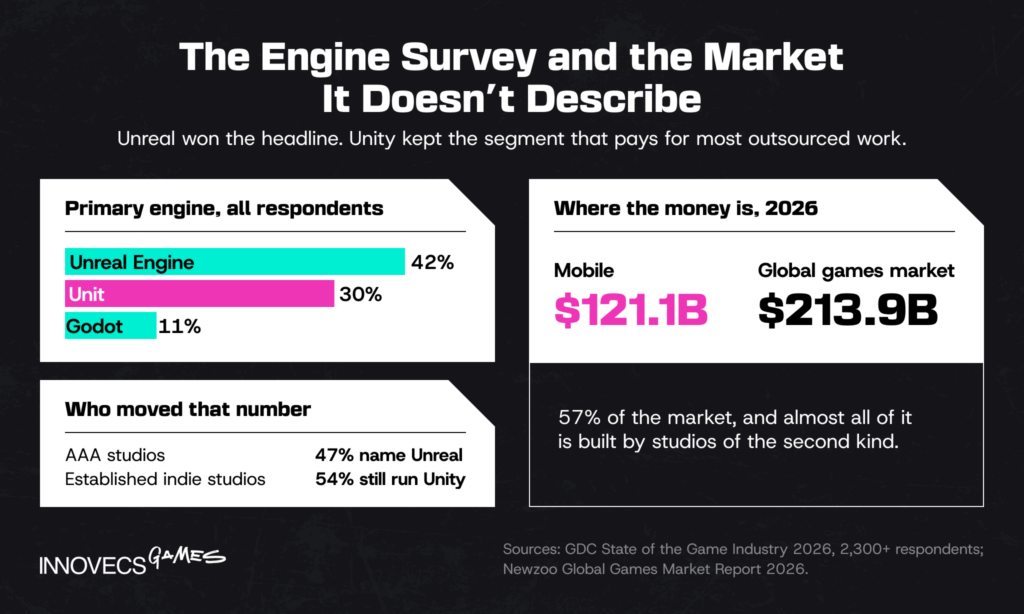
The question is live in 2026 because studios have fewer people to throw at it. GDC found 28% of respondents had been laid off in the past two years, rising to 33% in the US. Half said their employer ran layoffs in the last twelve months. Roadmaps didn’t shrink to match. Unity’s 2026 Game Development Report has 52% of developers naming smaller projects as their main way to cut risk, while 83% still support online multiplayer and 72% prioritize cross-play. Smaller teams, same technical surface area. That gap is what external Unity teams get hired to close, usually with a date already attached.
This piece does two things. First, fifteen studios across eight regions, each checked against named clients, shipped titles, or third-party review platforms rather than a marketing page. Then comes the half that decides the outcome: what to check before you sign, what the work costs by region and engagement model in 2026, and where AI has genuinely changed the math. If you’re comparing top Unity game development companies for a build that starts this quarter, read the vetting section closely.
Short answer: Unity game development companies build games in the Unity engine in one of four shapes: end to end, as a co-development partner on a defined slice, as engineers inside your pipeline, or as an art vendor. Innovecs Games, N-iX Games, Room 8 Studio, Program-Ace, and Juego Studios lead the verified list below. Rates run $20 to $170 an hour by region and seniority, and the check that predicts the outcome best is genre fit, not engine credentials.
List compiled and independently verified in September 2026. Every entry is cross-checked against at least two sources; nothing here is a paid placement.
What These Companies Actually Do, and Why the Right Pick Matters
Unity game development services get sold under one label and at least four business models, which price, staff, and fail in completely different ways. A full-cycle developer takes a concept and returns a submitted build, owning design, engineering, art, and QA. A team-extension or staff-augmentation partner rents you engineers who work inside your pipeline, on your board, under your producer. An art outsourcing house never touches your gameplay code at all and delivers assets to a spec. Co-development sits between the first two. A partner takes a defined slice: a platform port, a feature area, technical art, certification QA. It shares the milestone with you instead of working a ticket queue.
| Model | What you’re buying | Who owns delivery risk | Fits when |
|---|---|---|---|
| Full-cycle development | A finished, submittable build | The partner | You have IP and funding but no production team |
| Co-development | Senior judgment on a defined slice | Shared | You have a team and a gap in it |
| Team extension / staff augmentation | Hands inside your pipeline | You | Your process works, your headcount doesn’t |
| Art and technical art outsourcing | Assets to a spec, integrated or not | The partner, within spec | Engineering is fine, the art pipeline is the bottleneck |
Most bad engagements we see started as a mismatch in that last column rather than a bad studio in the second one. A team-extension contract signed by a client who actually needed full-cycle delivery produces six good engineers and nobody deciding what they build.
The stakes sit in the first eight weeks. A partner who has shipped your genre arrives with opinions about addressables, save architecture, and the frame budget on your weakest device. Those opinions compound for the rest of production. A partner who hasn’t will make defensible calls that cost you a refactor in month six. Rates differ by maybe 40% across the shortlist below. The gap between the right architectural call and the wrong one is worth several times that. Our Unity game development services page covers how we scope and staff each of the four models above.
How We Built This List
Every studio here has Unity work you can verify: named clients, shipped titles, or a documented record on review platforms such as Clutch and GoodFirms. A services page listing Unity among fourteen other technologies did not qualify. That rule removed more candidates than it kept. Each entry was cross-checked against at least two independent sources in September 2026.
The list spans Eastern Europe and the Baltics, North America, Latin America, South and Southeast Asia, Southern Europe, East Asia, and Oceania. That spread is deliberate. Region sets your rate and your daily overlap window, and those two usually decide the shortlist before capability does.
One disclosure. Innovecs Games is ranked first and publishes this article, which is a conflict worth stating rather than hiding. Every claim in that entry is checkable against the same sources we applied to everyone else.
The Full Ranked List
Fifteen studios, ordered by breadth of verified Unity delivery rather than headcount. Two things are worth knowing before you scan. The largest names here run programs of several hundred people, so a mid-size project gets mid-size attention. The smallest run forty specialists, so you get the founders and no bench when someone leaves. Neither is a defect. They are different products. The “Best for” line on each entry is the part to read.
| # | Company | HQ / region | Best for |
|---|---|---|---|
| 1 | Innovecs Games | Miami, USA (R&D in Ukraine, Poland, Hungary, Romania) | Engineering and art under one contract, US entity, EU delivery |
| 2 | N-iX Games | Lviv, Ukraine | Unity plus XR, AR/VR-heavy builds |
| 3 | Room 8 Studio | Limassol, Cyprus | Art production at volume with in-engine integration |
| 4 | Program-Ace | Kharkiv, Ukraine | Simulation-grade AR/VR and enterprise training |
| 5 | Juego Studios | Bangalore, India | Cost-sensitive full-cycle mobile and cross-platform |
| 6 | Starloop Studios | Lleida, Spain | EU-contracted co-development and premium outsourcing |
| 7 | Virtuos | Singapore | Large-scale porting and AAA co-development |
| 8 | PlaySide Studios | Melbourne, Australia | Buyers who need audited financials and governance |
| 9 | Treeview | Montevideo, Uruguay | Senior-only enterprise AR/VR on US time zones |
| 10 | The Knights of Unity | Wrocław, Poland | Multiplayer and VR engine specialists |
| 11 | Nordcurrent | Vilnius, Lithuania | Casual mobile with real live-ops economics |
| 12 | Lucid Reality Labs | Miami, USA | Regulated-industry XR and immersive training |
| 13 | Kevuru Games | Kyiv, Ukraine | Art and animation pipeline overflow at scale |
| 14 | Galaxy4Games | Tallinn, Estonia | Small full-cycle builds with a fixed, senior team |
| 15 | Winking Corporation | Taipei, Taiwan | Dual Unity and Unreal work with art outsourcing attached |
Read that table by column three, not column one. Ranking a services business is a soft exercise; matching a delivery model to your gap is not.
1. Innovecs Games
Innovecs Games is the games studio of Innovecs, founded in 2011 and headquartered in Miami. The R&D teams sit in Ukraine, Poland, Hungary, and Romania, so delivery runs across four countries rather than one office. The Unity line covers full-cycle builds, co-development, and team extension, and shipped Unity work includes match-style social games and Carnivores: Dinosaur Hunter. Zynga and JamCity are named clients, and both run live mobile titles. That is the harder kind of client to keep.
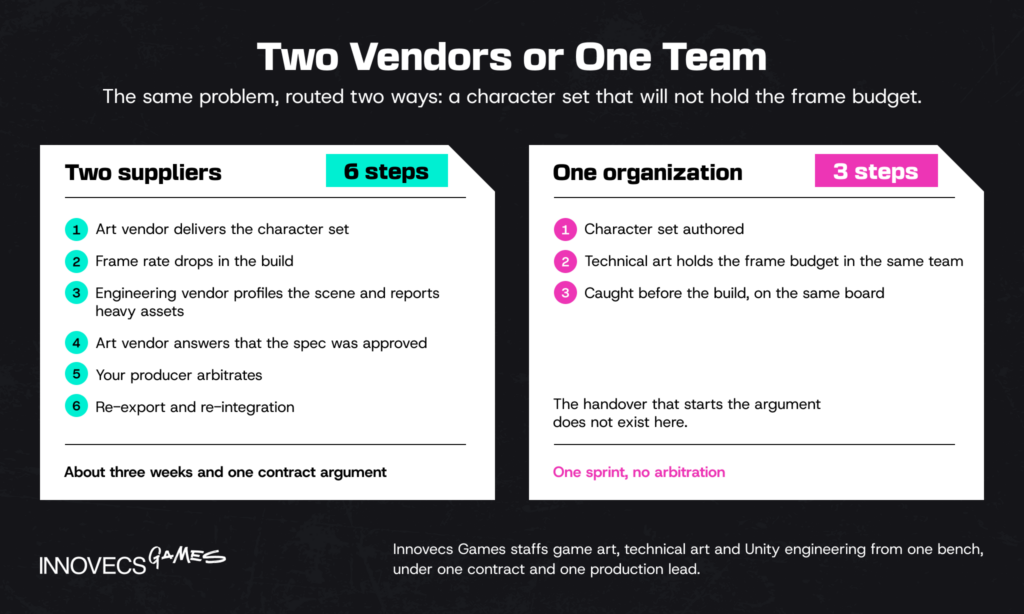
Here is what sets it apart on this list. Art and engineering sit in the same company. Game art, technical art, UI/UX, and LiveOps come off the same bench as the Unity engineers. So a character set and the shader work that keeps it inside a frame budget arrive from one team. No second vendor. No argument about whose fault the frame drop is. Most buyers build a top Unity game development company out of two suppliers and a coordination problem. Here it is one contract and one production lead.
The four countries do the same job for time zones. You get European hours with real US East Coast overlap. A six-person co-development slice can grow into a full production without onboarding a new vendor.
Now the numbers. More than a decade in business, 300+ games delivered, 100+ clients, and 200+ developers and artists across the US, UK, EU, Israel, and Ukraine. Innovecs is listed on IAOP’s Global Outsourcing 100 and reports 92% NPS. Read the award as a process check. Read the NPS as the real one, because clients score it after delivery, when they know how the project went. Our shipped Unity titles show the genre range.
Engagements here usually start small. One workstream with a clear edge. A four to six week paid pilot on real backlog, not a proposal document. Acceptance criteria written per milestone before anyone opens the editor. The honest downside, since every entry gets one: this is not the cheapest bid you will receive. We lose the deals decided on hourly rate. Studios that pick on rate and rebuild in month six often come back, which is a poor way to win work and a reliable one.
At a glance: Miami HQ · founded 2011 · R&D in Ukraine, Poland, Hungary, Romania · full-cycle, co-development, team extension, game and technical art · Zynga, JamCity · 300+ games · 200+ specialists · 92% NPS · IAOP Global Outsourcing 100.
Best for: studios that want Unity engineering and art on one contract, at EU rates, with a US entity to sign with.
2. N-iX Games
N-iX Game & VR Studio is the games arm of a larger engineering group, based in Lviv. Most of its verified Unity work is games and XR. AR/VR is where the engine depth shows, and immersive projects punish generalists: frame rates on standalone headsets leave almost no headroom, and comfort testing is a production phase rather than a QA line item. The studio also publishes its own research on the Unity outsourcing market, which says something about how much time it spends inside the engine.
At a glance: Lviv HQ · Unity and XR development · AR/VR delivery record · games arm of the N-iX engineering group.
Best for: Unity projects with a heavy AR/VR component and enterprise process requirements.
3. Room 8 Studio
Art production at industrial scale. Room 8 Studio was founded in 2011 and now runs out of Limassol as part of Room 8 Group, with delivery teams across Europe and the US. It lists more than 650 artists. Clients include Activision, Nintendo, Ubisoft, EA, and Xbox Game Studios, and the studio has worked on BAFTA-nominated projects. Its Unity work is in-engine integration, not a folder of FBX files handed over the wall. That difference decides whether an art package lands in your build or in your backlog. At this size you buy throughput and process. You do not buy a founder’s attention.
At a glance: Limassol HQ · founded 2011 · part of Room 8 Group · 650+ artists · Activision, Nintendo, Ubisoft, EA, Xbox Game Studios · art and co-development.
Best for: high-volume art and technical art work that has to arrive integrated and inside a performance budget.
4. Program-Ace
Program-Ace has been building software since the early 2000s, out of Kharkiv, with a US office in Atlanta. Its Unity depth shows at the hard end of real-time work: AR/VR products, training simulations, builds where physical accuracy beats art direction. Simulation clients ask for things game clients never do: deterministic behavior, hardware integration, and an audit at the end. Two decades in business also means this team has upgraded projects through more Unity versions than most studios have shipped games.
At a glance: Kharkiv HQ · US office in Atlanta · operating since the early 2000s · AR/VR, simulation, training · enterprise clients.
Best for: simulation-grade AR/VR and training builds where accuracy matters more than art direction.
5. Juego Studios
Juego Studios runs full-cycle and co-development Unity work from Bangalore, with entities in the US, UK, and Saudi Arabia. Read the technical vocabulary in its record rather than the logo wall: URP and HDRP optimization, IL2CPP builds. Those are the specifics you want from a partner scoping a cross-platform title. The studio reports more than 200 shipped titles and lists Disney, Sony, Tencent, and Warner Bros. Games. India is the lowest-rate option on this list, and the trade is management overhead. The time gap with North America makes every handover an async one, and async handovers need written acceptance criteria that teams routinely skip.
At a glance: Bangalore HQ · entities in the US, UK, Saudi Arabia · 200+ shipped titles · Disney, Sony, Tencent, Warner Bros. Games · mobile, PC, console, AR/VR.
Best for: cost-sensitive full-cycle mobile and cross-platform builds with a large bench behind them.
6. Starloop Studios
Spain’s largest game development outsourcing company, based in Lleida and part of the Magic Media group, with offices in twelve countries. It runs a dedicated Unity service line next to its Unreal work and reports more than 300 shipped games. The model is co-development and premium outsourcing rather than a body shop. For European buyers the win is contractual, not technical. An EU entity, EU data handling, and hours that overlap with UK and German publishers cut weeks off the legal review.
At a glance: Lleida HQ · part of Magic Media · offices in 12 countries · 300+ shipped games · dedicated Unity service line.
Best for: co-development and full-cycle Unity work that needs an EU entity and Western European hours.
7. Virtuos
Founded in 2004 and headquartered in Singapore, Virtuos is one of the largest external development partners in games. Roughly 4,000 staff across 25 offices in Asia, Europe, and North America. Independent industry reviews rank it among the biggest Unity outsourcing companies in the world, and its co-development and porting record covers Ubisoft, 2K, and Square Enix. The trade at this size is simple. You get process, capacity, and a team that can absorb a hundred-person program. You are also one program among many. If you need a founder on the call about a shader bug, look further down this list.
At a glance: Singapore HQ · founded 2004 · ~4,000 staff · 25 offices · Ubisoft, 2K, Square Enix · porting and AAA co-development.
Best for: large porting and AAA co-development programs where capacity beats intimacy.
8. PlaySide Studios
PlaySide is Australia’s largest game developer, listed on the ASX as PLY, with studios in Melbourne and on the Gold Coast. It builds original IP and licensed titles across mobile, PC, and console, and hires Unity developers at a scale few studios in the region match. The public listing is the underrated part of the pitch. Audited financials, reported revenue, and a real board answer the counterparty questions a buying team will ask, and those questions are usually the slow half of a large deal. Oceania rates sit closer to North America than to Eastern Europe. This is not the cost play.
At a glance: Melbourne HQ · second studio on the Gold Coast · ASX: PLY · original IP and licensed titles · mobile, PC, console.
Best for: buyers who need a publicly accountable partner and can fund Oceania rates.
9. Treeview
Senior only, so no juniors learning on your budget. Treeview works out of Montevideo with a second studio in New York, and roughly 45% of its delivery work is built in Unity. Enterprise clients include Medtronic, Microsoft, and ULTA Beauty, and it ranks near the top of the Unity category on Clutch. The reason a US buyer looks at Uruguay rather than Ukraine is overlap. A Montevideo team shares most of a working day with both US coasts, which turns a daily handover into a conversation. Senior-only staffing also means a higher blended rate, and that is the price of it. If you would rather hire unity game developers yourself, our guide to hire Unity developers covers the sourcing side.
At a glance: Montevideo HQ · second studio in New York · senior-only staffing · ~45% of work in Unity · Medtronic, Microsoft, ULTA Beauty.
Best for: enterprise AR/VR and Unity work that needs real-time overlap with US stakeholders.
10. The Knights of Unity
Founded in Wrocław by senior Unity developers and named after the engine. Roughly 100 specialists. Credits include Solasta: Crown of the Magister and GWENT: The Witcher Card Game, and the depth sits in multiplayer and VR. That is where Unity projects most often break. Netcode is unforgiving in a way gameplay code is not. Put the boundary between authoritative and predicted state in the wrong place and you find out in load testing, three months later. A team of a hundred also has limited surge capacity, so plan the ramp instead of assuming it.
At a glance: Wrocław HQ · ~100 specialists · founded by senior Unity developers · Solasta: Crown of the Magister, GWENT: The Witcher Card Game · multiplayer and VR.
Best for: multiplayer, netcode, and VR projects that need engine specialists rather than generalists.
11. Nordcurrent
Cooking Fever passed 450 million downloads. Airplane Chefs followed it. Both were built in Unity by Nordcurrent, which has been in business more than twenty years from Vilnius, with studios in Ukraine and Poland and over 50 shipped games. In-house LiveOps and monetization is the real difference here, and it is rarer than it sounds. Plenty of studios can build a casual game. Very few have run the events calendar, the economy tuning, and the payer segmentation on a title with hundreds of millions of installs. One caveat: Nordcurrent mostly publishes its own titles rather than taking outsourced work, so engagement terms will look different from the rest of this list.
At a glance: Vilnius HQ · studios in Ukraine and Poland · 20+ years · 50+ shipped games · Cooking Fever (450M+ downloads), Airplane Chefs · LiveOps and monetization in house.
Best for: casual and mid-core mobile projects where live-ops and monetization design decide the outcome.
12. Lucid Reality Labs
An AR/VR specialist with its HQ in Miami and development teams in Ukraine. Most of its work is built in Unity, and it clusters in enterprise training, simulation, and immersive media, with a strong reviewed record on B2B platforms for XR specifically. That focus matters when the client is a hospital or a manufacturer rather than a publisher. Those projects arrive with validation requirements, long buying cycles, and stakeholders who have never shipped software. A studio that has been through it is worth more than a cheaper one that has not.
At a glance: Miami HQ · development teams in Ukraine · most work built in Unity · enterprise training, simulation, immersive media.
Best for: regulated-industry XR, enterprise training, and simulation projects built in Unity.
13. Kevuru Games
Kevuru runs game art and animation outsourcing at scale from Kyiv, with offices in several countries and more than a decade of client projects. The output is 2D and 3D art, character design, and cinematics, for Unity and Unreal alike. Set expectations correctly: this is an art partner, not an engineering one. Use it as pipeline overflow when your artists are the bottleneck and your engineers are not. Art outsourcing lives or dies on the style guide and the review gate, so budget the days to write both before you order the first asset.
At a glance: Kyiv HQ · offices in several countries · 10+ years · 2D and 3D art, character design, cinematics · supports Unity and Unreal.
Best for: studios whose art pipeline is the constraint and whose engineering team is already staffed.
14. Galaxy4Games
A full-cycle and co-development Unity studio of roughly 40 people, registered in Tallinn, shipping its own live mobile, web, and blockchain titles alongside client work. A note on the address, since it comes up. Some directories list a different region, but the registered HQ, the founder records, Tracxn, and LinkedIn all point to Tallinn. We checked it across several sources before including the studio. At 40 people you get the senior team and no bench behind them, which is the trade every small studio asks you to make. Running its own live titles is the useful signal, because a team that operates a game economy tends to argue with your monetization design rather than build it quietly.
At a glance: Tallinn HQ · ~40 specialists · full-cycle and co-development · ships its own live mobile, web, and blockchain titles.
Best for: small and mid full-cycle builds where a stable senior team matters more than surge capacity.
15. Winking Corporation
Winking has built games since 2003, out of Taipei, as part of the Winking Studios group, and works in both Unity and Unreal. Credits include MMO and mobile titles such as Blade & Soul 2 and Lineage 2, plus a documented history of working with Unity Technologies on shipped projects. The current public entity leans toward art outsourcing and Unreal partnerships alongside its Unity work. Treat it as a dual-engine partner, not a Unity specialist. That is an advantage if your slate spans both engines, or if the engine choice is not final. It is a mismatch if you want a team that only thinks in C#.
At a glance: Taipei HQ · part of Winking Studios group · building games since 2003 · Unity and Unreal · Blade & Soul 2, Lineage 2 · art outsourcing attached.
Best for: dual-engine programs and art outsourcing across Unity and Unreal, with East Asian market exposure.
What to Check Before You Hire a Unity Development Partner
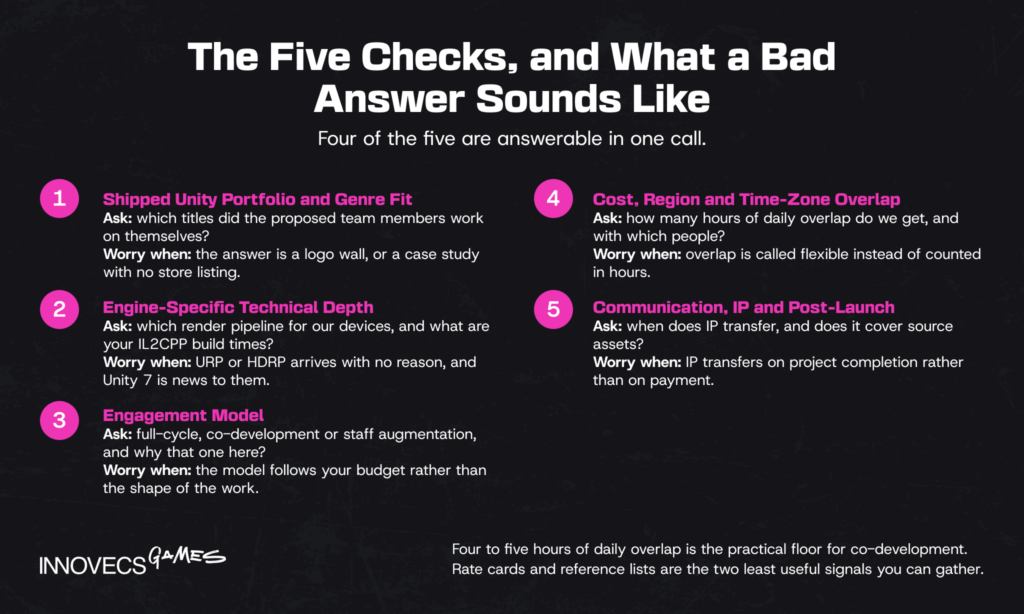
A shortlist is the easy half. The five checks below tell a top Unity game development company apart from studios that look identical in a proposal. Four of the five are answerable in one call, if you ask precisely. Most buying processes spend their energy on rate cards and references. Those are the two least useful signals you can gather. Ask instead about the last project that went wrong.
Shipped Unity Portfolio and Genre Fit
A portfolio proves the studio can ship. It does not prove it can ship your game. Genre carries most of the knowledge that transfers. A team with three match-3 titles behind it knows the economy, the events calendar, and the retention curve. A team with three VR training apps knows none of that, however strong its Unity engineering is.
Then there is the gap between the company and the people. Studios of any size staff projects from whoever is free, so the logo wall tells you very little. Ask which titles the proposed team members worked on themselves. And if a case study cannot be traced to a store listing, a credit, or a client who will confirm it, treat it as marketing.
Engine-Specific Technical Depth (URP/HDRP, IL2CPP, Performance Profiling)
Here is where a genuine unity 3d game development company parts company with a software house that has a games page. Four questions do most of the work.
Which render pipeline would they pick for your target devices? Listen for whether URP or HDRP arrives with a reason attached. How do they profile? The Unity Profiler and Frame Debugger are table stakes; platform-native tooling is the tell. What are their IL2CPP build times, and how do they manage shader variant counts, addressables, and memory budgets on the weakest device you support? And finally, what does their upgrade plan look like?
That last one has a date on it now. Unity 7 enters early beta in December 2026 and ships in early 2027. Unity has promised an upgrade path from Unity 6 that will not require rebuilding projects. A partner who has not read that roadmap is telling you something about their engineering culture.
Engagement Model: Full-Cycle vs. Staff Augmentation vs. Co-Development
Match the model to the shape of the gap, not to the price per hour. A three-month port with a hard date is a fixed-scope job. An eighteen-month production is a dedicated team. A capability you are missing on a project already in flight is co-development, and it costs more per month than staff augmentation because you are buying production judgment as well as hands.
The failure pattern is boringly consistent. Studios hire full-time for a temporary need, or run a two-year build on contractors who rotate off every quarter. Get the model right and a 10% rate difference stops mattering. Get it wrong and no rate saves you.
Cost, Region, and Time-Zone Overlap
Rates across the regions on this list vary by a factor of four. The cheapest option is rarely the cheapest outcome. What costs real money is the overlap window. Every hour without overlap turns a five-minute question into a next-day answer, and a milestone handover into a two-day round trip.
Four to five hours of daily overlap is the practical floor for co-development. More than any other constraint, that one decides which region a game development outsourcing shortlist survives. Below that floor you need written specs, recorded demos, and acceptance criteria detailed enough to survive a reader you cannot call. Good practice anyway. Expensive to acquire under deadline.
Communication, IP Protection, and Post-Launch/LiveOps Support
Settle the contract terms before the kickoff deck. IP assignment should be explicit, unconditional, and effective on payment rather than on project completion, and it has to cover source assets, not just the built output. Confirm where your code and art physically live. Confirm who holds repository access, and what happens to both if the engagement ends early.
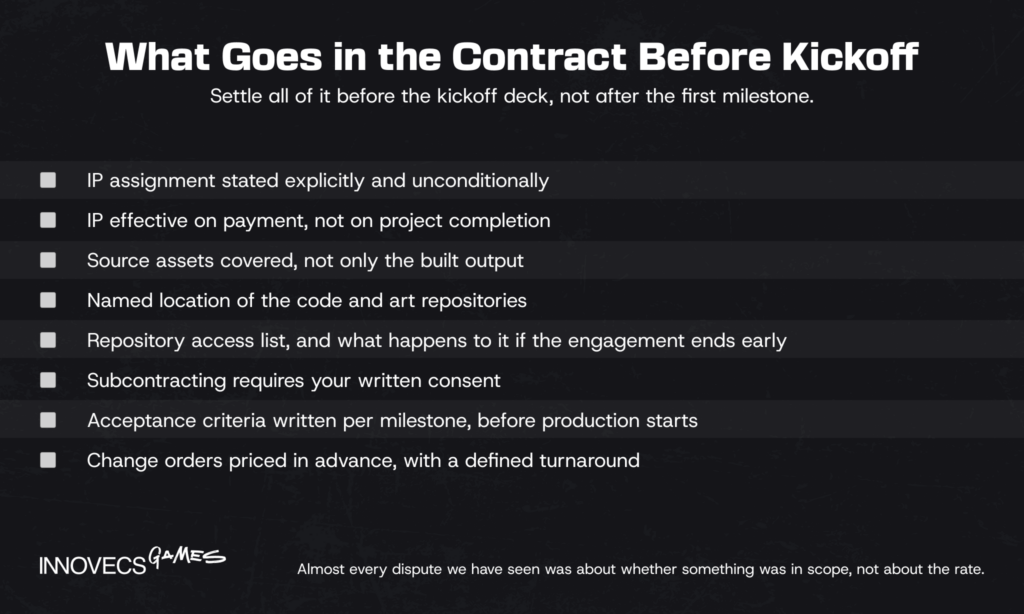
One clause people skip: subcontracting should require your written consent. A partner quietly passing your character art to a third party is a real scenario with a real cost attached. Last, ask what post-launch support looks like. A title that ships with no agreed live-ops arrangement discovers the need for one during its first live incident, at whatever rate the partner quotes that week.
Ready to Build Your Game in Unity with a Proven Partner?
Innovecs Games sells Unity game development services in three shapes: full-cycle builds, co-development, and team extension, staffed across the US, EU, and Ukraine. Maybe your gap needs a unity 3d game development company for a cross-platform build. Maybe it needs four engineers inside the pipeline you already run. Tell us the date it has to close by, and we’ll come back with a team composition and a monthly number.
How Much Does It Cost to Build a Game in Unity in 2026?
What a top Unity game development company charges is team size times blended rate times months. Region only moves the middle term. A partner’s commercial rate also covers management, benefits, and replacement risk, so it sits above the salary numbers for the same roles. Glassdoor puts average total pay for a US Unity developer near $79,695, on a range of $60,000 to $106,000. The US Bureau of Labor Statistics puts special effects artists and animators at a $102,030 median.
| Region | Junior | Mid-level | Senior | Notes |
|---|---|---|---|---|
| United States and Canada | $60 to $85 | $85 to $120 | $120 to $170 | Highest total cost, easiest alignment for US publishers |
| Western Europe | $50 to $70 | $70 to $100 | $100 to $140 | Deep technical art, longer notice periods |
| Eastern Europe and Ukraine | $30 to $45 | $45 to $65 | $65 to $95 | Largest Unity talent pool, 5 to 7 hour US overlap |
| Latin America | $30 to $45 | $45 to $65 | $65 to $90 | Best real-time overlap with US teams |
| South and Southeast Asia | $20 to $30 | $30 to $45 | $45 to $65 | Lowest rates, highest management overhead |
Source: Innovecs Games delivery data, projects staffed 2023 to 2026.
Read the notes column first. It’s the part people skip and then rediscover during a milestone handover at 2am.
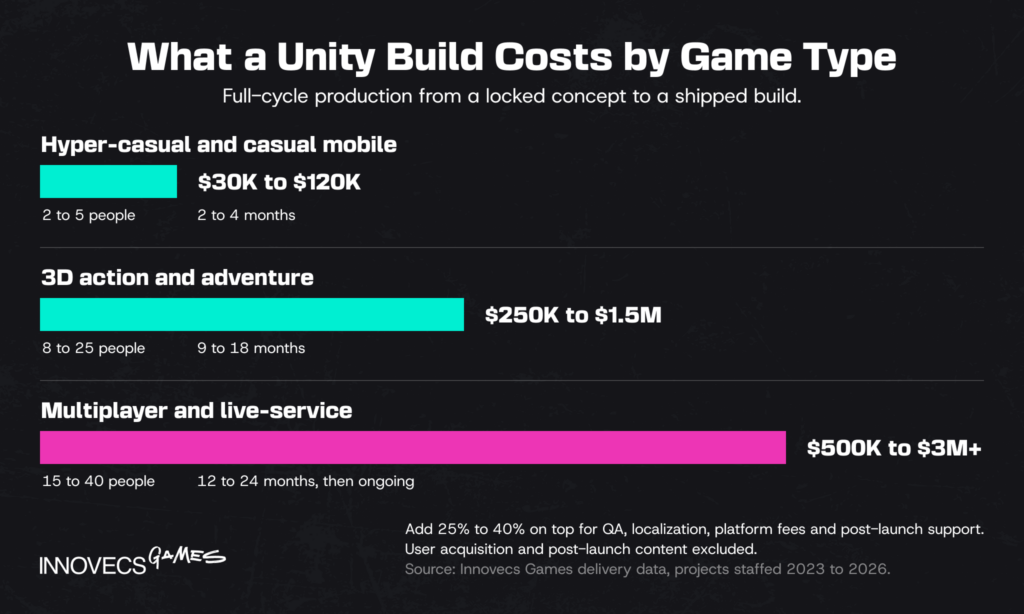
Project totals follow from those rates. A hyper-casual or casual mobile title runs $30,000 to $120,000 with two to five people over two to four months. A 3D action or adventure game lands between $250,000 and $1.5 million across nine to eighteen months. Multiplayer and live-service builds start around $500,000. They pass $3 million once server infrastructure, matchmaking, and a content pipeline enter the scope, and they keep spending after launch rather than stopping. Our Unity game development cost guide has the full breakdown by game type and discipline. It also covers the 25% to 40% that QA, localization, platform fees, and post-launch support add on top of a development-hours estimate. If the gap is a defined slice rather than a whole game, game co-development services price per workstream instead.
How AI Is Changing Unity Game Development
The industry’s own data points in two directions at once, and any studio telling you otherwise is selling something. Unity’s 2026 report has 62% of developers using AI for coding assistance and 44% for writing and narrative work. Half of respondents now run MCP servers, most of them wired to the engine or editor. GDC surveyed a wider population and got a different picture. Only 36% use AI tools at all. And 52% say generative AI has a negative effect on the industry, up from 30% a year earlier, with visual and technical artists the most negative group at 64%. Both sets of numbers are true. They answer different questions.
Three areas have genuinely moved. AI-assisted prototyping shortens the trip from a concept to something playable. That matters, because 67% of developers now spend three months or less in prototyping. The cheapest project you will ever build is the one you cancel in week six. Automated QA catches whole classes of regression cheaply and runs overnight. That frees human testers for exploratory work, where they are worth far more. And AI-driven live-ops tunes offers, difficulty, and event timing segment by segment, at a level of detail no analyst could keep up by hand. Together those three cut maybe 10% to 20% off engineering hours on a typical Unity project, mostly in the early and middle phases.
Where it hasn’t moved is judgment. Nobody has automated the call on which of three prototypes deserves funding, or why a level feels flat in its second minute, or what to cut eight weeks from submission. The US labor projections make the split visible. Special effects artists and animators sit at zero growth through 2035, and BLS names AI as a factor. Over the same decade, software developers grow 10% on a 2025 median of $135,980. That gap tells you which costs are falling and which are not. Our position, for what it’s worth: the price of a first draft has dropped close to zero and the price of judgment hasn’t moved at all. When you evaluate a partner’s AI story, ask what they’ve stopped doing manually and what they still refuse to automate. The second answer is more revealing.
FAQ
What is a Unity game development company?
A studio that builds games and interactive applications using Unity, either end to end or as a specialist partner inside someone else’s production. In practice the label covers four different businesses. Full-cycle developers deliver a submittable build, while co-development partners own a defined slice of one. Team-extension providers supply engineers into your pipeline, and art houses never touch gameplay code at all. A partner worth shortlisting will tell you which of those it actually is within the first ten minutes. The ones that claim all four with equal conviction usually mean the third.
How do I choose the right Unity studio for my game project?
Start with genre fit rather than engine credentials, because genre carries the knowledge that transfers. Then check that the people proposed for your team worked on the titles in the case studies. Staffing and portfolios are different things at any studio above thirty people. Match the engagement model to the shape of your gap before you compare rates. Finally, ask about a project that went badly, and listen for whether the answer names a mechanism or a scapegoat.
How much does it cost to hire a Unity game development company?
Commercial rates run from about $20 an hour for a junior in South Asia to $170 for a senior in North America. Eastern Europe sits at $45 to $65 mid-level and $65 to $95 senior. Totals are easier to plan with. Figure $30,000 to $120,000 for a casual mobile title, $250,000 to $1.5 million for a 3D action game, and $500,000 upward for anything with servers in it. Budget another quarter to two-fifths on top for QA, localization, platform fees, and post-launch support. None of them appear in a development-hours estimate, and all of them arrive anyway.
What’s the difference between hiring a studio and a freelance Unity developer?
A freelancer is the right answer for a bounded problem with a clear acceptance test: a port, a set of VFX, a performance pass, a shader. A studio is the right answer when the work needs coordination, continuity, and someone other than you owning the plan. The economics flip somewhere around three people. Below that, freelance is cheaper and the coordination cost stays manageable. Above it, you are paying your producer to run project management for contractors. That is the most expensive way anyone has found to save 15% on rates.
Which regions produce the strongest Unity game studios?
Eastern Europe and the Baltics hold the deepest commercial Unity pool, built over fifteen years of outsourced production for Western studios, at roughly half Western European rates. Latin America wins on overlap with US teams and is closing the gap on depth. South and Southeast Asia offer the lowest rates and demand the most management. Southern Europe and Oceania cost more but make the legal review easier, especially with EU or publicly listed counterparties. No region has a monopoly on quality. The spread inside a region is wider than the gap between regions.
How long does it take to build a game in Unity with an outsourced team?
Two to four months for a hyper-casual title. Four to nine for a polished 2D game. Nine to eighteen for a 3D action or adventure build. Twelve to twenty-four for multiplayer or live-service, before the content pipeline even starts. Add two to six weeks of ramp before any of that, depending on model: staff augmentation starts fastest, co-development takes longer because the partner has to read your codebase properly. Because cost tracks months directly, a schedule slip is a budget overrun wearing a different name.
Should I outsource my Unity project or build an in-house team?
Build in-house what defines your studio for the next several years, and rent the rest. An in-house senior Unity engineer costs 25% to 35% above base salary once you count taxes, benefits, hardware, and seats. Hiring one takes three to five months in a competitive market, and the milestone slips while the seat is empty. Outsourcing removes both problems and adds one: you still need somebody senior on your side owning acceptance criteria. In our experience studios rent too late far more often than too early.
What questions should I ask a studio before signing a contract?
Which of the proposed team members shipped the titles in the case study, and can they join the next call. Which render pipeline they’d pick for your targets and why. How they profile performance and on which devices. When IP transfers, and whether it covers source assets. Whether subcontracting requires your written consent. What happens to the repository if the engagement ends in month three. And what a change order costs, because almost every dispute we’ve seen was about whether something was in scope, not about the rate.
How is AI changing Unity game development in 2026?
Mostly in the early and middle phases of production, where boilerplate, editor tooling, and test scaffolding now cost a fraction of what they did two years ago. Automated QA and AI-driven live-ops tuning are the other two areas with returns you can measure. The change worth watching is tool access rather than generation. An assistant wired into the editor can read the actual project, and that is what turns a suggestion into a usable one. Late-stage work has barely moved. Balancing, certification, and polish still cost what they cost, and no roadmap on the table changes that in 2026.
Can AI replace a Unity game development team?
No, though it has absorbed a real share of the routine output juniors used to produce. The clearest signal is in the US labor projections: animators sit at zero growth through 2035, with AI named as a factor, while software developers grow 10% over the same decade. What survives is judgment: deciding what to build, what to cut, why a mechanic isn’t landing, and whether a build is shippable. Studios that trim senior headcount because tooling made the remaining team faster tend to meet that assumption again at the first milestone review, usually at a bad moment.
Ready to Build Your Next Game in Unity? Let’s Talk
Innovecs Games has delivered 300+ games with 200+ developers and artists across the US, UK, EU, Israel, and Ukraine. A Unity team comes off that bench in weeks, not quarters. Tell us the gap, the platforms, and the date, and we’ll scope a team against it. Choosing a top Unity game development company gets easier with one real proposal in front of you instead of a shortlist.