Top 15 Mobile Game Development Companies to Partner With in 2026
A verified, region-diverse shortlist of the top mobile game development companies, plus the vetting checklist to use before you sign one.
Written by the Innovecs Games production team. Company data verified September 2026. Last updated: September 2026.
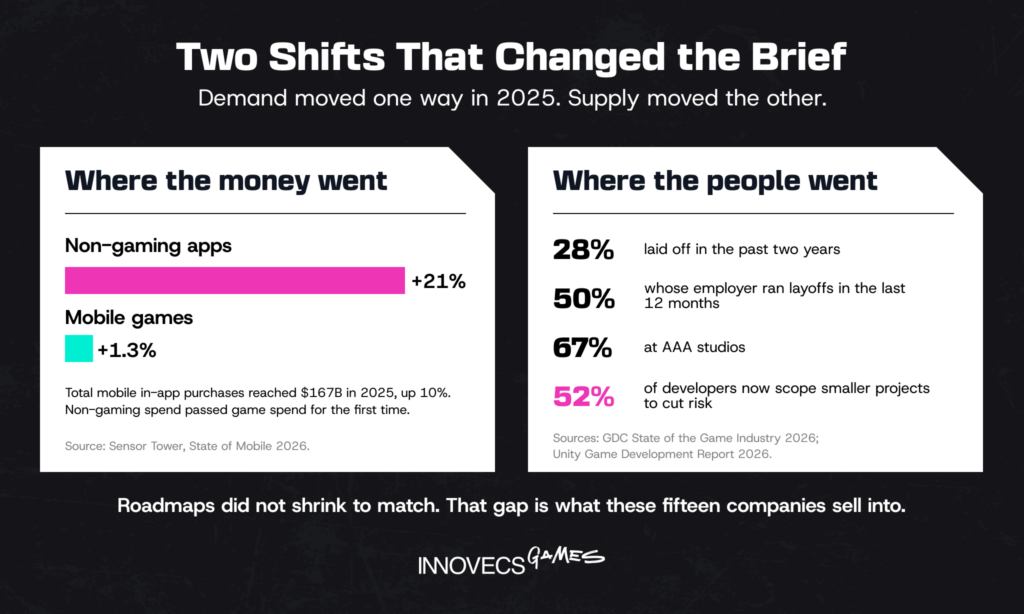
For the first time, people spent more money inside non-gaming apps in 2025 than inside games. Sensor Tower puts total mobile in-app purchase revenue at $167 billion for the year, up 10%, with the non-gaming half growing 21% while games managed 1.3%. The competition for a player’s wallet is a short-form drama app and an AI chatbot now, not only the puzzle game two slots down the chart. Choosing the top mobile game development company stopped being a procurement exercise somewhere inside that shift, and most buyers haven’t updated the process to match.
The supply side moved at the same time, in the opposite direction. GDC’s 2026 State of the Game Industry found 28% of respondents laid off in the past two years. Half said their employer ran layoffs in the last twelve months, and at AAA studios that figure hit 67%. Roadmaps didn’t shrink to match. The 2026 Unity Game Development Report has 52% of developers now scoping smaller projects as their main way of cutting risk, which is a polite way of saying the ambition got rationed. Capacity that used to sit on payroll is bought by the milestone instead, and that’s the market these fifteen companies work in.
What follows is a ranked list of fifteen studios that passed a verification bar. They sit in eight home countries across four macro regions, so you can compare cost tiers and time-zone overlap in one pass. After the list comes the part most roundups skip. What to check before you sign, what a build costs by region and engagement model, and where AI has changed studio output versus where it has changed only the pitch deck.
A word on the genre first. Plenty of roundups ranking mobile studios are directory scrapes with a payment link attached, where a services page mentioning games once is enough to buy a place in somebody’s top five. The bar used here is set out in the next section, and it’s the reason two well-known names below get a caveat instead of a superlative.
What These Companies Actually Do, and Why the Right Pick Matters
A mobile game development company is a studio that builds games for iOS and Android on a client’s behalf, either owning the whole project from concept to store release, or supplying a specific capability such as engineering, art, QA, or live operations to a team that already exists. It’s not one business model wearing one name. Three distinct things get sold under that label, and confusing them is the single most expensive mistake in this category.
Full-cycle development means the studio owns the build from concept through submission: design, engineering, art, QA, store release, and often the first live-ops cycle. You approve milestones, they carry delivery risk. Staff augmentation, sold in some markets as outstaffing, is the opposite arrangement. A Unity developer, a technical artist, or a QA tester joins your team, works in your Jira, and reports to your producer. Co-development sits between the two. A partner owns a defined slice such as the meta layer, a platform port, or the whole art pipeline, and your team keeps the core. Art-only outsourcing is narrower still, delivering 2D and 3D assets, characters, environments, and UI against your style guide without touching a line of code.
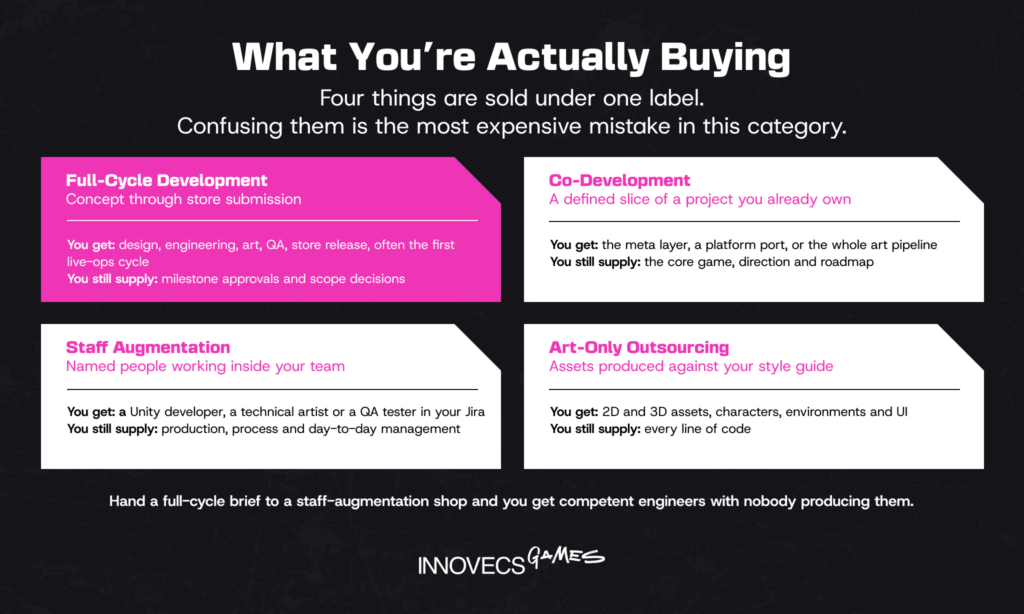
The stakes are in the mismatch. They usually surface in month three. Hand a full-cycle brief to a staff-augmentation shop and you get competent engineers with nobody producing them. Hire a full-cycle studio when what you actually needed was two Unity developers for eleven weeks, and you’ll pay a production overhead for management you already have. Timelines drift for the same reason. A team that has never shipped an iOS build discovers certification requirements at the point where they’re most expensive to fix. If you’re still mapping your gap to a model, our mobile game development services page lays the three out with the deliverables attached to each.
Genre history matters more than engine history. It’s also the check most buyers skip. A studio with fifteen hyper-casual titles behind it has a pipeline built for two-week prototypes and ad-driven monetization. Give that team a mid-core RPG with a live economy and you’re asking a sprinter to run a marathon on the same training plan.
How We Built This List
A directory badge on its own doesn’t make a top mobile game development company. Every entry here had to clear a harder bar, verified in September 2026: publicly verifiable mobile game development work, evidenced by named clients, shipped titles, or standing on a third-party review platform such as Clutch or GoodFirms, and confirmed against at least two independent sources per company. A services page listing “game development” among nineteen other offerings did not qualify. That one rule disqualified most of what a search for this keyword returns, which tells you something about the keyword. Each entry was cross-checked against at least two independent sources in September 2026. Where sources disagreed, we say so in the entry rather than quietly picking the flattering version. Two entries carry notes of that kind: one on a disputed address, one on a company that isn’t a work-for-hire vendor at all.
The list deliberately spans Eastern Europe, North America, South and Southeast Asia, and Western Europe. Region drives two variables you can’t negotiate away: hourly rate and time-zone overlap. A Kyiv or Warsaw team gives a US East Coast producer four hours of shared daylight. That’s enough for a standup and one real conversation. A Bengaluru or Hanoi team gives you close to zero, which is fine for asset production and painful for daily debugging on a live build.
| # | Company | HQ | Core model |
|---|---|---|---|
| 1 | Innovecs Games | Miami, USA | Full-cycle, co-development, dedicated teams |
| 2 | Room 8 Group | Limassol, Cyprus | Full-cycle, co-development, art and QA |
| 3 | Zco Corporation | Nashua, USA | Full-cycle app and game development |
| 4 | Juego Studios | Bengaluru, India | Full-cycle design and development |
| 5 | Kevuru Games | Kyiv, Ukraine | Full-cycle, co-development, art, porting |
| 6 | Starloop Studios | Lleida, Spain | Full-cycle mobile development |
| 7 | NipsApp Game Studios | Trivandrum, India | Full-cycle, high-volume delivery |
| 8 | Cubix | West Palm Beach, USA | Full-cycle multi-platform development |
| 9 | Stepico Games | Lviv, Ukraine | Development, art production, live ops |
| 10 | BEETSOFT | Hanoi, Vietnam | Outsourcing with a game-dev line |
| 11 | TekRevol | Houston, USA | Full-cycle mobile product studio |
| 12 | Vention | New York, USA | Staff augmentation, Unity hiring |
| 13 | Whimsy Games | Kyiv, Ukraine | Mobile-focused outsourcing |
| 14 | Galaxy4Games | Tallinn, Estonia | Full-cycle casual with in-house LiveOps |
| 15 | Kwalee | Leamington Spa, UK | Developer and publisher |
Read the fourth column before the first. The rank tells you how strongly a company verified, but the model column tells you whether it can take your brief at all.
The Full Ranked List
The entries run in verified order. The top mobile game development company for your project is whichever one matches the model column above, not automatically the one at number one. Each entry gives region, founding year, core specialty, one verifiable proof point, and a “Best for” line. Where an entry looks shorter than its neighbor, that’s what the public record supports, and we haven’t filled the gap with estimates. A list that gives every company the same three flattering sentences is a list nobody checked.
1. Innovecs Games
Innovecs Games is the dedicated gaming studio of Innovecs, established in 2011 and headquartered in Miami, with R&D centers running across Ukraine, Poland, Hungary, and Romania rather than concentrated in a single delivery location. The studio covers full-cycle mobile and AAA development alongside a standalone game art practice, which is a narrower claim than it sounds and a more useful one. It means a client can commission a whole build, or hand over only the art pipeline, or start with six people on a co-development slice and grow into a full team, without changing vendors when the shape of the project changes. That happens more often than anyone plans for.
Named clients include Zynga and JamCity, both of which are operators of live mobile titles rather than one-off commissioners, which is the harder kind of client to keep. The company is an IAOP Global Outsourcing 100 lister and reports 92% NPS across its delivery portfolio. Award listings are easy to over-read, so treat the first as a process credential and the second as the one that actually matters: NPS is measured after delivery, when the client already knows how the project went.
The multi-country R&D footprint is the practical differentiator against most of the list. Four delivery countries in the same organization means European working hours with real US East Coast overlap, a team that can scale without a new contract, and continuity that doesn’t depend on one office staying open. It also means a producer sits in your time zone rather than emailing you from nine hours away. You can see our shipped mobile titles for the genre range.
In short: Innovecs Games is the dedicated gaming studio of Innovecs, founded in 2011, headquartered in Miami with R&D centers in Ukraine, Poland, Hungary, and Romania. It provides full-cycle mobile and AAA game development, co-development, dedicated teams, and game art. Named clients include Zynga and JamCity. It is an IAOP Global Outsourcing 100 lister and reports 92% NPS.
Best for: full-cycle mobile builds and embedded co-development teams where the client wants to keep production control rather than hand the project over.
2. Room 8 Group
Room 8 Group is an end-to-end external development partner founded in 2011 and restructured into its current group form in 2018, headquartered in Limassol, Cyprus. Its services cover full-cycle mobile, PC, and console development plus co-development, art, and QA, which is the widest platform spread on this list, and the client roster is the credential behind it: Microsoft, Nintendo, Ubisoft, Sony, Gameloft, and EA. That profile also sets expectations on scale, since a group organized around platform-holder programs is built for large engagements rather than a single small mobile title.
Best for: large co-development and art programs that cross mobile, PC, and console in the same contract.
3. Zco Corporation
Founded in 1989 in Nashua, New Hampshire, Zco Corporation is one of the longest-running software shops in the US. Mobile game development is a named specialty here rather than a bolt-on. Longevity in this industry is rare enough to be a data point on its own. Thirty-plus years of continuous operation says something about client retention that no award does. Clients include Volkswagen, Microsoft, and Verizon, which points at brand and enterprise work as much as consumer titles. The trade-off is that a company with that client mix is not primarily a games studio in the way that entries 5, 6, or 14 are.
Best for: US-domiciled contracting requirements and brand or enterprise mobile game projects.
4. Juego Studios
Juego Studios is a game design and development company founded in 2011 and formally established in 2013, based in Bengaluru with a team of 250-plus. The company reports 200-plus shipped projects and 100 million-plus downloads across iOS, Android, PC, and VR, with a client list that runs to Disney, Warner Bros, and Coca-Cola, which puts it in the small group of outsourcing studios cleared for licensed work at that level. Licensed IP is its own discipline, with brand approval cycles that add weeks nobody budgets for. A studio that has run Disney and Warner Bros approvals before won’t be learning that process on your schedule.
Best for: licensed-IP casual and mid-core titles built at South Asia rates.
5. Kevuru Games
Kevuru Games is a game development and art production studio founded in 2012 in Kyiv, with a Warsaw office and 300-plus specialists. It offers full-cycle development, co-development, and porting. The strongest verified evidence sits on the art side: the studio contributed art and development work to Fortnite for Epic Games and to Big Farm for Goodgame Studios. Contributing assets to a live service at Fortnite’s scale means passing a review standard most mobile projects never encounter.
Best for: art-heavy production, co-development, and platform porting on an existing build.
6. Starloop Studios
Starloop Studios has run as a full-cycle mobile game development studio since 2011 from Lleida, Spain, and is now part of the Magic Media group. The numbers it reports are volume numbers, with 300-plus games delivered, 100 million-plus downloads, and 200-plus publisher clients, and that publisher-heavy base is the signal worth reading, because publishers re-contract on delivery predictability rather than on portfolio glamour. Being part of a larger group also means capacity beyond the local team, with the usual caveat that you should confirm which entity actually staffs your project.
Best for: publishers with a slate who need repeatable mobile delivery across several small-to-mid titles.
7. NipsApp Game Studios
NipsApp Game Studios is a full-cycle studio founded in 2010 in Trivandrum, Kerala, with an Abu Dhabi office and 200-plus in-house staff. The company reports 3,000-plus projects delivered across 25-plus countries. It was also named a 2026 Summer Clutch Global Award winner for Game Development, which is a review-platform credential rather than a self-declared one. A project count that high implies a high-throughput pipeline optimized for volume, so ask early how a single title gets senior attention inside it.
Best for: high-volume, budget-sensitive casual pipelines where throughput matters more than a bespoke process. Ask who your producer is.
8. Cubix
Founded in 2008, Cubix operates from West Palm Beach, Florida, with delivery offices in the UK, UAE, and Pakistan, and 350-plus in-house professionals. It ranks first in the Top Mobile Game Development Companies category on GoodFirms, and its services span full-cycle mobile, PC, console, and blockchain game development, which is a broader surface than a forty-person specialist can hold. The US front office with offshore delivery is a deliberate structure that solves a procurement problem for American buyers who need a domestic contracting entity. It is also the structure where you should confirm which office your producer actually sits in.
Best for: US-facing contracting with offshore delivery economics behind it.
9. Stepico Games
Stepico Games is a European video game development company founded in 2014 in Lviv, Ukraine, with 200-plus employees, and its service mix covers development, art production, and live-ops for mobile, PC, and console titles. Live ops as a named practice rather than an afterthought is the differentiator worth noting. The money in mobile has moved decisively from launch to the retention curve, and most studios that say “live ops” mean “we’ll fix bugs after release.”
Best for: taking over or reinforcing live operations on a title that has already shipped.
10. BEETSOFT
BEETSOFT is an IT outsourcing company founded in 2014 in Hanoi, with a Tokyo office and 250-plus staff. A dedicated game development line runs inside a broader services business. GoodFirms recognizes it as a Top Game Development Company in Vietnam. The Japan office is the practical detail: it signals real experience with Japanese client expectations, which are their own category of documentation discipline. Being a games line inside a general outsourcing firm also means the games team is smaller than the headcount suggests.
Best for: Asia-Pacific time-zone coverage and cost-sensitive production support.
11. TekRevol
TekRevol is a digital product studio founded in 2018 in Houston, Texas, with delivery teams in Pakistan, the UAE, and Estonia and 500-plus professionals globally. It runs a dedicated mobile game development service line for iOS and Android inside a wider app-development business, an arrangement that gives you enterprise delivery process and, on the other side of the ledger, a games team competing internally for the same senior engineers. Three of the entries here sit on US soil. If working with a mobile game development company in USA jurisdiction is a procurement requirement rather than a preference, TekRevol, Cubix, Zco, and Vention are where to start.
Best for: app-shop-style mobile builds where a US front office and a single vendor for app and game work is the priority.
12. Vention
Vention is a software engineering and staff-augmentation firm founded in 2002, headquartered in New York with 3,000-plus engineers. It runs a dedicated game development outsourcing and Unity developer hiring line, and it built a mobile game for Postman. This is the clearest staff-augmentation play on the list, and it should be read that way. You’re buying engineers by the seat, and you supply the production, design, and art direction. If you already have a producer and an art lead and what you’re short of is Unity headcount, that’s a feature. If you don’t, it’s a gap you’ll discover in week three.
Best for: Unity and engineering staff augmentation into a team that already has its own production leadership.
13. Whimsy Games
Whimsy Games is a game development outsourcing company founded around 2017 in Kyiv, with a UK office, 200-plus projects delivered, and a 30-plus in-house team that has stayed deliberately small while the project count climbed. Clutch lists the company at 100% Mobile Game Development focus, which is the single most concentrated mobile specialization on this list. A thirty-person studio cannot run four large projects at once, so the question to ask is what else is in the pipeline during your window.
Best for: small and mid-size mobile projects where full attention from a specialized team beats raw capacity.
14. Galaxy4Games
Galaxy4Games is a full-cycle game development studio founded in 2020 in Tallinn, Estonia, with 40-plus specialists working on casual, match-3, and Web3 mobile titles, with LiveOps handled in-house. One note on the record. A single GoodFirms category page lists a Vietnam address for the company, but the registered HQ, the founder’s location, and every other directory confirms Tallinn, including Tracxn, the GoodFirms company profile itself, and LinkedIn. We cross-checked that across five sources and are listing it as Estonian. Directory data drifts, and this is a good reminder to verify an address in a registry rather than a listing page.
Best for: match-3 and casual mobile titles that need LiveOps attached from day one rather than bolted on later.
15. Kwalee
Kwalee is a mobile game developer and publisher founded in 2011 in Leamington Spa by Codemasters co-founder David Darling. It reports 700 million-plus downloads, a large in-house development studio, and offices in India, China, and Portugal. Read that description carefully, because Kwalee is not a work-for-hire vendor like the fourteen entries above it. It operates as a developer and publisher, and as a co-development partner on titles it has signed. You approach it with a game to publish rather than a brief to build. Commissioning a custom mobile project from Kwalee the way you would from Room 8 or Kevuru isn’t the relationship on offer. It’s on this list because it belongs in the conversation, not because it will quote your brief.
Best for: studios with a finished or near-finished mobile title looking for a publishing or co-development partner, not a build vendor.
What to Check Before You Hire a Development Partner
The list narrows your options to fifteen. This section narrows them to two or three. Most buyers spend their evaluation time on portfolio pages and almost none on the engagement model, which is backwards, and five years of watching people test the other order hasn’t changed our read on it. Five checks, in the order they actually matter, before you hire a mobile game development company for anything larger than a prototype. The best mobile game development company for a match-3 with a live economy is rarely the right one for a hybrid-casual build. The reverse holds just as firmly.
Shipped Portfolio and Genre Fit
Ask for shipped titles in your genre, with store links, and check the update history rather than the launch date, because a release date tells you a team once finished something and an update cadence tells you they can keep a title alive. A puzzle game that has shipped 40 content updates in two years tells you the studio can operate a live title. One with a 2023 launch and nothing since tells you the team can ship and then leave. A portfolio page is marketing. An update history is evidence. Genre fit beats platform fit here, too. The hard problems in a mid-core RPG are economy design and retention; in hyper-casual they’re prototype speed and CPI. Request the postmortem on a project that went badly. Then take the answer seriously. A producer who can’t name a project that missed has either not shipped enough or isn’t being straight with you.
Engine and Platform Expertise (Unity, Unreal, cross-platform)
GDC’s 2026 survey puts Unreal Engine at 42% as a primary platform against Unity at 30%. Those shares invert on mobile, where Unity’s tooling and build pipeline still carry the majority of commercial titles. What you’re checking is not whether a studio lists a game engine on its website. It’s whether they’ve shipped an iOS and an Android build of a comparable title, cleared App Store review and Google Play, and handled certification. Device fragmentation is the other half of the question, since a large share of emerging-market installs sit on the low end of the Android range. Engine choice carries a hiring consequence too, since a Unity project needs C# engineers you can replace mid-contract, while a Cocos2D or in-house engine narrows that pool sharply. Cross-platform ambitions raise the bar again: 72% of studios in Unity’s 2026 report prioritize cross-play, and 38% name consistent experience across devices as their biggest obstacle. Ask which specific devices they test on, and who owns the device lab. The answer is often nobody.
Engagement Model: Full-Cycle vs. Staff Augmentation vs. Co-Development
| Model | You control | Partner owns | Best fit | Trade-off |
|---|---|---|---|---|
| Full-cycle | Milestones, scope, approvals | Design, build, art, QA, release | No internal production team | Least day-to-day visibility; scope changes are contract events |
| Co-development | Core game, direction, roadmap | A defined slice: art, meta, port, live ops | Existing team with one structural gap | Interface between the two teams needs an owner, or it becomes nobody’s job |
| Staff augmentation | Everything, including the process | Nothing but the individual’s output | Strong internal production, missing headcount | You carry all management overhead, and ramp-up is on your clock |
The disagreements we have with a client’s plan almost always sit on the boundary between two of those rows, not inside one of them. Co-development is the model most often chosen for the wrong reason, usually because full-cycle felt like too much surrender and staff augmentation felt like too little help. It works when the slice is genuinely separable. It fails when it isn’t, and it fails slowly. Our overview of game development outsourcing walks through how the three models get staffed in practice.
Cost, Region and Time-Zone Overlap
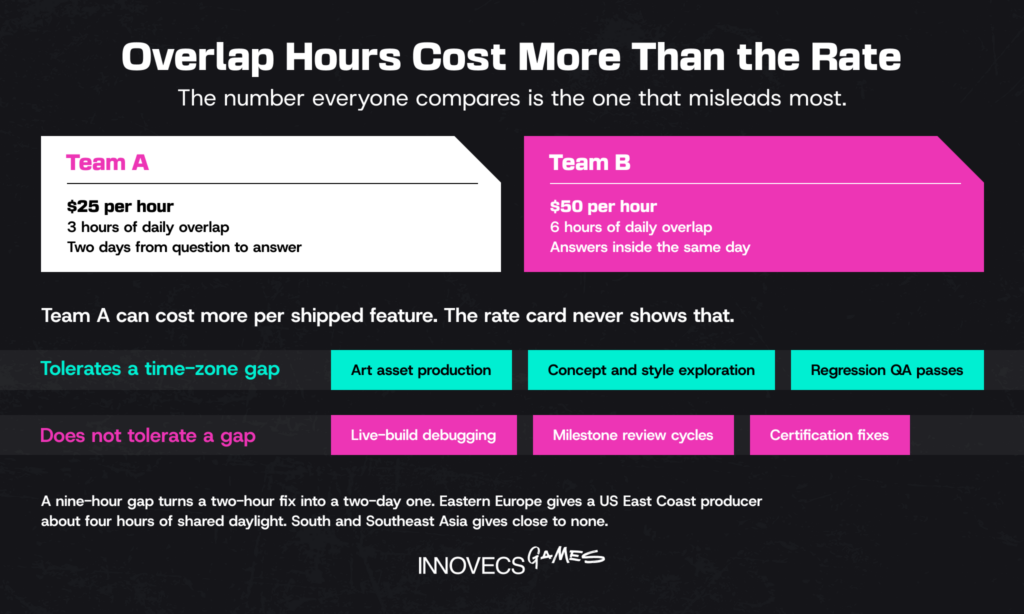
Rate is the number everyone compares and the one that misleads most. Compare two teams. A $25 hourly rate with three hours of daily overlap and a two-day question-to-answer cycle can cost more per shipped feature than a $50 rate with six hours of it. Do the arithmetic on your own project’s iteration frequency, because art asset production tolerates asynchronous work perfectly well, while live-build debugging with a nine-hour gap between question and answer turns a two-hour fix into a two-day one. Eastern European teams sit in the middle of that trade-off for US clients, close enough to nearshore hours for a New York producer to run a real standup. South Asian teams win on rate while demanding more management structure. No configuration wins on every axis. Anyone telling you otherwise is selling their own time zone.
Communication, IP Protection and Post-Launch Support
Establish who owns the source code, the art assets, and the intermediate files before the contract is signed. Confirm that the assignment covers work by subcontractors, not just direct employees. Ask specifically for the PSDs, the source Maya or Blender files, and the Unity project with its full commit history, not a built package. Post-launch terms need the same treatment, which means defining who fixes a crash discovered in week two, at what response time, at what rate, and for how many months after the final milestone is signed off. A studio that has run live titles will have a support SLA ready. A studio that hasn’t will offer to “stay available.” That isn’t a commitment you can hold anyone to. For a role-by-role breakdown of what to interview for, our guide on how to hire mobile game developers covers the screening questions per discipline.
Every project on this list started as a gap with a date attached: a port, an art pipeline, a live-ops team, a whole build. Tell us the gap and the timeline, and we’ll scope a team against it and tell you honestly if the shape you have in mind is wrong.
How Much Does It Cost to Build a Mobile Game in 2026?
Every check in that list eventually turns into a number. Mobile still carries 57% of a $213.9 billion games market this year, worth $121.1 billion across 3.10 billion players on Newzoo’s 2026 forecast, and none of that scale makes an individual build one dollar cheaper. Region sets the floor, and the spread is wide enough to change what game you can afford to make. The ranges below reflect blended rates for mid-level and senior production staff on mobile projects, not junior or trainee seats. They assume a team rather than an individual contractor.
| Region | Mid-level Unity developer, hourly | Senior or lead, hourly | Small full-cycle mobile build |
|---|---|---|---|
| South and Southeast Asia | $20 to $40 | $35 to $60 | $60,000 to $150,000 |
| Eastern Europe | $35 to $55 | $50 to $80 | $100,000 to $250,000 |
| Western Europe | $45 to $70 | $65 to $95 | $150,000 to $350,000 |
| North America | $75 to $150 | $110 to $200 | $250,000 to $600,000 |
Source: Innovecs Games delivery data, projects staffed 2023 to 2026. Rates are blended across mid-level and senior production roles on mobile projects and exclude platform certification and live-ops retainers.
No rate card survives contact with a real discovery call, but the shape of it holds. The comparison people forget to run is against building in-house: US Bureau of Labor Statistics data puts the median US software developer wage at $135,980 as of May 2025, and QA analysts and testers at $104,300. That’s before benefits, equipment, recruiting, and the six-to-twelve-week hiring lag. Art is the line that has moved differently: BLS reports the median for special effects artists and animators at $102,030, with 0% projected employment growth through 2035 against 10% for developers. That divergence shows up directly in what art outsourcing costs relative to engineering. For the full model with team compositions and phase-by-phase splits, see our breakdown of mobile game development cost.
Two lines reliably land outside the build budget: platform certification and store compliance work, and the first six months of live ops. Both get described as small in the kickoff call and neither ever is. Neither is optional. Both are far easier to negotiate before signing than after.
How AI Is Changing the Way These Studios Build Games
Rates answer what a team costs. The question buyers ask straight afterwards is whether they’ll need as many people at all, and the honest summary is that AI has compressed the front of the pipeline and barely touched the back of it. GDC’s 2026 survey found 36% of industry professionals using generative AI tools, with 81% of those using them for research or brainstorming and 35% for prototyping. Sentiment runs the other way, with 52% calling AI’s effect on the industry negative against 7% who see it as positive. Among visual and technical artists, the unfavorable share reaches 64%. Any studio pitching you an all-AI pipeline in 2026 is pitching against the opinion of most of the people who’d have to run it. Worth remembering in the demo.
Prototyping is where the gains are real, measurable, and largely uncontested even by the people most skeptical of everything else on the list. Unity’s own telemetry has median project development time down 77% between January 2022 and December 2025, from 91 hours to 21. A 91-hour median tells you what kind of project that measures, so read it as a statement about experiments rather than about shipped games. Alongside it, 62% of developers use AI for coding assistance and half now work with MCP servers. In practice a studio can test four mechanics in the time it used to test one. That changes the economics of pre-production far more than it changes the cost of a finished game. Automated QA follows the same pattern. AI-driven test generation and crash triage cover regression and device-matrix passes well, and still miss the class of bug that only shows up when a human plays badly on purpose.
Live ops is the third area, and the most commercially interesting. AI-driven segmentation and offer personalization now run inside the tools most studios already use, tuning difficulty curves and store offers per cohort rather than per build, which is the first place in the pipeline where the technology has changed a revenue line rather than a production schedule. Given where the growth isn’t coming from, squeezing the retention curve is where the remaining money sits, and AI does that job well because it’s fundamentally a pattern problem over a lot of data. This is also the one part of the pipeline where a studio’s AI story is worth taking at face value, since the results show up in a cohort report within a month.
Where it doesn’t help is the part that decides whether anyone stays. A model can generate a hundred level layouts and cannot tell you which one feels good on the fourth replay. It can produce character art in a consistent style and cannot decide whether that style is right for the audience you’re targeting. Our position, for what it’s worth: the price of a first draft has gone to nearly zero and the price of judgment hasn’t moved at all. When you evaluate a studio’s AI story, ask what they use it for and what they refuse to use it for. The second answer tells you whether they understand their own craft. The first one rarely does.
FAQ
What is a mobile game development company?
A mobile game development company builds games for iOS and Android. It works either as a full-cycle partner owning the project from concept to store release, or as a specialized supplier of engineering, art, QA, or live-ops capacity. Most operate with Unity or Unreal and employ producers, game designers, 2D and 3D artists, developers, and QA testers under one roof. Time is sold in one of three engagement models. The label covers everything from a 30-person specialist studio to a 3,000-engineer outsourcing firm with a games line, and those are very different purchases. Check which model a company actually runs before you check anything else.
How do I choose the right studio for my mobile game project?
Start with your gap, not with a vendor list. If you have a producer and an art lead and need Unity headcount, that’s staff augmentation and the shortlist looks nothing like the one for a full build. Then filter on genre evidence: shipped titles in your genre with a live update history, not a portfolio of screenshots. Third, check time-zone overlap against your iteration frequency, because daily debugging on a live build needs shared working hours in a way that asset production simply doesn’t, and that single variable decides more of your velocity than the hourly rate does. Finally, run a paid pilot on a real deliverable before committing to a full contract. The best mobile game development company on paper is regularly the wrong one for your specific gap.
How much does it cost to hire a mobile game development company?
Region decides most of it. Blended hourly rates for mid-level production staff run from the low twenties in South and Southeast Asia to three figures in North America, with Eastern and Western Europe between them, and the full band is in the cost table above. A small full-cycle mobile build typically lands between $60,000 and $600,000 depending on region and scope, with mid-core titles and live economies at the top of that range. What moves a quote most isn’t the rate, though. It’s whether the scope was pinned down before the contract or discovered during it.
What’s the difference between hiring a studio and a freelance developer?
A freelancer sells you individual output, while a studio sells you a team with a producer, a QA function, defined escalation, and continuity when someone leaves mid-project, which is the difference that shows up the week your only Unity engineer takes another contract. For a well-defined art task or a single feature, freelancers are frequently the better economics, and pretending otherwise would be dishonest. For anything with interdependent disciplines, meaning design that constrains engineering that constrains art, the coordination cost of managing five freelancers usually exceeds the rate savings by month two. The other difference is contractual: a studio can carry delivery risk and post-launch support obligations that an individual cannot.
Which regions produce the strongest mobile game studios?
Eastern Europe, particularly Ukraine and Poland, has the deepest concentration of full-cycle and art-production studios with AAA client references. It also offers the best time-zone compromise for both US and Western European clients. South Asia, mainly India, leads on cost and volume throughput, with several studios holding licensed-IP experience at Disney and Warner Bros scale. Southeast Asia, and Vietnam in particular, is growing fast in production support and art, though the depth of senior game design talent there is still thinner than the headcount numbers suggest. Western Europe and North America cost the most and win on contracting simplicity, IP jurisdiction, and same-day communication, which matters more than most buyers expect when a publisher deadline moves and every decision has to happen inside one working day. No region wins outright, which is precisely why this list spans four of them and eight home countries.
How long does it take to build a mobile game with an outsourced team?
A hyper-casual or simple casual title typically runs three to six months from kickoff to soft launch. A mid-core game with progression systems, a live economy, and multiplayer takes nine to eighteen months, and complex titles run longer. Unity’s 2026 report found 67% of developers keep prototyping to three months or less, which is the phase where outsourcing pays off fastest. Add four to eight weeks for platform certification, store setup, and soft-launch iteration, a stretch most first-time schedules leave out entirely and then absorb by cutting the polish pass, which is the one part of the calendar that shows up in reviews. Onboarding an external team adds two to four weeks before velocity is real, covering repository access, build setup, design context, and the first round of code review, so build that into the plan rather than discovering it in the first sprint report.
Should I outsource my mobile game or build an in-house team?
Outsource when the need is time-boxed, or when the skill is specialized enough that you wouldn’t keep the person busy for a year. The same holds when your hiring timeline runs longer than your delivery deadline. Build in-house when the capability is your competitive core, typically game design, economy design, and the live-ops decision loop on a title that will run for years. Most studios end up with a hybrid, keeping direction and design internal and buying production capacity externally, which is the arrangement the smaller-project trend described at the top of this piece points toward. The honest downside of outsourcing is that institutional knowledge leaves with the contract unless you insist on documentation as a deliverable. Write that into the statement of work. Not into an email.
What questions should I ask a studio before signing a contract?
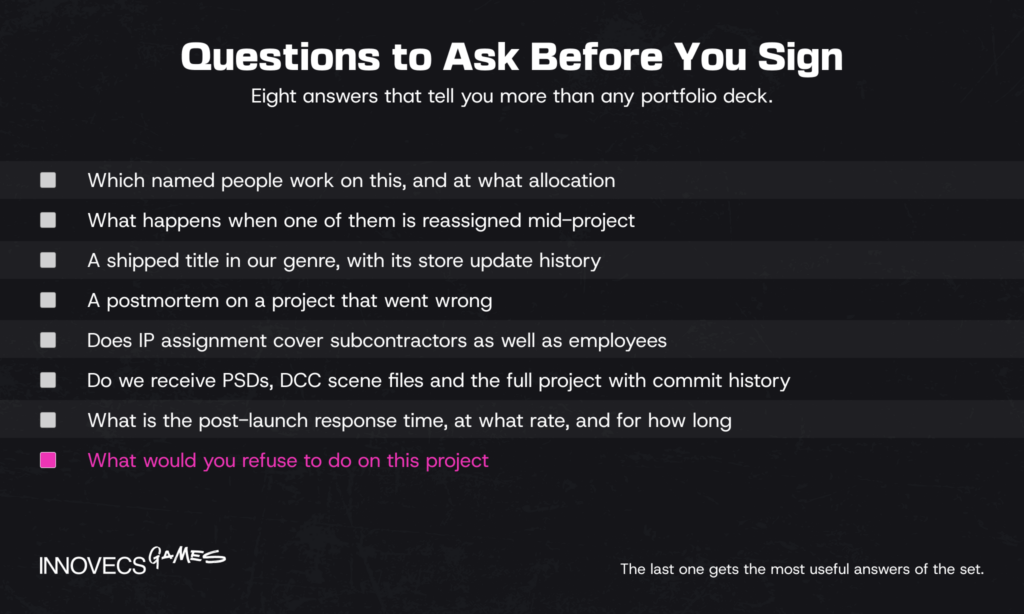
Ask which named people will work on your project, at what allocation, and what happens when one of them is reassigned. Ask for a shipped title in your genre and its update history, plus a postmortem on a project that went wrong. Confirm IP assignment covers subcontractors, and that you receive source files including PSDs, DCC scene files, and the full Unity project with commit history, not built packages. Get the post-launch support terms in writing with a response time and a rate, and confirm that the people named on the project are the people who will answer that ticket rather than a rotating support pool who have never opened your codebase. Finally, ask what they would refuse to do on your project, because a studio that says yes to everything hasn’t read your brief closely. That last question gets the most useful answers of the set.
How is AI changing mobile game development in 2026?
AI has compressed pre-production sharply and left production and polish largely intact. Concept exploration, code scaffolding, and first-pass level layouts now take hours instead of days, so a studio can test four ideas where it used to test one. Automated QA handles regression and device-matrix passes efficiently, and live-ops personalization tunes offers and difficulty per cohort, which together take real hours out of the two phases that historically consumed the most junior labor. Industry sentiment stays skeptical, as the survey data in the AI section above shows, and artists are the least convinced group of all. The practical read for a buyer is that AI changes how fast a studio can explore options, not how good its judgment is about which option to ship.
Can AI replace a game development team?
No, and the studios claiming otherwise are usually selling the claim rather than the result. AI generates assets, code scaffolding, test cases, and level variations at a speed no human matches, and that removes a real share of production labor from a schedule, particularly in the phases where a studio used to staff up with junior artists and testers. What it doesn’t do is decide whether a mechanic feels good on the fourth replay. It can’t hold a coherent art direction across two thousand assets, or diagnose why retention drops on day three. Those are the decisions that determine whether a game earns anything, and they still sit with a game designer, an art director, and a producer. Expect team composition to shift toward senior judgment and away from volume production. Not to disappear.
Ready to Work With a Verified Mobile Game Development Team? Let’s Talk
If you need a top mobile game development company rather than a vendor list, the conversation starts with the gap. A port, an art pipeline, a live-ops team, or a full build with a date on it. Tell us the scope and the deadline, and we’ll come back with a team composition, a timeline, and an honest read on what’s achievable in the window. Contact the Innovecs Games team to scope it.