RPG Game Development: A Practical Guide to Stages, Mechanics, Engines, and Teams
A producer’s notes on getting from “we’re making an RPG” to the day-one patch without paying for the same year twice.
Ask producers why a big RPG went wrong and you’ll mostly hear about money, or about people. It’s the most common belief in RPG game development. Dragon Age: The Veilguard makes a good test of it. BioWare made it, EA paid for it, and then EA reported that it had engaged about 1.5 million players in its launch quarter. That’s roughly half of what the publisher had expected.
Bloomberg’s reporting, summarized by ScreenHub, points somewhere less comfortable. Veilguard began as a single-player RPG, got turned into a live-service project, and was then turned back; the team ended up with about a year and a half to finish, and never went back to pre-production. Three months later Warhorse shipped Kingdom Come: Deliverance II, on a script the studio puts at more than 2.2 million words. Two million copies went in under two weeks. By June 2026 it had passed six million. Cash and talent don’t explain that gap. A design that kept moving after production started does. In an RPG that’s about the most expensive thing that can happen, since the systems all lean on each other and a progression call made in month three is still sending invoices in month forty.
So how do RPGs actually get made, and in what order? Sub-genre comes first here, since it sets more of the budget than anyone admits. Then the mechanics worth locking early, the stages with one quest in hand, and finally engines, people, money and the AI question that comes up in every first meeting.
What Makes a Game an RPG?
Take the dragons out. What’s left, if it’s an RPG, is a character who changes because of what the player did, in a world that notices. Four pillars hold that up:
- A character the player grows. Stats, levels, skills, gear: whatever makes hour forty feel different from hour one.
- Choices that stick. A build, a dialogue option, a quest outcome the game is still remembering twenty hours later.
- A world worth exploring. Factions and places with secrets in them, and a reason to wander off the road to the credits.
- A story the player shapes. Even a linear JRPG hands over the party, the build and the order of side content.
Remove one and you can still have a great game. It just isn’t an RPG anymore, and genre purists will be along shortly to explain why: loot without choices is an action game with bigger numbers, and branching dialogue without progression is a narrative adventure.
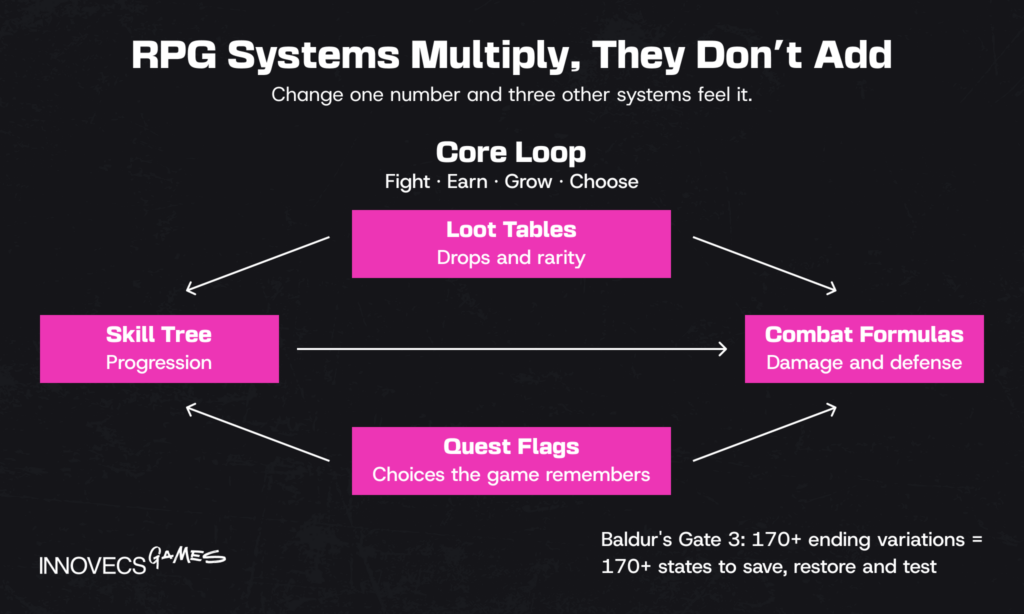
Those four are also why role-playing games sit near the top of any list of system-heavy projects. Each pillar is its own system. Put them together and they don’t add up, they multiply: the skill tree talks to the combat formulas, loot tables feed into both, and quest flags decide which parts of all that the player ever gets to see. Baldur’s Gate 3 ships with more than 170 ending variations. Each one is a state the save system has to restore and QA has to reach.
Players pay well for that complexity. GameDiscoverCo’s June 2025 breakdown of all-time Steam revenue, counting games that grossed more than $1 million, puts RPGs at 17.11%, second only to action. Within the genre, action RPGs account for about $3.89 billion in lifetime revenue, MMORPGs $3.69 billion and CRPGs $2.69 billion. Put the three side by side and they share a label. On the production side they share very little else.
Sub-Genres and How They Shape Scope
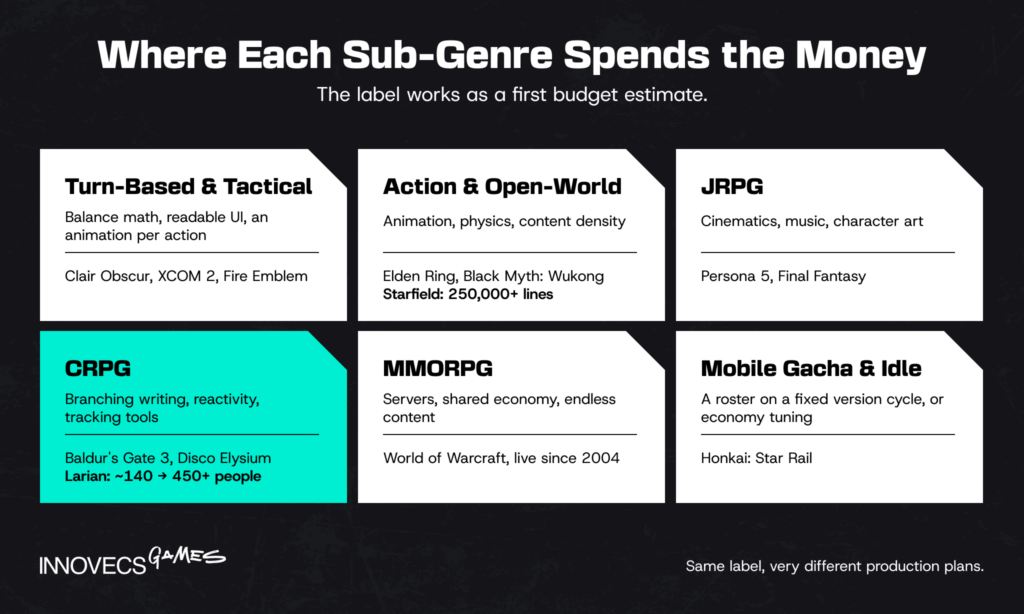
Sub-genre sounds like a marketing word. We treat it as the first rough budget. Say “CRPG” at a kickoff and you’ve already decided who you’ll be hiring for three years, how much writing one hour of play burns, and which specialist you’ll be begging for by month eighteen.
Turn-Based and Tactical
Turn-based games give the player time to think, so each number on screen has to survive being thought about. Right now the reference point is Sandfall Interactive’s Clair Obscur: Expedition 33, a turn-based RPG with real-time dodges and parries inspired by Sekiro. At The Game Awards 2025 it walked off with nine trophies, a record, and one of them was Game of the Year. Put the fight on a grid, XCOM 2 style or Fire Emblem style, and suddenly you’re paying for positioning and line of sight. You’re also paying for an enemy AI that can’t look stupid even once, since the player has all the time in the world to notice. The money goes into balance math, readable UI and an animation for every action, not into world size. We’d call turn-based the most underrated scope decision of the last few years: it swaps part of the motion-capture budget for a spreadsheet, and a spreadsheet is a lot cheaper to fix in month thirty.
Action and Open-World
Here the budget moves to animation, physics and content density. Elden Ring would be a much smaller story if its hits didn’t land the way they do, and Black Myth: Wukong is in the same position. On games like these, enemy tells and the camera get adjusted almost one frame at a time. An open world makes the content bill bigger again. Players can walk in any direction they like, and wherever they end up, they expect the walk to pay. Often the payment is a chest or a bandit camp. Sometimes it’s just a question mark on the map. Players clear every last one of them with real dedication, then go online and call it filler. Volume in this corner of the genre gets silly: a year before Starfield shipped, Todd Howard was already talking about more than 250,000 lines of dialogue. Skyrim, for scale, got by with roughly 60,000, and Fallout 4 with about 111,000. Streaming, level of detail and performance on a large map also need senior engineers early, and not in the last six months.
JRPGs and CRPGs
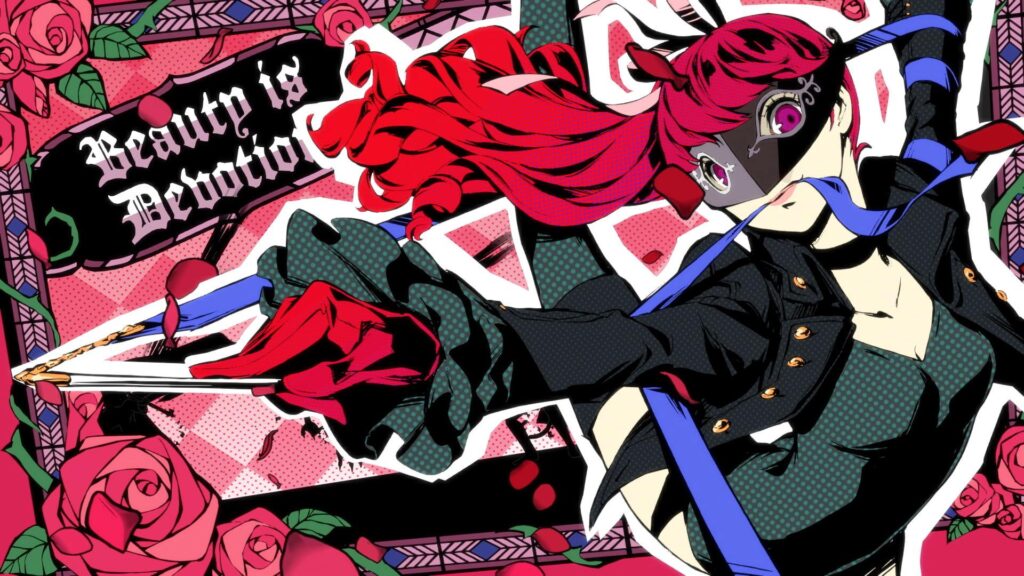
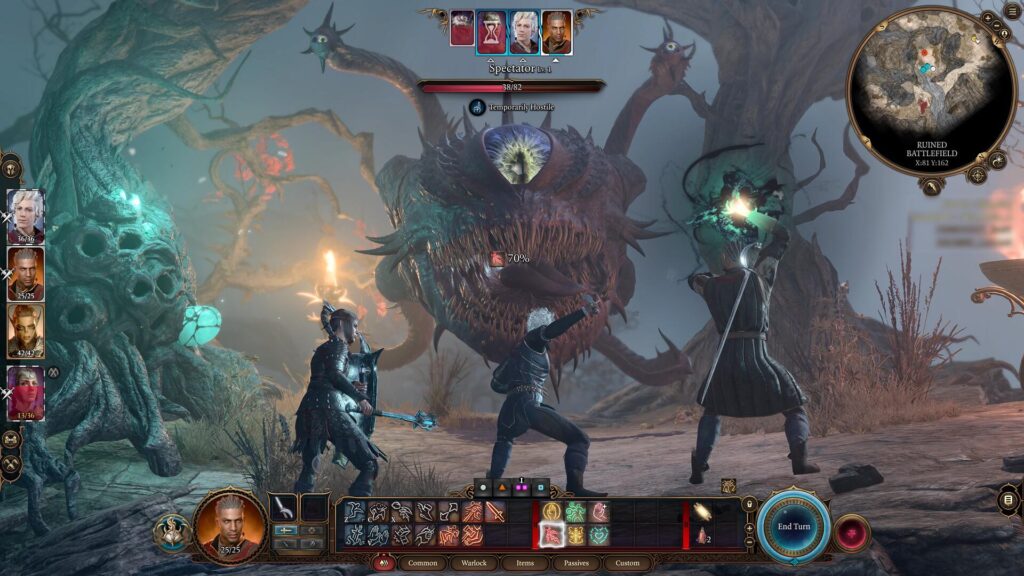
Both lean hard on dialogue. They just spend the words in different places. Persona 5 and the Final Fantasy games keep a tight grip on the story. The party is fixed, the big moments are staged, and the money shows up where you’d expect: cutscenes, a soundtrack people buy separately, character art fit for a poster. Baldur’s Gate 3, Pillars of Eternity and Disco Elysium let go of the story. The player drives, and the studio pays for every road he might take, plus the tooling that remembers which one he did. Larian had about 140 people in 2017. By 2023, with Baldur’s Gate 3 out the door, it had more than 450. Reactivity is the most expensive word in the genre. Each “the game remembered what I did” post on Reddit is a flag somebody wrote, tested and kept alive through years of patches.
Online and Multiplayer Worlds
MMORPGs need everything above plus servers, a shared economy and a content schedule that never ends. World of Warcraft? Live since 2004, and two decades on its team has never once been finished. Bots and real-money traders start testing the economy in week one, which is why server architecture, anti-cheat and economy design count as design inputs here rather than launch-week problems. An online RPG is really a service that happens to have a launch date, and the staffing plan should admit that on day one.
Mobile RPGs: Gacha, Idle, and Hybrid Models
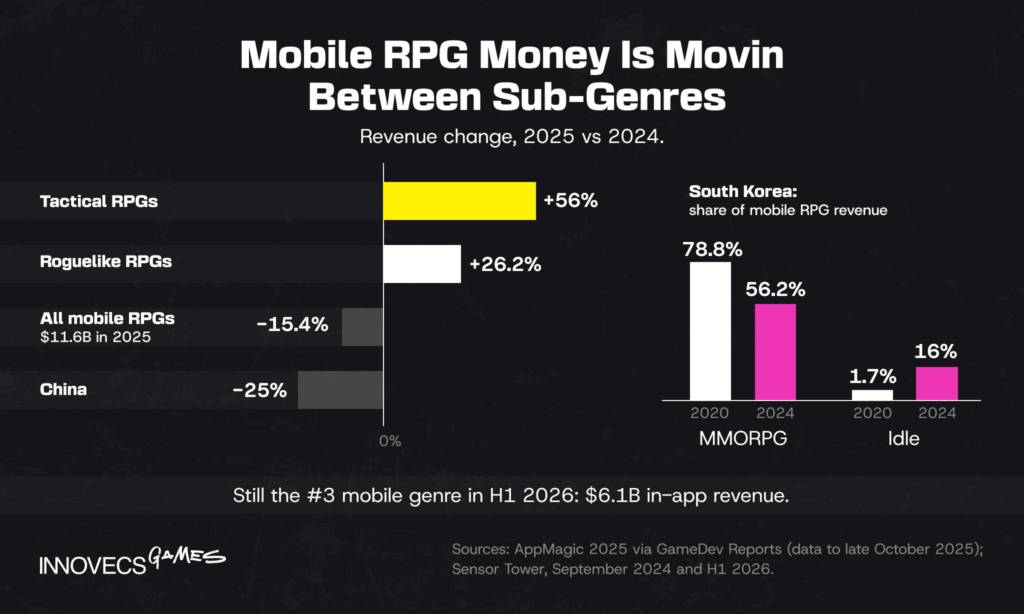
Mobile RPGs are a different business from everything above, and lately a harder one to grow in. Take AppMagic’s 2025 monetization report, summarized by GameDev Reports: RPG revenue on the App Store and Google Play fell 15.4% year on year to $11.6 billion in 2025, on data running to late October. China dropped 25%. Tactical RPGs grew 56% over the same period, roguelike RPGs 26.2%. Nobody should read that as a dying genre. Sensor Tower’s H1 2026 index still puts RPG third among mobile genres, at $6.1 billion in in-app revenue for the half year, with only strategy and puzzle ahead of it. The money is moving between sub-genres, and fast. South Korea saw this coming first. In 2020, MMORPGs took 78.8% of the country’s mobile RPG revenue. By 2024 they were down to 56.2%, and idle RPGs, which had sat at 1.7%, were up at 16% (Sensor Tower data, published September 2024).
On mobile, the business model ends up steering production harder than the story ever will. In a gacha RPG, the roster is the content pipeline. A new character means a model, animations, a combat kit, voice lines in several languages and balance against everyone already in the game, and it all has to land on a fixed version cycle that players learn to expect almost to the day. Gacha players, incidentally, are the most diligent economists in games. Give them a week after a new banner and somebody will have reverse-engineered your drop rates and put them on a fan wiki, with charts. Pricing has shifted toward cheap entry points: in the same AppMagic report, a $4.99 bundle in Honkai: Star Rail drew 13% of purchases and 3% of monthly revenue. Idle RPGs flip the equation, with lighter content and heavier economy tuning, since the progression curve is most of the game.
Two constraints apply to all of them. Loot boxes are regulated in more markets every year, and South Korea has required odds on the purchase screen since March 22, 2024, with 266 games found in violation in the first months, about 60% of them foreign. Design drop tables so they can be published from day one. The other constraint is hardware. Picture a 3D gacha RPG adding a character every few weeks, each of whom has to hold the frame rate on the cheapest phone in your analytics. The per-character technical art budget belongs in pre-production; discovering it the month before soft launch is how soft launches slip.
Core RPG Mechanics to Design First
Whatever the sub-genre, the same five systems carry the game, and no team has the time to design all of them well at once, so the order matters. Our general take on game mechanics applies here with one addition: in an RPG, no system is finished until you’ve watched it interact with the others. Good RPG game design starts with the loop the player runs hundreds of times. Fight, earn, grow, choose. Anything else either feeds that loop or decorates it, and it helps to know which before somebody builds it.
Character Creation and Progression
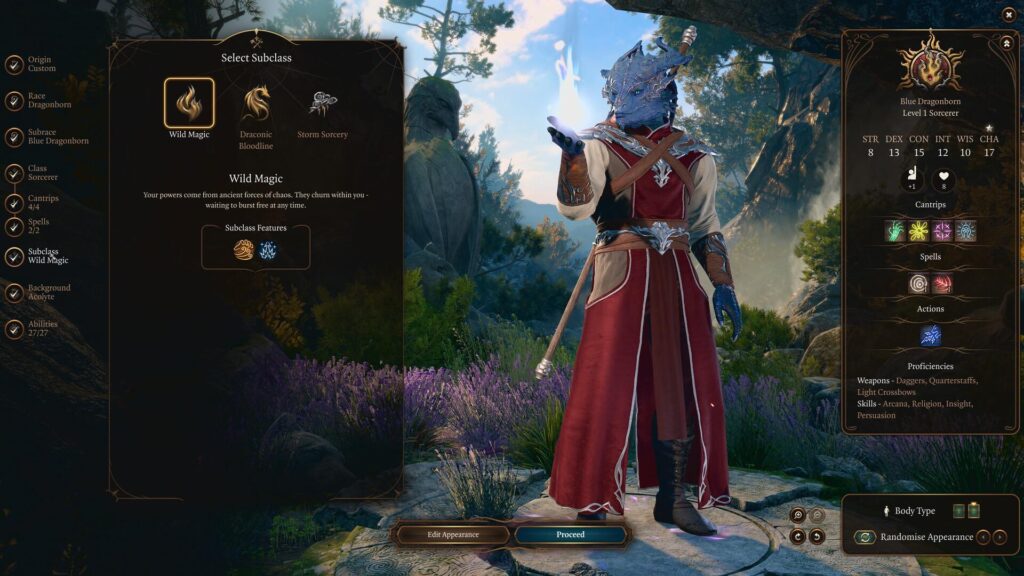
Progression is the promise that time spent pays off, and players read it more closely than any other system. Some of the decisions here are structural and come early. Classes, or classless? Levels, or skill-based growth? How steep does the XP curve get, and can players respec? Borrowing a ruleset saves years. Larian built Baldur’s Gate 3 on Dungeons & Dragons 5th Edition and got tested classes out of the deal, plus a rulebook players could quote back at every deviation. Borrowed rules come with borrowed rules lawyers. They will find the one page where you bent the book. Plot the curve in a spreadsheet before anyone builds it: game balance problems in progression compound, and a small edge at level three has a habit of becoming a broken build by level twelve. Character creation sits at the front of all this, writing promises the rest of the game then has to keep. Offer eight backgrounds and players will expect every one of them to matter somewhere.
Combat Systems
Combat gets prototyped first and rebuilt most, for the plain reason that players spend most of their hours in it. The core decision is time. Turn-based, real-time, or a hybrid in the style of Clair Obscur, with turns and real-time parries? After that come damage formulas, status effects, enemy roles and an encounter budget per area. Combat touches everything else: progression sets its numbers, loot changes its options, and quest design decides where fights happen and how often. The classic trap is tuning against developer builds. Real players will find the one ability that trivializes the final boss within a weekend. They always do.
Quests and Branching Narrative
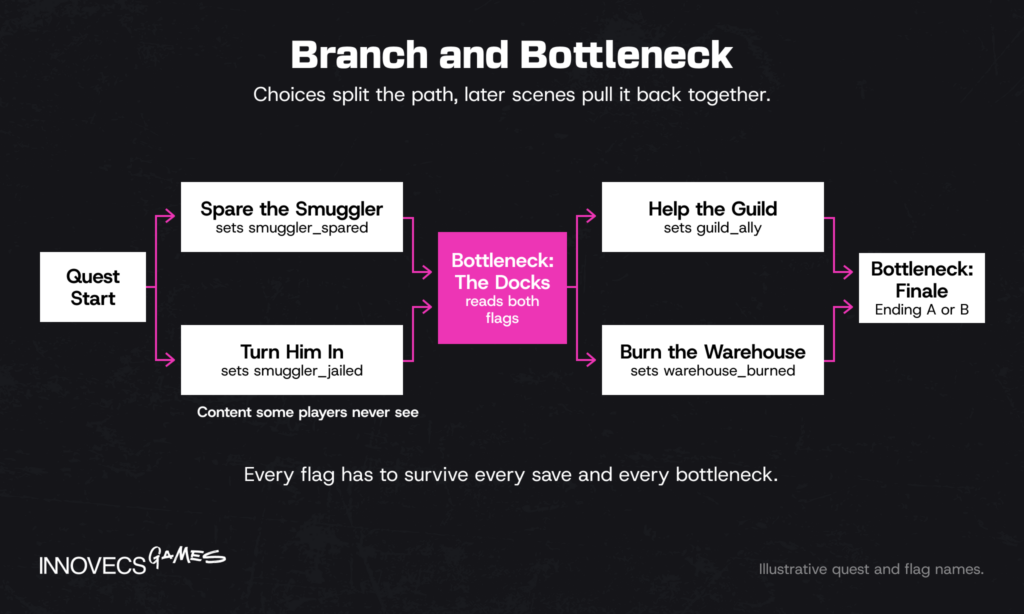
Players praise branching louder than any other feature. Producers lose sleep over it, for a simple reason: you pay full price for scenes most buyers will never see. The usual compromise is branch-and-bottleneck. Paths split on a choice and meet again a few scenes later, and the game carries the memory of what happened in between. Under the hood, that’s bookkeeping. Each choice sets a flag, and flags open or close lines of dialogue, sometimes whole quests. Give quest designers a tool that shows what a scene depends on, or they’ll learn it from the bug tracker one ticket at a time. Then there’s the word count. Nobody writes 2.2 million words, as Warhorse did for Kingdom Come: Deliverance II, without editing, voice direction and localization growing to match.
Inventory, Loot, and In-Game Economy
Loot is a reward schedule wearing armor. Drop rates and rarity live in the loot tables. Crafting is how a pile of surplus becomes a choice. What any of it is worth is the economy’s problem, and the economy needs drains: repair bills, crafting fees, a vendor at level thirty who still stocks something you’d actually spend gold on. Skip the drains and gold piles up faster than the game can soak it up, until opening a late-game treasure chest is a formality. Blizzard learned this in public. It shut down Diablo III’s real-money auction house in March 2014, having concluded that buying gear undermined the core loop, which was finding it. Inventory UI needs early attention too. Ask anyone who’s played a PC port on a gamepad. A grid designed for a mouse is miserable on a controller.
Dialogue and NPC Interaction
RPG mechanics and writing share custody of dialogue, and the handover isn’t always friendly. A persuasion roll is a number. So is a companion’s approval, and so is your standing with the guard captain. Disco Elysium went further than anyone, turning its skills into voices that argue with the player, in a game with almost no combat to speak of. The concrete decisions? Voiced or text-only. How many companions react to a given scene. Whether the innkeeper in act three remembers what you did in act one. Each “yes” multiplies the writing and voice budget. Put it in the pre-production estimate, where it hurts early, rather than in a column labeled “nice to have,” where it hurts later. If money forces the choice, we’d keep the writing and cut the voice. Players forgive a silent protagonist far more readily than a voiced one who sounds as if the script was finished on the morning of the session.
The RPG Development Process, Stage by Stage
The general game development process has five stages, and RPGs pass through the same ones with very different weight on each. Working out how to make an RPG game, as opposed to a shooter or a puzzle game? Expect pre-production to run longer. Production will be dominated by content more than by features, and testing has to cover far more states than levels.
| Stage | Goal | Main deliverables | Where RPGs usually go wrong |
|---|---|---|---|
| Concept and pre-production | Decide what the game is and isn’t | Pillars, audience, systems list, scope, risk register | Scope that grows with every meeting |
| GDD and vertical slice | Prove the systems work together | A living design document, one finished slice of each core system | A slice that shows the art and skips the hard systems |
| Full production | Build the content | Quests, areas, dialogue, items, tools, localization-ready text | A content pipeline that can’t keep up with the writing |
| Testing, balancing, polish | Make every path work and feel fair | Balance passes, bug fixing, performance, certification | State bugs found only after content lock |
| Launch and post-launch | Ship and keep the game healthy | Release builds, patches, DLC or live ops | No team or budget planned past launch day |
Look at the last column again. Nearly all of it gets decided in the first two rows, months before anyone files a bug.
Concept and Pre-Production
What you want out of pre-production is a short list of decisions that won’t change. Sub-genre, camera, combat model. One hero or a party, voiced or not, which platforms, and roughly how many hours of content. Those answers size everything after them, so this is the cheapest moment to stop scope creep and, annoyingly, the most tempting moment to let it in. BioWare had been here before. Kotaku’s account of Mass Effect: Andromeda describes procedurally generated planets explored from 2012 until the leads gave up on them at the end of 2015, a plan that shrank from hundreds of worlds to seven hand-made ones, and the bulk of the game built in its last 18 months. Nobody budgets for that. Our rule of thumb: an idea that can’t survive a one-page pitch won’t survive four years of production.
Game Design Document and Vertical Slice
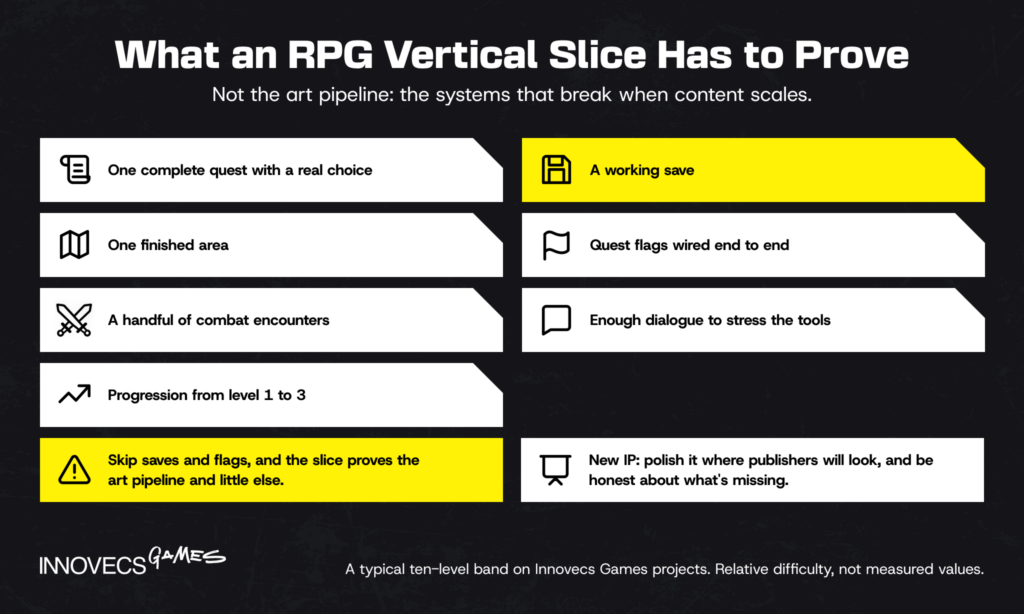
The game design document is where the decisions get written down. The vertical slice is where they get proved. For an RPG we’d want the slice to hold one complete quest with a real choice in it, one area, a handful of fights, levels one to three, a save that works, and enough dialogue to stress the tools. Building a beautiful slice that skips the save system and quest flags is tempting. Don’t. Saves and flags are exactly what breaks once content scales, and a slice that dodges them proves the art pipeline and not much more. With a new IP the slice has a second job. It’s the build a publisher or greenlight committee actually plays, so polish it where they’ll look, and be honest about what isn’t there yet. Warhorse found out how much rides on that first impression. Publishers turned the studio down, so in 2014 it took the first Kingdom Come: Deliverance to Kickstarter, asked for £300,000 and raised £1.1 million from 35,384 backers.
Full Production: Systems, Content, and World-Building
Somewhere in production an RPG stops being a design problem and becomes logistics. The systems are mostly locked by now. Writers are filling the world, along with the quest, level and environment people. If something’s slowing you down at this point, bet on the content pipeline before you blame the code. In RPG development the tools set the pace. If writers hate the dialogue editor, you get fewer lines. If the quest editor hides dependencies, you get more bugs. And if adding a sword means filing a ticket with a programmer, you get fewer swords. Lore bibles and naming rules feel like paperwork right up to the week you find one village spelled three ways by three teams. Localization gets planned here as well. Once a script runs to hundreds of thousands of words, each language eats months, so build the string tables in now; bolting them on later is the expensive version, and we’ve watched teams pick it anyway.
Some work never ends up in a screenshot. Memory budgets are the classic case, along with streaming, load times and the slow swelling of the save file. That debt grows with every region and every companion. The bill usually arrives at certification, which is the worst possible week for it: fixes are at their priciest and the engineers who could make them are buried. Our advice is boring, and it works. Schedule a technical art and performance pass at every milestone, including the ones where the build runs fine on a dev PC. It usually does.
From Outline to Shipped Quest
Most of an RPG’s production is one loop run a few hundred times: a quest taken from a line in a spreadsheet to something a player can finish, break and reload. Between a CRPG and an action RPG the steps hardly change. The headcount on each one does, and so does the price of going back a step.
| Step | What gets made | Usually owned by | What breaks if it’s skipped |
|---|---|---|---|
| 1. Outline | Goal, beats, rewards, and the flags the quest reads and sets | Quest designer, narrative lead | Rewards that don’t fit the economy; flags nobody else knows exist |
| 2. Blockout | Greybox space, NPC placement, a playable path with placeholder text | Level and quest designers | Dialogue written for a space that later changes shape |
| 3. First-draft writing | Dialogue in the dialogue tool, branch conditions, barks | Writers | Lines that can’t be implemented without a rewrite |
| 4. Implementation | Scripting, flags wired to dialogue and journal, encounter setup | Technical designers, gameplay programmers | A quest that only works in the order its designer played it |
| 5. Performance | Voice recording, motion capture, cinematics | Voice director, animators, cinematic designers | Lines that can’t change without a second studio session |
| 6. Path testing | Every branch, failure and reload checked against saves | QA | State bugs that surface after content lock |
None of this is glamorous. Ask a quest designer what ate last month and the answer is rarely the writing; it’s step four, and specifically finding out why the blacksmith still thinks the player is dead. Step five is where the order stops being negotiable. All 248 actors in Baldur’s Gate 3, NPCs included, put on a motion-capture suit, its performance director said in a thread reported by PC Gamer, and every line recorded that way is expensive to change afterwards. So writing locks before performance, never the other way round, and the lock date goes into the schedule in the first month, not the last.
Testing, Balancing, and Polish
An RPG’s test surface isn’t its levels. It’s every reachable combination of quest flags, companions, builds and save points. Good RPG testers grow a particular kind of suspicion. Whether the quest works is the boring question; theirs is what happens if you kill the quest-giver first. More players do that than you’d think. Automated checks catch crashes and broken scripts, but rare, important paths still need a human to play them. Balance needs real players as well, and early access is one way to get them: Baldur’s Gate 3 had about 2.5 million early access players, whose feedback reshaped classes, the UI and the companions, to the point that Halsin became a full companion because people liked him. Our guide to game testing covers QA planning in depth; for RPGs, the short version is to start full-path testing during production instead of after content lock.
Launch and Post-Launch Support
RPG players will wait a long time for a studio that keeps fixing things. They get loud, and quickly, with one that stops. Plan a stabilization period of patches first; DLC, expansions or live ops come after, and which of those depends on the business model you picked back in pre-production. Final Fantasy XIV is the extreme case. It launched in 2010 in such poor shape that Square Enix shut it down. In 2013 it came back as A Realm Reborn, a near-total rebuild under Naoki Yoshida, and went on to become the publisher’s biggest success. Square Enix could afford to rebuild a failed launch. Most publishers would have closed it quietly. Staff the post-launch period before launch day, and we’d go further: publish the first patch roadmap with the launch announcement. RPG players read a roadmap the way investors read guidance, and silence gets the least generous reading available.
Choosing a Game Engine: Unity, Unreal, Godot, and More
Yes, the engine comes after the stages in this article. In a real project it doesn’t. The call belongs to pre-production and should be settled before the vertical slice, because the slice is the first build that proves it. There’s no best RPG game engine, only a best fit for a given scope, art style, platform list and team. We’d only build a custom one if the engine has a business case of its own for the next decade, the way Divinity does for Larian. For everyone else it’s a second product nobody asked to buy. Look at the most successful RPGs and they don’t even agree with each other. Larian runs its own Divinity Engine. Warhorse built Kingdom Come on CryEngine. CD Projekt Red made three games on REDengine and then switched to Unreal Engine 5 for The Witcher 4. That bet now has more than 500 developers on it and a 2028 date pencilled in. Engine debates tend to be about the renderer. In RPG game development, though, whatever you inherit for dialogue, quests and saves will move your schedule more, and some engines give you close to nothing there. For the two largest options compared head to head, see our Unity vs Unreal breakdown.
| Engine | Best fit | Language | Strengths for RPGs | Trade-offs | RPGs built with it |
|---|---|---|---|---|---|
| Unity | 2D, stylized 3D, mobile and cross-platform | C# | Fast iteration, large asset store, strong mobile support | Large open worlds need custom streaming work | Pillars of Eternity, Disco Elysium, Genshin Impact, Sea of Stars |
| Unreal Engine 5 | High-fidelity 3D, console and PC | C++, Blueprints | Rendering, animation and open-world tools out of the box | Heavier builds, more performance work, 5% royalty on lifetime gross above $1M (Epic Games Store sales exempt) | Clair Obscur: Expedition 33, Black Myth: Wukong, The Witcher 4 (in development) |
| Godot | Small teams, 2D and lighter 3D | GDScript, C# | Free, MIT license, full source access | Consoles only through third-party porters, smaller talent pool | Cassette Beasts |
| RPG Maker | Solo projects, classic 2D | JavaScript plug-ins (MV, MZ) | Battles, maps and events already built | A look that’s hard to escape, little room for 3D or custom systems | To the Moon, Omori |
Read the last column as due diligence. A shipped game in your sub-genre proves the engine has already survived your hardest system once, whether that’s branching dialogue, a streamed open world or a party of five on a phone.
Unity
Unity is the practical default for 2D, stylized 3D, and anything with mobile on the platform list. Its RPG record runs wider than people tend to assume. Obsidian’s Pillars of Eternity is built on it; so are ZA/UM’s Disco Elysium and miHoYo’s Genshin Impact. The “mobile engine” label is mostly a reputation problem, since none of those three is anybody’s idea of a hyper-casual game. For anyone looking into how to make an RPG in Unity, the usual stack is C# gameplay code, ScriptableObjects for items and stats, a dialogue tool such as Ink or Yarn Spinner, and a custom save layer, because no engine’s default saving suits branching state. Big open worlds are possible, though the streaming work is yours to do.
Unreal Engine
Unreal Engine 5 is built for high-fidelity 3D, console-first projects and open worlds, and its rendering, animation and world-partition tools would take a studio years to make in-house. Game Science shipped Black Myth: Wukong on it. With Blueprints, designers can script encounters and quest logic without queuing for a programmer. In a genre where content outruns engineering by year two, that matters more than any rendering feature. The costs: heavier builds, more optimization for lower-end hardware, and Epic’s 5% royalty on lifetime gross revenue above $1 million. For realistic, cinematic RPGs, it’s where most of the industry has gone. Hiring follows.
Godot and Other Open-Source Engines
Godot is free under the MIT license and comes with full source access, which matters when an unusual system means bending the engine. Its community will tell you it can do anything, and it mostly can, as long as “anything” doesn’t arrive in a box marked PlayStation. Bytten Studio, a two-person team, built the monster-collecting RPG Cassette Beasts in it, partly because Godot let them write editor tools quickly for a game that had to feel dense with content. The Switch and Xbox versions went through a porting partner, Pineapple Works. That’s the standard route: Godot’s console builds come from closed third-party ports rather than from the engine itself, so a console plan needs a porter in the budget from the start.
RPG Maker and No-Code Tools
Open RPG Maker for the first time and most of the boring parts are already there, battles and menus included. A solo developer gets those months back for the story. To the Moon came out of it. So did Omori, and nobody talks about either one’s tech. Try 3D, or combat the defaults weren’t made for, and you’ll hit the walls quickly; a team that needs real version control hits them sooner still. For a studio it’s a prototyping and pitching tool. For a first solo project, it’s honestly hard to beat.
Key Roles on the Development Team
The engine decides which tools a team inherits. Whether anyone uses them well is down to the team. The disciplines are the usual ones. The proportions are odd. You’ll want more writers than you think, more systems design and extra QA for every hour of content, and you’ll want tools programmers, a job plenty of studios in other genres never post at all. Headcount also swings by stage, so the team in pre-production and the team in month thirty can look like two different studios.
Designers and Narrative Writers
Game designers own the loop. The numbers underneath it (XP curves, loot tables, the economy) belong to systems designers. Writers and narrative designers have the story. In an RPG they also need to be in the room when systems get decided, since a quest reward that wrecks the economy is a narrative bug and a balance bug on the same ticket. Disco Elysium is a nice example. It was written in articy:draft, and Cash DeCuir, who wrote for the game and directed its voice work, suggests a small trick: tag any memorable moment with a Boolean, so a scene hours later can call back to it. Writing habit or systems decision? Both. Level and quest designers turn all of it into playable space. Most genres can get by with one designer covering several of these jobs; an RPG with real choice usually can’t. In our experience the most expensive person on an RPG project is the systems designer nobody hired, because the job still gets done, just by five people in five different spreadsheets.
Programmers and Technical Specialists
Gameplay programmers build combat, AI and abilities. Engine and tools programmers build the editors every content team leans on. In an RPG the tools team is the multiplier. Larian extended its own Divinity Engine with cinematic tooling for Baldur’s Gate 3, and that’s how one studio got to more than 140 hours of cutscenes. Writers rarely thank the tools programmer in public. They probably should: the quest editor decides how many quests make it into the game at all. Specialists matter more than headcount here. Think save systems, UI frameworks for dense menus, open-world streaming, console certification. Many of them are needed for months, not years.
Artists and Animators
Concept artists, 2D and 3D artists and technical artists set the world’s look and animators make combat readable, all against asset lists that run unusually long in RPGs: armor sets, weapons, creatures, NPC variety, and a UI icon for every item in the game. When Larian revealed its next project in December 2025, it had 72 artists on staff, 23 of them concept artists, which gives a sense of what a CRPG at that level takes. Players will forgive a lot, but not finding the same sword they picked up four hours ago with a different number on it. Character art deserves its own process, and our guide on how to design video game characters walks through it.
Audio, QA, and Production
Audio sets the mood long before anyone notices it’s there. Past a few hundred thousand words of script, though, voice direction stops being a line item and becomes a small studio of its own, with casting, booking and retakes. QA on an RPG means walking paths, not levels. You’ll staff more testers per hour of content than a shooter would, and most of their week goes on loading saves to see whether the world still remembers. Holding all of it together falls to the producer: scope, dates, vendors, and the list of things that won’t ship. Their least popular and most important job is deciding which side quest doesn’t make it. Somebody has to. Obsidian had 18 months to make Fallout: New Vegas, and director Josh Sawyer has said that other ideas had to go so the team could concentrate on quests and story. Sixteen years later, it’s still the game people reach for when they talk about reactivity.
Core Team and External Partners
Outside help goes wrong most quietly on RPGs. The damage lands in data, not on screen. Your writers name a quest flag one way and a partner’s writers name it another; an item slips past the economy model; a companion gets a line in a voice she doesn’t have. None of it shows up in a weekly demo. All of it shows up in the bug tracker three months later.
So the line we’d draw runs through the canon, not through job titles. Four documents hold the truth about your game: the lore bible, the systems spreadsheet, the quest-flag map, the art bible. If someone can edit them, they’re making the game, so keep the pen with your game director, your lead systems designer, your narrative lead and your art director. Anything built against those documents can safely go outside. That covers environment and prop art, armor sets with their icons, animation and mocap cleanup, cinematics and VFX, plus technical art, porting, certification QA and localization. You’ll need most of it in bursts, around a vertical slice review or a cert window. Hire for it full-time and you’re paying people to wait for the next burst.
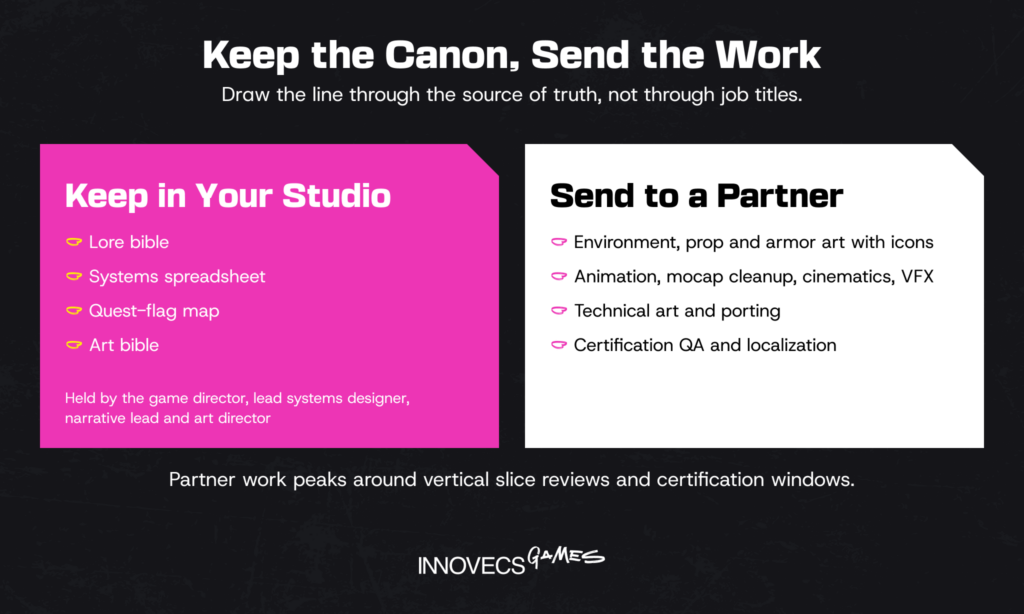
Three things make the handover hold. A test set built from one of your existing regions, say one armor set with its icon and an in-game shot under your lighting, before any volume is ordered. Naming and flag conventions, handed over on day one: one invented flag name from an outside writer is enough to break save compatibility, and nothing in the build will complain. And a named owner on your side for every boundary the partner touches. Without one, questions pile up on a lead who’s also trying to build the game, and they sit there for a week. The cost is real: an embedded team with its own lead bills above a group of freelancers, and your leads answer more questions in the first month, not fewer. It earns that back in the last year of an RPG’s production, when the content list is long, the dates are fixed and every week of a senior artist’s time is already spoken for.
How Long It Takes and What Drives the Budget
Team shape multiplied by calendar is most of an RPG budget, so this section follows straight from the last one. Treat it as a snapshot for self-qualification, not an estimate. For detailed numbers, see our articles on how long it takes to make a video game and the cost to make a video game.
Typical Timelines by Project Scope
| Scope | Typical team | Typical timeline | Public example |
|---|---|---|---|
| Small indie | 1 to 5 people | 2 to 4 years | Cassette Beasts: two people, announced in 2020, released April 2023. Undertale: Kickstarter in June 2013, released September 2015 |
| Mid-size | 20 to 60 core, plus partners | 3 to 5 years | Clair Obscur: Expedition 33: side project in 2019, studio founded in 2020, released April 2025 |
| AAA-scale | 150 to 500+ | 4 to 7 years | Baldur’s Gate 3: about six years, with the studio growing from roughly 140 to 450+ people |
Cassette Beasts was first shown in 2020 and Undertale’s Kickstarter ran in 2013, so even the smallest rows above took years, not months. The table also assumes a project that keeps its direction. Change the core concept midway, as Veilguard and Andromeda both did, and the clock restarts for each system that depended on it, which is a polite way of saying the team pays for the same years twice.
The Biggest Cost Drivers
Six things move an RPG budget more than anything else:
- Content volume. Hours of play, quests, areas and words of script. Starfield’s quarter-million lines show where open-world ambition leads.
- Voice acting. Full voice multiplies cost by each language and each rewrite. By Swen Vincke’s 2024 estimate, Baldur’s Gate 3 holds 1.3 million lines and over 140 hours of cutscenes.
- Number of systems. Each one adds design, code, UI, balance and testing, and the interactions between systems cost more than the systems themselves.
- Platforms. Every console adds performance work, certification and controller-friendly layouts for dense inventory and dialogue screens.
- Live ops. Online RPGs need a permanent team for servers, events, economy tuning and player support.
- Art fidelity. Realistic 3D needs more people per asset than stylized 2D, and RPGs need a great many assets.
Teams underestimate the first two more than the rest, and for a structural reason: writers and designers decide them long before anyone prices them.
Not Sure How Big Your Project Should Be? Let’s Talk
If your concept sits between two rows of that table, a scope review usually settles it faster than another planning meeting. Send us the pitch, the platforms and the systems list, and we’ll go through what each choice costs in time and people.
Common Mistakes That Derail Role-Playing Game Projects
None of these is exotic, and most start in year one. They act less like accidents than like habits; the postmortems we’ve read usually list three or four of them together:
- Oversized scope for a first project. Open world, full voice and sixty hours of content is a portfolio, not a first RPG.
- Systems designed in isolation. Different people tune combat, progression and loot with no shared model, and all three end up balanced against nothing.
- Balancing left too late. Balance gets baked into content. Wait until there are four hundred items, and every tweak to a damage formula means revisiting all of them.
- Treating the script as a fixed size. Each word gets paid for several times over: written, edited, recorded, then translated into every language you ship. The script always grows.
- No early save-system plan. A save has to restore every flag, inventory slot and companion state, and retrofitting that is among the worst jobs in production. Cyberpunk 2077 shipped on PC with an 8 MB cap on save files, and players who went past it could lose the save until a hotfix removed the limit in December 2020.
- Testing only at the end. Branching bugs found after content lock are the most expensive kind, because fixing them often means rewriting content.
How AI Is Changing RPG Production
Two of those mistakes, balancing late and testing late, are exactly where AI tools now help most. AI touches more of an RPG pipeline than most genres, because RPGs have more of what it’s good at drafting: text, items, variations. Adoption is already broad. Sulka Haro’s census of Steam releases counted about 9,400 games carrying an AI disclosure by mid-2026, roughly one in three new launches.
Procedural content and quest generation. Back in 2011, Skyrim’s Radiant system was already sending players off to clear yet another bandit cave. The idea is old. Newer tools draft quest variants, item descriptions and side content faster than ever. Good enough for filler. Useless the moment a quest has to mean something. Players spot repetition quickly. Use it to pad around authored quests, not to stand in for them. Get it wrong and reviewers notice within days. They’ll post screenshots of the cave.
AI-assisted dialogue and NPC behavior. Everstone Studio’s Where Winds Meet, published by NetEase, launched globally in November 2025 with chatbot NPCs that hand out small side quests, and reached 100 million players worldwide by August 2026. Within weeks players found that repeating an NPC’s own line back to it, or typing an invented action in brackets, could talk the bot into marking a quest complete. One player handed over an imaginary cat. The NPC took it. That’s the deal with open-ended dialogue: a feature and an exploit in one package. You test it the way you’d test any other system players will try to break.
AI coding assistants, automated QA and balance testing. Coding assistants speed up tool code, test scaffolding and the data plumbing RPGs are full of. Pair bots that play builds with simulations of thousands of combat encounters and you can catch a dominant build or a broken drop rate before a tester does. Whether that outlier is a bug or the most fun part of the game is still a designer’s call.
AI in art pipelines. This is where player trust is most fragile. In December 2025 Larian’s CEO said the studio had used generative AI to explore ideas, flesh out presentations, rough out early concept references and write placeholder text. Players pushed back hard, and by January 2026 Larian had ruled out generative tools in concept art for its next game. Disclosure used to be something marketing worried about at launch. Now it has to be settled while you plan production.
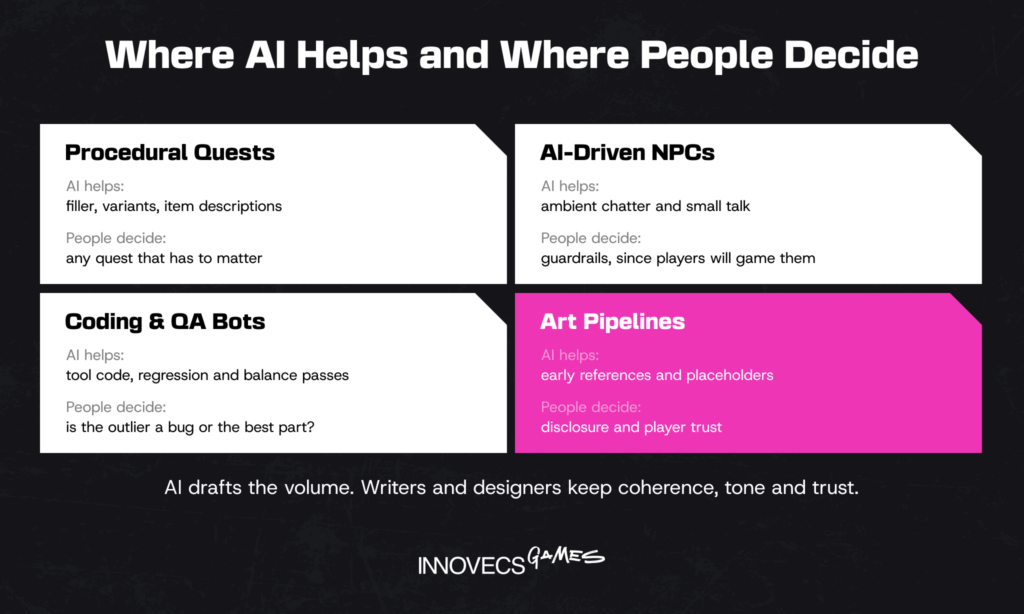
Where we’d actually use AI is the volume work a person checks afterwards. First drafts, variants, test passes. Narrative coherence, tone and player trust stay with writers and designers, and an RPG lives on all three. We’d use it to shorten the road to a playable build and keep it away from anything a player might quote back at you. The wider picture is in our piece on AI in game development.
FAQ
What does RPG game development involve?
At its core, building a game around a character who grows, choices with consequences, a world worth wandering and a story the player bends. Under the hood it’s five systems tangled together: progression, combat, loot, quests, dialogue. Then comes the content to fill them, more than any schedule seems to allow, and a test plan with more game states in it than anyone wants to count. Most teams go concept, design document, vertical slice, production, testing, launch, and then keep going after launch.
How do you make an RPG game?
Start small, then a bit smaller. Pick a sub-genre and a core loop, and do the uncomfortable sum of how many hours of content your money actually buys; it’s usually fewer than the pitch promised. Prototype combat and progression before anything else gets built. After that comes a vertical slice with one complete quest, a save system and real dialogue, then production, testing and launch, with balance work running throughout rather than at the end.
What is the best game engine for RPG games?
Nobody can name one without asking about your project first, since scope, art style and platforms decide it and the genre hardly comes into it. Going mobile or stylized, most teams land on Unity, while photoreal 3D on console usually ends up in Unreal Engine 5. Godot appeals to small teams who want the source, and RPG Maker still gets solo developers surprisingly far with classic 2D. Some large studios skip all four and run their own engine, as Larian does with Divinity Engine.
How long does it take to develop a role-playing game?
Two to four years, typically, for a small indie RPG. Mid-size projects run three to five, and AAA four to seven. Baldur’s Gate 3 took about six, with a team that grew past 450 people. Scope, voiced dialogue and the number of platforms move the timeline more than anything else.
What drives the cost of developing a role-playing game?
Content volume, multiplied by team size, multiplied by time: get those three right and you have most of the estimate. Everything else multiplies on top. Voice is the big one, since you pay for it again in every language, and that’s why so many studios record only the key scenes. Systems count, platforms, art fidelity and live ops each add their own slice.
Can a small team or a solo developer build an RPG?
Yes, if the scope is tight: Toby Fox went to Kickstarter for $5,000 to make Undertale and came back with roughly ten times that. Cassette Beasts? Two people, in Godot. The small-team RPGs that make it pick a 2D or stylized art style, keep the systems few, and lean on writing so good that nobody asks where the other forty hours went.
How do mobile RPGs make money?
Mostly through in-app purchases: gacha banners for characters and gear, battle passes, and bundles, with low-priced starter offers now doing much of the work of converting players into payers. Some idle RPGs add rewarded ads on top. Whatever the mix, drop rates must be disclosed in a growing number of markets, so the economy has to be designed to be published.
What is the difference between turn-based and action combat?
Turn-based hands the player a pause before every move, and he’ll spend it reading your numbers (they’d better hold up) and noticing when every enemy plays the same. Action combat waits for nobody; it’s animation, timing and how fast the controls answer. The line’s blurry these days. Clair Obscur takes turns but makes you parry in real time, and many action RPGs let you freeze the fight and queue orders.
Which gameplay systems should be prototyped first?
Combat and progression, since the player does those more than anything else and every other system feeds into them. After that, one quest with a real choice and the save system that has to remember it. Inventory, crafting and the economy can live in spreadsheets for a while. Just run simulations on them before content production starts, not after.
🤖 How can AI tools speed up RPG production?
By eating the repetitive stuff. Boilerplate and tool code go to coding assistants, and bots can grind through regression and balance passes overnight. Generative tools are decent at first-draft item descriptions and barks, provided a writer rewrites them. The final words, the art direction and the quest design stay human, and players have started checking.
🤖 Will AI-driven NPCs replace hand-written dialogue?
Not for anything the story depends on. For background chatter and small talk, generative NPCs can work. Over a long playthrough they drift, though, and Where Winds Meet showed how quickly players figure out how to game them. What we expect is a split: people write the quests and the characters, and AI fills the crowd.
Ready to Take Your RPG From Concept to Launch?
Maybe you’re still at the pitch, or maybe you’re mid-production with a backlog that keeps growing. Either way, our RPG game development specialists can join your pipeline through game co-development on systems, tools, art or QA. Tell us where things stand and we’ll come back with a next step.