How to Build a LiveOps Strategy for Games That Keeps Players Coming Back
Cadence, KPIs, monetization balance, team models and real 2026 costs, for studios that have to run the game long after it ships.
On September 21, Bungie promised to put back content it had deleted from Destiny 2, admitting that removing it “had a lasting impact on player trust.” The same studio had watched Marathon fall from 88,337 players on Steam to about 2,600 by July. Take-Two, meanwhile, was taking 84% of its net bookings from recurrent consumer spending, money that only exists because a game keeps running. Same industry, same kind of product, opposite results, and the difference was what happened after launch. That’s why a LiveOps strategy for games now gets drafted before the first milestone, not after the launch trailer.
The pressure comes from where players already spend their time. Newzoo’s 2026 PC and Console report found that new releases have taken only 12% to 13% of total playtime for three years running, and that the PC top five, led by Roblox, Counter-Strike 2 and League of Legends, hasn’t changed since 2023. So a new release isn’t really competing with other new releases. It’s competing with games that have shipped an event every week for years.
Studios know this, and that’s the uncomfortable part. On the revenue side, publishers keep leaning harder into live games. On the production side, many of the same companies have spent two years cutting staff, and the people left are asked to hold a weekly cadence with fewer hands than they had at launch. Our honest read on the last two years: the industry decided live games were the safe bet at the exact moment it let go of the people who run them.
This guide covers the four pillars a live game rests on and a step-by-step way to build them. It then looks at how the work shifts between mobile, console and PC, which KPIs deserve a place on the dashboard, what it all costs in 2026, and when to keep the team in-house or bring in a partner.
What Is LiveOps and Why It Defines a Game’s Long-Term Success
LiveOps, short for live operations, is everything a studio does to run a game after launch: in-game events, seasonal content, balance changes, offers, community management, and the analytics that decide which of those to do next. A patch fixes the game. Live operations change what the game is this week. If the games as a service model describes how a title earns over years, LiveOps is the team and the tooling that keep it earning on a Tuesday afternoon.
The money now sits almost entirely on this side of launch. EA reported that live services made up about 74% of its net revenue in the quarter ending June 30, 2026, carried by EA Sports FC, Apex Legends and Battlefield 6 content. On mobile, Scopely’s Monopoly GO passed $6 billion in lifetime in-app purchases about 21 months after launch, faster than any mobile game before it. The publisher credits “event-driven live operations at scale” as one of the reasons.
Worth saying before the rest of this article: LiveOps multiplies demand, it doesn’t create it. Concord was shut down two weeks after launch with around 800 concurrent players on Steam, and no event calendar would have saved it. Our view, after watching a lot of post-launch roadmaps meet real players, is that operations can turn a decent game into a ten-year business, but they can’t turn a game nobody wants into one people do.
The Core Pillars of a LiveOps Strategy
Concord is the extreme case. Most live games that stall have a working core loop and a broken operation behind it. Four pillars carry that operation, and they tend to fail in pairs rather than one at a time. A double-XP weekend is a cadence decision, but it also pours currency into the economy, and if telemetry only tracks sessions, the dashboard reports a great weekend while prices quietly inflate. A strong event calendar on top of a broken economy just delivers players to the broken part faster. Players mostly see the first pillar. The other three decide whether it still works by season two.
Content and Event Cadence
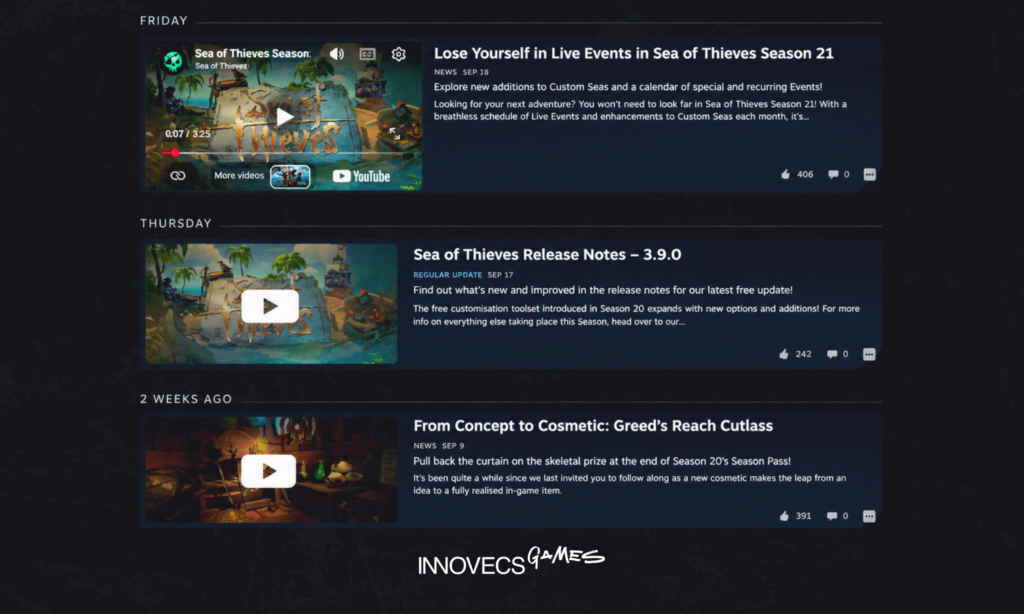
Cadence is the rhythm players learn to expect, and it usually runs on four layers. Daily quests and login rewards sit at the bottom, then weekly in-game events or tournaments, then seasonal events and battle pass cycles of six to twelve weeks, and finally one or two annual tentpoles such as an anniversary or a holiday arc. Monopoly GO runs several overlapping events and tournaments on most days, and its community sites publish the schedule like a TV guide. A cadence is a promise, though. Once players learn there’s something new every Thursday, a missing Thursday reads as a sign the game is dying. We’d rather see a studio commit to a monthly event it can keep than a weekly one it drops in month four.
Player Segmentation and Personalization
Not every player should see the same game. Useful segments cut three ways: by lifecycle (new, engaged, lapsing, returning), by spend (non-payer, occasional, high value), and by play style (competitive, collector, social). Epic’s Fortnite OG event on November 4, 2023 is the textbook returning-player play. It restored the 2018 map, an invitation aimed squarely at players who’d drifted away, and pulled 44.7 million people into the game in a single day. Spend segments matter more than they look: in Bain’s August 2026 gaming report, the top-spending 20% of players generated roughly 75% of revenue. Personalization follows from segments, meaning offers, difficulty and push notifications tuned to the group. Among Bain’s repeat direct buyers, 84% said a personalized offer would make them more likely to purchase, while raising a generic discount from 10% to 30% barely moved them. The trap is slicing too fine. A segment of 300 players produces noise, not insight. The other trap is segmenting by what’s easy to measure instead of by what changes behavior. Country is easy to measure. Country is rarely the reason somebody stopped playing.
Live Economy and Monetization Balance
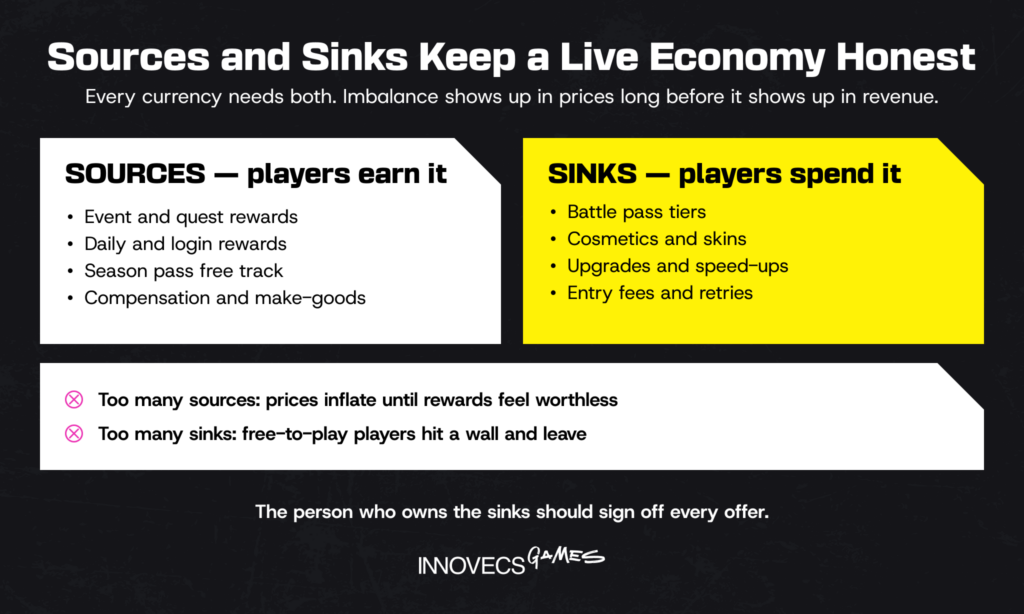
Every currency in a live economy needs sources (where players earn it) and sinks (where they spend it). Too many sources and prices inflate until rewards feel worthless. Too many sinks and free-to-play players hit a wall and leave. Battle passes, limited-time offers, cosmetics and in-app purchases all sit on top of that economy, and hybrid monetization adds rewarded ads to the mix on mobile. We cover pricing mechanics in our guide to game monetization strategies. Here the point is structural: monetization balancing is an economy design job, not a store merchandising job, and the person who owns the currency sinks should also sign off every offer. Players will forgive a dull event. They will not forgive working out that last month’s reward is now worthless.
Telemetry and Data-Driven Decisions
Telemetry is the event data the game sends back: sessions, purchases, level attempts, event participation, crashes. It is only useful if the taxonomy is agreed before launch, because “tutorial_step_complete” and “TutorialDone” logged by two different programmers will split one funnel into two for the life of the game. Nobody notices until the first event review. On top of that sits an analytics dashboard, remote config so balance values and event dates can change without a client build, and backend infrastructure sized for event-day spikes instead of average load. Every studio has one dashboard nobody opens and one spreadsheet everybody trusts; the job is making those the same thing. If the plumbing underneath is the weak part, that is usually a job for game engineering services rather than for the LiveOps team itself.
Ready to Extend Your Game’s Lifecycle? Let’s Talk
Most live ops setups we’re asked to look at have one pillar noticeably weaker than the other three. Share which one it is in yours and when the next season is due, and we’ll suggest a team shape that covers it.
How to Build a LiveOps Strategy Step by Step
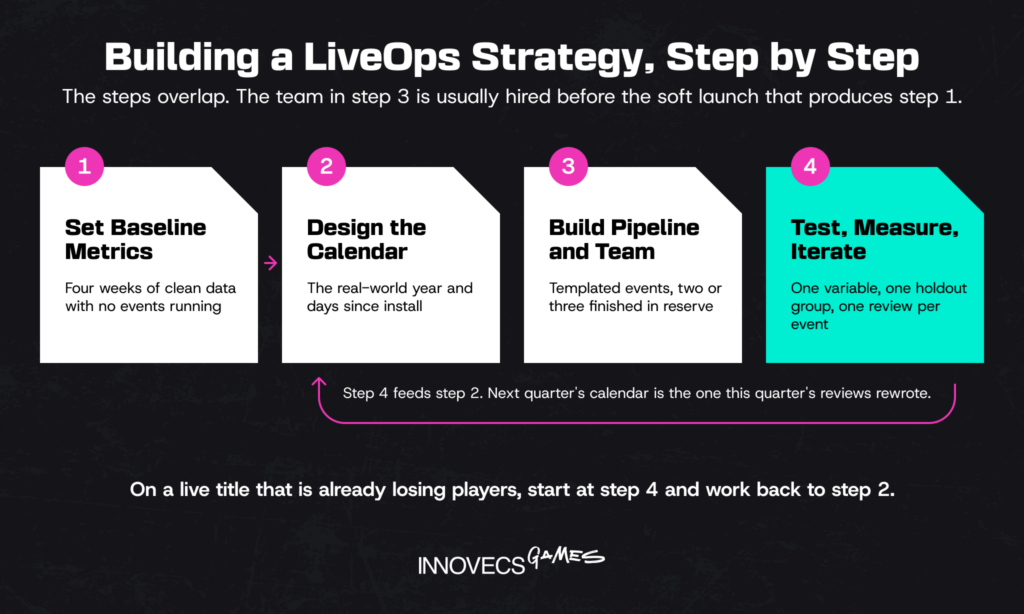
Knowing the pillars doesn’t tell you what to do first on Monday. Most teams build a LiveOps strategy for games in roughly the order below, though the steps overlap more than a numbered list suggests: the team in step three is usually hired during alpha, before the soft launch that produces step one’s baselines. On a live title that’s already losing players, the order flips. Start at step four with what the data already says, then work back to the calendar.
Set Your Baseline Metrics Before Launch
A soft launch in two or three markets exists to answer one question: what does normal look like? Keep it boring. Record D1, D7 and D30 retention, conversion rate, ARPDAU and session length for at least four weeks with no events running, because an event can only be judged against a baseline without one. Decide in advance which number would make you cancel or redesign an event. Studios that skip this end up judging events by how busy the Discord felt, which is a mood, not a metric.
Design Your Event Calendar Around Player Lifecycle
The calendar that works is built twice: once around the real-world year (holidays, sports seasons, school breaks) and once around the player’s own clock, meaning days since install. The second one is the calendar most teams forget.
| Lifecycle stage | Days since install | What the event should do | KPI it should move |
|---|---|---|---|
| New | 1 to 7 | Teach one system at a time, reward early wins | D1 and D7 retention |
| Settling in | 8 to 30 | First social or competitive event, first soft offer | D30 retention, first purchase |
| Engaged | 30+ | Seasons, battle pass, collections, guild events | ARPDAU, session frequency |
| Lapsing or lapsed | 14+ days inactive | Catch-up rewards, “what’s new” event, returner pack | Reactivation rate, churn rate |
Plenty of calendars are really marketing calendars with a game attached: Halloween, Black Friday, Lunar New Year, and nothing at all for the player who installed on a Tuesday. The bottom row is where most of them have nothing. A lapsed player is cheaper to win back than a new one is to buy, and that is before you count the friends list they bring back with them.
Build the Content Pipeline and Team Structure
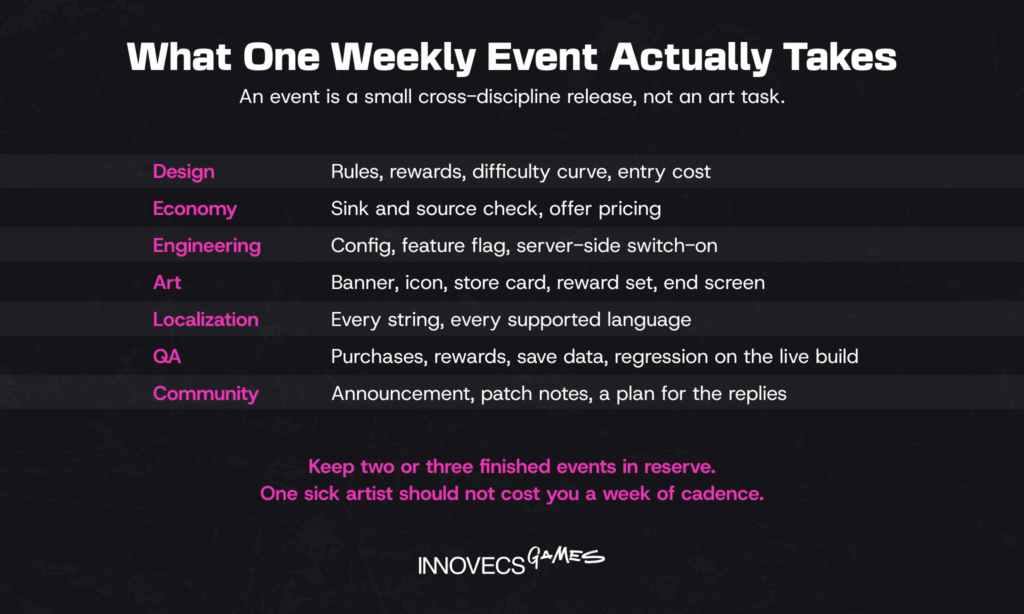
The content pipeline has to run deeper than the calendar. Keep two or three finished events in reserve, because one failed build or one sick artist will otherwise take out a week of cadence. The fastest pipelines use event templates, so a new event is configuration plus art rather than new code. A minimum LiveOps team usually includes a LiveOps producer, an economy or systems designer, a data analyst, client and backend engineers, artists, QA for live games, and community management. On small titles one person wears two of those hats. The economy and producer roles are the ones not to split across too many people, since they hold the game’s memory of what worked and what didn’t. QA deserves its own line in the budget: every event build needs regression on purchases, rewards and save data, and our overview of game testing services covers how that differs from pre-launch testing.
Event Art and House Style
Art is the part of an event that scales with the calendar, and the part that fails quietly. A single weekly event usually needs a banner, an icon, a store card, a reward set and a localized end screen, which is why the studios that hold a weekly cadence template the art before they template the code. Two things decide whether outside help works here. The first is that matching a house style is a different job from authoring one. It replaces an artist’s latitude with a pass-or-fail test set by your art director, and what shortens it is a style guide built from production files, your naming and export spec and your atlas budget. A screenshot and the word “similar” is the most expensive brief you can send. The second is variants. If you A/B test offers, someone has to produce three versions of the same card at final quality on the same day. That work is repetitive, it burns your senior artists first, and it is the easiest part of LiveOps to hand to a partner once the guide exists. Seasonal key art also gets reused in store listings and UA creatives, so it’s the cheapest asset in the pipeline to plan for and the most expensive to redo.
Test, Measure, and Iterate
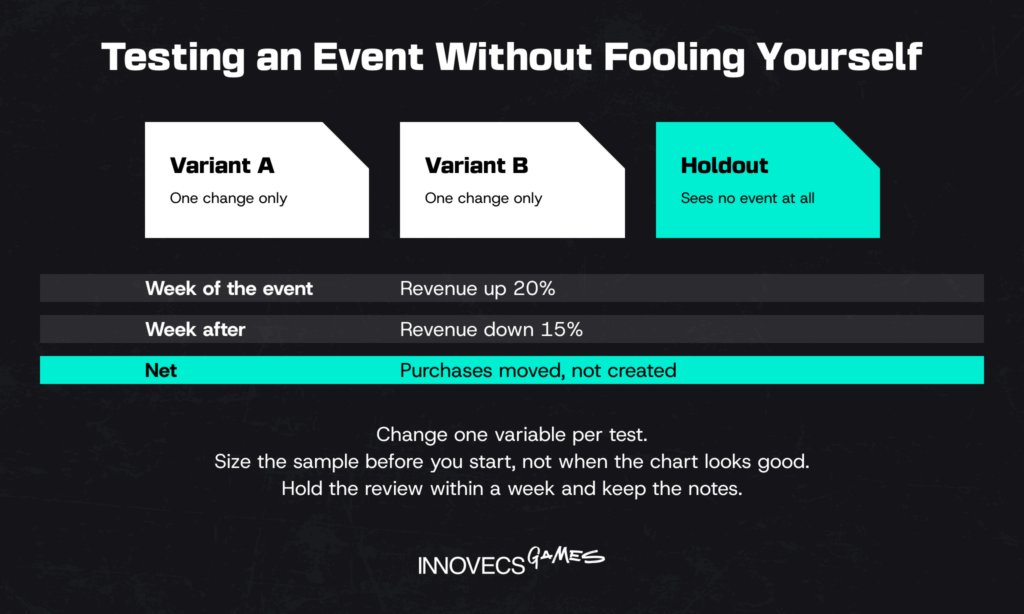
A/B testing is how a live game learns, and it only works with discipline. Change one variable per test, keep a holdout group that sees no change at all, and size the sample before starting rather than stopping when the chart looks good. Then check the week after. Watch for cannibalization: an event that lifts revenue by 20% in its week and drops it 15% the week after mostly moved purchases around. Hold a short post-event review within a week of every event and keep the notes in one place. The team that remembers why the spring event flopped won’t run it again next spring.
LiveOps by Platform: Mobile vs Console vs PC
The same event plan behaves differently on each platform, because each one has a different gatekeeper between your team and the player.
| Mobile | Console | PC | |
|---|---|---|---|
| Typical cadence | Daily and weekly events, seasons of 4 to 8 weeks | Seasons of roughly 2 to 3 months, fewer mid-season drops | Weekly to monthly, patching whenever needed |
| Update gate | App store review, avoided with remote config | Platform holder certification for client patches | Almost none on Steam |
| Main re-engagement channel | Push notifications, App Store in-app events | Platform storefront, social media | Steam news, Discord, creators |
| Where it goes wrong | Offer and notification fatigue | Slow hotfixes, cross-platform currency rules | Review bombs, dataminers spoiling events |
Notice that the gate and the failure mode line up in every column. What slows you down on a platform is usually what hurts you when something breaks there.
Mobile LiveOps
Mobile runs the fastest cadence and has the most tools built for it. Apple’s in-app events let a game show up to 10 published events on its App Store page. Each can run for up to 31 days and be promoted up to 14 days ahead, under badges such as Challenge, Competition, Live Event and New Season. Apple also states that daily rewards and price promotions without new content are poor candidates, which is a fair summary of what players think of them too. Because store review sits between you and a client update, a mobile game LiveOps calendar runs almost entirely on remote config: the event ships inside the client weeks in advance and gets switched on from the server. Push notifications are the strongest re-engagement tool on the platform, and the easiest to wear out. The constraint nobody budgets for is weight. Every shipped-ahead event adds textures and audio to the build, and the mid-range Android devices that carry most installs in emerging markets feel it as a longer first download, more memory pressure and a hotter phone halfway through a session. Ship event assets as downloadable bundles, set a size budget per event, and test on the device tiers your analytics actually report.
Console LiveOps
Console live ops moves slower because client patches go through platform holder certification, so a fix that takes an hour on PC can take days to reach a PlayStation or Xbox player. That makes server-side config even more important here, and it pushes teams toward longer seasons with a mid-season update rather than weekly drops. Our position on season length: two months of content that lands on the date beats three months that slips, because a late season has already told players what the schedule is worth. Marvel Rivals shows how sensitive console audiences are to changes in the rules of a season: NetEase announced a mid-season rank reset in early 2025 and reversed it within hours after the backlash. Cross-platform play adds another layer, since platform rules often limit whether premium currency bought on one console can be spent on another, and that shapes how cross-progression and offers are designed. Two scheduling facts follow from certification. A season that ships new client content needs its submission slot booked into the calendar next to the marketing date, and every extra platform adds a build and a QA pass to the same week. Performance is the other console tax. Seasonal skins, effects and a crowded hub scene all have to stay inside a frame budget set by the weakest hardware you support. That is technical art work rather than art work, and studios that skip it pay for it in a patch two months later.
PC LiveOps
PC gives the team the most freedom and the loudest audience. Both show up fast. Steam updates ship with almost no gate, so hotfixes are fast and the patch notes get read line by line. The same openness cuts the other way. When Sony required PSN account linking for Helldivers 2 in May 2024, Steam reviews collapsed, the game was delisted in 177 countries without PSN support, and Sony dropped the requirement within days. PC players also datamine client builds, so a surprise event shipped in the client is rarely a surprise. A community that reads patch notes line by line will find your bug before QA does, then post it with timestamps. Keep event content locked server-side until the day, and staff community management for the week a big update lands, not the week after.
Key Metrics to Track: LiveOps KPIs That Matter
Platform also changes what a good number looks like. GameAnalytics’ 2026 benchmarks, drawn from 16,262 mobile and 3,582 PC games, put top-quartile day-one retention above 30% on mobile but only 15% to 16% on PC, where the median session runs 18 minutes. Compare your game with its own platform, never with a headline figure from someone else’s. The three groups below also depend on each other in one direction: retention sets the ceiling for engagement, and engagement sets the ceiling for monetization. That’s why a review that opens on revenue usually ends up arguing about the wrong problem.
Retention Metrics
Retention is the share of players who come back on a given day after install, and it’s the first number any LiveOps review should open with.
| Mobile retention | Median game | Top 25% | Top 1% |
|---|---|---|---|
| D1 | ~22% | 30%+ | 64% to 68% |
| D7 | under 4% | 6% to 7% | 25%+ |
| D30 | ~0.7% | ~1.7% | 13% to 15% |
Source: GameAnalytics 2026 Mobile & PC Gaming Benchmarks
The gap between the median and the top 1% at D30 is almost twentyfold. Day-30 numbers look alarming in a board deck right up until somebody puts the benchmark beside them, which is the one slide worth preparing before the meeting rather than during it. That’s the distance good live operations, and a good game underneath them, can cover. Track churn rate alongside, defined for your genre (seven days of inactivity for a casual game, fourteen or more for a mid-core one), and track reactivation of lapsed players separately, since returners behave differently from new installs.
Monetization Metrics
ARPU spreads revenue across every active player, ARPPU across payers only, and ARPDAU across daily actives, which makes it the best number for judging a single event. Conversion rate, the share of players who ever pay, tells you whether the store works at all. LTV pulls it together: roughly ARPDAU multiplied by the number of days an average player stays. Here’s the arithmetic on a mid-sized mobile title. At 200,000 DAU and an ARPDAU of $0.10, the game earns about $20,000 a day, or $600,000 a month. An event program that lifts ARPDAU by 5% is worth around $30,000 a month, and if it also adds two days to average player lifetime, the LTV gain compounds on every future install. That is the business case for a LiveOps team in one paragraph.
Engagement Metrics
DAU and MAU measure reach; the DAU/MAU ratio measures stickiness, and among PC titles the top 1% sit just under 40%. Session length and sessions per day show how the game fits into a player’s routine: top-quartile mobile games average about 5.2 minutes per session and more than five sessions a day. Add event participation rate, the share of DAU that touches the current event, because a strong event that only 10% of players ever open is a content problem, not a success.
Common LiveOps Mistakes and How to Avoid Them
Most live ops programs that stall do so for predictable reasons, and each one shows up in the metrics above before anyone names it: over-monetization as a conversion spike followed by a weaker D30, event fatigue as falling participation, content removal as churn among your oldest players, and missing baselines as the absence of anything to compare against. None of them comes from a lack of ideas.
Over-monetization. Overwatch 2 (renamed plain Overwatch in 2026) launched in 2022 with new heroes locked behind the battle pass, and in March 2024 Blizzard made new heroes free for everyone. Players who’d already paid to unlock earlier heroes got nothing back, which turned one design reversal into two news cycles. Sell speed, convenience and self-expression. Never sell power, and cap how many offers one player sees per session. Anything that smells of pay-to-win in a competitive mode will cost more in churn than it earns.
Event fatigue from poor cadence planning. Back-to-back grind events train players to treat the game as a job. Watch participation rate across consecutive events: a steady slide is fatigue, not a weak theme. Build rest weeks into the calendar, rotate event types (competitive, cooperative, collection, social), and keep no more than two events asking for the same resource at once.
Taking content away. Studios retire old content for sound reasons: install size, a test matrix that grows with every season, and systems the old campaigns were never built for. Players read it as losing something they paid for, which is the lesson Bungie spelled out at the top of this article. Rotate content out on a published schedule, say when it returns, and budget the rework to bring it back, since Bungie now faces updated lighting and rebuilt encounters before anything vaulted can ship again.
Launching without baseline analytics. A studio that turns on events in week one has no idea what the game does without them, so every event looks like a win. Agree on the telemetry taxonomy in pre-production, get dashboards working in soft launch, and run at least a month of clean data before the first event.
In-House LiveOps Team vs Outsourcing: Which Model Fits Your Studio
Look at those four mistakes again and they’re ownership failures more than skill gaps: someone usually had the data, and nobody had the authority to act on it. So the real question behind the model choice is which decisions stay with your people and which work you rent. Answering it is harder than it sounds, because experienced LiveOps people are harder to hire than the job listings suggest. In GDC’s 2025 survey, a third of AAA developers were working on a live service game, but only 13% of all respondents wanted one as their next project and 42% said they’d rather not. The people who know how to run a live service game are in demand and not always keen to do it again. Most studios end up with some mix of the three models below.
| In-house team | Outsourcing | Hybrid (co-development) | |
|---|---|---|---|
| Time to staff | 3 to 6 months per senior hire | 2 to 6 weeks | 2 to 6 weeks for the external part |
| Cost structure | Fixed salaries, benefits, office | Monthly retainer or per project | Core fixed, capacity variable |
| Owns player knowledge | Fully | Partly, depends on access | Core team holds it, partner builds with it |
| Flexibility for peaks | Low | High | High |
| Main risk | Slow to scale, burnout in peak seasons | Handover gaps, context loss | Needs clear ownership split |
Source: Innovecs Games delivery data, projects staffed 2023 to 2026
The hybrid column is what most of our clients land on after trying one of the other two. That’s partly self-interest talking, so weigh it accordingly, but the pattern is consistent.
When an In-House Team Makes Sense
Keep LiveOps in-house when the live game is your main revenue line, the cadence is steady, and you already have a data team. The roles that should stay internal almost regardless of size are the LiveOps producer and the economy designer, because they make the judgment calls that depend on years of player history. An in-house team is also the right call if your game has a strong community voice that players recognize, since that voice does not transfer to a vendor. The downside is speed: hiring senior LiveOps staff takes months, and a fixed team is either overloaded in holiday season or underused in February.
When Outsourcing Makes Sense
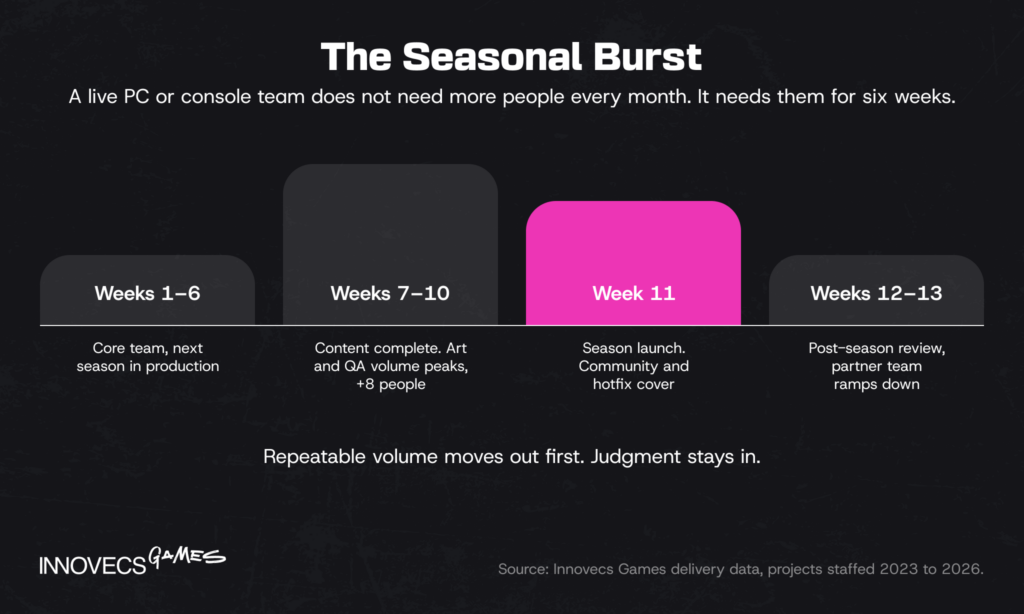
The work that travels well is the work that scales with volume: seasonal art, event implementation, building or rebuilding event tooling, QA on every live build, porting live content to a new platform, and coverage across time zones you don’t staff yourself. It’s also the fastest route when a publisher inherits a live title without the team that built it. On PC and console, the shape is usually seasonal. A team of forty carries a live title through the quarter, then needs eight more people for the six weeks around a season launch. Nobody hires for a burst that short. Leads at that size are hands-on in the build and mentoring at the same time, so the work worth moving out first is the repeatable volume, not the judgment. Game development outsourcing works best with a dedicated team that stays on the game for months and plugs into your tools, not a rotating bench. The honest weakness: an external team needs real access to your data and your post-event reviews, or it will produce technically correct events that miss the player.
How Much Does It Cost to Run LiveOps for a Game?
Whichever model you choose, three things set the bill: cadence, platform count and content type. A weekly event program needs roughly twice the content throughput of a monthly one. Each extra platform adds build management and certification QA, and a 3D seasonal skin line costs several times what a 2D event banner does. The ranges below are what studios spend with an external partner at Eastern European rates.
| Engagement | Team size | Typical cost | What it covers |
|---|---|---|---|
| Lean content pod (monthly retainer) | 4 to 6 people | $28K to $55K per month | Weekly events on one platform, 2D art, QA, part-time producer |
| Mid LiveOps team (monthly retainer) | 8 to 12 people | $60K to $120K per month | Seasons and battle pass, 2D and 3D art, client and backend engineering, analytics |
| Full live team (monthly retainer) | 15 to 25+ people | $120K to $250K+ per month | Multi-platform seasons, economy design, community support, 24/7 monitoring |
| Single event package (project) | 3 to 8 people | $15K to $40K per event | Design, art, implementation and QA for one event |
| Season content pack or battle pass (project) | 6 to 12 people | $40K to $110K per season | Pass structure, rewards, store assets, balancing, QA |
| LiveOps tooling setup (project) | 3 to 6 people | $40K to $150K one-off | Event framework, remote config, dashboards, A/B testing hooks |
Source: Innovecs Games delivery data, projects staffed 2023 to 2026
Platform moves the total more than people expect. Adding a console build to a PC live game typically adds 15% to 25% to monthly cost through certification QA and build management alone, before any extra content. Cadence is the other lever: dropping from weekly to biweekly events can cut content spend by a third, and if participation holds, players may not notice at all.
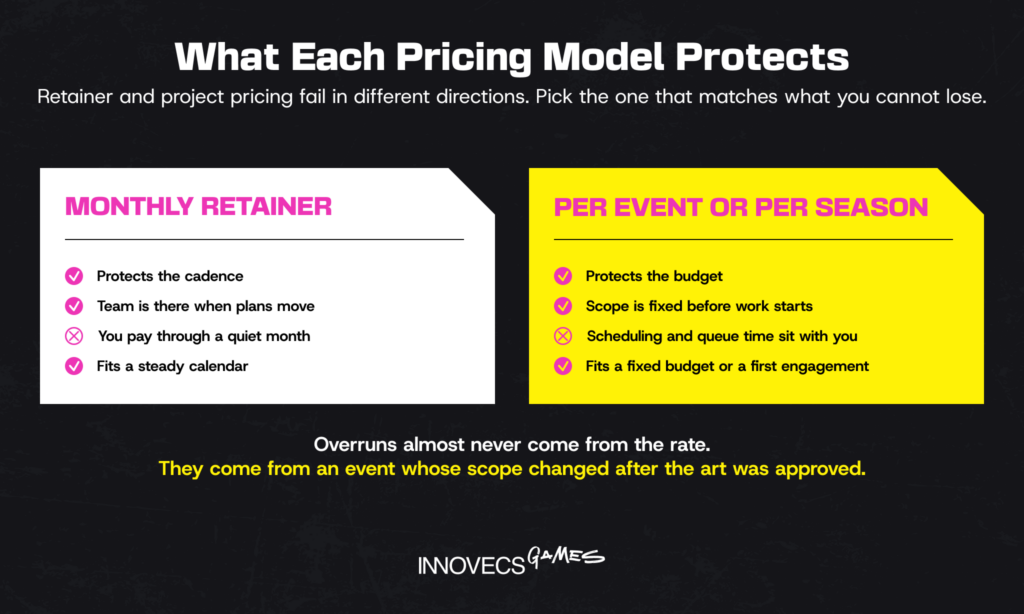
Pricing model matters as much as team size when the budget is fixed. A monthly retainer protects cadence, since the team is there whether or not the roadmap moved, while per-event and per-season pricing protects the budget and puts the scheduling risk on you. Overruns almost never come from the rate. They come from an event whose scope changed after the art was approved.
Go back to the $600,000-a-month mobile game from the metrics section. A mid LiveOps team at $80,000 a month needs to lift revenue by about 13% just to pay for itself. That is realistic for a game with no structured event program, and a stretch for one that already runs events well. Do that sum on your own numbers before choosing a team size.
How AI Is Changing LiveOps Strategy for Games
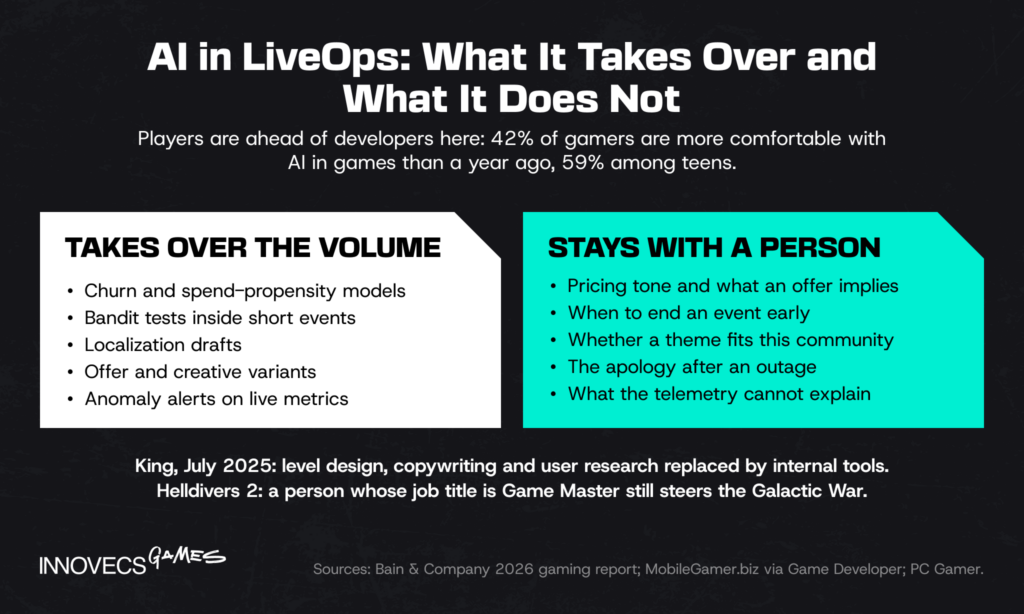
Players are warming to AI faster than developers are. Bain’s 2026 survey found 42% of gamers more comfortable with AI in games than a year earlier, rising to 59% among teenagers, while the developer mood in most industry surveys still runs negative. LiveOps is where that gap gets tested first, because it’s the part of the game players touch every week.
Player segmentation is where AI earns its keep most clearly. Churn prediction and spend-propensity models have been around for years. What’s new is that smaller teams can run them without a dedicated data scientist, and producers can query them in plain English instead of waiting for SQL. Automated A/B testing is the second win: multi-armed bandit tests shift traffic toward the winning variant while the test is still running, which suits short events where a classic two-week test would outlast the event itself.
Generative content is the contested part. In July 2025, King laid off around 200 people, and staff told MobileGamer.biz that level design, copywriting and user research teams were being replaced by internal AI tools they had helped build. Candy Crush has thousands of levels and a relentless release schedule, which is exactly the kind of volume where generated drafts make sense. It is also a reminder that the drafts still need someone who knows what a fun level feels like.
The counterexample is Helldivers 2, where Arrowhead has a human Game Master steering the Galactic War in real time. Players talk about “Joel” by name, and a good part of the game’s live appeal comes from knowing a person is making choices. Our read is that AI will take over most of the volume in LiveOps: variants, localization drafts, test allocation, anomaly alerts. The calls that shape how players feel about the game stay human, such as pricing tone, the apology after an outage, and when to end an event early.
For 2026 hiring, that changes what AI literacy means. A LiveOps analyst should be able to validate a model’s segment, not just read it. A producer should know when an automated test is underpowered, and an economy designer should treat AI-suggested prices as a first draft to argue with.
How Innovecs Games Supports Your LiveOps Strategy
Innovecs Games has delivered 300+ games over more than a decade, with 200+ developers and artists working across the US, UK, EU, Israel, Australia and Ukraine. For LiveOps game development, that usually means one of three shapes. A dedicated team takes over the recurring production on an existing title: event art, implementation and QA for live games. A burst team covers a holiday season or a platform launch and then ramps down on a date agreed at the start. A tooling team builds the event framework, remote config and dashboards that make the rest cheaper to run.
Through our game co-development services, the team works inside your Jira, Slack and build pipeline, with a dedicated project manager reporting on your cadence, so you’re adding capacity rather than managing another vendor. Engagements usually open small: one event package, priced as a project, delivered against your acceptance criteria, which tells both sides more than a proposal document does. If style matching is the worry, we produce a test asset against your existing references before a season is committed. Studios that already have a LiveOps team tend to use us as overflow next to it. Publishers running three or four vendors across their titles use us to consolidate, which mostly means fewer people to chase when an event build breaks on a Friday. If you’d like to see what we’ve shipped first, the portfolio is a good place to start. One thing we’d advise against, even though it would make our contract bigger: keep your economy designer and LiveOps producer in-house. We build the events; they should decide which ones run.
FAQ
What is a LiveOps strategy for games?
It’s the plan for running a game after launch, covering which events ship and when, how the economy and offers are balanced, which players get which content, and which metrics decide what happens next. A good strategy connects all four instead of treating them as separate teams. It also sets the cadence the studio can actually sustain, which matters more than the one it would like to promise.
How do you build an effective LiveOps strategy?
Start with baseline metrics from a soft launch, before any events run. Then build an event calendar around both the real-world year and each player’s days since install. Template the events so a new one is configuration and art rather than new code, and test changes one variable at a time against a holdout group. Review every event within a week and keep the notes, because that record is what makes the next season better.
What is the difference between LiveOps and a regular game update?
A regular update changes the game’s code, usually to fix bugs or add features, and on console or mobile it goes through platform review. LiveOps changes the experience players have without necessarily touching the client: an event switched on through remote config, a new offer, a rebalanced reward. Updates are periodic. LiveOps is continuous, and it is mostly run from the server.
What metrics should I track to measure LiveOps success?
Retention comes first: D1, D7 and D30, plus churn rate and reactivation of lapsed players. For revenue, watch ARPDAU for individual events, conversion rate for the store, and LTV for the long-term picture. Engagement metrics such as DAU/MAU, session length and event participation rate tell you whether players are choosing the content or just logging in.
How much does it cost to run LiveOps for a game?
With an external partner, a lean content pod of four to six people runs about $28,000 to $55,000 a month, a mid-sized team about $60,000 to $120,000, and a full multi-platform live team $120,000 and up. Project work ranges from $15,000 for a single event to $110,000 for a full season of content. Cadence and platform count move the number most. In-house costs depend heavily on location but are fixed, which is the real difference.
What is a live service game?
It is a game designed to be played and updated for years rather than finished and replaced, earning revenue from ongoing purchases, passes or subscriptions instead of only the initial sale. Fortnite, Genshin Impact, Monopoly GO and EA Sports FC are all examples. The model depends on steady new content and on keeping players’ trust in the economy.
Should I build an in-house LiveOps team or outsource it?
Most studios do best with a mix. Keep the roles that hold player knowledge in-house, above all the LiveOps producer and economy designer, and bring in a partner for the volume work: art, event implementation, QA and tooling. Full outsourcing suits publishers who inherit a live title without its original team. Full in-house suits studios whose live game is their main revenue line and whose cadence rarely changes.
How often should LiveOps events be scheduled?
That depends on the platform and genre. Casual mobile games often run something every day and a larger event every week, console titles tend to work in seasons of two to three months, and PC sits in between. The better question is how often your team can ship an event without cutting QA. A useful test: if the calendar has no slack for a sick artist or a failed build, the cadence is already too fast. Any rhythm you cannot hold for six months is a promise you will break in public.
How is AI reshaping LiveOps for game studios?
Mostly by taking over volume. AI now helps with churn prediction and player segmentation, automated A/B tests that shift traffic to winning variants mid-test, localization drafts and generated content variants. King’s reported move to replace level design and copywriting staff with internal tools shows how far some studios are going. The decisions that affect player trust, such as pricing, event themes and how to respond to an outage, still need a person who knows the community.
Can AI automate LiveOps event planning and player segmentation?
Segmentation, largely yes: models can cluster players by behavior and flag likely churners faster than a manual analysis, though someone still has to check the segments make sense. Event planning is only partly automatable. AI can suggest timing, reward values and variants to test, but it can’t tell whether a theme fits your community or whether players are tired of grind events. Treat AI output as a draft plan and keep the final call with the producer.
Ready to Build a LiveOps Strategy That Keeps Players Engaged? Let’s Talk
A LiveOps strategy for games only works if a team can ship it week after week without burning out. Send us the roadmap for your next two seasons and the KPI that has to move, and we will propose a team built around both.