Indie Game Development Cost: A Complete 2026 Budget Breakdown
What indie games really cost by team size, genre, platform and engagement model: a full indie game development cost breakdown, with real budgets to plan against.
Ask most people outside production what indie game development cost looks like in 2026, and they’ll describe a small check for a small game. It’s a comfortable idea, and the public numbers don’t back it up.
Take two games from opposite ends of the category. In 2014 Team Cherry asked Kickstarter backers for AU$35,000, a goal the founders later said was sized for a Metroidvania about two hours long. That campaign became Hollow Knight. In 2025 Sandfall Interactive shipped Clair Obscur: Expedition 33 on a budget reported as under $10 million, with a core team of around 30 and its battle animation outsourced to a studio in Korea. People spent the whole awards season arguing about whether it still counted as indie. By the definition that matters for budgeting, it did.
Indie describes who owns the game and carries the risk. It says nothing about the size of the check. So this breakdown doesn’t lead with a single average, which would describe no real project. It works from the three numbers that actually set a budget: how many people you pay, for how many months, and who covers their salaries while the game earns nothing. From there it builds up: budget tiers with public examples, a phase-by-phase estimate with a free template, the costs and pitfalls that break plans, and the levers that move the total, from team location to funding and AI.
What Is Indie Game Development and Why Cost Planning Matters
Indie game development is production where the studio owns its game and makes the creative calls, whether the money comes from savings, backers or a publisher advance. That definition stretches from a solo developer working evenings in Godot to a 40-person team with console partners, which is why budgets in the category span three orders of magnitude. AAA sits across the line: publisher-owned franchises, marketing measured in tens of millions, and teams in the hundreds.
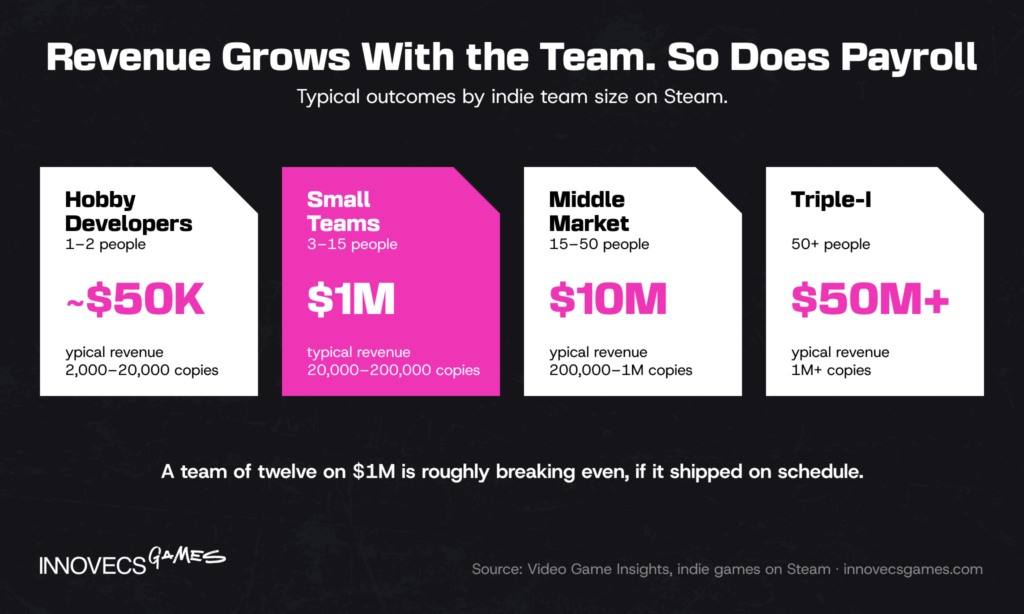
The indie game market around those studios is large and brutally uneven. Alinea Analytics estimated that indie games earned about $4.4 billion on Steam in 2025, roughly a quarter of the store’s game revenue, and that five new indie releases took 3% of all Steam game revenue between them. Video Game Insights splits that market by team size, and the typical outcomes climb with headcount: around $50,000 in revenue for one or two hobby developers, around $1 million for small teams of three to fifteen, and around $10 million for mid-market studios of fifteen to fifty. Revenue scales with the team, and so does the payroll. A solo developer can live on $50,000. A team of twelve on $1 million is roughly breaking even, if it shipped on schedule.
So how much does it cost to make an indie game? The short answer runs from the price of a laptop to eight figures. The useful answer is a monthly burn rate multiplied by a realistic number of months, plus the lines that don’t show up in either. Cost planning decides whether a project ships, because indie games rarely die from one bad estimate. They die because the estimate had no line for month nineteen. If you want these numbers set against mobile, AA and AAA production, our guide to video game development cost compares every scale side by side.
What Drives the Cost of Making an Indie Game
In the indie budgets we’ve scoped since 2023, salaries make up 70% to 85% of the total. Every driver below is therefore a question about how many people you pay and for how long, and the four interact: art style sets team composition, platform adds months at the end, and scope decides whether the timeline was ever real.
Team Size and Roles
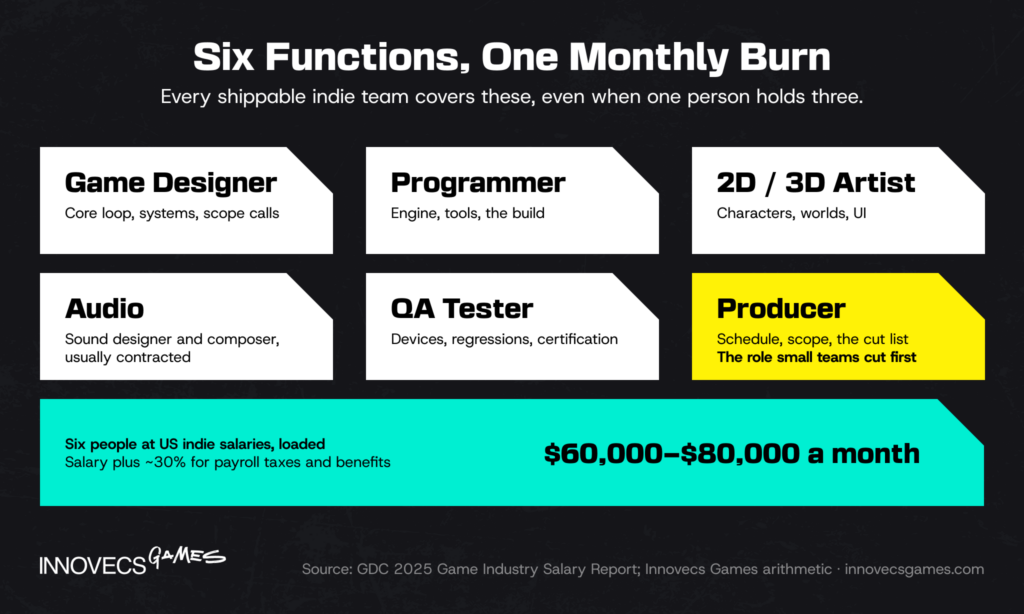
A shippable indie team covers six functions, even when one person holds three of them: game designer, programmer, 2D or 3D artist, audio (a sound designer and a composer, usually contracted), QA tester, and a producer or project manager. The producer is the role small teams cut first. In our experience it’s also the most expensive saving a small studio makes, because scope decisions then get made by accident, one Slack thread at a time.
Developer salary sets the rate. GDC’s 2025 salary report put average US pay at $150,000 for programmers and $124,000 for visual artists, while half of the respondents at indie studios earned under $100,000. Take $95,000 to $120,000 per head, add roughly 30% for payroll taxes and benefits, and a six-person US indie team costs $60,000 to $80,000 a month. That’s our arithmetic, not GDC’s, and it’s the figure the rest of this article builds on. Spending it on a full team before the core loop is proven is premature. A short engagement with game prototyping services answers the “is this fun” question for a fraction of one month’s payroll.
Art Style and Production Quality
Art style decides who you hire and how many. Pixel art is cheap per asset and expensive per decision: every sprite is small, and a mid-size game needs thousands of them. Hand-drawn frame-by-frame animation, the Hollow Knight approach, multiplies animator time for every character state. Stylized 3D moves the spend toward technical art, lighting and shaders, while high-fidelity 3D in Unreal Engine 5 brings an animation workload that small teams usually outsource.
Production quality compounds the choice. Each step up, from readable placeholder to shippable asset to trailer-ready hero shot, is a separate pass with its own review cycle, and teams consistently underestimate how many assets end up needing the top tier. Lock the style with a small vertical slice before you staff an art team against it. A style change in month six re-prices everything already built.
Platform, Engine, and Genre
Steam on PC remains the cheapest route to market for most indies. Every extra platform adds a port, a performance pass and a submission cycle, and console certification requires devkits that platform holders issue only to approved developers. Mobile app stores swap certification for a device matrix and a user acquisition problem, which our breakdown of mobile game development cost covers in detail.
Engine licensing costs less than most founders fear, but it has one trap. Unity’s current terms keep Unity Personal free below $200,000 in combined annual revenue and funding, with Pro at about $2,300 per seat per year after a 5% increase in January 2026. The trap is the word “funding”: a publisher advance above that threshold moves the studio onto Pro before the game has earned a cent. Unreal Engine is free until a product passes $1 million in lifetime gross revenue, then takes a 5% royalty on the excess. Godot is free under the MIT license, and GameMaker suits 2D teams that want a lighter toolchain.
Game genre bends the cost curve more than studios like to admit. Online multiplayer adds netcode, servers and anti-cheat that single-player games never pay for. Narrative games need writers, voice actors and a localization budget that grows with every line of dialogue. Systemic genres such as roguelikes and deckbuilders get their replayability from rules, not content, which is why Balatro and Vampire Survivors could each start with a single developer. Our slightly unpopular opinion: if a small team’s first game needs matchmaking servers, it probably needs to be a different first game.
Timeline and Scope
The development timeline multiplies everything above. At $70,000 a month, a six-month slip costs $420,000, which is more than many small games spend in total. Scope creep is how the slip happens: no single addition looks large, and together they add a quarter.
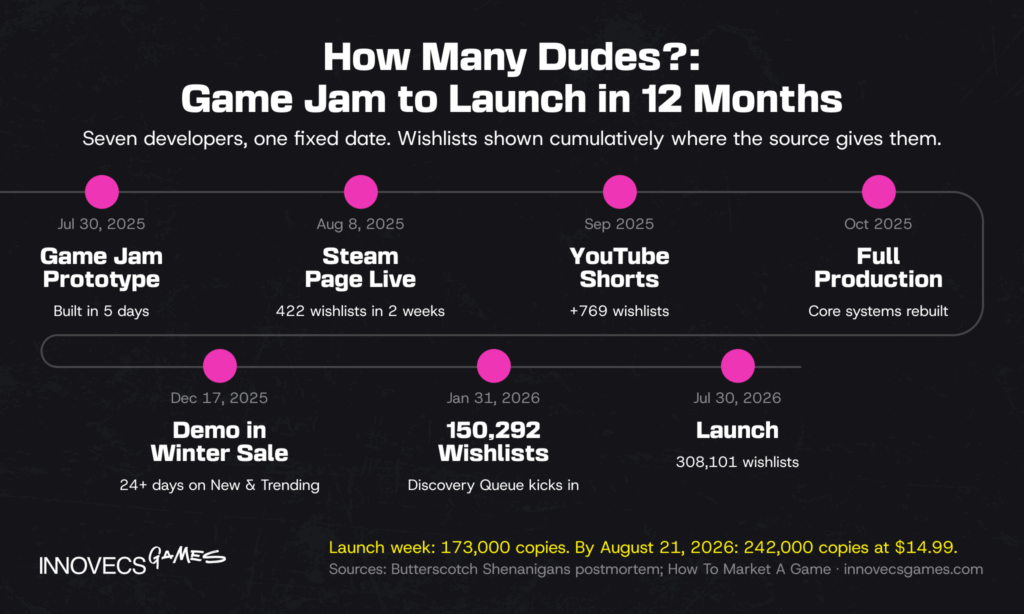
Two public cases show scope moving in opposite directions. Hollow Knight grew with its money. Team Cherry’s founders told Source Gaming that the campaign let them make the game a level bigger, then fund about two years of work, and the game got bigger again. Butterscotch Shenanigans went the other way. After five years on Crashlands 2, the seven-person studio built How Many Dudes? from a game jam prototype in about a year, and by its own account in the postmortem it became the most successful game of the team’s 14-year career. A fixed end date forced cuts that an open one would have postponed.
Whatever the date, put a contingency budget of 15% to 20% on top of the plan, and reserve it for problems you haven’t found yet, not for features you already have in mind.
How Much Does It Cost to Make an Indie Game by Project Type
The tiers below come from budgets we’ve scoped since 2023, checked against the handful of projects that published real numbers. Each range assumes everyone on the team is paid, including the founders.
| Tier | Core team | Timeline | Typical budget | Public reference point |
|---|---|---|---|---|
| Small-scale 2D | 1 to 5 people | 6 to 24 months | $30,000 to $400,000 | Hollow Knight: AU$57,138 raised on Kickstarter, about two years of work |
| Mid-scale | 5 to 15 people | 12 to 30 months | $400,000 to $3 million | How Many Dudes?: seven developers, about twelve months |
| High-end 3D and multiplatform | 15 to 40 core, plus partners | 2 to 4 years | $3 million to $15 million | Clair Obscur: Expedition 33: under $10 million, core team of about 30 |
Source: Innovecs Games delivery data, projects scoped 2023 to 2026; public figures as linked in this section.
The ranges overlap on purpose. A two-person 3D horror game can cost more than a nine-person card game, because the tier is set by what you build, not by what you call the studio.
Small-Scale 2D Indie Games
The best-documented indie game budget example at this scale is still Hollow Knight. Team Cherry’s 2014 campaign raised AU$57,138 from 2,158 backers, 163% of its goal, and that money carried a core team of three through roughly two years of production before the game shipped in 2017. What the cash figure hides is the team’s own time. Three people paid at the US salaries above for two and a half years would cost close to $900,000. The founders covered the difference themselves, in wages they never drew.
A funded small team is more predictable. Two to four paid people over nine to eighteen months, with contracted audio, localization into a handful of languages and a modest launch budget, typically lands between $150,000 and $400,000. Below that, the budget belongs to solo developers and duos with day jobs, where cash goes on art assets, music, tools and a trailer, and the real cost is paid in evenings.
Mid-Scale Indie Games
How Many Dudes? is a clean reference for this tier: seven developers, about twelve months, a $14.99 price, and 242,000 units sold on Steam within weeks of its July 30, 2026 launch. Butterscotch hasn’t published a budget, and we won’t guess one. We can build the tier from its parts instead. Here’s a worked estimate for an eight-person team making a stylized 3D game for PC and one console over 18 months, with a Western core and an outsourced pod in Eastern Europe.
| Budget line | Basis | Estimate |
|---|---|---|
| Core team, 5 in-house (designer, 2 programmers, art lead, producer) | About $10,500 a month per person, loaded, for 18 months | $945,000 |
| Outsourced pod, 3 people (3D artist, technical artist, QA) | About $20,000 a month for 15 months | $300,000 |
| Music, sound design, limited voice | Fixed-fee composer and sound designer | $40,000 to $80,000 |
| Engine and tools | Five Unity Pro seats, source control, plugins | $25,000 |
| Localization into 8 languages | Text only, about 60,000 words | $50,000 to $70,000 |
| External QA and platform submission | PC plus one console | $40,000 to $60,000 |
| Marketing and launch | Trailer, key art, festivals, creator outreach | $100,000 to $200,000 |
| Contingency | 15% of everything above | $225,000 to $252,000 |
| Total | $1.73 million to $1.93 million |
Source: Innovecs Games delivery data, projects scoped 2023 to 2026. US salary lines derived from GDC’s 2025 salary report.
A total like this only means something next to the sales it has to earn back. At $19.99, it needs roughly 150,000 copies, and the break-even table further down runs the same math for other budgets and prices.
High-End 3D and Multiplatform Indie Games
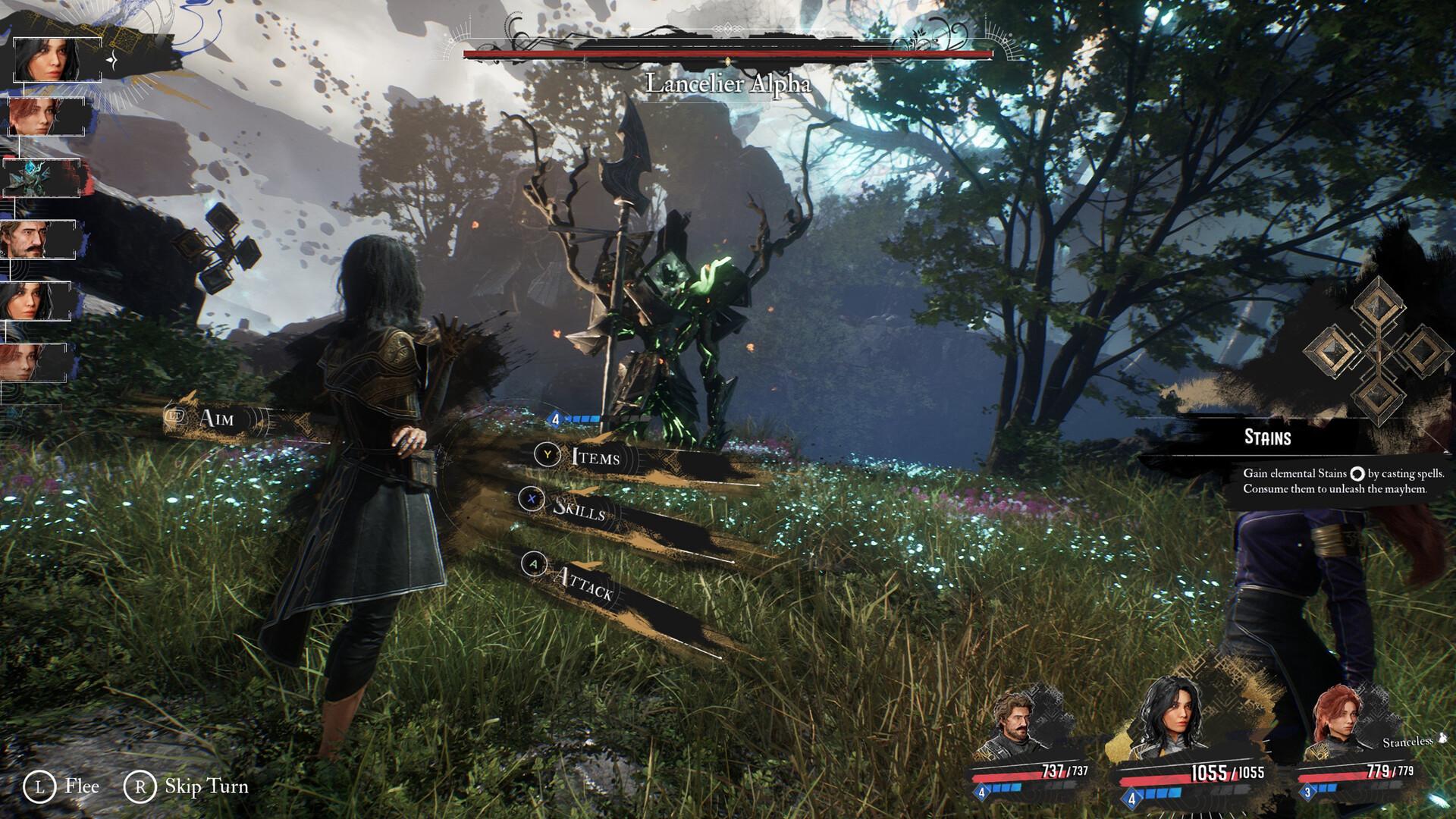
At the top of the tier, Clair Obscur: Expedition 33 shows how the money is organized, not only how much there is. GameSpot’s summary of The New York Times report describes a core team of about 30, battle animations outsourced to a studio in Korea, external teams for marketing and localization, and a deliberate choice of turn-based combat over an open world to conserve resources. The game has sold more than 5 million copies on PS5, Xbox Series X|S and PC.
Budgets here run from $3 million to $15 million, and nearly all of them are publisher-funded, because few founders can self-fund three platforms, console certification and an Unreal Engine 5 technical art pipeline. That’s still a small fraction of AAA game development cost, where typical budgets start around $80 million before marketing. The lesson people take from Expedition 33 is that small teams can make big games. The lesson in its budget is narrower: a small core can make a big game if it rents the volume and keeps the vision in-house.
Estimating an Indie Game From Scratch, Phase by Phase
The tier examples show where a budget ends up. They don’t show when the money goes out, and for a studio paying salaries from savings or an advance, timing matters as much as the total. So here’s an estimate split by phase, for a project smaller than the mid-scale example: a stylized 2D action game for PC, three salaried founders (designer-producer, programmer, art lead) at US indie rates, and outsourced art, animation and QA from Eastern Europe as the work requires.
| Phase | Months | Team | Leave the phase with | Cost | Spent so far |
|---|---|---|---|---|---|
| Concept | 1 | 2 founders | A one-page design, a target player, three comparable games and what they sold | $21,000 | $21,000 |
| Prototype | 2 to 3 | 2 founders, freelance placeholder art | A playable loop that outside testers finish and ask to play again | $48,000 | $69,000 |
| Vertical slice | 4 to 5 | 3 founders, 1 outsourced artist | Ten minutes at final quality, a locked art style, a live Steam page | $76,000 | $145,000 |
| Production | 6 to 12 | 3 founders, 3 outsourced artists and animators, contracted audio | Every level and system in the game, a public demo | $390,500 | $535,500 |
| Beta and festival | 13 to 14 | Core plus 2 QA testers, 1 artist on polish, localization into 5 languages | A stable release build, wishlists at target, a Next Fest showing | $122,000 | $657,500 |
| Launch | 15 | Core, plus trailer, key art and PR | The game on sale | $71,500 | $729,000 |
| Tools, engine, legal and accounting | Throughout | $15,000 | $744,000 | ||
| Contingency, 15% | $111,600 | $855,600 | |||
| Post-launch support, 6 months | 16 to 21 | 2 founders for 3 months, then 1 | Fixes, a content patch, a console port decision | $94,500 | About $950,000 |
Source: Innovecs Games delivery data, projects scoped 2023 to 2026. Founder cost is $10,500 a month per person, loaded, derived from GDC’s 2025 salary report.
The column to watch is the last one. Stopping after the prototype costs $69,000, and stopping after production costs more than half a million. That’s why the exit criteria matter more than the phase costs. Cancelling the game in month three is the least expensive decision in the whole table, and most teams find it the hardest one to make. If the founders take no salary, the cash budget falls to roughly $350,000 with contingency, the same trade Team Cherry made on Hollow Knight at a larger scale.
Download the free budget template for indie games: Excel (.xlsx)
Five tabs: assumptions, a phase budget with exit criteria and a running total, break-even at five price points, and a monthly burn check that flags when spending runs ahead of milestones. The example values are the estimate above.
How Many Copies Pay Back an Indie Budget
Budgets are approved in dollars and judged in copies, so it’s worth converting one into the other before anyone signs. The table assumes a studio keeps about 60% of the list price after Valve’s 30% share, sales tax and refunds, and that no publisher takes a cut.
| Budget | At $9.99 | At $14.99 | At $19.99 | At $24.99 |
|---|---|---|---|---|
| $300,000 | 50,000 copies | 33,000 copies | 25,000 copies | 20,000 copies |
| $1 million | 167,000 copies | 111,000 copies | 83,000 copies | 67,000 copies |
| $2 million | 334,000 copies | 222,000 copies | 167,000 copies | 133,000 copies |
Source: Innovecs Games arithmetic from the stated assumptions. Real figures are higher, because most lifetime copies sell at a discount.
For scale, the 242,000 copies How Many Dudes? sold at $14.99 would cover even the bottom row of that column, and that was the best result of a studio 14 years into its career. Most teams should plan against the top row and treat the bottom one as the upside. Most pitch decks we’ve seen quietly assume the bottom row, which is a big part of why publishers read pitch decks with a calculator open. If the only row that works is the one your best-case forecast reaches, the scope is too large for the price, and one of the two has to move before production does.
Hidden Costs Indie Teams Often Miss
Those copy counts assume the budget was complete to begin with. In the mid-scale estimate above, the lines outside the core build add up to roughly a third of the total, and that third is what first budgets tend to leave out. When an indie game development cost estimate breaks, it tends to break here, late in the project, when the account is at its lowest.
Marketing and Distribution
Wishlists are the currency of a PC launch, and they’re earned slowly. How Many Dudes? collected just 422 wishlists in the two weeks after its Steam page went up, and two viral YouTube Shorts added 769 more. Then the team launched a demo during the Steam Winter Sale, sat on the New & Trending Free list for more than three weeks, and earned 36,946 wishlists from that alone, according to Chris Zukowski’s breakdown. It launched with 308,000. Social media got them attention, and the demo got them the front page. Across the teams we work with, marketing and launch typically take 10% to 20% of the development budget, and the best-spent part of it is usually the demo build.
QA, Localization, and Platform Fees
QA is where small budgets most often trade money for reputation without meaning to. A game with a small team still needs compatibility testing across GPUs and handhelds, a regression pass before every patch and, on console, a certification pass against each platform holder’s requirements. A failed submission costs a resubmission window, and sometimes the launch date with it.
Localization pays back better than most lines. At GDC 2026, Valve said that 66% of Steam players have a primary language other than English, and called localization the most obvious investment a developer can make. Text-only localization into eight languages for a 60,000-word game runs $50,000 to $70,000 in our delivery data. It’s also the one line where cutting corners gets reviewed publicly, in the reviewers’ own language, on the store page. Platform fees fill in the rest: Apple’s developer program, Google Play registration, console devkits and middleware licenses. Each is small on its own. Together they deserve a line with a name on it.
Post-Launch Support
Launch is the start of a second budget. The first month brings crash fixes, balance patches and platform SDK updates, and Valve’s own data says more than half of active Steam users played on more than one device in 2025, so cloud saves and handheld performance aren’t optional extras. We advise planning 10% to 15% of the development budget for the first six months of post-launch support. Hello Games spent years of free updates rebuilding No Man’s Sky’s reputation, and that recovery was paid for by a launch that had already sold. Most small studios won’t get that second chance unless the money for it is set aside before launch day.
Console Ports After Launch
Most indie games that go to console reach Nintendo Switch 2, PlayStation 5 and Xbox six to eighteen months after their PC launch, and the port gets budgeted as an afterthought. It’s a real project with its own line. In our delivery data, porting a 2D Unity game with modest performance needs typically runs $30,000 to $80,000 over two to four months for the first console. A 3D game that needs serious memory and frame-rate work runs $80,000 to $250,000 over four to eight months, and each additional console adds roughly a third to half of the first port’s cost. Certification QA, covered above, comes on top.
Many studios don’t pay for the port in cash. A porting publisher covers the work in exchange for a share of console revenue, and in Voyer Law’s dataset those console-only deals averaged 63.1% of revenue to the developer. The least expensive port, though, is the one planned from the start. Input that assumes a mouse, UI text sized for a monitor and memory use that nobody measured are all cheap to fix in month four and expensive to fix after launch. Every PC game is designed for a mouse right up until someone picks up a controller.
Source for port ranges: Innovecs Games delivery data, projects scoped 2023 to 2026.
Budget Pitfalls That Sink Indie Games
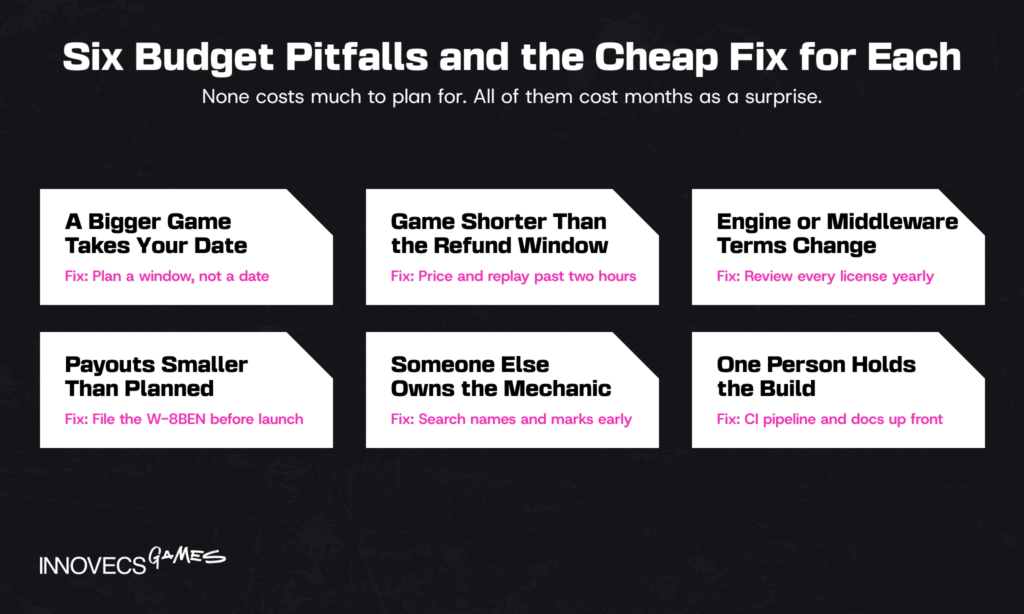
Hidden costs are lines a budget forgot. The pitfalls below are events: a decision someone else makes, a rule nobody read, or a gap in the team that shows up at the worst possible moment. None of them costs much to plan for, and all of them cost months as a surprise. The section ends with the internal signals that a plan is already slipping.
A Bigger Game Takes Your Launch Date
On August 26, 2025, Team Cherry announced that Hollow Knight: Silksong would launch on September 4. Within five days at least eight indie games had moved their launches or demos out of its way, GamesRadar counted. Demonschool slid from September 3 to November 19. One developer described the feeling as being “a little krill trying to not get eaten by a blue whale.” For a team burning $50,000 a month, a forced ten-week delay is a six-figure line nobody planned. Pick a launch window rather than a date, keep a month of runway in reserve for it, and check the release calendar again the week you announce.
The Game Is Shorter Than the Refund Window
Steam refunds any purchase requested within 14 days with less than two hours of playtime, no reason needed. A tight 90-minute narrative game can be finished and returned inside that window, and some players do exactly that. Those players aren’t villains. They’ve just read the refund policy more closely than the studio did. Short games aren’t a mistake, but they need a price and a replay hook that survive the two-hour mark. It’s cheaper to settle that in the design document than in the launch-week sales report.
Engine and Middleware Terms Change Mid-Project
Unity announced a per-install Runtime Fee in September 2023 and cancelled it a year later. In between, Massive Monster told players to buy Cult of the Lamb quickly, “’cause we’re deleting it on Jan 1”, and plenty of quieter studios spent part of that year pricing a switch to another engine. Smaller changes arrive more quietly. Unity’s own pricing update notes that Havok Physics stops being included with Pro from Unity 6.3. Audio middleware has thresholds of its own: Audiokinetic’s free Wwise license covers projects with budgets under $250,000, and the budget is checked again at release and a year after launch. A project that raises money past that line needs a paid license. Read every license in your stack once a year, not once per project.
Payouts Arrive Smaller Than the Spreadsheet
Store revenue isn’t paid out in full. Valve’s tax documentation states that most US-source income paid to a foreign company is subject to a 30% US tax rate. A tax treaty can reduce or remove it, but only after the studio files a W-8BEN form with a tax ID. A European studio that skips the tax interview can lose almost a third of its first payouts on top of Valve’s share, VAT and refunds, in exactly the months its runway is shortest. File the paperwork before the Steam page goes live.
Someone Else Owns the Mechanic
Pocketpair has changed Palworld twice while Nintendo and The Pokémon Company pursue a patent suit against it. It removed thrown Pal Spheres for summoning in November 2024, and in May 2025 it made players equip a glider instead of gliding with their Pals, according to Game Developer. Few small games draw a platform holder’s legal team, but name and trademark conflicts are common and inexpensive to check early. A search before the Steam page goes live costs a few hundred dollars. A rename after launch costs the store page, the wishlists and the press coverage attached to the old name.
One Person Holds the Build
On a team of four, it’s normal for one programmer to be the only person who knows how the build pipeline, the save system or the console SDK works. When that person gets sick, burns out or takes a salaried job, the project stops until someone else learns it, and that’s usually three to six weeks of paid time for everyone else. Documentation feels like a luxury at this scale. It’s cheaper than a month of salaries spent waiting. The same goes for the only machine that can make a release build. Spend a week getting builds out of a CI pipeline before production starts, not after the laptop fails.
Signs the Budget Is Already Slipping
Most of the pitfalls above land in a single week. More budgets fail slowly: they drift, and the drift shows up in production data long before it reaches the bank account. These are the signals we watch for on client projects, roughly in the order they appear:
- Spend runs ahead of milestones. If 50% of the budget is gone and 35% of the milestones are closed, the gap won’t close by itself. Compare the two every month, not every quarter.
- A phase gets “one more month.” The vertical slice is the usual victim. One extension is normal. A second one means the exit criterion was never realistic, or the game isn’t working yet.
- Tasks sit at 90% for weeks. Work that’s almost done and stays there is usually blocked on a decision, not on effort. Find the decision.
- The bug count grows while the feature list shrinks. By beta, new bugs should be arriving more slowly than old ones get fixed. If the curve still points up, the launch date is already wrong.
- Nobody outside the team has played the build this month. Playtests are the first thing to go when time gets tight, and they’re the only thing that tells you whether the time is being spent on the right game.
- The contingency is spent before beta. It exists for the surprises that arrive late. If it’s gone by production, the launch is running on hope.
Two of these at once is a reason to stop and re-plan. The budget template above includes a monthly burn check that flags the first sign automatically.
Indie Game Budget by Region and Engagement Model
When the burn check shows money running ahead of the plan, staffing is the fastest thing to change. Where your team sits and how it’s contracted moves the monthly burn more than any single design decision, and it’s the one indie game budget lever you can still pull after production starts.
In-House vs Outsourced Development
The table compares four ways to staff the same six-person workload: roughly two programmers, two artists, a designer and shared producer and QA time.
| Model | Monthly cost, six-person equivalent | Time to ramp up | Who carries delivery risk | The catch |
|---|---|---|---|---|
| In-house, US indie salaries | $60,000 to $80,000 | 2 to 4 months of hiring | You | Fixed cost through every quiet month |
| Freelancers | Lowest per hour, varies widely | Days to weeks | You, task by task | Nobody owns integration, and turnover mid-project is common |
| Outsourced project team, Eastern Europe | $40,000 to $60,000 | 2 to 4 weeks | Partner, against an agreed scope | Needs a spec tight enough to price |
| Co-development pod, Eastern Europe | $45,000 to $70,000 | 3 to 6 weeks | Shared, per milestone | Costs more per month than freelancers and needs your producer’s time |
Source: Innovecs Games delivery data, projects staffed 2023 to 2026. US line derived from GDC’s 2025 salary report.
Of the four columns, time to ramp up is the one budgets forget. A studio paying in-house salaries through three months of recruiting has already spent the price of a small outsourcing contract before the new hires write a line of code.
In-house wins when the work is long, continuous and central to the game’s identity: the core designer, the lead programmer, the art director. Game development outsourcing wins on bounded work with a clear finish line, like an asset set, a port or a QA pass. A dedicated team sits between the two for studios that need the same extra people for a year or more. Freelancers are the right call for short, well-defined tasks. They become the wrong one the moment five of them have to agree on how the build fits together.
Nearshore and Offshore Rates
The developer hourly rate for mid to senior game talent varies about fourfold across the regions small studios actually hire from. In our 2023 to 2026 delivery data, blended rates run $90 to $150 an hour in the US and Canada, $75 to $120 in Western Europe, $40 to $70 in Eastern Europe including Ukraine and Poland, $35 to $60 in Latin America, and $22 to $45 in India and Southeast Asia.
Nearshore means overlap. Eastern Europe shares most of the working day with EU studios and a few hours with the US East Coast, and Latin America does the same for North American teams. Offshore development in South and Southeast Asia saves the most per hour and asks the most in management: longer feedback loops, more detailed specs and a producer on your side who reviews work daily. The cheapest hour on that list is rarely the cheapest accepted milestone, and teams without a dedicated producer tend to find that out mid-project. Our view, which obviously isn’t neutral given where most of our team sits: for a small studio, working-day overlap is worth more than the last $10 off the hourly rate.
Need Help Scoping Your Indie Game Budget? Let’s Talk
If you have a design and a number but no plan joining the two, send us both. We’ll show you where the estimate is thin, which roles cost less to bring in than to hire, and how much contingency your scope really needs.
How Indie Teams Fund Their Games
Every source of indie money comes with a timeline attached. A Kickstarter pays once, a publisher pays against milestones, and a grant covers part of a project, not all of it. Your budget has to match the shape of the money as well as its size.
Self-Funding and Crowdfunding
Self-funding is still the default for small teams, whether it comes from savings, a day job or revenue from a previous game. It keeps ownership and every decision in-house, along with all of the risk. Its real cost is time: a self-funded team tends to build slower, which stretches the timeline and makes every other line more expensive.
Crowdfunding works best as validation with money attached. ICO Partners’ Thomas Bidaux counted 443 successfully funded video game projects on Kickstarter in 2025, raising just under $26 million between them, which averages under $60,000 a campaign. Bidaux put the scale in perspective himself: a full year of funded Kickstarter games adds up to about “two weeks of Steam releases.” Budget for the platform and payment fees, physical rewards and backer communication, and treat the campaign as a marketing beat as much as a funding round.
Publisher Advances and Revenue Share
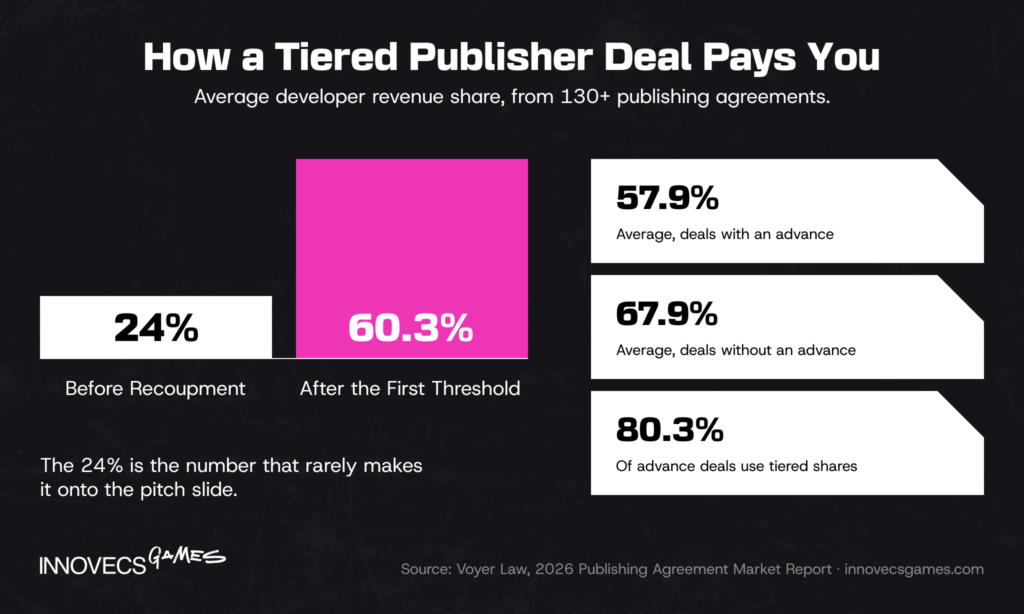
A publisher advance turns uncertain future sales into salaries today, and the price is a revenue share. Voyer Law’s 2026 market report, built on more than 130 publishing agreements, found that deals with an advance give the developer 57.9% of revenue on average. The average hides the structure. In 80.3% of those deals the share is tiered: the developer’s opening stage averages 24%, rising to 60.3% after the first threshold, which is usually recoupment of the advance. The 24% is the number that rarely makes it onto the pitch-meeting slide.
Read the recoupment terms before the headline split. How “net revenue” is defined, which costs the publisher can recoup and whether marketing spend counts toward it all decide when your share reaches the higher tier. And check what the advance triggers elsewhere: under Unity’s terms it counts as funding, so the studio needs Pro seats from the day it arrives.
Grants and Co-Development Partnerships
Public grants are growing in some markets. The UK government doubled the UK Games Fund to £28.5 million over three years, with applications opening on April 14, 2026, in three tracks: up to £20,000 for new companies, up to £100,000 for prototyping, and up to £250,000 to take a game to completion. Grants rarely fund a whole project, so they work best alongside a publisher deal or private money.
Co-development partnerships are the other route to capacity without payroll. A partner studio contributes a team for part of the game, paid in fees or a mix of fees and revenue share, while the originating studio keeps creative control. It’s how Ghost Ship Games brought Deep Rock Galactic: Survivor to market through a smaller partner studio while its own team stayed on the main game.
Early Access and Subscription Deals
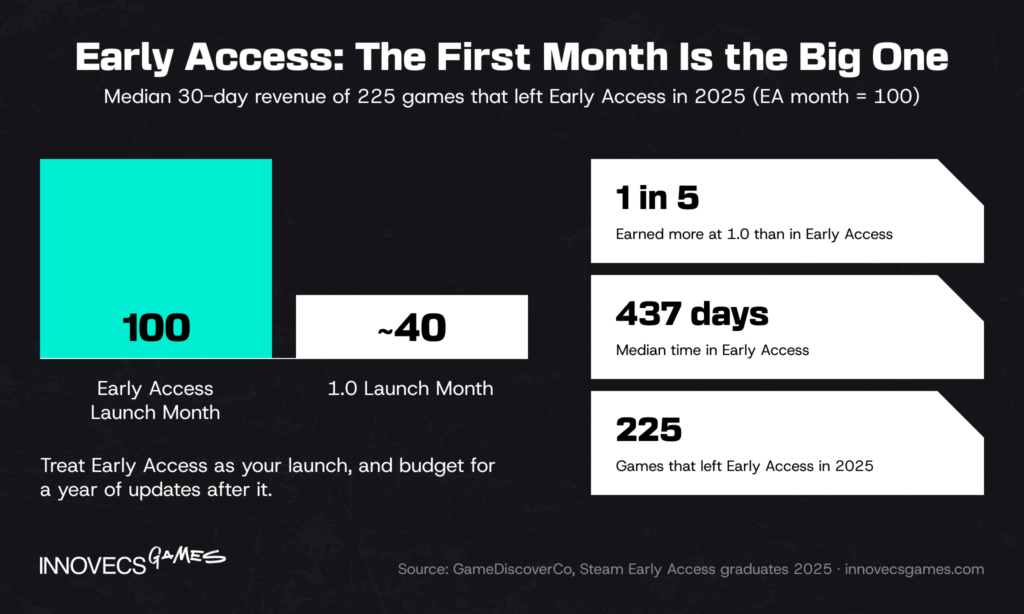
Early Access turns part of development into something players pay for. Schedule I, built by a solo developer and released into Early Access in March 2025, was the top-earning new indie game on Steam that year at about $151 million by Alinea’s estimate. That’s the exception. The rule is what happens at 1.0. GameDiscoverCo looked at 225 games that left Early Access in 2025 and found that the median 30-day revenue at full release was about 40% of the median Early Access launch month, and only one in five did better at 1.0. The median game spent 437 days in Early Access. Supergiant’s Hades shows the version that works: close to two years in Early Access, a steady cadence of content updates, and a 1.0 in September 2020 that landed as a new game rather than a patch note. Treat Early Access as your launch, and budget for more than a year of paid updates after it.
Subscription deals with services such as Xbox Game Pass or PlayStation Plus pay a studio a fixed sum up front, which can close a funding gap or pay for a port. Clair Obscur: Expedition 33 launched on Game Pass on day one and still sold millions of copies. The evidence on sales afterwards is thin, though. In a late-2025 survey by the Game Developer Collective and Omdia, only 4% of developers selling premium games said a subscription service had increased their revenue, against 17% of those selling DLC or in-app purchases. For a premium game without post-launch content, price the deal as the revenue, not as marketing for later sales.
Practical Ways to Cut Indie Game Costs Without Losing Quality
Funding decides how much money there is. These tips decide how far it goes, and the savings that last are decided before production starts, and none of the tips below involves paying people less.
Pick the engine your team already ships in. A switch to save on licensing costs more in retraining and lost months than the license ever would. Balatro shipped on LÖVE, a free Lua framework most studios have never considered, and nobody has ever refunded it over the engine. Godot is free, but console export needs a third-party porting partner. Choose by the team’s experience and target platforms, then stop revisiting it.
Prototype the loop before you staff the game. A game jam entry or a two-week prototype tells you whether the core loop works before anyone is hired for a year of production. It’s the least expensive insurance a budget can buy.
Keep revenue-share contributors on bounded work. A composer, a trailer editor or a writer on a defined scope can work well on revenue share with a written contract. Core roles rarely do. Revenue share pays in a currency that most games never earn, and people paid that way tend to leave when a salaried offer arrives.
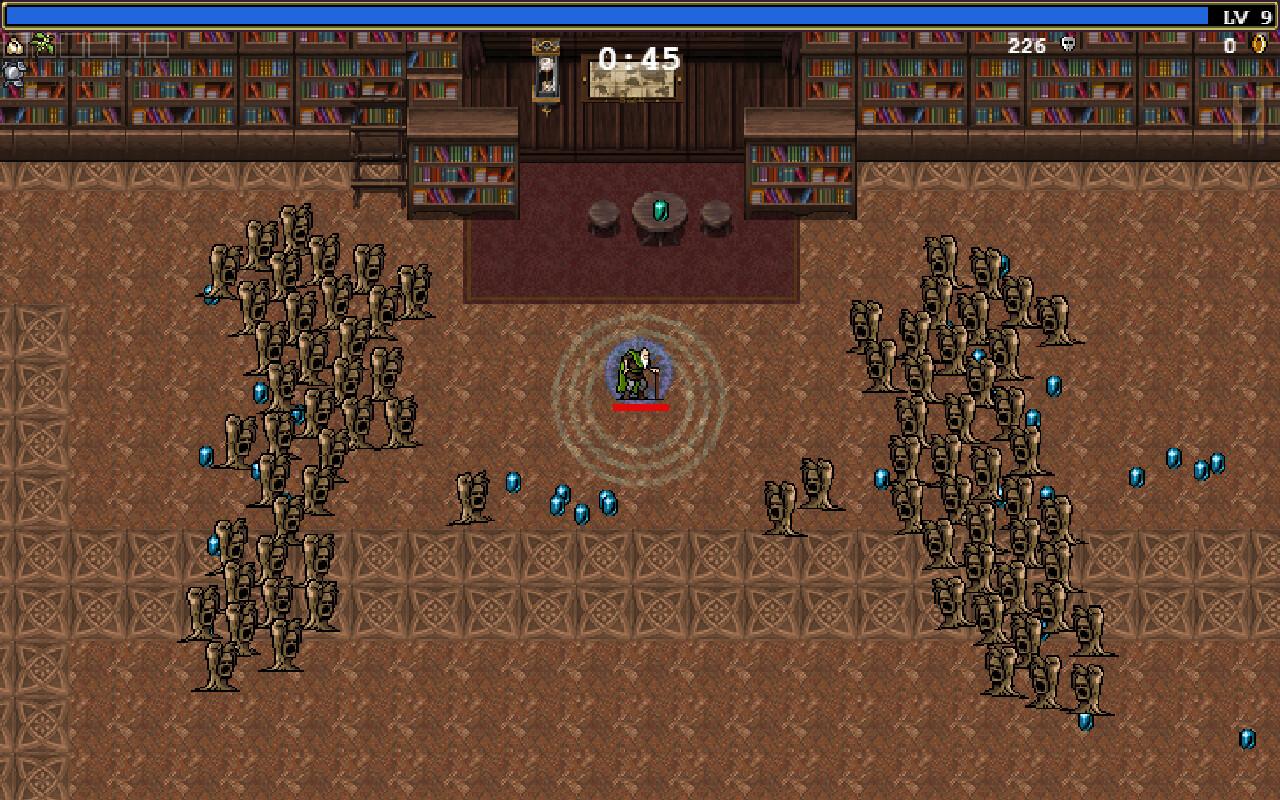
Buy what players won’t remember. Rocks, crates, foliage, UI sound effects and background props can come from an asset store, often for less than $100 a pack. Custom work belongs on the characters, the hero environments and the moments that end up in the trailer. The trick is a consistent style guide, so bought assets don’t look bought. Or lean in: Vampire Survivors’ developer spent around £1,100 on assets, art and music for the first Early Access version, and players cared about the loop, not the sprites.
Cut a system, not the polish. Removing one mechanic or one biome saves more than trimming polish across all of them, and players notice the missing polish first.
Rent specialists for the weeks you need them. Technical art, VFX, porting and certification QA are expensive to hire full-time and needed for months at most. Bringing them in for a defined stretch keeps the core team small and the monthly burn predictable.
How AI Is Changing Indie Game Costs in 2026
AI is the cost lever everyone asks about in 2026, and adoption is moving faster than the evidence on savings. A CESA survey released at Tokyo Game Show 2026 found that 85.8% of Japanese game developers now use generative AI in their work, against roughly 51% in CESA’s figures a year earlier, while PC Gamer noted that North American developers remain far more skeptical. For a budget plan, the useful question isn’t whether to use AI but which lines it actually shortens.
Where it lowers cost today:
- AI coding assistants cut time on boilerplate, editor tools, test scaffolding and debugging, which matters most for teams with one or two programmers.
- AI-assisted art and audio speed up concepting and placeholders, so a prototype can look and sound finished enough to test with players weeks earlier.
- Automated QA handles smoke tests, crash-log triage and duplicate bug reports, which frees human testers for the judgment calls.
- First-pass translation gives localization teams a draft to correct, as long as a native speaker reviews every string.
Where human expertise still decides the outcome is the part players notice: game design, the feel of the controls, final art, performance polish, and QA judgment about what’s actually broken. Sandfall learned how expensive a missed review can be. A few AI-generated placeholder textures slipped past QA into Clair Obscur’s launch build, and the studio replaced them within five days. Months later the Indie Game Awards retracted its Game of the Year and Debut Game wins over them. The textures saved almost nothing. The lapse cost two trophies.
Disclosure is part of the budget too. Steam asks developers to disclose AI-generated content that players see in the game or on the store page, and Game Oracle’s analysis found that 20.9% of games released on Steam between January and November 2025 carried a disclosure. Development tools such as coding assistants don’t need one under Valve’s January 2026 rules. Shipped assets do. Our view: AI works best as a way to test more ideas before a budget is committed, and worst as a line deleted from the art budget, because the review pass it needs is where the saving goes.
How Innovecs Games Helps Indie Studios Build Within Budget
Most indie studios that come to us have a strong core team of 10 to 40 people and a specific gap: technical art for a new renderer, VFX for a trailer build, a console port, or a QA pass before certification. We’ve shipped 300+ games over more than a decade, with 200+ developers and artists. The lesson from that work is simple: filling the gap is easier than growing the payroll.
Our game co-development teams join that core as a pod with its own lead, working in your engine, your repository and your sprint cadence, so the game and the decisions stay yours. When a studio needs one specific role for a few months, we staff that role alone. Where we’re the wrong fit, we’ll say so: a solo developer at prototype stage is better served by freelancers or a jam team than by a studio with a producer on every pod. The titles in our portfolio show the range of work that model has shipped.
FAQ
What is the average indie game development cost in 2026?
There isn’t a meaningful average, because the category runs from a solo developer’s few thousand dollars in cash to publisher-funded productions near $10 million. A more honest midpoint is the paid small-to-mid team: three to eight people for 12 to 24 months, which typically lands between $300,000 and $2 million with marketing and contingency included. Unpaid founder time can cut the cash figure by more than half. It doesn’t change what the game actually cost to make.
How much does it cost to make a 2D indie game?
Scope matters more than the number of dimensions. A small 2D game from a funded team of two or three over a year usually costs $150,000 to $400,000, most of it salaries. Frame-by-frame animation, a large cast or full voice acting pushes it toward mid-scale budgets. Pixel art and tile-based levels keep it down, as long as nobody adds a fourth biome in month ten. Celeste is the model: a small core team, one artist, one composer, and a scope that never tried to be bigger than its best idea.
What is a realistic budget for a small indie team’s first game?
Aim small enough to finish: nine to fifteen months, two to four people, and $100,000 to $350,000 if everyone is paid. First games overrun more often than any other kind, so hold 20% contingency instead of the usual 15%. The same Video Game Insights data suggests a studio’s second game sells about 40% better than its first on average, which is a strong argument for shipping the first one on time.
How much should I budget for indie game marketing?
Plan on 10% to 20% of the development budget, and start spending part of it early. A Steam page, a trailer and a demo do more for a PC launch than paid ads, because Steam’s discovery features respond to wishlists and demo activity. Paid user acquisition makes sense mainly for free-to-play mobile games with measured lifetime value. If the budget can’t cover a demo and a festival entry, the scope is probably too big for the money.
What’s the difference between self-funding and outsourcing an indie game?
One is about where the money comes from, the other about who does the work. A self-funded studio can still outsource, and many do it to stretch savings further, since an Eastern European team typically costs less per month than the same roles hired in the US. The trade-off is management time and a specification clear enough to price. Self-funding keeps full ownership, and full exposure if the game underperforms.
How does the development timeline affect indie game cost?
Almost linearly, because salaries make up most of the budget. A team costing $50,000 a month adds $300,000 for every six months of delay, and delays tend to arrive late, when the most people are on payroll. Fixed dates such as a festival, a publisher milestone or a platform promotion help precisely because they force scope decisions sooner.
Can I make an indie game for under $10,000?
Yes, if $10,000 is the cash budget and not the value of the work. Solo developers ship games on that money regularly by doing most of the work themselves and paying only for art assets, music, tools and the $100 Steam fee. The limits are scope and time: expect one developer, a short game and a year or more of evenings. Vampire Survivors started exactly that way. Keep some of the money for a trailer, because a game nobody sees earns nothing.
How does hiring a Unity game development team affect the budget?
The engine is the small part. Unity Personal is free below $200,000 in revenue and funding, and Pro seats cost about $2,300 a year above it. The team is the real cost, and Unity specialists are among the easiest engine talent to find, which keeps rates competitive: a mid-level Unity engineer in Eastern Europe typically bills $45 to $65 an hour. Our guide on how to hire Unity developers covers vetting and team structure.
🤖How is AI affecting indie game development budgets?
So far, mostly at the edges. Coding assistants shorten tools and boilerplate work, and generated placeholders speed up prototyping, but design, final art, audio and QA still run on human hours. The bigger shift is in pre-production, where small teams can test more ideas before committing money. Disclosure is the new cost line: Steam requires developers to disclose AI-generated content that players see.
🤖Can AI tools reduce the cost of making an indie game?
They can, on tasks where a mistake is cheap to catch. Code scaffolding, test automation, crash triage, draft translations for review and throwaway placeholders are good candidates. Shipped art and voice are riskier, since players and some awards bodies react badly, and every generated asset needs a review pass that eats into the saving. Use AI to move faster before production, not to delete a line from the art budget.
Ready to Plan Your Indie Game Development Cost? Let’s Talk
Send us the feature list, the target platforms and the number you’re working to. We’ll come back with a line-by-line estimate, the places it’s most likely to move, and the roles worth bringing in instead of hiring.