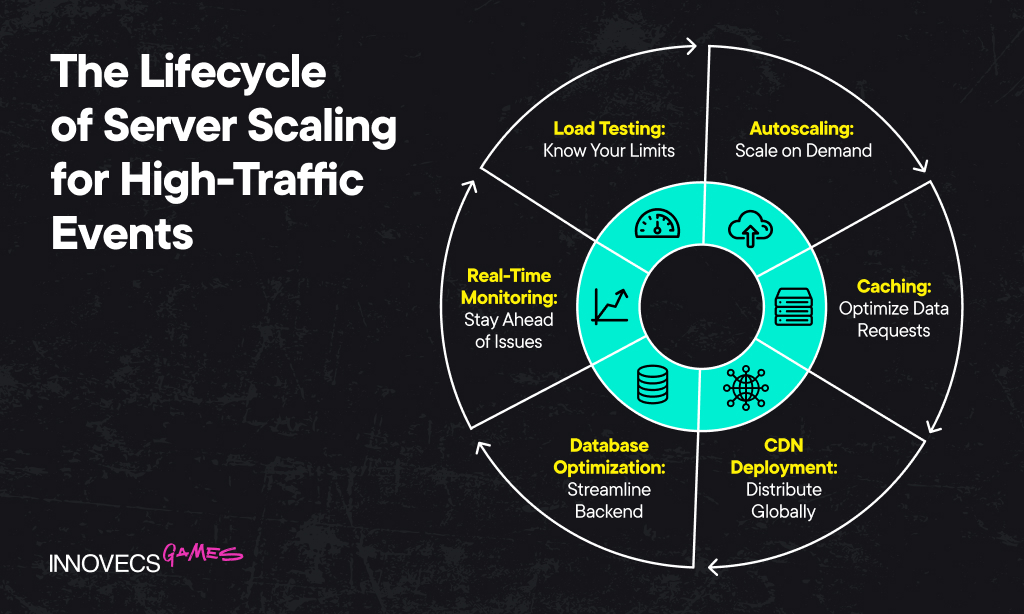
When the stakes are high, guesswork won’t cut it. Here’s how to stack the deck in your favor.
Load Testing: Know Your Limits
Ever hear the saying “hope for the best, plan for the worst”? That’s load testing in a nutshell.
Simulate high-traffic conditions to identify server vulnerabilities before they happen. Tools like JMeter or Locust allow you to mimic user behavior, stress-test your infrastructure, and address potential bottlenecks in advance.

Autoscaling Solutions: Roll with the Punches
Whether 10 players show up or 10 million, autoscaling solutions for games means your servers expand or contract capacity based on current loads.
Traffic spikes don’t send an RSVP. Autoscaling through cloud platforms like AWS GameLift, Google Cloud Game Servers, or Azure PlayFab adjusts your capacity in real-time.

Caching Techniques: Work Smarter, Not Harder
Caching is the secret weapon against redundant queries. Free up your servers so players get faster responses.
Tools like Redis or Memcached store temporary data, minimizing database queries and boosting database performance for games.

Content Delivery Networks (CDNs): Spread the Load
CDNs like Cloudflare or Akamai are built to keep latency in check by distributing data geographically making sure players get fast access no matter where they are.

Database Optimization: Don’t Let the Backend Bottleneck You
Techniques like query optimization, indexing, and horizontal scaling (using multiple database servers) improve database performance for games, ensuring backend processes remain fast and efficient.

Microservices Architecture: Build It to Scale
Transitioning to a microservices architecture enables modular scaling.
Instead of scaling the entire system, scale individual components, such as matchmaking or leaderboard services, independently based on their load requirements.

Real-Time Monitoring: Stay Ahead of the Curve
Don’t wait for players to tell you something’s wrong. Catch issues before they spiral and keep the gameplay uninterrupted. Use tools like Grafana, Datadog, or Prometheus to monitor your servers in real-time.

Edge Computing: Bring the Game Closer to Players
Reduce latency further by processing data closer to where players are located. Edge computing ensures that critical computations—like game logic or leaderboard updates—happen near the players rather than on central servers.

💡 Pro Tip: Ready to level up your server game? Check out our scalable game infrastructure solutions and make peak traffic a non-issue.