How to Make a Puzzle Game Players Can’t Put Down in Six Steps
Written for designers and producers who already like their mechanic and now need a few hundred levels that people actually finish (and open again the next day).
Hiroyuki Imabayashi’s 1981 game had exactly one rule, and you can say it in a breath: crates get pushed, never pulled. Sokoban went on sale with twenty levels. Forty-five years later, King’s community forum hands out a badge to Candy Crush Saga players who reach level 23,000, and the people who design those levels are still, at heart, arguing about where to put the crate.
That gap holds most of what you need to know about how to make a puzzle game. Then, in 1997, a University of Alberta computer scientist went and proved that solving Sokoban is PSPACE-complete, which is academic for “one verb and a few walls can outlast a computer.” And the pitches that land in our inbox? They tend to go the other way, with eight mechanics, two currencies, a story and a meta layer piled on top of a core rule nobody has played as grey squares yet. The deck is generous. The prototype, as a rule, isn’t much fun, because a puzzle’s depth comes from how hard a few rules are made to work, not from how many of them there are.
Sokoban’s own history covers the rest of the job. Imabayashi’s hobby version had five levels, the commercial release had twenty, and the 1984 sequel added fifty more along with a puzzle editor. A mechanic first, then levels that dig into it, then tools to make more of them. Put a short concept stage in front of that, to fix who the game is for, and you have the six steps below. They take you from the first concept to soft launch. After that we look at what changes when the game is a match-3 with years of new levels ahead of it.
What Separates a Great Puzzle from a Forgettable One
Take a puzzle game apart and there isn’t much in the box. You get some rules, some limits, a goal, and a route to that goal the game refuses to show you. Working out the route is the hard part. Once you’ve got it, walking it takes about five seconds. In Celeste you always know what to do; you just keep dying while you do it. In The Witness you can draw any line you like across a panel and still have no idea which one it wants. One’s an action game. The other’s a puzzle.
So puzzle game design leans on mechanics, levels and difficulty much more than on art or engine choice. A beautiful level with a bad rule is a screenshot. Threes took Asher Vollmer and Greg Wohlwend 14 months, and most of that went on fiddling with which numbers merge and how new tiles show up. The clones turned up within six days of launch. The famous one, 2048, was a weekend job by its creator’s own account, and it went viral on the borrowed rule. It did not copy the tuning, and the original remains the harder, deeper game. The rule set is the easy part to copy and the hard part to get right, which is why everything below starts with it.
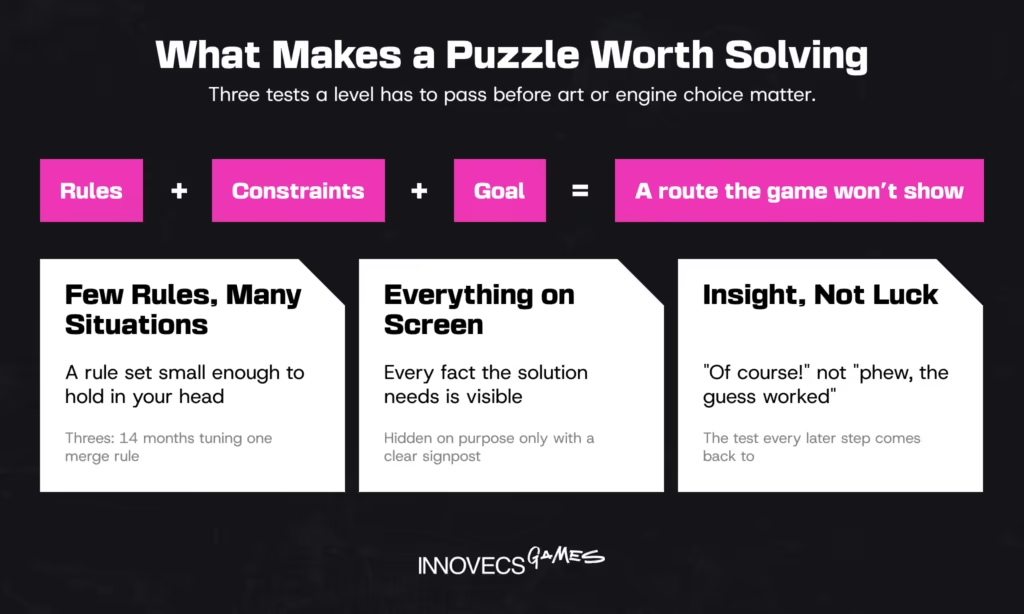
Then there’s fairness. If the player needs a fact to solve the level, that fact is on screen somewhere, and when the answer clicks they should think “of course!” rather than “phew, the guess worked.” Hold on to that test. It comes back in nearly every step below.
Types of Puzzle Games and the Thinking Each One Demands
Pick the type of puzzle and you’ve picked your production model, long before anyone starts talking about art. A logic or spatial game lives on hand-built levels that each take hours to design and test. A block puzzle can run on a single endless board and a well-tuned piece generator. Block Blast, which has no designed levels at all, was the most downloaded mobile game in the world in every month of the first quarter of 2026, by Sensor Tower’s rankings as quoted by its developer. Level designers are entitled to find that mildly insulting, and wise to take it seriously. These are the four broad types of puzzle games we see in pitches, and the kind of thinking each one asks of the player.
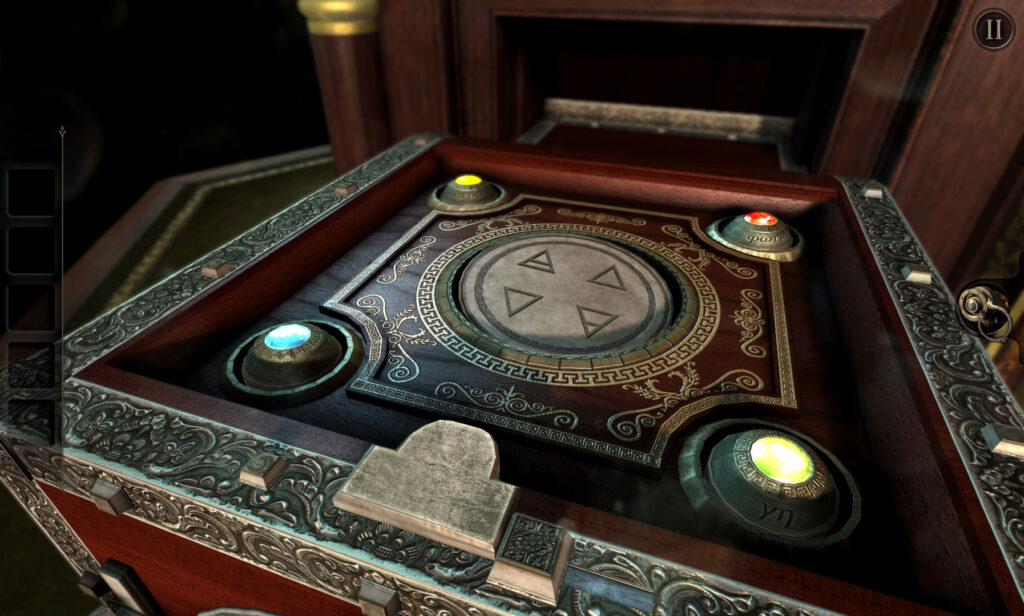
Logic and Deduction
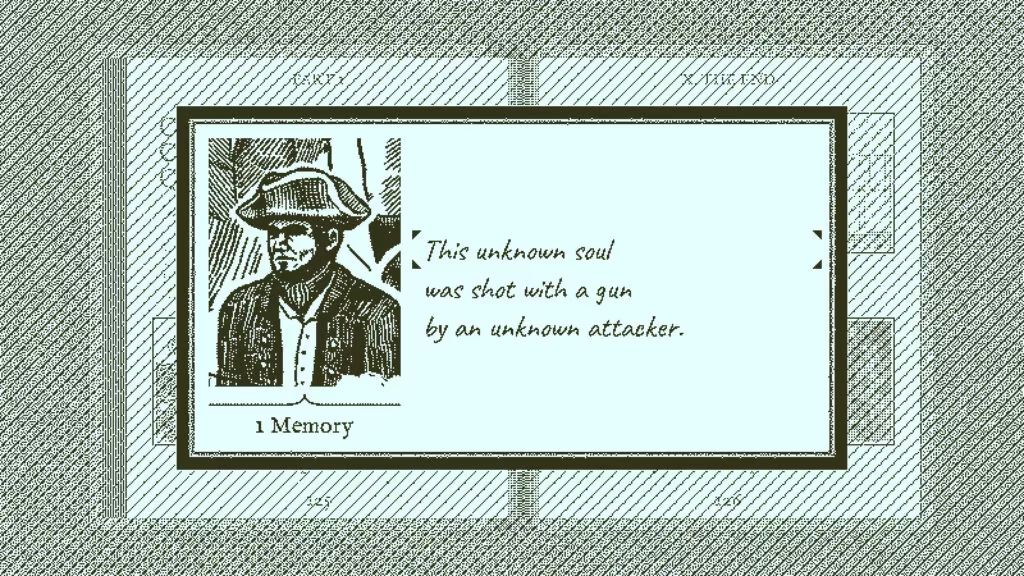
You have everything you need, there’s exactly one right answer, and if you get it wrong, blame your reasoning rather than the dice. Sudoku and nonograms are the old classics. The Witness and Return of the Obra Dinn are the genre with its sleeves rolled up. Designing one feels a lot like bookkeeping. You track what the player knows at each moment, when they get the next piece, and how many steps of thinking you’ve left between them and the answer.
Spatial and Physics
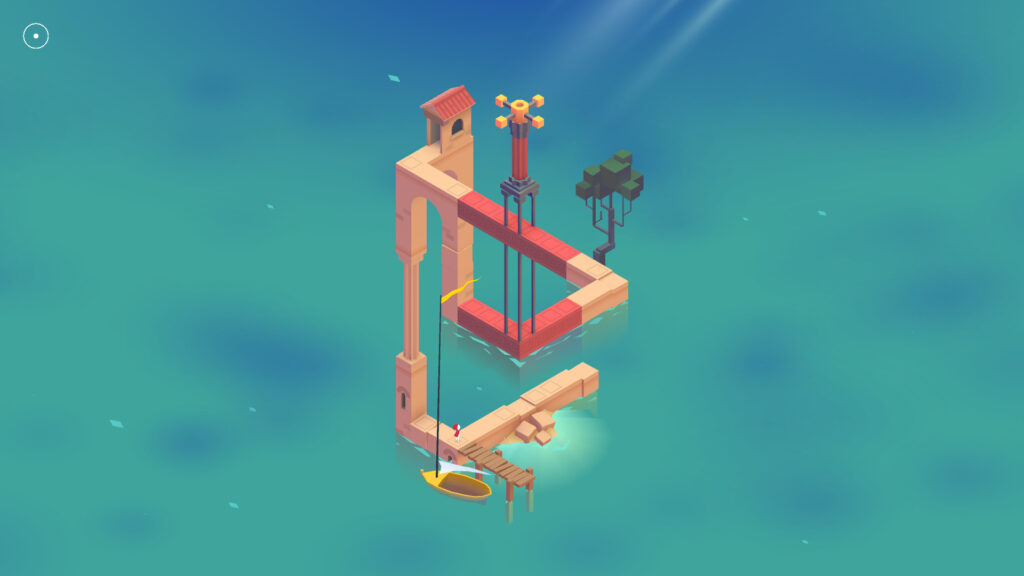
You push, rotate, cut or launch things, and the real test is picturing what happens a move or two ahead. Sokoban and its descendants belong here, as do Portal, Monument Valley and Cut the Rope. Physics adds timing and tolerance to the mix. It also adds a long hunt for the solutions nobody on the team meant to allow.
Tile-Matching, Block, and Merge
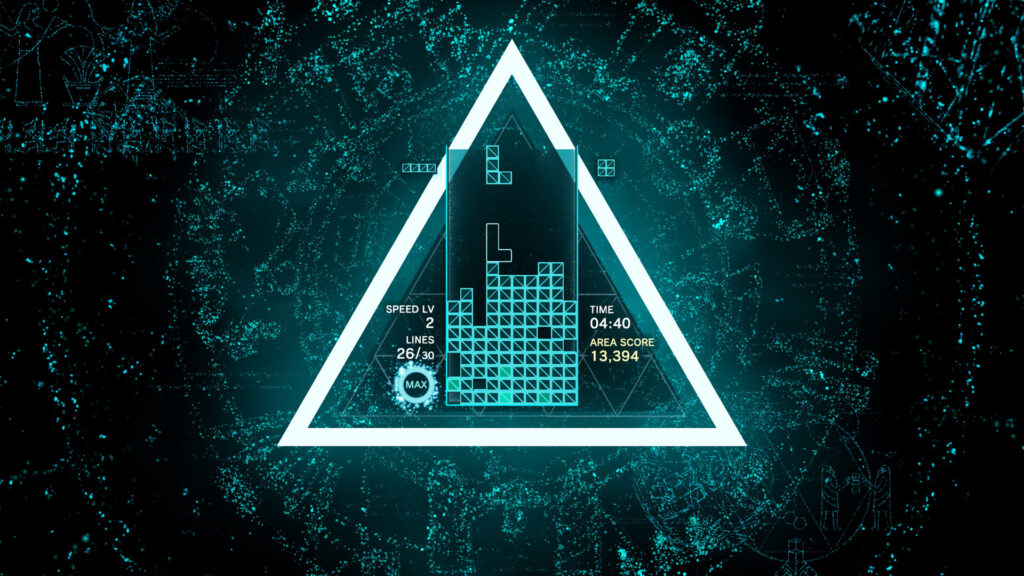
Here you’re spotting patterns and thinking a move or so ahead, and luck decides what drops in next. Tetris, Block Blast, merge games such as Merge Mansion and match-3 all belong here. This is the largest commercial category by a distance, so match-3 gets its own breakdown further down.
Word, Narrative, and Environmental
This last bunch borrows its puzzles from language, from story, or from the world around you. In a word game it’s your vocabulary on trial, and in a hidden object game it’s your attention. The Room and other escape room games test how closely you look and how sideways you can think. And the environmental puzzles in adventure games want you to read the room. Literally. How far can a small word rule go? Wordle settled that: one five-letter word a day, the same for everyone, and The New York Times paid a price in the low seven figures for it in January 2022.
This group also travels worst. A crossword or anagram puzzle can’t be translated, only rebuilt for each language with its own dictionary and its own difficulty tuning. Brazil’s Wordle, Termo, wasn’t a translation but a separate game with its own word list. That’s worth knowing before a publisher asks for twelve markets at launch.
The Puzzle Design Process at a Glance
Whatever the type, our projects go through the same six stages in the same order, with the expensive ones held back as long as we can. Studios ask us how to make a puzzle game faster all the time, and honestly the order is most of the answer. New to this and not sure how to design a puzzle game at all? Then the table below is your map. The steps below carry the same numbers. Read the last column as the exit test, because nobody moves on until it’s true. And put the decisions in a short game design document, since heads forget.
| # | Stage | What gets decided | Typical time, mid-size mobile puzzle | Where it’s covered | Finished when |
|---|---|---|---|---|---|
| 1 | Concept | Audience, session length, platform, business model, meta layer | 1 to 2 weeks | Step 1: Pin Down the Concept | All four constraints fit in one paragraph the lead designer and producer both sign |
| 2 | Core mechanic | One thing the player does, and the rule that makes it matter | 2 to 4 weeks | Step 2: Mechanics | The designer has 30 level sketches that don’t repeat, and every element has a row in the interaction grid |
| 3 | Rules and win state | What every piece does, and how you win or lose | 1 to 2 weeks | Step 3: Rules, Win States, and Fail States | The rules fit on a page, and an engineer could build them without asking anything |
| 4 | Paper or graybox prototype | Are 15 levels fun with zero art? | 3 to 6 weeks | Step 4: Build and Test a Prototype | Strangers finish the levels unaided and ask for more |
| 5 | Level set | Teaching, review, how hard levels get and how often new ones ship | 2 to 6 months | Step 5: Level Design, Difficulty, Progression | 100 to 200 levels are through review, and the curve still holds in closed tests |
| 6 | Playtest and polish | Is it readable, is it accessible, and what soft launch tells you | Alongside stage 5, then another 1 to 2 months | Step 6: Playtest, Polish, and Soft Launch | Soft launch hits the targets you wrote down before it started |
Two stages get skipped more than the rest. The first goes because it feels like paperwork when everyone wants to build something. The fourth goes because art directors want the game to look like something before a publisher sees it. But a mechanic that isn’t fun as grey squares won’t be fun with lighting on it either, and finding that out in week six costs a great deal less than finding it out in month six. Both stages are short, and the first is where we start.
Step 1: Pin Down the Concept Before the Mechanic
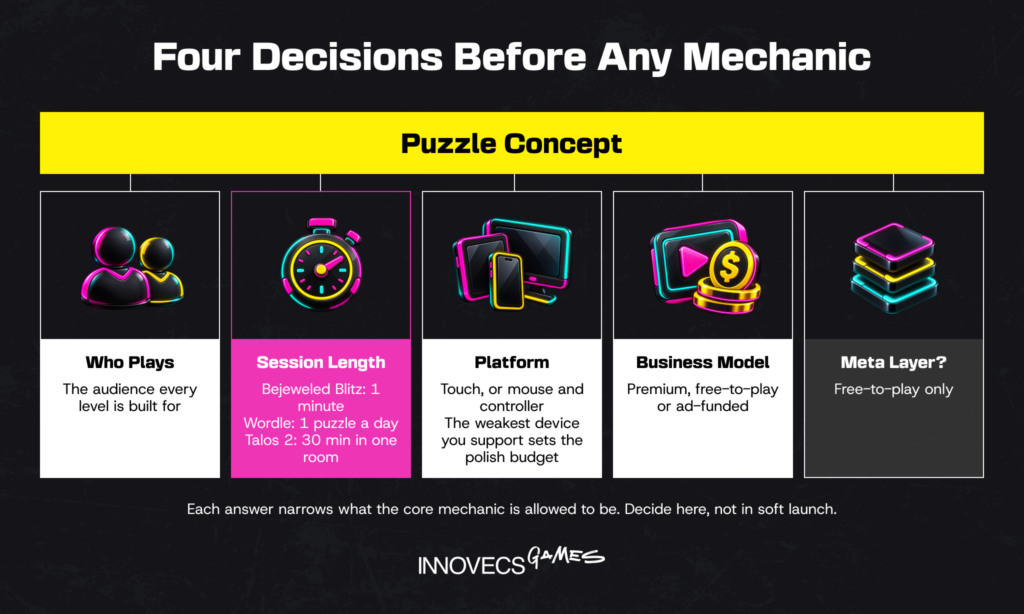
A puzzle concept is really four decisions. Who plays? For how long at a stretch, and on what device? How does the game pay for itself? Every answer narrows what the mechanic is allowed to be, and free-to-play throws in a fifth question, which is whether you need a meta layer at all. None of this is design yet. It’s fencing. The warning from the intro still applies, too: saying the game will have a meta layer is fine, but designing that layer before the core rule works is not. Skip the stage and you’ll get the answers anyway, only later, in soft launch, when acting on them means tearing up levels you’ve already built.
Audience, Session Length, and Platform
Of the four, session length hits level design hardest. Bejeweled Blitz is over in a minute. Wordle hands out one puzzle a day and closes for business. The Talos Principle 2, on the other hand, won’t mind if you spend half an hour staring at one room. Whatever your number is, a level should finish comfortably inside it. A game built for three-minute commutes has no room for levels that need fifteen minutes of thought, however clever they are, because nobody’s solving one of those between two metro stops. They close the app, and more often than any producer would like, forget it’s installed.
Platform comes next. Touch screens love big targets and clean, one-tile-at-a-time moves, and they punish anything that needs pixel precision. With a mouse or a controller you can get away with finer spatial puzzles. On PC and Switch, people still pay upfront for puzzle games. The free-to-play money, though, is nearly all on phones. Pick the weakest device you’ll support and write that down as well. In our experience it’s a budget Android phone, not the art director, that ends up deciding how much animation and effects polish the game gets.
Premium, Free-to-Play, or Ad-Funded
The business model reaches into level design further than most teams expect. Here’s how the three models we meet most often play out:
| Model | How it earns | Example | What it changes in level design |
|---|---|---|---|
| Premium | Players pay once | Monument Valley: 2.4 million copies at $3.99 in nine months | You can make it harder and let it end, but every level has to feel worth the money |
| Free-to-play with purchases | Players buy boosters, extra moves, lives and passes | Royal Match | Move limits and blockers turn into money levers, and you’ll need a meta layer and live ops |
| Ad-funded | Players watch rewarded and interstitial ads | Block Blast: about $127 million in ad revenue by August 2026, Sensor Tower estimates | Sessions are short or endless, and ads go between rounds, never in the middle of a thought |
One rule holds in every row. Never sell the only way past a level. Machinations makes the same point in its guide for designers of puzzle games, and players are right to read a paywall in front of a puzzle as the designer giving up on it. Paid boosters and extra moves are fine as long as a patient player can still win without them. A hint or skip that only money can buy isn’t, and players can spot a toll booth from the level select screen.
The Meta Layer
In free-to-play puzzle games, the meta layer is the second game players return for. In Homescapes your stars pay for a renovated house. Merge Mansion hides its board inside a renovation mystery. That one had passed 60 million downloads by the time Supercell agreed in 2026 to buy the rest of its studio, Metacore. A meta gives players a story that lasts longer than one level, and it gives live ops a place to hang events. The bill is real, though. You need a separate art pipeline, an economy and a UI of its own, and if you design it after the puzzle core, it usually looks bolted on. Decide here whether you’re building one, because it changes the size of the art team more than any puzzle decision does. For a studio’s first free-to-play puzzle game, we’d go with a deliberately thin meta done well. An ambitious one tends to eat half the art budget before anyone knows whether the puzzles are fun.
Puzzle Game Mechanics: Building Everything Around One Core Idea
This is step 2 of 6.
With the constraints on paper, the real design starts. By core mechanic we mean one action the player repeats in every level, plus the rule that makes it matter (our guide to game mechanics covers the general theory). Puzzle games are stricter about this than most genres. There’s no story to drag you along and no reflexes to show off, so the mechanic carries everything. Strong puzzle game ideas rarely come out of an open brainstorm. Arvi Teikari built the first version of Baba Is You at the 2017 Nordic Game Jam, where the theme was “Not There,” and the constraint forced a strange idea that turned out to have depth. Jams and hard limits work, and so do a handful of other starting points we keep seeing on projects:
- Cross a theme with a system. List what happens in a setting and ask which of those things could be a rule. A kitchen gives you heat, timing and order of operations; a circus gives you cannons, trapezes and things thrown in arcs.
- Ask “what if” about an existing rule. What if crates could be pulled as well as pushed, or the exit moved one tile every turn?
- Reverse a known puzzle. Start from a solved board and make the player take it apart, or turn matching into the hazard instead of the goal.
- Pair two mechanics nobody has paired. Strip Baba Is You down and you’ll find Sokoban after it met a programming language. Portal 2 got its gels when Valve hired the students behind Tag: The Power of Paint, and paint plus portals was enough for a whole sequel.
- Keep the bugs that are fun. Some strong mechanics began as an unintended interaction that playtesters wouldn’t stop exploiting. Log those before fixing them on reflex. QA will file it as a bug. Players, given the chance, might call it the best thing in the game.
Choose a Mechanic with Depth, Not Just Novelty
Novelty buys you one surprise. Depth is what’s still handing out new situations an hour later, after the surprise has worn off. We use a crude test, and it hasn’t let us down yet: before anyone writes code, ask the designer for 30 level sketches on paper, each built on a different idea. Repeats by level 12? It’s a gimmick, sorry. Threes would have passed easily. One small rule does it (a 1 and a 2 make a 3, and anything bigger only merges with its twin), and it keeps throwing up boards nobody drew by hand.
Digital or Analog, Core or Supporting
Two questions tell you a lot about a mechanic before a single level exists. The first: digital or analog? A digital mechanic has a handful of states and nothing in between. The switch is on or it’s off; the crate sits on this tile or that one. Analog is a sliding scale, where a physics object can land anywhere and the rope in Cut the Rope can be cut at any point you like. Digital levels are easy to think through and easy to hand to a solver. Give players too few states and they’ll stop thinking and just flip every switch to see what happens. Analog, meanwhile, is where surprises and emergent solutions come from. The price is weeks of tuning tolerances, until “nearly right” stops feeling like a fail. Our advice is a digital core with a little analog around the edges. Physics makes a wonderful servant and a terrible level designer.
Question two is which mechanic is the boss and which ones work for it. The helpers either fence the core in (a tile you can’t push onto, a move limit) or stretch it (a teleporter that takes the crate along). Try deleting one. If nobody would think about the level any differently, you’ve found decoration, and it still costs a row in the interaction grid below.
Map Every Possible Interaction
Once the elements exist, list how each one behaves against every other. Take a simple invented mechanic we’ll call “Frostbound”: the player pushes crates across a grid, and some floor tiles are ice.
| Element meets… | Crate | Ice tile | Hole | Another crate |
|---|---|---|---|---|
| Player | Pushes it one tile | Slides until stopped | Fails the level | Can’t push two at once |
| Crate | Not applicable | Slides until stopped | Fills it, becomes floor | Stops against it |
Why bother? Because it shows you two things. One is the fun stuff: the crate slides across the ice, drops into the hole, fills it, and suddenly you can walk over. The other is every gap in your rules, since an empty cell is basically a bug report nobody has written up yet.
Layer New Elements Without Breaking the Rules
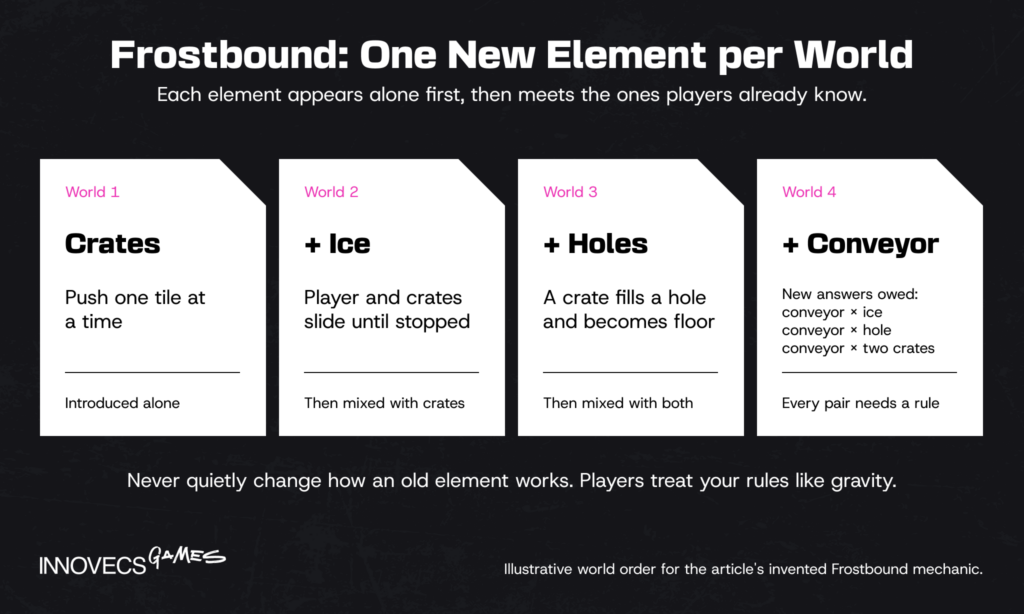
After a world or two, players want something new. Fine, but the new thing has to get along with everything already on the board. Add a conveyor belt to Frostbound and you now owe the team answers for conveyor and ice, conveyor and hole, conveyor and two crates in a row. Our cheapest habit is a dull one, and it works. Every world introduces one new element. It shows up alone first and mixes with the old ones later on. How much rule-writing can one addition take? Look at Portal 2’s gels. Gel goes through portals. One gel per surface, no more. Some surfaces refuse it, and water washes it off. Each of those lines is there because a playtester would otherwise have stood up and asked. One more thing, about old elements: leave their behavior alone. Players treat your rules like gravity, and gravity that quietly changes feels like cheating. And they hold that grudge longer than any patch cycle.
Give Players All the Information They Need
If a solution depends on something the player can’t see, the level stops being a puzzle and turns into trial and error. Return of the Obra Dinn puts every clue to sixty deaths on the ship somewhere and expects you to find it. Hiding something on purpose, as a mystery, is allowed. Just put up a signpost, and make the way to uncover it a rule that players can actually learn. Randomness is the hard case. Match-3 games draw new pieces at random, so the designer can’t guarantee one solution path. The fix there is to tune the odds, not to hide them, which we come back to in the match-3 section.
Step 3: Rules, Win States, and Fail States
So the mechanic is what the player does, and the rules are the rest of it: when they’ve won, when they’ve lost, what happens in between. Those rules get their own short document before anyone builds a level. One page is the right size. If it runs longer, the game probably has more rules than players will hold in their heads.
| Decision | Common options | Examples |
|---|---|---|
| Win condition | You reach a spot, clear a set of goals, or complete a pattern | In Monument Valley you walk to the end of the path, in Candy Crush Saga you clear the jelly, and in Sudoku or Obra Dinn you get every cell or fate right |
| Fail state | You can’t fail, you run out of moves, or you run out of time | The Witness never lets you lose (you just haven’t solved it yet), Candy Crush Saga stops when the moves run out, and Bejeweled Blitz stops when the minute’s up |
| Unwinnable positions | Design them out, spot them and offer a restart, or lean on undo | Sokoban: push a crate into a corner and it stays there forever |
| Randomness | Fixed boards, seeded boards or random refills | Logic puzzles never change; match-3 drops random pieces and reshuffles when you’re out of moves |
The fail-state row is the one with commercial consequences. A game with no fail state can’t sell extra moves, and a game with a hard move limit has to decide whether undo is free, limited or a booster, which pulls the business model from Step 1 straight into the rules. Unwinnable positions are the row teams forget. Picture a player who’s stuck and doesn’t know it. They’ll try for ten minutes, then blame the game, and to be fair they’ve got the right suspect. Two fixes work. Either the game spots the dead end and tells them, or undo is always one tap away.
Step 4: Build and Test a Prototype Before You Fund the Level Set
A one-page rule set nobody outside the team has played is still just a theory. So build whatever’s cheapest that lets a stranger play. Paper and tokens work for most grid puzzles. PuzzleScript, a free browser engine for turn-based grid games, gets a playable version online in an afternoon. A graybox scene in the real engine costs extra days, and we’d only pay that for physics or 3D puzzles, where the feel of moving is part of the mechanic. Paper or pixels, you want ten to fifteen levels with no art and no meta. The question at this stage is narrow: does the rule hold up for a stranger? Even games remembered for their art start this way. Monument Valley began as a single Escher-style concept drawing under the working title Tower of Illusion, and the finished game stayed close to it.
Most puzzle prototypes don’t survive their first room of strangers. What a dead concept really costs is the weeks a team spends hoping the next build will fix it, so we put three gates in front of the level set and give each one the power to end the project:
| Gate | When | What has to be true to continue |
|---|---|---|
| Playable prototype | Weeks 3 to 6 (paper or graybox is fine) | 10 to 15 levels get finished by strangers with no help, and some of them want more |
| Marketability test | Before art production | Ad creatives cut from real gameplay bring installs at a cost the genre can carry |
| Soft launch | After the first 100 to 200 levels | Early retention holds, and no single level ends a large share of sessions in the funnel |
The second row is the one teams resist, because it asks marketing questions of a game that barely exists. It’s also the cheapest way to learn that a clever mechanic doesn’t fit in a five-second ad. The ad network has no opinion on how elegant your rule is.
Hit-dependent studios get better odds from several cheap prototypes than from one expensive one. What we usually suggest is two or three concepts going through the first gate side by side, often built by a small external pod so the core team can stay on the live game. The release slate stays full, and nobody gambles with the next update.
The first gate is the one that releases the level set. Gate two comes just before art production in Step 5. Gate three is the soft launch, in Step 6.
Level Design: Teaching Through Play
Step 5 of 6, part one: building the levels.
Once the prototype clears the first gate, its ten to fifteen test levels become the seed of a few hundred. (The marketability test from Step 4 also runs in the first weeks of this step, before art production starts.) Here’s the awkward bit of puzzle game level design: one screen often has to teach a rule and test it at the same time. Teikari ran into exactly that right after the jam. He could make a playful sandbox that showed the system off, or a properly hard puzzle game, and doing both at once wasn’t easy. Most good level sets settle it the same way: sandbox up front, and the challenge grows out of it.
Build a Level Editor Early
Before the first production level gets built, the tool that builds them has to exist. There’s a reason Sokoban 2 came with a puzzle editor back in 1984. A puzzle game is a level factory, and the editor is the factory floor, so start building it while the prototype is still on the table rather than after alpha. Three features pay for themselves almost at once. The first is a play button that launches the level right from the editor. Then add a solver button for the shortcut check (more on that below), plus tags for difficulty and for the mechanic each level teaches. Some studios end up shipping the tool: Baba Is You gave its editor to players in November 2021, complete with online sharing. Ours never get that polished, if we’re honest. They do get used every day, which is the point.
Onboarding Levels That Explain Themselves
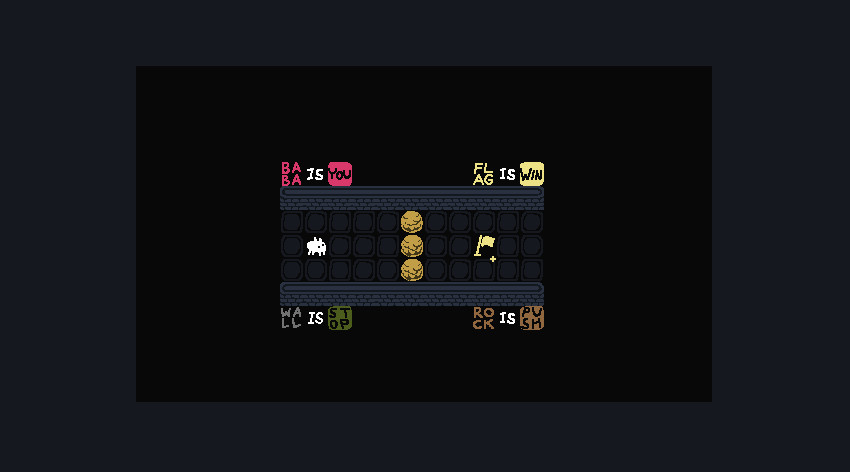
Baba Is You writes its rules on the floor in words you can push: BABA IS YOU, FLAG IS WIN, WALL IS STOP. You learn by walking around. A few minutes in, you’ve nudged a word out of line, and the walls (oops) no longer stop you. No tutorial text explains this. The design is the tutorial. We use the same structure for onboarding levels on client projects. Each level teaches one rule. The layout leaves the new move as the only interesting one, and the solution is impossible to miss but still has to be done by hand. When a playtester asks “what am I supposed to do?”, that’s on the level, not on them.
Work Backwards from the Solution
Strong levels are rarely designed from the start state forward. Good designers start with the “aha” (the single insight the level exists for) and grow the board around it. Say the Frostbound insight is this: shove the crate across the ice into the hole behind you, then walk back over it. So the last move comes first. Next come the walls and the ice, placed so that move is the only way out. Red herrings go in last: a second crate that looks handy, a tempting path that dies one tile short. They make the level harder without adding a rule, and that’s the kind of hard players forgive.
Then two checks. First, number the moves of the solution and look for any that take no thought at all. Eight moves and one idea means one idea plus seven chores. Second, run it in reverse. Set up the solved board, take a few pieces away, and see if putting them back gives you a better puzzle than the one you built forwards. The levels we like best tend to give one object two jobs. The crate you used as a bridge turns out to be the weight for a switch, and spotting that is the whole insight.
Remove Shortcuts and Unintended Solutions
Every level has the solution you designed and, unless you check, a few you didn’t. Players will find those within hours of launch, and they’ll have posted them by the evening. For grid games we lean on a solver. It’s a dumb, tireless script: it tries every sequence of moves up to some limit and reports every solution it found, the shortest one, and whether a single wrong move can make the level unwinnable. Physics puzzles need people instead, and you tell them outright that their job is to break the level. Even a designer as careful as Teikari admitted that “it’s extremely easy to be blind to certain types of unintended solutions,” as he told Game Developer a year before Baba Is You shipped. Human testers split into two useful groups, and you need both: experienced puzzle players find the shortcuts and alternate solutions, while first-time players find the gaps in your teaching. Neither group is good at the other’s job. Lucas Pope solved a related problem in Obra Dinn’s design, where players could brute-force the answers: correct fates are confirmed only in sets of three, so guessing gets you almost nowhere. The shortcut is closed by a rule, not by policing the player, which is the best kind of fix.
Run Every Level Through the Same Review Pipeline
A level set of any size needs the same path for every level, whoever built it. Ours has five stops:
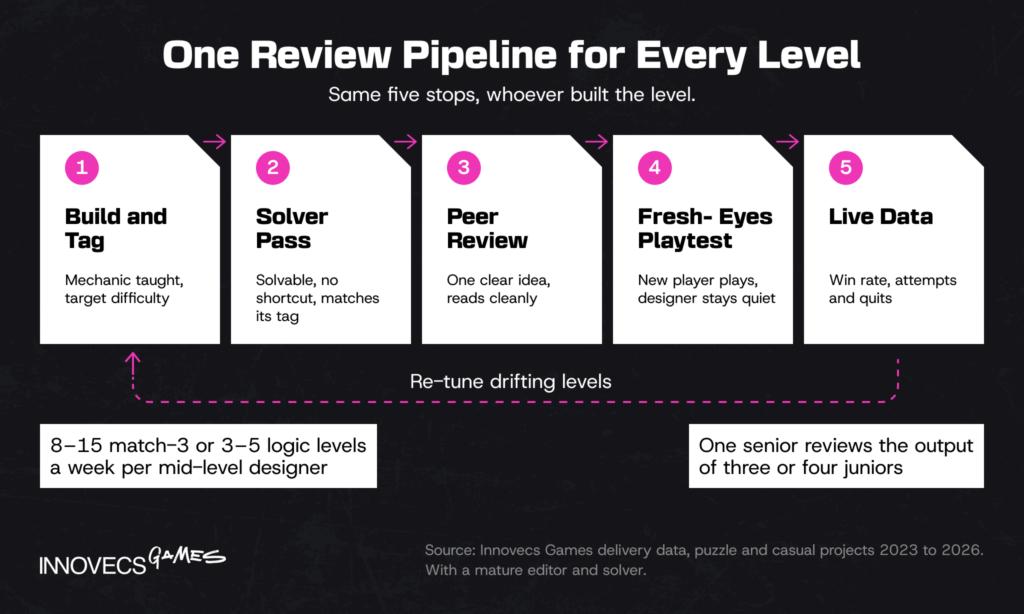
Stop four is the one designers dread. Watching a stranger miss the obvious move in your favorite level, without being allowed to say a word, is a small daily humiliation, and it’s also the most useful twenty minutes of the week. How fast does it go? Give a mid-level designer on our projects a mature editor and solver, and you’ll get roughly 8 to 15 shippable match-3 levels a week, or 3 to 5 hand-built logic levels (those take far longer to verify). It’s also what keeps a team full of juniors out of trouble. Juniors do the building and the solver catches their mechanical slips, so one senior can check the work of three or four people instead of redoing it.
Tuning the Difficulty Curve Without Frustrating Players
Step 5 of 6, part two: pacing.
A review pipeline makes each level sound on its own. Whether the levels work as a sequence is a separate question, and the difficulty curve is where good puzzle games lose players they’ve already won. Back in 2015 ustwo shared its Monument Valley sales numbers, and that game is about as gentle as puzzles get. Even so, only half of buyers had finished it, and they’d paid upfront. Put a harder curve in a free game and people leave faster, each of them at a particular level you can find in the data. Nobody’s asking for everything to be easy. You want the hard levels to feel earned, the way good game balance keeps any system fair to whoever’s playing.
Difficulty vs. Confusion
Hard is when the player gets the rules and sees the goal but can’t see the way yet. Confusing is when they aren’t sure what the rules even are, what counts as winning, or why their last move did that. Players will happily sit through hard. Confusing makes them quit. In a playtest the difference is easy to spot: hard looks like long silences and then careful attempts, and confusing looks like random tapping and somebody muttering “wait, why did that happen?” The fix for difficulty is often a breather level. Confusion, on the other hand, nearly always means the teaching level a few steps back wasn’t clear enough. Here we’d shamelessly copy The Witness. Not one of its symbols is explained in words. Each new one turns up in a few panels so simple that only one rule could possibly explain them.
Alternate Peaks with Breathers
A rising straight line exhausts people. Most successful level sets use sawtooth difficulty instead: a run of levels climbs to a peak, then drops into one or two easier levels that let the player use their new skill and feel good about it. A typical band of ten levels in our projects looks like this:
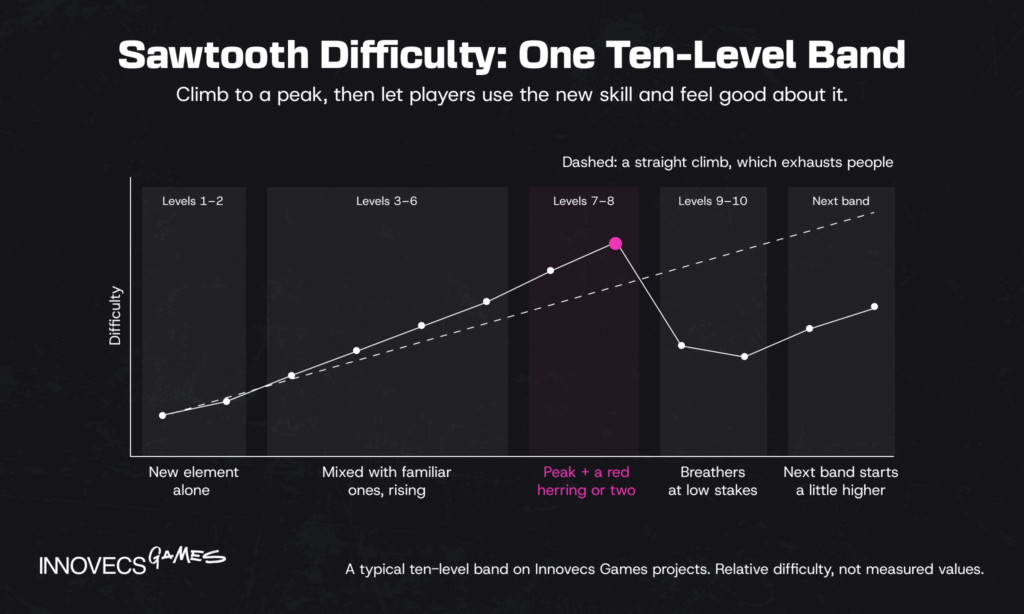
Candy Crush Saga adds a nice touch. It marks its peaks on the map as Hard or Super Hard levels, so players walk in knowing, and a wall becomes a challenge they picked. It’s a small piece of honesty, and we’d copy it into almost any level-based game. Pacing matters more in mobile puzzle games because session length is short. A player who hits a peak at the end of a five-minute session closes the app on a loss, and some of them don’t open it again.
Hints, Undo, and Other Safety Nets
Any deterministic puzzle needs undo. Leave it out, and one slip of the thumb means starting over, which the player will (unfairly, but still) pin on you. Hints work best as a ladder. A nudge toward the right area comes first, then the first move, and only then the whole solution. Professor Layton went further and turned hint coins into a collectible, so asking for help felt more like cashing in a reward. Skips are the last resort, and we’d still offer them, because a player who skips one level and keeps playing beats one who quits on it. In free-to-play games the same safety nets are also what’s on sale, and Step 1’s rule applies: never sell the only way past a level.
Measure Difficulty Before Anyone Plays
A solver can do more than prove a level works. It can also guess how hard a level is, so a designer can sort a pile of candidates before anyone plays them. The author of Board Game Analysis set out the levers after generating chess-based puzzles in bulk, and they match what we see on grid games:
| Solver metric | What it measures | Effect on difficulty |
|---|---|---|
| Solution length | Moves in the shortest solution | Longer is harder, until it tips into tedious |
| Branching | Valid moves available at each step | More options, more to hold in your head |
| Dead-end depth | Moves before a wrong choice reveals itself | The strongest lever: late-revealed mistakes hurt most |
| Dead ends vs. solutions | Wrong paths compared with right ones | Fewer solutions and more traps make a harder level |
Does any of this replace a playtest? Not a chance, and nobody claims it does. Where it pays off is the level that looks gentle on screen but hides a dead end twelve moves deep, which is the level a tired designer approves at the end of the week.
Spot Drop-Off Points in Playtest Data
Opinions from playtests tell you what people felt. Analytics tell you where they left. These are the signals we watch from the first closed test onward:
| Signal | What it tells you | What we usually do |
|---|---|---|
| Completion rate per level | Where the curve is steeper than intended | Move the level later or add a breather before it |
| Attempts per level | Whether difficulty comes from thinking or from luck | High attempts with low time per attempt points to luck; reduce randomness |
| Quit points (last level played) | Which level ends sessions for good | Playtest that level with fresh players, watch for confusion |
| Hint and undo use | Where players are stuck but still trying | Treat as an early warning before quit rates rise |
| Time to first move | Whether the level reads clearly | Long pauses on early levels mean the teaching failed |
The pattern that should worry a producer most is a quit spike right after a peak with no breather behind it. It’s the cheapest fix in the whole list (reorder two levels) and the one most often found three weeks after soft launch.
King does this at a scale few studios can touch. Its data team told GDC in 2024 that it looks at two numbers side by side, how long players take to give up on a level and how long they take to beat it. With those, it regularly pulls out the 100 least fun levels in Candy Crush Saga and fixes them. The talk’s most quoted example was level 65, once the game’s final level: it earned more money than any other level and drove more players away than any other, and easier versions kept people playing longer. “Crazy hard levels never pay off, at least in the long term,” as King’s head of central insights put it.
Progression, Rewards, and Live Content
Step 5 of 6, part three: progression and release cadence.
Can players finish a level? That’s difficulty. Do they want to start the next one? That’s progression, and whether a next one even exists is down to the release schedule. We’d settle all three while the level set is still being built, because the map, the rewards and the content plan each change which levels get made.
Linear Paths or Open Level Maps
A strictly linear sequence is the easiest to tune, because you know exactly what every player has seen. It’s also the structure most likely to lose people, since one wall stops everything. Opening several levels at once fixes that. The Talos Principle 2 asks for eight puzzles in each of its twelve areas and lets players pick the order, with optional puzzles on top. The Witness lets you walk away from a panel and come back later with a new idea. On mobile, our usual compromise is a linear path with occasional forks, with two levels open at once at the points where playtests show the most quits.
Stars, Unlocks, and Other Rewards
Rewards work best in puzzle games when they point back at the puzzle. Cut the Rope and Angry Birds made the three-star rating standard, and it’s a neat trick: experts get a second game inside the first, and nobody else’s level gets harder. Unlocks (a new world, a cosmetic theme, a fresh mechanic) make the map feel like it’s going somewhere. Give out achievements for odd solutions too; that’s exactly the poking-around you want more of. What doesn’t work is inflation: when every level ends in confetti, the confetti stops meaning anything.
Live Events and Content Cadence
Once a free-to-play puzzle game is out, the release schedule is a design constraint like any other. Events are how you stop it feeling like a treadmill. Well, for players. For the team it’s still a treadmill, just a better-lit one. You’ll mostly see limited-time level sets, win-streak challenges, collection events (finish levels, earn pieces of something) and seasonal reskins of old worlds. Each one reuses the core mechanic, which is why they’re cheaper than new content and why they wear out if the core is thin.
The arithmetic deserves a line in the plan. Candy Crush Saga adds 30, 45 or 60 levels every Wednesday, a pace few teams outside King could sustain. A more typical target, thirty new levels every two weeks, is 15 a week, which at our throughput figures above is one to two level designers doing nothing else, before a single event is built. Before global launch, most teams we work with also bank 8 to 12 weeks of validated levels, so one bad sprint never turns into a missed update. And when the work spills over, it’s usually event art packs and reskins that spill. There’s a lot of it, the deadlines are tight, and once a style guide exists a second team can pick it up.
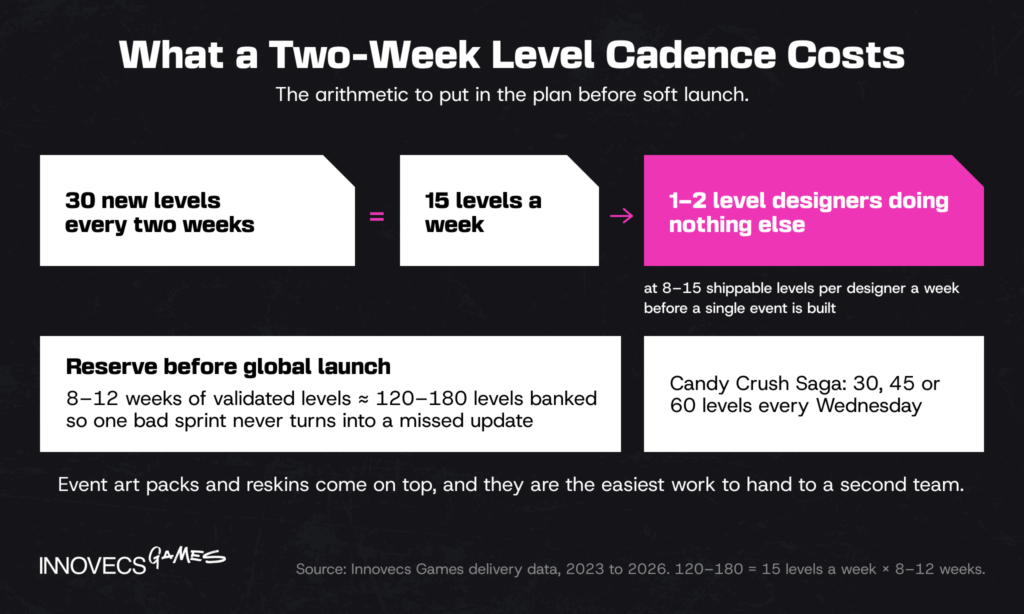
Live cadence is a staffing decision; making it after launch means the reserve runs out before the hiring does.
Step 6: Playtest, Polish, and Soft Launch
“Polish” sounds like decoration, and in most genres it partly is. In a puzzle game, it’s what lets a stranger read every move, tell every color apart and get a fair shot at every level. It also runs next to the level set right up until soft launch tells you whether the whole thing works.
Make Every Move Readable
Can the player read the board at a glance, and see what their last move did? If not, the puzzle isn’t fair, however clever it is. We run these checks on every build:
- State is visible without inspection. If a tile is slippery, locked or about to change, it looks like it from arm’s length. If you have to tap a tile to learn what it does, the art has failed.
- Every move answers back. A short animation and a sound confirm a valid move, and an invalid one gets a distinct, gentle response. Silence reads as a bug.
- Show the result before the commitment. Tetris’s ghost piece, the outline of where the falling block will land, is listed among the indispensable rules of the official Tetris Guideline. Any puzzle where a move can’t be taken back benefits from the same preview.
- The HUD stays small. Moves left, the goal and an undo button. Everything else can live in a menu.
- Rules can be looked up again. A player returning after two weeks needs a way to check what the blue tile does without replaying world three.
Teams underestimate how much of a puzzle’s feel lives in this layer. The click of a piece settling into place is part of why a correct move feels correct, and cutting that audio pass to save a week makes the whole game feel less certain of itself.
Design for Color Blindness from Level One
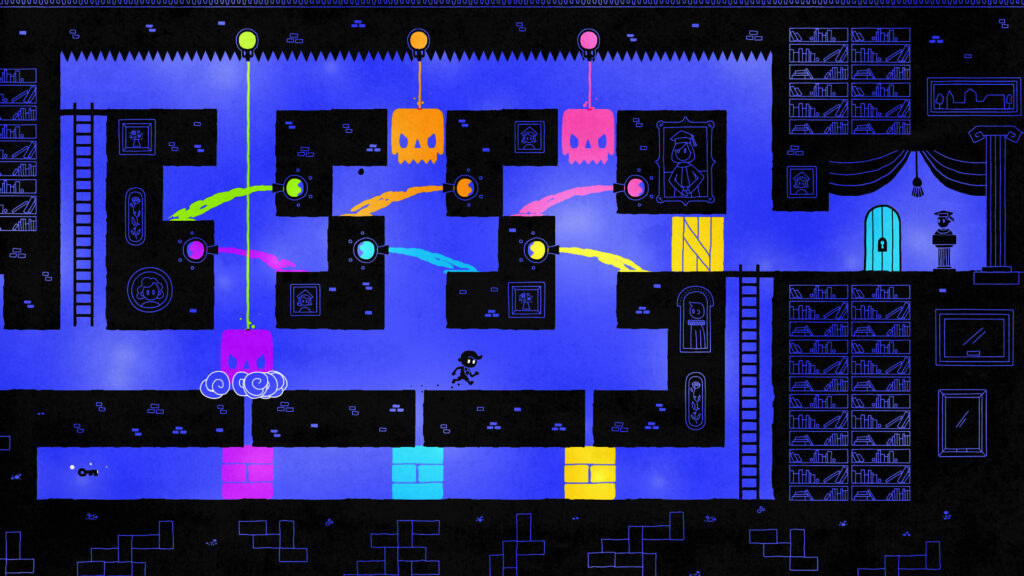
Around 1 in 12 men and 1 in 200 women have some form of color blindness. Puzzle games, meanwhile, use color for almost everything. Match-3 pieces, colored keys and switch states are the usual offenders. Hue is a puzzle platformer about switching colors, so for its team color blindness was never a side issue. Patterns were the first try and turned out too noisy. What shipped was one option that puts a small symbol on every block of color. Fixing this in month one costs almost nothing; in month nine it’s a rework. Give every color a backup signal (a shape or an icon will do), and put screenshots through a color-blindness simulator while the art can still change. And treat colorblind mode as an extra, not as the one door some players are forced to use. We’d make this a rule, not a feature request, because the cheapest moment to add a symbol to a gem is before anyone has painted the gem. Big touch targets, undo everywhere and no timers unless the design truly needs one all started life as accessibility fixes, and they end up helping nearly everybody.
Playtest With Strangers, at Scale
Colleagues stop being useful testers after the first week, because they already know the rules. By December 2013 Monument Valley’s beta had more than 1,000 testers, and on average they finished in 90 minutes. That’s how ustwo knew its short, finishable premium game really was short and finishable. On a free-to-play game that’s the closed test’s job, with full analytics running. Before anyone says the words “launch date”, per-level events should be firing, sessions should be recorded (where players said yes), and the drop-off table from Step 5 should be full of real numbers.
Soft Launch Without Surprises
Soft launch is gate three from Step 4. Being prepared matters more here than being brave. Royal Match first went live only in Canada, Turkey and the UK before going global. Before the first install, we want this lot in place:
- Events for every level start, win, loss and quit, and for each hint and undo (yes, all of them).
- Remote config for move counts, hint timing and level order. When a level’s numbers look bad, you fix it that afternoon.
- Working A/B tests. Tiny ones are fine to start.
- The level reserve from Step 5, so the team spends soft launch tuning, not panicking.
- Crash and ANR reporting on the cheapest devices in the target markets.
- A clear rule for what result moves the game to global launch, and what result stops it.
There’s no Step 7. From here the level pipeline is the product, which is what the match-3 section covers.
Match-3 Games: The Same Principles at Commercial Scale
None of the above stops applying with match-3. What changes is the scale, and at that scale the work gets organized differently. Dream Games ships new Royal Match levels every two weeks, and the game had passed 12,400 of them by November 2025. Candy Crush Saga had more than 18,700 levels by May 2025, according to AP, and the level 23,000 badge from the top of this guide shows how far it has climbed since. The money matches the volume. By PocketGamer.biz’s count, Royal Match has pulled in more than $7 billion from players since 2021. Its sequel, Royal Kingdom, crossed $750 million in July 2026 after 19 months in soft launch. So if you’re figuring out how to make a match 3 game, forget the perfect level. What you’re really building is a machine that turns out thousands of good ones.
The core loop. Swap two neighbors. Get three in a row. They pop, and new pieces fall in. It’s one of the most learnable verbs in games, which is why the genre reaches casual players nobody else does. It’s also why the rest of the design has to work hard: the verb itself has almost no depth. That’s the genre’s quiet joke. The most profitable puzzle games on earth are built on the least interesting move any puzzle genre has, and everything that makes them good is layered on top.
Special pieces and combos. Depth comes from what bigger matches create. Line up four and you get a striped or rocket piece. An L or T shape gives a bomb, five gives a color clearer, and smashing two specials together gives something bigger again. Each combo is just another cell in the interaction grid from the mechanics section, and we’ve watched match-3 teams that skipped the grid spend months chasing combo bugs.
Blockers and level objectives. Ice, chains, crates, chocolate that spreads: blockers are the layering rule at work, each one getting its own world before it’s mixed in with the others. Objectives keep the same board feeling new, because one level wants the jelly cleared, the next wants ingredients dropped, and a third wants you to collect a color.
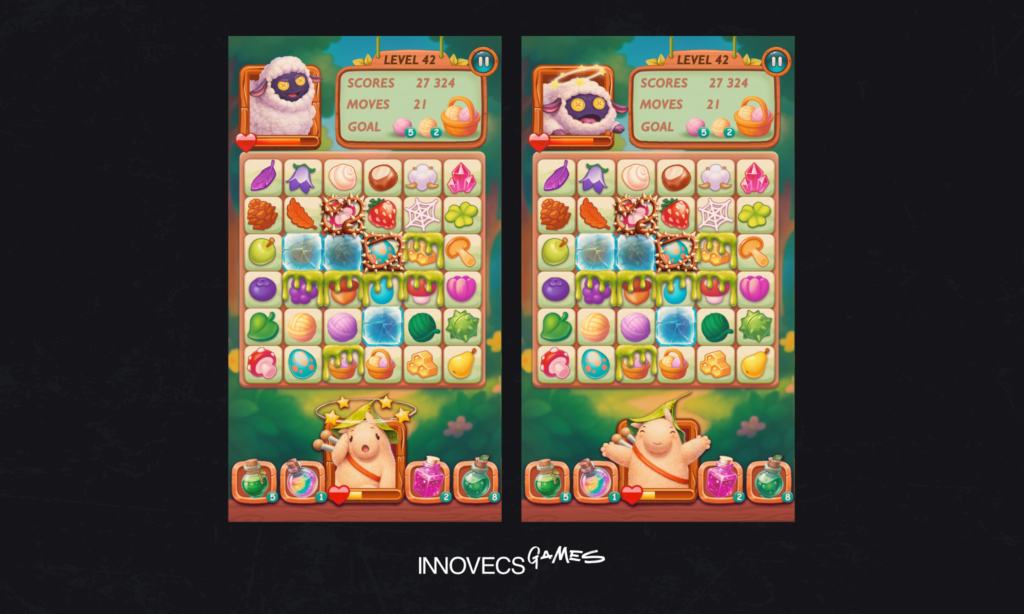
Move limits as the main difficulty lever. Most match-3 levels are tuned through the move count more than the layout. Two moves can be the difference between a breather and a wall. Boosters, extra moves and lives sit right on top of that lever, which is why level tuning and mobile game monetization are permanently tangled in this genre. We’d tune the curve for players who never pay and let monetization sell convenience on top of a fair game. King’s level 65 is what the reverse looks like: great in month two, terrible in month nine.
Data-driven tuning at volume. With thousands of levels and randomness in every board, nobody tunes by feel alone. The review pipeline from Step 5 runs at industrial scale, with bots or test cohorts on every new level and old levels re-tuned when they drift, as King does with its least fun levels. Match 3 game development is, by year two, mostly an operations discipline: a level pipeline, a release cadence and live ops events, all run on the same metrics as the drop-off table above. Cookie Jam, one of the match-3 titles in our portfolio, shows how much of that work happens after launch, and our guide to mobile game design covers the UI and session side of it.
Need an Experienced Team to Build Your Next Title? Let’s Talk
If the mechanic already works as grey squares and the hard part is now the level pipeline, the editor and the live game around it, that’s the work our puzzle game development team does every day. A playable prototype and a list of target platforms are enough for a first call.
Choosing the Right Engine and Tools
The engine decision really lands between Step 1 and Step 4: the concept fixes the platform, and a graybox needs something to run in. It sits here because for most puzzle games it’s the least consequential choice on the list. Puzzle games almost never push an engine hard. What really decides it is what your team already knows, where you’re shipping and what the license costs, not rendering power. The three engines we see in puzzle pitches compare like this in 2026:
| Unity | Godot | Unreal Engine | |
|---|---|---|---|
| Where it fits best | Mobile 2D or 3D, match-3, anything that has to run on lots of devices | A small team making 2D or light 3D for PC and mobile | 3D spatial and physics puzzles that need to look stunning |
| What a six-person team pays in 2026 | Nothing below $200,000 in revenue and funding; above that, six Pro seats cost $13,860 a year | Nothing, whatever you earn (it’s under the MIT license) | Nothing until a game grosses $1 million, then a 5% royalty on the rest, so a $3 million hit owes $100,000 |
| Strengths | Largest pool of mobile puzzle developers, mature ad and analytics SDKs | Light editor, fast iteration, full source access | Rendering quality, Blueprints for designers who prototype |
| Honest drawback | Seat costs grow with team size | No official console exports; ports go through third parties | Heavy for a 2D game, larger builds on mobile |
For a mobile puzzle game with free-to-play monetization, Unity remains the default. Godot is a serious option for a premium PC or mobile release, as long as nobody plans a Switch port without budgeting for it. Unreal makes sense when the puzzle is three-dimensional and the art is a selling point. Otherwise it’s a lot of engine for a grid. Shipped games bear that out. Royal Match and Monument Valley were made in Unity. Croteam moved The Talos Principle 2 from Unreal Engine 4 to Unreal Engine 5 during development, and Baba Is You was built in Clickteam’s Multimedia Fusion 2 with Lua scripting on top. The rules travel between engines; the hiring market and the SDK list don’t.
Honestly, the tools around the engine matter more than the engine, and you’ve met all three already. There’s the game design document that holds the rules and the interaction grid, the level editor and solver from Step 5, and the per-level analytics and remote config from Step 6. Move counts and hint timings are cheap to test and expensive to guess.
Staffing a Puzzle Game: Roles by Stage
Puzzle teams start small and grow sideways. Lucas Pope designed and drew Return of the Obra Dinn essentially on his own, Threes had two core developers, and Monument Valley’s core team was eight. Premium puzzle games can stay that size. A free-to-play launch rarely runs on fewer than ten, because the level pipeline, the meta and live ops each need people. This is how a mid-size mobile puzzle game usually staffs up on our projects:
| Role | Joins at stage | Typical headcount | Owns |
|---|---|---|---|
| Lead game designer | Concept | 1 | Core mechanic, rule set, interaction grid |
| Producer | Concept | 1, part-time at first | Milestones, scope, soft launch plan |
| Gameplay engineer | Core mechanic | 1 to 2 | Prototype, rules engine, undo and replay |
| Tools engineer | Prototype | 1 | Level editor, solver, build pipeline |
| Level designers | Level set | 2 to 4 | Levels, pacing, difficulty |
| 2D/UI and technical artists | Level set | 2 to 3 | Pieces, feedback, effects, interface |
| QA testers | Level set | 1 to 2 | Regression, device coverage, solvability checks |
| Data analyst | Closed test | 1 | Funnels, quit points, A/B tests |
The tools engineer is the role studios most often leave off the plan, and the one level designers would vote for first if anyone asked them. That one person sets how many levels the designers turn out each week, and a designer with a good editor and a solver leaves one with a spreadsheet far behind. So if the budget forces a cut, cut art polish before tools. You can repaint a level later. Three hundred hand-made levels that nobody ever validated are a far bigger rescue job.
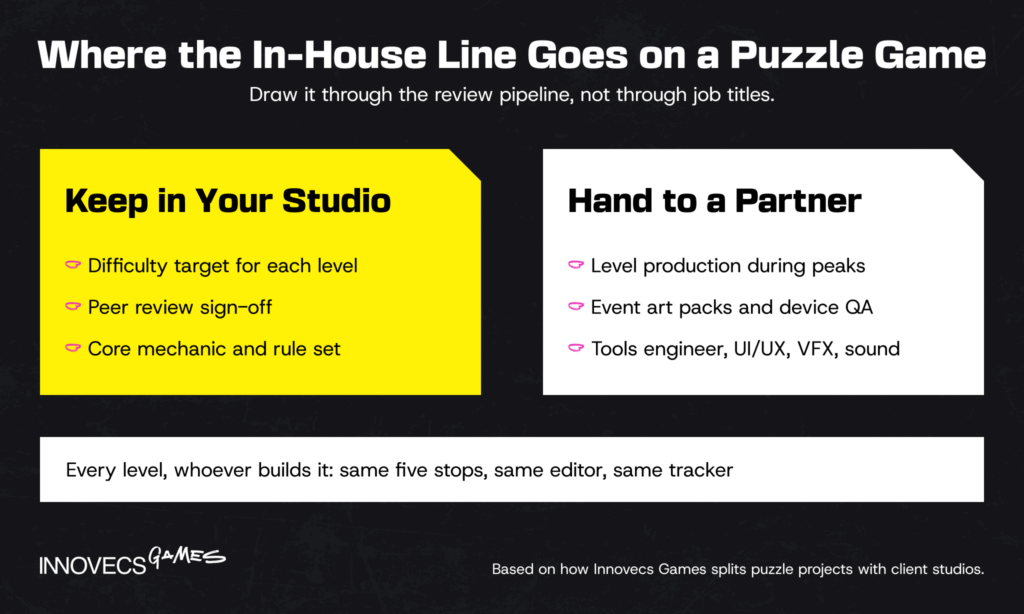
Where should the line between your people and outside people go? On a puzzle game we’d draw it through the review pipeline rather than through job titles. Who builds a level matters much less than who sets its difficulty target and signs off its peer review, and that person should sit in your studio. Everything else is fair game for outside help. Think level production during peaks, event art packs, device QA and the tools engineer, plus the short specialist jobs (a UI/UX pass, combo VFX, a sound pass) that rarely justify a permanent hire. The arrangement breaks in one predictable way: outside levels arrive through a side door. Route them through the same five stops, in the same editor and tracker, and most “hard to manage” problems never get a chance to start.
How AI Is Changing Puzzle Design
The newest pair of hands on most puzzle teams isn’t a person. AI has moved further into puzzle design than into most genres, mainly because puzzles are made of small, testable units. A level either has a solution or it doesn’t, and a bot can try it ten thousand times overnight. The broader shift is covered in our article on AI in game development. Four uses already matter for puzzle teams.
Procedural level generation. Generators can produce endless boards for block and merge games and draft candidate levels for hand-built ones. King told MobileGamer.biz in 2024 that practically every Candy Crush Saga level is now created with the help of AI. The franchise’s general manager also told AP that the company uses it to refresh older levels that leave players bored or stuck. A generator optimizes for what it can measure, such as solvability and predicted win rate, and has no view on whether a level is interesting.
Solvers that check solvability and shortcuts. People often lump the Step 5 solver in with AI. For deterministic puzzles it’s really plain old search, with no machine learning involved. It’s still the most valuable automation a puzzle team can build, and the one to set up before any model.
Playtest bots. King’s researchers published a paper in 2018 on human-like playtesting with deep learning. Their agent, trained on real player moves, estimated the difficulty of a new Candy Crush level in under a minute. Human playtesting of each 15-level episode had taken seven days. Notice the word “human-like” there. A perfect bot is that colleague who clears every level in the minimum moves and calls them all easy, and you learn nothing from them about where real people get stuck.
Difficulty prediction from player data. Once a game is live, models trained on win rates and attempts predict where a new level will land on the curve before release. They’re also how a live game finds its drifting old levels, the job King described in its GDC talk.
Where does that leave designers? A solver can prove a level has a solution. It can’t tell you whether finding it felt clever. The decisions that make a puzzle game good (which insight a level is about, whether a red herring is fair or cruel, when the player needs a breather) still need someone who has watched people play. What we see change on live games is where design hours go. Fewer go into building boards and more into curating them, and the teams that get into trouble are the ones that kept the old split and let the generator’s output through with nobody playing it first.
FAQ
How to make a puzzle game from scratch?
Six steps, in this order: concept, one core mechanic, the rules with their win and fail states, then ten to fifteen paper or graybox levels played by strangers. We know, everyone wants to jump straight to the level set, the polish and the soft launch. Don’t, until those strangers pass. If they don’t ask for more, swap the mechanic and leave the art alone.
What makes a good puzzle game?
Short version: rules you could explain to a friend in one sentence that still surprise you twenty levels in. Nothing the answer needs is hidden, so cracking a level makes you feel smart instead of lucky. Pacing does the rest. Hard levels get followed by easy ones, and players spend more time feeling clever than feeling stuck.
Do you need coding skills to design puzzles?
Not to design them. Plenty of puzzle designers work on paper, in spreadsheets or inside a studio’s level editor, and with a browser tool like PuzzleScript you can prototype a grid puzzle with hardly any code. You’ll want engineers once you’re shipping a commercial game, though, for the editor, the solver, analytics and platform work. Designers who can script small tools do tend to iterate faster.
How many levels should you ship at launch?
Depends who’s paying. A premium game ships finished, and The Talos Principle 2’s main story has 96 puzzles across 12 areas, plus optional ones. A free-to-play match-3 tends to open with several hundred and then keep adding on a schedule (every two weeks, in Royal Match’s case), because the cadence counts for as much as the launch number.
How do you keep puzzles hard but fair?
Get fair right before you worry about hard. That means every level can be solved from what’s on screen and is built around one clear insight. Then lean on pacing (peaks, then breathers), keep undo one tap away and give hints in tiers. Finally, get outside eyes on it. Your own team stopped being able to tell hard from confusing months ago.
Which game engine should you choose: Unity, Godot, or Unreal?
Unity, for mobile and free-to-play, mainly because hiring and SDK support are easy. A small team shipping 2D to PC and mobile should give Godot a serious look (it’s free and light), as long as everyone knows console ports go through third parties. Unreal we’d keep for 3D spatial or physics puzzles where the visuals help sell the game.
How long does it take to build a puzzle game?
Roughly a year, for a small premium one. Threes took 14 months, and Monument Valley took its eight-person team 55 weeks. On our projects, a mid-size mobile puzzle game usually needs six to ten months to reach soft launch. A free-to-play match-3 often spends another six months or more in soft launch before going global.
How much does it cost to make a puzzle game?
Our small-team projects tend to land a casual or premium puzzle game’s first store build at $30,000 to $150,000 (the mobile game development cost breakdown shows how that compares with other genres). A free-to-play match-3 is a different animal. Once there’s a meta layer, live ops tools and a soft launch, budget several hundred thousand dollars before global launch. After that comes a monthly bill for levels and events, and that’s the figure to really plan around.
Why are match-3 games so popular with players and studios?
Players get a move they can learn in seconds and play in two minutes on a bus. For studios, the level-based structure supports years of new content and live ops, and the same move limit that sets a level’s difficulty is also what boosters, extra moves and lives are priced against. The result shows in revenue: Royal Match alone has taken more than $7 billion in player spending since 2021.
🤖 Can AI generate levels automatically?
It can, and the biggest match-3 studio already leans on it: King says AI now helps make practically every Candy Crush Saga level. What a generator can’t do is care whether a level is any fun. So every generated level still goes through a solver and a human, because “technically solvable” and “completely boring” sit together quite happily.
🤖 How is AI used in playtesting and balancing?
Bots trained on real player behavior can play new levels thousands of times and estimate how hard they will feel to people. King’s research team reported estimating a new Candy Crush level’s difficulty in under a minute, where human playtesting had taken seven days for each 15-level episode. On live games, models watching win rates and attempts flag the levels that need re-tuning. Picking the target, though, is still a designer’s job.
Ready to Turn Your Puzzle Concept into a Finished Game?
Most studios that reach us already know how to make a puzzle game prototype; the hard part is the next two hundred levels and everything that ships them. Our puzzle game development team can take it from there, from level editor and analytics to soft launch.