How to Choose a Game Development Outsourcing Company: A Step-by-Step Guide for 2026
Shortlist, vet, and sign an external partner without losing the milestone, the budget, or the IP.
Newzoo expects the global games market to reach $213.9 billion in 2026, a record, up 6.1% year over year. In the same industry, 28% of the developers surveyed for GDC’s 2026 State of the Game Industry were laid off in the past two years. Those two facts live in the same building, which is why picking a game development outsourcing company has stopped being a procurement errand and turned into a production decision.
The gap is structural, not seasonal. Studios rebuilt smaller and kept the roadmap they had when they were big. Unity’s 2026 Game Development Report found 52% of developers deliberately scoping projects down, while 83% still ship online multiplayer and 72% support cross-play. Fewer hands, same feature surface. Someone external is closing that difference, and the External Development Summit’s 2026 Insights Report shows what the arrangement now looks like: six to twelve month agreements are the most common contract length on the provider side, which is not the profile of short-term overflow help.
That shift moved the risk too. When a partner handles a bug queue for six weeks, a bad choice costs six weeks. When a partner owns your rendering pipeline through certification, a bad choice costs the ship date, and the recovery lands on the people you have left. The stakes moved. In most studios, the process for choosing did not.
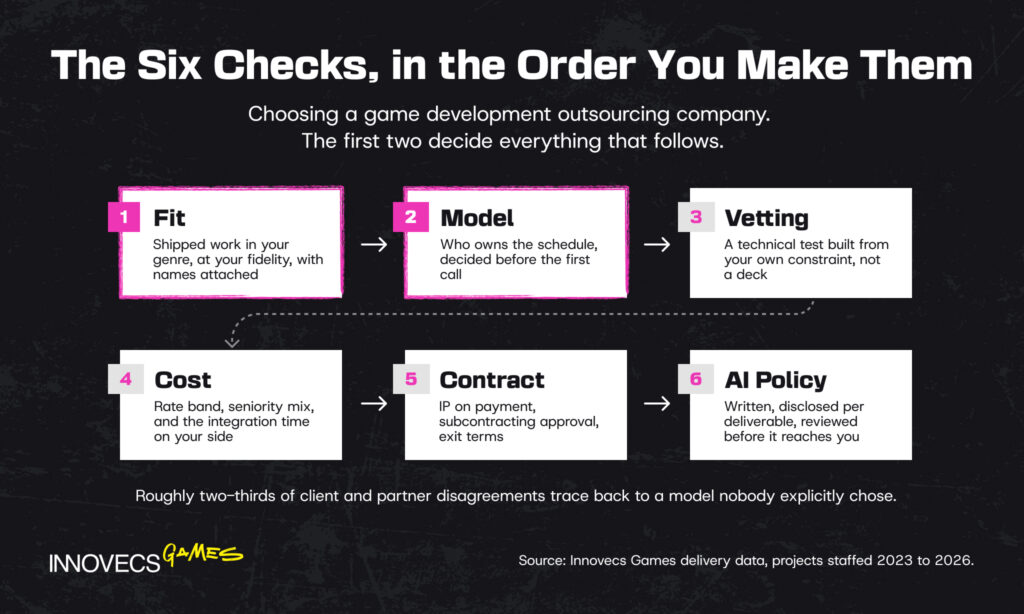
How to choose a game development outsourcing company comes down to six checks, and this guide runs them in the order you actually make them: what separates a fit from a plausible-looking vendor, which engagement model matches your gap, how to vet portfolios and engine claims, what the work costs by role and region, what belongs in the contract before you sign, and where AI has genuinely changed the calculus.
What Makes a Game Development Outsourcing Company the Right Fit
An external development partner supplies production capacity your studio does not have in-house: engineers, technical artists, VFX and animation, QA, sometimes a full production line from concept through submission. For a game studio that runs its own pipeline, the good ones aren’t a labor pool. They plug into your pipeline, take named milestones, and show up in your standups with opinions about your acceptance criteria.
Fit is narrower than capability. Most game development outsourcing companies claim Unity and Unreal, cross-platform delivery, and a decade of experience on the same page. What varies is the part nobody puts on a homepage: whether they have shipped in your game genre at your fidelity, whether their leads have sat through console certification, whether their producer will tell you a milestone is slipping in week two instead of week six.
Getting it wrong is expensive in a specific, predictable order. First the schedule goes, because integration takes longer than anyone scoped. Then quality, because the fix comes out of polish time. Then budget, because you are paying two teams to solve one problem. IP exposure shows up last and hurts longest, usually when you discover the assets were built by a subcontractor whose contract with your partner says nothing useful about ownership.
Our read, after a decade of sitting on both sides of this table: fit is a production question wearing procurement clothes. The people who can actually answer it are the ones who would work with the partner every day, and they are usually handed the shortlist after somebody else has drawn it up.
The fix isn’t a longer RFP. It’s testing three things directly: proof they’ve done this exact work, a model that matches how much control you want to keep, and a contract that survives the relationship going sideways. Our own game development outsourcing services are built around the same three checks, mostly because we have been on the receiving end of studios running them properly.
Why Studios Choose to Outsource Game Development
The reflex answer is cost, and it is the weakest of the four reasons. Rate arbitrage saves money on paper and gives it back through management overhead. The reasons that hold up are about access and timing.
Specialized talent that isn’t hireable on your timeline. The US Bureau of Labor Statistics puts special effects artists and animators at 0% projected employment growth through 2035, with a 2025 median wage of $102,030 and about 4,200 openings a year, most of them backfills. Software developers sit at 10% growth and a $135,980 median. Meanwhile Glassdoor puts the average US game developer’s total pay at $96,642. Games ask for more specialization than general software and pay roughly $39,000 less for it at the middle of the market, which is exactly why the senior technical artist you need for eight months is not sitting in your applicant pool.
Time-to-market. Unity’s 2026 report has 67% of developers spending three months or less in prototyping, and 48% getting more selective about which prototypes graduate into full production. Schedules compressed. Player expectations didn’t. Parallel workstreams are how small teams keep pace, and you cannot run parallel workstreams with a team that’s already single-threaded.
Scalability without permanent headcount. A port, a co-dev push before alpha, a live-ops content run: these have end dates. Hiring for them means either carrying the cost afterward or running a layoff round, and the industry has demonstrated recently how well that goes.
Cost efficiency, honestly stated. It is real, and it is second-order. A blended external rate in Eastern Europe lands at roughly half to two-thirds of a fully loaded senior US role once you count benefits, equipment, recruiting, and the six weeks a new hire spends learning the codebase. The savings evaporate if you need three of your own people managing the arrangement, which is the part the rate card never mentions.
Not every gap should go external. If the work is your core loop, your differentiating tech, or anything you’ll iterate on weekly for two years, build it in-house and hire a game development team for it. Outsourcing is strongest on bounded, well-specified, deeply skilled work. It is worst on “figure out what this game should be.”
Engagement Models Compared: Full-Cycle, Co-Development, and Task-Based
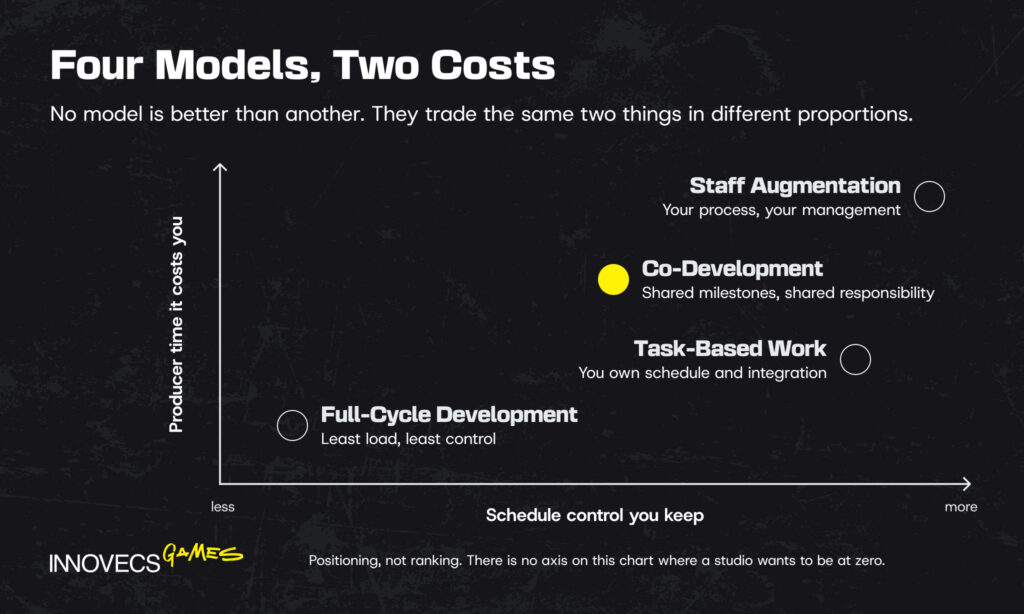
Model choice determines who owns the schedule, and that single question predicts more about how the relationship goes than rate, region, or headcount. Roughly two-thirds of the disagreements we see between studios and partners trace back to a model that was never explicitly chosen, just drifted into.
| Model | Who owns the schedule | Best fit | Ramp time | Main trade-off |
|---|---|---|---|---|
| Full-cycle development | The partner | Studios without an internal production line, or a title outside their core competence | 4 to 8 weeks | Least day-to-day load, least control; course corrections are slow and cost change orders |
| Co-development (dedicated team) | Shared, against your milestones | Studios with a pipeline and a capacity or capability gap | 2 to 5 weeks | Highest monthly cost per person, and it needs real producer time on your side |
| Task-based work | You | Bounded deliverables with clear acceptance criteria | Days to 2 weeks | Cheapest and most flexible, but the integration and QA burden stays with you |
| Staff augmentation | You | Named skills missing from your team for a fixed period | 1 to 3 weeks | You carry management, onboarding, and the ramp cost of a temporary teammate |
Read the trade-off column first. It’s the one people skim and then rediscover in month four.
Full-Cycle Development
The partner takes the project from concept or an early build through to submission: design, art, engineering, QA, sometimes store setup and first-patch support. You approve at milestones and hold the IP.
This suits publishers without an internal studio, an indie studio taking on a title well outside its usual genre, and anyone whose alternative is standing up a production line from scratch. It is the model with the lowest daily management cost and the highest cost of being wrong. Direction changes travel through a statement of work, and a statement of work is not a fast document.
The honest downside: full-cycle needs the most upfront specification of any model, and games are the medium least suited to upfront specification. Go in with a design document nobody has stress-tested and you will spend the savings on change orders. Nobody finishes the sixty-page one, including the person who wrote it.
Co-Development
The partner’s team works inside your pipeline, on your board, against your milestones, with shared responsibility for delivery. In practice that means their engineers commit to your repo, their technical artist argues with your art director about the shader graph, and their producer sits in your milestone reviews.
This is the model most established studios end up in, because it is the only one that scales capacity without handing over direction. It fits a Switch 2 port running alongside main development, a feature team for multiplayer, a technical art pod ahead of certification QA.
It costs more per person per month than task-based work, and it needs something from you: a producer with actual availability, a working build the team can run on day one, and acceptance criteria that mean the same thing to both sides. Studios that treat co-development as a way to stop thinking about a workstream get the worst version of it, and then tell people co-development doesn’t work.
Task-Based Work and Staff Augmentation
These get grouped because both keep the schedule with you, but they solve different problems.
Task-based work buys a deliverable: a set of character models to spec, a localization pass, a VFX package, an optimization sprint against a frame budget. Scope is written, acceptance is objective, and you can run three vendors in parallel without anyone tripping over anyone. Bounded art and effects work is where this shines, which is why game VFX outsourcing is often a studio’s first external contract.
Staff augmentation buys people: a senior Unreal engineer for five months, two QA engineers through certification. They report to your leads and follow your process.
The catch on both is integration. Every deliverable that arrives still needs review, merge, and QA from your side, and studios routinely forget to budget that. It’s the least interesting line in the plan and the one that decides whether task-based work turns out cheap or merely looked it. A rule from our own delivery data that has held up: for task-based art and code, reserve about 15% of the external spend in internal time for integration. If you cannot fund that, you do not want task-based, you want co-development.
Working With a Partner When You Already Have a Team
Almost every studio that signs an external partner already has a full team. The question isn’t replacement, it’s where the boundary runs, and three patterns account for most of what works.
Overflow against a specific milestone. A bounded surge to protect a date: extra QA through certification, a second art pod for a content drop, engineers on a feature that would otherwise eat the main line. Scope ends when the milestone does.
Parallel prototyping. Your team stays on the shipping title while an external team validates the second concept. Studios with a backlog of unvalidated prototypes get the most out of this one, because the internal cost of switching context is the thing that keeps the backlog frozen.
The invisible layer. Technical art, optimization, tooling, build pipeline, device performance. Visible work wins every prioritization argument against invisible work, which is how a team with excellent artists ends up with a beautiful build that drops frames on half its target hardware. Pipeline debt accrues quietly and gets paid back at the worst possible moment, usually six weeks before submission.
There is a fourth reason that studios rarely put in the brief. Leads at a fifty to a hundred person studio are hands-on in the build, running reviews, mentoring a junior-heavy team, and answering to production all at once. Handing a workstream to a partner with its own lead gives that person their week back. That’s a legitimate reason to outsource and it belongs in the business case, not in the part nobody says out loud.
Three things to settle before anyone starts. Final say on code review and art direction stays with you, in writing. The boundary runs by system or by feature, not by task, because task-level splits generate more coordination than they’re worth. And one named person on each side owns the interface, because two named people on each side means nobody does.
The honest cost: bringing a partner alongside an existing team adds coordination load immediately and pays it back somewhere in week four to six. If your milestone is three weeks out, external help will probably make it worse rather than better.
Not Sure Which Model Fits Your Project?
Most studios arrive knowing the gap and unsure of the shape. Tell us the milestone you’re worried about and the date attached to it, and we’ll come back with a model, a team composition, and a range. If the honest answer is that you should hire internally instead, we’ll say that.
How to Evaluate a Game Development Partner
Due diligence is where the decision is actually made, and where most processes are weakest, because they test presentation rather than production. The XDS 2026 Insights Report is instructive on where the pain has moved: security and infrastructure concerns dropped 38 points among developers and publishers, and quality misalignment fell 29 points among providers, while communication rose about 15 points to become the top reported challenge overall. The industry solved the technical objections and inherited a coordination problem in their place, which is progress of a sort. The best game development outsourcing company for your project is the one that handles coordination where you can see it, so vet for that rather than for the objections everyone has already answered.
Portfolio and Case Studies
A portfolio tells you what a company has been near. It doesn’t tell you what they did, and that distinction is the whole exercise.
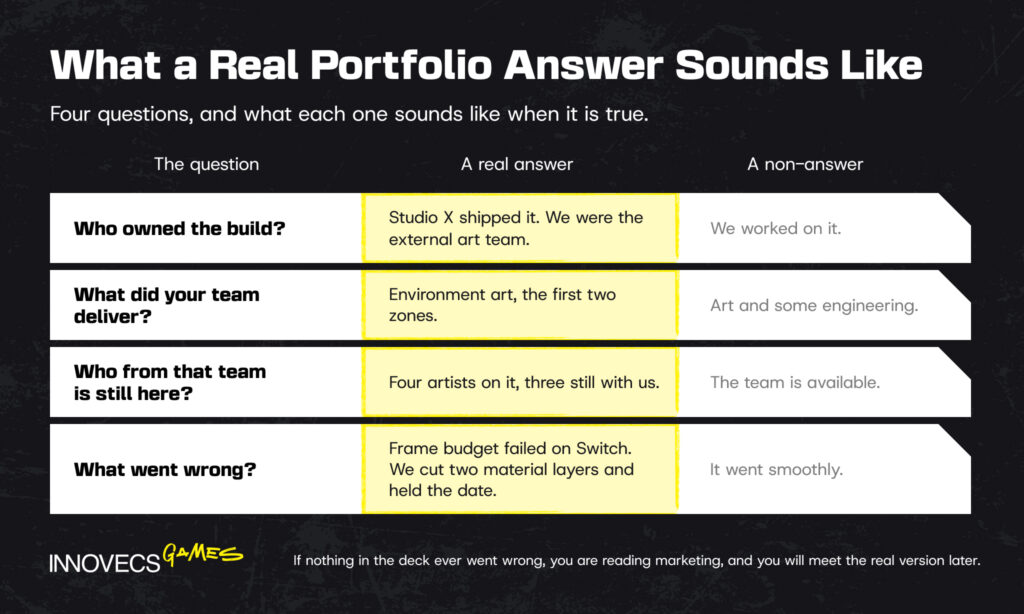
For every title that matters to you, ask four questions: which studio owned the build, which parts did this team deliver, how many of the people on that project are still here, and what was the team size at peak. A partner who answers “we did the environment art for the first two zones, four artists, three of them still with us, here’s the lead” is telling you something. A partner who answers “we worked on it” is telling you something else.
Ask for a case study with a constraint in it. Anyone can produce a case study where the work went well. The useful ones name the problem: a frame budget that wouldn’t hold on Switch, a milestone that slipped and how it was recovered, a scope cut and who made the call. If nothing in the deck ever went wrong, you’re reading marketing, and you’ll meet the real version later.
Look at consistency across the reel too. Studios that subcontract heavily show a fidelity spread that’s hard to hide once you know to look for it.
Technical Expertise and Engine Fit
Engine claims are the easiest thing to overstate and one of the easier things to test. GDC’s 2026 data puts Unreal at 42% of developers’ primary engine, Unity at 30%, and Godot at 11%, with Unreal reaching 59% at AA studios. Everyone selling development supports the top two, and everyone’s site says so with the same two logos. Depth is what varies.
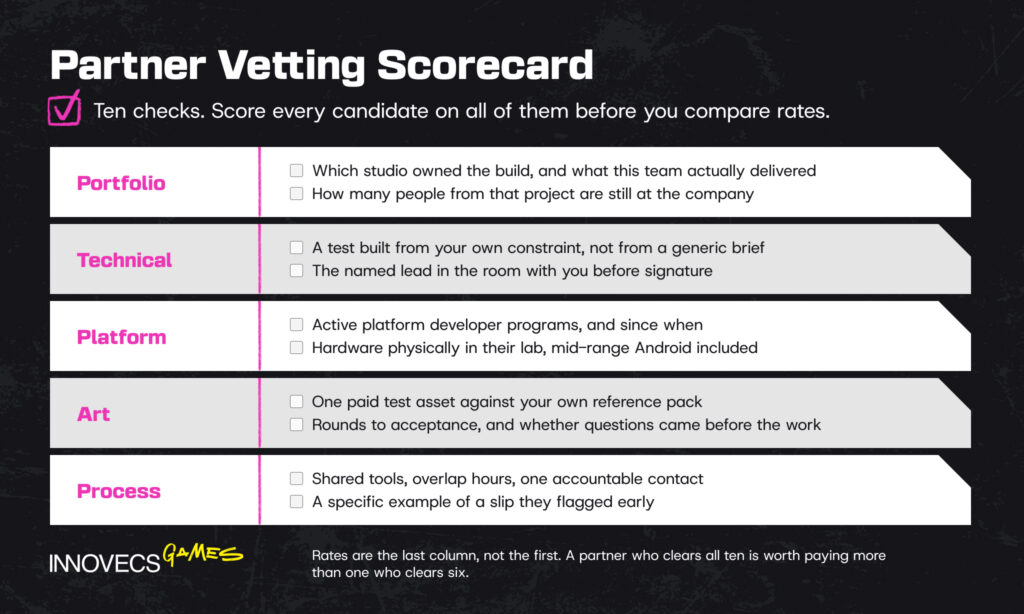
Test it with your own problem, not a generic one. Give a candidate a real constraint from your project, a draw call budget, an asset that fails validation, a shader that behaves differently on two platforms, and ask how they’d approach it. Thirty minutes of that beats any capability deck. Listen for whether they ask about your target hardware before answering, since the ones who do not ask are the ones who will guess later.
Then check the specific discipline, not the engine. Unity and C# generalists are plentiful. People who can debug a memory budget on Switch 2, build a deterministic netcode layer, or run a technical art pipeline that survives contact with an art team are not. Ask who specifically would be on your team, then ask to talk to them. A partner who won’t put you in a room with the actual lead before signing is protecting something. Nine times out of ten it’s the fact that the lead hasn’t been picked yet.
Platform, Porting, and Certification Experience
Platform work is where capability claims break, because it takes licensing as well as skill. Development kits are issued by platform holders to registered developers, so a partner without an active Nintendo, Sony, or Microsoft developer relationship cannot legally hold your build on their hardware. “We will get one” is a multi-week application with an outcome nobody controls, and it isn’t a detail you want to discover after the statement of work is signed.
Four questions settle it. Which platform developer programs are you registered with, and since when. What hardware do you test on, physically, in your own office. How many titles have you taken through submission. And what happened on the first pass, because a partner who has never had a build rejected has probably never submitted one.
Mobile has its own version of this. Frame rate does not die on a flagship device, it dies on the mid-range Android handset that most of your install base is holding. Ask what device tier they target, what is actually in their test lab, and how they handle asset compression, memory ceilings, thermals, and battery drain over a thirty-minute session. A partner who validates on a current Pixel and one iPhone will hand you a build that runs beautifully for them and gets one-star reviews about overheating.
Art Style Fit and the Test Task
A reel shows what a studio chose to show you. It says very little about whether they can hit your house style, which is a different skill from making attractive assets and the one that decides whether the work integrates.
Test it directly. Send a reference pack: three shipped assets from your own game, the style guide, palette callouts, a turnaround, and the acceptance criteria you use internally. Then pay for one asset at the fidelity you actually ship. A few thousand dollars answers a question that a portfolio review cannot, and it costs a rounding error against an eight-month contract that turns out to need supervision on every delivery.
What to watch isn’t only the asset. How many rounds did it take. Did the questions arrive before the work or after the first rejection. Did the annotated sheet come back with the file, or did you get a render and a hope. A team that asks about your target platform’s memory budget before drawing anything is a team that has integrated assets into a real build before.
Style expectations also travel badly across regions, and studios shipping to several markets at once feel this most. A partner who has delivered into your market reads your references faster, which is worth more than it sounds when you are trying to keep four titles looking like they came from the same studio.
Communication and Project Management
Communication is now the number one challenge in external development, ahead of delivery and security, and it is the least glamorous thing to diligence. Do it anyway.
Establish four things before signing: which project management tools you share (Jira, Perforce, Slack, or theirs), the overlap window in working hours, who your single accountable contact is, and what happens when something slips. On the last one, ask for a specific example from another client. The answer “we escalate immediately” means nothing. The answer “on a Q2 project we flagged a two-week slip at the milestone-two review, re-cut the scope with the client’s producer, and shipped milestone three on the original date” means something.
Time zones matter less than people think, up to a point. Four hours of daily overlap is enough for a co-development pod. Zero overlap turns every question into a next-day answer, and on a hard milestone that compounds into a week per month.
One quiet detail worth checking: whether their producer writes the status report or their salesperson does. You can usually tell by week three, and by then you’ve signed.
Red Flags to Watch For
- They can’t name who’s on your team. Named leads before signature, or the composition will be assembled from whoever’s free.
- Undisclosed subcontracting. The XDS 2026 report found roughly two in five developers and publishers say their providers subcontract portions of the work to third parties. Subcontracting is not automatically a problem. Finding out about it in month three is.
- No pushback during scoping. A partner who agrees to every date and every scope has either not read the brief or has decided to renegotiate later.
- Rates far below the regional band. A $15 hourly rate in a market where seniors cost $50 is buying juniors, subcontractors, or turnover.
- A portfolio where nothing ever went wrong. Every studio has lost a milestone. A partner who cannot name one is either very new or editing heavily.
- IP terms that arrive as “standard” and stay vague. Ownership should transfer on payment, explicitly, including work in progress and source files.
- Sales owns the relationship after signing. Ask who runs the account in month two. If the answer is the person selling you now, the delivery team is somewhere else entirely.
When to Consolidate Vendors
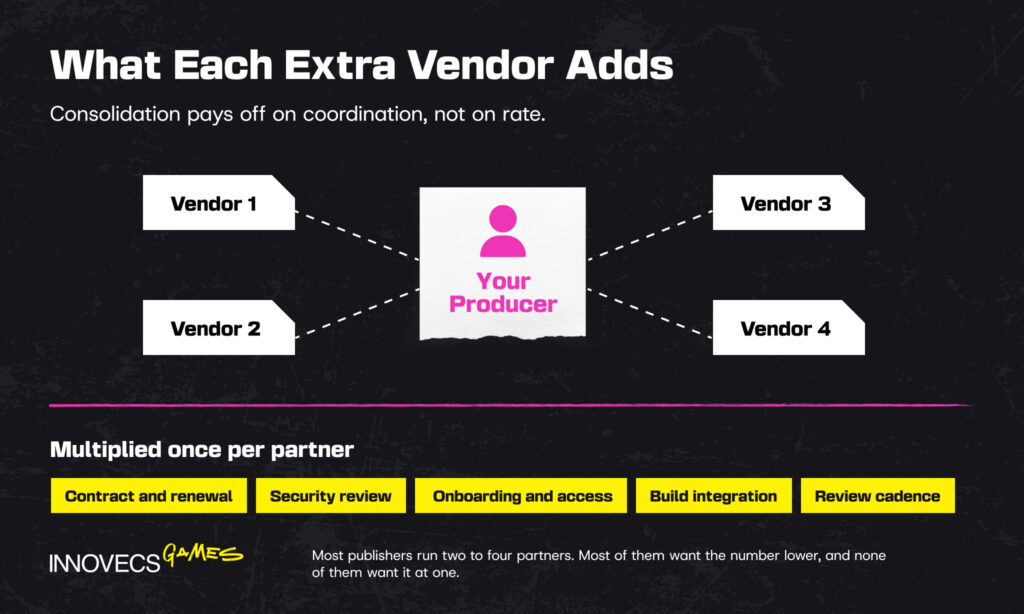
Most studios didn’t choose their vendor list, they accumulated it. The XDS 2026 data explains how: 73% of external partnerships begin at industry events and two-thirds through internal referrals, which is a relationship process rather than a procurement one. Two to four partners is the normal state at a publisher, and most of them want the number lower.
More vendors is the right answer when the disciplines are genuinely different, when deliverables are bounded and run in parallel without touching each other, or when a critical path needs redundancy you can afford. Splitting character art across two studios who both do character art is a different situation, and it’s usually the one people are actually in.
Consolidation pays off on coordination, not on rate. Every additional partner is another contract, another security review, another onboarding, another build integration, another review cadence in someone’s calendar. A producer running four vendors loses the better part of a week a month to vendor administration alone, and that week comes out of the work only they can do.
Live titles are where scattered delivery hurts most. Seasonal events and content drops have fixed dates and no slack, and when four vendors deliver at four quality levels, someone internal spends the last week normalizing everything instead of testing it. That person is usually the art lead, and it is usually the same week the next drop needs approving.
The argument against consolidating, which we will make even though it works against us: one partner concentrates your risk. Lose their lead to another project, or hit a quarter where their delivery slips, and there’s no second team already inside your pipeline. If a title carries real revenue, keep a second partner on a small recurring scope even when the efficiency argument says not to. Paying a modest premium for optionality is a reasonable trade, and the studios that skip it tend to find out during a live event.
How Much Does It Cost to Outsource Game Development?
Rates vary by roughly 4x across regions for comparable seniority, and the cheapest option is almost never the cheapest total. Two variables set the number before anyone talks about people: where the team sits, nearshore or offshore, and which pricing model you sign, time and materials or fixed price against a defined scope. Here’s what the market looks like going into late 2026 for mid to senior game development talent.
| Region | Hourly rate (mid to senior) | Practical notes |
|---|---|---|
| US and Canada | $90 to $150 | Full time zone overlap, deepest AAA console experience, highest total cost by a wide margin |
| Western Europe | $75 to $120 | Strong console and technical art depth, stricter labor and notice terms |
| Eastern Europe | $40 to $70 | Large senior console and engine pool, 4 to 8 hours of EU or US East overlap |
| Latin America | $35 to $60 | Best overlap for US teams, shallower AAA console track record |
| India and Southeast Asia | $22 to $45 | Lowest rate, largest volume, needs the most management overhead per delivered milestone |
Source: Innovecs Games delivery data, projects staffed 2023 to 2026, blended across engineering, art, and QA.
The band that gets misread is the bottom one. It’s genuinely cheaper per hour and genuinely more expensive per accepted milestone if you don’t staff a producer to run it, which is a trade some studios should make and many make by accident.
Role matters more than region once you’re inside a band. These are Eastern European rates, where most of our delivery sits.
| Role | Hourly rate | Typical monthly cost (full time) |
|---|---|---|
| Gameplay engineer (Unity, C#) | $45 to $65 | $7,200 to $10,400 |
| Engine or graphics programmer (Unreal, C++) | $55 to $85 | $8,800 to $13,600 |
| Technical artist | $50 to $75 | $8,000 to $12,000 |
| 3D character or environment artist | $35 to $55 | $5,600 to $8,800 |
| VFX artist | $40 to $60 | $6,400 to $9,600 |
| QA engineer (functional and certification) | $25 to $40 | $4,000 to $6,400 |
| Producer or delivery lead | $50 to $70 | $8,000 to $11,200 |
Source: Innovecs Games delivery data, projects staffed 2023 to 2026. Figures are indicative and move with scope, duration, and seniority mix.
Two rows in that table tend to surprise people. Technical artists cost more than character artists, which reads as backwards until the first time a beautiful build misses its frame budget. And QA looks cheap, right up to the week of certification, when it stops looking cheap very quickly.
For project totals, the ranges that hold up across the work we’ve scoped: a small mobile title runs $60,000 to $200,000; a mid-core mobile game with live-ops runs $300,000 to $1.2 million; an AA console or PC co-development scope runs $800,000 to $4 million; and a single AAA workstream, a feature team or a technical art pod, runs $1 million to $3 million a year.
Source: Innovecs Games delivery data, projects scoped 2023 to 2026.
Four things move a number inside those ranges more than the rate card does:
- Engagement model. Co-development carries producer time, onboarding, and shared ceremonies. Budget a quarter to a third above the equivalent task-based headcount, and get schedule control in exchange.
- Team seniority mix. A pod of five seniors and a lead costs more per hour and usually less per milestone than eight mid-level people. The exception is high-volume asset production, where the reverse holds.
- Platform count. Every additional platform adds certification QA, performance work, and a submission cycle. Porting costs surface late, usually after the build is locked.
- Specification quality. Vague acceptance criteria are where scope creep enters, and they get billed twice: once when the work is done, once when it is redone.
Most disagreements we have with a client’s budget happen on the boundary between two of those rows, not inside one of them.
The pricing model sits underneath all four. Time and materials bills what happens and is cheaper when the scope is honest, which is most co-development. Fixed price moves the risk onto the partner, and the partner prices that risk: expect a premium, commonly a tenth to a fifth of the contract value, plus change control strict enough that every adjustment becomes a document. Neither one is safer. What decides it is how well you can specify the work, and studios routinely overestimate that about themselves.
Fixed budgets rarely break on the rate. They break on change orders, three or four of them at 5% each, none of which felt like a decision at the time. If your budget genuinely has no give in it, the protective clause is not a lower rate, it is a written change-control process with a named approver and a running total that both sides can see.
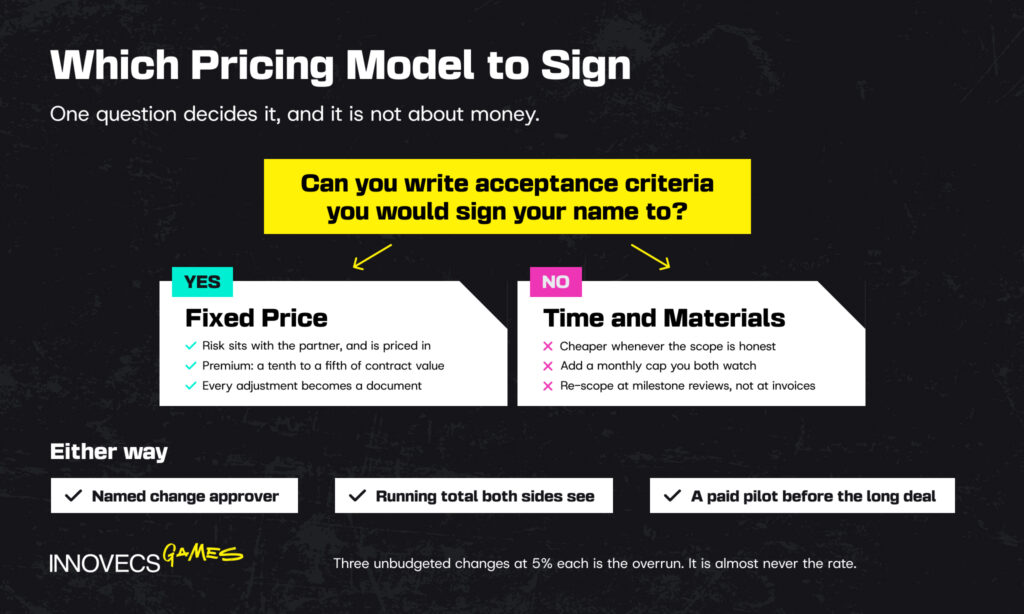
Which is also the honest answer to “this costs more than we planned.” A discount is the wrong instrument, because a partner who cuts a fifth off the price to win the work takes it back somewhere you can’t see. A smaller first commitment is the right one: one paid milestone, four to six weeks, real acceptance criteria, priced at a fraction of the annual number. You find out how fast they ramp, whether their estimates survive contact with your codebase, and what their review quality looks like under a real deadline. A partner who resists a paid pilot is telling you their economics depend on the length of the contract rather than the quality of the work.
How to Protect Your IP and Reduce Delivery Risk
This is the section where being thorough costs you an afternoon and being casual costs you a lawsuit, so it is worth reading slowly.
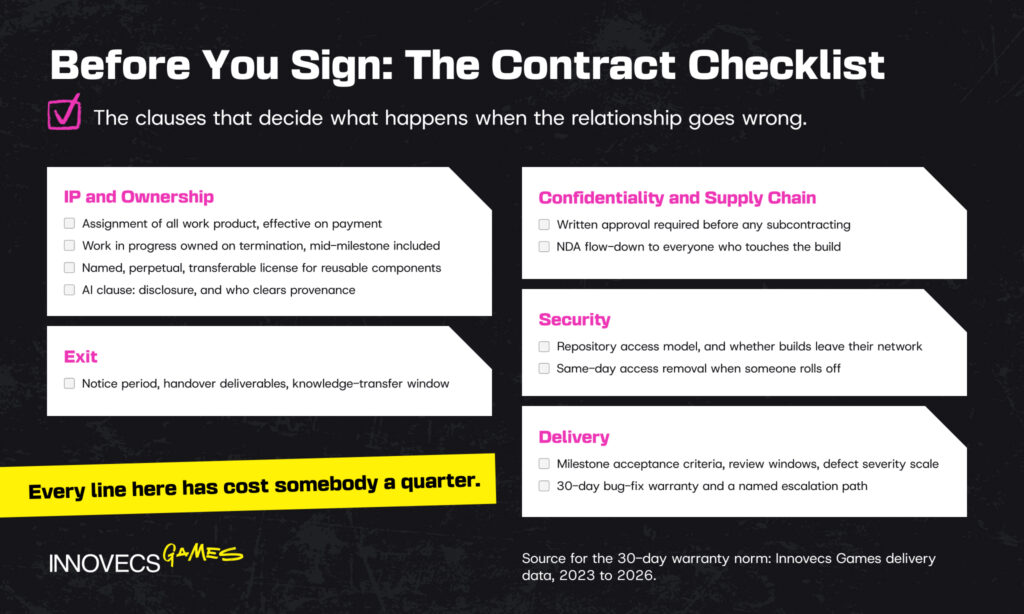
IP ownership has to be explicit and complete. Assignment of all work product to you, effective on payment, covering source files, project files, intermediate assets, and tooling built for the project. Two clauses get skipped and both matter: work in progress on termination (you should own what’s been paid for, mid-milestone), and any pre-existing or reusable components the partner brings in, which need a named, perpetual, transferable license rather than a handshake. Check the AI clause too, since generated assets have contested provenance and you want the contract to say who’s responsible for clearing that.
NDAs run both directions and cover subcontractors. Third-party involvement is common enough, as the red flags above cover, that an NDA binding only the signing entity leaves a real gap. Require written approval before any subcontracting, and flow-down terms for anyone who touches the build.
Data security in practice, not policy. Ask what happens to your source on their machines: repository access model, whether builds leave their network, device policy, and offboarding. When someone rolls off your project, how long until their access is gone? The answer should be same-day and someone should be able to show you the process. Industry-wide anxiety about this has fallen sharply, and that reflects real maturity rather than a reason to skip the question.
SLAs that describe games, not tickets. Generic uptime language is useless here. What you want defined: milestone acceptance criteria and review windows, a defect severity scale with response times, a bug-fix warranty period after each milestone (30 days is standard), and a named escalation path with a person’s title on it.
Exit terms you would be willing to use. Notice period, handover deliverables, documentation standard, and a knowledge-transfer window. A partner who resists a clean exit clause is telling you how the relationship ends. Build a pilot in first where you can: one bounded milestone, real acceptance criteria, before the twelve-month commitment. It is the cheapest diligence available, and it tests everything a reference call cannot.
How AI Is Changing Game Development Outsourcing
AI has changed this market in one direction more than the other. It has made evaluation faster and production quality harder to read.
On the buying side, AI-assisted vetting is now routine: parsing portfolios, cross-checking credits against public sources, summarizing reference calls, running first-pass code review on a technical test. It compresses a three-week shortlist into about one week. It does not tell you whether a lead will flag a slip early, which is still the thing that decides whether the project lands.
Inside partner studios, adoption is real and uneven. Unity’s 2026 report has 62% of developers using AI for coding assistance and just under half for narrative and writing design. GDC’s survey found 36% of professionals using AI tools at work, and, in the same sample, 52% saying they believe it’s having a negative effect on the industry. Both numbers are true at once, and any partner who tells you the question is settled is not paying attention.
The contract picture moved fastest, and in a direction that surprised us. XDS 2026 found calls for outright AI prohibition in contracted work fell from 44% to 18% year over year, while 54% of providers report that fewer than one in ten clients currently permit AI in delivered work. Prohibition is out of fashion; permission has not arrived. Most studios have landed on disclosure and case-by-case approval, which is the sensible middle and also a lot of email.
Where it genuinely helps at a partner studio: automated regression and playtest passes, asset variation and LOD generation, localization first drafts, boilerplate and tooling code, and documentation nobody wanted to write. Where it does not: art direction, systems design, netcode debugging, performance work against a fixed frame budget, and certification. Our position, for what it’s worth, is that the price of a first draft has gone to nearly zero and the price of judgment hasn’t moved at all. Three years of watching people bet the other way hasn’t changed it.
Two questions to put to any candidate. What’s your written AI usage policy, and will you disclose per deliverable? And who reviews AI-assisted output before it reaches us? A partner who can answer both is using the tools. One who cannot is either not using them or not tracking it, and the second is worse.
Why Studios Choose Innovecs Games as a Development Partner
We’ve delivered 300+ games over more than a decade, with 200+ engineers and artists across the US, UK, EU, Israel, Australia, and Ukraine, and we’re listed on IAOP’s Global Outsourcing 100. The work concentrates in AAA and AA console and PC: technical art, UI/UX, and engineering, plus mobile builds that need the same performance rigor.
What we do differently is mostly about the model. Co-development is our default rather than our upsell, because embedded teams that share responsibility for a milestone produce better outcomes than teams that execute a document. Named leads before signature, not after. A working pod in two to five weeks rather than two to five months. And a producer whose job is to tell you early when something is slipping, which is a low bar that a striking number of vendors fail to clear.
Most lists of top game development outsourcing companies rank by headcount or review volume, which measures neither of the things you care about. Look at our portfolio, then ask us for the two projects that got difficult and what we did about them. That conversation is more useful than any ranking, and we would rather lose a deal on it than win one on a deck.
FAQ
These are the questions that come up most often on first calls, roughly in the order studios ask them. The last two are new to the list as of about eighteen months ago, which tells you something on its own.
What does a game development outsourcing partner do?
An external partner supplies production capacity you do not have internally: engineering, art, technical art, VFX, animation, QA, or a full production line from concept to submission. Scope ranges from a single bounded deliverable to owning an entire title. The better arrangements are not hand-offs. The partner’s team works against your milestones, in your pipeline, with a producer accountable for delivery on their side.
How do I choose the right game development outsourcing company?
Start from your gap, not from a vendor list. Define what’s missing, whether that’s a discipline, a headcount, or a platform, and pick an engagement model before you talk to anyone, because the model determines who owns the schedule. Then vet on production evidence: shipped work in your genre at your fidelity, named leads you can actually speak to, a technical test built from your own constraint, and references you sourced yourself. Finish on contract terms and run a paid pilot milestone before committing to a long agreement.
What’s the difference between outsourcing and co-development?
Outsourcing is the umbrella term for any external delivery arrangement. Co-development is one model under it, where the partner’s team works inside your pipeline against your milestones and shares responsibility for hitting them. The practical distinction is schedule ownership. In full-cycle outsourcing the partner owns the plan and you approve at gates; in co-development the plan stays yours and the capacity is shared. Co-development costs more per person and gives you far more control. If you can only afford one of those, work out which problem you actually have before you start calling vendors.
How much does it typically cost to bring in an external game development team?
Across our own delivery data, rates for mid to senior talent run roughly $40 to $70 an hour in Eastern Europe, $35 to $60 in Latin America, $75 to $120 in Western Europe, and $90 to $150 in North America. A full-time engineer or technical artist in the Eastern European band lands around $7,000 to $12,000 a month, and project totals scale from low six figures for a small mobile title to seven figures for console co-development. The line most budgets miss is on your side of the invoice: review, merge, and QA of everything the partner delivers, plus the producer time to run the relationship. Price that in before signing rather than discovering it in month two.
What red flags should I watch for when vetting a development partner?
The reliable ones: no named team members before signature, undisclosed subcontracting, rates far below the regional band, a portfolio where nothing ever went wrong, and vague IP language described as standard. Add one more that’s easy to miss, which is a partner who never pushes back during scoping. Agreement to every date and every scope means the brief was not read or the renegotiation is planned for later.
How long does it take to find and onboard a game development partner?
Shortlisting and vetting properly takes three to six weeks, though AI-assisted portfolio and reference screening has compressed the early stage to about one. Contracting adds two to four weeks depending on how much your legal team wants to say about IP. Onboarding runs one to three weeks for task-based work, two to five for a co-development pod that needs repo access, build setup, and pipeline familiarity. Plan on six to ten weeks from first call to productive output. Start earlier than feels necessary: the belief that a partner can be found and onboarded inside a month has ruined more launch quarters than any bug.
Should I hand off the entire project or just specific tasks?
Hand off entire projects when the title sits outside your core competence or you have no internal production line, and accept that direction changes will travel through change orders. Hand off specific tasks when the work is bounded, specifiable, and testable against clear acceptance criteria. Anything in between, meaning a real capability gap on a project you intend to keep steering, is a co-development case. One thing should not go external at all: your core loop and your differentiating technology.
How do I protect my game’s IP when working with an external studio?
Get written assignment of all work product to you, effective on payment, covering source files, project files, intermediate assets, and any tooling built for the project. Cover work in progress on termination so you own what you’ve paid for mid-milestone. Require written approval before subcontracting, with NDA flow-down to anyone who touches the build. Define repository access and same-day offboarding in the contract rather than the kickoff call. Add an AI clause specifying disclosure and who carries responsibility for the provenance of generated assets.
How is AI changing how studios evaluate development partners?
Screening moved first. Portfolio parsing, credit verification against public sources, reference-call summarization, and first-pass review of technical tests now compress a three-week shortlist into roughly one. The contractual side moved too, in an odd direction: XDS found most providers report that fewer than one in ten of their clients currently permit AI in delivered work, even as outright prohibition clauses went out of fashion. Disclosure requirements replaced both. What has not changed is what the shortlist is for. AI narrows the field; a conversation with the actual lead about your actual constraint still decides it.
Can AI replace an external game development team?
No, and the honest version of that answer is more interesting than the flat one. AI has absorbed real work at partner studios: regression and playtest passes, asset variation and LOD generation, localization drafts, boilerplate code, documentation. It has not absorbed art direction, systems design, netcode debugging, performance work against a fixed frame budget, or certification. The BLS numbers show where the pressure lands, with special effects artists and animators projected at 0% employment growth partly because some tasks are now faster with AI, while software developers sit at 10%. Teams are getting smaller and more senior. Nobody has yet shipped a console title by describing it clearly to a model, and we would have heard.
Ready to Build With the Right Partner? Let’s Talk
You know the gap and the date attached to it. Send us both, along with your target platforms, and we’ll come back with a team composition, a timeline, and a cost range within three business days. If a game development outsourcing company isn’t the right answer for your situation, we’ll tell you that instead.