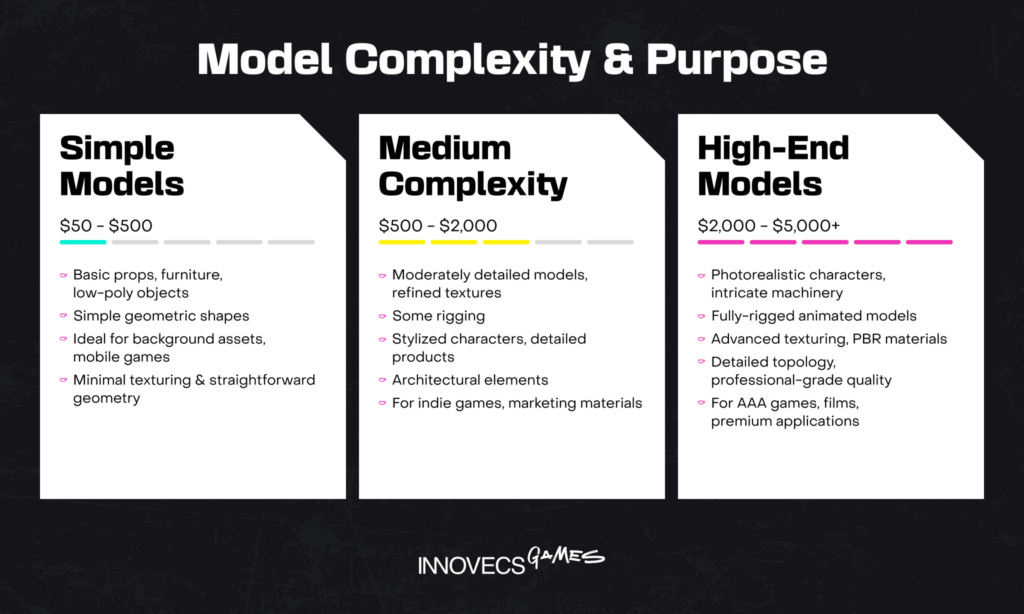
Different 3D asset categories have distinct price brackets, contingent on technical prerequisites, industry, and market demand.
Cost Breakdown by Model Type
Here’s what you’ll confront:
Low-Poly vs. High-Poly Models
Polygon count affects the file size, render speed, animation performance, and detail expression of your model.
Low-poly models use minimal geometry, under 10,000 triangles for a complete object. These are seen in real-time applications—games, VR, AR, live visualizations. Your phone or computer can display them smoothly because the graphics processor isn’t choking on millions of polygons.
High-poly models throw those constraints out. A high-poly character might contain 5 million triangles. You can’t use these in real-time; they’re for pre-rendered work where computers have hours to calculate each frame.
The low-poly barrel relies on textures and lighting to fake the roundness your eye expects. So it takes experience—knowing where you can cheap out on geometry and where you absolutely need more subdivisions.
High-poly models seem easier because you have so much geometry, but they’re actually more demanding in different ways. You need to maintain a clean topology, even with millions of polygons, or your file becomes unmanageable. You’re equally sculpting detail organically in the software, which requires artistic sensibility outside technical modeling.
And the kicker is that most production workflows use both. Artists create high-poly models first, capturing all the detail they want. Then they retopologize down to a low-poly game model and bake the high-poly detail into texture maps. So you’re paying for high-poly creation plus low-poly optimization, plus texture baking. Three distinct skill sets.

Realistic vs. Stylized Models
Realistic models chase accuracy. You’re trying to replicate how models look in the human world, as closely as possible. So the modeler conducts a ton of research, collecting reference photos and understanding material properties. They have to know how light interacts with different surfaces as well.
The cost driver in realism is iteration toward accuracy. Client sees first pass: “The metal doesn’t look right.” Artist adjusts. “Now it’s too shiny.” More adjustments. “The scratches look fake.” Even more adjustments. You’re chasing a moving target called “looks real,” which is subjective but also has objective markers everyone recognizes when you miss them. This back-and-forth takes time. Realistic models often need 30-50 percent more revision time than stylized ones.
Stylized models follow artistic interpretation, not reality. This doesn’t mean they’re easier—you’re trading technical accuracy for artistic coherence. The model needs to match an art style consistently.
All the forms need to share similar approaches to shape simplification. Colors need to work within a defined palette. Line weights and edge treatments need consistency across all assets. It’s a different skill set, leaning more toward design than technical reproduction.
Cost-wise, stylized can be cheaper or more expensive depending on the style and your team’s experience with it. We’ve had stylized projects cost more than realistic ones because achieving a specific art direction in 3D is sometimes harder than just making it look real.
Custom Models vs. Stock Models
Customized solutions ensure models are built to your specifications. For example, you say, “I need a Victorian desk with three drawers, brass hardware, mahogany wood, showing signs of 50 years of use.” Artist builds exactly that. The great side is that the design fits your art style perfectly. It meets your technical requirements precisely.
The model also includes only the details you need, nothing extra. You typically own full rights or exclusive licensing.
Custom is expensive because you’re funding the entire creation process, start to finish, with no cost sharing. In a majority of custom projects, you can expect slower periods. Clear communication, along with project management, is vital.
Stock models spread development costs across many buyers. An artist builds a generic the same Victorian desk, uploads it to a 3D marketplace for $180. Then sells it to 200 people. They’ve made $36,000 from one model, and buyers get it cheap.
The downside is that you can have the same desk for three other companies in your space. Or it has eight drawers when you needed three. Or it’s the wrong wood species. Or it’s built for pre-rendering and crashes your game engine. Premade works great for generic background props. However, that is bad for anything that defines your project’s identity.
Cost Breakdown By Industry Application
Game Characters
| Asset Type | Technical Scope | Time Estimate | Cost Range | Notes |
|---|
| Low-poly NPC (background / filler) | 4k–8k triangles, single 512 texture set | 6–10 hours | $180–$550 | Textures only |
| Stylized hero character (rig-ready) | 25k–40k triangles, 2K textures, Unity / Unreal import | 12–15 days | $2,000–$5,000 | Facial rig included, 3 LODs |
| AAA boss creature | 150k–250k triangles, 4K textures, cloth & hair simulation | 120+ hours | $8,000–$20,000 | ZBrush sculpt → retopo → engine integration |
Product Design and Prototyping
| Asset Type | Technical Scope | Time Estimate | Cost Range | Notes |
|---|
| Consumer gadget (medium detail) | STEP files + rendered hero shots | 2–3 days | $330–$1,600 | Wall thickness ≥ 1 mm, STL-ready |
| Precision machined component | ±0.05 mm tolerance, M3–M12 threads | 10–20 hours @ $55–$85/h | $550–$1,700 | Includes GD&T annotations |
| Functional RC car chassis (1:10) | 30+ printed parts, TPU tires, PLA/CF body | 4–5 days printing + 2 days CAD | $450–$1,200 (file pack) | Motors & bearings not included |
Architectural Visualization
| Project Type | Technical Scope | Time Estimate | Cost Range | Notes |
|---|
| Suburban house exterior only | 1–2k m² façade, mid-poly | 2 days | $400–$1,000 | No interior, no landscaping |
| High-rise condo + lobby & amenities | 25k–40k m², full texture set | 10–14 days | $4,000–$12,000 | VR-ready (Twinmotion / UE5) |
| Interactive VR walkthrough (add-on) | +60–100% scope on top of modeling | +5–7 days | +$3,000–$10,000 | 90 Hz, Oculus / Vive |
3D Printing and Miniatures
| Asset Type | Technical Scope | Time Estimate | Cost Range | Notes |
|---|
| 28 mm tabletop vehicle (single STL) | 1:64 scale, pre-supported | 1 day | $250–$700 | Download & print yourself |
| 1:24 scale model kit car | Multi-part STL, opening elements | 5–7 days | $800–$2,000 | Licensed or original design |
| 1:10 Formula / supercar full kit | 50–60 parts, TPU tires, CF-nylon arms | 7–10 days | $1,200–$2,500 (file set) | ~58 cm length, no electronics |
| Print farm labor (support removal) | Charged per cm² or per hour | — | $0.10–$0.25 / cm² or $35–$50 / h | Global average (2025) |
Game Character Models
Humanoid or creature-based alternates, featuring facial topology, optimized edge flow for animation, and intricate texturing, cost more.
Read also: Character Concept: A ‘Make it or Break it’ in Game Design
High quality models and characters designed for AAA games or films can surpass $10,000.
Product Models
Visualizations of consumer goods, electronics, furniture, and merchandise. The pricing fluctuates based on the complexity of the mechanics and the precision of the materials used.
Architectural Models
Architectural designs, structures, interiors, or urban tableaux with dimensionally accurate geometry and materials. Particular projects with luxurious furnishings often come with a higher price tag.
Vehicle Models
Mechanical design projects: automobiles, aircraft, or spacecraft with functional mechanical assemblies. Racing simulations and training software need proportionate, fidelity assets.
Filmmaking Models
In the realms of film production and AAA game development, compensation typically ranges from 50-200 percent above standard rates due to superior quality standards, protracted revisions, and short timelines. These sectors demand portfolio-caliber work adhering to exacting technical criteria.