How to Hire Unreal Engine Developers for Your Game Studio in 2026
What to test a UE5 candidate on. Where the good ones hide. Which setup survives your milestone plan, and the 2026 price tag.
Here’s an odd pair of facts. In March, Epic Games, the company that makes Unreal, laid off more than 1,000 people, about a fifth of its staff, after Fortnite engagement fell off. Meanwhile the studios building on its engine still can’t fill senior Unreal seats. You’d think anyone trying to hire Unreal Engine developers this year would be swimming in candidates. Mostly, they aren’t.
Layoffs rarely free up the people studios actually need. Back in 2023, when Epic let 830 people go, two-thirds of the cuts landed outside its development teams, and the rest of the industry hasn’t really stopped cutting since. So yes, recruiters see more CVs with “UE5” on them than ever. Now ask those people to read an Unreal Insights capture from a PS5 build. Or to explain why their replication code survived launch weekend. The list gets short fast. Sticky-note short.
This guide is about the names on that sticky note. It runs in roughly the order a hire really happens:
- what to test, and the questions that test it;
- the roles you’ll need besides programmers;
- where people turn up, and a five-step way to vet them;
- four engagement models, plus how to check a partner;
- what people cost in 2026, region by region (public numbers linked, our own labeled).
What Unreal Developers Do and When Your Project Needs Them
An Unreal developer’s day is split between two languages. The heavy, every-frame stuff (movement, combat, netcode, save games) is C++. Blueprints, Unreal’s node-based visual scripting, sit on top. Designers use them for gameplay logic and UI flow, and for the tuning values they’d rather not wait on a recompile to change. Most people in production touch both before lunch.
So why is this harder to staff than “a game programmer”? We’d point to three things. First, the pool is smaller than the engine’s popularity makes it look, since surveys count people who use Unreal, not people who’ve shipped on it. Second, demand keeps going up. Every studio that walks away from its own engine lands in the same line; Halo Studios told Xbox Wire in 2024 that switching to UE5 would make bringing in talent a far smoother process, and its first UE5 game, Halo: Campaign Evolved, came out in July 2026. Third, UE5 moved the goalposts. Nanite, Lumen, World Partition and Iris (the newer replication system) don’t behave like the UE4 habits a lot of senior CVs grew up on, so ten years of experience can include seven of the wrong kind. And console? That’s its own filter. Cert requirements, memory ceilings, devkit quirks: it all sits under platform NDA, and you only learn it by shipping on the hardware.

Is Unreal even the right call? For a good-looking 3D game aimed at PC or console first, usually yes. Same if the world is huge and streamed, or the multiplayer is competitive and the server has to be the boss. For 2D, casual or light mobile work we’d mostly point elsewhere. We go through that choice in Unity vs Unreal. If it’s still open on your side, close it before you write the job ad, because the two engines draw from different pools of people.
Unreal Engine Developer Skills to Look For
Epic’s release calendar turns out to be a decent hiring guide. UE 5.8 shipped in June as the last planned major UE5 release, and Epic is aiming for an Unreal Engine 6 Early Access at the end of 2027. So someone you hire today spends year one on a settled UE5 and year two, quite possibly, prepping a migration. We test five things. Here they are, ordered loosely by how often each one has sunk a build we’ve seen. (Staffing both engines? Our guide on how to hire Unity developers covers the C# side. The overlap’s smaller than you’d guess.)
C++ vs. Blueprints: Two Different Developer Profiles
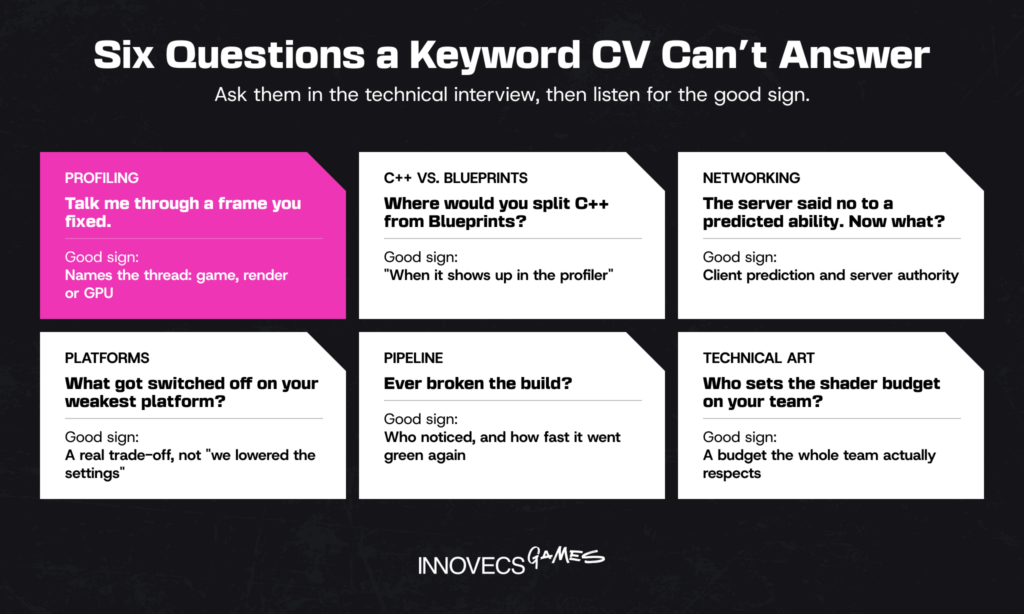
Think of these as two hiring profiles. Not junior and senior. The C++ person lives in Unreal’s reflection system (UCLASS, UPROPERTY, garbage collection), opens engine source when the docs give up, and decides what designers get to touch. The Blueprint-heavy person, often a technical designer, builds and iterates on features fast in the editor. One isn’t a lesser version of the other: Sandfall Interactive shipped Clair Obscur: Expedition 33 with every gameplay system in Blueprints and just four programmers, going by slides from its GDC 2026 talk. What you’re really testing is judgment about where the line goes. Ask when they’d move a Blueprint into C++. “When it shows up in the profiler” is a great answer. If they say “always” or “never,” keep digging.
UE5 Core Tech: Nanite, Lumen, and World Partition
Put Nanite, Lumen and World Partition in a job ad and you’ll get a pile of CVs claiming all three. Studios that hire Unreal Engine 5 developers run into this constantly. The better question is what a candidate switched off on their last project. And why. Nanite and Lumen cost milliseconds, and cheap hardware has few to spare; in 5.8 Epic shipped a lighter Lumen mode just so Switch 2 and mid-range PCs could stay at 60 fps. Now look at the top end. CD Projekt Red brought a Witcher 4 tech demo to State of Unreal 2025, and it held 60 fps on a PS5 with ray tracing on, mostly thanks to new streaming code and Nanite foliage. Your open-world or AAA game development hire should be able to walk you from one of those to the other. Bonus points if MetaHuman, Niagara and Chaos budgets come up without you asking.
Gameplay Systems, Multiplayer, and Networking
Ask a producer where their Unreal schedule slipped. “Netcode” usually comes out before you’ve finished the question. So check for real Gameplay Ability System (GAS) experience: attributes, gameplay effects, ability prediction, and what it cost the last time one of those went wrong. Then replication. A strong candidate can talk about server authority, relevancy and RPC reliability without notes, and probably knows Iris went production-ready in 5.8. Running dedicated servers? Ask who has actually stood one up on Linux and load-tested it before launch. Plenty of CVs say “multiplayer” and mean a co-op prototype on a LAN.
Performance Profiling and Platform Optimization
Plenty of people can build a feature. Fewer can get it to ship at frame rate, and profiling is where you find out which kind you’ve got. Ask about one specific frame they fixed. What did Unreal Insights show? Game thread, render thread or GPU? What did they change? Shader compilation hitches make a good probe this year, since PSO pre-caching has become the standard fix (Epic says its 5.8 work cut Fortnite’s shader count by 68%). Console experience surfaces here too. Ask about memory and just listen. Somebody who has scraped megabytes together on a Series S sounds very different from somebody whose whole career ran on a 64 GB workstation.
Pipeline Habits: Source Control, Builds, and Code Reviews
Unreal projects are mostly big binary assets. That’s why most studios run Perforce, not Git, and it’s partly why Epic open-sourced Lore, its own version control system, this June. You want someone at home with exclusive checkouts, changelists and streams. Bonus if they’ve killed a nightly build once and can still describe the standup after. Code review habits matter. So does how they handle engine upgrades. Running your own engine branch? Then somebody has to pull in Epic’s changes without the team losing a week to merge conflicts. And this sounds petty, but a person who writes decent changelist descriptions is worth a lot to your build engineer.
Roles You May Need Beyond Programmers
Staff an Unreal project with programmers only and it stalls the week the art shows up. Our guide on how to hire a game development team covers the full org chart. Here we’ll stick to the four groups Unreal projects tend to run short of first.
Gameplay and Engine Programmers
“We need to hire Unreal Engine programmer talent” can mean two quite different jobs. One is gameplay: abilities, enemy AI, UI, the camera, anything the player actually touches. The other is engine work, underneath all that, in rendering, memory, streaming, platform layers and the tools everyone else leans on. Those people are much harder to find. Our advice: only go looking for one if you really plan to modify the engine. Otherwise a senior gameplay programmer who profiles well, plus a tools programmer, covers most of it.
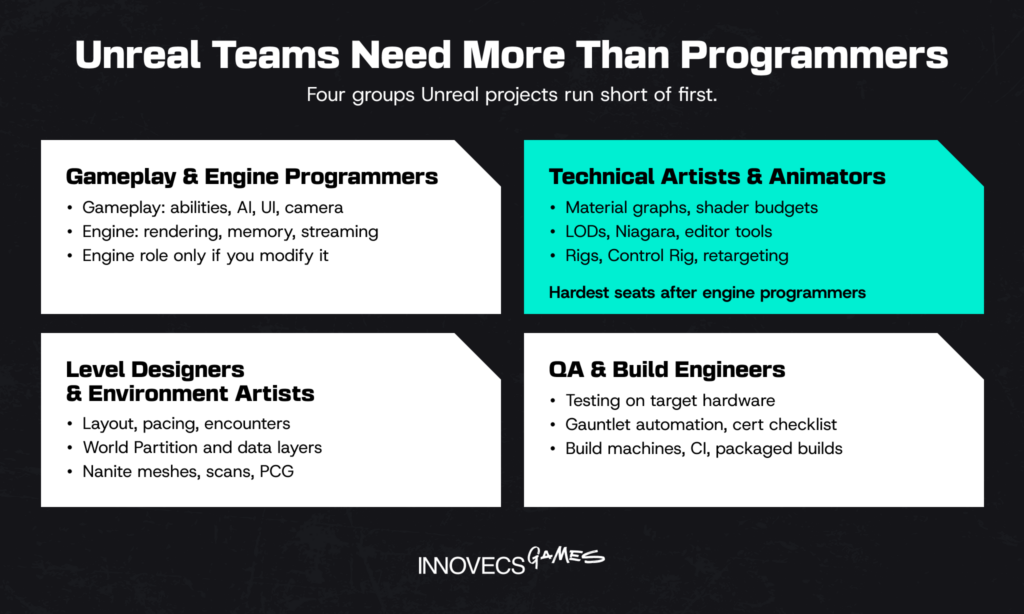
Technical Artists and Technical Animators
A technical artist is who artists go to when the engine says no. They own material graphs and shader budgets, LODs, Niagara, and usually a drawer full of Python and editor scripts that keep art flowing in. Technical animators do the same job for motion. Rigs, Control Rig, retargeting, plus the animation blueprints that decide whether a character feels heavy or floaty on the stick. On UE5 projects these are often the hardest seats to fill after engine programmers. It’s a big reason studios bring in a game technical art partner for a milestone rather than wait months on a hire. Lighting artists and Sequencer cinematics people are similar. Most teams need them for a trailer or a milestone push. A full year? Rarely.
Level Designers and Environment Artists
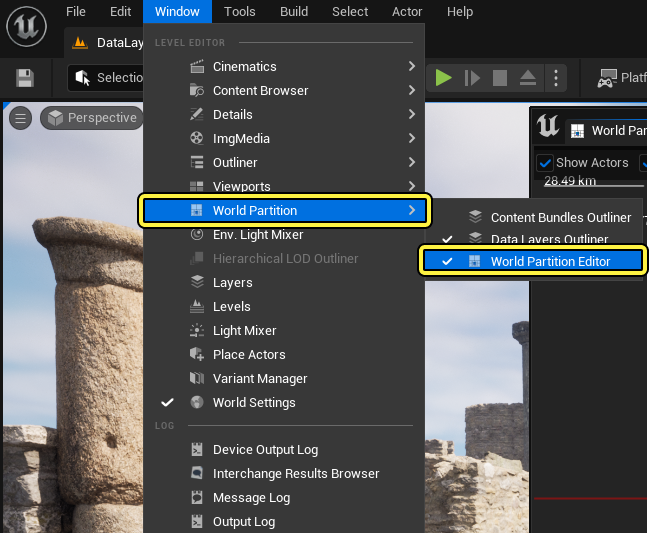
Level designers block out the space, pace it and script the fights, a lot of that in Blueprints. On a big map they also have to get World Partition and data layers, or the thing won’t load. After them come environment artists with Nanite meshes, scans and PCG rules to fill it in. Open-world projects lose weeks at exactly that handoff, and usually nobody notices until it’s late. So ask both roles how they’ve worked together before. Plenty of studios add capacity here through specialist level design services, especially for a vertical slice or a content push.
QA and Build Engineers
Good Unreal QA doesn’t just play the build on a dev PC. They test on the actual console, write automation in Gauntlet and the Automation Test Framework, and keep the cert checklist honest. The build engineer is whoever notices at 2 a.m. that nothing compiles. Build machines, shader caches, CI, packaged builds for PC, PlayStation 5, Xbox Series X|S and Nintendo Switch: all theirs. Neither role shows up in most early budgets. Both show up as emergencies somewhere around alpha.
Where to Find Unreal Engine Developers for Hire
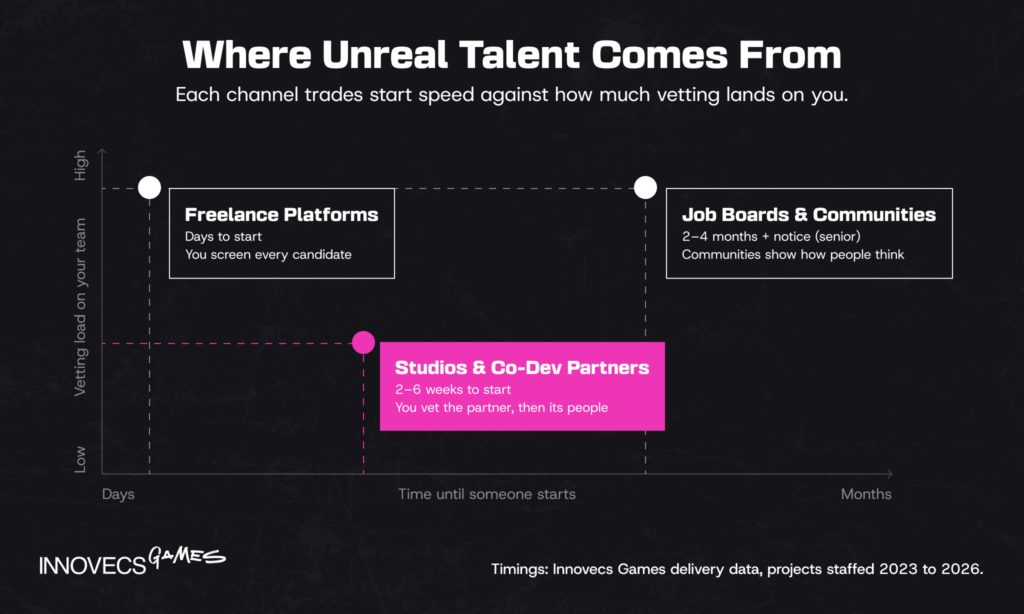
Programmers, tech artists and build engineers almost never come through the same door. Every channel below works. The difference is how much vetting lands on your desk, and how fast someone can start. Don’t count on job ads. ITJobsWatch, which tracks UK IT postings, counted 52 permanent ads mentioning Unreal Engine in the six months to November 2, 2026. Fifty-two, for a whole country. Seniors move through referrals and ex-colleagues, and they’re usually off the market within weeks. So decision speed ends up mattering about as much as the channel. We’ve watched shortlists wait three weeks for a second round and come back half the size.
Freelance Platforms and Talent Marketplaces
Want an Unreal Engine developer for hire on a call by Thursday? Upwork, Toptal and the like are your fastest bet. Days, often. They’re good for bounded work like a plugin, a pitch prototype, a performance pass on one level or porting one system. The weak spots are vetting and staying power. Five stars means a past client was pleased. It doesn’t mean console. And someone juggling three clients might not be free the week you need them. Budget your own hours to screen each one. Nobody on the platform side will.
Job Boards and Developer Communities
Hiring permanent, or for a long contract? Then you’ll probably post on Hitmarker, Work With Indies or GamesIndustry.biz Jobs. LinkedIn too, obviously. That’s where volume lives. Signal, in our experience, lives in communities. Think of the Unreal Slackers Discord, Epic’s developer forums, Unreal Fest, or the regional Dev Days Epic now runs around EMEA. If someone’s spent a year answering other developers’ questions in public, you’ve already seen how they think. That’s half a technical interview, in writing, for free.
Game Development Studios and Co-Development Partners
Need several people at once? Or one rare skill by next Tuesday? A studio partner usually beats both channels above. Co-development partners and staff augmentation vendors already have Unreal engineers, tech artists and QA on payroll, so the hiring part is done. Your job shifts to vetting the partner, and the specific people it puts forward. It’s also the most practical way to hire remote Unreal Engine developers in other time zones without opening payroll in another country. The risk? Partner quality. That’s what the partner checklist further down is for.
How to Vet and Hire Unreal Developers Step by Step
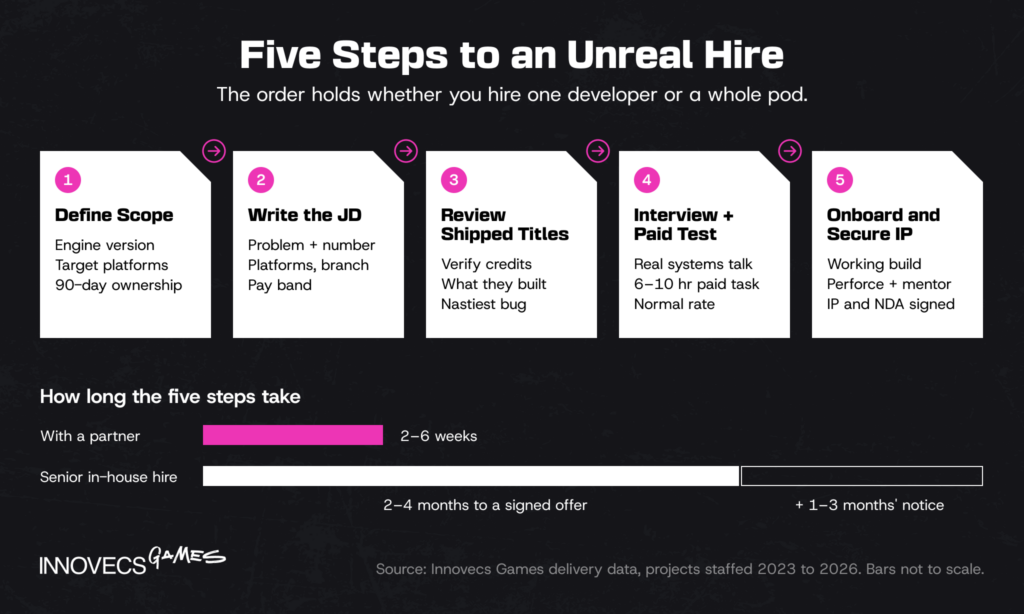
With a partner, the five steps below take two to six weeks. A senior in-house hire runs two to four months, by our own delivery data. Whether you hire Unreal Engine developer by developer or as a whole pod, the order holds.
Step 1: Define Scope, Engine Version, and Target Platforms
First, three notes on paper. What will this person own by day ninety? What engine version are you on? Which platforms do you have to certify? Give the engine version more thought than usual right now. 5.8 is the last big UE5 drop Epic has planned, and UE6 Early Access is pencilled in for late 2027. So is this person going to drive an upgrade, or hold a frozen version together until you ship? Those are different hires. Platforms shape the shortlist too. A Switch 2 port and a PS5-first action game need different people. Console in scope? Sort out devkit access before the start date, not after.
Step 2: Write a Job Description That Filters for Engine Depth
A job description listing “UE5, C++, Blueprints, Nanite, Lumen” filters out exactly nobody. They’re on every CV already. Write the problem down instead. “Own replication for a 32-player session on dedicated servers.” “Hold 16.6 ms on PS5 in a streamed open world.” Then the boring facts: platforms, source control, engine version, custom branch or not. And put the pay band in. People who’ve shipped on Unreal know the market, and an ad with no range reads like one that’s below it. A skeleton we’ve seen work:
- the problem you’re hiring for, in one sentence, with a number in it;
- engine version, whether you run a custom branch, and your source control;
- target platforms, and whether certification is in scope;
- their first-90-days scope, and their manager;
- pay band, time-zone requirement and contract type.
Step 3: Review Portfolios and Shipped Titles
Shipped games count for more than a reel. Credits are easy to verify on MobyGames, or by sitting through the credits yourself. Ask what they personally built on each one. Then ask about the nastiest bug they hit in that system. Most programmers can’t show you code, since it belongs to whoever paid for it. The bug story is often all the portfolio you’ll see. A GitHub sample or a small UE5 side project helps. With technical artists, ask for the material graph. Not the beauty shot.
Step 4: Run a Technical Interview and a Paid Test Task
Our technical interviews look more like a pairing session than an exam. We’ll put a profiler capture on screen and ask what they see. Or a replication bug. Or an ugly Blueprint graph to clean up while thinking out loud. We’d skip puzzle-style coding tests; they mostly measure how much someone has practiced interviews. After that comes a paid test task of six to ten hours that looks like real work. Add a predicted ability to a small GAS sample, say, or find and fix the hitch in a level you supply. Pay their normal rate for it. Ask for unpaid homework and the seniors with options simply walk. Next to one bad hire, the fee is nothing.
Questions we keep coming back to, because keyword-heavy CVs tend to stall on them:
Step 5: Onboard With Clear Pipelines and IP Ownership
Do the onboarding work the week before they arrive. Day one should mean a build that runs, a Perforce login that works, and an actual human as mentor. Plus a small task they can merge before Friday. Get the paperwork done by then, too. Employment and contractor agreements should assign all project IP to the studio, and the NDA needs to cover the codebase plus any platform-holder material. One Unreal quirk: engine source on GitHub only shows up after each person links a personal Epic account and accepts the EULA. Working through a vendor? Read how its own employment contracts handle IP. If the chain breaks there, it breaks for you, and due diligence skips that page more often than you’d hope. Hiring someone abroad directly? Then you’re dealing with local contractor rules or an employer-of-record service. (A partner that already employs its people takes that question off your plate.)
Then agree up front on what “working” means, so nobody’s judging a new senior on vibes in week three:
- Day 30. They’ve merged code to main, run the game on every target platform, and know who owns which system.
- Day 60. They own one system or feature end to end, including reviewing other people’s changes to it.
- Day 90. Full speed. They estimate their own work and raise risks before standup does. By now you’ll know whether the hire worked.
Same checkpoints for a partner team, with one extra: by day 30, its first deliverable should have been accepted from a build on your machine.
Red Flags to Watch For
Most bad Unreal hires were visible in the interview. Somebody just had to know where to look:
- Every answer is a feature name (Nanite, Lumen, GAS, PCG), and not one comes with a trade-off.
- No shipped title, and no clear answer to “what did you build yourself?”
- Profiling stories that start and end with “we lowered the settings.”
- “Multiplayer” turns out to mean listen-server co-op. No dedicated server anywhere.
- Contempt for Blueprints, or for C++. Either extreme is hard to sit next to.
- Won’t do a paid, scoped test, yet wants a senior rate.
- Goes vague about who owned the code on past contracts.
- Vendors who go quiet when you ask for names.
In-House, Freelance, Dedicated Team, or Outsourcing: Which Model Fits?
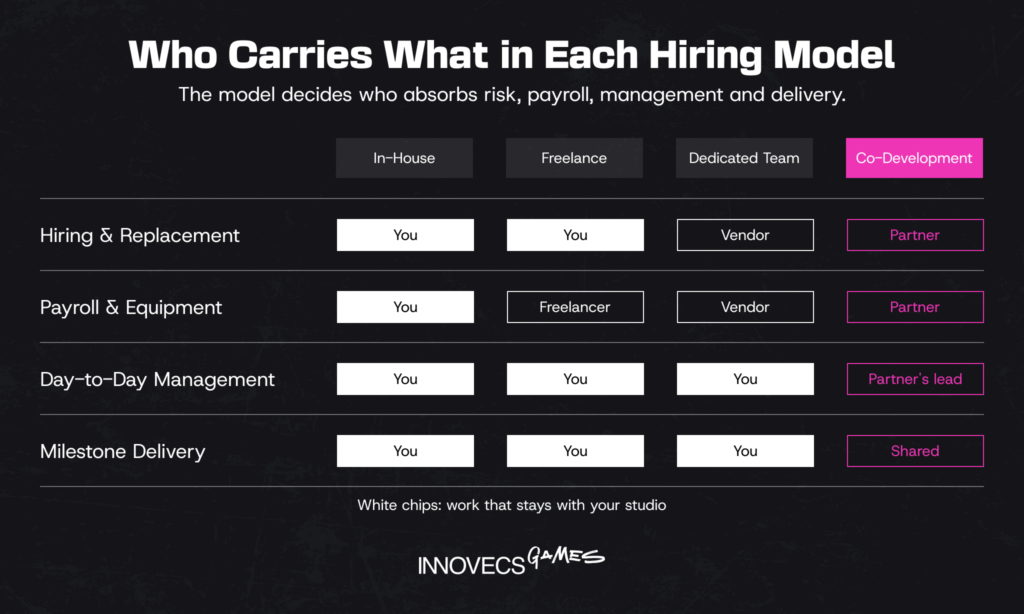
A small confession about structure. In real life you pick the model before the channel and before the vetting, because the model decides whether you’re screening individuals or a partner, and which channels are even worth opening. We still put it here. Judging a model is easier once you know what a good candidate sounds like. Underneath, it’s a question of who eats the risk when someone quits, and who manages them every day. Row by row:
| In-house team | Freelance | Dedicated team / staff augmentation | Outsourcing / co-development | |
|---|---|---|---|---|
| Cost | Big fixed bill, recruiter fees. Pays off over years | Smallest invoice. Your hours are the hidden part | Flat monthly per person. No recruiter, no severance | Retainer, or a price per milestone |
| Speed to start | 2 to 4 months for a senior, plus notice | Days to 2 weeks | 2 to 6 weeks | 2 to 6 weeks |
| Control | Full | Task by task | Your leads, every day | Shared: you set direction, they run delivery |
| Scalability | Slow to grow. Painful to shrink | One person, fine. Five? Good luck | Up or down, with notice | Whole workstreams in or out |
| Best for | Core tech. Creative leads. IP you’ll keep for a decade | Plugins, prototypes, the odd fix | Plugging holes in an already good team | Full features, ports, art and QA in bulk |
| Honest downside | Pricey to staff for peaks | No continuity; you vet everything | You still manage people | Needs a clear brief and a shared pipeline |
Honestly, read the bottom row first. Each model breaks in its own boring, predictable way. Better to know which one now than in month four.
In-House Hiring
You get the most control and the slowest start. Your technical director, the engine leads and anyone who’ll own core systems for years belong here, since that knowledge isn’t something you want to rent. The price is time and flexibility. A senior Unreal search plus a European notice period can outlast an entire production phase, and a team sized for full production gets expensive to carry through the quiet months after launch.
Freelance Specialists
Got a job with clear edges? A plugin, one shader that won’t behave, a prototype for a pitch? That’s where freelance Unreal Engine developers earn their rate. The rate looks good. So does the start date. The catch is everything around the person. You vet, you manage, you handle the knowledge transfer when they leave. Flu the week before a milestone, and you’re on your own.
Dedicated Teams and Staff Augmentation
With a dedicated team, the people are yours in all but payroll. They sit in your Jira, your Perforce, your sprint planning. Laptops, contracts, finding someone new when a person quits: the vendor’s headache. Staff augmentation is the smaller version, usually one or two specialists slotted into a team you already run. Both shine when your leads know exactly what they want and just don’t have enough hands. Neither one lightens your management load, though. What comes off your books is the hiring risk.
Outsourcing and Co-Development
Outsourcing means handing off a chunk with clear edges: a port, an art package, a QA pass. Co-development is closer. The outside team works inside your pipeline with its own lead, owns a whole workstream, and is on the hook for the milestone with you. (We’ve written up how video game co-development works if you want the mechanics.) An Unreal Engine development company running game co-development services or game development outsourcing can stand up a whole feature team in a few weeks. When the date can’t move, that’s the point. For leads who already write code half the week, here’s the real difference from staff augmentation: they review results instead of handing out tickets. The downside is setup. Shared source control, build access and review rules take a few weeks to get right. Skip that, and sooner or later your partner is working on a three-day-old build.
Which Model Fits Which Situation
Tables are tidy. Real studios aren’t. Size changes the math a lot. At a 50-to-100-person AA shop the leads still write code, so the true price of any model is the management it dumps on their week. At AAA there’s usually an external development director picking vendors, and they care more about contract terms and proof than about who can start Monday. Five situations we see over and over:
- AA studio, milestone in eight weeks, no senior network programmer. One senior through staff augmentation, or a co-development partner that owns replication as a workstream. An in-house search won’t close before the milestone.
- AAA team needing a console port or Switch 2 version next to the main build. Get an outsourced or co-development pod with its own lead and devkit access. Your core team stays on the main platform.
- New IP in pre-production, launch two or three years out. Keep the technical director and engine leads in-house. Bring partners in later for volume, things like environment art and QA.
- Live game with a fixed content cadence and a stretched team. A dedicated team on a retainer that grows or shrinks by season.
- One narrow problem: a hitch, a plugin, a shader. A freelancer, or a short specialist engagement of two to six weeks.
Most studios we work with are in two of these at the same time. Hence all the mixed setups.
Vetting a Partner: Discovery, Acceptance, and Exit
Vetting a partner is a different sport. You’re not buying a CV, you’re buying how they deliver. Before the first invoice, we’d nail down four things:
- Paid discovery, or a small first milestone. A few weeks on your build that leaves you something to keep (a risk list, a performance capture, one merged feature) even if you switch vendors afterwards.
- Named people. Whoever’s on the proposal should be on the project. Any swap needs your sign-off.
- Acceptance you can check yourself. A milestone is done when it builds from your Perforce on your build machine, not when it runs on the vendor’s workstation. For art, the first batch gets reviewed against your style guide before volume starts.
- Licensed content and exit. Put it in writing: which code the vendor brings from earlier work, which Fab assets and AI-generated content end up in the build, and who holds which license. Then the handover itself, meaning docs, credentials, and a clean build done by someone outside the vendor’s team.
Not Sure Which Model Fits Your Project? Get Expert Advice
None of the five fit? Or you’re stuck between two? Send the milestone plan and a note on who’s missing. A producer on our side will sketch a mix, and sometimes the honest answer is “hire in-house.”
How Much Does Unreal Talent Cost in 2026?
How much does it cost to hire a game developer who knows Unreal? Less than you’d think in salary. More than you’d think in total. On Glassdoor, a US Unreal Engine developer’s median total pay sits around $113,000 a year. Thin sample, mind you: 27 salaries. Now hold that up against the $135,980 median the Bureau of Labor Statistics reports for all US software developers as of May 2025. Games have always paid under general tech. That gap is part of why senior Unreal programmers drift into simulation, automotive and film, where the skills carry over and the developer salary doesn’t lag. Studios that hire Unreal Engine developers at the bottom of the band often find themselves filling the same seat a year later.
Hourly Rates by Region and Seniority
A salary is what an employee costs you. A rate is what shows up on an invoice. The table is the second kind: typical developer hourly rate ranges for Unreal programmers on contract or through a vendor in 2026 (vendor overhead included, yours not). The far-right column is a sanity check, the nearest public salary figure we could find per region.
| Region | Mid, 3 to 5 yrs (USD/hr) | Senior, 5 to 8 yrs | Lead / principal | Nearest public salary number |
|---|---|---|---|---|
| North America | 70 to 100 | 100 to 150 | 140 to 200 | US: ~$113K median total pay (Glassdoor) |
| Western Europe | 55 to 85 | 80 to 120 | 110 to 160 | UK Unreal ads: £65K median (ITJobsWatch, Nov 2026) |
| Eastern Europe / Ukraine | 35 to 50 | 45 to 70 | 60 to 90 | Ukraine, any stack: $3.5K/mo net, June 2026 (DOU) |
| Latin America | 35 to 55 | 50 to 75 | 65 to 95 | Nothing Unreal-specific we’d trust |
| India | 20 to 35 | 30 to 50 | 45 to 70 | Game devs: ₹5.5 lakh/yr, Glassdoor May 2026 (via Outlook Respawn) |
India is cheapest, and hardest for console work, since not many teams there have shipped on PlayStation or Xbox. US studios wanting shared hours tend to look at Latin America. UK and EU studios tend to look east, to Eastern Europe, which also runs deep on shooters and open worlds (GSC Game World finished S.T.A.L.K.E.R. 2 on UE5 with part of its Kyiv team relocated to Prague). We’re based in that region ourselves, so weigh that last sentence accordingly. Working hours matter as much as rates, too: from Warsaw or Kyiv, a normal day overlaps the US East Coast by two to three hours and the UK by most of the day. Offshore pricing only holds if the time you spend managing it doesn’t eat the difference.
Monthly Cost by Engagement Model
One senior Unreal gameplay programmer, one month, priced four ways. The last row is a small co-development pod, for scale.
| Option | Monthly rate | Includes | Doesn’t include |
|---|---|---|---|
| In-house, US | $12.5K to $17.5K ($120K to $160K base + employer costs) | Full control. Knowledge stays | Recruiter fee (we estimate 20% to 25% of year-one salary), kit, months of searching |
| In-house, UK | $7.5K to $10.5K (near the £65K median + employer costs) | Full control | Same, plus 1 to 3 months’ notice |
| Freelance, E. Europe or LatAm | $6.5K to $12K (140 to 160 hrs) | Their hours. That’s it | Managing them, QA, cover, continuity |
| Dedicated dev via vendor, E. Europe | $8K to $11.5K | Payroll, kit, a replacement if they leave | Daily direction. Still your leads |
| Co-dev pod, E. Europe (lead, 2 devs, tech artist, QA, part-time producer) | $35K to $55K | A workstream that runs itself and owns delivery | Creative calls, final sign-off |
Per hour, the freelancer wins. Per shipped feature, it’s usually a lot closer than that, because the freelancer’s row has no QA, no producer and nobody covering a sick week.
What a single month hides is the wait, and the wait is the expensive bit. Picture it: three senior Unreal programmers, six months, one multiplayer feature that has to hit a milestone. We’ve used the rates above, plus two assumptions from our own projects (an in-house search eats two months, and nobody’s at full speed for their first four to eight weeks):
| Option | People start | Cost over six months | Months of full-speed work in the window | What’s missing |
|---|---|---|---|---|
| In-house, US (3 hires) | Month 3 | $222K to $330K, recruiting fees in | 2 to 3 | QA, production help. Most of the payoff comes after month six |
| Freelance, E. Europe or LatAm (3) | Week 1 or 2 | $117K to $216K | ~5 | QA. A manager. Anyone covering sick days |
| Dedicated devs via vendor, E. Europe (3) | Weeks 2 to 6 | $144K to $207K | 4.5 to 5 | Daily direction (still your leads’ job) |
| Co-dev pod, E. Europe (5: lead, tech artist, QA, 2 devs) | Weeks 2 to 6 | $210K to $330K | 4.5 to 5 | Creative calls and final sign-off stay with you |
No, the in-house row isn’t a typo. Need people for two years? Hire them. Need them for six months? Then half that money buys you a search and a ramp-up, not features. And the pod looks pricey until you notice it’s the only row with its own QA and its own lead. Put it next to the freelance row plus your leads’ evenings spent managing three contractors. That’s the honest comparison.
One more lever: the contract. Scope that’ll shift (so, most of production) belongs on time and materials. A port, or a milestone with acceptance criteria you could hand to a stranger? Fixed price works fine there. We’ve watched teams sign fixed price on scope nobody had properly explored. They spent the next quarter haggling over change requests. The game waited.
Hidden Costs: Onboarding, Tooling, Licensing, and Turnover
Five lines that rarely make it onto a rate card, and always make it into the budget:
- Onboarding. Four to eight weeks before a senior is fully productive in a large Unreal codebase, longer on a custom engine branch. And it repeats with every new hire and every vendor rotation.
- Tooling. Perforce seats past the free tier, build machines, shader cache storage, Fab plugin licenses, console devkits (whose terms sit under platform NDAs). Epic’s open-source Lore might trim the version control line one day. It’s too new to bet a production on.
- Engine licensing. Under Epic’s current terms, games pay a 5% royalty on lifetime gross revenue above $1 million per product, and sales through the Epic Games Store are royalty-free. Ship on the Epic Games Store no later than on other stores and Launch Everywhere with Epic drops that to 3.5%. Quick math: a $10 million game owes $450,000 the usual way, $315,000 the Launch Everywhere way. (The $1,850-a-year seat license you may have heard about? Non-game commercial use. Doesn’t apply here.) Epic has changed these terms more than once since 2024. Check the page again before the budget’s final.
- Turnover. A senior leaves, and you pay twice: the new search and ramp-up, plus everything they knew that nobody wrote down. Docs and pairing look cheap next to that.
- Platform work. Cert passes, compliance fixes and submission builds almost never appear in an engineering estimate. They always appear in the schedule.
How AI Is Changing Unreal Engine Hiring
Epic is moving faster on AI than most of its users. UE 5.7 put an in-editor AI Assistant into the editor in November 2025, one that answers questions and writes C++. Version 5.8 followed with an experimental MCP plugin that hooks models like Claude and Gemini straight into Unreal projects, and Epic’s UE6 plans include AI-assisted pipeline features plus a shift of gameplay programming toward Verse. The people you’d hire are warier. In GDC’s 2026 survey, 59% of game programmers said generative AI was hurting the industry. Epic itself made a point of saying its March layoffs were not related to AI. Expect strong candidates to have opinions about these tools, then, and take that as a good sign. (For the wider picture beyond Unreal, see our piece on AI in game development.)
Where the tools change the work, and where they don’t:
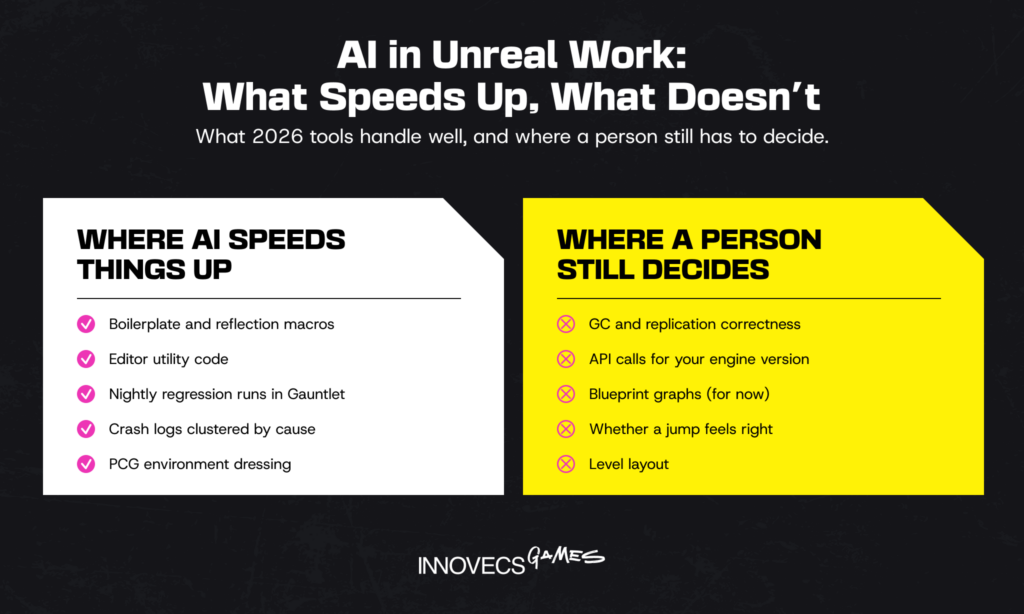
AI literacy in 2026 hires. A strong candidate uses an assistant and can tell you where it got something wrong last week. Generated code gets the same suspicious read they’d give a new junior. Platform code under NDA never goes near a public model. Ask about all three. Someone who’s never tried the tools and someone who can’t work without them both deserve a follow-up question.
Verse is the long-term wild card. If UE6 pushes gameplay code toward it, people with UEFN experience get a head start, but requiring it today would filter out most of the market for a language your project doesn’t even use yet.
Our read, for what it’s worth: AI has made the first draft of Unreal code much cheaper. It hasn’t touched the price of knowing why a frame takes 19 milliseconds. Hire for the second.
How Innovecs Games Helps You Build an Unreal Team
That kind of judgment takes years to grow in-house and a few weeks to bring in. We’ve been building games with studios and publishers for 11+ years now: 300+ titles delivered for 100+ clients, with 200+ developers and artists on the team. Our Unreal Engine game development services cover the gaps this article keeps coming back to. Senior C++ and Blueprint engineers, technical artists, level designers, QA, either as individuals for a few months or as a co-development team with its own producer. Studios that hire Unreal Engine game developers through us usually start with one workstream (a multiplayer system, a console port, a performance pass) and grow from there. Full-cycle development, concept to live ops, is on the table as well.
We work in your Perforce and your sprints, sign NDAs before the first technical call, and transfer IP on delivery. A dedicated team from us costs more per month than a freelancer, and if one freelancer for six weeks would solve your problem, we’ll tell you so. We can’t show our Unreal case studies publicly yet. The portfolio covers the wider range of our work, and references in your genre are available under NDA.
Is there a milestone you’re nervous about? A req that’s been open since spring? Grab a slot with our Unreal team. Tell us the platforms and the date that keeps you up, and we’ll name who could pick it up. If you’d rather see how we work first, one feature is a perfectly good place to begin.
FAQ
How do I hire Unreal Engine developers for a game project?
Scope first. Write down what they’ll own, your engine version, and every platform you’ll certify. Then the model: in-house, freelance, a dedicated team, or co-development. That decides where you look. To vet, we’d talk through real systems instead of quizzing, then pay for a six-to-ten-hour test task. IP and NDAs get signed before day one, not after.
How much does it cost to hire Unreal Engine developers?
In the US, about $113,000 a year in median total pay, per Glassdoor. Hourly is a different story. Senior contract rates in our 2023 to 2026 projects: $100 to $150 in North America. Western Europe, $80 to $120. Eastern Europe, $45 to $70. Then the extras nobody quotes you: ramp-up weeks, tooling, and Epic’s royalty after your first $1 million in lifetime gross.
Is console experience necessary for a UE5 project?
PC only? Then no. Console in scope? Pretty much yes. Cert rules, memory limits and devkit habits are all under platform NDA, so the only school is shipping. The good news: one senior who’s been through it can usually carry two or three PC folks through their first submission.
What skills should I test when hiring a UE5 developer?
Three basics for everyone. C++ the Unreal way, with reflection and GC. Good sense about when Blueprints are enough. And real time spent in Unreal Insights. Past that, test whatever your game leans on hardest. Multiplayer means GAS and replication. Open world means World Partition and streaming. Pretty pixels mean Nanite and Lumen trade-offs. A paid task on an actual problem beats trivia every time.
Should I choose freelancers or a dedicated team?
Depends how long, and how tangled. A plugin, a prototype, one optimization pass? Freelancer. Months of production where someone has to remember why things were built that way? Team. Our rough rule: past three months, or across more than one system, the team tends to win per shipped feature.
How long does it take to fill an Unreal role?
Senior, in-house: two to four months to a signed offer. In a lot of Europe, add one to three months of notice on top. A freelancer might start this week. Partners (dedicated teams, co-dev studios) usually land somewhere between two and six weeks.
Is it better to build an in-house team or outsource development?
Rarely either-or. What should stay home is whatever you’d be lost without in five years: core tech, creative direction, the IP. The spiky stuff can go out. Ports, a wave of art, QA, a few extra hands before a milestone. Almost every studio we know runs some mix.
What is the difference between C++ and Blueprint developers?
Roughly: C++ people build the engine-side plumbing and the fast code, then expose knobs. Blueprint people (often technical designers) grab those knobs and iterate on gameplay in the editor, no recompile. You’ll want both. The best hires can cross over when needed.
🤖 How is AI changing the way studios recruit Unreal talent?
Interviews increasingly ask how a candidate uses coding assistants, and how they check what comes out. With Epic’s in-editor AI Assistant and the MCP plugin in UE 5.8, AI literacy is now part of the job, so studios look for people who treat generated code the way they’d treat a junior’s pull request. Some studios also screen CVs with AI. That makes a paid test task more important, not less.
🤖 Can AI tools replace engine programmers on a game team?
No. Boilerplate, doc lookups, test scaffolding? Sure, faster. But no tool owns a frame budget. Or answers for a replication model, or a failed cert. Someone has to catch it when generated code is quietly wrong. That’s the engine programmer, whose value goes up, not down.
Ready to Start Your Next UE5 Project? Let’s Talk
One feature or a whole crew, if you need to hire Unreal Engine developers before the next milestone, drop us the brief. Platforms too. You’ll get back names we’d staff it with, plus the first risk we’d go after.