How to Hire Mobile Game Developers in 2026
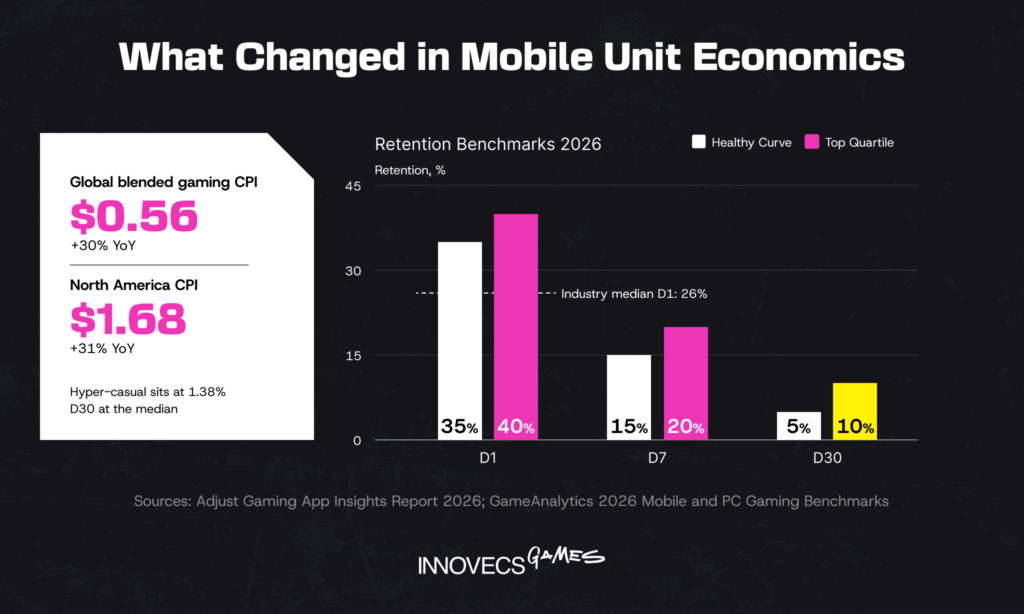
Buying a mobile player costs about a third more than it did a year ago. Adjust’s Gaming App Insights Report 2026 puts global blended gaming CPI at $0.56, up 30% year over year, and North America at $1.68 after a 31% jump. Now set that against what happens to the players you just paid for. GameAnalytics’ 2026 Mobile and PC Gaming Benchmarks put the industry median at roughly 26% day-one retention, with a genuinely healthy curve sitting at 35/15/5. Five percent at day thirty. The old 40/20/10 rule that everyone quotes stopped being the average some time ago; it is now the top quartile.
Run that arithmetic against your own title and the squeeze is hard to miss. You are paying more for every install, and nineteen out of twenty of those installs are gone inside a month. Hyper-casual sits at 1.38% D30 at the median, which is a rounding error dressed up as a business model. Whatever margin is left in mobile now gets generated by the systems that hold on to the twentieth player, not by the campaign that bought the first nineteen.
Which is exactly why the hiring conversation changed. Retention stopped being a marketing lever and became an engineering and design output: session pacing, economy tuning, remote config, live event infrastructure, and a backend that lets you move any of it without shipping a client update. The people who can build that are a much narrower group than “developers who know Unity,” and every studio in the segment is currently bidding for the same shortlist.
So the useful question isn’t where the talent is. It’s which hiring structure puts that talent on your project before your launch window closes, and what it costs you when you pick the wrong one. This guide covers the roles that matter on mobile, the three channels worth using, how to vet candidates without burning six weeks on it, 2026 rates by region and project type, and where AI has and hasn’t changed the math.
What It Really Means to Hire Mobile Game Developers Today
The market itself is sending mixed signals, and they’re worth reading before you write a job spec. Mobile games pulled $81.75 billion out of in-app purchases in 2025 while downloads fell 7.2%, according to Sensor Tower’s State of Mobile 2026. That’s the second consecutive year of decline, and the same report notes that consumers spent more on non-game apps than on games for the first time. More revenue, fewer players, and a shrinking share of overall attention.
Studios have already adjusted. Unity’s 2026 Game Development Report found 64% of studios with 10 to 49 employees deliberately narrowing scope toward smaller, more manageable projects, with 57% of them monetizing through in-app purchases. Smaller teams, deeper systems, same shipping date. A five-person team carrying live-ops, a store, an economy, and two platforms has no room for a hire who only half fits.
Which means the 2026 decision isn’t really about finding someone who knows Unity. It’s a choice between a freelancer, an in-house hire, and a dedicated team, and that choice sets your time-to-market, your quality ceiling, and how much of your producer’s week disappears into coordination before anyone writes a line of code. Get it wrong and the cost doesn’t show up in the invoice. It shows up in month four, when a milestone slips and nobody on the project has the context to explain why.
Key Skills and Roles to Look for When Hiring
The labor market sends two contradictory signals right now. The US Bureau of Labor Statistics projects software developer employment to grow 15% between 2024 and 2034, far above the average across all occupations, with median pay at $133,080. Meanwhile GDC’s 2026 State of the Game Industry, based on more than 2,300 respondents, found 28% had been laid off in the past two years, rising to 33% in the United States. Plenty of available talent, plenty of demand, and a widening gap between the two in the middle: people with shipped mobile titles and live-ops scars are still hard to land.
| Role | What they own on mobile | The mobile-specific constraint | Signal that they’re senior |
|---|---|---|---|
| Mobile game programmer | Core loop, engine integration, build pipeline, platform submission | Frame budget on five-year-old Android hardware; binary size limits | Has shipped and updated a live title, not just launched one |
| Game designer | Core loop, progression, economy, retention mechanics | Two-minute sessions, one-thumb input, D1 drop-off | Can name the D7 number their last game held and what moved it |
| UI/UX designer | Onboarding, HUD, store, settings | Thumb-reach zones, notch and cutout variance, readability at 5 inches | Designs the failure states, not only the happy path |
| QA engineer | Device matrix, regression, certification QA, live build verification | Android OEM fragmentation; store review requirements | Owns a device matrix and can justify every phone on it |
| Producer | Scope, milestones, external dependencies, live-ops calendar | Store release windows, seasonal event cadence | Talks about acceptance criteria before talking about velocity |
Read the third column first. It is the part of the table people skip, and then rediscover during certification.
Mobile Game Programmers (iOS and Android)
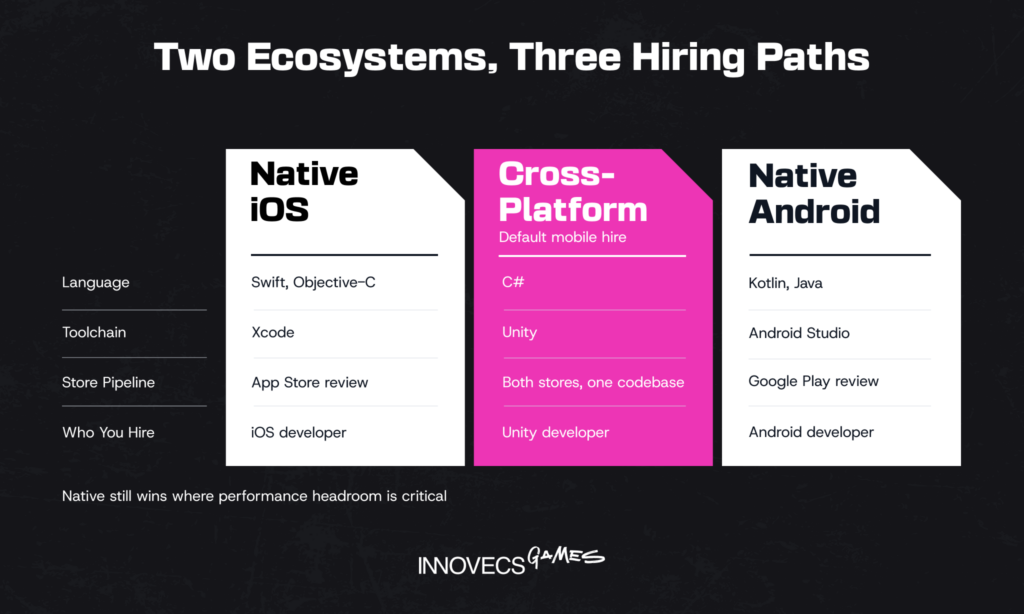
The platform split is where the money goes. An iOS developer works in Swift and Objective-C inside Xcode; an Android developer works in Kotlin and Java inside Android Studio. Cross-platform development in Unity with C# covers both from one codebase, which is why the Unity developer is the default hire in mobile and why Glassdoor puts the average US Unity game developer salary at $92,533, rising to $117,748 for senior. An Unreal developer is the right call when you’re pushing rendering fidelity on flagship hardware, and Unreal Engine’s mobile support has been production-grade for years now, but mobile game engine share in the hyper-casual and casual segments where most of the volume sits still runs heavily to Unity.
The skill most studios underweight is submission and certification experience. Store requirements shift, privacy disclosure rules tighten, and a programmer who has never taken a build through review will treat it as paperwork rather than as a milestone with a rejection risk attached.
Game Designers and UI/UX Specialists
Mobile design is not console design at a smaller resolution. Session length is measured in minutes, input is one thumb, and a player who does not understand the first interaction inside thirty seconds closes the app and does not come back. Everything downstream, from tutorial pacing to store layout, is shaped by those three constraints.
A designer whose entire portfolio is PC or console will underestimate how much that matters, and will discover it during playtesting. Playtesting is an expensive room to learn that in. Ask for a mobile title they worked on, then ask what the day-one retention was and what they changed to move it.
QA and Testing Engineers
Device fragmentation makes mobile QA a discipline rather than a phase. A build that holds a stable frame rate on one Android handset can drop frames on a different manufacturer’s device running the same OS version, because the thermal profile and the GPU driver are not the same. That is why an experienced mobile QA engineer arrives with a device matrix and a reason for every phone on it.
Store review is the other half of the job. Apple’s App Store Transparency Report puts rejections at roughly 1.93 million out of 7.77 million submissions, close to one in four, and performance failures such as crashes and unreachable features account for more rejections than any other category. Getting a QA engineer with App Review Guidelines experience involved before feature lock is cheaper than a rejection two weeks from a launch date you have already bought media against.
Where to Find Mobile Game Developers for Hire
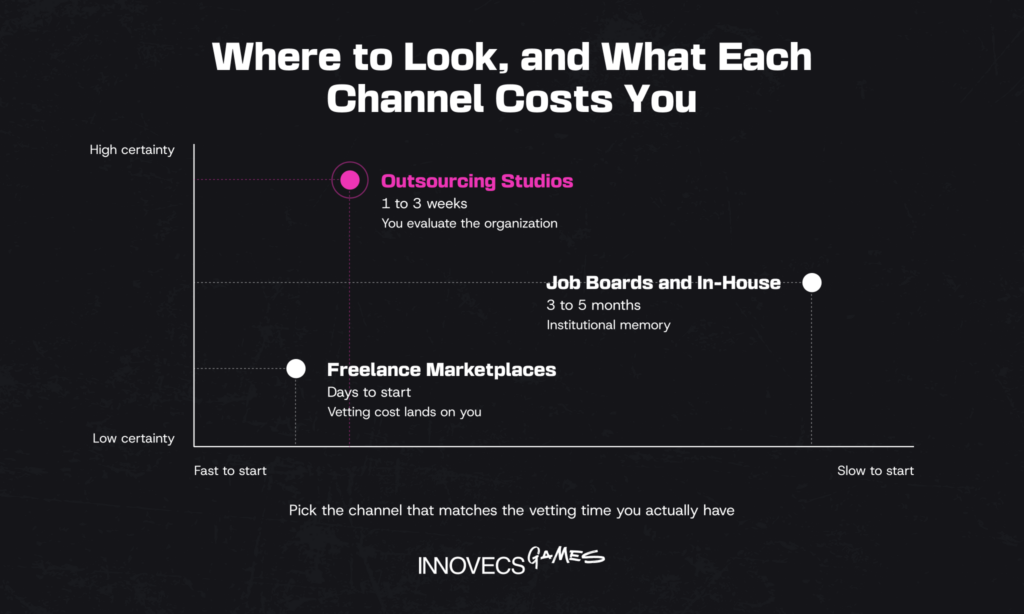
Every channel trades speed against certainty. Marketplaces are fast to search and slow to verify, because nothing on a profile is independently checked. Job boards buy you permanent headcount and cost you a quarter to fill it. Studios hand you an assembled team, and ask you to evaluate an organization instead of a person. Pick the channel that matches how much vetting time you actually have, not the one with the largest talent pool.
Freelance Marketplaces
Upwork, Toptal, and Fiverr Pro give you volume and same-week availability. What they don’t give you is consistency: profiles are self-reported, portfolio attribution is rarely verifiable, and the vetting cost lands entirely on your side. Budget real hours for filtering, because the search is the cheap part and the shortlist isn’t.
Availability is the structural problem here. A freelancer carries several clients at once and will triage when two deadlines collide, and you usually learn about it late. That’s fine for a bounded piece of work: a shader pass, a single system, a porting job, a QA sweep on a build that is nearly done. As the foundation for a full production with a fixed ship date, it is poor.
Job Boards and Developer Communities
LinkedIn, Indeed, and the places mobile developers actually talk to each other: the Unity forums, r/gamedev, engine Discords, and post-mortem threads on Game Developer. In-house hiring through these channels buys you something no other model does, which is institutional memory. The person who built your economy system is still there in year two, when it needs rebalancing and nobody can remember why the curve was set that way.
Time is the cost. A senior mobile game developer with shipped titles on both the App Store and Google Play is rarely browsing job boards, and the run from posting to start date for that profile typically lands somewhere between three and five months, before onboarding even begins. If your production window is shorter than that, in-house hiring is a parallel track, not the plan.
Outsourcing Studios and Dedicated Teams
An established studio hands you a group that has already worked together, with tooling, build infrastructure, and a device lab in place. You evaluate the organization: shipped titles you can download, references you can call, and a process you can audit. That’s a faster and more reliable assessment than trying to verify five individual contributors in parallel.
The honest trade-off is that you’re buying a team rather than picking each person, and the rate carries the studio’s overhead. Our mobile game development services are built around this model, with teams that have shipped across iOS, Android, and cross-platform. For studios with a production already moving, this is usually where the decision lands.
How to Evaluate and Vet Mobile Game Developers
Sourcing is the easy half. Decisions go wrong at evaluation, because a portfolio is a marketing artifact and an interview rewards fluency over judgment, so the confident candidate outscores the careful one on a format that was never designed to tell them apart. Three steps fix most of that: verify the shipped work, test the reasoning, and know which signals mean walk away.
Reviewing Portfolios and Shipped Titles
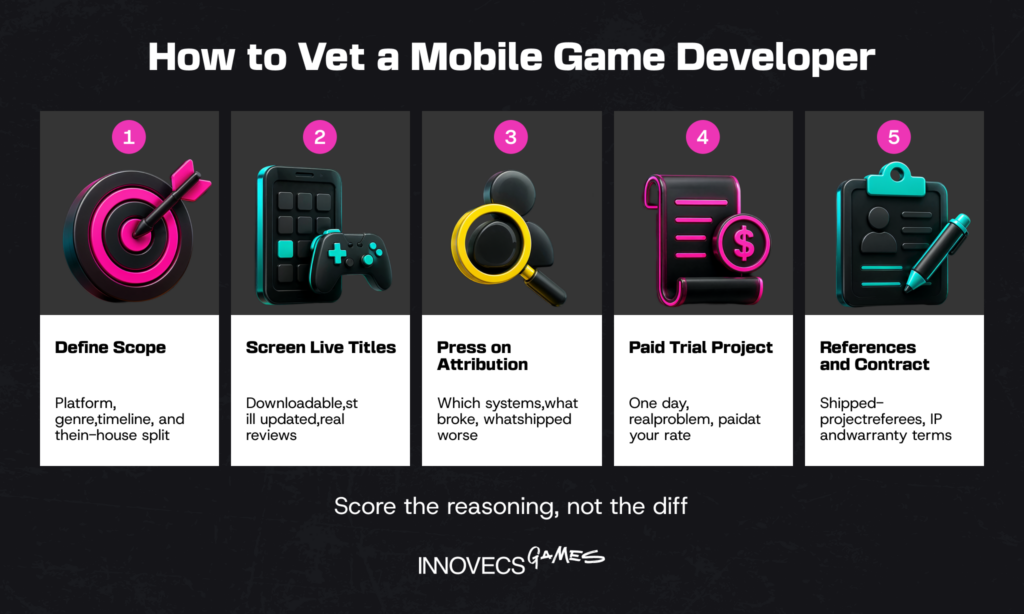
Live apps are the filter. Not prototypes, not internal builds, and not early access titles that quietly never launched, because all three are portfolio material that no player has ever been asked to pay for. Open the App Store or Google Play, download something they worked on, and look at three things: whether it’s still being updated, what the recent reviews say about stability, and whether the monetization actually works. Two live titles with real user bases tell you more than a deck of unreleased concepts.
Attribution is the second pass. Mobile teams are small enough that contribution is usually specific, but “I worked on this” covers everything from architecture to a bug queue. Ask which systems they built, what they owned when it broke, and what shipped worse than they wanted. A polished case study deck tells you what someone’s marketing team approved. The answer to “what went wrong in month four” tells you who you’re hiring.
Technical Interviews and Test Tasks
Capability questions are close to worthless, because every candidate will confirm they can do whatever you’ve just described. Ask instead for a decision: a technical trade-off they made on a shipped project, what they gave up, and what it cost later. Then get specific to mobile. How have they profiled and fixed a frame rate drop on a low-end Android device? What’s their approach to cutting build size without losing visual fidelity? How do they structure remote config so live-ops can change an economy without a client update?
Red Flags to Watch For
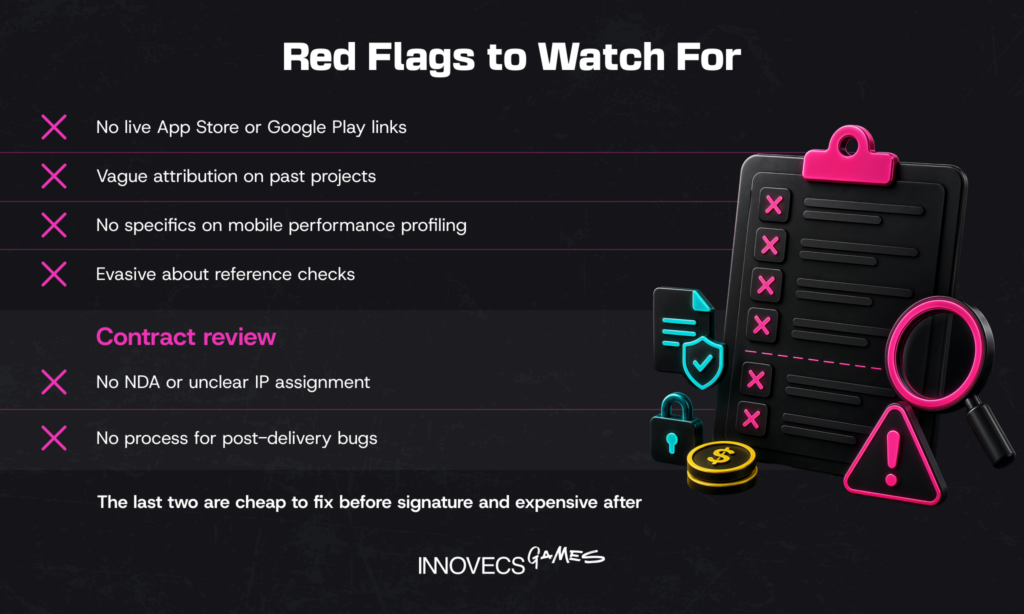
The last two belong in the contract review rather than the interview, and they are worth escalating to whoever owns legal on your side before signature. IP assignment on work-for-hire and post-delivery bug handling are the two clauses that cause real disputes on mobile projects, and both are cheap to fix in advance.
Hiring Models Compared: Freelance vs Dedicated Team vs Outsourcing
Most arguments about hiring models are really arguments about who absorbs the coordination cost. Every model produces code. Where they differ is in how much of your producer’s week goes into keeping people pointed the same direction, and in what happens when a milestone slips.
| Model | Time to start | Coordination load on you | Best fit | Main risk |
|---|---|---|---|---|
| Freelance | Days | High, and it scales with headcount | Bounded, well-specified tasks | Availability collapses when another client escalates |
| In-house | 3 to 5 months per senior hire | Low once onboarded | Long-horizon products with permanent scope | Slow to start, expensive to unwind |
| Dedicated team | 1 to 3 weeks | Low to medium | Full production runs, multi-discipline work | Rate carries studio overhead |
| Outsourcing (fixed scope) | 2 to 4 weeks | Low, if the brief is good | Defined workstreams with clear acceptance criteria | A weak brief moves the problem out of sight |
| Co-development | 2 to 4 weeks | Medium, by design | Extending an existing pipeline mid-production | Requires your team to have pipeline discipline already |
Read the coordination column against your producer’s actual capacity, not against an ideal week. The model that fails most often isn’t the wrong one on paper. It’s the one nobody had time to manage.
Freelance Hiring
Lowest commitment, fastest to start, easiest to scope down. The limits here are structural rather than personal: a freelancer optimizes across a portfolio of clients, so your project’s priority is set by whoever is loudest that week. Coordination cost also grows non-linearly. One freelancer is a conversation. Four freelancers plus your own team is a producer’s full-time job, and that producer isn’t producing anything else that quarter.
Use it for isolated work with clean boundaries, meaning a specific system, a short porting job, a QA pass, or an art batch that can be specified once and delivered without a weekly sync. Don’t build a full mobile production on it and expect the schedule to hold.
Dedicated Team Model
A stable group assigned to your project for a defined period, usually through a mobile game studio, with the same people every sprint. Context accumulates instead of resetting, which is the entire point: by month three the team knows why the economy is structured the way it is, and you stop re-explaining it. Studios that need to hire dedicated mobile game developers without carrying permanent headcount generally land here, and staff augmentation sits in the same bracket when you want individual specialists slotted into your own remote team rather than a whole unit.
The honest negative: you’re paying a blended rate that includes overhead you never see, and it costs more per month than the equivalent freelancers. What you get for it is that availability, replacement, and ramp-up become someone else’s problem rather than yours. If you’re working to a publisher milestone, that’s usually the trade worth making.
Outsourcing and Co-Development
Outsourcing hands a defined workstream to an external studio that manages itself against acceptance criteria. Co-development embeds the external team inside your pipeline, in your tracker, on your build system, sharing milestone responsibility. The first needs a strong brief. The second needs your pipeline to already be in a state that someone else can join without a month of archaeology.
Game development outsourcing done well removes coordination overhead. Done badly, it relocates the management problem somewhere you can’t see it until the milestone review. The difference is almost always the quality of the acceptance criteria written at the start.
What to Lock Down in the Contract
Whichever model you pick, the same eight clauses decide how much room you have when something goes wrong. None of them are expensive to negotiate before signature, and all of them are expensive to argue about in month six.
- IP assignment and moral rights. Assignment should be explicit, cover everything created for the project including tooling and build scripts, and specify whether it transfers on payment or on delivery. Those are different dates and only one of them protects you.
- Source and asset handover. Name the deliverable formats: project files, layered art, source scenes, and repository access, not compiled builds. Access from day one rather than at the end also removes the leverage problem entirely.
- Warranty window. A defined period after each milestone, usually 30 to 60 days, during which defects are fixed at no charge. Specify what counts as a defect and what counts as a change request, because that boundary is where most disputes actually sit.
- Key personnel and replacement. Name the people you evaluated. Require notice before a substitution, and put ramp-up time for a replacement on the supplier’s side of the ledger rather than yours.
- Notice period and wind-down. Thirty days is standard for a dedicated team. Pair it with an obligation to deliver a working build and current documentation at termination, whatever the reason for it.
- Rate structure and scope change. Time and materials or fixed price, and a written path for what happens when scope moves. A change order process nobody has agreed in advance turns every new feature into a negotiation.
- Confidentiality and data handling. If the team will touch live player data, analytics events, or store credentials, the contract needs to say who may access what and under which jurisdiction.
- Acceptance criteria per milestone. Attached to the contract as a schedule, not agreed in a call. This is the clause that determines whether “done” is a fact or an opinion.
Ask for the supplier’s standard MSA early and read the termination and IP sections first. A studio that has run this model before will have clean answers ready; one that has not will send you a document written for a different kind of business.
Starting Well: The First Thirty Days
Getting the contract signed is not the same as getting the team productive, and the gap between the two is where a lot of otherwise good engagements lose a month. Most of the work in week one lands on your side rather than theirs.
Access is the bottleneck. Repository, build machine, ticket tracker, analytics dashboards, art source, and whatever internal documentation exists: every day one of those is missing is a day of paid capacity spent reading a design doc. Send the device list you actually support, not the one in the pitch deck. Nominate one person on your side who can answer questions in hours rather than days, and protect their calendar accordingly.
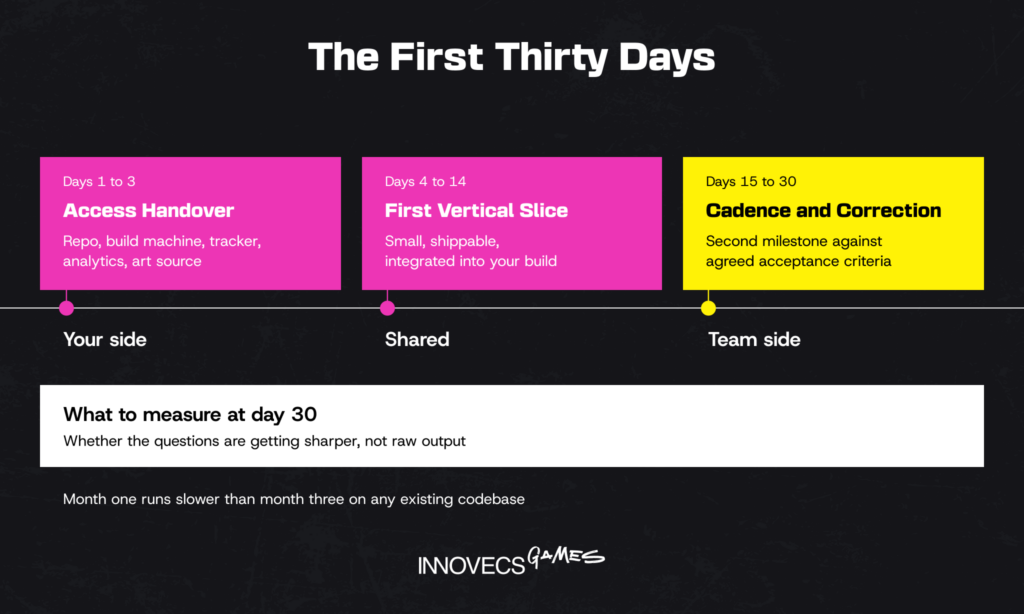
Make the first milestone small and genuinely shippable. Two weeks, one vertical slice, integrated into your build rather than delivered as a standalone demo. A four-week first milestone with no interim build gives you nothing to correct against, and by the time you see it the team has already made twenty decisions you would have adjusted at day three.
Set the expectation on velocity honestly, including internally. Month one runs slower than month three for any team joining an existing codebase, and a studio that promises otherwise is either overpromising or has not read your project. What you should measure in the first thirty days is not output but whether the questions the team asks are getting sharper.
How Much Does It Cost to Hire Mobile Game Developers?
Hiring cost splits three ways: the developer hourly rate, the team you need around that rate, and the spend that never appears in a development quote at all. Most budget overruns we see aren’t caused by a rate being wrong. They’re caused by that third category being missing from the sheet entirely, and it’s the one nobody asks about during procurement.
Hourly rates by region and seniority
| Region | Mid-level (USD/hr) | Senior (USD/hr) | Notes |
|---|---|---|---|
| United States | $75 to $110 | $120 to $155 | Senior architects sit at the top of the band |
| Western Europe | $55 to $85 | $85 to $120 | Strong Unreal depth, smaller mobile pool |
| Eastern Europe (incl. Ukraine) | $30 to $45 | $45 to $60 | Nearshore for EU studios, deep Unity bench |
| Latin America | $30 to $50 | $50 to $70 | Nearshore for North America, strong time-zone overlap |
| Southeast Asia | $25 to $40 | $40 to $60 | Lowest offshore rates, highest management overhead |
Source: Innovecs Games delivery data, projects staffed 2023 to 2026.
The Southeast Asia row is the one that gets misread. The rate is real, and so is the extra producer time that comes with a nine-hour offset and a feedback loop that runs a day behind.
For an in-house comparison, Glassdoor puts the average US iOS developer salary at $134,096, with senior iOS roles averaging $169,454. Add benefits, equipment, recruiting fees, and the three to five months that seat sits empty while you search, and the loaded cost of a permanent hire lands well above the headline number, usually by a margin that surprises whoever built the original budget.
Platform choice moves the rate too. Cross-platform developers working in Unity, React Native, or Flutter typically cost 10% to 25% less than native iOS specialists, and native Android in Kotlin comes in slightly under native iOS. That gap narrows sharply at the senior end, where you’re paying for architecture judgment rather than for a language.
What a full mobile team costs per project
| Project type | Typical team | Duration | Budget range |
|---|---|---|---|
| Hyper-casual prototype | 2 to 4 people | 1 to 3 months | $20K to $80K |
| Casual game with monetization | 5 to 8 people | 4 to 8 months | $80K to $180K |
| Mid-core with live-ops | 8 to 15 people | 8 to 14 months | $180K to $450K |
| Real-time multiplayer / persistent backend | 15+ people | 12 months and up | $450K and up |
Source: Innovecs Games delivery data, projects staffed 2023 to 2026.
Most disagreements we have with a client’s budget happen on the boundary between two of those rows, not inside one of them. A casual title with a live event calendar is priced as mid-core, and the argument is usually about the word “casual.”
What that team actually contains
Headcount on its own tells you very little, because two eight-person teams can be built completely differently and only one of them will ship your genre. Here is what those numbers break down into in practice.
| Project type | Engineering | Design and art | QA and live support | Production |
|---|---|---|---|---|
| Hyper-casual prototype | 1 Unity generalist | 1 designer doubling as artist | Shared QA, part-time | Producer at 25% |
| Casual with monetization | 2 Unity, backend part-time | 1 designer, 1 UI/UX, 1 to 2 artists | 1 QA | Producer at 50% |
| Mid-core with live-ops | 3 to 4 Unity, 1 backend, 1 technical artist | 1 lead designer, 1 economy designer, 1 UI/UX, 2 to 3 artists | 1 to 2 QA, 1 live-ops engineer | 1 producer full-time |
| Real-time multiplayer | 5+ client, 2 to 3 netcode and backend, 1 DevOps | Full design and art pod | 2+ QA plus dedicated live-ops | Producer and technical lead |
Source: Innovecs Games delivery data, projects staffed 2023 to 2026.
Two roles get cut first when a budget tightens, and both are mistakes we watch play out repeatedly. The economy designer disappears into the lead designer’s job description, and the technical artist gets replaced by a general artist plus hope. The first shows up as a monetization curve nobody can tune; the second shows up as a frame rate problem on mid-range Android four months later.
Costs that land outside the build
- Store commission. Apple takes 30% as standard and 15% under the App Store Small Business Program; Google Play’s service fee is 15% on the first $1 million of annual earnings.
- Certification and resubmission. Budget for at least one rejection cycle on each store.
- Device lab and QA coverage. Physical devices, cloud device time, and the tester hours to use them.
- Live-ops after launch. Content cadence, event configuration, and balance passes, typically 15% to 25% of the original build cost per year.
- User acquisition. Not development spend, but it competes for the same budget and it is rising as installs fall.
Taken together these routinely add 20% or more to a total that looked complete. The cheapest developers on paper rarely produce the cheapest finished game.
If you already know the gap and the date, we can price it against a real team composition rather than a rate card. Send the scope and we’ll come back with the shape of a team and what it costs per month.
How AI Is Changing the Mobile Game Developer Hiring Process
The 2026 data on AI in game development is contradictory in a useful way. GDC’s survey found 36% of professionals now use AI in their workflow, while 52% believe generative AI is having a negative impact on the industry, up from 30% a year earlier and 18% the year before that. Among game programmers specifically, 59% hold an unfavorable view. Adoption is climbing and enthusiasm is falling at the same time, which tells you the tools are useful and the second-order effects aren’t welcome.
What has genuinely changed is throughput at the implementation layer. Coding assistants compress boilerplate, tooling, and glue code. Automated regression suites cover device sweeps that used to consume manual tester hours. Unity’s 2026 report describes exactly this pattern: smaller teams shipping in less time, with AI absorbing back-end and support work. The practical effect on hiring is that a team of six can now hold scope that needed eight or nine three years ago.
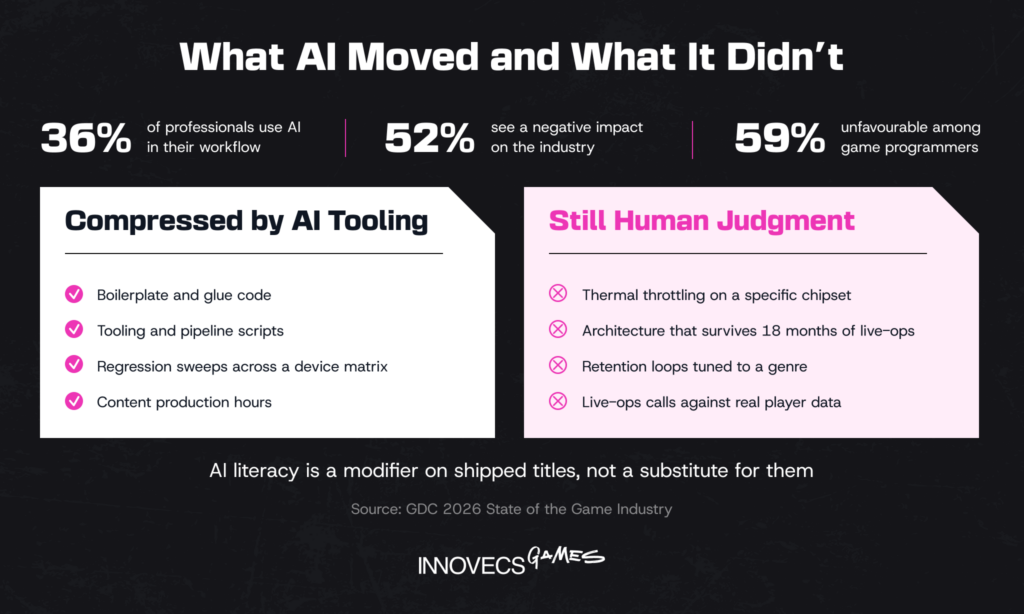
What has not changed is the judgment layer. Diagnosing a thermal-throttling frame drop on one specific Android chipset, choosing an architecture that survives eighteen months of live-ops, designing a retention loop that fits a genre’s actual player behavior: none of that is being automated, and all of it is what separates a title that holds D30 from one that doesn’t.
Our position, for what it’s worth: the cost of producing a first implementation has fallen a long way, and the cost of knowing which implementation to keep has not moved at all. Add AI tooling fluency to your criteria for 2026 hires, because a developer who refuses the tools is now slower than one who uses them well. Just don’t let it outrank shipped titles, because it’s a multiplier on production experience rather than a substitute for it.
How Innovecs Games Helps You Hire the Right Mobile Game Team
Assembling a vetted mobile team through conventional hiring takes a quarter that most productions don’t have spare. We shorten that to weeks by starting from teams that have already worked together, which is the only part of this that can’t be bought quickly.
We run dedicated team, co-development, and full-cycle models, so the engagement structure follows the project rather than the other way around. Our mobile game development services cover iOS, Android, and cross-platform builds across hyper-casual, casual, and live-service titles. Unity is our primary mobile stack, and if you want to hire Unity developers in Ukraine specifically, that is where our deepest bench sits, at rates well below Western equivalents.
Art and engineering sit under one roof, so if you also need to hire a 2D game artist alongside the development team, that is one contract and one point of contact instead of two vendors and a coordination problem.
Our standard MSA puts IP assignment on payment, source and repository access from week one, and a named-personnel clause with replacement ramp-up on our side. We wrote it that way because those are the three things every experienced Head of Production asks about in the first call, and we would rather answer them before the question.
Productions already in motion get priority. A scoped team can be on your project in days.
FAQ
How do I hire mobile game developers for my project?
Start with scope, not with candidates. Platform, genre, timeline, and the split between what stays in-house and what goes out will determine the model before you talk to anyone. A bounded task points to a freelancer, a full production run points to a dedicated team, and a self-contained workstream with clean acceptance criteria points to an outsourcing partner. Once you have a shortlist, verify live App Store or Google Play titles, run a technical interview built around trade-offs rather than capabilities, and check references from a shipped project. Vetting is where most mobile hiring decisions actually go wrong.
How much does it cost to hire mobile game developers?
Rates in 2026 run from roughly $25 per hour for mid-level developers in Southeast Asia to $155 for senior architects in the US, with Eastern Europe including Ukraine at $30 to $60 and strong Unity depth. Project totals matter more than hourly rates: hyper-casual titles land at $20K to $80K, casual titles with monetization at $80K to $180K, and mid-core with live-ops at $180K to $450K. Real-time multiplayer with a persistent backend starts above that and keeps going. Store commissions, certification cycles, device coverage, and post-launch live-ops typically add 20% or more on top of the build.
Where can I find mobile game developers for hire?
Three channels cover almost everything: freelance marketplaces such as Upwork and Toptal, job boards and communities like LinkedIn, the Unity forums, and r/gamedev, and outsourcing studios with standing mobile teams. Marketplaces are the fastest to search and the slowest to verify. Job boards give you permanent headcount at the cost of a three to five month hiring cycle. Mobile game developers for hire through a dedicated team model arrive with workflows, build infrastructure, and a device lab already in place, which removes the assembly work entirely.
Should I hire freelance mobile game developers or a dedicated team?
Freelancers fit bounded work with a clear specification and a short horizon: one system, one port, one QA pass. A dedicated team fits anything running longer than a few weeks, crossing more than one discipline, or requiring consistent context across a production. The deciding factor is usually coordination rather than cost. Managing four freelancers is close to a full-time producer role, and that time comes out of whoever on your team is already most stretched.
What skills should a mobile game developer have?
Platform expertise comes first. iOS work means Swift, Xcode, and the App Store submission process; Android means Kotlin, Android Studio, and Google Play requirements. Unity developers working in C# cover both from one codebase, which is why they’re the most in-demand profile in mobile game production. Beyond the stack, look for the mobile-specific skills: performance profiling on low-end hardware, build size management, remote config and live-ops implementation, and retention mechanics that have actually been measured rather than assumed.
How long does it take to hire a mobile game development team?
Through conventional job boards, a senior mobile hire runs three to five months from posting to start date, before onboarding. Freelancers engage in days individually, but assembling and aligning a full multi-discipline group takes considerably longer than most studios plan for. A dedicated outsourcing studio is the fastest route, with a scoped team typically deployable inside one to three weeks. Scope clarity is the variable that moves every one of those timelines, in both directions.
What’s the difference between hiring for iOS vs Android game development?
iOS runs on Swift with Xcode as the primary toolchain; Android runs on Kotlin with Android Studio. The two ecosystems draw from different developer pools and the skill sets overlap less than most non-technical stakeholders assume. Cross-platform development in Unity or Unreal bridges the gap for the majority of mobile games, though native still wins where performance headroom is critical. Budget separately for platform QA either way: Android OEM fragmentation alone requires a device matrix and the tester hours to work through it.
How do I evaluate a mobile game developer’s portfolio?
Download something they shipped and use it. Confirm it’s still live, still being updated, and carrying real user reviews rather than a handful of launch-week ratings. Then press on attribution: which systems they built, what broke during production, and what they would rebuild differently now. A portfolio of live titles paired with honest answers about what went wrong is worth more than any case study deck. For senior roles, close with a short paid test task on a real problem from your codebase.
How is AI changing the way studios hire mobile game developers?
AI fluency has become a baseline expectation rather than a differentiator. GDC’s 2026 survey puts AI usage at 36% of industry professionals, while 52% think generative AI is having a negative impact, so the tools are widespread and the sentiment around them isn’t settled. Practically, a mid-level developer with good AI habits covers ground that used to need more headcount, which shrinks the team you need for a given scope. Treat it as a modifier on existing skills, though, not as a primary filter. Shipped titles and live production experience still decide the best hires.
Can AI tools replace mobile game developers?
In narrow, well-defined tasks, AI has already reduced the headcount required. Automated suites handle regression coverage across a device matrix, coding assistants accelerate implementation work, and procedural tooling cuts the hours that used to go into content production. None of that touches the work that determines whether a mobile game succeeds: retention system design, performance debugging on specific hardware, live-ops decisions made against real player data, and architecture that survives a year of updates. AI has made experienced developers faster. It has not made them optional.
Ready to Hire Mobile Game Developers? Let’s Talk
Tell us the gap and the date, and we’ll scope a team against it. If you are still deciding between a freelancer, an in-house hire, and a dedicated team, we’ll give you a straight read on which one fits your production. Send us the project brief and we’ll come back with a team composition and a monthly cost.