How Much Does Game Porting Cost? A 2026 Guide to Budgets, Platforms, and Hidden Fees
Realistic price ranges for every port direction, the six things that move the total, and the fees that never make it into a first quote.
Three questions arrive with almost every porting inquiry we get. How much? How long? And, usually a week later: why did the other studio quote three times more for the same game?
The third question is the useful one, because both quotes can be honest. Game porting cost isn’t a price list. It’s the distance between where a game runs today and where it has to run next, measured in engineer-months. When Saber Interactive first got The Witcher 3 running on Nintendo Switch, the build weighed 46GB against a 32GB cartridge and used 5GB of memory on a console that has 4GB in total, according to the studio’s GTC 2020 talk. Closing that gap took a year or more, depending on who’s counting: CD Projekt Red says about 12 months, and Saber’s own talk says 15. A 2D Unity game moving from Steam to PlayStation 5 has almost no gap at all, and the invoice shows it.
The sections below price that distance. You’ll get ranges for each port direction, the factors that widen or shrink them, the fees nobody lists up front, one estimate worked through line by line, and a way to build your own number before you ask anyone for theirs.
What Is Game Porting and Why Does the Price Vary So Much?
Most ports we’ve scoped cost between $20,000 and $250,000 per platform and take two to eight months. Simple 2D projects sit at the bottom of that range, while complex 3D or custom-engine ports can pass $500,000.
Game porting means taking a finished game to a platform it wasn’t built for: PC, console, mobile or the web. The game itself stays the same. Content, design and story don’t change, and the work goes into everything underneath them, from rendering and memory to input, saves and store integration. That’s the line between a port and its two cousins. A remaster keeps the original game and upgrades how it looks and sounds, and a remake rebuilds it from scratch, the way Capcom did with Resident Evil 4 in 2023. Both are priced as productions. A port is priced as engineering. Marketing departments blur the three on purpose, and a budget can’t afford to.
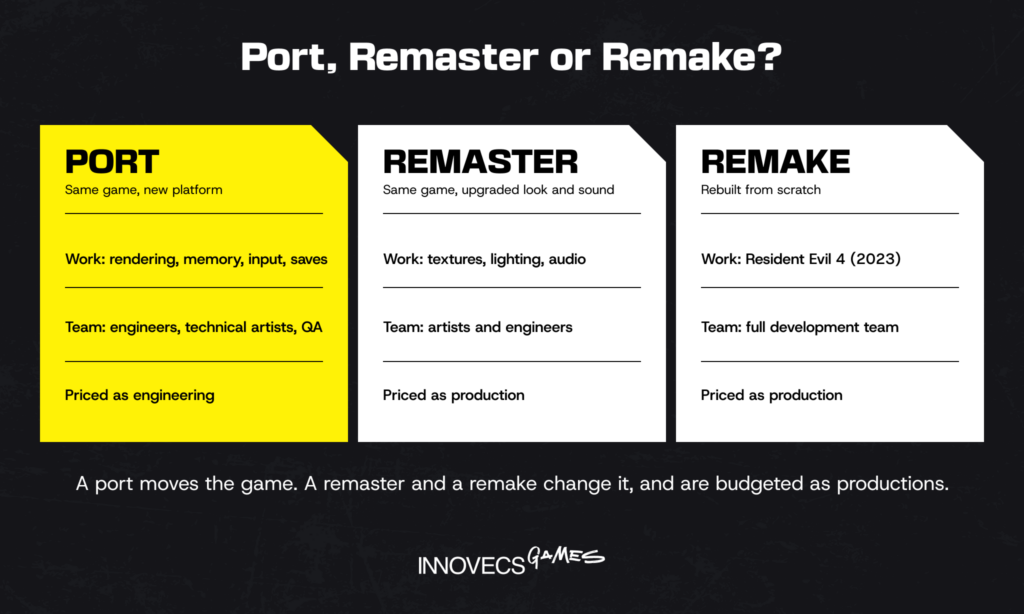
Quotes for one game differ several times over because studios quietly price different jobs. One estimate covers getting the build to boot and hold a frame rate. Another adds certification QA, platform features such as achievements and cloud saves, UI adaptation and three months of patches. In video game porting the second quote is usually the honest one, and it’s rarely the cheaper one. Our game engineering services team sees the gap most often on certification: one bidder treats it as a milestone and the other as somebody else’s problem.
How Much Does It Cost to Port a Game? Price Ranges by Platform
Start with scope, since it sets the range before the platform does. The three tiers below are for one target platform, priced at Eastern European blended rates, with certification QA included and platform fees left out.
| Port scope | What it looks like | Typical price range | Timeline |
|---|---|---|---|
| Simple | 2D or light 3D game on a current Unity or Unreal Engine version, similar hardware class, no engine changes | $20,000 to $60,000 | 6 to 12 weeks |
| Mid-level | 3D game that needs real memory and frame rate work, UI adaptation and full platform feature integration | $60,000 to $180,000 | 3 to 6 months |
| Complex | Custom engine or an engine migration, open world or online play, a large step down in hardware | $180,000 to $600,000 and up | 6 to 12 months or more |
Source: Innovecs Games delivery data, projects scoped 2023 to 2026.
A second or third platform doesn’t cost the same again. In our projects each additional one adds roughly a third to half of the first port’s budget, because the audit, the refactoring and most of the optimization are already paid for.
Direction matters as much as scope. In video game porting, going up in hardware power is mostly a compatibility job, and going down is where the months go.
| Direction | Typical range | Timeline | Main blocker |
|---|---|---|---|
| PC to PlayStation 5 or Xbox Series X|S | $40,000 to $150,000 | 3 to 6 months | Certification, Series S memory |
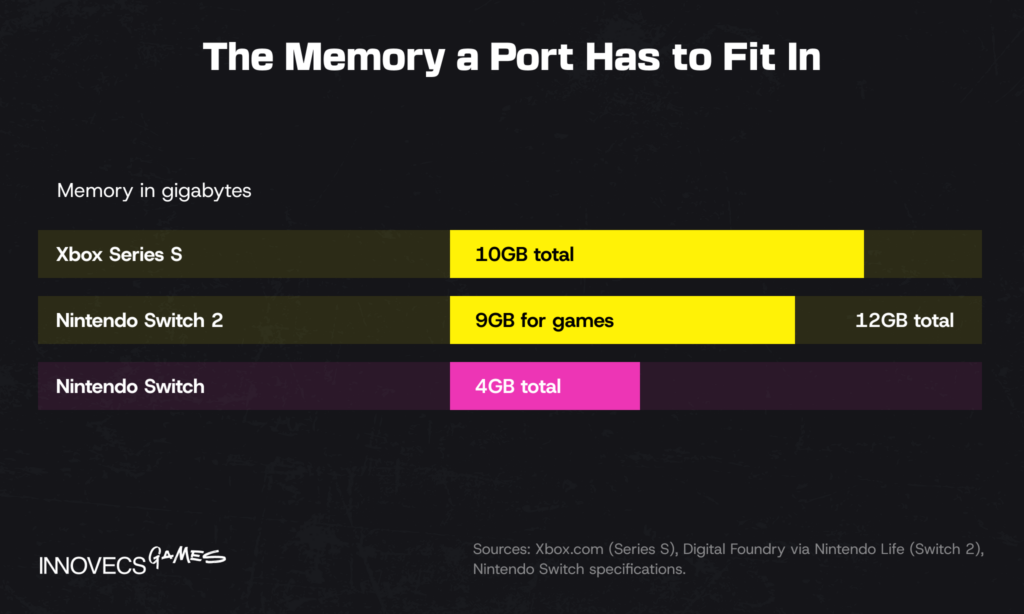
| PC to Nintendo Switch 2 | $60,000 to $180,000 | 3 to 6 months | 9GB memory budget, handheld frame rate, dev kit access |
| PC to original Nintendo Switch | $90,000 to $250,000 | 4 to 8 months | 4GB of memory, content cuts to fit |
| Console to PC | $30,000 to $150,000 | 2 to 6 months | Open-ended hardware matrix, shader stutter, input options |
| Mobile to PC or console | $40,000 to $200,000 | 3 to 7 months | UI and asset resolution, controller support, business model |
| PC or console to mobile | $80,000 to $300,000 and up | 4 to 9 months | Touch controls, thermal limits, Android device spread |
| PC or mobile to WebGL | $20,000 to $80,000 | 1 to 3 months | Download size, browser memory limits |
Source: Innovecs Games delivery data, projects scoped 2023 to 2026. First target platform, Eastern European blended rates.
The widest rows are the ones that cross a hardware class, and that’s where two quotes for one game drift furthest apart.
PC to Console (PS5, Xbox, Switch)
PlayStation 5 and Xbox Series X are close enough to a mid-range gaming PC that the rendering work is modest, and the budget goes to platform features and certification instead. Budget $40,000 to $150,000 for the first of the two. They aren’t priced identically, though. In our projects the Xbox version of a game runs 10% to 20% above the PlayStation one, because it has to pass on two hardware profiles, and the smaller of them, Series S, has 10GB of memory. Nintendo hardware is the expensive branch. A Switch 2 gives games 9GB of its 12GB of memory and runs them on a battery, which is why a console port for it runs $60,000 to $180,000 even for games that already ship on PS5. The original Switch costs more again: $90,000 to $250,000, and some content cuts with it. CD Projekt Red kept Cyberpunk 2077’s Switch 2 version in-house and shipped the full game with its expansion on a 64GB card, as its technology VP told Nintendo Life. CD Projekt can do that because it wrote the engine. Most studios don’t have that team on staff, and that’s the gap an external porting team is hired to fill.
Console to PC
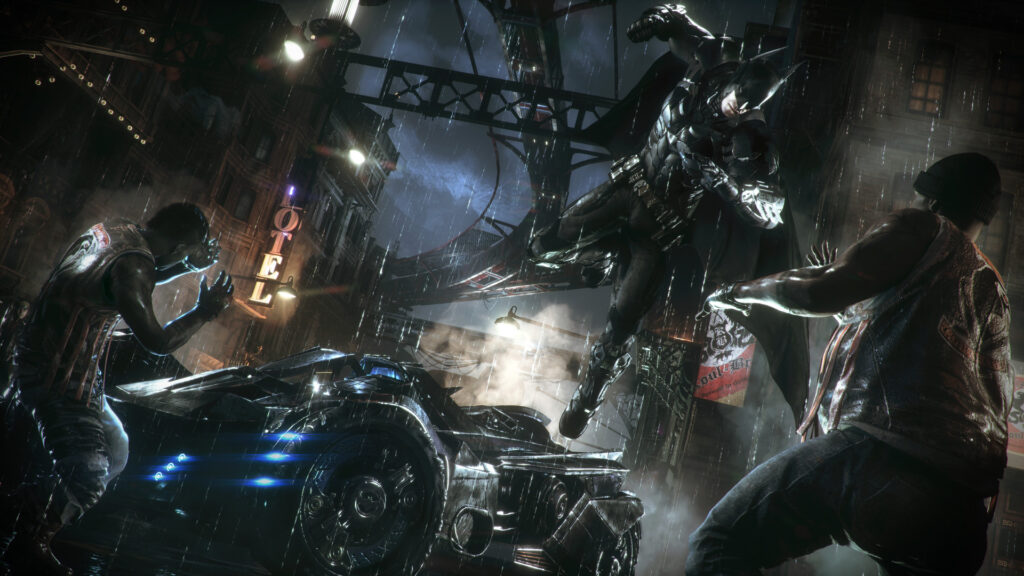
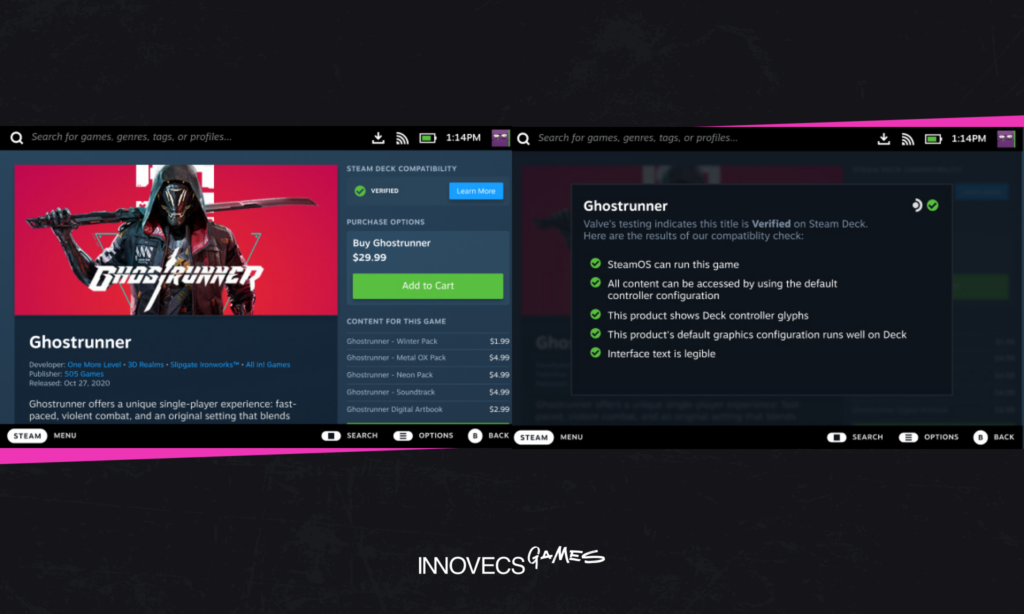
This direction used to look like free money, and 2026 complicated that. Alinea Analytics estimates that Sony’s first-party games have grossed about $1.5 billion on Steam, with Helldivers 2 well ahead of the rest. The later ports earned less each time, though: Horizon Forbidden West sold three times slower on PC than the first Horizon did. In May 2026 PlayStation’s studio chief reportedly told staff that narrative single-player games would stay exclusive from now on, while multiplayer titles keep coming to PC. For everyone else the takeaway is about timing: a PC version that arrives two years late is competing with its own discount history. The engineering work is rarely the rendering. It’s everything a fixed console never asked for: graphics settings, ultrawide monitors, mouse and keyboard, shader compilation, and thousands of GPU and driver combinations. PC players will forgive a late release. They won’t forgive one that can’t rebind a key. Skimp on that and the result is Batman: Arkham Knight, whose PC version Warner Bros. pulled from sale a day after launch in June 2015. Expect $30,000 to $150,000, and add a Steam Deck pass: Valve’s Verified checklist wants controller glyphs throughout and no text under 9 pixels tall at 1280×800.
Mobile to PC or Console
A mobile game going up in hardware has performance to spare and almost nothing else. Touch UI has to become controller and mouse UI, textures authored for a six-inch screen look soft on a 4K television, and free-to-play economies built around short sessions rarely survive a $20 price tag. The cheapest version of this route costs close to nothing: since March 2025 Google has made Android games available on PC by default through Play Games, with a “playable” badge for the ones that merely run and an “optimized” badge for the ones somebody actually adapted. The service left beta in September 2025 with more than 200,000 titles. A native release with proper controller support and rebuilt UI runs $40,000 to $200,000. Console adds certification on top, and mobile-first teams tend to meet it for the first time here.
For a mobile publisher the bigger job often sits in the service layer, not the renderer. Purchases have to move from Apple’s and Google’s billing to each console’s own commerce system, with entitlements that follow the player’s account. The rewarded ads that fund a lot of mobile games rarely have a console equivalent, so the economy needs a redesign and not a recompile. Every SDK in the stack, from Firebase and PlayFab to AppsFlyer and Adjust, has to be checked for a build on the target platform. Some have one and some don’t. On our projects this layer takes 20% to 30% of a mobile-to-console budget, and it’s the part first quotes most often leave out. Our view, for what it’s worth: if nobody on the call can say how the game earns money on the new platform, it’s too early to price the engineering.
PC or Console to Mobile
Going down to phones is the most expensive direction per hour of gameplay, and the one where engineering success guarantees the least. Touch controls need design work, not input remapping. Thermal throttling cuts performance once the phone heats up, and the Android device spread turns QA into a matrix. The two stores aren’t one target either. iOS means a short list of devices and Apple’s App Review. Android means hundreds of device models, the larger share of QA hours, and a rulebook that moves every year: since August 31, 2026, new apps and updates on Google Play must target Android 16. A dedicated performance pass for mid-range Android, covering asset compression, frame rate stability and battery draw, runs $25,000 to $70,000 over four to ten weeks in our delivery data. It’s worth pricing as its own line.
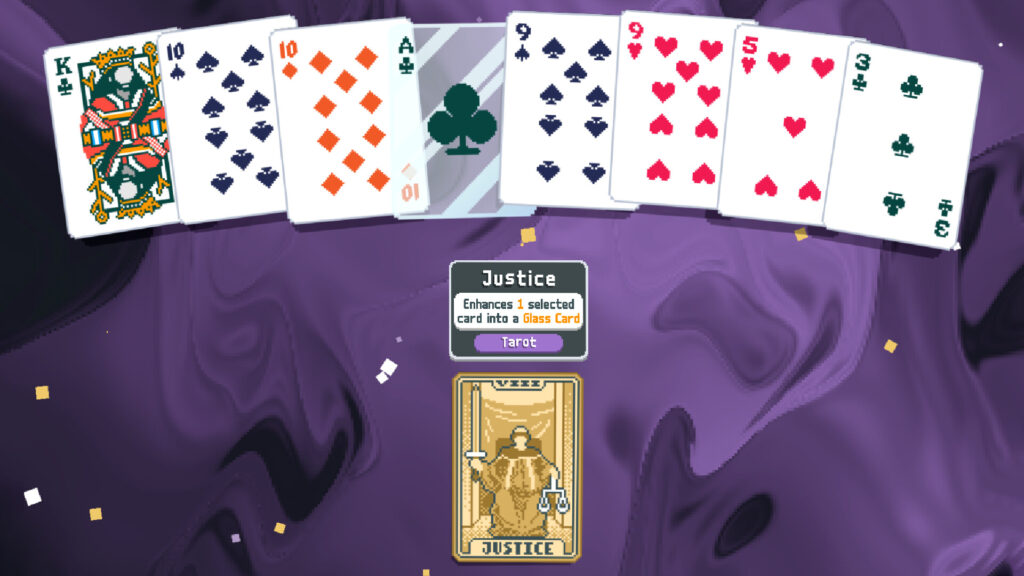
Then comes the market. Appfigures estimated that Assassin’s Creed Mirage on iPhone drew about 123,000 downloads and fewer than 3,000 paying players in its first three weeks in June 2024. Balatro, a card game one person built, made roughly $4.4 million on mobile within about two months of its September 2024 release. The technically harder port lost to the one that suited a phone, because nobody starts a long stealth campaign in a checkout queue. Budget $80,000 to $300,000 or more, and read our breakdown of mobile game development cost before deciding whether the game needs a port or a redesign.
PC or Mobile to Web (WebGL)
The browser is the cheapest target on the list, at $20,000 to $80,000, and the one with the strictest technical ceiling. Unity’s web platform doesn’t support C# threads or direct socket access, so anything multithreaded and any custom netcode has to be rewritten, not recompiled. Memory is the other wall. The heap can grow to 4GB in theory, but Unity’s own guidance is to keep it as small as possible, because a browser that can’t find one contiguous block simply crashes the tab. Nobody certifies a web build, which sounds like a saving until you remember that nobody tells you it’s broken either. This route suits 2D and light 3D games with short sessions. For a streaming open world it’s the wrong tool.
What Each Platform Adds to the Bill
The directions above set the engineering cost. Each platform then adds its own gatekeeper and its own fixed fees, and those are worth seeing side by side before you rank your targets.
| Platform | Who approves the build | Fees you can see | Where the money goes |
|---|---|---|---|
| PlayStation 5 | Sony, against its TRC | Dev kit price isn’t public | Platform features, certification QA |
| Xbox Series X|S | Microsoft, against Xbox Requirements | Dev kit $2,000, free for approved ID@Xbox projects | Two hardware profiles, Series S memory |
| Nintendo Switch 2 | Nintendo, through Lotcheck | Dev kit price isn’t public | Handheld performance, 9GB for games |
| Nintendo Switch | Nintendo, through Lotcheck | Dev kit about ¥50,000 at launch in 2017 | 4GB of memory, content cuts |
| PC on Steam | Nobody; the Steam Deck review is optional | $100 per game | Hardware matrix, graphics settings, input options |
| iOS | Apple, through App Review | $99 a year | Touch controls, thermal limits |
| Android | Google Play policies | $25 once | Device spread, yearly target API updates |
| Web | Nobody | Hosting | Download size, browser memory |
Source: platform holder documentation and press reports linked in this article; the original Switch kit price is from Game Developer. Sony and Nintendo share current terms only with registered developers.
The fees column is the small one. The first column costs more: every named gatekeeper is a queue, and your release date sits behind it.
What Drives Game Porting Cost: Six Factors That Move the Price
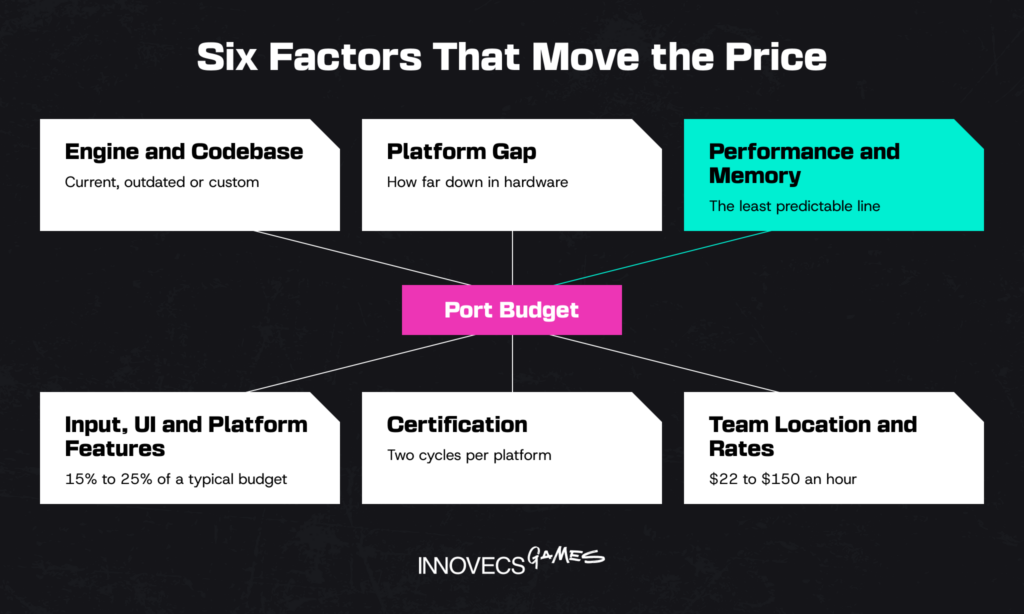
Two games in one row of the tables above can still land $100,000 apart. In the ports we’ve scoped, six factors explain nearly all of that spread. The first two get decided before anyone writes a line of code, so a good estimate begins with an audit and not with a rate card.
Engine and Codebase Condition
A game on a current Unity or Unreal Engine release already has most of the target platform’s plumbing, and the port is mostly configuration, optimization and compliance. A game on a five-year-old engine version needs an upgrade first, because current console SDKs are built against recent engine releases. That upgrade can cost more than the port itself. Custom engine projects sit at the top: someone has to write the rendering backend, file system and input layer for each new platform in C++, and that someone is senior and scarce. Quite often it’s the person who wrote the engine, and they left in 2021. Third-party plugins are the quiet risk in every case. We’ve seen one abandoned plugin with no console build add three weeks while the team replaced it.
Platform Gap and Hardware Limits
The bigger the step down in memory, CPU and storage speed, the more of the game has to be rebuilt instead of recompiled. Xbox is the standing example. Microsoft’s certification rules, last revised in September 2026, say a game’s modes must be the same on Series X and the weaker Series S, “subject to technical limitations.” That rule held Baldur’s Gate 3 back from Xbox in 2023 until Larian and Microsoft agreed to launch without split-screen co-op on Series S. The feature only reached that console in early 2025, more than a year after launch. A studio with Larian’s resources spent that long on one feature for one hardware model. We think the rule is good for players and expensive for everyone who ships there, and we don’t see a contradiction in that. Check the weakest device on your target list first, because it sets the budget for all the others.
Performance Optimization and Memory Budgets
Performance optimization is the line that estimates get most wrong, because nobody knows the real number until the game runs on a dev kit. The work comes in layers: texture streaming and compression, LODs, shader variants, draw-call batching, asset loading, and sometimes whole systems moved from CPU to GPU. Saber did exactly that with The Witcher 3’s cloth simulation on Switch. Each layer has a technical artist and an engineer attached. A game that was built with a memory budget ports in weeks. A game that was built with “it runs on my machine” ports in months, and it’s hard to tell the two apart from a trailer.
Input, UI, and Platform Features
This factor looks small on a feature list and takes 15% to 25% of a typical port budget in our projects. Controller support is more than button mapping: menus need focus navigation, tooltips need glyphs for each pad, and text sized for a monitor has to be readable from a couch or on a handheld. The inventory screen is where most claims of “full controller support” quietly end. Then come the platform features that certification will check, including achievements or trophies, user accounts and profile switching, cloud saves, suspend and resume, and the platform’s own invite and friends UI. The save system deserves a line of its own. Save formats that assumed a PC file system often have to be rewritten, and cross-save between platforms adds a backend.
Certification and Compliance
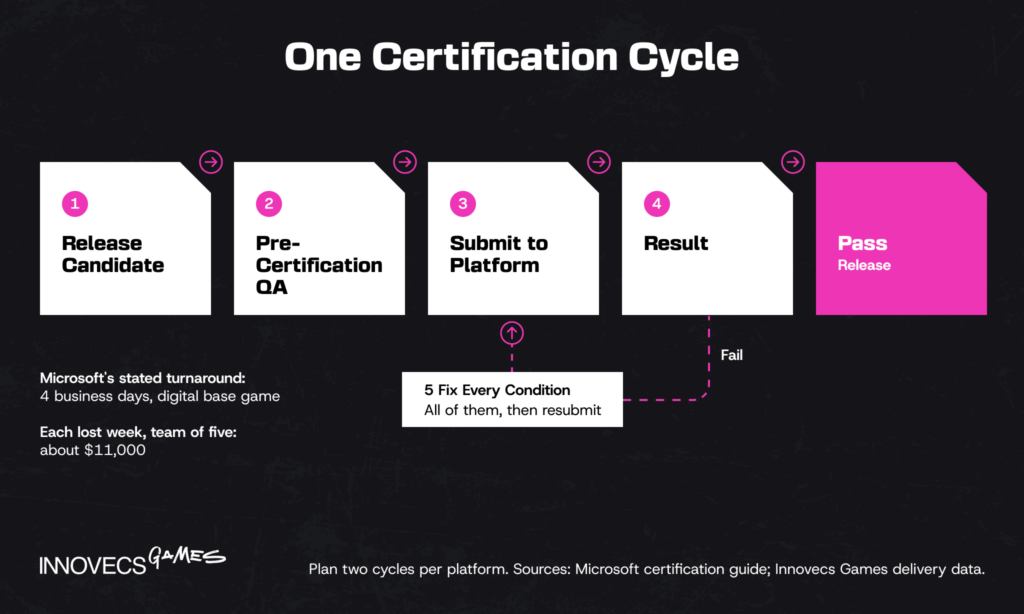
Every console maker tests a build against its own rulebook before release: Sony’s TRC, Nintendo’s Lotcheck, and Microsoft’s Xbox Requirements, which veterans still call TCR. Microsoft is the only one that publishes its certification timelines: four business days for a digital base game. A failed submission returns a list of conditions, and all of them must be fixed before the next attempt. Platform certification is cheap for teams that build against the checklist from week one and expensive for teams that read it at the end. On a mid-level port we plan three to six weeks of QA tester time for pre-certification alone. Our game testing guide covers what those passes actually check.
Team Location and Rates
The same port costs two to three times more in San Francisco than in Kyiv, and the hours don’t change. The table prices one mid-level port, about 2,560 hours of work, at the blended hourly rate each region typically charges for senior porting engineers, technical artists and QA.
| Region | Blended hourly rate | The same 2,560-hour port |
|---|---|---|
| US and Canada | $90 to $150 | $230,000 to $384,000 |
| Western Europe | $75 to $120 | $192,000 to $307,000 |
| Eastern Europe, including Ukraine and Poland | $40 to $70 | $102,000 to $179,000 |
| Latin America | $35 to $60 | $90,000 to $154,000 |
| India and Southeast Asia | $22 to $45 | $56,000 to $115,000 |
Source: Innovecs Games delivery data, projects staffed 2023 to 2026.
The bottom row is real, and so is its catch. Offshore development at those rates only saves money if the team has already passed certification on your target platform, and that record is rarer than the rate suggests. Nearshore teams cost more per hour and share your working day. That matters in the two weeks before submission, when questions can’t wait overnight. We sit in the middle row, so adjust for bias. Still, we’d tell a studio hiring someone else exactly this: pay for the certification record first, then compare rates.
Hidden Costs That Blow Up the Budget
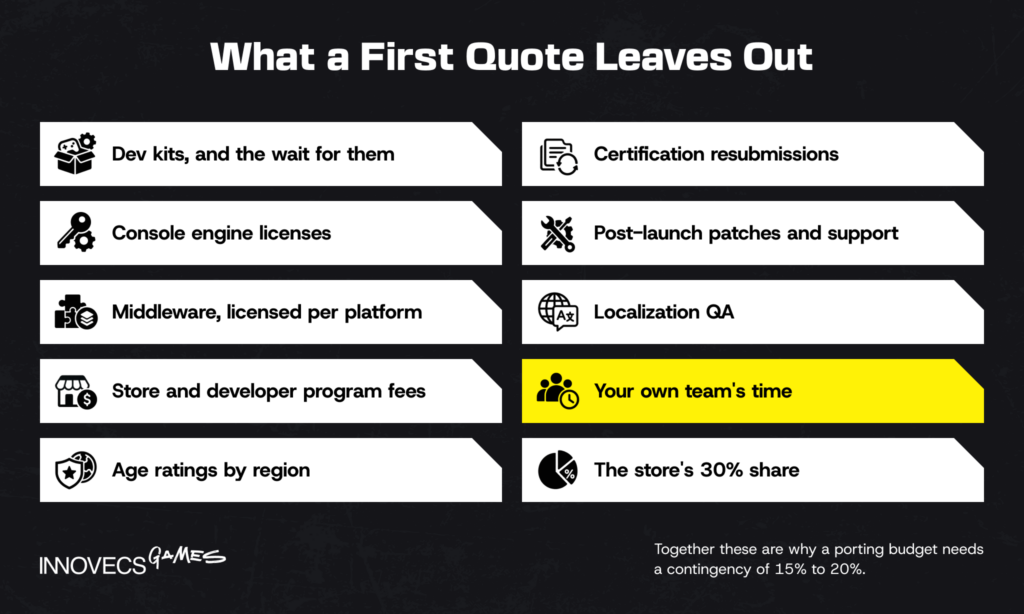
Rates and hours are the part of a quote everyone negotiates. The lines below are the part nobody negotiates because they never appear, and together they’re why we advise a contingency of 15% to 20% on any porting budget. That isn’t padding. It covers the things you already know will happen and can’t yet schedule.
Dev Kits, Licenses, and Platform Fees
Dev kits cost money and, more to the point, time. Microsoft raised the price of an Xbox development kit from $1,500 to $2,000 in October 2025. Developers with a concept approved by ID@Xbox get kits free of charge, but free isn’t the same as fast: one approved studio said in January 2026 it had waited most of a year for its hardware. Nintendo’s access has been uneven too. Digital Foundry reported from Gamescom 2025 that many studios couldn’t obtain Switch 2 kits at all, and in February 2026 the Danish outlet Arkaden still found them “largely unavailable” to teams that had shipped on the first Switch. A month later New Blood’s Dave Oshry said getting kits was “not much different than the Switch 1”, and that launch approval was the slower step. A porting partner that already has kits can save you a quarter, so ask about hardware before you ask about rates.
Licensing fees come next. Unity requires a Pro subscription or a platform holder’s license key to build for consoles, and Pro is listed at $2,310 per seat per year after its January 2026 increase. Middleware for audio, physics and video is often licensed per platform, so a new platform reopens every one of those contracts. Nobody remembers who signed the audio middleware deal until the new platform asks to see it. Store requirements add small fixed charges: $100 per game on Steam, $99 a year for Apple’s developer program and a one-time $25 for Google Play. Age ratings are a questionnaire for digital releases, which the ESRB and other boards run through IARC. A boxed release goes through a full review with a fee, and the ESRB’s reduced tier for small games was $3,000 when it was introduced in 2017. Store assets in every required size and localized store pages rarely get a line in the first quote either. The largest fee of all never shows up on an invoice: the store’s 30% share. It belongs in the payback sum further down.
Certification Resubmissions
A failed submission doesn’t carry a fine. It carries a team. While the fixes go in and the build goes back through the queue, the whole porting team stays on payroll, and for five people at Eastern European rates each lost week costs roughly $11,000 (200 hours at a blended $55). Microsoft also sells optional pre-certification submissions as a paid service, priced per package. We plan two submission cycles per platform as the default and treat a first-time pass as a pleasant surprise. The larger cost is the date: a resubmission that slips past a marketing beat or a store promotion can’t be bought back at any hourly rate.
Post-Launch Patches and Live Support
A port isn’t finished on release day. The day-one patch is usually in certification before the launch build is public, and the first month brings crash reports from hardware configurations no test lab had. Launch day is when the port meets the one tester you couldn’t hire, which is everyone. On console every patch goes through certification again, so a fix that takes an afternoon on Steam takes days on console. Microsoft’s own target for a content update is two business days, and that’s after the fix is built and tested. If the original game is still getting updates, each of them now has to ship on one more platform, indefinitely. Cross-save and online features add a bill that doesn’t end either, since account linking, cloud storage and servers are charged monthly for as long as the game is live. We advise setting aside 10% to 15% of the port budget for the first three months of post-launch support, and deciding before signing who owns the branch after that.
Localization and Regional Requirements
A new platform tends to mean new markets, and each market adds lines. Certification typically checks system messages and platform terminology in every language the game supports, so each language is a compliance surface as well as a translation. Text expands, too. The button that said “Save” now has to say “Speichern,” and nobody asked the layout. German and Russian strings overflow UI boxes sized for English, and Chinese, Japanese and Korean fonts take memory that a tight budget may not have. Languages are a storage problem as well: Saber shipped The Witcher 3’s Switch cartridge with three of them where the plan had four, to make the build fit. Age ratings differ by region as well, and a boxed release needs each board’s own review. On our projects localization QA adds 5% to 10% to the QA line for every extra language.
Your Own Team’s Time
No quote includes the hours your own people spend on the port, and no port runs without them. Someone has to answer questions about the codebase, review builds, approve each visual trade-off and sign off milestones. On our projects that comes to roughly a day a week from a senior engineer, plus a few hours each from a producer and an art lead. Over a 16-week port, that’s more than three working weeks of your most expensive engineer, taken from the next game and missing from every invoice. It’s also the line studios try hardest to squeeze, and that backfires quickly: a question that waits three days for an answer keeps four people waiting with it. At AA studios, where leads already carry three jobs each, this is the line that decides whether a port helps the team or exhausts it. Ask the partner for one point of contact per discipline and questions batched twice a week, not a stream of pings.
Port Timelines and Team Size: How Time Drives the Price
Strip away the detail and every porting quote is one multiplication: team size, times months, times rate. Four people for four months at a blended $55 an hour comes to about $141,000. The same team at $120 an hour costs $307,000. That’s why timeline slips hurt more than rate differences. Two extra months on that first team adds $70,000, often more than the gap between two competing bids.
| Port scope | Typical team | Duration | Where the time goes |
|---|---|---|---|
| Simple | 2 to 3 people: engineer, QA tester, part-time producer | 6 to 12 weeks | Platform SDK integration, input, certification |
| Mid-level | 3 to 5 people: 2 engineers, technical artist, QA tester, producer | 3 to 6 months | Memory and frame rate work, UI adaptation, two certification cycles |
| Complex | 6 to 10 or more: engine and rendering engineers, technical artists, QA team, producer | 6 to 12 months or more | Engine migration or new backend, content re-authoring, online services |
Source: Innovecs Games delivery data, projects staffed 2023 to 2026.
The producer is the role clients most often ask us to remove from a porting team, and the one we argue hardest to keep. Somebody has to hold the submission calendar, the platform holder’s account manager and the list of open certification risks, and an engineer doing that job isn’t optimizing anything. Technical artists are the other underestimated line. On a port that steps down in hardware, they do as much to hit the memory budget as the programmers do.
A Worked Estimate: One Port, Line by Line
Ranges are easier to trust once you’ve watched one being assembled. Here’s the mid-level case from the tables above, built up from hours: a 3D action-adventure on a current Unreal Engine 5 release, already selling on Steam and heading to PlayStation 5. Four people in Eastern Europe work on it for about 16 weeks at a blended $55 an hour.
| Work package | What’s in it | Hours | Cost |
|---|---|---|---|
| Audit and plan | Code and content audit, risk list, milestone plan | 120 | $6,600 |
| Platform bring-up | SDK integration, build pipeline, first boot on a dev kit | 240 | $13,200 |
| Platform features | Accounts, save system, trophies, suspend and resume, store entitlements | 320 | $17,600 |
| Input and UI adaptation | Controller-first menus, glyphs, text scaling, haptics | 400 | $22,000 |
| Performance and memory | Profiling, streaming, shader and LOD work to a locked frame rate | 720 | $39,600 |
| QA and pre-certification | Functional passes, checklist runs, regression after each optimization | 440 | $24,200 |
| Certification, two cycles | Submission builds and fixes for returned conditions | 160 | $8,800 |
| Production management | Planning, platform holder liaison, reporting | 160 | $8,800 |
| Labor subtotal | 2,560 | $140,800 | |
| Dev kits, licenses, middleware | Allowance | $8,000 | |
| Age ratings, store assets, localized store pages | Allowance | $4,500 | |
| Post-launch support, three months | 12% of labor | $16,900 | |
| Contingency | 15% of labor | $21,100 | |
| Budget to approve | About $191,000 |
Source: Innovecs Games delivery data, projects scoped 2023 to 2026. An illustrative model, not a quote.
The vendor’s quote for this project says $141,000, and the budget a studio should approve is 36% higher. Neither number is wrong. They answer different questions, and your finance lead will only ever ask one of them, probably in month five. If two bids land $50,000 apart, look at the bottom four lines before you look at the rates, because one bidder has usually left some of them out. Inside the labor, performance is both the largest package, at 28%, and the least predictable. A game that never had a memory budget can double it, and nothing else in the table moves that far.
Now add a second platform. Taking this game to Switch 2 afterwards needs about 1,150 more hours, or $63,000. That’s 45% of the first port, because bring-up patterns, platform features and most UI work carry over. More than half of those hours go to performance and memory for handheld mode. With support and contingency at those percentages and $5,000 in fees, the second platform comes to roughly $85,000 and the pair to about $277,000. At a US rate of $120 an hour, the labor alone for both would be $445,000.
Download the free port estimate template: Excel (.xlsx)
Five working tabs: the estimate above with live formulas, a second platform, break-even in copies with the pay-or-share comparison, a grid for lining up three vendor quotes, and a pre-quote brief to fill in before you ask for prices.
It opens with the worked example from this article filled in, so you can replace the numbers with your own.
The Same Sum at AAA Scale
The method doesn’t change with the size of the game, but the numbers do. A AAA title heading to several platforms rarely gets ported after the fact. It gets a co-development pod that works beside the core team for most of a year, and the releases are staggered by hardware class. Take Hogwarts Legacy. Avalanche shipped it on PlayStation 5, Xbox Series X|S and PC in February 2023 and on the previous console generation three months later. The Switch version, handled by a separate studio called Shiver Entertainment, didn’t arrive until that November. Nine months separated the first platform from the last, and each wave had its own certification calendar.
Priced our way, a pod of ten costs about $88,000 a month at a blended $55 an hour: rendering and platform engineers, two technical artists, three QA testers and a producer. Ten months of that is $880,000 in labor, and roughly $1.1 million once support and contingency are added. The lines that grow fastest at this scale aren’t engineering. QA grows because every SKU multiplies the test matrix, and production grows because somebody is now running three submission calendars at once. Past a certain size a port stops being a project and becomes a department.
Source: Innovecs Games delivery data, projects staffed 2023 to 2026. An illustrative model, not a quote.
How Many Copies Pay for the Port
A budget is only half a decision until it has a sales number next to it. Nintendo, Microsoft and Sony each take 30% of digital sales on their stores, according to documents filed in Epic v. Apple. After sales tax and refunds, our working assumption is that a studio keeps about 60% of the list price.
| Port budget | At $19.99 | At $29.99 | At $39.99 |
|---|---|---|---|
| PlayStation 5 only, $191,000 | 16,000 copies | 10,600 copies | 8,000 copies |
| PlayStation 5 and Switch 2, $277,000 | 23,100 copies | 15,400 copies | 11,500 copies |
Source: Innovecs Games arithmetic from the stated assumptions. Real break-even points are higher, because many copies sell at a discount.
Those numbers look small next to a PC launch, and they’re meant to. The port is paid back by one platform’s audience, usually a year or more after the game’s marketing peak, with no second launch campaign behind it.
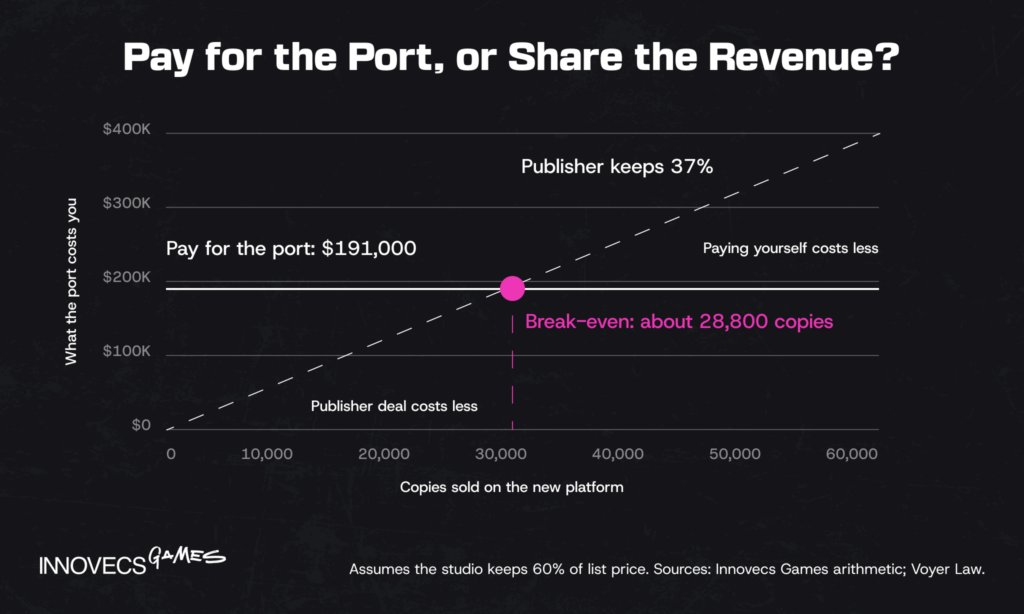
That arithmetic also settles whether to pay for the work at all. A porting publisher covers the cost and keeps a share, and in Voyer Law’s review of more than 100 publishing agreements, console-only deals left the developer 63.1% of revenue on average. Giving up roughly 37% is cheaper than $191,000 until the platform has earned you about $518,000, which is around 28,800 copies at $29.99. Below that line the publisher’s deal costs less, and above it you keep paying for the port every month the game sells. Forecasts for a new platform are rarely right, but they’re usually wrong in the same direction, so run this sum with the pessimistic one.
Porting a Catalogue, Not One Game
Publishers rarely ask for one port. They ask for three titles on two platforms and want to know what volume buys. What we see in practice is a second game costing 20% to 30% less than the first, provided it runs on the same engine and targets the same platform, with a third coming in slightly lower still. You only buy the build pipeline once. The same goes for the platform layer that handles saves, accounts and achievements, and for a certification checklist that’s already mapped to code. None of the saving comes from optimization. That work is specific to each game and stays at full price.
Two conditions make the discount real. The games have to share an engine version, or the common layer forks on day one. And the work has to sit with one team. Split three ports across three vendors and you pay for each lesson three times, plus a producer on your side to coordinate them. That’s also the case for keeping a port, its QA and its certification submissions under one roof. When a build fails, nobody spends a week establishing whose bug it is. One caution from our side of the table: a volume discount that isn’t tied to shared code is just a discount, and it’s fair to ask what was cut to fund it.
How to Estimate Your Budget Before Asking for Quotes
A studio that arrives with four facts gets a quote in days, and a tighter one. A studio that arrives with a Steam link gets a wide range and a long questionnaire. Which four? Your engine version, every third-party plugin in the project, the frame rate and resolution you’re aiming for, and how much of certification you want the vendor to own. Three steps produce them.
Audit Your Build and Source Code
On our projects a source code audit takes one senior engineer a week or two, and it’s the cheapest money in the whole project. Write down the exact engine version and every modification made to it. List each plugin and middleware package, and whether its vendor supports your target platform. Then profile memory and frame time on the weakest hardware you support today, and go hunting for anything in the codebase that quietly assumes a keyboard, a file path or a connection that never drops. Should the audit conclude that the engine needs upgrading first, good: you’ve found the biggest line in the budget before a vendor found it for you.
Define Target Platforms and the Quality Bar
“Port it to console” isn’t a scope, and neither is “it should feel good on a controller.” A scope names every platform and every hardware model, and the weak ones matter most: Series S, the original Switch, a three-year-old Android phone. It also puts the quality bar in numbers a tester can check. Sixty frames per second at 1080p docked is a target, and so is a load time under ten seconds. Decide which platform features are in, bearing in mind that cross-save alone, in our experience, can add a month. Last, tell your partner which platform matters most, because the work can be staged so the first release pays for the second.
Compare Fixed-Scope and Time-and-Materials Quotes
Fixed-scope pricing gives you a number you can take to a publisher, and the vendor prices their risk into it. In the quotes we see, that’s usually 15% to 30% on top. Time and materials costs less when things go well and has no ceiling when they don’t. We’d be suspicious of a fixed price offered without an audit: either it’s padded heavily or the change requests will make up the difference. The structure we recommend is a paid audit first, then milestone-based pricing with fixed fees for the parts that are now understood and capped time and materials for optimization, where honest uncertainty remains. Whichever you choose, ask each bidder the same five questions:
- Which certification passes are included, and how many resubmissions?
- Who supplies the dev kits and engine licenses?
- Is post-launch support priced, and for how long?
- What frame rate and resolution are you committing to, on which hardware?
- Who owns the port branch and build pipeline at handover?
Two quotes that answer those the same way can be compared on price. Two that don’t are quotes for different projects.
Not Sure What It Will Cost for Your Game? Let’s Talk
Send us the engine version, the target platforms and a build, and we’ll review it before we talk numbers. You’ll get a scoped estimate with the risky lines marked, whether or not we end up doing the work.
In-House vs. Outsourced vs. Co-Development: Which Model Costs Less?
The cheapest model on paper is whichever one you already have people for. The cheapest in practice depends on how many ports you plan to ship, and on whether your own engineers have anything better to do. They almost always do.
| In-house team | Outsourced to a specialist | Co-development | |
|---|---|---|---|
| Cost structure | Salaries and hardware, fixed | Per project or per milestone | Monthly team fee, shared milestones |
| Ramp-up time | 2 to 4 months of hiring, plus dev kit approval | 2 to 4 weeks | 3 to 6 weeks |
| Certification experience | Built from zero unless you’ve shipped on the platform | Bought with the team | Bought, and passed on to your staff |
| Flexibility | Low: headcount is fixed | High between projects, lower inside a fixed scope | High: scale the pod monthly |
| Idle time after ship | Yours to pay | None | None, with notice |
Source: Innovecs Games delivery data, projects staffed 2023 to 2026.
In most of the comparisons we’ve run, idle time swung the result harder than the hourly rate did. It’s also the row in-house budgets tend to leave blank.
In-House Porting Team
If ports are a permanent part of your business, build the team. That means a publisher with a back catalogue to move, or a studio that puts every title on five platforms. The knowledge stays with you, and so do the tooling and the relationships with platform holders. So do the salaries, in the months when nothing is shipping. GDC’s latest salary report puts the average US game programmer at $150,000 a year before benefits, and certification experience can’t be hired quickly at any price. Recruiting a platform specialist for one port is a bit like buying a van to move house once. For a single port, an in-house team is the most expensive option once recruiting time is counted.
Outsourcing to a Specialist Studio
Game porting outsourcing is the default for one-off projects, and for good reason. The partner brings hardware, a certification record and engineers who’ve already made the mistakes on somebody else’s budget. You pay per milestone and nothing afterwards. What you lose is knowledge. The day the contract ends, the only people who understand your Switch build go with it, and your first post-launch patch turns into a new purchase order. A handover, proper documentation and a support window all belong in the contract for that reason. Our game development outsourcing page describes how we scope that. Some game porting services come bundled with publishing, paid for with a revenue share. The copies table above shows when that trade is worth taking.
Co-Development with a Partner Studio
With game co-development the partner’s engineers work inside your repository and on your sprint cadence, next to your team, and the game never leaves the building. You’ll pay more per month than under a fixed-scope contract. Your tech lead will also give up real hours to it, and there’s no way around that. In return, the port ships in step with the main game, and your engineers learn the platform as it happens. It’s the right model for simultaneous launches and for live games, where the port has to keep up with every content update. For a finished game heading to one extra platform, it’s more than you need.
What to Check Before You Pick a Porting Partner
Rates are easy to compare and tell you little. These six checks tell you more, and a serious partner can answer all of them in one call.
- Shipped titles on your exact target platform, with the dates they passed certification. “Console experience” isn’t an answer.
- Dev kits in hand today, and how many. Approved and waiting doesn’t count.
- Active developer agreements with each platform holder, and engine licenses that cover console builds.
- Who runs certification QA: the partner’s own testers, or a third vendor you’ll never meet.
- Named engineers and the ports they’ve shipped, in place of a headcount.
- The last port of theirs that failed a submission, and what it cost the client.
The last question is the useful one. A partner with no answer either hasn’t shipped much or isn’t going to tell you.
Running a Port With an External Team
Most bad-vendor stories we hear are really stories about undefined acceptance. The contract said “port to Switch 2,” and nobody wrote down what done looked like. Five things settle most of that before the first invoice.
- Acceptance criteria per milestone, in numbers. Frame rate, resolution, memory headroom and load times, each on named hardware.
- Visual parity sign-off. Capture reference screenshots and video from the original at fixed points, and have your art director approve each visible downgrade in writing. “It looks worse” isn’t a bug report, and a side-by-side frame is. If the game carries a licensed IP, the licensor’s approval goes on that list, and it can take longer than certification.
- Payments tied to evidence. A split that works for us: 10% on the audit report, 25% on first boot on a dev kit, 25% at feature complete, 25% on the certification pass and 15% after the support window.
- One weekly report. Hours burned against the estimate, open certification risks and the next submission date. If it takes more than ten minutes to read, it’s hiding something.
- Ownership at handover. The port branch, the build pipeline, the platform configuration and the documentation transfer to you, and the contract says when.
None of this is exotic. It’s a producer’s ordinary week, and it’s the first thing to disappear from a cheap quote.
How AI Is Changing Game Porting Cost
Every porting proposal in 2026 gets asked the AI question, phrased as “shouldn’t this be cheaper now?” Parts of it are. The evidence on how much is messier than most pitch decks admit, and developers themselves are cooling on the claim: in the Game Developer Collective survey from early 2026, the share who believe generative AI reduces costs fell from 27% to 21% in a year.
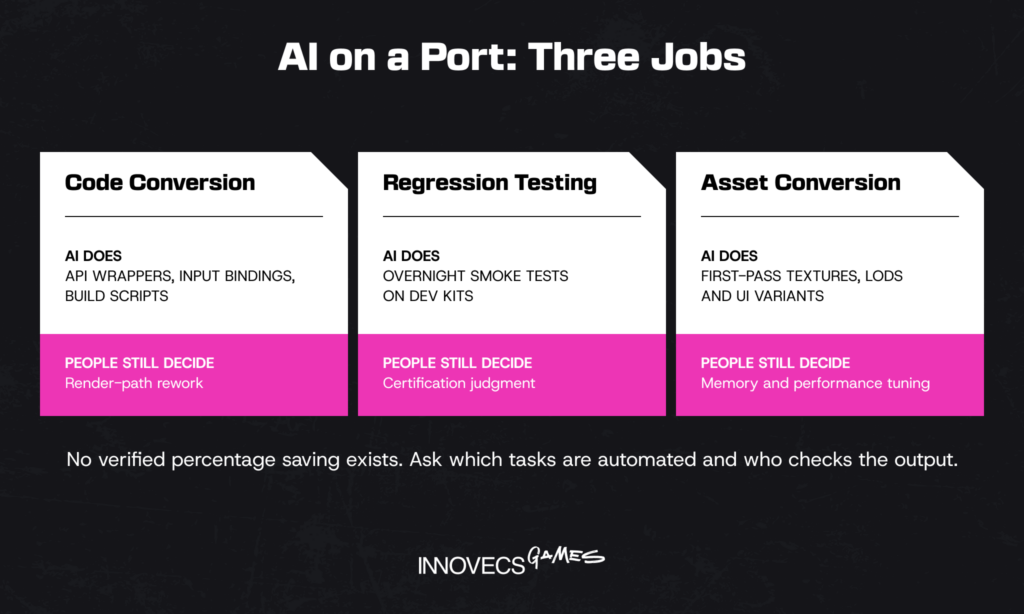
Code conversion and boilerplate. This is where an AI coding assistant earns its seat. Platform API wrappers, save-data serialization, input bindings and build scripts are repetitive, well documented and easy to verify. In a 2025 paper, Google’s engineers reported that LLMs wrote about 74% of the code changes across 39 internal migrations and estimated the total time was cut in half. Those migrations were uniform and backed by tests, though, which is not how a ten-year-old game codebase looks. The research group METR measured experienced developers working 19% slower with early-2025 tools on code they knew well, then called that result outdated a year later and said speedups now look likely but hard to measure. A fair reading is that AI in game development saves real hours on the mechanical part of a port, and nobody can tell you how many.
Automated QA and regression testing. Ports generate enormous regression loads, since every optimization can break something that worked last week. EA’s research division put the scale in numbers back in 2023: testing Battlefield V’s 601 features manually would take around half a million hours. Scripted bots and learned agents now run those smoke tests overnight on dev kits, and Epic shipped an experimental plugin in Unreal Engine 5.8 that lets an LLM drive the editor for testing and optimization tasks. That shortens the loop between a fix and its verification, and on a port that loop is where most of the calendar goes. The bots have limits of their own, mind. One will walk into a wall for nine hours and report that the wall is stable.
Human expertise still decides the outcome in three places. Render-path rework is the first. When a deferred renderer has to become a forward one for a mobile GPU, no assistant will design that for you. Memory and performance tuning is the second, because it depends on judgment about what players will and won’t notice. Certification is the third. A model can read the checklist. It can’t tell you which borderline behavior a platform holder will let through this quarter. We don’t quote a percentage saving from AI, and we’d be wary of anyone who does without showing where the number came from.
How Innovecs Games Helps Studios Reach New Platforms
Innovecs Games has delivered 300+ games over more than a decade, with 200+ developers and artists. Our engineering team works across PC, PlayStation, Xbox, Nintendo Switch, iOS, Android and WebGL, and the same people who do the low-level engine and rendering work also handle performance engineering and platform certification testing. Much of that work is in Unreal Engine and Unity, and our Unity game development team is the usual starting point for mobile and Switch targets.
Our game porting services come in three shapes, and the right one depends on what you’re missing. Co-development suits a simultaneous launch, where our pod works in your repository next to your team. Outsourcing fits a finished game heading to a new platform with a fixed scope and date. Staff augmentation covers the case where you have the plan and need two rendering engineers or a technical artist for four months. If you’re weighing a port against building for several platforms from the start, our article on cross-platform game development compares the two routes, and for new titles we take on full-cycle development as well.
One thing we don’t do: fund ports for a revenue share. If you need a publisher to carry the cost, a porting publisher is the better call, and we’ll say so on the first conversation. We’d rather lose that deal in week one than in month three. Our portfolio shows the kind of game studio and publisher we work with.
FAQ
What is the average cost of porting a game?
There’s no useful average, because a 2D Unity game and an open-world game on a custom engine sit in different price brackets. Most projects we scope land between $20,000 and $250,000 for the first platform. The mid-level example in this article comes to $141,000 in labor and $191,000 once fees, support and contingency are in. Anyone who gives you a single figure before they’ve seen the build is guessing, however confident the email sounds.
How long does it take to port a game?
Six to twelve weeks if the game is simple, three to six months for a typical 3D title, and up to a year, sometimes more, once a custom engine is involved. Those are engineering weeks. The calendar also has to hold things nobody on the team controls, like the platform holder’s approval, the wait for dev kits and at least two certification rounds per console. They only overlap with development if somebody kicks them off on day one.
Why is a Nintendo Switch port so expensive?
Because the hardware gap is the widest of any current console. The original Switch has 4GB of memory and a mobile chipset, Nvidia’s Tegra X1, so a game built for PlayStation 5 has to shed most of its memory footprint and often half its frame time. Switch 2 narrows the gap, but it’s still a handheld on a battery. Closing that gap is memory, streaming and rendering work, done by the most senior (and most expensive) people you can find.
What is the cheapest way to bring a game to a new platform?
Plan for it before the first platform ships. An input layer that doesn’t assume a mouse, a memory budget somebody actually tracks and UI that scales are nearly free in production and painful to retrofit. For a game that’s already out, we’d pick the platform closest to its current hardware, stay on a supported engine version and pay for an audit first. And port one platform at a time: the first release funds the second and exposes the problems while they’re still cheap.
Does the game engine affect the price of a port?
Yes, and more than anything else on the list. With Unity or Unreal Engine the export path to every major platform already exists, so what you’re paying for is optimization and compliance. Fall behind on engine versions and there’s an upgrade to fund before the port starts, while a custom engine means platform backends written by hand, which can double or triple the bill. Godot sits in between: its foundation doesn’t maintain console versions, so those releases go through third-party porting providers.
What is the difference between porting and remastering a game?
A port tries to be invisible: the game you already shipped, on new hardware, with as little visibly changed as that hardware allows. A remaster wants to be noticed, so it brings higher-resolution textures, new lighting, re-encoded audio and usually a few quality-of-life fixes. That takes artists as well as engineers, a longer schedule and a bigger invoice. Plenty of re-releases are a bit of both, and that’s exactly where a vague scope turns expensive.
What extra fees come with a console port?
Expect to pay for development hardware, an engine license that covers console builds, middleware licensed per platform and an age rating in each region. Microsoft’s paid pre-certification check is optional, and in our experience it earns its fee on a first submission. Nobody charges for patches on Xbox any more (Microsoft stopped in 2013), though every patch still spends a certification cycle. Go physical and you add manufacturing and distribution on top.
Should I port in-house or hire a game porting studio?
If this is your first release on the platform, or the only port on this year’s plan, hire one. What you’re really buying is hardware that’s already on a desk and a certification history, and both are worth more than the partner’s margin. An in-house team starts to pay when you ship on that platform again and again and can keep those people busy in between. When the port has to launch on the same day as the main game, co-development is the sensible middle.
🤖 Can AI lower the price of a port?
It lowers some lines. Boilerplate code, build scripts, regression testing and first-pass asset conversion all take fewer hours with current tools. The big ones haven’t moved much, and those are rendering rework, memory optimization and certification fixes. So when a vendor offers an AI discount, we’d ask which tasks they’ve automated and who checks the output.
🤖 Can AI handle a port without human engineers?
No. Translating a shader or wrapping a platform API is well within an assistant’s reach. Profiling a game on a dev kit isn’t, and neither is deciding which visual trade-off players will forgive or talking a platform holder into a waiver. Platform SDKs also sit behind NDAs, so public models have seen little of that documentation; what AI does is give a small senior team more reach.
Ready to Get a Realistic Estimate? Let’s Talk
Send over the engine version, the platforms on your list and the date you can’t miss. You’ll get back a game porting cost range for your build, with the assumptions written out and the two or three risks most likely to move it.