What to Include in a Game Development Contract in 2027
For studios and publishers outsourcing all or part of a game. After reading, you’ll be able to check your own draft for the clauses, pricing terms and red flags that decide whether a deal protects your game.
A game development contract can settle everything that matters and still hand the outcome to strangers. Obsidian’s deal for Fallout: New Vegas covered what got built, when it counted as done, how the money moved and who owned the result, and the studio still missed its bonus by a single Metacritic point.
Chris Avellone, then a co-owner of Obsidian, explained it in 2012. The game had been a straight payment from Bethesda with no royalties, plus a bonus if it reached 85 on Metacritic. It scored 84 on PC and Xbox 360. Nobody cheated anybody, and the contract did exactly what it said.
That’s the uncomfortable part. It tied the developer’s upside to a number that a few dozen critics set and no one at Obsidian could touch, and outsourcing disputes tend to start there: with wording that leans on something nobody can verify. Think of a scope written in adjectives, approval “to the publisher’s satisfaction,” or an IP clause that waits for the final invoice. What follows is written for the side that pays. Keep your own draft open while you read. You’ll come away knowing which documents you need and how your pricing model shifts the risk, plus which clauses deserve your lawyer’s hours and what to push back on before you sign.
This article is general information, not legal advice. Have a qualified lawyer review any agreement before you sign it.
What Is a Game Development Contract and Why It Matters
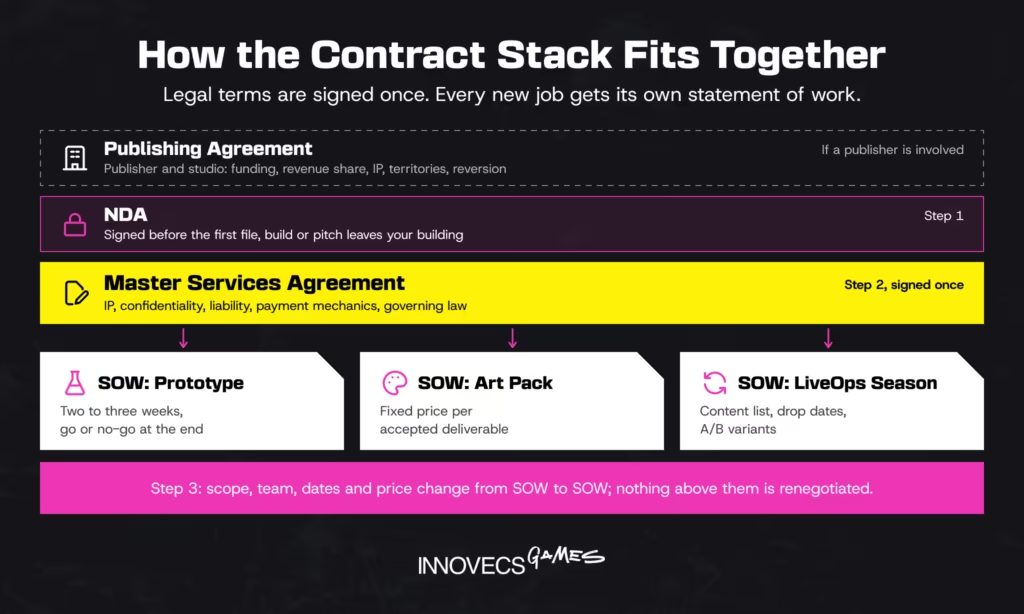
In plain terms, it’s the agreement between the owner of a game (a studio or a publisher) and the partner who builds some or all of it. It fixes the scope and the money for the work, along with the timeline and who owns what comes out the other end. And it’s rarely one document. On most outsourcing deals you’ll sign a short NDA first, then a master agreement with the legal terms, then a statement of work for each piece of the project.
You won’t see the stakes at signing. Price is seldom the fight. It’s the one number both sides wrote down. The fights start over what nobody pinned down: whether a build met the bar, whether a request was in scope, who owns a tool the vendor brought along. A developer and its publisher took exactly that kind of argument, over one rejected milestone, to the High Court in London in 2026 (the details are in the milestones section below).
No contract will stop a game from changing, and it shouldn’t try. What it can do is decide, in advance and in writing, who pays when it does.
The Main Agreement Types You Will Encounter
Most outsourcing deals are built from some mix of five documents. Lawyers name them differently, so judge them by what they do, not by their titles. A small art pack might need two. A three-year co-development partnership with a publisher in the loop can need all five, plus a pile of amendments that somebody will one day have to read in order.
Development Services (Work-for-Hire) Agreement
It’s the classic outsourcing contract: you pay, the partner builds to your spec, and what it makes for you becomes yours. It fits art packs, ports, a feature inside your codebase or a QA pass. Most studios reach for a work-for-hire agreement first, and for bounded jobs that instinct is right, though the label alone doesn’t always transfer ownership (the IP section explains the catch). Fallout: New Vegas was made under this kind of video game development agreement, with Bethesda owning the franchise and paying Obsidian a fee to build the game.
Co-Development Agreement
In co-development, an outside team builds part of the game inside your pipeline, with its own lead and producer and a share of responsibility for your delivery dates. The contract has to say who owns each system, whose repository and tools everyone works in, and how decisions get made when the two teams disagree. They will. Halo: The Master Chief Collection is the case people in production bring up. Microsoft’s 343 Industries built it in 2014 with several partner studios, Saber Interactive and Certain Affinity among them, and launch went badly enough that the warranty section below comes back to it. Our explainer on how video game co-development works walks through the setup, and our game co-development services page shows how we run it.
Publishing Agreement
A game publishing contract runs the money the other way. The publisher funds development and marketing, often as an advance it recoups from sales, and takes a share of revenue. Read the split and the recoupment terms first. Then check who owns the IP, which territories and platforms the publisher gets, and which derivative rights it takes: sequels, DLC, ports, remasters, soundtrack, merchandise. Reversion triggers decide when rights come back to you, for example if funding stops, the game isn’t released by a set date, or the publisher goes insolvent. On royalties, the definition of net revenue matters more than the percentage. Ask which deductions are allowed, how often you get statements, and whether you can audit them.
The best-known example became public during an unrelated lawsuit in 2012. Activision’s ten-year deal with Bungie left Bungie owning the Destiny IP and, according to GameSpot, paid it 20% to 35% of operating income from its titles. Sign a publishing deal and then outsource part of the work, and your terms with the vendor have to fit inside your terms with the publisher. If they don’t, you’re the one stuck in the middle.
Non-Disclosure Agreement (NDA)
The NDA comes before anything else, ahead of the GDD, the build or the pitch deck. A useful one says what counts as confidential (unannounced titles, builds, footage, sales data), how long the duty lasts after talks end, and which country’s law applies. And not having one doesn’t mean anything goes.
At CES in January 2025, accessory maker Genki showed 3D-printed mockups of the unannounced Switch 2 and reportedly felt safe because it had never signed an NDA with Nintendo. Nintendo sued anyway, over trademarks and false advertising, and Genki agreed to pay damages in a settlement that September. With a vendor, don’t rely on other laws to fill the gap. Get the NDA signed before the first file leaves your building.
Master Services Agreement and Statement of Work
Long partnerships run on two layers. The master services agreement (MSA) holds what stays the same: IP, confidentiality, liability, payment mechanics, governing law. Each statement of work (SOW) holds what changes from job to job, such as scope, deliverables, team, dates and price. A new art pack or another LiveOps season becomes a new SOW, not a renegotiation. That’s how an external development director at a large studio keeps two to four vendors running without six legal reviews a year. It’s also how short bursts of specialist work get bought. Once the MSA is in place, a VFX artist for six weeks or a lighting pass before a trailer can go out under a two-page SOW the same week.
The same structure suits live games and casual studios, where work arrives in small, fast batches. A season or an event pack gets its own SOW with a content list, a turnaround time per drop (two to four weeks is a typical rhythm for event assets) and the number of variants you want for A/B tests. Prototypes fit too. A two- or three-week SOW with a go or no-go review at the end lets you test an idea without signing up for production. And if you already have a strong in-house team, an SOW is how you buy overflow or a parallel prototype without anyone touching your core roadmap.
Fixed Price, Time & Materials, or Dedicated Team: Choosing a Pricing Model
Agreement types tell you what you’re signing. The pricing model tells you which clauses inside them will carry the weight. On fixed price, the scope annex and the change process do most of the work. On time and materials, it’s caps and reporting. Pick the model first, then check that the contract was drafted for it and not copied from a deal that used another one. For the budget side of the same decision, see our guide to the cost to make a video game.
| Model | Best for | Budget control | Flexibility | Typical risks | How milestone money moves |
|---|---|---|---|---|---|
| Fixed price | A port, an art pack or a prototype with a frozen feature list | Strong while the scope holds | Low, since changes go through change requests | A risk premium baked into the price and arguments over what was in scope | Paid per accepted deliverable |
| Time and materials | Production where the design will move after playtests | Depends on the cap and on reading the reports | High, because priorities can change each sprint | Spend that drifts upward without a cap or a re-estimate | Monthly invoices, sometimes with a holdback released at review points |
| Dedicated team | Long production or LiveOps with a steady backlog | Predictable monthly cost | High within the team’s capacity | Paying for idle people when your approvals stall | A monthly fee, with milestones used for reviews and bonuses |
Long projects often end up on more than one model: hours for the prototype, a fixed price for a later art pack. If your MSA only describes one, switching later means reopening it, and nobody’s keen on that conversation in month ten. Ask for payment terms that cover both from the start.
Fixed Price
Here the partner commits to a deliverable for a set fee and eats the cost if its estimate was low. It isn’t a charity, so it prices that risk in. Milestone payments carry the deal, and every payment should match something you can accept or reject against agreed criteria. Obsidian’s New Vegas fee was fixed price in its plainest form, with a review-score bonus as the only upside. We wouldn’t tie a partner’s money to a review aggregate, because a clause like that pays out on a number neither side controls. Fixed price works when “done” can be checked by someone who wasn’t in the room when the deal was made, as with a port that passes certification or forty props built against a style guide that already exists. It works badly for a game that’s still looking for its fun, where every design change becomes a change request and a small argument.
Time and Materials
On time and materials you pay for the hours worked, billed monthly, and the estimate is a forecast. You’re carrying the budget risk, and you’ve got the steering wheel. Your protection here is a monthly cap that can’t be exceeded without your written approval, a burn report against the estimate that someone on your side actually opens, re-estimates at agreed points, and the right to approve who joins the team. Add the right to audit timesheets, and agree what counts as billable: meetings and onboarding usually are, while time lost waiting on your approvals is worth settling in writing before it shows up on an invoice.
Budget-sensitive studios sometimes avoid T&M on principle. We think a capped T&M contract with honest reporting is often safer than fixed price on a thin spec. You see an overrun the month it happens, not at the final invoice.
Dedicated Team
With a dedicated team you’re renting named people who work only on your project, at a monthly rate per head, often with the partner’s lead and producer included. Contracts for it need rules the other models skip: notice periods for scaling up or down, how fast the partner must replace someone who leaves, and whether key people can be moved to another client. Studios rarely complain to us about rates, oddly enough. They complain that the senior engineer they interviewed was gone by month three. If you’re weighing that option against building a team yourself, our guide on how to hire a game development team compares the routes.
Key Clauses to Cover in Every Outsourcing Deal
Pricing decides how money moves when things go to plan. The clauses below decide what happens when they don’t, and on anything longer than a quarter, something won’t. None of them takes long to write. Leaving one vague is what’s expensive. If your lawyer only has time for some of them, start with acceptance, IP and termination, because those three are where a game development contract gets tested in a dispute.
Scope of Work and Deliverables
Write the scope in nouns, not adjectives. “High-quality environment art” means nothing in an argument. “Twelve modular environment kits with 2K PBR textures, delivered as UE5 assets in your repository, with LODs and collision” is something anyone can check. Attach your game design document, or the relevant part of it, and name the version, since a GDD that changes weekly needs a frozen copy for the contract. Say which files you get, too. For art that means layered working files (PSD, Substance, Maya or Blender scenes), not only the exported textures, or the next vendor will be rebuilding assets from a JPEG.
Good boundaries fit in a sentence. Virtuos co-developed Oblivion Remastered with Bethesda, and the game runs the original engine for world logic and Unreal Engine 5 for everything players see. A scope annex can describe a split like that in one line, and both teams know whose bug is whose. Name the entity doing the work too, and make handing any of it to a third party something the partner has to clear with you first.
Milestones and Acceptance Criteria
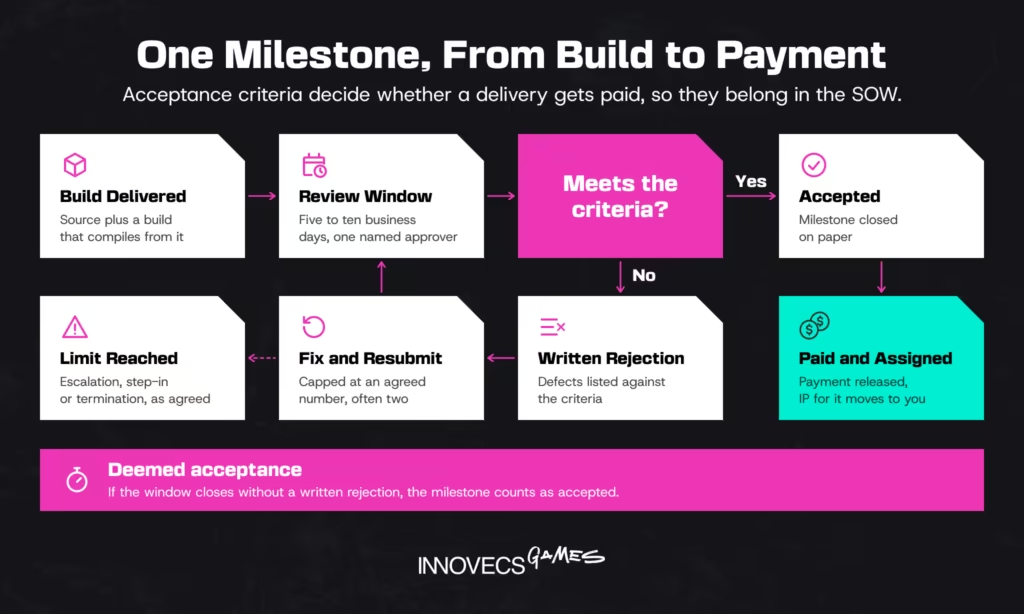
Milestones turn a long project into payable pieces, and acceptance criteria decide whether each piece gets paid. Typical game development milestones follow the game development process: prototype, vertical slice, alpha, beta and gold master, with smaller ones for art packs or LiveOps drops. Each needs a definition (“alpha: all features in, playable start to finish, no crash bugs on target hardware”), a review window of five to ten business days, and a cap on resubmissions. Because milestone payments hang on acceptance, a vague definition is a payment dispute with a date already set.
Art needs one more line. If several vendors work on one game, acceptance should check every asset against the same style guide and a set of reference assets already approved in your build, and the sign-off should come from your art lead, not from each vendor’s own reviewer. That’s what keeps characters from three studios looking like they belong in one world.
Six Days in Fallujah shows how far that can go. Its publishing deal released development money only after the publisher approved each build, and it included a step-in right: fail a milestone after two resubmissions, and the publisher could take over development, raise its revenue share to 75% and receive the full source code. The publisher rejected one submission over AI performance and loading times. The developer argued the rejection had been decided in advance. In a judgment reported in August 2026, the High Court refused interim relief to both sides and encouraged them to settle.
The lesson? It isn’t to avoid step-in rights. It’s to write acceptance tests that a third person could run and reach the same answer.
Your own side of the deal belongs here as well. A partner can’t hit a date if feedback takes three weeks, so good contracts give the client obligations too: review within the agreed window, access to builds and tools on day one, materials you actually have the rights to, and a single person whose sign-off counts. When approvals slip, the deadline moves with them. That clause isn’t a favor to the vendor. It’s what keeps a delayed approval from turning into an argument about who missed the date.
Payment Terms and Invoicing
Spell out when invoices go out, how long you have to pay (30 days is normal, 60 is common with large publishers), the currency, who carries bank fees, and what happens when a payment is late. Advances need their own line. A partner that staffs up for you will want money before the first delivery, and that’s fair if the advance is credited against later invoices.
The partner’s side matters too. A suspension clause lets it pause work once invoices are overdue past a set date. Without one, the team keeps working on credit, and it’s the relationship that sours long before anyone files a claim. In 2025 Hidden Variable Studios sued Skullgirls publisher Autumn Games for about $1.2 million in unpaid payments, and still handed over the account logins needed to keep community support running. A clear payment clause protects the paying side as well, because it says exactly how long it has before work stops.
IP Ownership and Assignment
Under US law, copyright starts with whoever creates the work, contractors included. A work-for-hire agreement moves authorship to you only if the work fits one of nine statutory categories (a contribution to an audiovisual work, such as a game, is one) and both sides sign a written agreement saying so, as the Copyright Office explains. Standalone code is treated as a literary work and may not fit. That’s why careful contracts pair the work-for-hire clause with a backup assignment of everything the partner creates for you: code, art, audio, documentation and tools built for your project. Name the less obvious pieces as well. Economy and balance tables, live-ops configs and monetization logic are easy to leave out and expensive to rebuild.
There are two local wrinkles you’ll want to raise with your lawyer. Hiring an individual in California on work-for-hire terms can make that person a statutory employee under state law. In France and Germany, moral rights stay with the author even after a full buy-out, so contracts there limit how those rights are exercised instead of waiving them.
Ninja Theory learned what ownership is worth. Sony funded Heavenly Sword, and when the studio later wanted to go multiplatform, co-founder Tameem Antoniades said a multiplatform sequel was off the table because Sony owned the IP and the tech built for it. The studio walked away from both and built its next game on new IP.
Pre-Existing IP, Tools, and Third-Party Assets
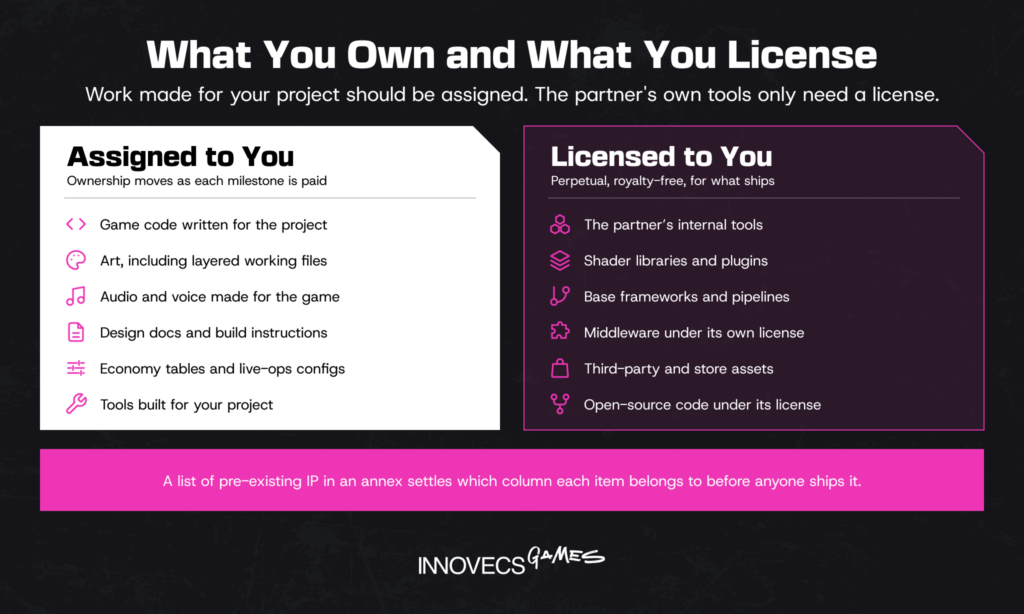
Partners bring things with them: internal tools, shader libraries, plugins, a procedural pipeline, a base framework. You don’t need to own those. You do need a license to keep shipping and patching the game with them forever, and that doesn’t end when the partnership does. The contract should list pre-existing IP in an annex, grant you a perpetual, royalty-free license to whatever ends up in your game, and require the partner to declare third-party assets and open-source code. Copyleft licenses such as the GPL can oblige you to publish your own source. That declaration isn’t paperwork.
The worst case on record is an old one, and nobody’s topped it since. Silicon Knights sued Epic in 2007 over Unreal Engine 3 and lost the counterclaim. In 2012 a US court found it had copied Epic’s code into its own engine and ordered it to recall and destroy unsold copies of Too Human and X-Men: Destiny. If a partner’s framework carries someone else’s code, your game inherits the problem.
Source Code, Builds, and Repository Access
Make sure the work happens in your repository, or at least gets pushed there on a fixed schedule, with build scripts, project files and source art, not only compiled builds. A partner that holds the only working copy holds a bargaining chip you never meant to hand over. The contract should also say what arrives at each review point (source plus a build that compiles from it), who holds admin rights, and what happens to the partner’s copies when the work ends. If the partner’s own engine or framework runs underneath your game, ask for its source to be held in escrow, released to you if the partner goes under or stops supporting it.
Courts don’t treat source code lightly, either.
In the Six Days in Fallujah case, the judge weighed moving source built for over $50 million to a publisher that had put in a fraction of that, and declined to order it at the interim stage. If the code had sat in a shared repository from day one, there’d have been far less to argue about.
Confidentiality and Data Security
Beyond the NDA, the main contract should set rules for handling your material: who on the partner’s side gets access, on which devices and accounts, and how fast access is removed when someone rolls off the project. Ask how builds get shared. Ask about personal laptops. And ask how quickly the partner has to tell you about a breach, because a week of silence after an incident costs more than the incident.
If that sounds like box-ticking, remember what happened to CD Projekt Red in February 2021. The ransom note claimed full copies of source code from the studio’s Perforce server, and files for Cyberpunk 2077 and The Witcher 3 were reportedly sold at auction within days. That wasn’t a vendor breach, since attackers hit the studio itself. Every outside team you add brings another set of credentials into a server like that one, so access rules belong in the contract, not in an onboarding email.
Player data needs its own paper. If the partner touches anything personal, such as LiveOps tools, support tickets, analytics, or QA on live accounts, you’ll need a data processing agreement alongside the main contract. Under GDPR it names what data the partner may handle, where it’s stored, which subprocessors are allowed, and how fast it reports a breach. Mobile and live-service studios run into this first, since their vendors often sit closer to players than the game’s own designers do.
Change Requests and Scope Creep
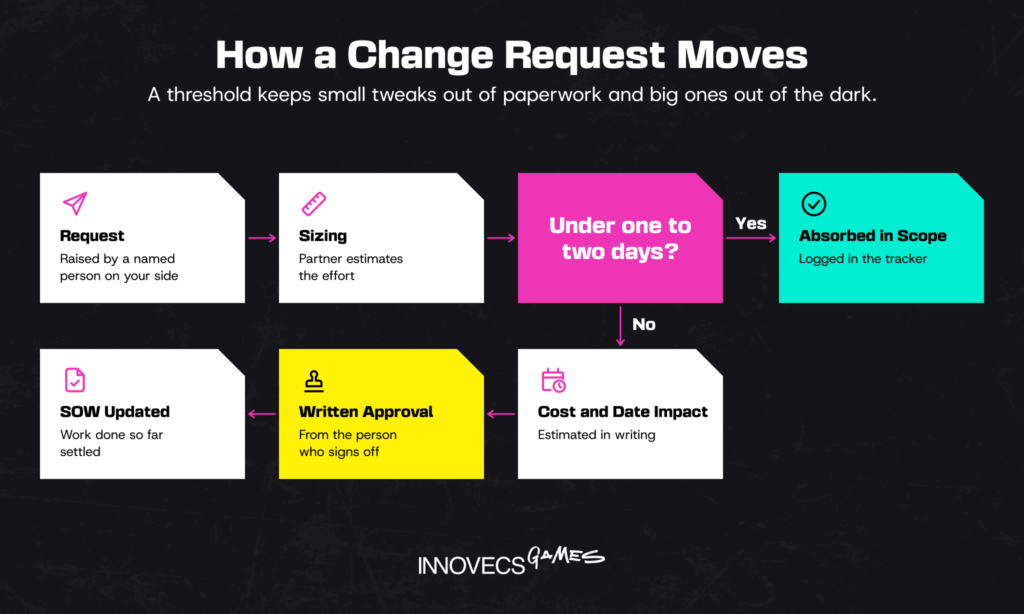
Games change once people play them, and that’s normal. The contract should treat it that way. A change request process needs four parts: who can ask, how the partner estimates the effect on cost and dates, who approves it in writing, and what happens to work already done.
Add a threshold for small changes, say anything under a day or two of effort is absorbed and anything bigger goes through the process. Without it, a fixed-price job turns into a negotiation over each tweak, and a T&M plan quietly stretches from twelve months to eighteen.
Star Citizen is the extreme case of scope set by enthusiasm. Its 2012 crowdfunding campaign promised a game in November 2014, and Chris Roberts later told Kotaku that as stretch goals kept getting hit, the scope changed. Each one was, in effect, an approved change request with no change to the date. Most scope creep on outsourced work is smaller and closer to home, and in our experience it tends to come from your own team’s review comments, one quick tweak at a time, none of them worth raising alone and all of them together big enough to move a date.
Governance, Reporting, and Key People
A contract can decide how much of your leads’ week the partner takes up. Write in who runs the partner’s side (a named lead and producer) and what they report: a weekly status, a monthly burn and risk summary your executive producer can forward to leadership as is, and an escalation path with response times. Agree the seniority mix too, for example no more than a third of the team below mid-level, plus your right to approve replacements and a handover period when someone rotates off. Junior-heavy studios feel this clause most.
Your leads are already mentoring their own people, and they shouldn’t have to mentor the vendor’s as well. For an external development director running several partners, the same reporting format from each one is worth asking for in the MSA, since it turns four status calls into one spreadsheet.
Publishers also ask whether the same team can work for a competitor in the same genre. Full exclusivity for a whole studio is rarely realistic or worth its price. A narrower clause usually does the job: people on your project don’t move to a competing title while they’re on it (and for an agreed period after), and teams on different clients’ projects don’t share repositories or builds.
One more detail people forget until the end: credits. Agree in the contract how the partner’s team appears in the game’s credits and whether it can show the work in its portfolio, and from what date.
Warranties and Post-Launch Bug Fixing
In a warranty, the partner promises its work matches the spec, is original and doesn’t infringe anyone’s rights. For code, add a defect warranty: for a set period after acceptance or launch (60 to 90 days is common), the partner fixes bugs in its own work at no charge. Define severity levels and response times, and agree a rate for fixes outside the warranty, because a live game needs patches long after the warranty runs out.
The Master Chief Collection launched on November 11, 2014 with matchmaking so unreliable that 343 publicly apologized and gave players free content, and Destructoid reported it was still routinely broken more than 100 days later. When several studios build parts of one game, a clear warranty clause is what stops a week of each team saying the bug lives in someone else’s code.
Termination, Handover, and Exit Terms
Both sides need a way out: for breach (after notice and a chance to fix it), for convenience (with a notice period and payment for work done), and for insolvency. What studios forget is the exit itself, and it’s the part that costs most when it’s missing. The contract should require a handover package on termination, with source, assets, documentation, build instructions and access credentials, plus a few weeks of paid knowledge transfer. Add a kill fee if you want the right to stop a fixed-price job midway, and a non-solicitation clause so neither side hires away the other’s people for a year or so.
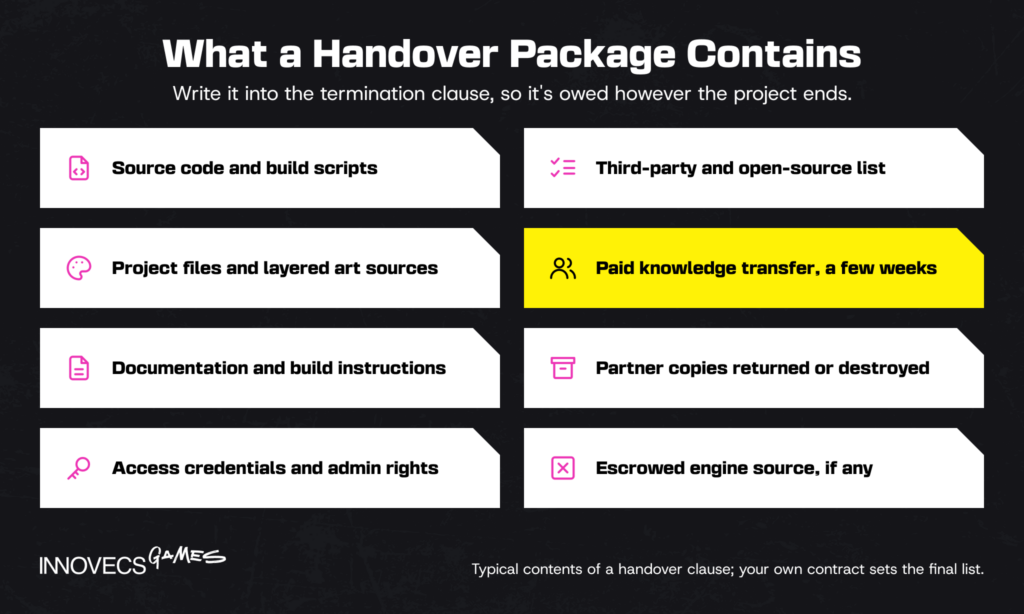
Bloodlines 2 changed studios mid-project; a handover clause decides how much earlier work survives a move like that.
Force majeure deserves more than the boilerplate paragraph it usually gets. Ask the partner for a written continuity plan: what happens to the work during power or network outages, whether people can switch to another location, and which key roles have named backups. The contract should then say what moves when an event hits (dates, yes; payment for work not done, no) and how long it can last before either side may terminate. Distributed teams make this easier, not harder, as long as the plan exists before anyone needs it.
Paradox removed Hardsuit Labs from Vampire: The Masquerade – Bloodlines 2 in February 2021, and The Chinese Room later restarted the project. The game shipped on October 21, 2025, after which Paradox wrote down about SEK 355 million of capitalized development costs. A clean handover can’t rescue a troubled project. Nothing can, at that stage. It does decide how much of the work you paid for is still usable on the other side.
Liability, Indemnity, and Governing Law
A liability cap limits what either side can owe. Fees paid over the previous 12 months is a common starting point, with carve-outs for confidentiality breaches and IP infringement. Indemnity decides who pays when a third party sues, and IP is where that bites. In May 2025 an independent artist found decals lifted from her 2017 poster designs in the Marathon alpha, and Bungie confirmed a former artist had put them in a texture sheet before settling with her that December. Bungie’s problem came from its own staff, not a vendor. With a vendor, the same mistake lands on whoever the indemnity clause names. Large publishers back that clause with insurance requirements, typically professional liability (errors and omissions) and cyber cover, with the policy limits stated in the contract. Ask for certificates before work starts, because an indemnity from a partner that can’t pay is a nice sentence and not much else.
Last come governing law and dispute resolution. Arbitration is often faster than court and easier to enforce across borders. The NFLPA’s royalty dispute with Saber Interactive over Wild Card Football went that way and ended in a final award of more than $3.1 million in May 2026, with collection still contested in court months later. Pick a seat and rules both sides can live with while everyone’s still friendly.
Red Flags to Catch Before You Sign
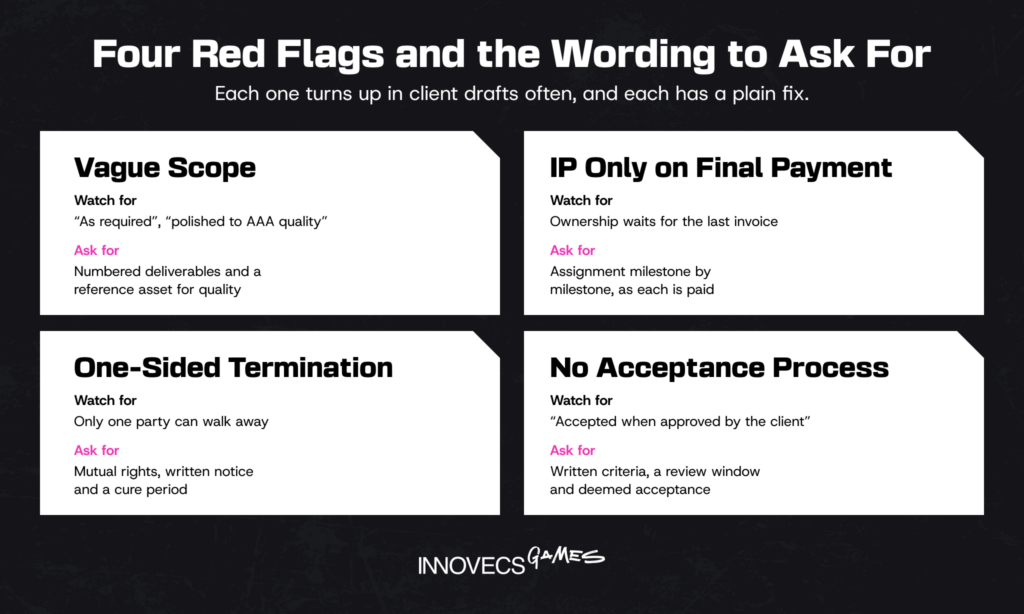
Most bad clauses aren’t written in bad faith, and that’s what makes them easy to miss. They’re copied from a template or drafted for a different kind of project, and nobody stopped to ask what they’d mean in month nine. These four turn up in client drafts more often than any others, and each has a plain fix.
Vague Scope and Open-Ended Deliverables
Watch for “as required,” “including but not limited to” inside the deliverables list, or “polished to AAA quality.” For the partner they turn a fixed price into an open commitment, and for you they leave nothing to enforce. Replace them with a numbered list, a reference asset or build that sets the quality bar, and one line saying anything not listed is a change request.
IP That Transfers Only on Final Payment
Partners ask for this to protect themselves against unpaid invoices. Fair motive. The timing, though, is the problem. If the project ends early, or a dispute holds up the last payment, you may not own work you’ve already paid for. Ask for assignment milestone by milestone as each one is paid, with the partner holding rights only to unpaid work. We sign it in that form as a vendor, and a partner confident in its own invoicing shouldn’t object.
One-Sided Termination Rights
If only one party can walk away, or the notice period runs in one direction, the other side has nothing to negotiate with when things go wrong. The DragonSword dispute shows why notice rules need care too. Developer Hound13 announced in February 2026 that it was ending its publishing deal with Webzen over an unpaid minimum guarantee. Webzen said it paid on February 27, called the notice legally invalid, and sued in April to block a separate Steam release. Mutual rights, notice in writing, a cure period and a fixed payment date make that kind of fight far less likely.
No Acceptance or Review Process
“Accepted when approved by the client,” with no criteria and no deadline, makes payment depend on someone’s mood that week. It’s bad for both sides. The partner can’t plan cash flow, and you lose the weight a formal rejection would carry. Ask for criteria on paper, a fixed review window, and deemed acceptance if the window closes without a formal rejection.
Pre-Signing Checklist for Studios and Publishers
Four flags are quick to spot once you know them. The rest of a draft needs a slower read, so run it against this list before it goes to legal review, ideally with the producer who’ll manage the partner sitting next to whoever negotiated the price, since they tend to read the same clause very differently. Each “no” is a question for the other side, not automatically a deal-breaker.
- Does the scope annex list deliverables as countable items, with the GDD version attached?
- Has each milestone got a written definition, a review window and a limit on resubmissions?
- Are payments tied to accepted milestones, or to monthly invoices under a cap, with late-payment terms spelled out?
- Does IP assignment cover everything made for your project, economy tables and tools included, and take effect as each milestone is paid?
- Is pre-existing IP listed in an annex, with a perpetual license for anything that ships?
- Does the work live in your repository, with source and a compiling build arriving at each review point?
- Are access rules, breach notice and offboarding written into the contract, with a data processing agreement if the partner touches player data?
- Is there a change request process, with a threshold for small changes?
- Does the bug-fix warranty name a period, severity levels, response times and a post-warranty rate?
- Can both sides terminate, is a handover package priced in, and is there a continuity plan behind the force majeure clause?
- Are key people named, including the partner’s lead and producer, with a seniority mix, a reporting cadence, a replacement deadline and your consent needed for subcontracting?
- Do AI tools, disclosure and data handling have their own clause? (See the AI section below.)
A game development contract template is a reasonable start for the NDA and for the legal terms of an MSA. Those change little from deal to deal. It’s a poor start for the SOW, because scope, acceptance and the payment schedule describe your game and nobody else’s. Use a template to make sure nothing is missing, then rewrite every part that describes the work.
If the first milestone feels too uncertain to define, make it small. A paid prototype through game prototyping services gives both sides something concrete to accept or reject before a production budget is on the line.
Looking for a Development Partner Who Works Transparently? Let’s Talk
Some deals stall on one clause, usually acceptance or IP. If yours has, a short call with our delivery team will show you how we’d structure that part of the engagement.
AI-Generated Assets and Code: What Your Contract Should Say
By October 2026, almost half of new games on Steam carried an AI disclosure, according to a community count of Steam data, up from 1.7% in January 2024 when Valve brought in the rule. Regulation has caught up as well: the EU AI Act’s transparency obligations have applied since August 2, 2026, including labels for deepfakes. So going into 2027, your partner’s tools are part of your product, and most contracts written before 2024 don’t mention them. The tools do speed up real work, from code scaffolding and test automation to placeholder art and first-draft localization, and the contract should cover where they’re already being used.
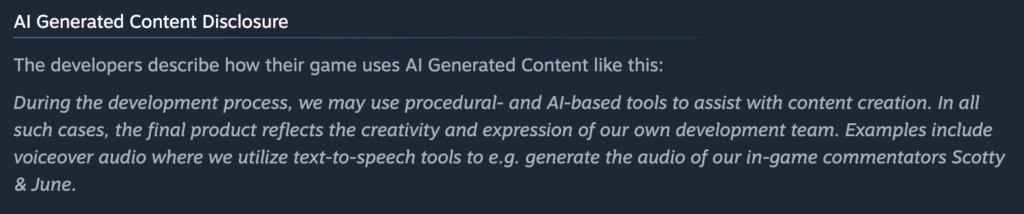
Placeholders are where it slips. They always were. In November 2025 players spotted an AI-generated loading screen in Ubisoft’s Anno 117: Pax Romana, and the company said it was a placeholder that had slipped through its review process. That’s what happened inside one publisher. Put a vendor between the tool and the build, and the same slip happens across two companies with less visibility on each side.
Ownership is harder. Stephen Thaler spent years trying to get his AI system recognized as an author, and in March 2026 the US Supreme Court declined to hear his case, leaving in place the rule that copyright needs a human author. A fully generated asset may not be protectable at all, so “the vendor assigns all rights” can assign very little. After the ruling, Mayer Brown and other IP firms gave the same practical advice: document the human contribution to AI-assisted work.
Five clauses cover most of it:
| Clause | What it should say | Why it matters |
|---|---|---|
| Tool disclosure | The partner names the AI tools it uses and the kinds of work it uses them for | You need this to answer platform disclosure forms truthfully |
| Tool approval | New tools need your written approval, and some uses (hero characters, voice, key art) can be ruled out | Keeps generated content away from the assets players judge you on |
| Ownership and human authorship | The partner assigns whatever rights exist and keeps records of the human edits to AI-assisted work | Supports your copyright claim where one can exist |
| Training data warranty | The partner warrants its tools are licensed for commercial use and covers claims that arise from them | Puts the infringement risk on the side that chose the tool |
| Data and confidentiality | Your files never go into services that train on customer data or store it outside agreed regions | An unreleased build pasted into a public chatbot is still a leak |
Teams forget the last row. Nobody thinks of a chat window as a file transfer.
We’d approve tools before we’d ban AI outright. A blanket ban is hard to verify and easy to break quietly, while an approved list with a short disclosure log gives you something you can audit. For the wider shift in production, see our piece on AI in game development.
How Innovecs Games Structures Outsourcing Engagements
Most of what we’ve recommended here is how we already like to work, and we’ll admit it makes our own job easier. Written criteria settle arguments that goodwill only postpones. Across 11+ years and 300+ game projects, our 150+ specialists have delivered art, engineering, QA and LiveOps work for studios and publishers including Xbox Game Studios, Ubisoft and King.
Our game development outsourcing services come in four shapes. Feature-based work covers a specific mechanic, system or module. Functional support adds one discipline, such as art, QA, backend, LiveOps or porting. A full dedicated team is cross-functional and self-managed inside your workflow. Pipeline-aligned delivery means we adapt to your tools, ceremonies and release cadence instead of asking you to adopt ours. Contract game development with us starts with onboarding (goals, scope and team structure, then access to your tools), runs on regular syncs, and moves through milestone-based reviews of real builds. Each team has a producer on our side who owns status reporting for your leads and executives.
The legal terms (IP assignment, access, warranties, handover) are agreed project by project with you and your lawyers, on your paper or ours. If you’re consolidating vendors, one partner can cover engineering, art and QA under a single MSA. Examples of that work are in our portfolio.
FAQ
Do I need a lawyer to review a game development contract?
Yes, for anything beyond a small one-off job. A lawyer who knows games will catch jurisdiction issues, IP gaps and liability terms that a producer can miss. The commercial annexes are still your team’s job, though: scope, milestones, acceptance criteria and the payment schedule describe a game no lawyer has played.
Who owns the IP when you outsource game development?
Whoever the contract names, and if it doesn’t name anyone, it’s often the people who made the work, because under US law contractors own what they create unless a valid work-for-hire clause or a written assignment moves it to you. Good contracts use both and list the deliverables they cover, from source and art to tools built for your project. Pre-existing tools normally stay with the partner, licensed to you.
What is a work-for-hire agreement and when is it used?
Under one, you’re treated as the author of what the partner creates, provided the work fits a category in the Copyright Act and both sides sign. Studios use it for art packs, ports, features and QA passes, where the partner builds to spec and keeps nothing. Because standalone code may not qualify, pair it with a backup IP assignment.
How do milestone payments work with an external studio?
Each payment is tied to a defined deliverable, such as a vertical slice or an art pack, and released once you accept it against written criteria. Many contracts add an advance at signing, credited against later invoices. You get a review window, often five to ten business days, and the partner gets a limited number of resubmissions. If the window passes without a written rejection, the milestone is deemed accepted.
What’s the difference between a video game development agreement and a publishing deal?
The money flows in opposite directions. In a development deal you pay a partner to build something you’ll own. In a publishing deal the publisher pays you, funding development and marketing in return for a revenue share and some rights, and it often recoups its advance first. Plenty of projects have both at once.
Should I sign an NDA before sharing my game concept with a vendor?
Before anything confidential leaves your hands, yes. A short mutual NDA takes a day to agree and covers the GDD, builds, footage and business data you’ll share while scoping. Make sure it survives the end of the talks for a set period. Reputable partners will sign yours or offer their own without fuss.
Which pricing model is safest for a first project with a new studio?
Pick something small and bounded on a fixed price, such as a prototype or a short art package. That lets you judge quality, communication and estimating without committing a production budget. Once that’s gone well, move larger work to capped time and materials or a dedicated team.
What happens to the source code if the partnership ends early?
That’s decided by the termination and handover clauses, so check them before signing. A good contract obliges the partner to deliver all source, assets, build scripts and documentation for paid work, plus a short paid knowledge transfer. If the code already lives in your repository, most of the handover is done before anyone gives notice.
🤖 Can a vendor claim rights to AI-generated content in my game?
Not if your contract assigns everything the vendor creates for you, AI-assisted work included. The bigger risk is that nobody owns a fully generated asset, since US law requires a human author. So the clause should also oblige the vendor to record the human edits and warrant that its tools are licensed for commercial use.
🤖 Should a contract limit which AI tools a vendor can use?
It should, though an approved list works better than a ban. Require the vendor to name its tools, ask before adding new ones, and keep your files out of services that train on customer data. Many studios also rule out AI for hero characters, voice and key art.
Ready to Start Your Game Project With the Right Partner?
About to sign a game development contract with an outside team? Start with a first deliverable small enough to judge us by, and decide on the rest once you’ve seen the build.