Cross-Platform Game Development: How to Build Games That Work Everywhere
Reach players on PC, console, and mobile from one production line, instead of paying for the same game three times.
Cross-play is no longer something you pitch. Unity’s 2026 Game Development Report has it at 72% of studios, which puts it closer to a baseline expectation. The same survey gets less comfortable a page later. Of the people running those studios, 38% say they can’t hold the experience steady across devices. Both numbers describe a project most of us have met. It shipped on one platform. It sold well enough to justify a port. Then it spent two quarters finding out what the codebase had quietly assumed about the hardware.
The audience scattered faster than production pipelines adapted. Nintendo has moved 23.68 million Switch 2 units in the console’s first year, by its own sales data to June 2026. Valve did something quieter and just as awkward for anyone holding a plan. Its Steam Deck now sits fourth on the list of platforms developers build for, at 28%, in a 2026 GDC survey of more than 2,300 professionals. A year earlier that device wasn’t on the list at all. Your target list grew by two platform families. Your headcount didn’t move.
This guide covers what cross-platform game development involves in 2026. That means where the gains are real, what the work looks like week to week, and which engines carry which platforms. It also means current costs and an honest read on AI. Every number here carries a date and a link. Most of what’s written on this topic still quotes 2021, and we’d rather not add to the pile.
What Is Cross-Platform Game Development and Why It Matters
Strip the term back and it’s simple enough. One shared codebase, one asset pipeline, several platforms at once. You don’t ship on one and port later. It’s a production decision more than a technical one, and the engine work is only the visible part. The harder half is deciding early which platform’s constraints the whole project gets designed against.
Availability drives monetization, and that logic hasn’t changed since we first wrote about this. On one storefront, your ceiling is that storefront’s audience and its discovery algorithm. On three, players who never see your Steam page find you on mobile. One account then carries their progress and their purchases between the two.
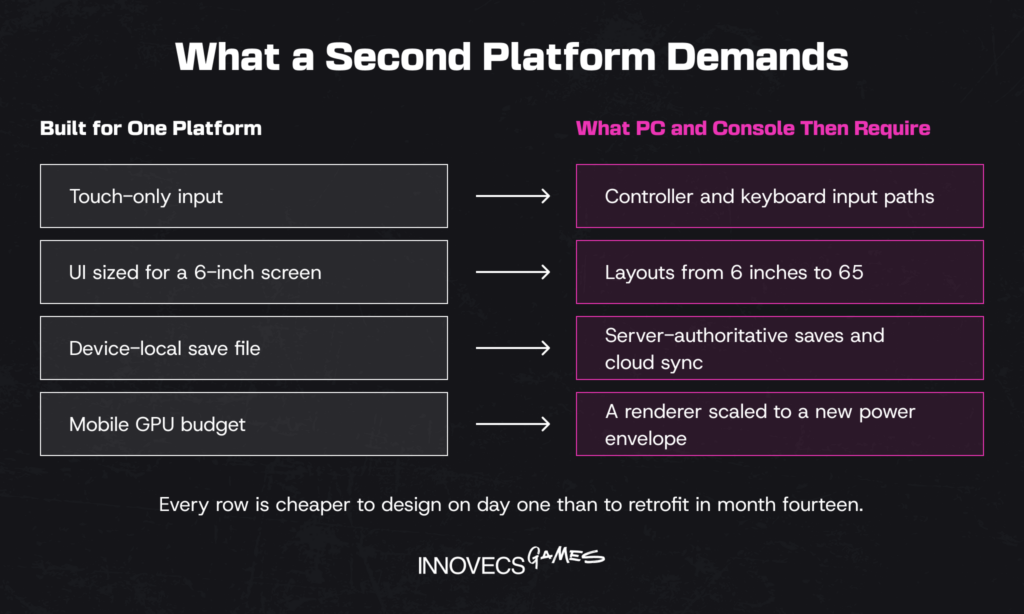
The expensive version of this decision is the one made backwards. A team builds for mobile with a mobile-shaped architecture. The game does well. Then someone asks about a PC release. Now the input system assumes touch, the UI assumes a 6-inch screen, the save system assumes a local file, and the render path assumes a mobile GPU budget. None of it is unfixable, and all of it is cheaper on day one than it is in month fourteen. That assumption has ruined more launch quarters than any bug.
Timing is the part nobody controls. InnerSloth put Among Us on mobile and PC in 2018, then watched it go viral two years later. The Switch version landed in December 2020, with PlayStation and Xbox arriving through 2021. Demand showed up first and the platforms caught up afterwards. A three-person team absorbs that. A forty-person studio on a publisher milestone does not.
The counterargument deserves a hearing. Building for three platforms from the start slows your first release, and a game that never ships is worth nothing on any device. That’s a real trade-off, and we’ll come back to it in the cost section. Weighing whether to carry the work internally or bring in an external team? Our game development outsourcing page lays out the engagement models.
What You Gain from Building Cross-Platform
The benefits get listed everywhere and quantified almost nowhere. Two of the three below hold up under scrutiny, while the third is weaker than the industry pretends, and that difference matters when you’re defending a budget line. There’s a useful gap in Unity’s report between what studios do and what they say works. Online multiplayer is supported by 83% of them. Of those, 55% focus on small sessions of two to nine players, and 74% of small teams say they’re targeting new platforms.
Why Does a Single Codebase Make Updates Faster?
One codebase means one bug fix, one build pipeline, and one regression suite instead of three of each. The saving isn’t in writing the feature, which costs about the same either way. It shows up in the tail. Every live-ops update, every seasonal event, every emergency patch after a bad launch weekend. Developers working in Unity now finish a median project in 21 hours, down from 91 in January 2022, a 77% drop the company reported at the end of 2025. Read that as tooling and iteration speed rather than as proof about cross-platform work. Then be careful with the phrase itself. “Single codebase” turns aspirational the moment console code arrives. On our own builds the shared core lands somewhere between 85% and 95%. What’s left is platform-conditional, and that is not the same animal at all.
How Does Cross-Platform Play Improve Player Retention and Matchmaking?
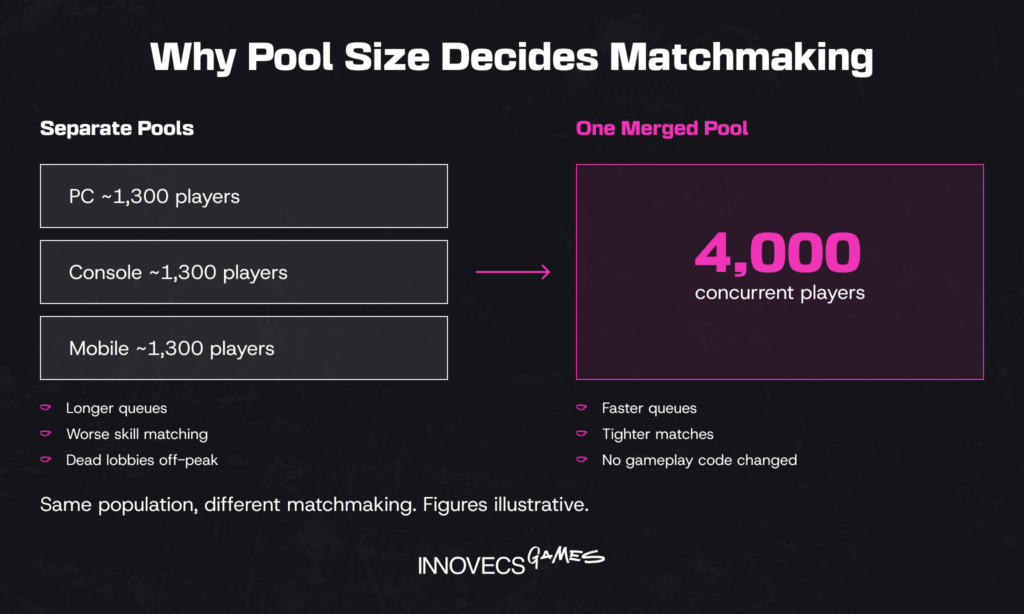
Multiplayer matchmaking quality is a function of pool size, and pool size is the thing cross-play fixes directly. Take a shooter with 4,000 concurrent players split across three platforms. That’s three separate games of roughly 1,300 players each, which means longer queues, worse skill matching, and dead lobbies off-peak. Merge the pools and the same population gives you faster queues and tighter matches. Not one line of gameplay code changes. Epic has run the public demonstration of this for years. Fortnite and Rocket League drop console and PC players into shared queues, and neither one markets the fact. Cross-play stopped being a feature and became furniture. Social retention follows the same mechanism. People stay in a game where their existing friends already are. Recruiting new ones is work, and most players won’t do it. Which is why 72% of studios prioritize cross-play, and why the 38% wrestling with device consistency still won’t switch it off.
Can Cross-Platform Release Really Increase Revenue?
Now the honest version, which is less fun. Everyone quotes a 20% to 40% revenue lift. Chase it back and you land on a VentureBeat webinar from 2021, and nobody has re-run the study since. Its companion stat is in the same shape. Unity found in 2021 that 87% of multiplayer gamers wanted more cross-platform titles, and the page that hosted that number has since gone dark. We’re not going to reprint either one as a 2026 finding. What’s defensible is narrower and still worth the money. A second platform gives you a second discovery surface and a second monetization environment, and the same player can be sold to on whichever device they happen to be holding. Revenue gains are real, uneven, and genre-dependent. A live-service title with cross-progression gets far more from it than a single-player narrative game, where a PC release is closer to a straight audience expansion.
Thinking About Taking Your Game Cross-Platform?
Most of the money in a multi-platform release is committed in the first month, when the architecture decisions get made. Weighing a port, a simultaneous launch, or a full cross-platform game development program across mobile, PC, and console? Tell us the target platforms and the date you need to hit. We’ll come back with a team shape and a schedule we actually believe.
How to Approach Cross-Platform Development, Step by Step
None of this framework is new, and it hasn’t changed much in a decade. Learn the performance you actually need. Find where the build will break before it breaks. Then order the optimization work so the expensive fixes land while they’re still cheap. What has changed is the number of targets you’re doing it against. Three steps. Each one lands on a milestone, and each one produces something a producer can hold you to.
- Set the target and map what you can’t share. Before the first sprint. Produces a hard performance budget, plus a list of platform-specific systems with a named owner against each.
- Profile per platform and fix in cost order. From first playable, on a repeating schedule. Produces separate profiling datasets per target rather than one blended number. Also the first honest answer to which platform is setting your ceiling.
- Prove it in QA, then clear compliance. Alpha through submission. Produces automated regression on real hardware on every build, plus a certification calendar with slack in it.
Miss the milestone on step one and the other two get more expensive, which is the whole reason for the ordering. This sequence assumes a project committed to at least three platforms, and it slots into the wider game development process rather than replacing it.
What Should You Analyze Before Starting Development?
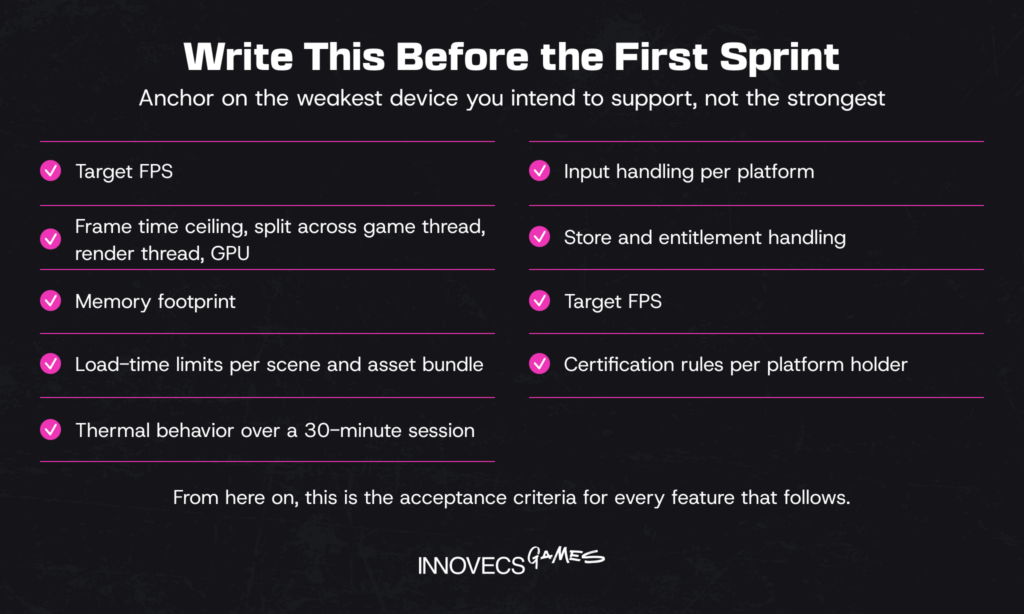
Anchor on the weakest device you intend to support. Instinct says anchor on the strongest, and that instinct costs money later. Against that weakest device, write a hard performance budget. Target FPS and frame time ceiling, memory footprint, load-time limits, and how the thing behaves thermally after half an hour. From then on, it’s the acceptance criteria for every feature that follows. Then map the work you can’t share, which usually comes down to input, store and entitlement handling, save and cloud-sync behavior, and the cert rules that each platform holder applies. Among the executives GDC surveyed, 73% still put PC in their top three next-gen priorities. So the practical question is which console or handheld joins it, and how early. Settle that before the first sprint. Your renderer follows from it. So do your asset budgets, and so does the middleware you end up licensing.
How Do You Handle Platform-Specific Performance Bottlenecks?
Profile per platform, on hardware, on a schedule. Treat the results as separate datasets, never as one blended number. A build that runs at 60 FPS on a development PC can be GPU-bound on Switch 2. The same build can be CPU-bound on a mid-range Android device and thermally throttled on a Steam Deck after twenty minutes. Each of those needs a different fix. We tend to reach for the same levers in the same order. Draw call batching and instancing come first. Then LOD and texture streaming tuned per platform, shader variant stripping, a physics tick decoupled from render rate, and asset bundles sized for the slowest storage in your matrix. Keep a per-platform scalability config from the start, because bolting one on later means auditing every system that reads it.
What Does a Solid Cross-Platform QA Process Look Like?
The split is easy to describe and hard to hold. Machines take the repetitive layer of QA testing; people take everything machines are bad at. On the machine side sit smoke tests, build validation, and performance regression, running on every target platform on every build. Real devices in a device farm, please, not emulators. Human testers then earn their cost somewhere else entirely. They belong on cross-play sessions between mismatched clients, on store and entitlement flows, on cert checklists, and on the exploratory passes that turn up bugs nobody thought to write a test for. Pair that with a code review rule. Any platform-conditional branch gets a second pair of eyes, because those branches are where builds start to diverge. Budget certification QA separately and early, because platform holders reject builds for reasons that have nothing to do with whether your game is fun.
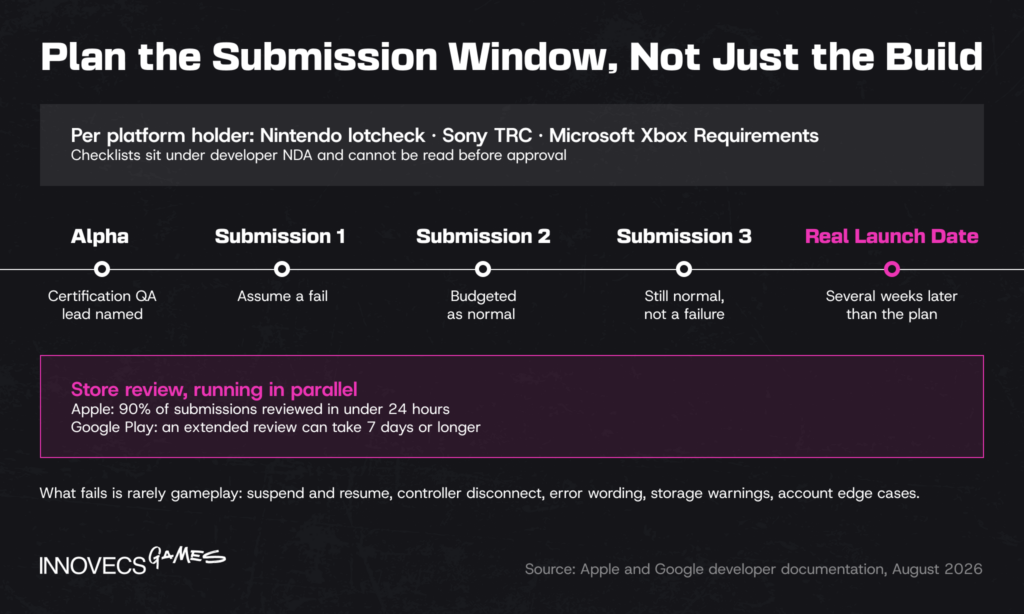
That’s the schedule risk teams underestimate most, so it’s worth being specific. Each platform holder runs its own compliance regime with its own checklist. Nintendo calls the process lotcheck, Sony works from a Technical Requirements Checklist, and Microsoft from its Xbox Requirements. Those checklists sit behind developer NDAs, so you can’t read them until you’re an approved developer, and you can’t plan properly against them before that. There’s no clever way around this one. What you can do is assume you won’t pass on the first attempt. Plan for two submission cycles per console platform, treat a third as normal rather than as a failure, and put a named owner on compliance from the start instead of handing it to whoever has capacity in the final month. What fails is rarely gameplay: suspend and resume behavior, controller disconnect handling, error message wording, storage warnings, account edge cases. Store submissions run faster but still need a slot in the plan. Apple clears 90% of submissions inside 24 hours, by its own account. Google is blunter about the tail: an extended review can run 7 days or longer. Line those up against a console cert window and you have your real launch date, which is usually several weeks later than the one on the plan.
What Challenges Come with Cross-Platform Development
Two categories of problem dominate. The first is performance divergence, where the same build behaves differently across your device matrix. The second is the class of bugs that only appear when two different clients talk to each other. Neither category is exotic, and neither shows up on the platform you develop on, which is why both survive to the end of the schedule.
How Do You Prevent FPS and Load-Time Issues Across Devices?
Prevention is a budgeting exercise done at the start, not a heroic optimization sprint at the end. Set the frame budget in milliseconds rather than FPS, then split it between game thread, render thread, and GPU so you know which one you’re overspending. Load times want the same treatment, instrumented per scene and per asset bundle, with a ceiling that fails the build when exceeded. Load-time creep arrives one 200-millisecond asset at a time, and nobody notices until it’s eight seconds. Test on cold boot, then on a device that’s been running for half an hour. Thermal throttling on handhelds and phones gives you a completely different profile from the one in your morning benchmark.
What Are the Most Common Cross-Platform Bugs to Watch For?
The recurring offenders, roughly in order of how much time they cost us:
- Infinite or runaway actor spawns that a fast PC absorbs and a mobile device does not, surfacing as a freeze rather than a crash.
- Floating-point and physics divergence between clients, which quietly desyncs a networked match until two players see different worlds.
- Input assumptions baked into gameplay logic, where a touch-designed ability becomes unusable or overpowered with a controller.
- Save and cloud-sync conflicts when a player moves between devices mid-session, usually resolved by whichever save wrote last, which is rarely the one they wanted.
- Store and entitlement mismatches, where a purchase on one platform doesn’t appear on another because the account linkage was an afterthought.
- Memory ceilings hit only on the lowest-spec target, usually from uncompressed textures or audio that nobody re-checked after the art pass.
Most of these are cheap to catch in a device farm and painful to catch in a store review. The ordering above is ours, drawn from projects where we arrived mid-production to stabilize somebody else’s build, so treat it as a starting checklist rather than a universal ranking.
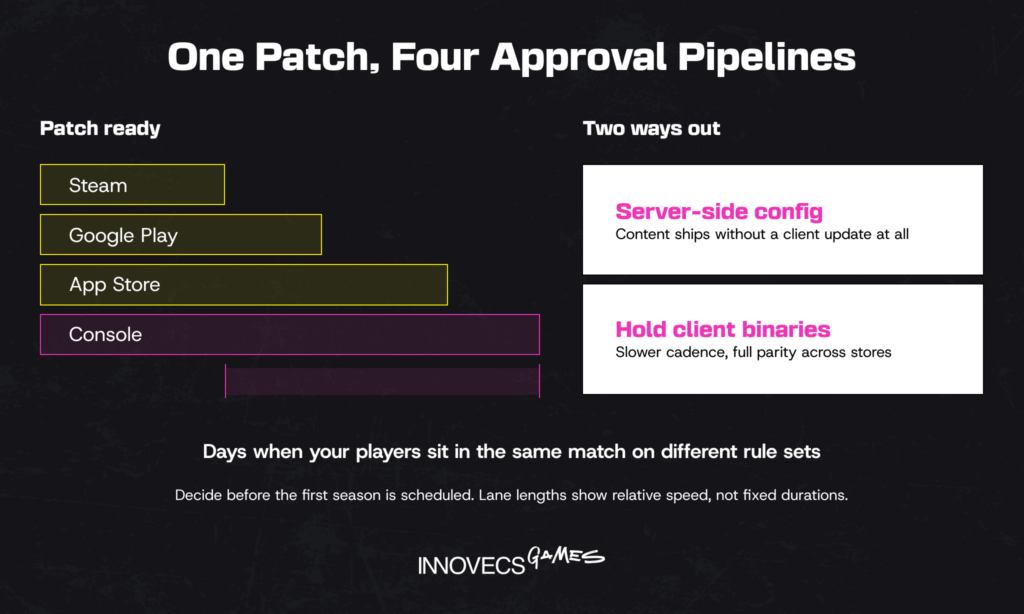
One challenge outlives the launch, and live-service teams meet it every patch. Once a title runs on four storefronts, every update has to clear four approval pipelines that move at different speeds. The mobile builds go live while the console builds are still in review. Nobody minds for a cosmetic patch. A balance change is different, because for a few days your players are sitting in the same match on two different rule sets. Teams that handle this well decouple two things. They ship content through a server-side config or a remote asset bundle that needs no client update. And they hold client binaries until every platform has cleared, taking a slower cadence in exchange for parity. Teams that handle it badly discover the constraint during their first live event. Whichever route you pick, decide before the first season is scheduled, since retrofitting server-driven config into a client-authoritative economy is close to a rewrite.
Which Game Engines Support Cross-Platform Development Best
Engine choice moved more between 2024 and 2026 than in the previous five years combined. Asked which engine they treat as primary, 42% of GDC’s 2026 respondents named Unreal, against 30% for Unity and 19% on proprietary tech. GDC headlined it as more developers using Unreal than Unity. The split by studio size matters more than that headline. Unreal is at 59% among AA studios and 47% at AAA, while 54% of developers at established indie studios are still on Unity.
One caution about that 42%, because two credible numbers point opposite ways. GDC asks which engine a developer names as their primary one. Video Game Insights counts what actually shipped, and its engines report put Unity at 51% of 2024 Steam releases against Unreal’s 28%. Both are true. Unreal has the mindshare and the high-budget projects while Unity has the volume, and if you’re choosing an engine on market share alone you’re reading the wrong column anyway. Licensing terms below come from each vendor’s own pricing page as of August 2026, and are worth re-checking before you sign anything.
| Engine | Strongest fit | Console support | Licensing in 2026 | Trade-off to weigh |
|---|---|---|---|---|
| Unity | Mobile-first and mid-scope multi-platform titles | Mature, all major platforms | Free under $200K revenue and funding; Pro $2,310/seat/yr | Broadest platform reach, weaker out-of-box high-end fidelity |
| Unreal Engine | High-fidelity PC and console builds | Mature, all major platforms | Free to $1M lifetime gross per product, then 5% royalty; Epic Games Store sales exempt | Heavier runtime and build sizes on mobile |
| Godot | 2D and smaller 3D projects, tooling-heavy teams | Via third-party porting partners | Free, MIT licence, no royalty | No first-party console export; you pay a porting house |
| GameMaker | 2D games with small teams | Enterprise tier only | Free non-commercial; one-time Professional licence; Enterprise subscription for console | Limited beyond 2D scope |
| CryEngine | Visually demanding PC and console | PC and major consoles | 5% royalty above the first $5,000 gross per game per year | Small talent pool, thinner documentation |
| LibGDX | Java teams wanting full code control | No first-party console path | Free, Apache 2.0 | You build the tooling yourself |
Read the trade-off column first. It’s the part people skip and then rediscover in month four, usually when a publisher asks about a console SKU. Cross-platform game development tools divide most sharply on that console column. Two of the six rows can’t reach a console without a third party, and a third gates it behind a paid tier. That one fact eliminates more candidates than any feature comparison.
Is Unity or Unreal Engine Better for a Cross-Platform Project?
Neither. The honest answer depends on where your fidelity ceiling sits. Unity is the pragmatic default when mobile is one of your primary targets. Its build pipeline, SDK handling, and asset workflows were shaped by a decade of mobile shipping, and the talent pool for gaming work at that scope is deep. Its licensing is settled now in a way it wasn’t two years ago. Unity canceled the Runtime Fee in September 2024, and what replaced it is a plain per-seat subscription: free under $200,000 in annual revenue and funding, then $2,310 per seat per year on Pro. Note that Havok Physics stops being included with Pro and Enterprise from Unity 6.3, which is the kind of detail that surfaces in a budget review at the worst possible moment. Middleware bundling changes more often than the engines do, so re-check what your licence includes before you commit a physics-heavy design to it.
Unreal earns its place where rendering quality is the product. Building a console-and-PC title with a high visual bar? Unreal’s renderer, Nanite and Lumen, and its console tooling put you further ahead on day one. The 42% primary-engine share reflects where high-end production has gone. The cost sits at the other end of the matrix: heavier builds and more work to hit mobile performance budgets. Whichever you pick, the cross-platform game development tools that decide your schedule are usually the ones around the engine, not inside it. That means your build automation, your device farm, and your profiling setup. For a longer breakdown, we’ve written a separate piece on choosing between Unity and Unreal.
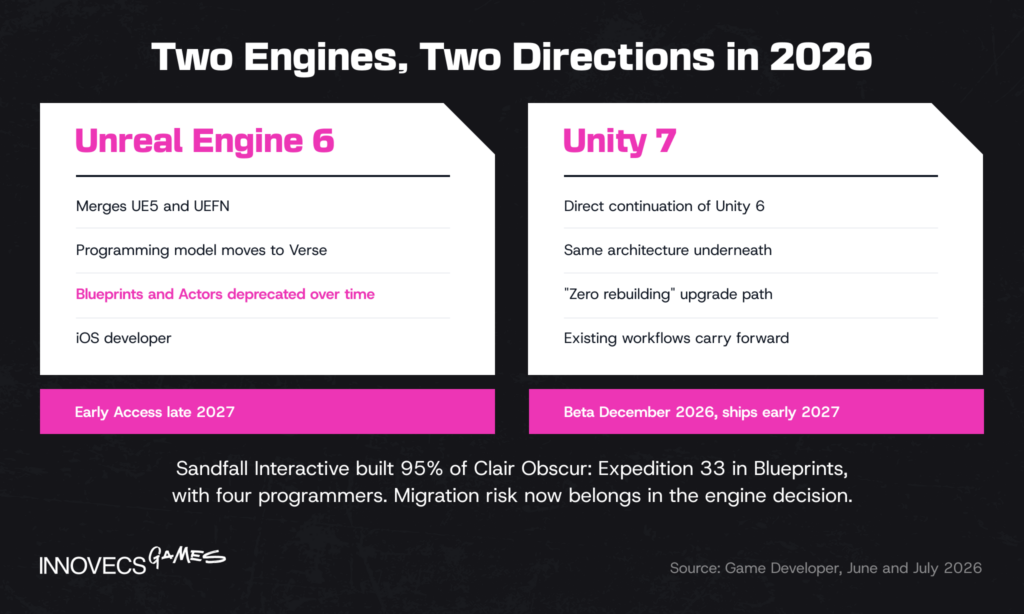
There’s a 2026 wrinkle that a three-year project has to price in. Both engines announced their next major versions this summer, and they’re heading in opposite directions. Epic detailed Unreal Engine 6 at Unreal Fest in June. It merges UE5 with Unreal Engine for Fortnite, moves the programming model from C++ to Verse, and will in time deprecate Blueprints and the Actors system. Conversion tools are promised, and Early Access lands in late 2027. Sit with that last clause for a second. Sandfall Interactive shipped Clair Obscur: Expedition 33 with four programmers, and told GDC in March that 95% of the game was built in Blueprints on a deliberately vanilla engine. Every studio that took the same route now holds a codebase written in a system with an expiry date attached. Unity went the other way a month later, pitching Unity 7 as a direct continuation of the Unity 6 architecture, with a “zero rebuilding” upgrade path, in early beta from December 2026 and shipping in early 2027. If your build will still be in production in 2028, that gap in migration risk belongs in the engine decision alongside the rendering comparison.
What Other Engines Are Worth Considering in 2026?
Godot is the one that changed. The Godot Foundation’s own usage data, published in May 2026, shows exponential growth in Steam releases built on the engine. Developers at newer indie studios put their Godot adoption at 11% in the GDC survey. It’s free under an MIT licence with no royalty, which is a real advantage for a small team, and it has no first-party console export at all, which means a paid porting partner in your budget the moment consoles appear on the roadmap. That’s the trade, stated plainly.
GameMaker still suits small 2D teams that value speed of iteration over engine flexibility. CryEngine delivers visual quality and comes with a hiring problem, since the talent pool is a fraction of Unity’s or Unreal’s. LibGDX gives Java teams complete control and expects them to build their own tooling in exchange. In cross-platform mobile game development, where the phone is the primary target and PC arrives later, engine choice matters less than pipeline discipline. Our mobile game development services page covers how we structure that work.
How Much Does It Cost to Build a Cross-Platform Game?
If you’re here for a single number, there isn’t one. Anyone who hands you one hasn’t asked what you’re building yet. Development cost questions get answered with a range and a set of multipliers. Platform count, project scope, engagement model, and region each move the total by more than the game’s genre does. The hourly rate figures below come from current contracts, and the project ranges count what a platform actually costs once certification, QA, and store integration are in the number.
| Region | Mid-level engineer | Senior engineer | Typical use in a cross-platform team |
|---|---|---|---|
| North America | $80–120/hr | $110–160/hr | Creative direction, publisher-facing roles |
| Western Europe | $65–95/hr | $90–130/hr | Technical leadership, on-site coordination |
| Eastern Europe | $35–55/hr | $50–75/hr | Core engineering, technical art, QA automation |
| Latin America | $35–55/hr | $50–70/hr | Time-zone overlap with US publishers |
| South and Southeast Asia | $20–35/hr | $30–50/hr | Cheapest option, highest management overhead |
Source: Innovecs Games delivery data, projects staffed 2023 to 2026.
The last row is the one that gets misread most often. It’s the lowest rate on the table and it carries the highest coordination cost, and on a multi-platform build with tight cert deadlines that overhead can eat the whole saving.
| Scope | Indicative cost | Timeline | What moves the number |
|---|---|---|---|
| Port of a shipped mobile title to PC and Steam | $60K–150K | 3–5 months | Input rework, UI rebuild, store integration |
| Cross-platform mobile game development, mid-scope, mobile plus PC | $250K–600K | 8–14 months | Content volume, art fidelity, live-ops scope |
| Adding one console family (Switch 2, PlayStation, Xbox) | $40K–120K per platform | 2–4 months | Certification passes, platform SDK work, performance rework |
| Cross-play multiplayer backend and cross-progression | $80K–250K | 3–6 months | Account linking, entitlement sync, anti-cheat parity |
Source: Innovecs Games delivery data, projects staffed 2023 to 2026. Ranges assume a blended Eastern European team; verify against current rate cards before quoting.
The roles that make a multi-platform release work are not the ones a single-platform plan budgets for.
| Role | When it joins | Why a multi-platform project needs it |
|---|---|---|
| Platform engineer | Pre-production, one per console family | Owns SDK integration, store and entitlement code, and the cert checklist for that platform |
| Build and release engineer | Pre-production | Multi-target build automation, device farm, per-platform artifacts. The first role teams cut and the first one they regret |
| Technical artist | Pre-production | Per-platform asset budgets, LOD and shader variants, keeping the art bar honest on the weakest device |
| Backend engineer | Before first playable, if cross-play is in scope | Account linking, cross-progression, matchmaking, entitlement sync across stores |
| QA automation engineer | First playable | Regression suites running on real hardware on every build |
| Certification QA lead | Alpha at the latest | Owns compliance per platform holder and the submission calendar |
| Live-ops engineer | Post-launch | Patch parity across storefronts, server-side config, staged rollouts |
Source: Innovecs Games delivery data, projects staffed 2023 to 2026.
Two rows draw pushback, the build engineer and the certification QA lead, and the argument is always that somebody already on the team can absorb the work. Sometimes true at two platforms. At four it isn’t, and the failure shows up as a slipped submission rather than as a missing person.
Three multipliers sit on top of these numbers. Platform count is not linear, since the second platform costs more than the third once your pipeline is genuinely multi-target. Each extra target also buys reach at the expense of time-to-market. Engagement model matters too. A dedicated team costs more per month than contractors and less per shipped milestone, because nobody spends the first three weeks of each sprint re-explaining the architecture. Engine licensing is a rounding error next to headcount, though a $2,310 Unity Pro seat across a 25-person team is still a line somebody has to approve. Studios extending an internal team rather than replacing it usually land in a game co-development services arrangement, which is where most of our multi-platform work sits.
How AI Is Changing Cross-Platform Development
AI adoption across the gaming industry is real, uneven, and far less popular with developers than the tooling vendors suggest. Roughly one in three professionals use generative AI at work, 36% in GDC’s 2026 survey. Inside game studios that drops to 30%. At publishers and marketing firms it climbs to 58%. Then the other half of the picture. More than half the profession, 52%, thinks generative AI is doing the industry harm, up from 30% a year earlier, and visual and technical artists were the most opposed at 64%.
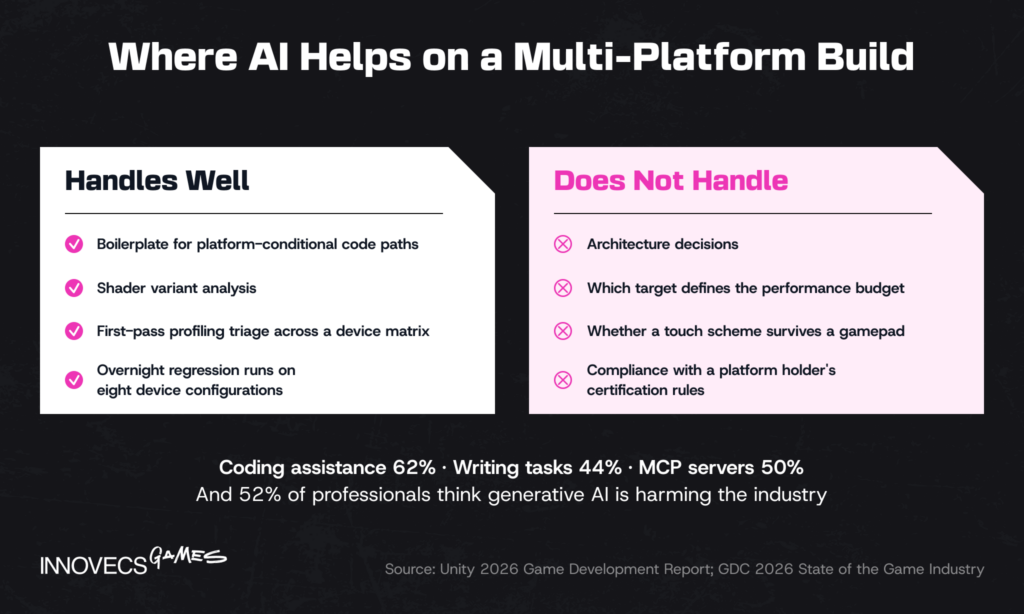
Where it clearly helps is the repetitive middle of the pipeline. Developers using back-end AI tools cluster in two places. Coding assistance takes 62% of them and writing tasks 44%, with 73% naming efficiency as the payoff, in Unity’s 2026 report. On a multi-platform build, that means boilerplate for platform-conditional code paths, shader variant analysis, first-pass profiling triage, and the tedium of keeping build configs in sync. Half of Unity’s respondents now run MCP servers, most often to connect tools directly to the engine and editor. That’s a quieter change than image generation and a more useful one.
QA is where the automation case is strongest. Square Enix said in its November 2025 business plan update that it intends to automate 70% of QA and debugging with generative AI by the end of 2027, working with researchers from the University of Tokyo. For cross-platform testing, agents that drive a build through a regression suite on eight device configs overnight solve what was always a headcount problem.
Now the limits. AI does not port a game. It generates plausible platform-conditional code that a senior engineer then has to verify against a platform holder’s rules. The failure mode is code that compiles, runs, and violates a cert rule you’ll find at submission. It doesn’t make architecture decisions. It doesn’t know which of your three targets should define the performance budget. It can’t tell you the touch control scheme won’t survive contact with a gamepad. Our position, for what it’s worth: the price of a first draft has gone to nearly zero and the price of judgment hasn’t moved at all. When hiring for 2026, test whether a candidate can tell when the tool is confidently wrong, which matters a great deal more than whether they can prompt it.
How Innovecs Games Helps You Ship Cross-Platform Games
We’ve spent more than a decade building and shipping multi-platform titles, and most of that work looks like joining a studio’s existing production rather than taking a project away from it. As a cross-platform game development company, we embed engineers, technical artists, and QA specialists into your pipeline, on your tools, against your milestone schedule. We share responsibility for delivery rather than working to a statement of work and a handover.
The disciplines that matter for multi-platform releases sit in one place. Engine work in Unity and Unreal. Technical art and performance optimization, cross-play and backend engineering, automated and certification QA, and live-ops support once the thing is out. Teams that need Unity depth can start with our Unity game development services. Teams extending an existing group can read how we structure making co-development work for your next game.
What we won’t do is tell you every platform is worth targeting. Part of the value of cross-platform game development services is an honest read on which platforms your title should skip, and we would much rather have that conversation in scoping than in month nine.
Stuck on a port, a certification pass, or a multiplayer build that behaves differently on every device? Send us the problem and the deadline. We’ll tell you what it takes to fix, and whether we’re the right team for it.
FAQ
What is cross-platform game development?
It’s the practice of building a game from a shared codebase and asset pipeline that targets several platforms, such as PC, console, and mobile. You don’t ship on one and port afterwards. The shared core covers gameplay, systems, and most content, while input handling, store integration, and cert stay platform-specific. On the projects we’ve delivered, the shared core accounts for 85% to 95% of the codebase. The decision is architectural and belongs at the start, since retrofitting it later is what makes ports expensive.
What’s the typical cost of building a cross-platform game?
Ranges vary enormously with scope. A port of an existing mobile title to PC runs $60,000 to $150,000 over three to five months. A mid-scope title built for mobile and PC from scratch lands between $250,000 and $600,000 across eight to fourteen months. Each console family you add costs a further $40,000 to $120,000, mostly in cert and platform SDK work. Regional rates move the total more than anything else. Mid-level engineers run $35 to $55 per hour in Eastern Europe, against $80 to $120 in North America.
Which game engine is best for cross-platform development?
There’s no universal answer, though the practical split is clear enough. Unity suits projects where mobile is a primary target, with the deepest platform reach and settled per-seat licensing. Unreal is stronger when rendering fidelity on PC and console defines the product, and GDC’s 2026 survey put it ahead as the primary engine for 42% of developers. Godot has grown fast and costs nothing, but it has no first-party console export. One more thing to weigh in 2026: Unreal Engine 6 will change the programming model and eventually retire Blueprints, while Unity 7 promises an upgrade path that needs no rebuild.
What are the biggest technical challenges in cross-platform development?
Performance divergence heads the list. A build that holds 60 FPS on a development PC can be GPU-bound on one console, CPU-bound on a mid-range phone, and thermally throttled on a handheld after twenty minutes. Next come the bugs that only appear when two clients interact: physics desyncs, save conflicts across devices, and entitlement mismatches between stores. Ask studios to name their primary obstacle and 38% land on a consistent experience across devices, per Unity’s 2026 report. Same problem, stated one level up.
How long does it take to build a cross-platform game?
Eight to fourteen months is realistic for a mid-scope title targeting mobile and PC, assuming a team that’s shipped together before. Add two to four months per console family. Most of that goes to certification and platform-specific performance work rather than new features. Ports of existing titles are faster, usually three to five months. The schedule risk isn’t in development, it’s in submission: a rejected cert build costs weeks, and platform holders don’t queue you back at the front.
Does cross-platform development really increase revenue?
Usually yes, though the widely quoted 20% to 40% figure comes from a 2021 study nobody has repeated with current data. Treat it with caution. What’s defensible is that a second platform gives you a second discovery surface and a second monetization environment. Cross-progression then lets you sell to the same player on whichever device they’re holding. The size of the gain depends heavily on genre. Live-service multiplayer titles benefit most, since pool size compounds, while single-player narrative games see a straight audience expansion instead.
Should I build for one platform first or go cross-platform from the start?
Building for one platform ships faster, and a game that never launches earns nothing anywhere. Most studios land on a compromise: build for one platform, architect for several. Keep input abstracted, keep saves server-authoritative, set the performance budget against the weakest device you might eventually support, and keep platform assumptions out of gameplay code entirely. That costs a little up front and saves a great deal if the second platform arrives. Committing fully to three simultaneous launches only makes sense when the game is multiplayer and pool size is central to the design.
How is cross-platform play different from cross-platform development?
Cross-platform development describes how the game is built, from a shared codebase targeting several platforms. Cross-platform play, written variously as cross-play or crossplay, describes what players can do: join the same match from different devices. You can have one without the other. Plenty of games are built cross-platform and keep their player bases separate, usually for competitive balance between input methods. A few games with platform-specific builds still support cross-play through a common backend. Cross-play adds account linking, matchmaking, and anti-cheat parity on top of the development effort.
How is AI changing cross-platform game development?
The gains so far sit in the repetitive middle of the pipeline rather than in creative work. Unity’s 2026 report found coding assistance at 62% and writing tasks at 44% among developers using back-end AI tools, with half now running MCP servers. On multi-platform builds, that usually means boilerplate for conditional code paths, profiling triage across a device matrix, and automated regression runs. Sentiment is another matter. More than half the profession now thinks generative AI is doing the industry harm. GDC put that at 52%, up from 30% the year before.
Can AI handle cross-platform porting and optimization on its own?
No, and it isn’t close. AI tools generate plausible platform-conditional code, but plausible isn’t the standard a platform holder applies at submission. A build that compiles cleanly can still violate a cert requirement you won’t find until the rejection notice arrives. Optimization decisions depend on judgment about what the game can afford to lose visually, which is a design call rather than a technical one. Throughput is where AI genuinely helps. Overnight regression runs, first-pass profiling analysis, and the boilerplate that used to eat a junior engineer’s week. A senior engineer still verifies the output.
Ready to Build Your Cross-Platform Game? Let’s Talk
Tell us your target platforms, your engine, and the date you need to hit. We’ll come back with a team composition, a schedule, and an honest view of which platforms are worth the certification effort. Cross-platform game development works best when that conversation happens before the architecture is locked.