Console Game Development Cost in 2027: Budgets for PS5, Xbox, and Switch Explained
For studio leads and producers: how to put a realistic number on a console release, which expenses exist only on console, and where outsourcing or co-development actually saves money.
In August 2024, Black Myth: Wukong sold 10 million copies in three days on PC and PS5. Xbox owners? They waited exactly a year. Game Science’s founder Feng Ji blamed the Series S: fitting the game into 10GB of shared memory, he said, was “really impossible” without years of optimization experience. A studio with one of the biggest hits of the decade still needed twelve months for one more console.
Most studios meet that wall with less money, and that’s usually when console game development cost gets its first honest look. Your PC build holds 60 fps on every machine in the office. Then the deal memo shows up asking for PlayStation 5, Xbox Series X|S and Nintendo Switch 2, all in one launch window, and the budget grows lines nobody priced: dev kits, three certification calendars, a second Xbox with 6GB less memory, and a handheld running the game off a battery. The engineering itself is mostly familiar. What surrounds it isn’t, and platform holders keep most of their terms under NDA, so real numbers rarely turn up in public.
This article puts real numbers on console game development, as plainly as we can manage: budget ranges by scope and platform, the share each production stage takes, and rates by role and region. You’ll also find a line-by-line estimate for a mid-size game on two consoles, what ten well-known console games actually cost, and a free calculator for your own numbers. Short on time? Read the console-only expenses. That’s where plans built on PC habits usually come apart, and where a budget review spends most of its questions.
How Much Does It Cost to Make a Console Game?
A small console game made by a paid team usually lands somewhere between $150,000 and $3 million in 2026. AA projects run from $5 million to $50 million. AAA starts near $80 million and often clears $200 million, and that’s before anyone spends a dollar on marketing. Taking a finished PC game to one console is a different purchase. In the ports we’ve scoped, it lands between $40,000 and $250,000 per platform, depending on how far the hardware drops.
Those ranges sit closer to PC numbers than most people expect. Payroll is still most of any budget. What pushes overall video game development cost higher on console is a set of lines that exist only because a platform holder stands between you and the player:
- Fixed hardware targets. The game has to hold its frame rate and memory budget on the weakest model of each console, with no settings menu to hide behind.
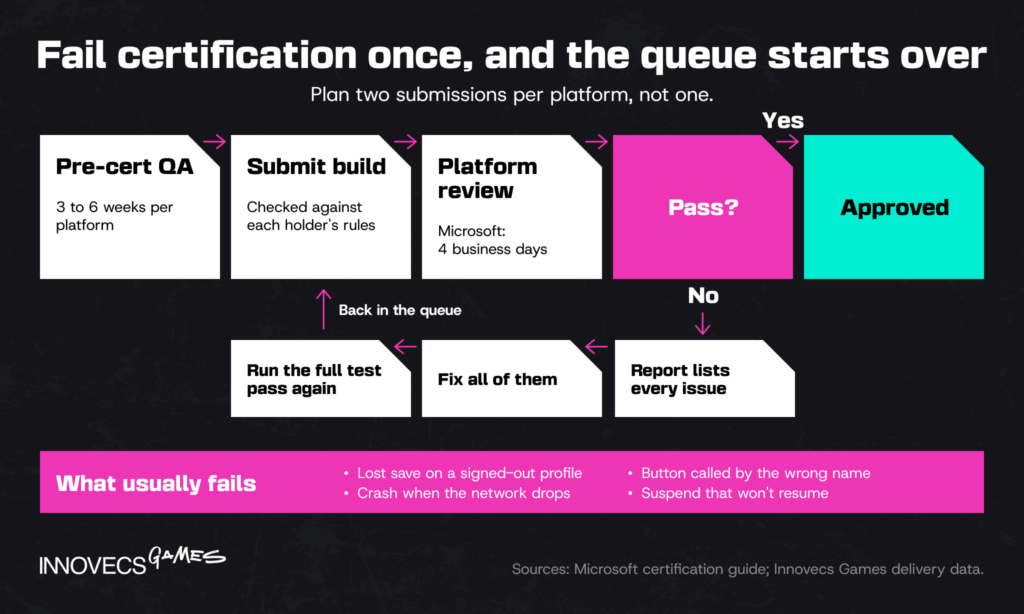
- Certification. Each platform tests your build against its own requirements list, and a failed submission means fixing everything on the report and going back into the queue.
- Dev kits and developer programs. The hardware isn’t sold in shops, access starts with an application, and approval isn’t instant.
- Platform rules. Trophies and achievements, save data, account switching, suspend and resume, store assets and age ratings all have to follow each holder’s rules, platform by platform.
None of these is enormous alone. Together they add up, and in the projects we’ve budgeted they come to roughly 10% to 20% on top of what the same game would cost on PC only, with more on a team’s first console project, when every requirement is being read for the first time. The good news about fixed hardware is that once a build runs well on the kit, it runs well on every console of that model. The bad news is the same sentence, read from the other side. For the platform-neutral picture, our guide on how much it costs to make a video game compares PC, mobile and console side by side.
Console Game Development Cost by Project Scope
The game’s ambition sets its tier, and the tier sets how much console work comes with it. A small team usually ships digital-only on one or two consoles; an AAA team ships on every major platform on the same day and pays for every SKU it adds.
| Scope tier | Typical budget | Team size | Timeline | What fits the tier |
|---|---|---|---|---|
| Small and indie | $150,000 to $3 million | 3 to 15 people | 12 to 30 months | 2D or stylized 3D, one or two consoles plus PC, digital release |
| AA and mid-size | $5 million to $50 million | 25 to 150 people | 2 to 4 years | 3D action, RPG or co-op on PS5, Xbox Series X|S and PC, Switch 2 often later |
| AAA | $80 million to $300 million+ | 200 to 1,000+ people | 3 to 6 years | Open worlds, cinematic action, live service, day one on every major platform |
| Port of an existing game | $40,000 to $250,000 per platform | 4 to 15 people | 2 to 8 months | A finished game moving to new console hardware |
The gap between the first two rows isn’t a typo. Projects that land between $3 million and $5 million are usually indie games that picked up a console deal halfway through production. In our experience they behave like AA on the schedule and still get paid for like indie.
Small and Indie Titles
At this size, console costs are paid in time. Digital releases can be age-rated for free through IARC, and Sony and Microsoft both run programs that put kits in the hands of new developers. What it really costs a small team is weeks, spent on compliance when they could have gone into content. Billy Basso worked on Animal Well for about seven years, mostly by himself. It came out on PS5, Switch and PC in May 2024, and Xbox got it five months after that. That’s a typical indie shape, one person or a handful, with consoles staggered to match whatever the team can certify at once. Our advice for this tier: pick one console besides PC for launch and treat the second as a funded follow-up, not a promise. Platform promises are free to make in a pitch deck and surprisingly expensive to keep.
AA and Mid-Size Games
Here console decisions start moving millions. The clearest public example is still Ninja Theory’s Hellblade: Senua’s Sacrifice. About 20 people spent three years on it. It launched on PS4 and PC in 2017 and sold half a million copies in its first three months. The studio said that roughly $13 million in revenue put the game in profit. That team cost less per head than the same 20 people would today, and it shipped on one console at launch. A modern AA plan with three consoles, a Series S target and a handheld mode usually needs two to three times that headcount for the same length of game. We’d still call Hellblade the most useful budget story in console history, mainly because the studio told it in public, which almost nobody does.
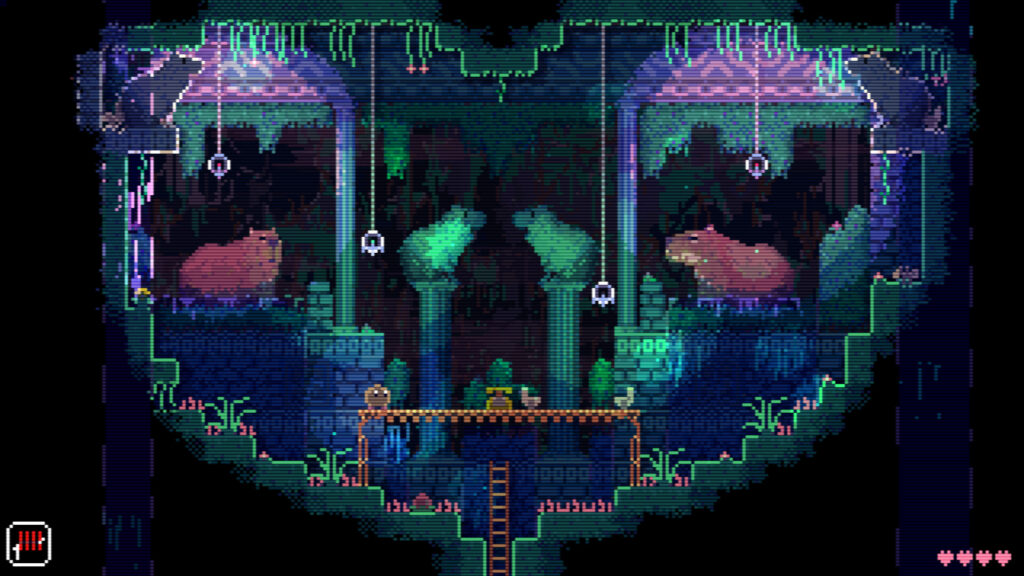
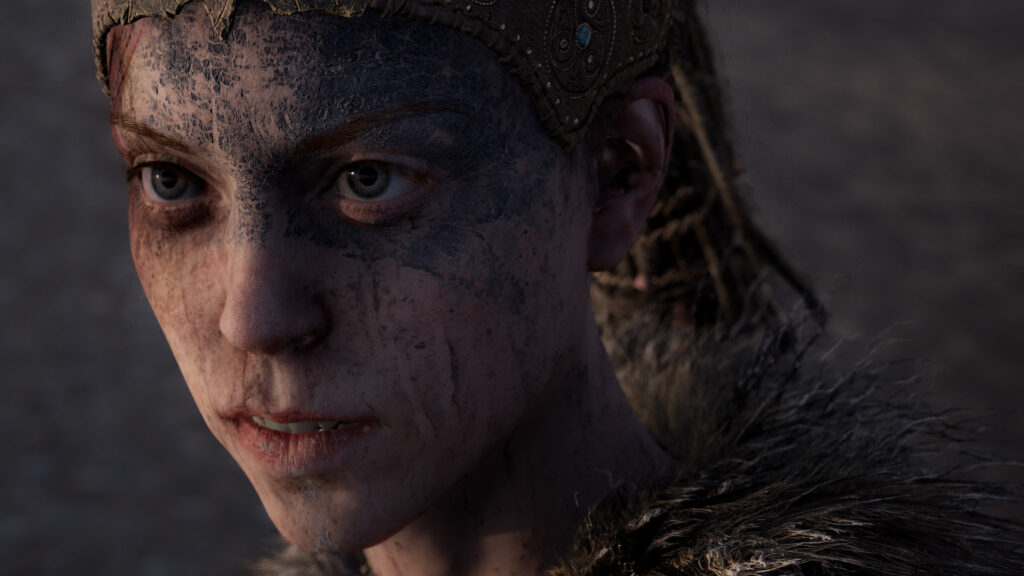
A solo developer’s seven-year project next to a 20-person AA game: two very different console budgets.
AAA Productions
AAA budgets begin around $80 million and run past $300 million at the top, with teams of several hundred working three to six years. Our breakdown of AAA game development cost covers what drives numbers that large. The useful counterexample comes from Sony itself. Team Asobi built Astro Bot with around 60 developers in roughly three years, and its director later said many of its choices, from team size to having no text or voice, “could be labelled double-A”. It won Game of the Year anyway. A publisher’s logo doesn’t set the budget; scope does.
Ports of Existing Games
A port buys the console-only work without the rest of the game, which makes it the cleanest way to see what consoles really add. In our projects, game porting cost from PC runs $40,000 to $150,000 for PS5 or Xbox Series X|S. Switch 2 takes $60,000 to $180,000, and the original Switch $90,000 to $250,000. Every extra platform adds a third to half of the first one’s budget, and our guide to pricing a port breaks the work down line by line. One honest caveat: a port quote is only as good as the audit behind it, and a game with no memory budget can double a number that looked safe.
What Well-Known Console Games Cost
Publishers almost never share budgets. The public numbers we have came out of court filings, leaks, tax authorities and the odd talkative founder. Here are ten console games whose figures made it out, cheapest first. Check the third column before you compare rows, because some numbers cover development only and others fold in marketing or a whole studio.
| Game | Release and platforms | Reported budget | What the figure covers |
|---|---|---|---|
| Clair Obscur: Expedition 33 | 2025, PS5, Xbox Series X|S, PC | Under $10 million | Development, per The New York Times; core team of about 30 |
| Hellblade: Senua’s Sacrifice | 2017, PS4 and PC | Not disclosed; in profit at about $13 million revenue | About 20 developers over three years, self-published |
| Kingdom Come: Deliverance II | 2025, PS5, Xbox Series X|S, PC | About $41 million | Development, per co-founder Daniel Vávra |
| Black Myth: Wukong | 2024, PS5 and PC | Over $42 million (300 million yuan) | Development, per Game Science; an investor cited $70 million |
| Alan Wake 2 | 2023, PS5, Xbox Series X|S, PC | About €70 million, of which €50 million development | Analysts’ estimate, development and marketing |
| Ratchet & Clank: Rift Apart | 2021, PS5 | $81 million | Total budget, leaked Insomniac documents |
| Marvel’s Spider-Man: Miles Morales | 2020, PS4 and PS5 | $156 million | Total budget, same leak |
| Horizon Forbidden West | 2022, PS4 and PS5 | $212 million | Development, Sony court filing |
| The Last of Us Part II | 2020, PS4 | $220 million | Development, same filing |
| Marvel’s Spider-Man 2 | 2023, PS5 | $315 million | Total budget, leaked Insomniac documents |
Source: public reporting linked in the first column. Figures are as reported and not adjusted for inflation or currency.
The bottom four are Sony first-party games, and they show the AAA band from the inside. The top five were made outside the US, in Europe and China. The three with disclosed figures above $10 million land between about $40 million and $80 million, which is the upper half of what this article calls AA. Ratchet & Clank is the instructive middle case. The same leak showed it at 2.2 million copies and still about $8 million short of its budget. So even an $81 million exclusive from a first-party studio can take years to earn back. If there’s a lesson for budget reviews, it’s to price the sales forecast as hard as the build.
How Console Budgets Grew From PS1 to PS5
Each new generation raised the bill, and the size of those jumps explains today’s ranges. The table mixes averages with top-end games, so treat it as a trend line, not a fair comparison.
| Console generation | Typical or reported budget | Source |
|---|---|---|
| PlayStation (1994 to 2000) | $800,000 to $1.7 million for an average game | Digital Trends, 2013 |
| PlayStation 2 | $5 million to $10 million for an average game | Same article |
| PlayStation 3 | $18.8 million to $28.2 million for an average game | Same article |
| PlayStation 4 | $212 million to $220 million at the top, for Horizon Forbidden West and The Last of Us Part II | Sony court filing |
| PlayStation 5 | $70 million and up as the new normal, per SEGA’s president; $315 million for Marvel’s Spider-Man 2, with $385 million planned for its sequel | GameDev Reports; leaked Insomniac documents |
Source: reporting linked in the table. Not adjusted for inflation.
An average PS3 game cost about what a mid-size AA console project costs today. The top of the market, meanwhile, has grown more than tenfold. That gap is the whole story of the AA tier: the middle of the market learned to ship big-looking games on PS3-era money, while the top kept climbing. Somewhere along the way, “average” stopped being a useful word in a console budget.
How Budgets Differ for PlayStation, Xbox, and Nintendo Switch
Scope sets how big the bill gets. The platform list decides which console-only lines it carries, and studios don’t weigh those platforms equally. In GDC’s 2026 State of the Game Industry survey, 80% of respondents were interested in PC, 40% each in PS5 and Steam Deck, 39% in Switch 2 and just 20% in Xbox. Interest and cost don’t line up. The platform with the least enthusiasm behind it is, in our projects, one of the more expensive to certify, because it brings two hardware profiles under one store. Liking a platform least and paying most to ship there is a deal nobody would sign on purpose, yet plenty of plans include it by default.
In console game development, the bill shifts between platforms for five reasons: hardware headroom, memory, the frame rate players expect, the developer program and the submission rules. Most fees, kit terms and certification timelines sit under NDA. Where a number below is public, it’s linked. Where it isn’t, we say so instead of guessing.
PlayStation 5
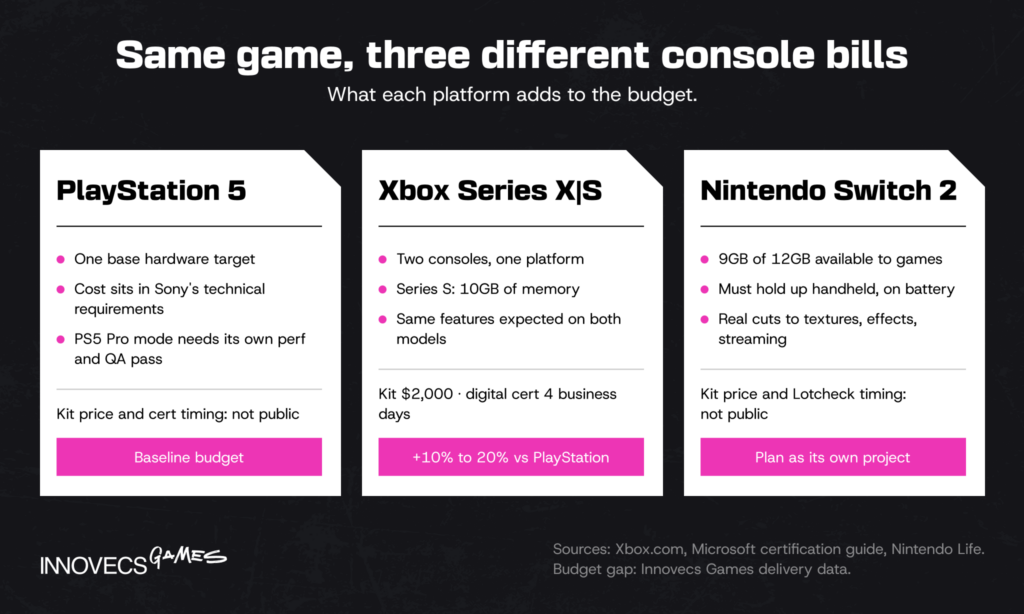
Sony had shipped 97.9 million PS5 consoles by the end of September 2026, which makes it the first console in most budgets we see. There’s one base hardware target, close enough to a mid-range gaming PC that rendering work is rarely the problem. The money goes on Sony’s technical requirements: trophies, activity cards, save data, user switching and the many small system behaviors a certification tester will check. PS5 Pro adds an optional enhanced mode, and if the marketing plan wants that label, budget a separate performance and QA pass for it. The badge is cheap for marketing and expensive for engineering, so find out who actually asked for it before anyone starts.
Xbox Series X|S
Xbox is two consoles sold as one platform. Every game has to run on the Series S, with 10GB of memory, and Microsoft expects the two models to get the same features, with exceptions granted case by case. Black Myth: Wukong wasn’t a one-off. In June 2026, Moon Studios dated No Rest for the Wicked’s 1.0 release for PC and PS5 in October and left the Xbox and Switch 2 versions undated, with its director saying “Series S is making that rough”. Budget the Xbox version at 10% to 20% more than the PlayStation one; that’s the gap we see in our projects, and nearly all of it is Series S work. On the plus side, Microsoft is the only holder whose kit price and certification timelines are both public.
Nintendo Switch 2
Nintendo had sold 26.35 million Switch 2 units by September 30, 2026, which puts a large and young audience behind the most demanding port in this list. Of the console’s 12GB, 9GB is available to games, and the same build has to hold up in handheld mode on battery power. A game built for PS5 usually needs real cuts to textures, effects and streaming. Kit access has been uneven since launch, and Nintendo publishes neither kit prices nor Lotcheck timelines. Plan Switch 2 as its own project with its own performance owner. It is not a checkbox in the PS5 plan, and every producer who has treated it as one has a story about it that they don’t tell at parties.
Multi-Platform Releases
Shipping on all three costs less than three separate projects. The platform abstraction, the input layer and most optimization get paid for once. It still costs more than one. Most of the extra goes on calendar: three submission queues, three sets of store assets, three patch pipelines moving at different speeds. Our guide to cross-platform game development covers how to structure the codebase so the second and third platforms stay cheap. Unless a publisher is paying for a simultaneous launch, we’d ship first where your audience already lives and use that revenue to fund the rest.
Where the Money Goes: Budget Breakdown by Production Stage
Platforms tell you which lines go into the budget. Stages tell you in which month each one gets paid. The game development cost breakdown below is what we see on console projects that run from concept to the end of their first year on sale. Compared with a PC-only plan, the QA row is fatter and starts earlier.
| Stage | Share of total budget | What’s console-specific |
|---|---|---|
| Pre-production and prototyping | 10% to 15% | Platform list, developer program applications, kit orders, frame-rate and memory targets per SKU |
| Full production: code, art, animation, and audio | 50% to 60% | Platform layer, save and account systems, per-SKU asset budgets |
| QA, compliance testing, and optimization | 15% to 20% | Requirement test cases, pre-certification passes, performance capture on kits |
| Launch, patches, and post-launch support | 10% to 20% | Submissions, day-one patch, patch certification, platform events |
A console plan with less than 15% in that third row usually hasn’t removed the testing. It has buried it inside a production estimate, often one written by someone who has never seen a failed submission report.
Percentages are easier to argue with once they turn into dollars. Here is what the work packages typically cost on a mid-size single-player 3D game for two consoles, built mostly in Eastern Europe, which is the same project as the worked example further down.
| Work package | Typical cost | What it covers |
|---|---|---|
| Concept, pre-production and vertical slice | $300,000 to $600,000 | Core loop prototype, ten minutes at final quality, platform targets per SKU |
| Game and level design | $250,000 to $500,000 | Systems, levels, progression and tuning across production |
| Gameplay engineering | $700,000 to $1.2 million | Player systems, AI, cameras, combat, save and load |
| Engine and platform layer, per console | $150,000 to $350,000 | SDK integration, trophies or achievements, accounts, suspend and resume, memory budget |
| Art, animation and technical art | $1.2 million to $2.2 million | Characters, environments, animation, shaders, LODs, per-SKU variants |
| UI and UX | $120,000 to $250,000 | Menus, HUD, platform glyphs, readability on TV and handheld |
| Audio, music and voice | $60,000 to $150,000 | Composer, sound design, limited voice |
| QA, compliance testing and submissions | $300,000 to $600,000 | Functional QA, requirement test cases, pre-certification passes, two submissions per platform |
| Online multiplayer, if included | Add $500,000 to $1.5 million | Netcode, servers, platform friends and invites, cross-play |
| First year after launch | 10% to 20% of the build budget | Day-one patch, fixes, patch certification, platform events |
Art is the largest line on most 3D projects, and the platform layer is the only line that repeats for every console you add.
Pre-Production and Prototyping
The creative work here is the same on every platform: a small team proves the core loop, then builds a slice at final quality. So is the temptation to leave everything administrative until the game is fun, and on console that’s exactly the work that has to start early. PlayStation Partners, ID@Xbox and Nintendo’s developer portal all want an application, often with a pitch or design doc attached, and nobody ships you a kit until you’re approved. This is also the stage to fix the frame-rate target and memory budget for each SKU, in writing. Change either one after art production starts and you’re redoing assets.
Full Production: Code, Art, Animation, and Audio
This is the biggest share because the team is at its largest. On console, production also carries the platform layer. Think trophy and achievement hooks, saves that follow each holder’s rules, account handling, controller glyphs, and all the code that talks to each SDK. Art pays its own console tax: an asset that fits the PS5 memory budget may still need a lighter twin for Switch 2. Late features hurt more than on PC, too, because on console every nice-to-have shows up with three checklists attached.
QA, Compliance Testing, and Optimization
Console QA is really two jobs, done by different people. Functional testing scales with content. Compliance testing scales with the platform count, and it’s built from each holder’s requirements list. Start it the day the game first boots on a kit; content lock is far too late. Performance lives in the same budget row, since certification and players both notice when the frame rate wobbles. Our game testing guide explains how to stage both kinds of testing.
Launch, Patches, and Post-Launch Support
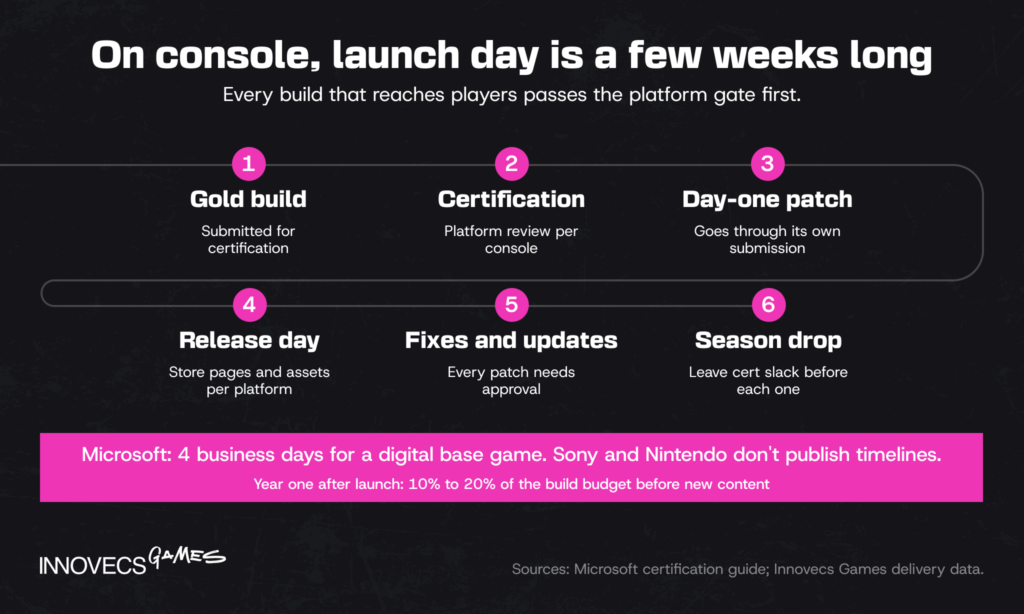
On console, launch day is really a few weeks long. The gold build goes in for certification, and the day-one patch follows through its own submission. Every later update needs approval too. A fix that takes an hour to write can take days to reach players, and the same applies to a whole release: Nightdive’s System Shock 2 remaster launched on PC in June 2025 while its console versions waited on certification until July. Store pages, pre-orders and platform features such as activity cards need assets per platform, and for the live and premium console games we support, the first year after launch typically costs 10% to 20% of the build budget before anyone ships new content. Live games feel the gate hardest. A season, an event pack or a balance change is a submission on every platform, so the content calendar has to leave certification slack in front of each drop, and the team building the next season can’t be the same people fixing the last one’s rejection report.
Console-Only Expenses That Catch Studios Off Guard
The stage plan prices the team’s time. The lines below sit around it, and most of them reach the spreadsheet only after a budget has been signed. For each one, the useful questions are what it is, who pays for it and how to plan for it. The table gives the short version; the sections below give the detail.
| Expense | Who pays | What it costs | How to plan for it |
|---|---|---|---|
| Dev kits and developer programs | The developer, unless loaned | Xbox kit $2,000; PS5 and Switch 2 kit prices not public | Apply in pre-production; count kits per engineer and per tester |
| Certification and resubmission | The developer, in team time | No public submission fee; three to six weeks of pre-certification QA per platform in our projects | Plan two submissions per platform in the schedule |
| Age ratings | The publisher of record | Free through IARC for digital releases; paid for physical and for Japan | Rate digital editions through IARC; budget physical and CERO separately |
| Engine and middleware licenses | The developer | Unity Pro required for console builds; Unreal royalty on revenue; middleware priced by budget | Check console terms with each vendor before production |
| Physical editions | Usually the publisher | Switch 2 Game Card estimated at about $15 per unit | Decide digital or physical before certification |
| Performance tuning on fixed hardware | The developer | Often the largest of these lines, measured in engineer-months | Set budgets per SKU and profile on kits every milestone |
Source: platform holder documentation and press reports linked in the sections below; QA weeks from Innovecs Games delivery data, 2023 to 2026.
Only the last row scales with the size of the game, while the rest scale with the number of platforms, which is why a third console always costs less than the first and never costs nothing.
Dev Kits and Platform Developer Programs
There’s no public PS5 dev kit cost. None. Sony shares hardware terms with registered partners only, and the most recent widely reported figure, about $2,500 for a PS4 kit, dates from 2013. What Sony has made public is a hardware loan program. Since July 2022 it has offered newly licensed developers one PS5 development kit and one testing kit, subject to its terms. Only Microsoft’s price is public. An Xbox kit has cost $2,000 since October 2025, up from $1,500, while studios with an approved ID@Xbox concept get kits at no charge. Nintendo publishes neither price nor lead time for Switch 2 kits.
The developer pays, in money or in waiting. Free kits arrive on the platform holder’s schedule, not yours, and a studio that applies after production has started can lose a whole quarter waiting for hardware it assumed would simply turn up. Apply to all three programs in pre-production, even for a platform you won’t touch until next year. And count kits honestly. Every engineer who touches platform code needs one, QA needs test kits, and the build machine running overnight tests needs a spare. Shared kits look like a saving until two programmers spend a week taking turns.
Certification and Resubmission Cycles
Sony checks the final build against its Technical Requirements Checklist, Microsoft against Xbox Requirements, and Nintendo runs Lotcheck. Only Microsoft says how long review takes: four business days for a digital base game, according to its certification guide. Fail, and you get a report listing every issue. The game can’t go back in the queue until all of them are fixed and the full test pass has run again. What fails is usually boring stuff, like a save lost on a signed-out profile, a crash when the network drops, a button called by the wrong name or a suspend that won’t resume. Timing makes even a small fix expensive. In November 2025, QA on the rhythm game UNBEATABLE found a rare progression blocker the night before launch. Fixing it meant missing the console date because of certification timelines, so the developer moved the whole release, PC included, from November 6 to December 9 rather than ship the platforms apart.
Submitting costs no public fee; the cost is team time and calendar. In our projects, pre-certification QA takes three to six weeks per platform on a mid-size game, and the schedule should carry two submissions per platform, not one. Patches queue at the same gate, so the post-launch plan needs certification time too. Want to pass cheaply? Turn every requirement into a test case from the first playable build and rerun them at each milestone. By the final pass there should be nothing left to discover.
Age Ratings, Middleware, and Engine Licenses
Digital ratings got cheaper. Through IARC, ESRB and PEGI ratings for console downloadable games cost developers nothing. Physical editions are a different matter. In the US they go through ESRB’s paid long-form review. In Japan they go through CERO, which charges non-members 200,000 yen per review plus 60,000 yen for each extra platform carrying the same game. The publisher of record usually pays, so whether that’s you or a partner should be written into the deal.
Engines and middleware need a console check before production, not before launch. Unity only builds for consoles on a Pro plan or with a license key from the platform holder, and a Pro seat now costs $2,310 a year. Unreal Engine’s standard license has no upfront fee; Epic takes 5% of a product’s lifetime gross once it passes $1 million, so that cost lands on revenue rather than on the development budget. Audio, physics and networking middleware usually price by development budget. Console versions often go only to registered developers under NDA, so get platform support and price in writing before anyone builds on it.
Physical Editions and Game Cards
A boxed release adds manufacturing, a paid rating and its own production lead time, and on Switch 2 it adds a format choice. According to Bloomberg’s reporting, Nintendo offers publishers only two options: a full 64GB Game Card or a Game-Key Card that downloads the game. Nintendo keeps card prices to itself, but industry estimates put a 64GB card at around $15 to $16. On a $30 game, that’s a painful bite. Boxes look lovely on a shelf and rather less lovely in a P&L. Settle the physical plan before certification; it changes the rating route, the build and the price.
Performance Tuning for Fixed Hardware
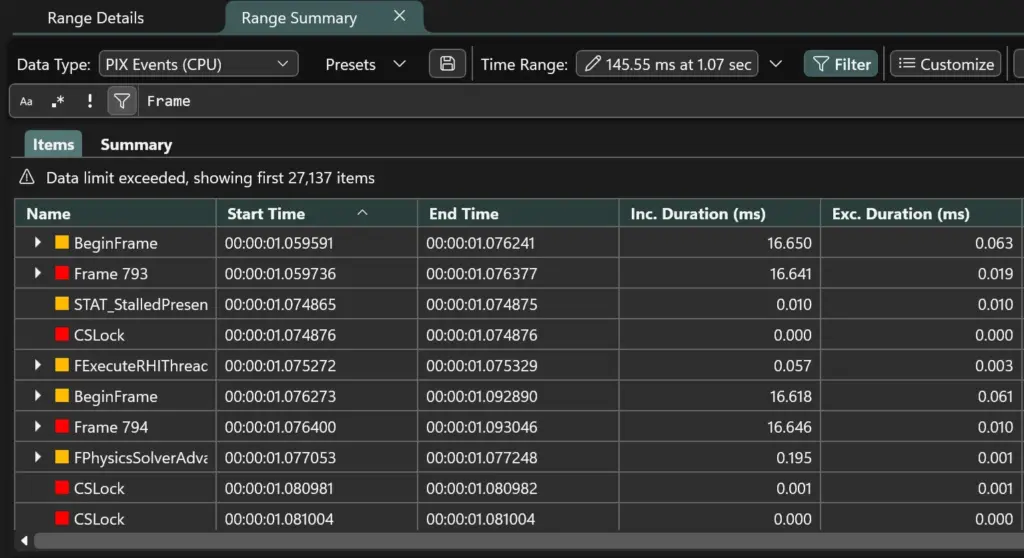
This line grows with your game. A console doesn’t have a Low preset. It has the one version you ship, and that version has to hold its frame rate on the weakest SKU, in the busiest scene, with the worst-case save file. So you need a memory budget per level and streaming that fits each console’s storage. Series S and Switch 2 need their own shader and texture variants, and someone has to capture performance on real kits at every milestone. The developer pays for all of it, mostly in senior engineering and technical art time. Late optimization costs far more than planned optimization, because content has to be rebuilt around it. Teams that lack that depth in-house often bring in game engineering services for profiling and optimization rather than hire for a few months of peak need.
Marketing, Accessibility, and Post-Launch Content
Three more lines sit outside the build and still decide whether it pays back. Marketing is the largest. For the AA console games we’ve helped budget, it has run from about 20% to 50% of the development budget, and at AAA scale Raph Koster’s analysis of the cost of games puts it at 75% to 100% of development. On console part of that money is format work: trailers, key art and store pages built to each holder’s specifications, plus the assets for platform showcases and events. When a budget review needs to cut something, we’d rather lose a level than the marketing line. A smaller game people have heard of beats a bigger one nobody has.
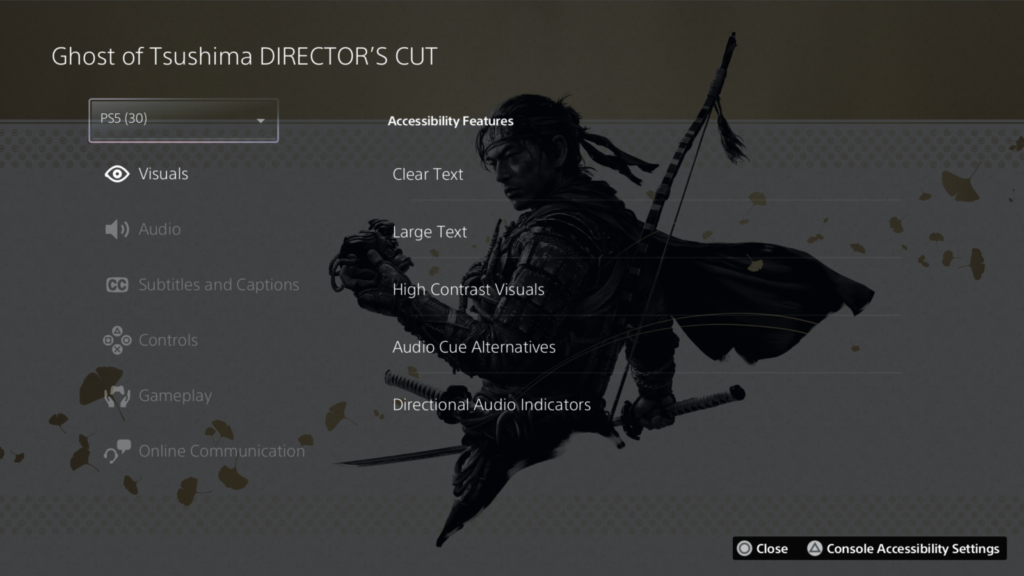
Accessibility has become visible at the point of sale. Since 2023 the PlayStation Store has shown accessibility tags, and there are more than 50 of them. Xbox went further in 2025 and put every digital listing on the industry’s standardized Accessible Games Initiative tags. You only get a tag if the feature meets its criteria. So subtitle sizing, remappable controls and colorblind modes belong in the production plan, not in a patch.
Post-launch content is the third line. DLC, seasons and community management keep a game selling, and on console every piece of new content goes through certification like the base game did. Budget a community manager from the first public trailer, and price each content drop with its submission time included.
Managing External Partners Across Platforms
Most console games now ship with outside help, and nobody invoices you for coordinating it. At a small studio, the bill comes out of a lead’s evenings. Big publishers hire for it: some people’s whole job title is external development director, and outsource managers keep two to four vendors moving at once, every one with its own builds and its own questions. Consoles make it messier. Each partner needs a kit, the right platform branch and the same reading of the requirements list as everyone else. A vendor that tests against last quarter’s checklist can fail a submission for everyone.
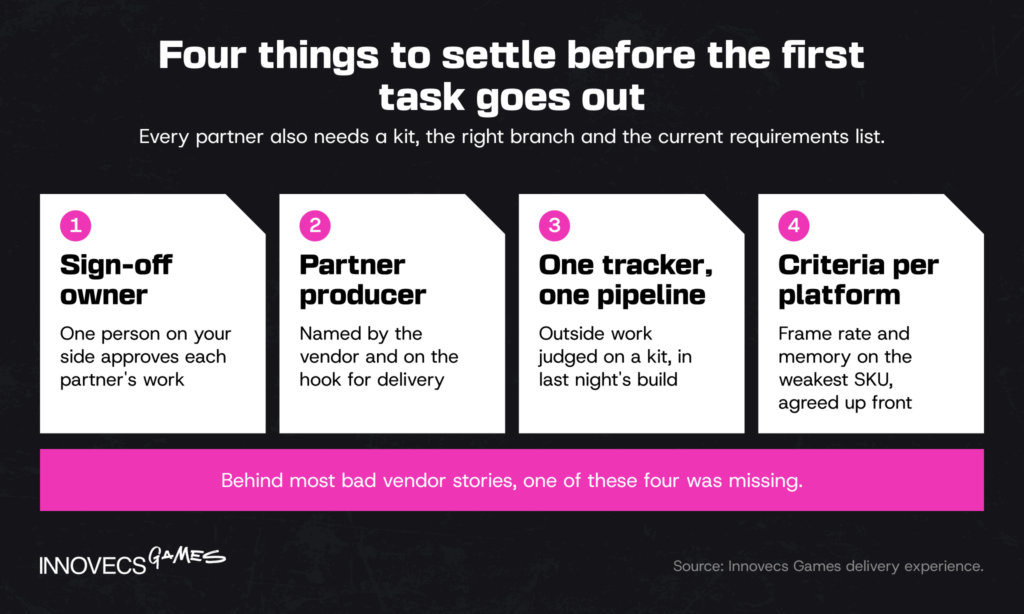
Sort out the setup before the first task goes out. Name the person on your side who signs off each partner’s work, and get the partner to name a producer who’s on the hook for it. Put everyone in one tracker and one build pipeline, so outside work gets judged the way players will see it, running on a kit in last night’s build. Then write acceptance criteria per platform before the work starts, including frame rate and memory on the weakest SKU. When studios tell us about a bad vendor experience, one of those pieces was almost always missing. Consolidating from four vendors to two cuts that overhead noticeably in our experience, with one honest cost: each remaining partner holds more of your game, so pick the ones whose certification record you’ve already seen.
Console Game Developers: Roles and Hourly Rates by Region
Kits, certification and partner management all come back to the same thing: people’s time. Each team-month gets multiplied by a rate, and rates swing hard by region: a senior engineer in Eastern Europe or Asia bills roughly a third of what the same person costs in the US. On console, a handful of senior seats carry more of the load than on PC, so who you hire matters about as much as where.
Core Roles and Team Size
Nothing exotic on the org chart: gameplay and engine programmers, technical artists, 3D artists and animators, designers, QA testers and a producer. What changes on console is the weight of each. Engine programmers own the platform layer and the memory budget. Technical artists decide whether assets fit three different SKUs, and QA needs people who know a requirements checklist as well as a bug tracker. For a 25-person AA team shipping on three consoles, we’d want at least two engineers with shipped console titles. Add one technical artist for every four to six artists and a QA lead who has run submissions before. Experienced console game developers are the scarcest part of that list, which is why they’re also the line studios most often try to rent rather than hire.
Hourly Rates by Region
The figures are what studios and vendors bill for senior people, which sits well above what those people are paid.
| Role | United States | Western Europe | Eastern Europe, including Ukraine | Asia (India, Southeast Asia) |
|---|---|---|---|---|
| Gameplay programmer (C++, C#) | $120 to $170 | $100 to $140 | $65 to $95 | $45 to $65 |
| Engine or graphics programmer | $135 to $180 | $110 to $150 | $75 to $100 | $50 to $70 |
| Technical artist | $115 to $155 | $95 to $125 | $65 to $85 | $45 to $60 |
| 3D artist or animator | $100 to $125 | $80 to $105 | $55 to $70 | $40 to $50 |
| QA tester, mid to senior | $45 to $80 | $40 to $65 | $25 to $45 | $18 to $30 |
| Producer | $110 to $145 | $90 to $120 | $60 to $80 | $40 to $55 |
Rates become budgets through monthly burn. Say you have 20 people in Eastern Europe at a blended $56 an hour, 160 hours a month each. That’s roughly $179,000 a month, or $3.2 million across 18 months. Run the same plan with a US in-house team at $103 blended and you’re at about $330,000 a month, close to $6 million in total. Nothing about the game changed between those two numbers except where the team sits, and that alone is worth close to $3 million.
In-House vs Outsourced Teams
Your own staff cost salary, taxes and benefits, plus kits and desks. Filling a senior seat also takes three or four months, and you pay for that wait too. They also stay on payroll through the quiet weeks after a milestone ships. What you get back is memory: the person who wrote the save system is down the hall when it breaks in year three. Outside teams cost more per month than a freelancer, and somebody on your side has to review their work every week. Hardly anyone budgets that review time, but it’s real. What it buys on console is people who’ve already passed certification on your target platform, kits already on desks, and room to scale for the last six months without a hiring cycle. The split we see most often keeps design, art direction and core systems in-house and sends platform work and pre-certification QA outside.
What Pushes the Price Up or Down
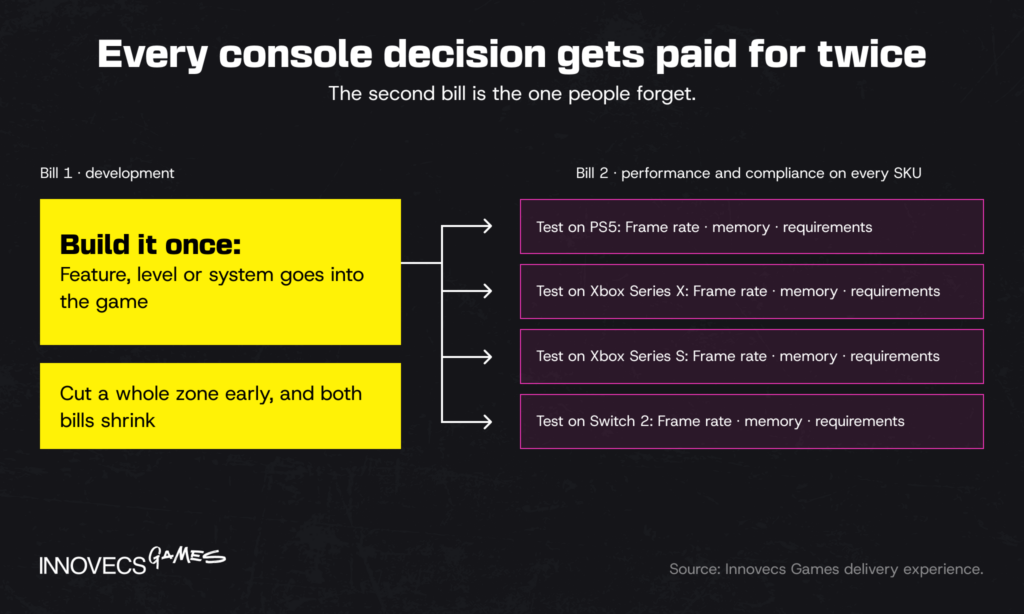
Rates set the price of a month. How many months you need comes down to four things, the same four as in general game development cost planning, with one console twist. Every decision gets paid for twice on console. You build it once, then test it again on each SKU, and that second bill is the one people forget.
Scope, Genre, and Content Volume
Content costs money in a nearly straight line. On console, each piece also passes performance and compliance checks on every SKU. Open worlds multiply the streaming and memory work, while hand-built linear levels keep it predictable. Genre matters as well. Put a few thousand units on screen in a strategy game and you’ll find the CPU ceiling fast; a story-driven adventure may never get near it. When something has to go, we’d cut a whole zone or system, and we’d cut it early. Each removal also deletes its compliance and performance testing on every SKU, which trimming polish late never does.
Visual Fidelity and Performance Targets
In our experience, players now expect a 60 frames-per-second option on PS5 in most action genres, and holding it on Series S and Switch 2 is where fidelity gets expensive. Go photoreal and the bill lands on lighting, technical art and LOD work first, then lands again when every asset needs a lighter version for the weaker consoles. Stylized art shrinks better and loses less on a handheld screen. Given one budget and three consoles, we’d pick style over realism, and it wouldn’t be close. So pin down the frame rate and resolution for every SKU in the design doc before full production starts. Then let the weakest console, not the strongest, set the art direction.
Obsidian on holding Avowed’s GPU budget across Series X, Series S and PC.
Online and Multiplayer Features
Online costs you netcode, servers and moderation on any platform. Console makers add their own rules on top, covering friends lists, invites, privacy, cross-play and what happens when a connection drops. Certification checks every one. Want cross-play between PlayStation, Xbox and Switch? Then you also need account linking and someone who has read three sets of terms very carefully. And servers start billing at the first public playtest, not at launch. Remember XDefiant? Ubisoft’s free shooter came out in May 2024 on PC, PlayStation and Xbox, and about six months later the company announced the shutdown and cut 277 jobs. If a publisher with that much money couldn’t make a free shooter cover its server bills, a 40-person studio’s co-op mode needs a very good business case. Our advice is to settle online before production, and to say yes only if multiplayer is why people will buy the game. A thin online mode still carries the full certification and server load.
Engine Choice: Unreal, Unity, or Custom
Both Unreal and Unity give registered developers console support out of the box, so nobody starts the platform plumbing from zero. Unity requires Pro seats for console builds and Unreal takes its royalty from revenue, but the bigger difference is which one your team already ships fast in. Our comparison of Unity vs Unreal goes through the trade-offs. With a custom engine, someone writes a platform layer per console in C++. Studios that have done it before can afford that; studios that haven’t tend to learn the price the hard way. As a hobby, writing your own engine for a first console game is fine. As a business plan, it isn’t. The safe call is the engine your senior people have already taken through certification. Switching engines is fine, just not halfway through production; make that call early and budget it as its own line.
How to Estimate a Budget for Your Own Project
With the drivers and hidden lines on the table, what’s left is mostly arithmetic. That’s good news, because arithmetic survives a greenlight meeting and a gut feeling about scope doesn’t. Our worked example is one realistic project. It’s a stylized single-player action game in 3D, about ten hours long. We built the numbers around Unreal Engine 5, a PS5 and Xbox Series X|S launch, and a team that’s mostly in Eastern Europe.
Define Scope and Target Platforms
Start by fitting the whole game on one page. Genre, length, how many levels and characters, which platforms at launch and which later, and what you’ve already cut. Under that go the targets for each SKU (say 60 fps on PS5 and Series X, 30 or 60 on Series S) and a resolution range for each. Add physical or digital, languages and online features. Every one of those answers becomes a budget line: platforms drive certification and QA, frame-rate targets drive optimization, and physical editions drive ratings and manufacturing. A platform list that still reads “probably all of them” means it’s too early to estimate.
Turn Team Size and Timeline into Team-Months
Then staff each stage: how many people, for how many months, at what blended monthly rate. Our article on how long it takes to make a video game gives typical stage lengths if you’re starting from nothing.
| Stage | Team and duration | Team-months |
|---|---|---|
| Pre-production and prototyping | 7 people for 6 months | 42 |
| Full production | 22 people for 16 months | 352 |
| QA, certification and launch | 24 people for 4 months | 96 |
| Total | 26 months | 490 |
| Team cost, Eastern Europe | About $9,100 blended per team-month | $4.45 million |
| Team cost, same plan with a US in-house team | About $16,600 blended per team-month | $8.12 million |
A blended rate hides which seats are expensive, so here is the same plan role by role. Monthly rates are blended for a mix of mid and senior people at 160 hours a month.
| Role | Headcount: pre-production / production / QA and launch | Team-months | Eastern Europe, per month | Eastern Europe, total | US in-house, per month | US in-house, total |
|---|---|---|---|---|---|---|
| Producer | 1 / 1 / 1 | 26 | $10,000 | $260,000 | $18,000 | $468,000 |
| Game designer | 2 / 2 / 1 | 48 | $9,000 | $432,000 | $16,500 | $792,000 |
| Gameplay programmer | 1 / 4 / 3 | 82 | $11,000 | $902,000 | $19,500 | $1,599,000 |
| Engine and platform programmer | 1 / 2 / 2 | 46 | $13,000 | $598,000 | $22,500 | $1,035,000 |
| Technical artist | 1 / 2 / 2 | 46 | $10,500 | $483,000 | $19,000 | $874,000 |
| 3D artist or animator | 1 / 8 / 3 | 146 | $8,300 | $1,211,800 | $16,000 | $2,336,000 |
| UI artist | 0 / 1 / 1 | 20 | $7,800 | $156,000 | $14,500 | $290,000 |
| QA and compliance tester | 0 / 2 / 11 | 76 | $5,300 | $402,800 | $9,500 | $722,000 |
| Total | 7 / 22 / 24 | 490 | $4,445,600 | $8,116,000 |
Two rows carry the console-specific weight. The engine and platform programmers are the most expensive seats on the team, and the QA row jumps from two people to eleven in the last four months, because that’s when compliance testing, pre-certification passes and two submissions per platform all land at once. Art is the biggest line in dollars, which is normal for a 3D action game and the first place to look if the total needs to come down.
The number your CFO will actually watch is the peak. In full production this team spends about $204,000 a month in Eastern Europe, or about $374,000 in the US. Pre-production costs roughly a third of that, around $71,000 a month. That gap is the whole argument for cutting scope early.
Add Platform Expenses and a Contingency Buffer
Next come the costs that aren’t people. Add those, then put a buffer over the lot.
| Line | Basis | Estimate |
|---|---|---|
| Dev and test kits | Six Xbox kits at $2,000, plus an allowance for PS5 kits on Sony’s terms | $27,000 to $42,000 |
| Engine | Unreal Engine 5; royalty comes from revenue, not the budget | $0 upfront |
| Middleware and tools | Audio middleware, source control, build servers, crash reporting | $40,000 to $80,000 |
| Age ratings | IARC for digital in North America and Europe; more if physical or Japan | $0 to $10,000 |
| Localization | Text into 8 languages, about 60,000 words | $50,000 to $70,000 |
| Audio and voice | Composer, sound design, limited English voice | $60,000 to $150,000 |
| Store assets and trailers | Per-platform store art, two trailers | $30,000 to $60,000 |
| Non-team lines | About $210,000 to $410,000 | |
| Total with 20% contingency, Eastern Europe | About $5.6 million to $5.8 million | |
| Total with 20% contingency, US in-house | About $10 million to $10.2 million |
The PS5 kit allowance is our planning assumption, since Sony doesn’t publish kit prices.
Contingency belongs at 15% to 25%, toward the top for a first console project. It exists for the failed submission and the memory problem nobody has found yet. If it ends up paying for somebody’s favorite feature, it won’t be there when the real problem shows up. One more step turns the budget into a sales target: divide it by what the studio keeps from each copy. Take a $39.99 game. After the store’s 30% share, sales tax and refunds, the studio keeps roughly 60% of that. At those numbers the Eastern European build breaks even somewhere between 233,000 and 243,000 copies, before marketing, and the US build needs 416,000 to 427,000. Plenty of those copies will sell at a discount, so the real number is higher. Once production starts, report spend per platform as well as per stage. When an executive producer asks what Xbox is actually costing, or whether Switch 2 still pays for itself, the answer should already be in the monthly report rather than in someone’s head.
What Changes If You Add or Drop a Platform
Platform lists move during production more than any other part of a console plan. Here’s roughly what each change does to the example above. Use it to put a price on the request before anyone says yes.
| Change to the plan | What it adds or removes | Typical effect on this budget |
|---|---|---|
| Drop Xbox Series X|S, ship PS5 only | One submission track, Series S memory work, one set of store assets | Saves roughly $150,000 to $300,000 in team time |
| Add Switch 2 after launch | A port of the finished game, handheld performance work, Lotcheck | Adds $60,000 to $180,000 over three to six months |
| Add Switch 2 at launch | The same work in parallel, while the game is still changing | Adds roughly 1.5 times the post-launch figure, and risk to the date |
| Add PC on day one | Settings menu, input options, compatibility QA, store integration | Adds $80,000 to $200,000 |
| Add a physical edition | Paid rating route, manufacturing setup, per-unit media | Adds $15,000 to $60,000, plus about $15 per Switch 2 card or less per disc |
Adding Switch 2 after launch is usually cheaper than doing it in parallel, since the first two certifications have already shaken out most platform bugs. Dropping a platform late saves less than people expect, because the shared platform layer is already built.
Download the free console budget calculator: Excel (.xlsx)
Six tabs with live formulas: inputs, rates by role and region, headcount per stage, platform and optional lines, and a summary with the total range, monthly burn and break-even copies.
It opens with the worked example above, so you can change one number at a time and watch the total move.
Need a Realistic Number for Your Game? Let’s Talk
Got a plan and a platform list already? We’ll check it. Send over the scope and targets. We’ll reply with a scoped estimate, the team we’d suggest and whatever lines we think are missing.
How to Spend Less Without Cutting Quality
The worked example shows where the money goes. Most of the ways to save it get decided before production starts, not in a rate negotiation. A discount that wins 5% on the rate is undone the day someone adds a third console halfway through production.
Co-Development and Outsourcing
Console game development outsourcing works best when the job has edges: a platform layer, a port, a performance pass, pre-certification QA, a pile of art. A specialist on any of them is flat out for a few months and then idle, and that’s exactly the hire you don’t want on payroll. Longer work is where game co-development services come in: an outside team that sits inside your pipeline and hits your milestones. Classic game development outsourcing is for work you can hand over in one piece, provided both sides agreed up front what “done” means. Either way, keep design, art direction and core systems with your own people. Outside teams should go through the same sign-off setup we described for managing external partners.
Short-Term Specialists and Consistent Art
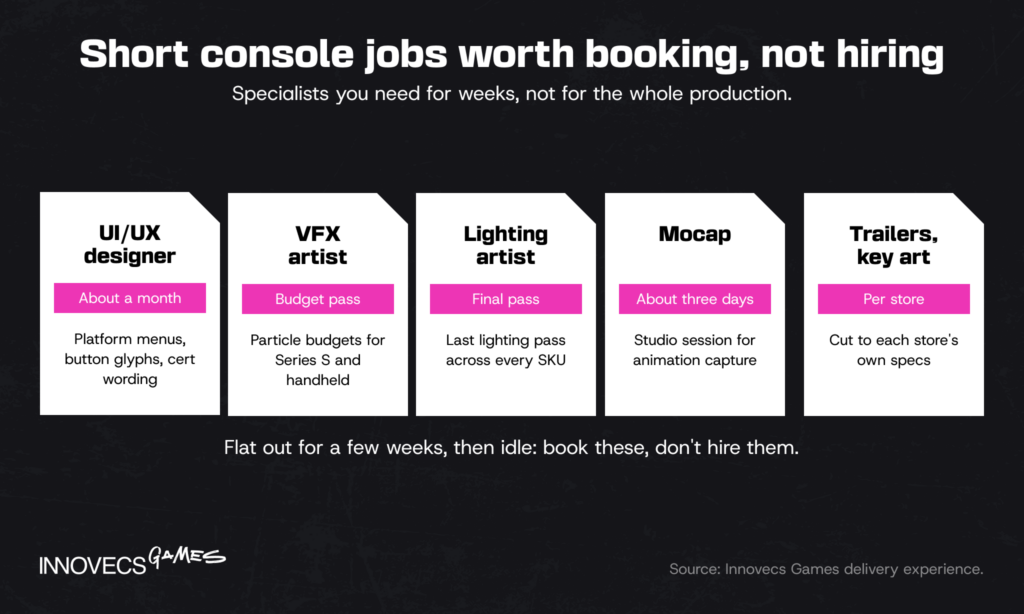
Some of the work is short. You might need a UI/UX designer for a month, someone who knows each platform’s menus, button glyphs and the wording certification checks for. Or a VFX artist to rebuild particle budgets for Series S and handheld mode, plus a lighting artist for the final pass. Mocap might be three days in a studio. Every store wants its own trailer and key art, cut to its own specs. On most budgets you wouldn’t hire any of these people full-time, but you should book them early: good freelancers fill up around the same launch windows you’re aiming at.
Outside art has to look like yours on every screen it ships to. On console that means approving assets on a 4K television and on the Switch 2 handheld display, not only in the editor, since a texture that holds up at ten feet can fall apart at arm’s length. Give partners a style guide that shows finished assets as they look in the game, not mood boards, and before any new art partner gets volume, buy one finished asset from them as a paid test. It’s the cheapest quality gate there is.
Burst Capacity Around Certification
A lean AA team is a sensible way to control burn, right up to the week a submission fails three weeks before launch. The fix list lands on the leads, who are already building the game and mentoring a junior-heavy team, and that is how a release month turns into a burnout month. A lead who quits after launch takes the platform branch’s history along, and no contractor rate comes close to that bill. That’s why we tell clients to book extra platform engineers and compliance testers months before the first submission, not the morning the rejection report lands. And the extra people should come with their own lead. If they don’t, your leads end up dispatching someone else’s team at the worst possible moment. Studios with a strong team of their own use the same arrangement differently, for overflow, a port or a side prototype, so their people never leave the main game.
Pricing Models and What the Contract Should Cover
There are two usual ways to pay. Time and materials charges for the hours actually worked, which fits production, where scope shifts every month. Fixed price fits a tightly defined port or platform pass, and in the quotes we see it costs 15% to 30% more, since the partner is quietly pricing in a failed submission. So which one is cheaper? Honestly, neither. Fixed price buys you certainty, T&M buys you room to change your mind, and the costly mistake is paying for the one your project doesn’t need.
Whatever you sign, check that it covers a few console clauses that generic outsourcing templates leave out:
- Platform accounts and kits. Whose developer accounts the builds are submitted under, and whose kits the team works on.
- Certification ownership. Who runs the pre-certification pass, who submits, and who pays for the work a failed submission triggers.
- Acceptance per platform. Frame rate, memory and load-time targets on the weakest SKU, written as pass or fail.
- Post-launch window. How long the partner fixes platform bugs after launch, and at what rate.
- IP and code ownership. Everything built for you, including the platform layer and tools, assigned to you.
Before signing, ask the questions that separate a console partner from a general one. What has the team shipped on this exact platform since 2024? Are the kits already on desks? How many first submissions passed? And whose names will actually be on your project?
Reusable Tech, Tools, and Assets
Console plumbing is the part not worth building twice. Unreal and Unity come with platform modules. Audio and crash-reporting middleware cover all three consoles with one integration. A pipeline that builds every SKU overnight probably saves more engineer hours than any tool you could buy. Write your platform abstraction once and every console after that gets cheaper. No player has ever bought a game for its hand-rolled crash reporter. Art works the same way: shared materials and reusable kits save schedule, and on Series S and Switch 2 they save memory, which helps the frame rate. Save custom work for what a player remembers: the hero character, the signature locations and every shot that ends up in a store trailer.
Phased Platform Launches
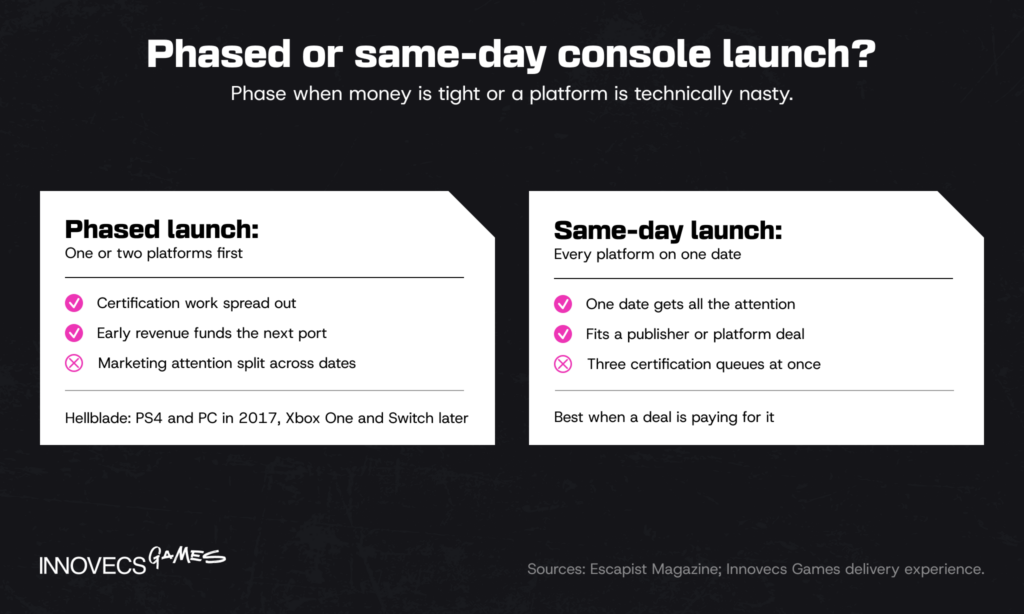
Ship on one or two platforms first and you spread the certification work, let early revenue pay for the next port, and catch platform bugs while only one queue is involved. Hellblade did exactly that: PS4 and PC in 2017, then Xbox One and Switch later, once the first release had paid for itself. What you give up is marketing punch. One launch date gets all the attention, a staggered launch splits it, and players on the later platforms sometimes take the wait personally. We’d phase when money is tight or a platform is technically nasty, and launch everywhere at once when a publisher or platform deal is paying for it.
How AI Is Changing Console Development Budgets
Every saving above comes from planning and staffing. Tools are the newer lever, and AI already trims hours in console production, mostly in work players never see. Coding assistants are good at the boring parts: platform wrappers, build scripts, test harnesses, save-data migrations. That matters most on small teams, where one engineer owns the entire platform layer. Leave automated runs going on a test kit overnight and you come back to a report of crashes, memory growth and frame-time spikes. Art teams use generation for concept exploration and placeholders. Procedural tools still handle most terrain and foliage, as they have for years.
Compliance is where the tools are newest. Teams now feed requirement checklists into language models to draft test cases. Vendors are building AI into regulatory work too. k-ID showed its Neimo tool in May 2026: it drafts market-by-market compliance briefs from a database of more than 200 jurisdictions, and legal teams still sign off. AI also adds lines of its own. In October 2026, the UK trade body Ukie and the law firm Sheridans launched an AI compliance review for studios that need to show publishers and investors how they use these tools. A full check with a written policy costs £1,500 to £2,500.
What AI doesn’t remove is the expensive judgment. Certification is still a human decision on the platform side and a human responsibility on yours. If a vendor demo shows AI “handling certification”, it’s worth asking which platform holder agreed to that. Holding a frame rate on Series S or Switch 2 still takes engineers reading captures on real hardware, and creative direction is still the thing players are paying for. Our position: AI is worth paying for where it cuts repetitive QA and code hours, as long as the review time it creates is in the plan. It isn’t a reason to trim the optimization budget. Our overview of AI in game development covers the wider picture.
How Innovecs Games Helps Studios Build for Console
Most studios that come to us already have a game and a console gap with a date attached. It might be a platform layer nobody on staff has written, a Series S build that won’t fit, a Switch 2 version, or QA before a submission. We’ve been doing this for 11+ years, across 300+ game projects, and most of our 200+ specialists sit in Eastern Europe. Our console game development services cover full development, porting, optimization and compliance testing in Unreal and Unity. Our people work in your tools and your sprints; nobody throws builds over a wall.
You can bring us in three ways: a co-development pod run by our own lead and producer, a dedicated team that grows with your plan, or a fixed scope signed off against acceptance criteria. Each gives a studio senior console talent for the months it’s needed, without building a permanent department around one release. We price in the Eastern European band, which isn’t the cheapest option for every job; for high-volume asset work that needs little judgment, Asian vendors usually come in lower, and we’ll tell you so up front. The easiest way to test us is small: a performance audit on a dev kit, a pre-certification pass or one paid asset made to your style guide. Every team gets a producer on our side who owns reporting and status for your executives, and one partner can cover platform engineering, art and compliance QA if you’re trying to cut the number of vendors. The range of work behind these numbers is in our portfolio.
FAQ
What is the average console game development cost in 2026?
Honestly, there isn’t one that helps: the range goes from a single developer to studios of a thousand. Small paid teams we’ve seen spend anywhere from $150,000 up to about $3 million. AA lands between $5 million and $50 million, while AAA begins near $80 million and blows past $200 million all the time, marketing not included. And if all you need is your finished PC game on one console, our ports have come in at $40,000 to $250,000.
How much does it cost to put a game on Xbox, PlayStation, or Switch?
With the PC version already done, our ports have cost $40,000 to $150,000 per console on PS5 or Xbox Series X|S, and $60,000 to $180,000 on Switch 2. Fees barely register: $2,000 per Xbox kit, nothing for IARC ratings on digital games, nothing to submit. You’ll spend the real money on engineers, optimization and certification QA. Then, once it’s on sale, the store takes its share, typically 30%.
How much does a PS5 dev kit cost?
Sony won’t say, and its terms only go to registered partners under NDA. The last number anyone reported widely was about $2,500, and that was for a PS4 kit back in 2013. What we do know is that since July 2022, newly licensed developers can borrow one PS5 development kit and one test kit through Sony’s hardware program.
Why is console development more expensive than PC or mobile?
Mostly because there’s a company between you and your players. Sony, Microsoft and Nintendo each want certification, approved dev kits and their own rules for saves, accounts and trophies. And with fixed hardware, a slow build can’t hide behind a settings menu. On our projects it comes to roughly 10% to 20% more than PC alone.
Is it cheaper to launch on one platform first or on all of them at once?
Phasing usually costs less, though it isn’t always the smarter move. You spread certification out, early sales pay for the later ports, and bugs stay in one queue. A same-day launch on everything is pricier up front but gets you one big marketing moment, and that’s often what publishers are paying for.
How expensive is it to port a PC game to PlayStation or Switch?
On our projects a PS5 port of a finished PC game has run $40,000 to $150,000 and taken three to six months. Switch 2 is pricier at $60,000 to $180,000, thanks to its 9GB memory budget and handheld mode, and the original Switch costs more again, $90,000 to $250,000. What moves the quote most is the engine version and the state of the code.
How long does a typical console project take?
A small console game takes 12 to 30 months; AA, two to four years; AAA, three to six. Ports are quicker, two to eight months. Whatever the size, leave four to six weeks per platform for certification and a possible resubmission, because that’s the part of the calendar you control least.
Can a small indie studio afford a PlayStation or Switch release?
It can, if it plans around time instead of fees. Kits are the easy part, because Sony and Microsoft both give them to new developers, and digital ratings through IARC cost nothing. Weeks of compliance testing and optimization are the hard part. That’s why lots of small teams pick one console to start or hand the platform work to a porting partner.
🤖 Does AI actually lower the cost of making a console game?
Some, mostly in code, placeholder art and repetitive testing. An assistant will knock out platform wrappers and tooling faster, and test bots happily grind routes on kits all night. Nobody’s automated certification, fixed-hardware optimization or creative direction yet, though. Expect smaller savings than the vendor demos show, and remember that someone has to review everything AI produces.
🤖 Can AI tools speed up QA and platform certification?
For the prep, yes. For the verdict, no. Models are decent at turning a requirements checklist into test cases, sorting crash logs and rerunning regression routes overnight. But the platform holder signs off the build, and whether a borderline bug fails it is a judgment a person makes.
Planning a Console Release? Get a Clear Estimate
Get in touch with your scope, platforms and launch date, and we’ll send back a line-by-line console game development cost estimate. It comes with the team we’d staff and every assumption behind the numbers.