MMORPG Game Development: A Practical Guide to Building an Online RPG in 2027
Less about the world map, more about what keeps an online RPG alive: how it gets planned, built and paid for, who you’ll need on the team, and when a partner is worth bringing in.
It took Intrepid Studios nine years to get Ashes of Creation into Early Access, and 52 days to watch it implode.
Ask a friend who doesn’t play MMOs what makes them hard, and they’ll probably talk about the world (thousands of quests, a continent of zones, a lore bible thicker than the design doc). Ashes had plenty of that. The world is also the part of MMORPG game development that studios most often get right.
And on paper Intrepid was doing fine. The Kickstarter had brought in $3.27 million back in 2017, headcount had climbed to about 250, and Early Access finally opened on December 11, 2025. Then it unraveled. By February 2 the founder was gone after a row with the board, the studio had shut its doors and the Steam page was dead; the game’s Wikipedia entry even lists a cloud provider suing over $850,000. By April somebody had bought the IP, and then the deal was reversed. The lawsuits are still going.
Nobody’s verdict on Ashes was that the map was too small.
MMOs rarely die of too little world. They die of what sits underneath it: servers that hold on launch night, a live team that ships every few weeks, and a business model that pays for both for years. That’s where this guide spends its time, from the first design decisions to the team you’ll still be paying in year five.
What Makes MMORPG Development Different From Other Genres
The textbook definition is short: a role-playing game whose world thousands of strangers share, and which nobody ever pauses. What it leaves out is how rude that world is. Log off on Friday and by Monday iron ore costs twice as much, a guild you’ve never heard of owns the castle, and the quest giver you needed has twelve people camped around him. Every system in the game (quests, raids, crafting, PvP, the lot) sits on that never-paused state and inherits its headaches.
Three things make it a different job, not just a bigger one:
- The server is the game. A single-player RPG trusts the player’s machine. An MMO can’t: your client is basically a window onto a simulation running in somebody’s data center, so every system gets designed around what the server can verify.
- The content never ends. A single-player game ships and moves to patches. An MMO ships and then starts its real production schedule, because players clear in weeks what took a year to build.
- Failure is public and expensive. A weak single-player game sells fewer copies. A weak MMO loses players in front of everyone, those players were the content for everyone else, and the server bill keeps arriving whether they log in or not.
That’s why MMORPG development is often called the hardest job in games, and we’d agree with one caveat. Plenty of studios can build every individual part. The hard part is building all of them so they hold together for ten years, under load, with real people trying to break them.
2027 is a cautious year to start one. In October 2025 Amazon stepped away from MMO development and ended work on New World, and its Lord of the Rings MMO was cancelled along the way. Amazon can afford most things; it decided it couldn’t afford this one. Blue Protocol and Ashes of Creation are gone too. Meanwhile the games that got the fundamentals right are still running and earning years later, from Final Fantasy XIV to Albion Online, and Korea’s mobile charts still lean heavily on MMORPGs. Publishers haven’t stopped funding MMOs. They fund them in smaller steps, against proof at each stage, which is why the rest of this guide keeps asking what each stage has to prove.
Core Systems Every Massively Multiplayer Online Game Needs
Whatever stage a project is in, that proof is about the same five foundations, and most MMOs share them whatever the setting. They’re also where most of the irreversible decisions get made: change the art style in year three and you have a painful quarter, change the server architecture in year three and you have a different game. If your team is light on server, backend and networking people, this is where game engineering services earn their keep, before the first zone is built on top of the wrong foundation.
Persistent World and Server Architecture
This layer answers two questions: how many players can stand in one place, and what you do with everyone else when they can’t. The oldest trick is sharding: copy the world, call each copy a realm, split the players between them. The other is zone-based servers, where every chunk of the map gets its own server process and your character is quietly handed off when you cross a river. Most current games do both and add instanced dungeons on top, since nobody enjoys queuing behind three hundred tourists for the same raid boss.
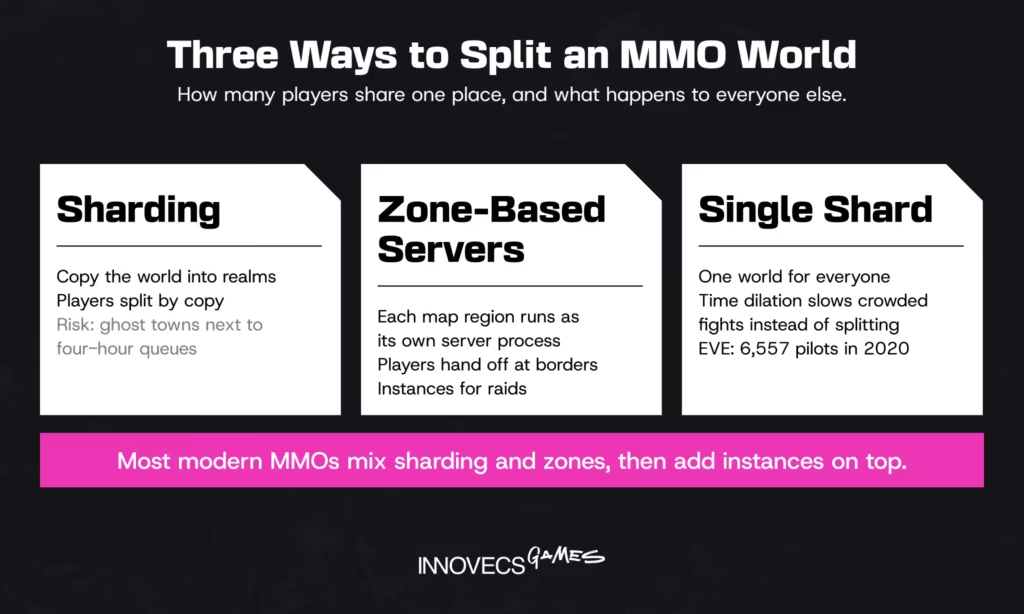
EVE Online goes the other way and runs a single shard for everyone. When a fight gets too crowded, the server slows time itself down, which is how its battle at FWST-8 in 2020 held 6,557 pilots in one system, with time dilation maxed out for the whole fight. Misjudge it and you’ll recognize the result from a dozen launches. One realm is a ghost town, the next has a four-hour queue, and merging them later turns into a small project of its own.
Networking, Replication, and Latency Handling
Netcode decides who hears what. Which client gets told about which player, how often, and how much may it guess before the server says yes or no? Sending everything to everyone isn’t an option, so replication filters by distance and relevance, and combat has to be tuned for somebody’s patchy home Wi-Fi rather than the studio LAN. Skimp here and every crowded town turns into a rubber-band festival. Worse, cheaters learn that the client is trusted, and they learn it faster than your QA team does.
Character Progression and Combat
Players never see the server layer when it works. What they pay for is the climb. First the levels, then the gear, then the sideways stuff that opens up at the cap. Combat (tab-target, action, something in between) is the part they feel every minute, and in an MMO it has to survive a laggy connection while still working for two friends and for a forty-person raid. Both are game balance problems with very long tails, because every new tier of gear has to sit sensibly against everything players already own. Players will grind for years if the arc feels right: Old School RuneScape players still chase level 99 in skills that haven’t changed much since 2007. Underbuild progression and the endgame arrives in a fortnight. Overbuild it and nobody can find a group anymore, because the population is spread across too many tiers.
In-Game Economy and Crafting
Ask an economy designer about the job and you’ll hear about faucets and sinks. Monsters drop gold (a faucet); repair bills eat it (a sink). Crafting, trading and the auction house move whatever’s left from one player’s pocket to another’s. Real money is never far away, because anything players value will be sold for cash by somebody. Amazon found that out in public. A couple of months into New World, gold and item dupes got bad enough that it switched trading off for a while and rolled the servers back.
So give the economy an owner and a telemetry dashboard. That spreadsheet from pre-production? Real players will have broken it by week three.
Social Systems: Guilds, Chat, and Group Content
Here’s the awkward bit. Guilds and group finders are why people stay once the content runs dry, yet in most schedules we’ve seen they get scoped last and handed to whoever’s free that sprint. They also bring a moderation bill nobody likes to price: chat filters, a report button and, eventually, real people reading what got reported. And a group finder that ignores roles will happily build you a queue made of nothing but the two classes nobody wants to play.

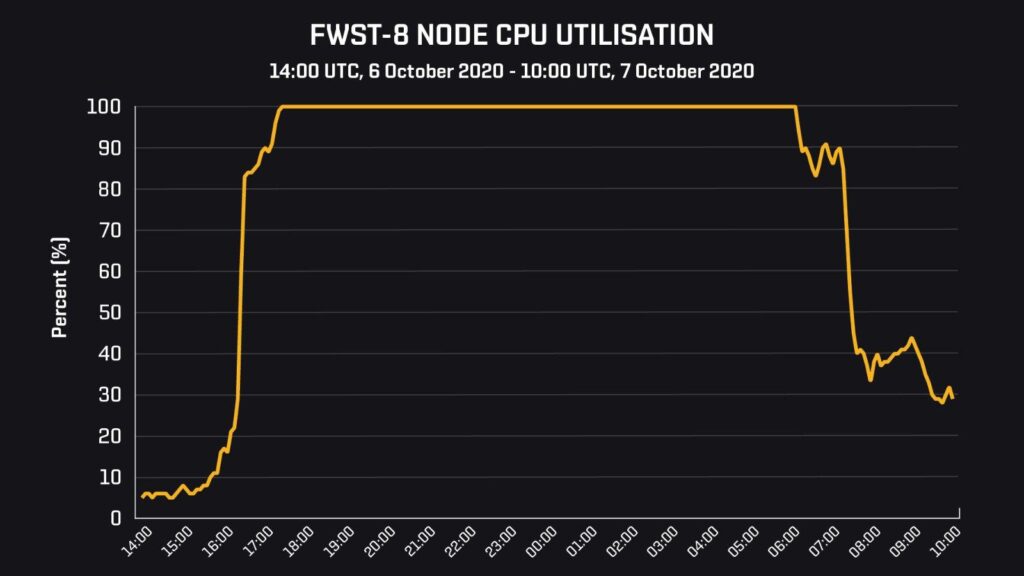
EVE Online (CCP Games). At FWST-8 in 2020 one star system held 6,557 pilots, with the server pinned at its limit for the whole fight.
Want to see how far it can go? In EVE Online, player corporations run wars, spy rings and treasuries, and a few of them are better organized than real companies we could name. Our honest view: if the budget forces a cut, cut a zone before you cut the guild tools. A zone gets cleared in a weekend. A good guild keeps players paying for years.
How to Make an MMORPG: A Step-by-Step Process
None of those five systems arrives finished. You prove each one small, build it wide, then keep it running for years, and if that sounds like a production plan, it is one. So how to make an MMORPG? Mostly through the same five stages as any big game, with two twists: every stage has to prove something about scale, not just fun, and the last one never ends. (The generic version lives in our guide to game development stages. Here we stick to what changes once the game is online and shared.)
| Stage | Who leads it | What it must prove before moving on |
|---|---|---|
| Concept and GDD | Game director, lead systems designer, producer | Target audience, business model, the one thing this MMO does that the incumbents don’t |
| Prototype and vertical slice | Small senior team, server engineer from day one | The core loop is fun and the server can carry it with a few hundred bots |
| Full production | Full team, pipelines for code, content and art | Content can be made at the rate the live game will need it |
| Load testing, alpha and beta | Server, QA, LiveOps, community | Stability at target concurrency, and retention among real players |
| Launch and live operations | LiveOps team, analysts, community managers | The live team can ship on schedule while the servers stay up |
Look at the right-hand column again. Only one row in five is about whether the game is fun.
Concept, Scope, and the Game Design Document
Concept is the cheap stage, which makes it the right one to argue in. What kind of MMO? For whom? Who pays, and how? Then open your game design document and look for the chapter most of them skip: target concurrency, world structure, launch regions and platforms, and which systems the server owns. If it’s missing, write it before anyone opens an engine.
Get the genre identity wrong and players will tell you, loudly. Bandai Namco spent eight years on Blue Protocol and the game didn’t make it to two years live; Japanese players kept saying they’d come for an MMO and found an action RPG. Throne and Liberty teaches the other lesson, about how long a fuzzy concept can drift. NCSoft first showed it as Lineage Eternal back in 2011, rebuilt it on a new engine and only shipped it worldwide in 2024 (the Wikipedia page has the whole saga). The stage ends when the director, the producer and whoever funds the game agree on one page about what the game is and isn’t. If the lore chapter in your GDD is longer than the server chapter, you’re writing a novel with a hosting bill.
Prototype and Vertical Slice
The prototype proves the core loop is fun with a handful of people. The vertical slice proves it at quality, with one zone, one dungeon and the real server architecture underneath, and then you put a few hundred bots on it and see what breaks. A slice that only works with eight developers on a LAN has proven one thing: that eight developers like it. In our experience, studios that bring a server engineer into the slice save themselves a rewrite; the rest discover their architecture in beta.
Decisions to Lock Before Full Production
Production is where headcount and burn rate jump, so anything still open at that point gets expensive fast. Before the team scales, we’d want a written answer to each of these:
- Target concurrency: per world, per zone, and for the biggest fight you’re willing to allow.
- World structure. Realms, zones, instances, one giant shard, or a mix. Then sketch how a player actually walks between them.
- Server authority. List what the client may guess; everything else belongs to the server.
- Engine, backend stack and hosting model, with a named owner for each.
- Platforms and launch regions, including whether mobile or console versions follow.
- Business model, and the shop, pass and event content it implies.
- Economy rules: the main faucets and sinks, and who owns economy telemetry.
- Content cadence after launch, in zones, dungeons and events per quarter.
- Build model. Who’s in-house, who’s a partner, and who signs off on the partner’s work.
- Beta exit numbers for concurrency, crash rate and day-7 retention, agreed now rather than in the beta post-mortem.
A slice that can’t answer most of these isn’t finished, however good it looks in the trailer.
Full Production: Code, Content, and Art Pipelines
Production is where the team grows from dozens to full size and the game gets wide. Level designers and environment artists build zones in parallel, quest designers script hundreds of quests, and engineers turn prototype systems into ones that survive scale. The question this stage must answer is not “can we build it” but “can we build it at the rate the live game will need.”
So measure it. Three numbers from production become your live content plan:
- weeks to build one zone, from blockout to final art;
- weeks to build and tune one dungeon or raid encounter;
- hours of play each of those delivers once it’s live.
Staff for the content treadmill now. Wait until launch and you’ll be hiring into a fire.
Load Testing, Closed Alpha, and Open Beta
For load testing you throw bots and scripted clients at the servers, well past the concurrency you expect, and watch what breaks first. It’s rarely the game server, in our experience; it’s the database or the login queue. Closed alpha brings in real players under NDA to test systems and balance. Open beta tests the infrastructure with the public and gives marketing its first wave. Marketing will want the beta to look like a party; the server team wants it to look like a stress test. Side with the server team. New World’s launch week, with hours-long queues and server shortages, is what happens when the party wins.
A beta should end with numbers: peak concurrent users held, crash rate, day-7 retention, and a list of every exploit found. The cheapest exploit you’ll ever fix is the one a beta tester reports.
Launch and Live Operations
Launch is the first day of the real project. From here the LiveOps team runs the calendar, which means patches, events, seasonal content, balance changes, battle pass tracks and store updates, along with a community that reacts to every one of them within the hour and remembers each misstep for years. Think of it as the games as a service model with the difficulty turned up. MMO players expect a roadmap measured in years, and every season needs fresh art, VFX and shop assets ready by a date marketing announced months ago.
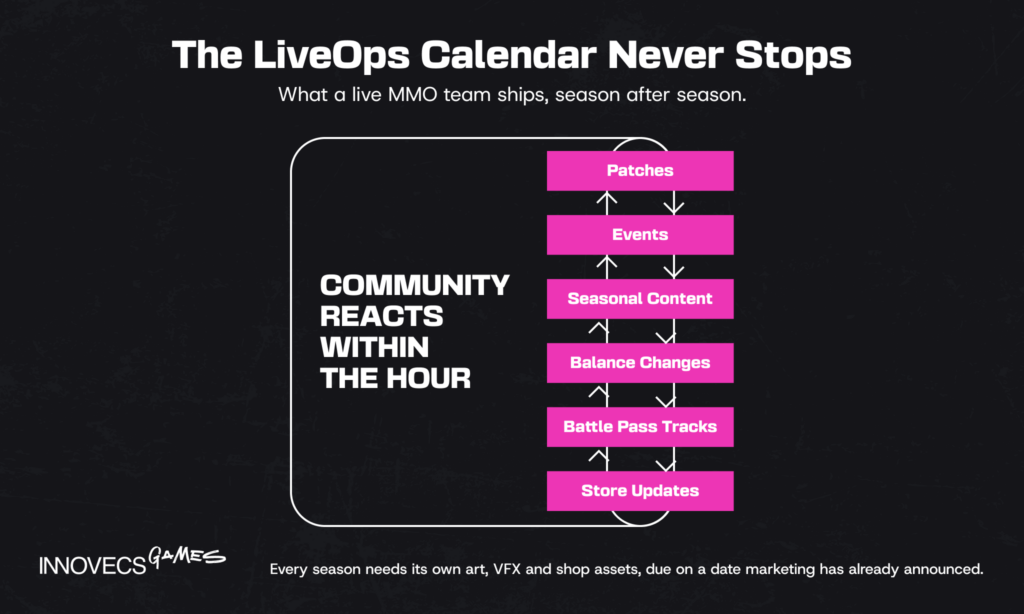
The calendar is the product after launch, and every slot on it needs content made in advance.
When it works, you get Final Fantasy XIV. Square Enix kept expansions and patches on a fixed rhythm for a decade, and by January 2024 the game had passed 30 million registered players (still the latest number they’ve given, and it counts free-trial accounts). The failure mode is quieter. It’s a roadmap with nothing on it.
Sometimes the right update is a step backwards. In 2013 Jagex relaunched RuneScape from a 2007 backup after players voted for it, and Old School is still going strong long after many MMOs launched since then have closed. Listening to players is a LiveOps skill, even when what they say is “undo the last six years.”
Choosing an MMORPG Engine and Tech Stack
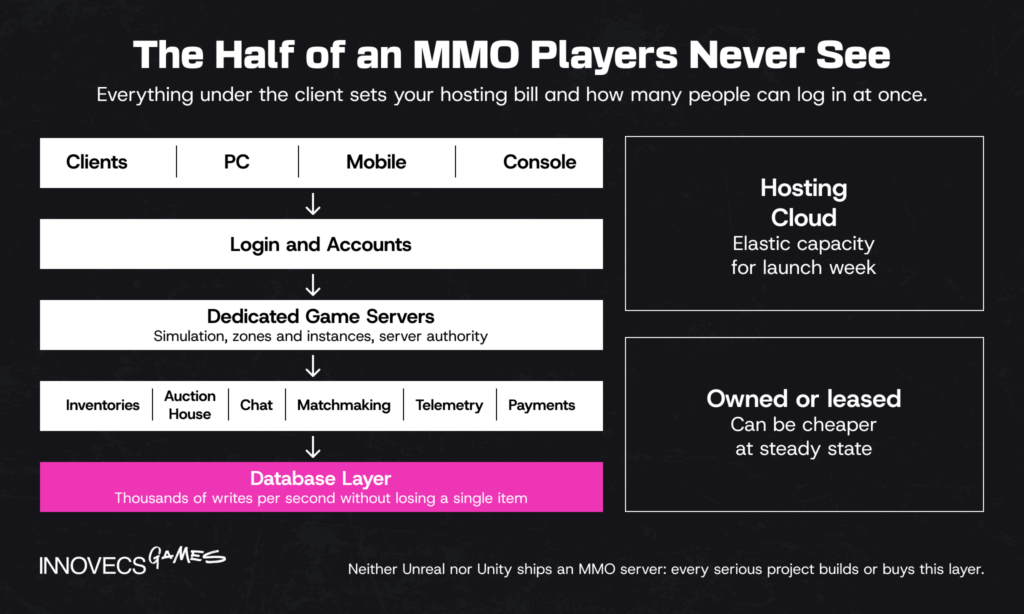
The engine and backend are concept-stage decisions, and they sit on the checklist above. They get a section of their own because they’re the hardest of those decisions to reverse once production starts. Most of the engine debate is about the client: rendering, animation, tools, platforms. For an online RPG, that’s half the decision. The other half, the backend, is the one that sets your hosting bill and your scalability ceiling, meaning how many people can log in at once. And no, neither Unreal nor Unity gives you an MMO server in the box. Every serious project ends up building one or buying one. For the client side compared directly, see our Unity vs Unreal breakdown.
| Option | Strongest fit | Shipped online RPG examples | Honest trade-off |
|---|---|---|---|
| Unreal Engine | High-fidelity PC and console worlds | Lost Ark (UE3), Throne and Liberty (UE4), Ashes of Creation (UE5) | Built-in replication is designed for session games; MMO scale needs custom server work, plus a 5% royalty above $1 million |
| Unity | Cross-platform PC and mobile, stylized art | Albion Online | Lighter visuals by default; networking and server stack largely your own |
| Proprietary engine | Studios planning a decade on one title | World of Warcraft, Final Fantasy XIV, EVE Online, Black Desert | Full control, at the cost of a second product to maintain and a smaller hiring pool |
Notice where the trade-off column lands for all three: the server. No engine on this list makes that decision for you.
Unreal Engine for High-Fidelity Worlds
If the pitch deck is mostly screenshots, the engine is probably Unreal. Huge open worlds and detailed characters on PC and console are its home turf. Its C++ codebase copes with big teams, too, and hiring is easier because more AAA people have shipped on Unreal than on anything else. The catch is networking. Unreal’s built-in replication was made for matches of a few dozen players, not zones of thousands, so MMO teams end up replacing or heavily extending it and running their own server processes. Put that work in the budget on day one and give it an owner and a milestone (a few thousand bots in one zone is a fair test), because nobody sells a plugin that does this job.
Unity for Cross-Platform and Mobile Projects
Unity usually gets the nod when one world has to run on a phone and a PC. Everybody’s favorite example is Albion Online, where Sandbox Interactive ships a single Unity project to PC, Mac, Linux, iOS, Android and Xbox, all into the same world, with Android as the performance baseline. You pay for that reach in custom work if you want high-end visuals, and while gameplay code is C# that plenty of mobile developers already know, picking the networking stack is largely on you.
Mobile and Cross-Platform MMORPGs
Albion’s choice of Android as the baseline isn’t a quirk. Outside the West, the mobile MMO is the main event. Sensor Tower’s data put MMORPGs at about 30% of Korea’s mobile game revenue for the first three quarters of 2025. And the newest hit over there was built cross-platform from the start: NCSoft launched Aion 2 on mobile and PC, it went straight to the top of both Korean app stores, and by September 2026 it had pulled in about $38 million from mobile in-app purchases alone. Western publishers moving into mid-core and RPG keep looking at numbers like these.
Cross-platform development here is a different job from shrinking a PC MMO. The hard constraints are hardware and sessions:
- Mid-range Android is the real target. Reviews get decided by asset compression, draw calls, frame caps in busy towns and how hot the phone gets, not by the flagship in the trailer.
- Sessions are short. People play on the bus, not across a four-hour raid night, which is the whole reason auto-play, idle progression and quick daily loops exist. PC purists call auto-play the game playing itself. Mobile players call it Tuesday.
- Cross-progression is expected. One account on phone, PC and maybe console means one backend, one economy, and a UI that has to work for thumbs and a mouse at the same time.
- Store readiness is a workstream of its own. Device-matrix QA, store compliance and (if console versions follow) certification all go smoother with people who’ve survived it before.
We’ve watched the same mistake play out more than once: build for PC, call mobile “a port”, then burn a year on performance work that should have shaped the art pipeline on day one.
Backend Services, Databases, and Cloud Hosting
That shared account is also the moment the backend stops being plumbing and turns into design. Backend here means everything that isn’t the game simulation: login, accounts, character data, inventories, auction houses, chat, matchmaking, telemetry, payments. Most studios combine dedicated servers for the simulation with a set of backend services and a database layer that can take thousands of writes per second without losing a single item, because a player will forgive a lag spike long before they forgive a missing sword. Cloud hosting gives you elastic capacity for launch week. Owned or leased hardware can be cheaper at steady state.
Newer approaches are worth watching. Clockwork Labs built BitCraft Online on its own SpacetimeDB, which merges the database and the server logic into one system, and in January 2026 published the game’s server code for anyone to read. Whichever backend frameworks you pick, load-test the database early. Databases like to fail quietly for months and then loudly, on the one night everybody’s watching.
Team Roles Behind a Successful MMO
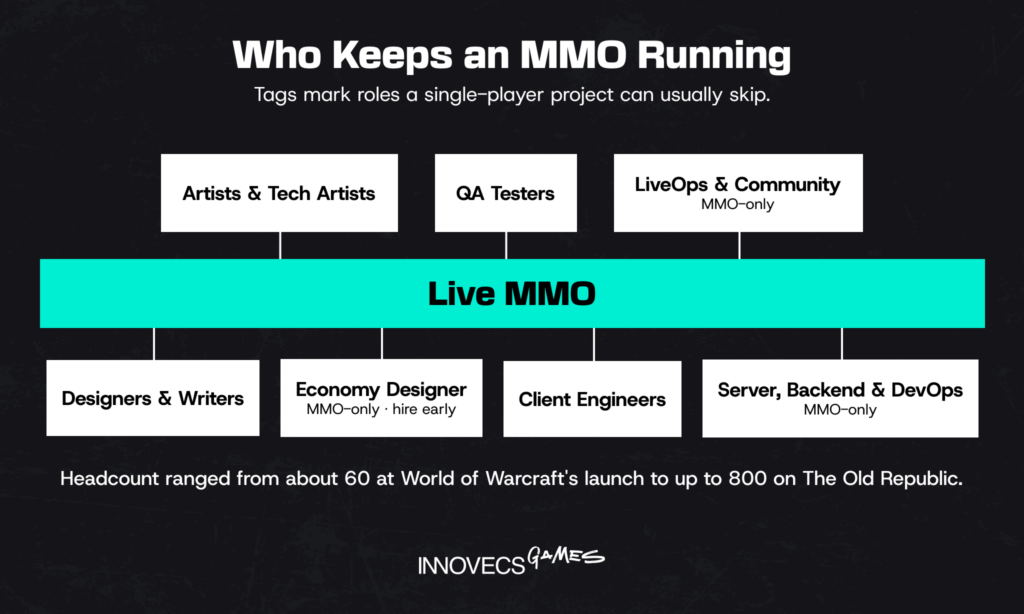
Every layer of that stack, and every system before it, needs an owner, and headcount varies by an order of magnitude. World of Warcraft was built by a team of roughly fifty people and shipped with about sixty, while Star Wars: The Old Republic took 800 people on four continents six years. What changes less is the shape. MMO game development also pulls in whole disciplines a single-player team never hires: server engineers, database people, a LiveOps crew, community managers, and usually somebody whose entire job is the economy. The four groups below are where those differences show up.
Designers, Systems Designers, and Writers
On paper the split is simple. The game designer holds the vision; systems designers own the parts that collide (progression, combat math, crafting, the economy). In an MMO those parts get retuned for years against live data, so the systems designers we’d hire are the ones who can read a telemetry chart in the morning and survive a thread of furious players by lunch. Writers and quest designers, meanwhile, feed the story to a live calendar that has never heard of writer’s block. Don’t underestimate the volume, either. Final Fantasy XIV’s Dawntrail has enough cutscenes to watch The Lord of the Rings trilogy twice, and somebody wrote, voiced, localized and tested every minute of it.
One role we’d add early: an economy designer whose only job is faucets and sinks. Nobody notices the role until the auction house breaks.
Client and Server Engineers
Client engineers build what players see. Server engineers and network programmers own the side where the actual game lives: simulation, replication, persistence and every service hanging off them, kept upright by backend, database and DevOps people. A single-player studio can usually get by with one engineer who “does the networking stuff.” An MMO needs a team, and its most senior hire is usually the server architect, not the graphics programmer. The graphics programmer will disagree, and the first launch night will settle it.
Artists, Animators, and Technical Artists
Nothing out-eats an MMO on assets, and every one of them has to look good with a hundred other players in frame. Character artists, 3D artists and animators make the stuff, level designers turn it into places, and for a big content push, outside level design services are a common way to add hands without adding headcount. Technical artists sit between art and engineering and keep the frame budget honest, which is why many teams add them through a game technical art partner during production. A raid boss with gorgeous particle effects is lovely right up until forty players use their cooldowns at once.
Some specialists you need for weeks, not years. Think of a cinematic trailer before beta, a VFX pass for a new raid, a shop UI overhaul, a lighting artist for the last pass on launch zones or a mocap session for a new class. You’ll never keep any of them busy full-time, so figure out where they’ll come from before the week you need them.
QA, LiveOps, and Community Teams
MMO QA isn’t level testing. QA testers go after systems, balance and load, and they do it all over again on every patch. LiveOps plans and ships the events and updates, with analysts telling them what’s landing and what isn’t. Community managers carry the conversation with players, and in an MMO that conversation is a feature: players forgive a lot from a team that talks to them, and very little from one that goes quiet. Naoki Yoshida’s regular Letter from the Producer livestreams for Final Fantasy XIV are the model here: a director explaining decisions on camera, bad news included. These are the roles most often missing from early budgets, and the ones the game can’t run without on day two.
Costs and Timelines: What Studios Should Expect
Those people, multiplied by the years it takes, are most of the development budget. The totals are hard to find, though, because publishers rarely disclose MMO budgets and the live phase never really closes the books. The public figures that do exist mostly describe the high end. For how platforms, genres and regions move a general budget, our breakdown of the cost to make a video game goes deeper; below is what’s specific to an online RPG.
Budget Ranges by Project Scope
| Project | Public budget or funding | Team | Development time | Source |
|---|---|---|---|---|
| Star Wars: The Old Republic (2011) | About $200 million to launch | Up to 800 people | About 6 years | GameSpot, citing the LA Times |
| Star Citizen (in development) | $1 billion crowdfunded by May 2026 | Not disclosed | 14 years and counting | Simulation Daily |
| Ashes of Creation (2025 Early Access) | $3.27 million Kickstarter, mostly founder-funded beyond that | About 250 people | 9 years | GamesRadar, Wikipedia (linked above) |
| World of Warcraft (2004) | About $63 million, a widely cited estimate Blizzard never confirmed | About 50 to 60 people at launch | About 5 years | Massively OP, Blizzard Watch |
Those rows describe what was possible, not what’s typical. For planning, we group projects into three scopes:
| Scope | What it usually means | Indicative budget to launch |
|---|---|---|
| Small or indie | One shared world for a few thousand concurrent players, stylized art, a narrow feature set (often survival or sandbox) | $2 million to $10 million |
| Mid-size | Tens of thousands of concurrent players, several zones, PvE and PvP, cross-platform or mobile | $10 million to $50 million |
| AAA-scale | High-fidelity world, hundreds of thousands of concurrent players at launch, multiple regions and platforms | $50 million to $300 million+ |
Real projects rarely sit neatly in one row, and the arguments happen on the borders. Our favorite: a small team pitching one unbroken world for a hundred thousand players. That’s a mid-size budget written on an indie spreadsheet.
What drives the numbers? Concurrency first, because it sets server architecture, backend complexity and load-testing effort. Content volume at launch second, since every zone and dungeon is labor. After that come fidelity, the number of platforms, the business model (a shop and a battle pass are systems and art, not just prices) and the live team you mean to keep.
If the budget is fixed, fund it in gates. Release money stage by stage, against the exit criteria in the process table above, so a concept that fails its slice costs a slice and not a production. Investors and publishers tend to like it (it reads as discipline), and your team gets a clear moment where saying “not yet” is allowed.
Typical Timelines From Concept to Launch
Plan on four to six years to launch for a full MMORPG. World of Warcraft took Blizzard about five; The Old Republic took BioWare about six. Go past that and it’s rarely because the team was slow. Somebody kept adding to the scope, and MMO scope behaves like a gas: it fills whatever budget you leave lying around. Blue Protocol took eight years; Ashes of Creation nine.
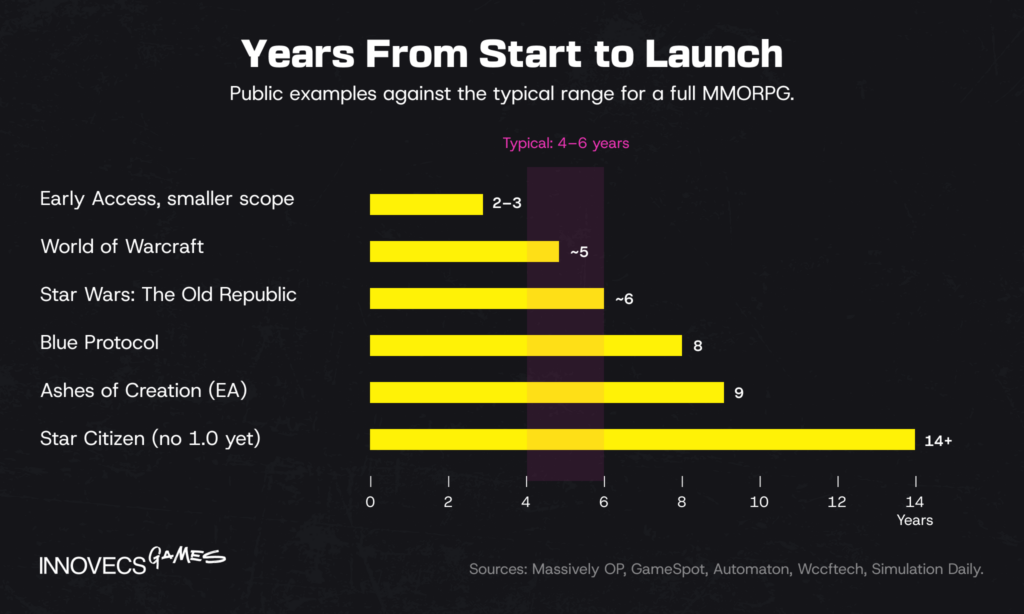
Smaller scopes and Early Access can bring a first public build in two to three years, at the price of building the rest in front of paying players. Final Fantasy XIV shows the other extreme. Its 1.0 launch went so badly that Square Enix rebuilt the game as A Realm Reborn, kept the broken original running in the meantime, carried over as little as 10% of the old assets and relaunched in August 2013.
Ongoing Costs: Servers, LiveOps, and Moderation
The launch budget is the down payment. The same LA Times report that put The Old Republic at $200 million also said “tens of millions” a year would go into updates. The recurring lines look like this:
- server and cloud hosting that scales with players, in every region you run;
- a LiveOps team shipping content, events and store updates on a schedule;
- support tickets, moderation and anti-cheat, none of which ever really gets quieter;
- community management, localization of every patch, and analytics.
Ashes of Creation’s cloud dispute is the cautionary version: a provider suing over more than three years of unpaid fees, according to the Wikipedia entry cited earlier. Our rule of thumb: nobody signs off the launch budget until two years of running costs sit on the same sheet, priced at a realistic player count rather than the beta peak.
How MMORPGs Make Money: Subscription, Buy-to-Play, and Free-to-Play
Whether that check passes depends on the model you pick, and honestly the model shapes production about as much as it shapes revenue. Each one creates its own content demands, from the shop’s art pipeline to how often the live team has to ship.
| Model | Shipped example | What it asks of production |
|---|---|---|
| Subscription | Final Fantasy XIV, World of Warcraft | Steady, visible content every month to justify the fee; lower shop pressure |
| Buy-to-play, often with an optional subscription | The Elder Scrolls Online, Guild Wars 2 | Paid expansions or seasons, plus a premium membership worth keeping |
| Free-to-play | Lost Ark, Throne and Liberty | A shop, battle pass and event art pipeline from launch; constant monetization assets |
Models also change mid-life, and each change is a production event in itself. ZeniMax has reworked ESO’s model three times: it dropped the mandatory subscription in 2015 for buy-to-play plus an optional ESO Plus membership, switched to paid seasonal Content Passes in 2025, then for 2026 made new content free and bolted on a seasonal battle pass. Each switch meant new store systems, new UI, and new art on a fixed date.
Free-to-play doesn’t mean no money up front, either. Before Lost Ark had even launched in the West, players bought more than 1.5 million Founder’s Packs from Smilegate, about $75 million worth in two days, according to Korea Economic Daily. Our advice is to pick the model before the vertical slice and staff for the content it implies. If we had to bet on one model for a new mid-size Western MMO, we’d take buy-to-play with an optional subscription: the box price filters out bots and tourists, and the subscription rewards the people who stay. Whichever you choose, avoid anything players will read as pay-to-win. In a shared world, one player’s purchase is every other player’s problem.
Common MMORPG Development Challenges and How to Avoid Them
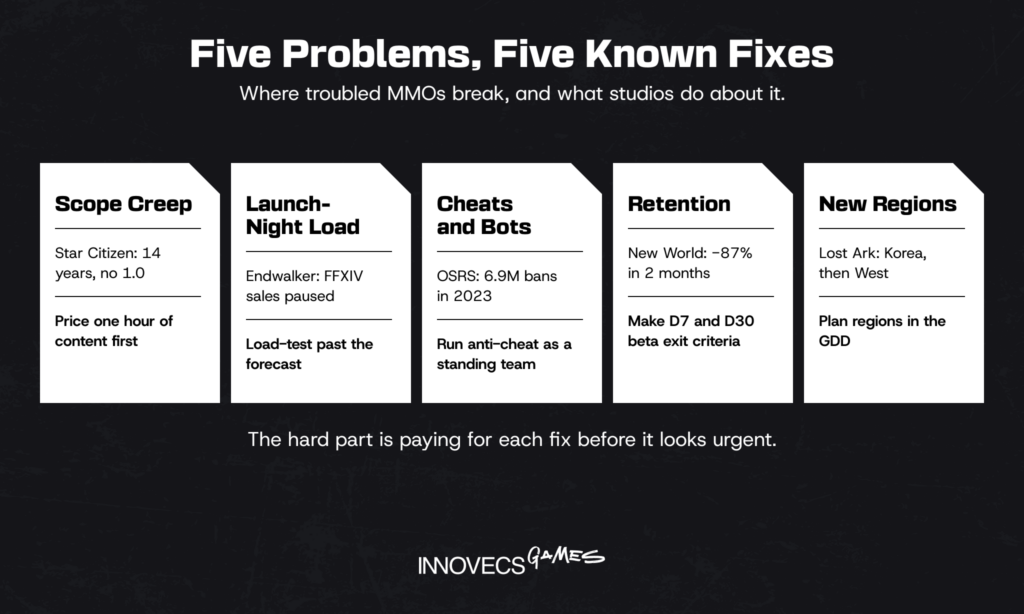
Picking a model is the easy part. Keeping the game alive long enough for the model to pay off is where projects actually fail, and if you read enough post-mortems you’ll notice the same five problems over and over. None of them is a secret. What surprises us is how often big, well-funded teams walk into them anyway. Every one has a known fix; the hard part is paying for it before it’s urgent.
Scope Creep and the Content Treadmill
Scope creep hurts more in an MMO, because every feature you add turns into a permanent cost: servers, testing, balance passes and content, forever. Star Citizen is the extreme case. Cloud Imperium has raised a billion dollars, still hasn’t shipped 1.0 after fourteen years, and now points to 2027 or 2028. That works only because its backers keep funding it, a business model most CFOs would not sign off on twice. Most studios don’t have that option.
After launch the same problem gets a new name, the content treadmill: players chew through in days what took you months. Same disease, same medicine. Before launch, find out what one hour of play actually costs you to make. Then plan the roadmap off that number rather than the wish list, and say no more often than feels polite.
Server Stability at Launch
Launch week is when your architecture finally meets the public, at peak concurrency. Blue Protocol’s Japanese launch day drew 200,000 concurrent players, and plenty of them spent it trying to squeeze into full servers. Veterans aren’t immune either. Square Enix, of all studios, had to pull Final Fantasy XIV from sale when Endwalker arrived in December 2021, because more people wanted in than the servers could hold. The cure is dull, and it works. Load-test past the forecast. Treat the queue screen and login throttling as features somebody designs on purpose, not a 2 a.m. hotfix. And don’t let the server engineers book holidays in launch month. A queue is irritating. A rollback is a reputation.
Cheating, Exploits, and Bots
Put a price on anything in an MMO and someone will farm it, dupe it or sell it on a sketchy website. Old School RuneScape puts numbers on that. Jagex banned 6.9 million accounts in 2023, then cleared out more than 6.2 million bots in the first half of 2026 alone, and players suddenly found their old farming spots empty.
That’s why we’d never put anti-cheat on a launch checklist. It’s a standing operation. The server stays in charge of anything that matters; every economy event gets logged, so a dupe can be traced to an account and to the patch that opened the hole; and anti-cheat gets its own people, its own roadmap and a voice in planning. The bots will be back next week.
Player Retention After the First Month
Expect the drop. Launch-week tourists were never yours to keep. What matters is how many leave and whether the bleeding stops. New World lost about 87% of its Steam crowd in two months, sliding from 913,027 at the peak to 119,135. That didn’t kill it outright. Amazon paid to keep it going for four more years, stopped development in October 2025, and is switching the servers off on January 31, 2027.
We’ve read a lot of MMO post-mortems, and they get repetitive fast. The endgame runs dry before the first content patch. Or the economy breaks under dupes and inflation. Or progression splits the population into groups too small to fill a dungeon. You can catch all three in beta if day-7 and day-30 retention are exit criteria rather than nice-to-know numbers. Same with the first three months of content after launch: if it isn’t planned by launch day, it’s already late.
Launching Across Regions and Platforms
Games that keep their players usually go looking for more. Usually that means a second region, and moving an MMO abroad is a project in itself. Take Lost Ark. Smilegate launched it in Korea in 2019; the Western version needed until February 2022, a publisher (Amazon Games), a full localization pass, new servers and, on day one, a delayed server deployment. Worth it, judging by Steam’s chart: 1,325,305 people online at the peak.
Expect a shopping list per region. Data centers close enough for decent ping. Text and voice localization for every patch, forever. Somebody also has to sort out local payments, age ratings and privacy law, and you’ll often want a community team that speaks the language. The art might need a pass as well, because a character design that sells in Seoul can read very differently in São Paulo or Seattle. So write the regions into the GDD on day one. Retrofitting a pipeline for ten languages is far more painful than building it that way from the start.
In-House, Outsourcing, or Co-Development: Choosing How to Build Your Game
Even Smilegate didn’t take Lost Ark west alone. It brought in a publisher. Very few game studios build an MMO entirely by themselves, and we’d argue almost none should. For a studio head, then, the question isn’t whether to bring in outside help but which parts, and how tightly that outside team gets stitched into yours. Our rough comparison:
| In-house | Outsourcing specific disciplines | Co-development | |
|---|---|---|---|
| Control | Full | Defined by the brief and acceptance criteria | Shared; your leads set direction |
| Speed to scale | Slowest: senior server hires take months | Fast for defined work | Fast, with a few weeks of onboarding |
| Cost profile | Highest fixed cost, cheapest hour long-term | Pay for scope delivered | Monthly team cost that can flex |
| Main risk | Hiring and carrying a live team between peaks | Briefs go stale on systems that change weekly | Needs shared tools, pipelines and trust |
| Fits best | Core design, server architecture, the IP | Art volume, QA, porting, localization | Whole features, content production, LiveOps support |
No column comes without risk. The trick is choosing the risk your team is good at babysitting.
Building Fully In-House
Keep the brain of the game at home. Your director, systems leads and server architect carry ten years of decisions in their heads, and you don’t want that knowledge on someone else’s payroll. The price is speed. Very few studios can carry every discipline at full strength for six years, and the ones that try usually find out in the first quiet quarter after launch, when half the floor has nothing urgent on its plate and payroll hasn’t noticed.
Outsourcing Specific Disciplines
If you can write it in a brief and check it when it lands, game development outsourcing will handle it. Think environment and character art, animation packs, QA passes, localization, porting. MMOs generate mountains of exactly that. Where it creaks is live systems that change weekly, because by the time the work comes back, the brief describes a game that no longer exists. Keep the systems in. Send the volume out.
Co-Development With an Experienced Partner
Co-development is the closer arrangement. Their people commit to your repo, sit in your sprint reviews and use your tools, with their own lead keeping them pointed the right way, and the milestone risk is shared. For an MMO, where content, features and live-ops never quite stop, that’s usually the shape you want. Even the giants work like this. Throne and Liberty was NCSoft’s game; getting it to Western players was Amazon Games’ job.
If you’re vetting an MMORPG game development company for this, three questions sort them quickly. What server or backend work have you shipped? Do you do staff augmentation, dedicated teams, or both? And what did your first month inside someone else’s live codebase look like? Expect game co-development services to cost more per month than freelancers, and to need a few weeks before they’re fully up to speed. What you get back is a team that scales up for an expansion and down afterwards without anyone on your side being laid off.
Making External Teams Work on an MMO
Most vendor horror stories we hear from big online games aren’t about talent. They’re about how the work was set up. Here’s what we’d do instead:
- Start with a paid pilot. One zone, one feature or one event’s art pack, accepted against written criteria, before any monthly team is signed.
- Lock style before volume. A style guide with finished examples at in-game distance, and a test asset reviewed by your art director, keeps a third vendor’s armor from looking like a different game.
- One tracker, one build. Partners commit to your repo and close tickets in your tracker. If it doesn’t run on your build machine, it isn’t done.
- Name one producer on each side. Without one, guess who ends up answering vendor questions at 11 p.m.? Your leads.
- Fewer, bigger partners. Each vendor you add is another contract, another onboarding and another weekly sync that nobody budgeted for.
Burst capacity is the other reason to set this up early. In our experience, MMO milestones don’t slip because a team is bad. They slip because five leads are trying to build the game, mentor juniors and herd outside help in the same week. Something gives, usually sleep first and the milestone second. A partner who already knows your build can bring in extra people within weeks. Hiring them yourself takes a quarter, on a good day.
Planning a Multiplayer RPG? Get an Expert Look at Your Scope
Not sure yet about the server architecture, the team size, or what to keep in-house? A second opinion never costs less than before production starts. Send us the concept and your target concurrency, and our engineers will go through the scope and tell you which risks we’d tackle first.
How AI Is Changing MMO Development in 2027
However you staff the game, part of the work now goes to tools rather than people. AI tools are in most big pipelines by now, and oddly, people like them less each year. GDC’s 2026 State of the Game Industry survey caught the mood: 36% of developers use generative AI at work, yet 52% think it’s bad for the industry, up from 18% two years before. For MMO game development we’d skip the yes-or-no debate. The better question is where it saves real hours and where it quietly opens a new hole.
AI-assisted coding. We like assistants for the dull stuff. Scaffolding a service, writing a data migration, knocking up a test harness or a little tool for designers: fine. Trust drops sharply once they touch the code that makes an MMO an MMO. Replication rules, server authority and concurrency are exactly where a confidently wrong suggestion becomes next month’s exploit. Every generated change to server code still needs a senior review.
Automated QA and bot-based load testing. Here AI clearly pays for itself. Bots don’t get tired or bored, which is the whole point. Leave them on a build overnight and by morning they’ve played thousands of sessions, battered the login flow and walked every quest chain the patch touched. No human QA team gets you to realistic concurrency on its own.
Procedural world and quest generation. Terrain dressing, foliage, quest variations: procedural tools crank these out faster than any team, and a world filled this way does look full. Whether a zone is worth remembering, or a quest worth doing, is still a designer’s call, and players can spot a generated fetch quest from three zones away.
AI-driven NPC dialogue. NetEase’s Where Winds Meet shipped NPCs that respond to free-text chat, reportedly using DeepSeek models server-side. Within two weeks of its November 2025 launch, players had found they could type a stage direction into the chat to make a quest’s missing characters appear and claim the reward. In an MMO, anything that hands out rewards is part of the economy, and an LLM that takes instructions from players is an attack surface. Give players a chatbot blacksmith and someone will try to talk him out of his inventory before lunch.
Anti-cheat and moderation. Spotting bot behavior, gold-selling patterns and toxic chat across millions of events is a natural job for machine learning, and Old School RuneScape’s 2026 ban waves show what better detection does to a bot economy. False positives are the limit. An automated ban on a real player is a support ticket at best and a public controversy at worst, so humans still review the edge cases.
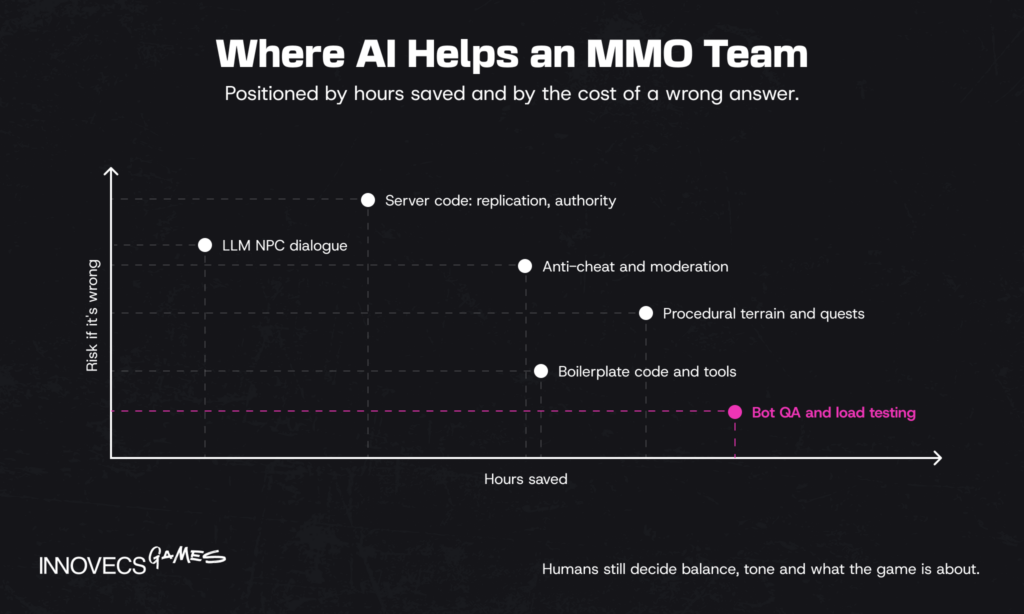
Where we’ve landed: AI gets you to a first draft sooner, and it makes testing a lot cheaper. It doesn’t change who decides balance, tone or what the game is about. For the broader picture across genres, see our piece on AI in game development.
How Innovecs Games Supports Online RPG Projects
Tools change. The gaps studios call us about are still people-shaped. Usually there’s a solid core team with one obvious hole in it. Sometimes that’s server and backend engineers; other times it’s a content push before beta, technical art for crowded scenes that blow the frame budget, mobile optimization, or LiveOps help once the game is out. Innovecs Games has delivered 300+ titles over more than a decade, with 200+ developers and artists across the US, UK, EU, Israel, Australia and Ukraine. Clients such as Zynga and JamCity run live games, and we’re listed on IAOP’s Global Outsourcing 100.
Our MMORPG game development services are built around joining your production rather than replacing it:
- Engineering: networking, backend, tools and performance work, including mobile optimization.
- Content: art, level design and VFX capacity for zones, seasons and event packs, matched to your style guide.
- QA: functional, device and load testing on every patch.
- Co-development pods: whole features owned by a team with its own lead.
- Full-cycle development when a publisher needs a complete team.
Every engagement gets a dedicated producer on our side who reports in your tools and on your cadence. Teams with strong in-house staff often use us for overflow when time-to-market gets tight before a milestone, or to run a parallel prototype while their own people stay on the live game.
One honest note: a dedicated team from us costs more per month than individual freelancers, and it’s the wrong shape for a two-week prototype. That’s why we usually start with a paid pilot small enough to judge. The range of work behind these numbers is in our portfolio.
FAQ
What does MMORPG game development involve?
Two jobs, really. First you build it: a shared RPG world plus the servers, backend and tools nobody sees. Then comes the longer job of running it, which has no real finish line: patches, events, fresh content and the odd emergency rebalance at midnight.
How much does it cost to make an MMORPG?
It ranges wildly. At the cheap end, a small stylized world can come in at a few million dollars. At the other sits Star Wars: The Old Republic, where BioWare’s bill reportedly reached about $200 million. What moves you from one end to the other is mostly concurrency, launch content and how good it has to look, and that’s before running costs, which arrive every year the servers are on.
How long does it take to develop an MMO?
For a full MMORPG, think four to six years (Blizzard spent roughly five on World of Warcraft). Blue Protocol needed eight and Ashes of Creation nine, and neither is still running. Want something in players’ hands sooner? Cut the scope or go Early Access, and two or three years is doable.
Can a small indie studio realistically build an MMORPG?
Yes, if nobody lies about the scope. The small MMOs we’ve watched survive kept things modest: one world, not many features, and a few thousand people online rather than a hundred thousand. What usually kills a small team isn’t the build at all. It’s the server bill that keeps arriving afterwards, so put a number on it before anyone writes code.
Which game engine works best for a massively multiplayer online game?
Honestly, it depends on the game. Unreal wins most pitches that live on high-end PC and console visuals; Unity tends to win when phones and PCs have to share a world. Plenty of the old giants run their own engines. Whatever you pick, the server is on you, so don’t spend the whole debate on the client.
What does MMO stand for in gaming?
It’s short for massively multiplayer online. The RPG part means leveling characters, quests and a persistent world; MMOs without it can be shooters, survival games, even space sims like EVE.
How big does the development team need to be?
Smaller than you’d think, at least at first. World of Warcraft shipped with about sixty people; The Old Republic used up to 800. We’ve seen tightly scoped MMOs launch with 15 to 40. After launch, though, the live team’s size matters more than the peak, since it sets how fast new content shows up.
Is it better to outsource or co-develop a multiplayer RPG?
Usually both, just for different work. Send out defined jobs like art packs, QA passes or localization, and bring in co-development for the work that never stops: features, content production, LiveOps. Core design and server architecture tend to stay in-house.
🤖 How is AI used in online game development today?
So far, mostly coding help, automated testing, bot-driven load tests and procedural content. Some games, like Where Winds Meet, also use language models for NPC conversations. Roughly a third of developers use generative AI at work, according to GDC’s 2026 survey, and mostly for research and brainstorming.
🤖 Can AI-driven NPCs and procedural content replace hand-made quests?
Not yet, in our view. LLM-driven NPCs are fine for optional chatter, but people still write the main quests and story beats. Players have already talked AI NPCs into handing out rewards, which is a real problem in any MMO economy. And procedural tools can fill a world without deciding what a quest is for.
Ready to Start Your MMORPG Project? Let’s Talk
Whether you’re scoping a new world or need extra hands on a live one, our team can join your MMORPG game development at the stage you’re in. Send us your concept, target platforms and concurrency goals, and we’ll come back with the team and first steps we’d suggest.