Match 3 Game Development: How to Build a Puzzle Game Players Keep Coming Back To
Written for producers and tech leads who already have a board that works and now need the hard part: level 600, the events calendar, the team to run it, and a budget that survives contact with soft launch.
Picture the greenlight review. Your prototype board feels good, the first thirty levels test well, and the publisher’s head of production scrolls straight past all of it to ask one thing: what does level 600 look like, and who’s building it in month eighteen? Most match 3 game development plans we get shown can’t answer that yet. It’s the answer that decides whether the game ever earns anything.
You can see why the question comes first. AppMagic counted 120 new match-3 releases in the first half of 2026, and not one of them crossed $100,000 a month in in-app revenue (unless you count a Vietnamese build of Gardenscapes, which AppMagic itself files under technicality). Over the same six months the genre took around $2.4 billion, more than half of all puzzle IAP. The money hasn’t gone anywhere. It’s going to games that launched years ago and haven’t stopped shipping since.
So the swap itself gets one section here, and everything built around it gets the rest. That means seven production steps, the meta that carries players past level 100, the engine and the team, three ways to staff the work, budget ranges we’d put our name to, and the production tips we find ourselves repeating.
What Makes the Match-3 Genre Different and Why It Still Wins on Mobile
So what is a match 3 game, exactly? Short version: you swap (or link) neighboring pieces until three or more of a kind line up, they pop, new ones drop in from the top. Then the level throws a goal at you. Twenty red gems, say, or all the ice broken, or a cake dragged down to the bottom row, and you only get so many moves to do it. The family tree is short. Eugene Alemzhin’s Shariki set the rule on MS-DOS in 1994, PopCap’s Bejeweled took it to the web in 2001, and in 2012 King wrapped it in a level map with lives and boosters and called it Candy Crush Saga. That game turned fourteen this year. In mobile years, that’s roughly as old as chess.
Has age hurt it? Not much. Naavik’s analysis of Sensor Tower data puts puzzle IAP above $10 billion in 2025, behind only strategy, and match-3, merge and blast titles took something like 70 to 75% of that pile. Royal Match alone pulled in over $1.4 billion that year; Candy Crush Saga, a bit over $1.1 billion. And 2026 hasn’t changed the order much. AppMagic estimates have Royal Match at $884 million for the first half, 12% of all puzzle spending, with Candy Crush slipping to third behind a merge game, Gossip Harbor. We can’t think of another casual genre that squeezes this much money out of a two-minute session, and match 3 puzzle games do it with players who (per Mistplay’s survey, quoted in the same report) mostly just want to relax.
Here’s the catch, though. AppMagic’s newest numbers show the genre’s revenue flat while downloads climb about 10%, so growing now means taking someone else’s players. Newcomers do break in. They just tend to win on execution, not on some brand-new idea. Good Job Games’ Match Villains made about $30 million in IAP in the first half of 2026, and it did it while juggling some twenty event formats at once. Oh, and Royal Match’s toughest new rival? It came out of the same building. Dream Games’ second title, Royal Kingdom, has made about $510 million in IAP since its November 2024 global launch, more than Royal Match earned over those same months ($465 million).
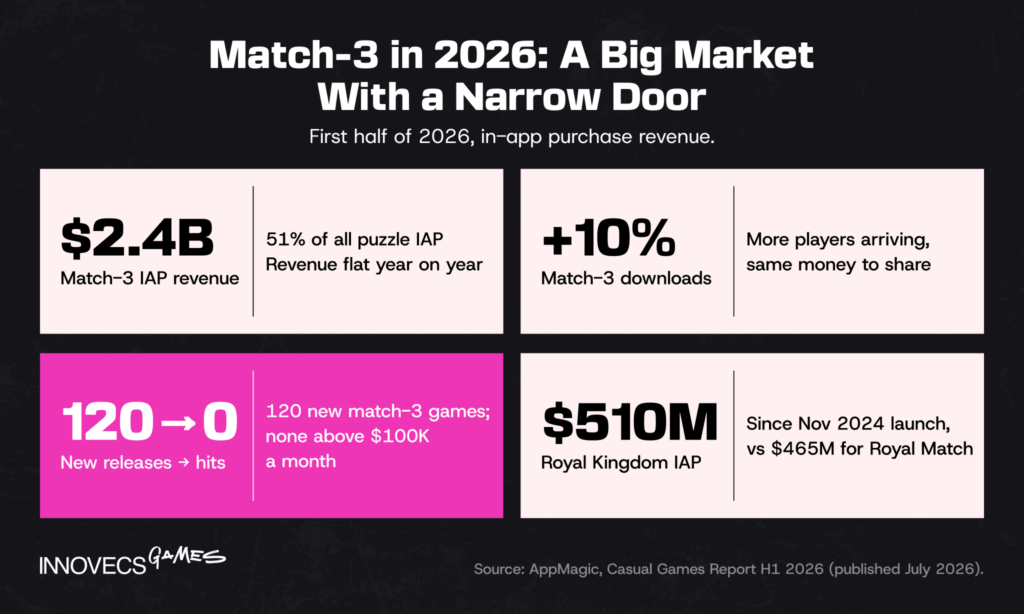
That’s the pattern behind every match-3 hit worth studying. Levels, meta and LiveOps decide who wins, and that’s also where the budget goes. It’s the part of the work our puzzle game development services are built around, and the reason most of this article is about what happens after the first swap.
Core Mechanics Every Match-3 Game Is Built On
In 2018 a designer called Kirill Razumovskiy sat down and catalogued 45 level mechanics from top match-3 games for Game Developer: portals, conveyors, wind, flood and plenty stranger. Look closely, though, and almost every one of them is doing one of three jobs. It changes how a move works, or what a match leaves behind, or what’s in the way. Hence the three groups below.
Swap, Link, Collapse, and Shooter Mechanics
The input verb is the first decision, and it changes far more than controls. A swap game rewards spotting patterns two moves ahead. Linking rewards tracing paths. Blast games (the collapse family) are different again: tap any clump of two or more and it’s gone, which makes them quicker to play and much more dependent on special pieces. And shooters? You’re aiming and bouncing shots off walls, so the board puzzle quietly turns into a physics one.
| Family | How a move works | Well-known example | What it changes in production |
|---|---|---|---|
| Swap | You trade two neighbors to make a line of three or more | Candy Crush Saga, Royal Match | Expect the heaviest special-piece and combo work, and most of your tuning time goes into cascades |
| Link | You drag a path through touching pieces of one color | Two Dots | The board code gets simpler; the work moves into path feedback and level shapes |
| Collapse (blast) | You tap any group of two or more | Toon Blast | Sessions run faster, so you’ll need more levels at launch than you think |
| Shooter | You fire a piece into a cluster to match three | Bubble Witch 3 Saga | Physics, aim assist and a ceiling that keeps dropping take over from the grid |
The blast family is smaller, but it’s not dead: AppMagic has match-2 blast games at $257 million for the first half of 2026, with downloads up 35%. Triple-match 3D games like Peak’s Match Factory sit further out, honestly closer to sorting than to grids. Our advice? Pick a verb your team has already shipped, unless the twist is the whole point of the game. Most of the expensive surprises live in the board code.
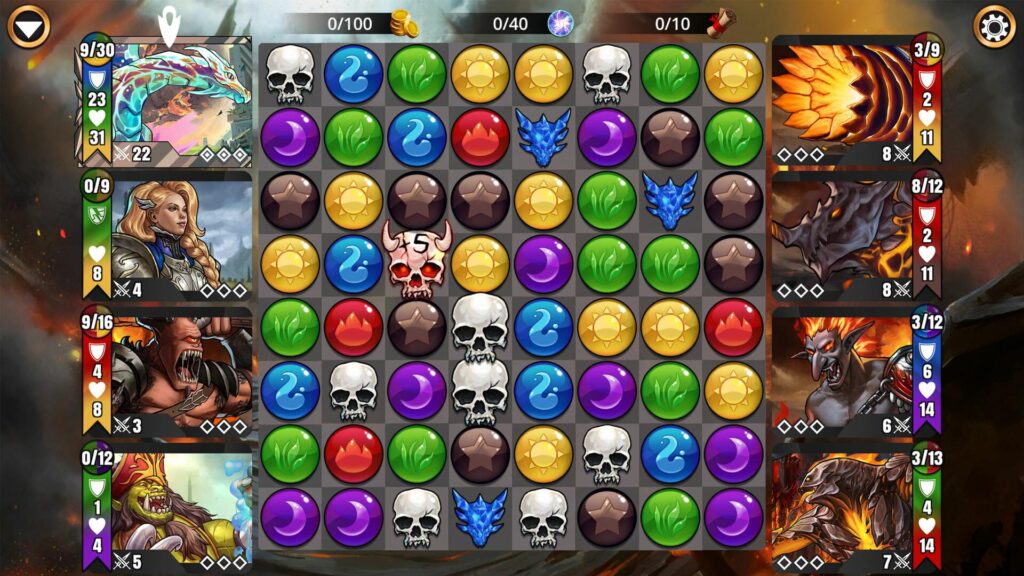
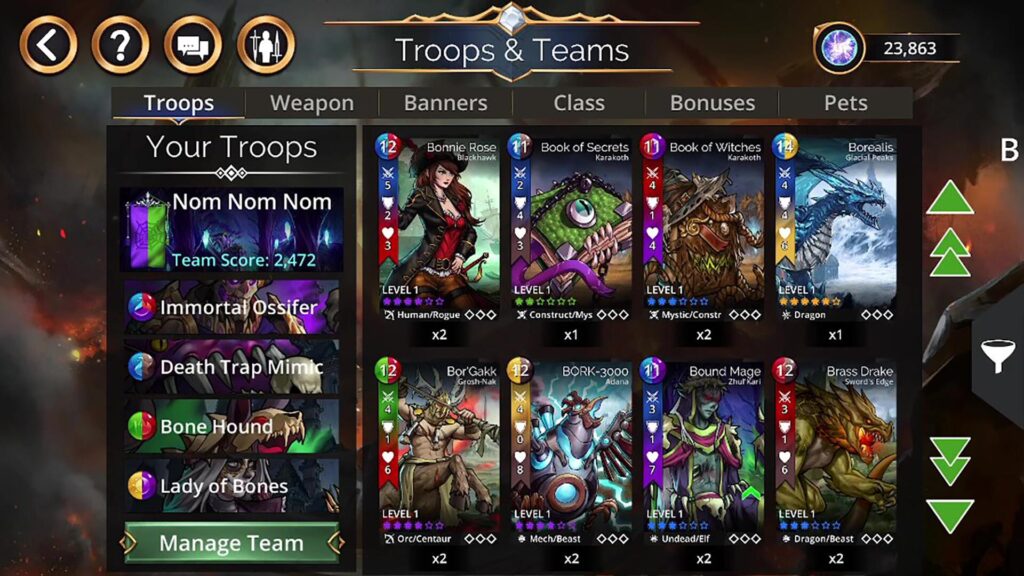
What about hybrids? They pull the genre toward mid-core. GungHo’s Puzzle & Dragons and Small Giant’s Empires & Puzzles turned every match into an attack (swap, deal damage, level up a hero between fights), and Harry Potter: Puzzles & Spells slips hidden-object scenes in between its match-3 levels. Each hybrid drags the other genre’s workload along with it. RPG hybrids need combat balancing and a lot of character art; hidden-object ones need scene after illustrated scene. Budget for both games, not one and a half.
Boosters, Special Tiles, and Combo Logic
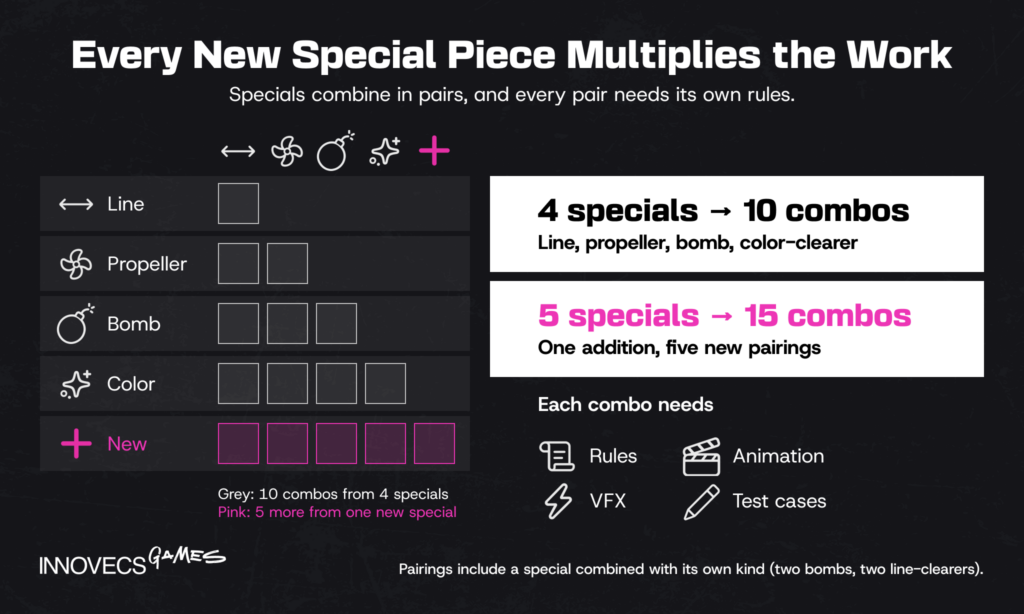
Depth in a swap game comes from the special tiles (or power-ups) that larger matches create. Line up four and you get a line-clearer. A two-by-two square gives you something like Royal Match’s propeller; an L or T shape, a bomb; five in a row, a color-clearer. Then the specials start combining, and this is the bit producers underestimate every time. Four specials mean ten possible pairings. Each of those ten needs its own rules, animation, VFX and test cases. Add a fifth special? Now it’s fifteen. Boosters sit on top of all that, both the pre-level kind (bought or earned before you start) and the in-level kind like a hammer or a shuffle, and somebody has to price them in the economy before a single level gets balanced.
Cascades are where randomness earns its keep. Refills can line up free matches, and the spawn rules decide how often that happens. Players credit their own genius for every lucky cascade and blame the random number generator for everything else, which is fine, as long as your designers are the ones who decided the odds.
Blockers, Objectives, and Board Layouts
Blockers and obstacles make an identical board feel new. Think grass you clear one tile at a time, honey that creeps outward, boxes needing two hits, chains pinning a piece in place. The usual approach is to give each one a world to itself first and only mix it with the others later. Objectives do the same job from the other side. Free the trapped character. Fill the jar. Knock the tower over before you run out of moves. Board shape is the third lever: punch a hole in the grid or squeeze a column and suddenly the specials form in different places.
Underneath all three sits the move limit. One move, added or taken away, can be the whole difference between a level people breeze through and one they quit on. It’s also the number designers touch most after launch.
How to Make a Match 3 Game: A Step-by-Step Process
Mechanics are the parts list. Turning them into a game that’s still shipping levels in year three is a process, and done well, it can move fast. Dream Games closed its seed round in November 2019. By July 2020 it had Royal Match in a limited test in the UK and Canada, where (going by the founders’ own count) it picked up about a million downloads and 200,000 daily players. The game went global in February 2021, made by a team of roughly 30. Honest footnote: those founders had already shipped Toy Blast and Toon Blast together back at Peak Games. In this genre, speed is mostly experience you’ve already paid for. The seven steps below are how we’d run it with a team that hasn’t.
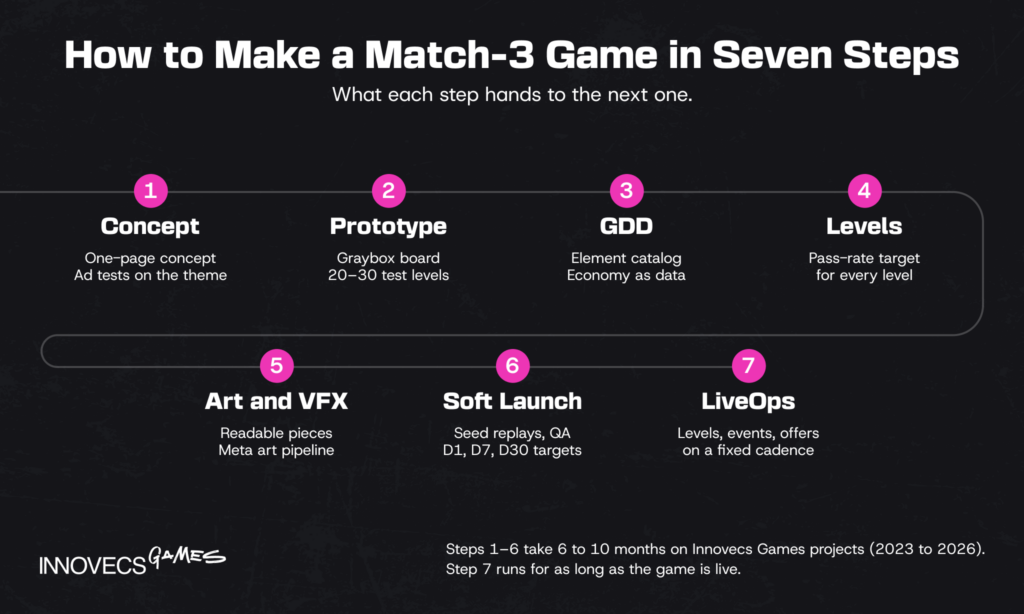
Step 1. Define the Concept, Audience, and Theme
Start with who’s playing and why they’ll pick you over the incumbents. Mistplay’s survey of puzzle players, cited by Naavik (81% women, 84% playing to relax), describes the default player, and the default is crowded. So what’s your one difference? It has to show up in a five-second ad. A board twist can do it, or a well-known license, or a meta nobody else runs. “Better art” doesn’t count; every competitor’s pitch deck promises exactly that. On our projects the producer, the lead designer and someone from UA or marketing own this step together. What comes out of it is a one-page concept, a teardown of the five games you’ll actually be fighting, and a handful of mock ad creatives tested on pocket money before anyone locks the art style. Learning that a theme doesn’t sell costs a few thousand dollars at this point. Learning it from a finished art bible costs a lot more.
Step 2. Prototype the Core Loop
The prototype answers one question: does the board feel good to play with no art at all? You’ll need swap, fall, cascade, special-piece creation and two or three blockers, with timings tuned frame by frame, because the half-second after a match is most of what players mean by “feel”. In our experience a gameplay engineer and the lead designer get there in six to ten weeks, with 20 to 30 graybox levels. Polish can make a good board look better. It has never once made a dull board feel good.
Two more things belong here. Write the kill criteria down before the build starts (how a stranger’s first ten levels should feel, what a creative test has to cost per install), because a prototype judged after the fact always seems to earn one more month. And don’t think prototyping stops at launch. Live games do it too, just smaller: you can try a new blocker or event mechanic in a sandbox build in a week or two, long before it goes anywhere near the level set. If your core team is tied up on a live game, this is the step studios hand to game prototyping services most often, so two or three ideas get tested side by side and nobody gets pulled off the release train.
Step 3. Write the Game Design Document
A match-3 game design document is more spec sheet than story bible. Inside: the element catalog (every piece, blocker and special, plus how each one reacts to the rest), spawn rules, the level file format, the economy (soft currency, lives, booster prices, rewards per level), the meta spec and the event framework. Engineers live in the interaction rules. Artists mostly care about the element list. The economy designer owns the spreadsheet and guards it. Keep the parts that keep changing, element rules and economy especially, as versioned data rather than prose; once levels start shipping, they’ll change weekly. And if the lore chapter is longer than the spawn rules? Then somebody’s priorities are upside down.
Step 4. Build Levels and Tune the Difficulty Curve
Level production is where match 3 game development stops being a project and becomes a schedule. Designers build in an in-house editor, bots and testers play each level, and two numbers matter most: the pass rate (or attempts per completion) and the spot where players quit. Want a reference point? Tactile Games’ 2021 player data on Lily’s Garden, analyzed in a 2024 study, settled at roughly 3.2 attempts per completion after the tutorial, and the hard levels averaged up to about seven. Your curve should climb in waves, a marked hard level and then a couple of easier ones. When a churn point shows up, move or re-tune the level. Don’t paper over it with a sale. We’ve written up the editor, solver and review pipeline in more depth in our guide to puzzle level design, and teams short on designers often bring in game level design services for exactly this stage.
Step 5. Produce Art, Animation, and VFX
Readability first. Every piece needs its own silhouette and color at phone size (back each color up with a shape or symbol, for color-blind players), and you should be able to tell at a glance whether a blocker has one layer of ice left or two. After that the money goes two places. Match and combo VFX are where players feel the game; meta art, the rooms and gardens and characters, is what brings them back for the next star. Most titles get by with 2D art, Spine animation and particle VFX, plus a technical artist who keeps atlases, overdraw and draw calls inside what a mid-range Android phone can handle. That means texture compression per device tier and a frame-rate cap when the board’s idle. A gem shimmering at 60 fps while someone reads an offer is just eating the battery of a person playing twenty levels on the train. Sound does more work than budgets admit: players hear the match and combo sounds thousands of times, and the thousandth still has to be pleasant. In most match 3 games we’ve worked on, the meta art pipeline outgrows the board art pipeline within a year.
Step 6. Test, Soft Launch, and Iterate
Match-3 QA has two halves. One is ordinary regression across devices and OS versions. The other is specific to the genre: replaying every level with fixed random seeds so a fix to the board code doesn’t silently change how hard level 212 is. Then there’s a third half (yes, we know), which everyone forgets: localization and store readiness. German button labels overflow. Offer screens break in right-to-left languages. Every market wants its own store screenshots. Our game testing guide covers the general process. Soft launch follows, in a few markets, with per-level analytics, remote config and A/B tests running, and it lasts until player retention (D1, D7 and D30 against targets you set beforehand) and game balance both hold. How long is that? Playrix’s Austin’s Odyssey has been in soft launch since August 2022, by AppMagic’s tracking. Big studios treat “not ready” as a perfectly normal result. Somewhere in Canada, a group of players has probably seen more unfinished match-3 games than most producers have.
Step 7. Launch and Run LiveOps
Global launch is the start of the expensive part. UA ramps up, fed by ad creatives cut from real gameplay and swapped out every few weeks. Meanwhile the game itself needs new levels on a fixed cadence, an events calendar, seasonal art and offers, and all of it gets tuned against live data. Match Villains, for one, rolled out seven new event types in six months on top of everything it already ran. Playrix’s Gardenscapes team, by PocketGamer.biz‘s 2021 count, grew from 20 people at launch to about 300 five years later. Event design deserves its own mention, since it’s the skill studios coming from premium or hypercasual most often lack. What does this event pay out? Does it flood the economy with coins? Which offer gets bolted to it? Somebody answers those, then runs two or three art versions against each other and ships the one that wins. Our honest advice: staff for year two, not launch week. And keep a few weeks of finished, tested levels in the drawer, because one bad sprint shouldn’t cost players their Wednesday update.
Meta Layers: What Keeps Players Going Past Level 100
The seven steps treat meta, money, engine and team as line items. The next four sections open each of them up, starting with the one players see first.
In 2016, Playrix shipped Gardenscapes, and the genre hasn’t been the same since. Every cleared level suddenly had a purpose outside the board, because the stars you earned paid for restoring a garden, bench by bench and hedge by hedge. Playrix’s Maxim Kirilenko later called it “a drastic innovation for the game mechanics of 2016,” and five years on the game’s daily audience was almost six times bigger. These days most of what studios ask us to scope is match-3 and meta-game development in one contract. That’s because the meta is now where long-term retention lives (and a good share of the spending). It also comes with its own art pipeline, its own economy and its own UI, so pick it early.
Decoration and Renovation Meta
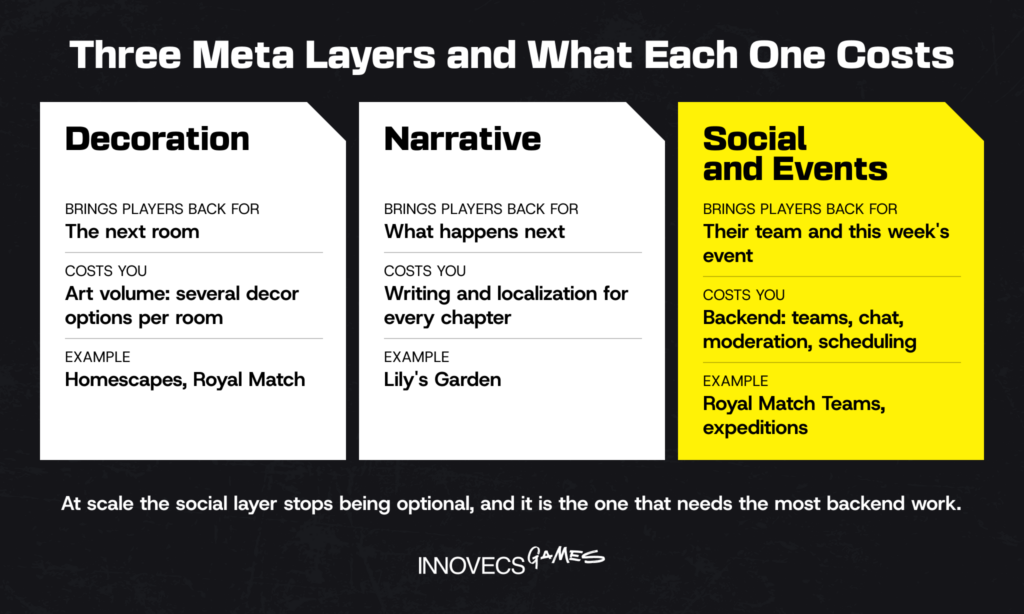
This is the most common meta, and the safest. You beat a level, you get a star, the star buys a new sofa. Homescapes runs on it, so does Gardenscapes, and King Robert in Royal Match has spent five years fixing the same castle. Every so often the game lets you pick between two lamps, and somehow that’s enough to make the room feel like yours. It’s easy to explain in an ad. It fits almost any theme. The bill comes in art volume, since every room needs several decor options and a reveal. Players will happily grind through 500 levels to see what the next room looks like, which is either very flattering to your artists or slightly worrying, depending on how you look at it.
Story and Character-Driven Meta
Narrative meta wraps progress in episodes and characters. Tactile’s Lily’s Garden runs on chaptered drama; Harry Potter: Puzzles & Spells borrows a whole licensed world. When it works, players come back for a reason no event can give them: they want to know what happens next. When it doesn’t, it’s a treadmill of writing and localization, because each chapter has to be scripted, illustrated and translated before its levels can ship. Would we pick it? Only with a writer on the team from day one, and a format you can actually produce at the same pace as levels.
Social, Event, and Competitive Meta
The third layer turns a solo puzzle into something people do together. Royal Match’s Teams feature shares progression rewards between members. Candy Crush Saga and the other leaders run time-limited events, some cooperative, some competitive. Playrix popularized expedition events: map-style journeys you fund with a currency earned in ordinary levels. Leaderboards, win-streak races and team chests fill in the gaps. At scale, none of it is optional, and all of it needs backend features (teams, chat, moderation, event scheduling) that the board itself never asked for.
How Match-3 Games Make Money
Meta keeps players around; whether they pay is decided mostly on the board. Revenue per player also varies more than the genre’s similar look suggests. By Naavik’s 2025 estimates, Royal Match earned about $0.17 in IAP ARPDAU against Candy Crush Saga’s $0.11, and Candy Crush adds roughly $200 million a year from ads on top. Both numbers, and the LTV behind them, come straight back to level design. Lives, extra moves and boosters only sell because the levels are hard enough to need them. For the wider toolkit, see our mobile game monetization guide.
In-App Purchases: Boosters, Lives, and Extra Moves
Which screen earns the most? The fail screen. The player is one or two moves short, fully invested, and here’s an offer: five more moves for some coins. Lives and their refill timer set the pace of a session, and boosters bought before a level give spenders a smoother run. Bundles bring in the volume. When AppMagic looked at Match Villains on US iOS, a $1.99 coin pack and a $9.99 bundle each made about 13% of revenue. Our rule: if a level can only realistically be beaten by paying, it’s a badly designed level, however well it sells this month. Curves tuned around payers tend to look great for a quarter and terrible in year two.
Rewarded Ads and Hybrid Models
Ads and match-3 have an awkward history. King pulled every ad out of Candy Crush in 2013, then quietly brought rewarded ads back in 2018. According to Digiday’s 2022 reporting, King’s ad team works with the level designers so that boosters earned from ads don’t make levels too easy, holds ads back until a player is well into the game, and skips them entirely for heavy spenders. Royal Match went the other way. For five years, no ads at all was practically its brand. Then 2026 happened. Dream Games added rewarded and interstitial ads to Royal Kingdom in the spring and, in May, brought both formats to Royal Match. The same analysis links the move to blended-ROAS user acquisition, and notes the one-star reviews that piled up right after. So even the genre’s best-known IAP-only game ended up hybrid.
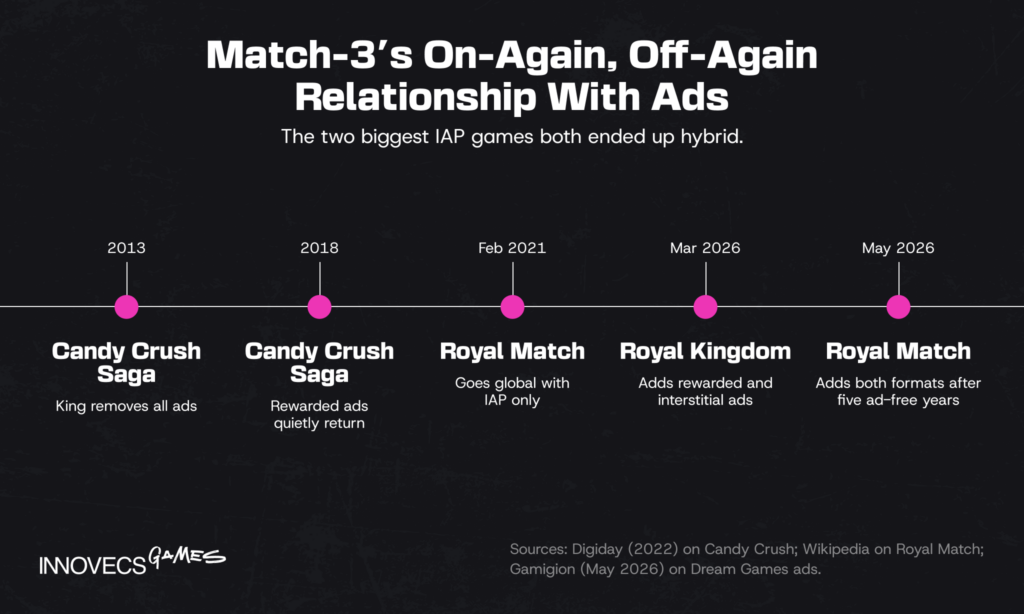
Where does a hybrid model make sense? Mostly for games with a broad, lower-spending audience. It makes the least sense anywhere an ad would interrupt the one moment you could have sold a booster. For a brand-new title, we’d still launch on purchases only and add rewarded ads once the data shows the moments players simply won’t pay for. Dream Games has just shown what adding them later costs: about a week of angry reviews. Most studios can live with that. Pulling ads out after players have built habits around free boosters is much harder.
Battle Passes, Subscriptions, and Live Events
Look at the top-grossing match-3 games we track and you’ll find a season pass (the genre’s take on a battle pass) in nearly all of them. There’s a free track and a paid one, both filled by playing levels and events, and regular play turns into steady revenue. Events cover the rest, since each one gives players a reason to come back and usually carries an offer. Subscriptions? Rarer, and harder to justify in a genre where people dip in and out; we’d only test one once the pass has proven itself. All of these eat fresh content every season. A season pass is basically a promise to ship content on time, signed months in advance, so the real question isn’t which to add. It’s whether your LiveOps team can keep feeding it.
Choosing Your Game Engine and Tech Stack
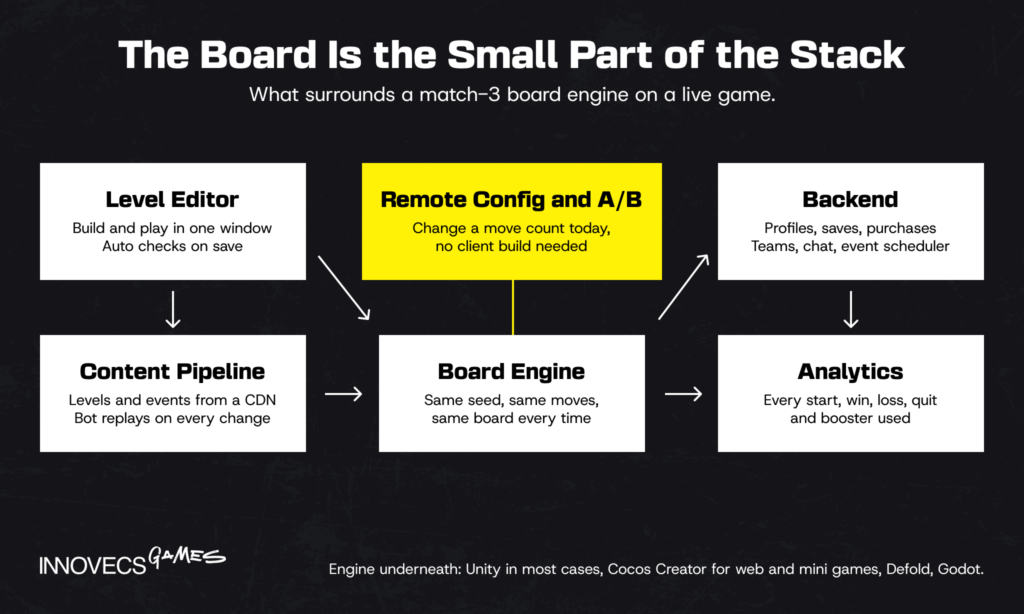
Every offer, pass and event above has to be switched on, priced and measured somewhere, which is why the board is the easy part of the stack. Most of the engineering in match-3 game development goes into what surrounds it: a level editor, a content pipeline, a backend for teams and events, and analytics with remote config on top. Engine choice matters less than people expect, mostly because nearly all of them can draw a grid.
Game Engines: Unity, Cocos Creator, and Other Options
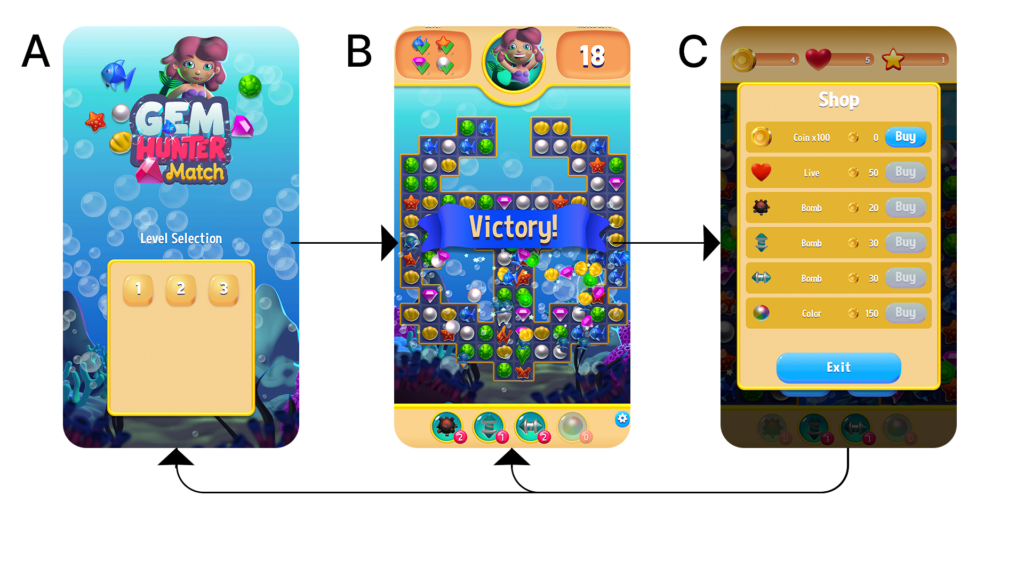
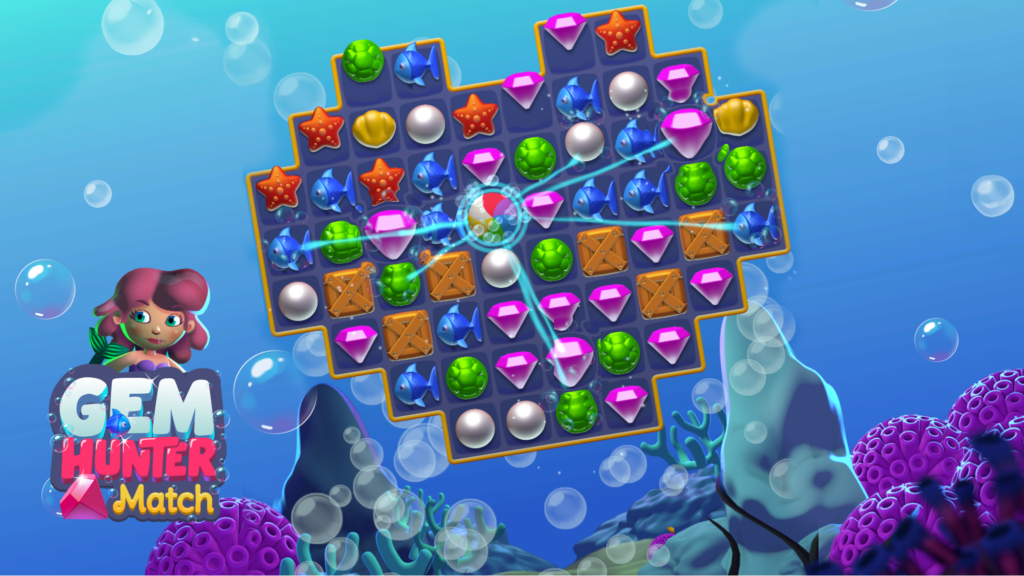
For mobile match-3, Unity is the default. You get C#, one project that builds for both iOS and Android, a deep bench of developers who’ve already shipped the genre, and whatever ad, analytics SDK or store plugin you can think of. If you’re working out how to make a match 3 game in Unity from a standing start, Unity’s own Gem Hunter Match sample is a fair place to look. It came out in 2024 for Unity 2022 LTS and URP 2D, with three levels, crate and rope blockers, boosters set up as data assets, and the 2D lighting and VFX that make the gems shimmer. Treat it as a reference, though, not a foundation. A commercial board needs far more state and far more testing than any sample. Our Unity game development services team works in that engine daily.
Where web and instant platforms matter, look at Cocos Creator. It’s light, you script it in TypeScript, and it exports to HTML5; back in 2022 Cocos claimed it powered about 60% of China’s mini games. That’s the company’s own number, but it tells you something. Defold is worth a look too. King bought it in 2014, gave it away free in 2016, and in 2020 handed it to an independent foundation. Godot? Fine for small 2D teams. Unreal only earns its weight on 3D variants.
Board Logic the Engine Has to Get Right
Tutorials get a swap, a match and a refill working in an afternoon. The rules below are what separates that from a board you can ship thousands of levels on, and most of them are cheap if decided early and painful if retrofitted:
- Start boards cleanly. Generate the opening board with no ready-made matches and at least one valid move, or the first second of the level plays itself.
- Resolve in a fixed order. After every fall, find all new matches, fire specials in a defined sequence, then refill. The same seed and the same moves must always produce the same board, for bug reports, for level replays and for validating scores in competitive events.
- Handle dead boards. Spot the moment no move is left, then reshuffle where the player can see it happen. If that reshuffle eats one of their moves, you’ve found the quickest route to a one-star review.
- Control the randomness. Use spawn weights per level, let designers place specific drops, and add a soft guard against long runs of bad luck. That way difficulty stays with your designers, not with the dice.
- Make hints smart. An idle hint should point at a useful move, not the first legal one the search happens to find.
- Decide on input during cascades. Locking the board while pieces fall is simpler; letting players move on settled parts of the board feels faster but multiplies the states you have to test. Pick one before the first level ships.
Backend, Analytics, and Remote Config
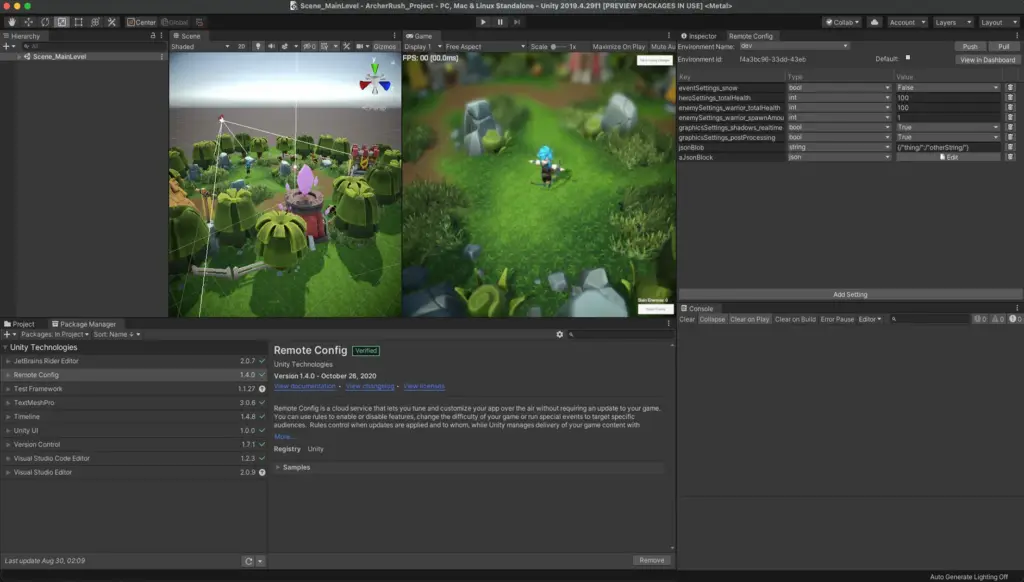
What does the backend actually hold? Player profiles and cloud saves. Purchase validation. Teams, chat, leaderboards. An event scheduler that can start and stop content worldwide. PlayFab, Firebase and Nakama handle a lot of that out of the box, though bigger titles tend to end up writing their own services for events and the economy. Put team chat in the plan early, by the way. Nobody scopes it, and by month three everybody needs it moderated. On analytics: log every level start, win, loss and quit, plus every booster used, so pass rates and churn points come from data instead of opinions. Remote config and A/B testing pull it all together. If changing a move count needs a new client build, your LiveOps team will be a release cycle behind competitors that don’t need one.
Level Editors and Content Pipelines
Your level designers will spend more hours in the editor than in any other program, so treat it like a product they’re paying for. Building a level and playing it should happen in one window. Hitting save should run the checks on its own: can it be solved, is it near the target difficulty, will anything spawn where it can’t. And what gets saved is versioned data the game can download later, no store update needed. That’s the editor. Then there’s the pipe it feeds. Level files and event configs come down from a CDN without an app update, a staging environment catches problems before players do, and bots replay the whole level set whenever someone touches the board code. We’ve seen teams save two months on tooling and spend the next two years paying it back, one fiddly level at a time.
Key Team Roles and What Each One Owns
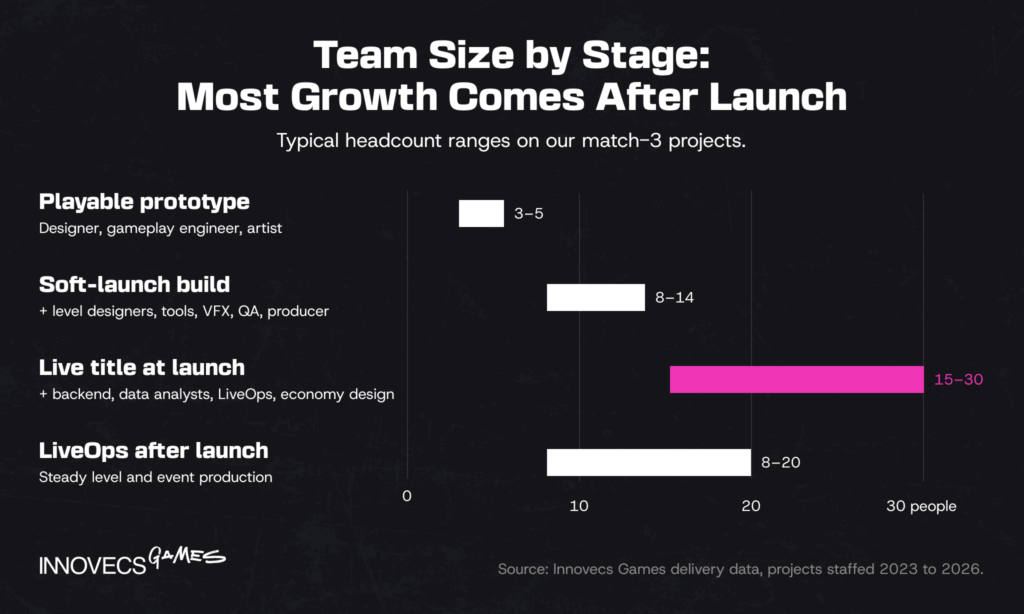
Each system above needs an owner, and some owners are much harder to find than others. On the match-3 projects we’ve staffed since 2023, level designers and tools engineers were the two roles clients asked us to fill most often, usually because hiring them locally had stalled. Below is what game developers for match 3 games typically cover. Mostly, what changes once the game is live is how many of each you need.
Game Designers and Level Designers
Somebody has to own the board rules, the economy and the meta, and say out loud what the game is for. That’s the lead game designer. Level designers turn all that into hundreds of levels. Each one gets a target difficulty and a reason to exist, and these are the people opening the pass-rate dashboards first thing every morning. On a live title, level design turns into a production line with weekly output targets. An economy designer often joins once boosters, currencies and offers need balancing as one system. Mostly junior team? That’s survivable. Give one senior the difficulty targets for each world, hand the juniors a library of level patterns that have already worked, and keep them away from the blank board for the first few months.
Engineers and Technical Artists
The board engine belongs to gameplay engineers. It has to give the same result from the same seed every time, run fast on a cheap phone, and survive being tested against thousands of levels. Tools engineers make the editor and the pipeline around it (and, once the game is live, they tend to inherit the event tools nobody else wanted). Profiles, teams, events, purchases: that’s backend. Technical artists keep effects and meta scenes inside the frame budget of a low-end phone, which matters more than it sounds, given how many of your players are on one.
Artists, Animators, and VFX Specialists
2D artists draw the pieces, blockers, UI and the whole meta world. Animators bring characters and interface to life, usually in Spine. Then VFX, which is where a match starts to feel like a small win. A player sees that little burst of sparkles thousands of times. We’ve had plenty of feedback on match-3 games over the years. Nobody has ever asked us to make it less satisfying. Get a UI/UX designer in early, too, because every shop, event and offer screen will be designed and redesigned many times.
QA Testers, Analysts, and LiveOps Managers
QA covers devices and regressions, plus seed-based replays of the level set, which means a tester on a live match-3 plays level 212 more often than any player ever will. Analysts own the funnels, the churn points and the A/B tests, and every week they flag which levels need re-tuning. LiveOps managers run the calendar: events, offers, seasons, and whatever content each of those needs. Producers hold it all together. On a live match-3, most of their week goes on protecting the release cadence.
In-House, Outsourcing, or Co-Development: Which Model Fits Your Project?
Listing the roles is the easy part. Deciding who sits in your studio and who doesn’t is harder, and almost nobody gets away with a single answer. Here’s the split we run into most. Your own people keep the live game and where it’s heading. Outside help gets called in for prototypes, for the months when level output has to double, for event art, and for the odd specialist.
| In-house | Outsourcing | Co-development | |
|---|---|---|---|
| Speed to start | Slowest, since hiring takes months | A few weeks | A few weeks |
| Cost | Highest fixed cost, though the cheapest hour | You only commit to the scope you buy | A monthly fee you can push up or down |
| Control | Complete | Whatever the brief and acceptance criteria say | Shared, and your leads still set direction |
| Scalability | Painful to scale down after a peak | Great for work you can define up front | Great for ongoing peaks and LiveOps |
| Best for | Core design, economy, long-term IP | Prototypes, art packs, ports, QA | Level production, features, LiveOps support |
| Honest downside | Slow, and pricey to staff for peaks | Struggles with work that changes weekly | Takes onboarding time and shared tools |
Most studios we work with end up using all three columns at different stages, sometimes in the same quarter. Picking the “wrong” model is rarely the mistake. Picking one model and forcing all the work through it usually is.
Building In-House
In-house gives you the most control and the slowest start. It’s where the lead designer, the economy, the data and anything else that defines the game’s identity should live. The downside shows up after launch. A team sized for a content peak is expensive to keep between peaks, and good level designers or technical artists can take months to hire.
Outsourcing to a Match 3 Game Development Studio
If you can write the job on one page, outsource it. A prototype fits on that page. So does an art pack, or forty levels at an agreed pass rate, or a QA sweep across twenty phones. When you’re picking a mobile game studio for it, ask to see how they build and test levels, because a pretty art portfolio tells you almost nothing about that. (Here’s how we run game development outsourcing, if it helps to compare.) Where does it struggle? Features that change every week with live data, because the brief goes stale faster than the work gets done.
Co-Development With an External Team
Co-development puts an outside team inside your pipeline. They work in your tools, your sprints, your review process, usually under a lead of their own. It’s a good fit for level production, new features and LiveOps support on a live title, anywhere the work never stops but the volume goes up and down. Game co-development costs more per month than freelancers and takes a few weeks of onboarding. In return it scales up for a season and back down again without anyone getting laid off.
Making External Teams Work on a Match-3
Whatever model you choose, external work on a match-3 tends to break in the same three places. All three can be fixed before the first invoice.
- Style drift. A partner who nails your gems but not your UI makes the game look like two games stitched together. So ask for a test set first (six pieces, one blocker in every damage state, one offer screen) drawn against your own references, and don’t order any volume until your art director signs it off.
- Levels that skip your difficulty targets. External level designers need the same pass-rate targets, level pattern library and dashboards as yours, and their levels should go live through the same remote config. A world built to someone else’s idea of “medium” shows up in your churn data three weeks later.
- Too many owners of shared data. The element catalog, the combo rules and the economy sheet are touched by everyone. When three vendors each keep a local copy, the board starts behaving differently depending on who built the level. Fewer partners, each with one clearly owned area, keeps that data in one place.
Two more habits help. Start with one bounded deliverable, such as an event’s art pack or a world of 20 levels, before committing to a monthly team, so both sides see the real pace. And use short engagements for the specialists you need only now and then (a combo VFX pass, a UI/UX overhaul of the shop, a technical art pass on low-end devices) rather than hiring for a few months of work.
Not Sure Which Model Fits Your Game? Let’s Talk
A short call with one of our producers is usually enough to see which mix of in-house and external work suits your game’s stage. Sometimes the right answer is to hire, and we’ll say so.
How Much Does It Cost to Build a Match-3 Game, and How Long Does It Take?
The model decides who you pay. Scope decides how much, and there’s no single figure for match 3 game development cost, because the range runs from a few weeks of prototyping to a live title with dozens of people on it. What follows is based on our own projects and excludes user acquisition, which on the live match-3 titles we’ve seen usually outspends development by a wide margin. For how this compares with other genres, see our mobile game development cost breakdown.
Typical Budget Ranges by Scope
| Scope | What it includes | Team | Duration | Budget |
|---|---|---|---|---|
| Playable prototype | The core board, a few specials, 2 or 3 blockers and 20 to 30 graybox levels; no meta yet | 3 to 5 people | 6 to 10 weeks | $30,000 to $70,000 |
| Soft-launch build (MVP) | The full board, 150 to 250 levels, a light meta, IAP, analytics and remote config | 8 to 14 people | 6 to 9 months | $250,000 to $600,000 |
| Live title at global launch | The full meta, an events framework, teams and social features, 500+ levels and LiveOps tools | 15 to 30 people | 12 to 20 months in all | $800,000 to $2,500,000 |
| LiveOps after launch | New levels on a fixed cadence, 2 to 4 events a month, seasonal art and offers | 8 to 20 people | For as long as the game runs | $60,000 to $200,000 a month |
Plan around the last row. If the game works, you keep paying for content for as long as it runs, and before long that monthly bill is the biggest number in the plan after UA.
Typical Development Timelines
Here’s how a mid-size match-3 usually runs on our projects:
- Concept and prototype: 2 to 3 months, ending in a playable board and a decision to go on or stop.
- Pre-production: another month or two on the GDD, the economy, the art style and the level editor.
- Production to soft launch: 3 to 5 months of levels, art, meta and backend work.
- Soft launch: 6 months or more, until retention and monetization targets are met.
- Global launch and LiveOps: open-ended, with content growing as the audience does.
Royal Match’s roughly fifteen months from seed round to global launch is the fast end. Soft launch is the stage that stretches most, and that’s fine, because it’s the cheapest place to find out the game isn’t ready.
What Drives the Final Budget
Seven factors move the total more than anything else:
- Meta scope. A decoration meta with dozens of rooms can end up costing more than the board.
- Levels at launch. Each one gets designed, tested and tuned, and a live game wants hundreds before global launch.
- Art style. 3D pieces and meta scenes cost more than 2D, and they take longer to optimize.
- Social features. Teams, chat and competitive events all mean backend work, plus moderation.
- Event framework. A flexible one costs more up front, then far less per event.
- Licensed IP. Every asset goes through brand approval, and every approval is another review cycle.
- Platforms and markets. Web builds, extra stores and localization each add a line of their own.
Overruns rarely come from rates. On match-3 projects they start with scope that creeps: a meta that gains a second building, a fifth special piece (and five new combos with it), or an event framework that gets designed after the first three events were hard-coded. Fixed-scope phases with a go or no-go at the end of each, matching the rows of the budget table above, are the simplest way to keep the total where it was promised.
How AI Is Changing Match-3 Production
Budgets in this genre are mostly level and content hours, so it matters where those hours can now be saved. Why has AI moved further into match-3 than into most genres? Because the genre comes in small, measurable pieces. A level has a pass rate, and a bot can play it a thousand times overnight. The research is also more grounded than the marketing, and both studies below were built on real player data from shipped games.
AI-Driven Level Generation and Balancing
So far, the most useful trick is predicting difficulty before any player sees the level. In the 2024 Lily’s Garden study we mentioned earlier, researchers working from Tactile Games’ player data found that simulated play from a trained agent was what made it possible to predict a brand-new level’s difficulty at all, for player cohorts and for individual players alike. Procedural generators can also spit out candidate layouts by the hundred. The same models could, in principle, personalize the game too, say by changing which levels or offers a struggling player sees next. The catch? They chase what they can measure (solvability, predicted pass rate), so a designer still has to pick which drafts are worth finishing.
Automated Playtesting and QA
Bots now do much of the replaying. In a 2021 paper, Rovio and Aalto University researchers trained AI players on Angry Birds Dream Blast and checked them against data from 95,266 real players across 168 levels. The bots’ pass rates followed the humans’ closely (a rank correlation of 0.80), and adding a model of the player population made the estimates sharper still. The same agents also catch soft-locks, impossible spawns and crashes across the whole level set after every change to the board code. That’s regression work humans dislike more than almost anything.
Where Human Designers Still Make the Call
Bots make tireless testers and terrible critics. They can tell you a level is beatable, and how often. Is it fun, though? Does the theme land? Is this the right week to bring in a new blocker? No idea. AI-assisted art is handy for concepts and ad variations, but between store policies, licensing and player trust, anything that ships should get a human sign-off. Where do we draw the line? Use AI wherever a number can check the answer (pass rate, crash count, spawn validity). Keep people wherever it can’t, like whether a level is fun or whether this week’s event feels like a reward or a chore.
Match-3 Development Tips We Keep Repeating to Clients
Bots and models help most when the team around them has good habits. Most of the advice above belongs to a step or a budget line. These don’t; they’re smaller habits that come up on nearly every match-3 project we join, usually after something has already gone sideways.
- Tear down the leaders’ first 100 levels before designing yours. Write down the level where each new blocker appears, how long it stays on its own before mixing with others, and where the first marked hard level sits. It’s the cheapest pacing reference you’ll ever get, and it’s sitting in the app store.
- Make the first session generous. Early levels should be near-certain wins, a special piece should show up in the first minute, and the first booster should be a gift. Players who haven’t felt clever yet won’t stick around long enough to feel challenged.
- Treat every new blocker as a permanent cost. Each one needs art for every damage state, VFX, a tutorial level, rules against all the specials and combos, and regression tests for as long as the game runs. If it doesn’t change how players think about the board, cut it before it ships.
- Give every level a one-line purpose. “Introduces honey”, “breather after world 12’s peak”, “combo practice”: if a designer can’t write the line, the level probably doesn’t need to exist.
- Hand out boosters before you price them. Free grants in soft launch show which boosters players actually value and on which levels they use them. Prices built on that data beat prices copied from a competitor’s shop.
- Version levels like code. Log every live change to a level with its pass rate before and after. Six months in, that log is how you know whether a re-tune helped or just moved the churn point three levels along.
- Test trends as events, not as the core. Sort puzzles more than tripled their revenue in H1 2026 and block puzzle releases rose 89%, by AppMagic’s count, so the temptation to bolt one on is real. Run the trendy mechanic as a limited-time event first, and keep it only if your own players come back for it.
How Innovecs Games Helps Studios Ship Puzzle Hits
Those habits are easier to keep with a team that learned them the hard way on earlier projects. We’ve spent 11+ years as a co-development and outsourcing partner, with 300+ game projects delivered and 150+ specialists across Europe and North America. On the puzzle side, that includes casual and puzzle level design on Candy Crush Saga for King, and Unity co-development plus level design on Harry Potter: Puzzles & Spells for Zynga. As a casual game development company, we can plug into your pipeline as a feature team for new mechanics or meta, as level design and LiveOps support on a live game, as art and UI production, or as a full dedicated team running full-cycle development. Nine out of ten clients keep working with us long-term.
FAQ
What is a match 3 game?
Think Candy Crush Saga or Royal Match. You swap two pieces next to each other, three of a kind line up and vanish, and fresh ones tumble in from above. Each level hands you a job, like freeing a few trapped pieces or smashing all the crates, and only so many moves to get it done.
Should you build a match-3 game from scratch or start from a template?
For learning and quick prototypes, a template or sample is fine, and engines ship their own starting points, from GameMaker’s match-3 template to Unity’s Gem Hunter Match. Commercial games are different. Most studios end up writing their own board engine, because they need full control over spawn rules, specials, test determinism and the level editor, and a template you’ll rewrite anyway is a good way to learn but a poor thing to ship on.
How long does it take to develop a match-3 game?
Longer than most people plan for. On our projects, the first playable board shows up after 6 to 10 weeks and soft launch after 6 to 10 months. Then soft launch can easily eat another half a year, and once you’re global, well, you’re never really done.
How much does it cost to make a match-3 game?
On our projects, a prototype runs $30,000 to $70,000, and a soft-launch build $250,000 to $600,000. A live title at global launch typically lands between $800,000 and $2,500,000, then $60,000 to $200,000 a month for LiveOps. User acquisition comes on top of all of it.
Which game engine is best for match-3 games?
Usually Unity, mainly because every mobile SDK supports it and hiring people who’ve shipped a match-3 in it is easy. Going after web or Chinese mini-game platforms? Then Cocos Creator is worth a serious look. We’d put a small 2D team on Godot without much worry, but Unreal is overkill unless your board is properly 3D.
How do match-3 games make money?
Purchases, mostly. Players buy boosters, five extra moves when they’re one gem short, lives, coin bundles and season passes, and a lot of that spending happens during events and limited-time offers. Rewarded ads come on top now even at the top of the chart: Candy Crush Saga brought them back in 2018, and Royal Match gave in this year.
What roles does a puzzle game development team need?
To get a prototype standing you’ll want a designer, a couple of level designers, a gameplay programmer and someone on tools, 2D art, animation or VFX, a tester and a producer. Launch is when it gets bigger, oddly enough. That’s when backend people, analysts, LiveOps managers and usually an economy designer show up.
What keeps players engaged after the first few hundred levels?
The meta layer and live events, mostly. Fixing up a house or following a story makes each level count for something. Teams and seasonal events pull people back on days they’d otherwise skip. And a fresh batch of levels (with a new blocker every so often) keeps the board itself from feeling like a chore.
🤖 How is AI used in match-3 level design and balancing?
Mostly as a stand-in player: a bot runs a new level hundreds of times and guesses how many real people will get stuck. Generators draft candidate layouts, and models flag live levels whose pass rates start to drift. The target difficulty, and the call on which levels ship, still belong to designers.
🤖 Can AI tools speed up production and cut costs?
Some, yes. The biggest wins we see are in testing and balancing, where a bot can grind through the whole level set while the team sleeps, and in early art sketches. It won’t decide what your next event should be, though, and it won’t make the final art. Experienced people still own those calls.
Ready to Start Your Match 3 Game Development Project?
Right now our people are building levels, features, art and events inside puzzle games that are already live. Got a prototype that needs proving, or a game stuck somewhere in soft launch? We can pick up either. Book a call, and a producer from our casual games team will walk through your scope with you.