How Much Does Game Development Outsourcing Cost? A 2026 Breakdown of Rates, Models, and Budgets
Budget an outsourced game project with numbers you can defend: rates by region and role, how each pricing model bills, what typical projects cost, and the lines a quote leaves out.
Every outsourcing quote leads with the hourly rate, and it’s the line that predicts the least. We’ve seen two vendors quote within a few dollars of each other and finish the same milestone plan months and a six-figure sum apart. The gap was never in the rate. It hid in a scope somebody wrote in a hurry, in a pricing model nobody argued about, and in the hours your own leads quietly lost to the arrangement. Add those up and you’re looking at most of your real game development outsourcing cost.
The rate isn’t even standing still. Eurostat’s figures for the second quarter of 2026 put EU hourly labor costs 3.2% above a year earlier. Hungary’s rose 7.8%. Bulgaria’s rose 9.9%. Poland cooled off to 4.7% and Romania barely moved at 1.8%, but most of the cheaper rows on a European rate card are still climbing faster than the average. Sign a two-year deal on this year’s numbers and you’ll feel it before year two starts.
We’d suggest reading any quote as four numbers multiplied together: the rate, the shape of the team, how long it runs, and what it costs you on your side of the contract. Each one gets its own section here, with ranges from projects we’ve staffed and outside data wherever a neutral source exists. One disclosure up front: most of our delivery sits in Eastern Europe, in the middle of the regional table, so check that section against your other quotes before you trust ours.
What You’re Actually Paying For When You Outsource Game Development
Short answer: you’ll pay somewhere between $30 and $170 an hour for a mid or senior developer from an outside studio in 2026. Eastern European teams land at $45 to $95, Asian ones lower, North American ones at the top. Useful, but that’s where the math starts, not where it ends. The region sets the rate, the roles set the blend, the pricing model decides who eats a wrong estimate, and the scope decides how long the meter keeps running.
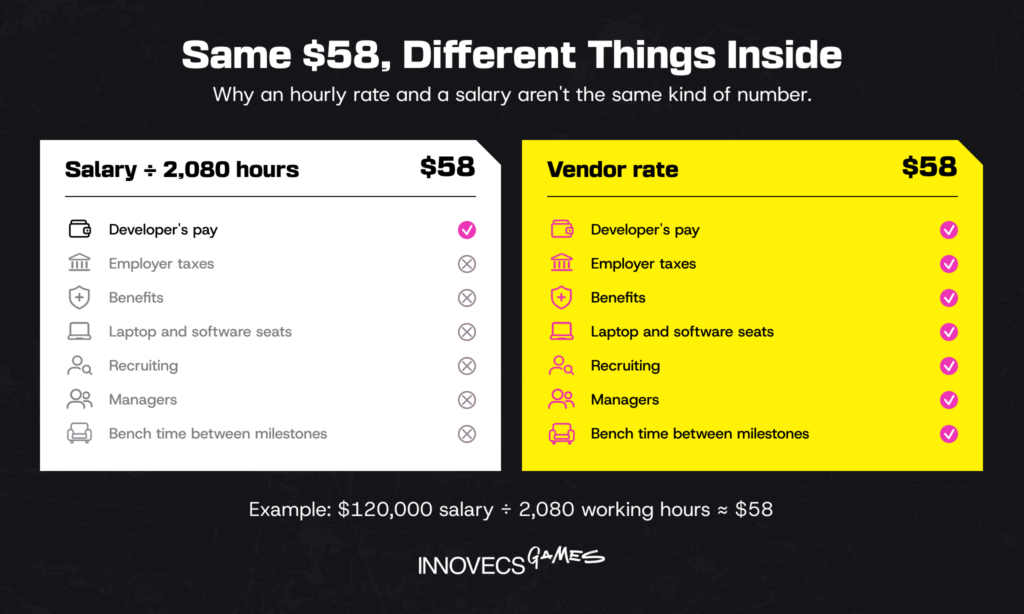
Don’t hold a vendor’s rate up against a salary, either, because they aren’t the same kind of number. Baked into the rate are the developer’s pay, employer taxes, benefits, the laptop and the software seats, recruiting, the vendor’s managers and the margin that keeps people free between your milestones. Divide a $120,000 salary by 2,080 working hours and you get roughly $58. Put that next to a $58 vendor rate and the two look identical, which they aren’t. That comparison sits in a lot of business cases, and it flatters the in-house option every single time.
What the rate buys depends on how much you hand over. A feature team, an art pod, a QA group through certification and a whole title each put a different load on your producers and leads. That load is part of the price, whether or not it appears on an invoice. Still sizing the whole project rather than its external share? The wider game development cost picture, from team size to marketing, is in our guide on how much it costs to make a video game. The figures in this article come from the work behind our game development outsourcing services, across all four of those shapes.
Developer Rates by Region in 2026
Region is the biggest single lever on the rate, whether you buy onshore, nearshore or through offshore development. For comparable seniority, the top and bottom of the table sit about three times apart. The figures below are blended commercial rates, meaning what you’d pay a vendor, not what the developer takes home.
| Region | Mid / senior, per hour | One senior, per month | Workday overlap, New York / London | What studios usually buy there |
|---|---|---|---|---|
| North America | $85 to $120 / $120 to $170 | $19,200 to $27,200 | Full / 1 to 4 hours | A lead or one scarce specialist |
| Western Europe | $70 to $100 / $100 to $140 | $16,000 to $22,400 | 3 to 4 hours / Full | Console depth, technical art, EU contracts |
| Eastern Europe | $45 to $65 / $65 to $95 | $10,400 to $15,200 | 2 to 3 hours / 6 to 8 hours | Co-development pods and whole features |
| Latin America | $45 to $65 / $65 to $90 | $10,400 to $14,400 | 6 to 8 hours / 2 to 5 hours | US-hours pods, mobile and Unity work |
| Asia-Pacific (India, Southeast Asia) | $30 to $45 / $45 to $65 | $7,200 to $10,400 | Little or none / 1 to 4 hours | Art volume and repeatable test passes |
Source: Innovecs Games delivery data, projects staffed 2023 to 2026. Monthly figure at 160 hours; overlap assumes a 9-to-6 day in each location.
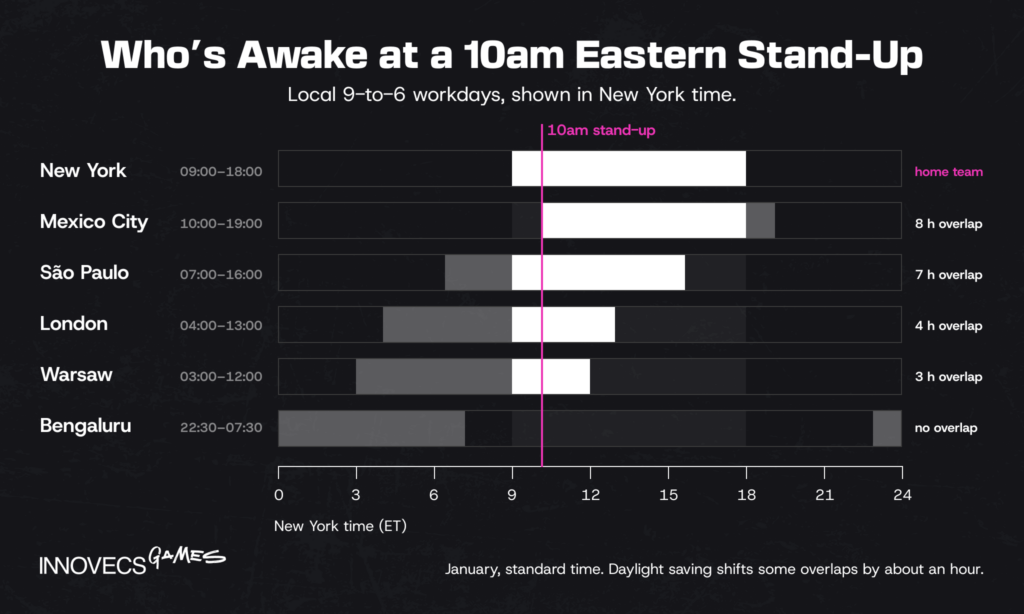
The last two columns belong together. Time zone overlap decides more of the daily experience than the rate does, and it explains most of what studios end up buying where. A team working from a written task list can live on two shared hours. A team that needs your designer to settle something before it can keep building loses most of a day every time it asks.
North America and Western Europe
Senior rates here run $100 to $170 an hour. The money buys console and AAA experience, a shared working day with American or British publishers, and contracts your lawyers can read without calling anyone. It also buys about half the people the same budget would get you in Eastern Europe. That’s why most studios hire here for one hard-to-find specialist, say a rendering lead or a cinematic director, and put the volume somewhere else. Nobody outsources to Montreal to save money. They go there because the people who’ve already shipped the thing they’re attempting live there.
Eastern Europe
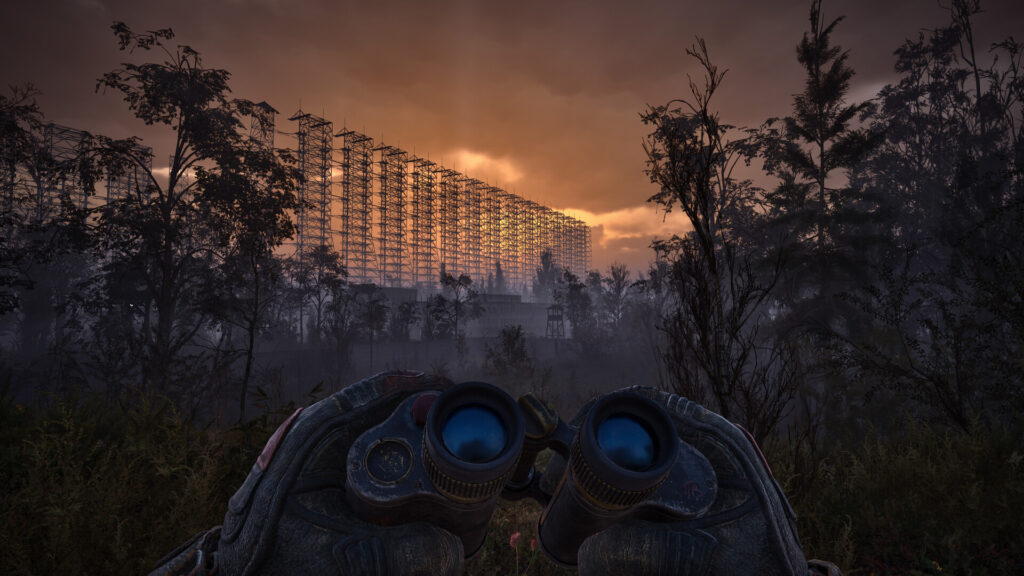
Poland, Ukraine, Romania and their neighbors combine a deep senior pool in Unreal, Unity and C++ with rates of about $45 to $95 an hour. That mix is why the region carries so much co-development work for Western publishers. The overlap with London is close to a full day, while New York gets an afternoon. The trade-off is wage growth: labor costs in most of the region rise faster than the EU average, so expect rate reviews sooner than in Western Europe. Ukraine adds a continuity question as well. The industry has watched that question get answered the hard way. GSC Game World’s staff left Kyiv in February 2022; the studio restarted S.T.A.L.K.E.R. 2 out of a new Prague office, kept going through blackouts with a big part of the team still in Ukraine, and shipped in November 2024. Ask any vendor with people there to be that specific about how your project keeps moving if one city goes dark.
Latin America
Studios in Brazil, Mexico, Argentina and Colombia charge roughly what Eastern Europe does, and for a US team they’re awake at the same time, often for the full day. Mobile, Unity and art are where that talent pool grows fastest. Fewer people there have pushed a console game through certification, though, so if you need that, check it name by name. For a US studio that runs daily stand-ups and quick feedback loops, the time-zone fit can be worth more than a few dollars an hour. At a 10am Eastern stand-up, São Paulo has had its coffee and Warsaw is thinking about dinner.
Asia-Pacific
The cheapest rates in the table come from India, Vietnam, the Philippines and China, at $30 to $65 an hour for mid and senior people. We’d send offshore game development here for big, well-specified batches of work, like environment art, asset variations or regression passes. It struggles with work that needs a judgment call every day, because the person who can make the call is usually asleep when the question comes up, and a milestone built from small waits slips by weeks rather than days. Our view: this is the best price in the table for work you can describe completely, and the most expensive one for work you can’t.
What Changed in Rates in 2026
The regional gap moved less in 2026 than most buyers expect. BLS data has US private-sector compensation costs up 3.3% in the year to June 2026, and Eurostat’s EU figure for the second quarter was 3.2%. Eastern Europe split in two. Poland’s growth fell to 4.7% from 9.7% a year earlier, as CEO Magazine Poland noted from the same Eurostat release, while Hungary and Bulgaria stayed far above the average.
On our own rate card, that came through as increases of roughly 3% to 6% for Eastern European roles in 2026, with senior engine programmers and technical artists at the top of that range. AI didn’t lower an hourly rate anywhere we’ve seen. What it changed is the number of hours quoted for boilerplate-heavy work, which the AI section below covers. Anyone who expected AI to make rate cards cheaper this year will have noticed that rate cards didn’t get the memo.
Rates by Role and Seniority
Inside one region, the role moves the price more than the country does. A senior graphics programmer and a junior QA tester at the same Eastern European vendor can sit four or five times apart. A team’s blend counts for as much as its headcount. The table uses Eastern Europe as the reference point. Scale it with the regional table above for other markets.
| Role | Junior | Mid-level | Senior | Senior, per month (160 hours) |
|---|---|---|---|---|
| Gameplay programmer (Unity, C#) | $30 to $45 | $45 to $65 | $65 to $95 | $10,400 to $15,200 |
| Engine or graphics programmer (C++, Unreal) | Rarely staffed | $55 to $75 | $75 to $100 | $12,000 to $16,000 |
| Technical artist | $40 to $50 | $50 to $65 | $65 to $85 | $10,400 to $13,600 |
| 2D or 3D artist | $25 to $40 | $40 to $55 | $55 to $70 | $8,800 to $11,200 |
| Animator | $28 to $40 | $40 to $55 | $55 to $70 | $8,800 to $11,200 |
| Game designer | $30 to $40 | $40 to $55 | $55 to $75 | $8,800 to $12,000 |
| Producer | Rarely staffed | $50 to $60 | $60 to $80 | $9,600 to $12,800 |
| QA tester (functional and compatibility) | $18 to $25 | $25 to $35 | $35 to $45 | $5,600 to $7,200 |
Source: Innovecs Games delivery data, projects staffed 2023 to 2026.
On an outsourced team, the junior column looks like savings more often than it is. Every junior needs a senior’s review time, and on your contract that senior bills from the right-hand side of the table.
Programmers and Engineers
Gameplay programmers are the most plentiful role on the market, and a mid-level Unity developer is the easiest game programmer to find anywhere. Engine, graphics and network programmers are scarce everywhere, which is why they cost 15% to 30% more than gameplay work in our rate data. A vendor offering a “senior Unreal Engine developer” at a gameplay rate deserves one more interview, ideally with a GPU capture on the screen. Does your game need someone who can keep rollback netcode deterministic or find what’s eating the render thread? Then budget for that person by name instead of averaging them into a team rate.
2D/3D Artists and Animators
Artists get paid per thing as often as per hour, whether the thing is a hero character, a modular environment kit or a set of locomotion animations. That makes quotes easy to line up side by side and hard to check, since one vendor’s “character” is a sculpt and another’s is a game-ready model with LODs, a rig and three texture sets. With animators, the split is keyframe work versus cleaning up motion capture. Cleanup is cheaper per second of animation and far more dependent on the capture you hand over. Plan roughly one technical artist for every four to six production artists. It’s the most expensive seat in the pod per hour, and leaving it empty doesn’t save money; it moves the cost to the week the art arrives on time and doesn’t fit the frame budget.
Game Designers and Producers
Outsourced game designers come in for a defined job: level design, economy balancing, a LiveOps event calendar, a first-time user experience. Producers are the line studios most often try to cut from a quote, and the one that earns back its cost fastest. A producer on the vendor’s side turns your feedback into tasks and reports a slip while it’s still a slip. If a proposal has no producer line, that work hasn’t vanished. It’s moved onto your producer’s calendar, at your producer’s rate.
QA Testers
QA is the cheapest role per hour and the one most often under-budgeted in hours. Functional testing grows with content, while compatibility testing grows with the device list. A mobile title checked on a dozen Android models needs a different budget from one checked on four. Console certification testing needs people who know each platform holder’s requirements by heart, and they bill above general testers. They’re still cheaper than a failed submission.
Freelancer Rates Compared With Studio Rates
Freelancers are the cheapest line on paper and the hardest one to compare, because a freelance rate covers one person’s hours and nothing around them. No producer, no QA, no backup when someone gets sick in the week before a milestone.
| Region | Freelance, mid-level | Freelance, senior |
|---|---|---|
| North America | $60 to $100 | $90 to $150 |
| Western Europe | $50 to $85 | $80 to $130 |
| Eastern Europe | $30 to $50 | $45 to $80 |
| Latin America | $30 to $50 | $45 to $75 |
| Asia-Pacific | $15 to $35 | $30 to $55 |
Source: freelance quotes seen on Innovecs Games client projects, 2024 to 2026.
Generalists usually price roughly 15% to 35% below a studio’s rate for the same seniority, which matches the gap between this table and the regional one. Scarce specialists, a shader programmer or a rigging lead, often price above it, because they know exactly how rare they are. Freelancers work best for a bounded task your own lead can review. They’re a poor fit for anything that needs three people to coordinate, because nobody in a group of freelancers owns the integration, and an unowned merge is how a Friday build breaks.
Short-Term Specialists
Some people you need for three weeks and then never again. Think of the UI/UX designer who reworks your store page, the VFX artist you borrow before a trailer, the lighting artist for the last pass, a day of motion capture, one cinematic. Putting any of them on payroll makes no sense, and the good freelancers are booked when you call. So studios sell these as short engagements, usually with a minimum term attached.
| Specialist work | Typical rate or price | Usual minimum |
|---|---|---|
| Senior UI/UX designer | $55 to $80 an hour | 2 to 4 weeks |
| Senior VFX artist | $50 to $75 an hour | 2 to 4 weeks |
| Lighting artist | $55 to $80 an hour | 2 weeks |
| Motion-capture shoot, studio and cleanup | $8,000 to $20,000 per shoot day | 1 day plus cleanup |
| Cinematic trailer, 60 to 90 seconds | $40,000 to $250,000 | Fixed scope |
Source: Innovecs Games delivery data and partner quotes, 2024 to 2026. Trailer range covers in-engine capture at the low end and fully pre-rendered work at the top.
Look twice at the motion-capture row. The shoot is the cheap part. Cleanup, retargeting and getting the result into the engine take longer than the day on the stage did, and they’re billed by the hour.
Pricing Models and How Each One Shapes the Final Bill
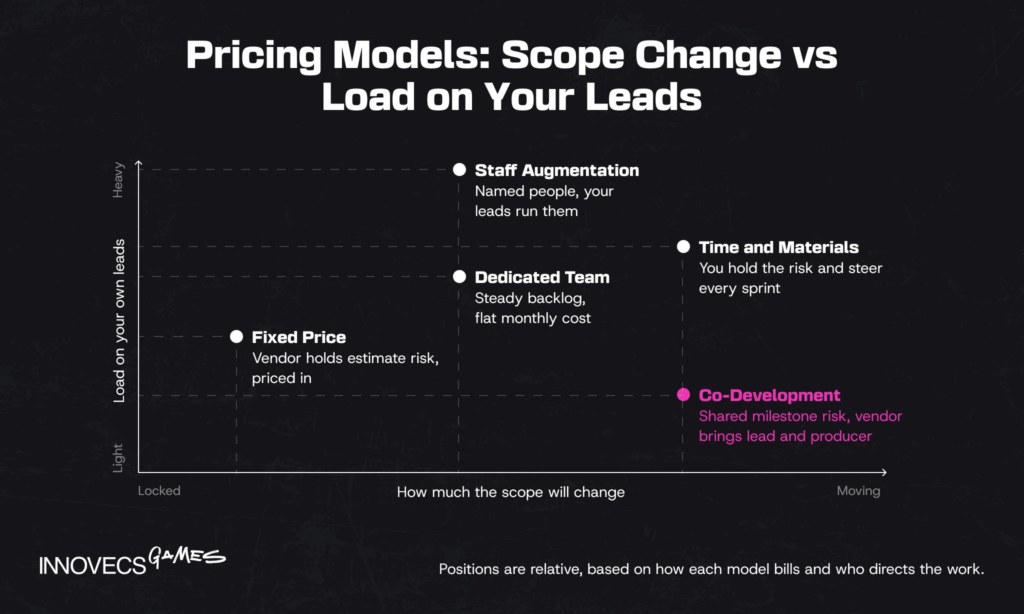
Give two studios the same team at the same rate and the bills can still come out wildly different. What decides it is the pricing model, because it settles what happens when the estimate turns out wrong. In game outsourcing it usually does, at least a little. A design changes once people play it, and nobody has found a contract that stops that. Each model answers the same question differently: who pays for the change?
| Model | How you pay | Who carries the estimate risk | Best fit | Watch for |
|---|---|---|---|---|
| Fixed price | Per deliverable, in milestone payments | The vendor, priced in at 10% to 20% | Bounded work with objective acceptance | Change requests on every adjustment |
| Time and materials | Hours worked, billed monthly | You | Scope that will change after playtests | Burn without a cap or a re-estimate |
| Dedicated team | Monthly rate per person | You, on a predictable curve | Long production or LiveOps with a steady backlog | Idle capacity when your approvals stall |
| Co-development | Monthly or T&M, with a lead and producer included | Shared, against your milestones | A capability gap inside your own pipeline | Unclear ownership of each system |
| Staff augmentation | Monthly rate per named person | You | A named skill for a fixed period | Management load on your leads |
Source: Innovecs Games delivery data, projects staffed 2023 to 2026.
Every model costs the same uncertainty. The real choice is who holds it and how visible it stays.
Fixed Price
Here you agree on what gets delivered, for how much and by when, and money moves in milestone payments as each piece is accepted. If the vendor guessed low, that’s their problem, so they build the risk into the price. In the contracts we see, that adds 10% to 20% to what time and materials would cost, more if the spec is thin. A change process comes with it, and it turns each design adjustment into a document. Fixed price suits bounded work where acceptance is objective: an art pack against a style guide, a port of a finished build, a prototype with a frozen feature list. For a game that’s still finding its fun, it’s a fixed itinerary for a trip with no destination yet.
Time and Materials
Here you’re billed every month for the hours people actually worked, and the estimate is a forecast, not a promise. You carry the budget risk. You also get the steering wheel, so priorities can change every sprint without anyone reopening the contract. Time and materials suits co-development and any scope that will move after playtests, which covers most scope. Protect yourself with a monthly cap, a burn report someone opens, and a re-estimate at every milestone. The third is the one studios skip.
Dedicated Team
You rent a stable team at a monthly rate per person, usually with the vendor’s management and tooling included, and direct the work yourself or through their lead. Cost is flat month to month, and the team builds knowledge of your codebase that a rotating bench never does. The risk is idle capacity. If your pipeline stalls for a month waiting on approvals, you still pay for twelve people, and they’ll be very well rested. Some vendors call this arrangement a retainer. Most contracts we see allow scaling with around 30 days’ notice, so read that clause before you sign.
Co-Development and Staff Augmentation
With co-development, an outside team works inside your pipeline and shares the responsibility for hitting a milestone. With staff augmentation, you get named people who report to your own leads. Both bill as time and materials or as a monthly dedicated rate. Co-development costs more per head because a lead and a producer come with it, about 20% to 30% above the same people under staff augmentation in our rate data. In return, your leads stop being the only people who plan, review and unblock that slice of the game. Staff augmentation is the cheapest per head and the most expensive in your management hours. It works best for one or two people slotting into a team that already runs well. If we had to pick one model for a 50- to 100-person studio with a fixed ship date, it would be co-development, for a simple reason: it’s the only model where somebody outside your building also loses sleep over your milestone.
Typical Budgets by Project Type
Totals depend on scope more than on any rate card, but ranges help when you’re deciding whether a project is worth a first call. The table covers the external share of game development outsourcing cost for each tier, from mobile to PC and console, with team size and duration included. Each tier also has a dedicated cost article on our blog, linked below, if you need the full breakdown.
| Project type | External team | Duration | Total external budget | Typical monthly team cost |
|---|---|---|---|---|
| Hyper-casual mobile | 2 to 4 people | 4 to 8 weeks | $11,000 to $35,000 | Usually a fixed fee |
| Casual mobile | 2 to 5 people | 4 to 7 months | $30,000 to $150,000 | $8,000 to $30,000 |
| Mid-core mobile | 8 to 15 people | 12 to 18 months | $300,000 to $1,000,000 | $25,000 to $60,000 |
| AA PC or console co-development | 10 to 25 people | 12 to 24 months | $800,000 to $4,000,000 | $65,000 to $170,000 |
| AAA co-development workstream | 10 to 40 people | Ongoing | $1,000,000 to $3,000,000 a year | $85,000 to $250,000 |
| Art-only contract | 2 to 10 artists | Weeks to months | $20,000 to $500,000 | Per asset or per artist-month |
| Feature-only contract | 3 to 8 people | 2 to 6 months | $40,000 to $300,000 | $20,000 to $60,000 |
| Port to one new platform | 3 to 5 people | 2 to 9 months | $20,000 to $600,000+ | $15,000 to $70,000 |
| Localization into 5 to 10 languages | Vendor plus your team | Weeks to months | $25,000 to $300,000 | Per word, plus LQA hours |
Source: Innovecs Games delivery data, projects scoped 2023 to 2026.
The jump between mobile and AA isn’t a matter of more of the same. Somewhere around mid-core, certification, multiplayer services and a LiveOps team start appearing in the plan, and each of them brings its own budget line.
Mobile Games From Hyper-Casual to Casual
A hyper-casual build is a market test: a prototype for a publisher’s CPI check, built in weeks for $11,000 to $35,000. Plenty are killed on day three of the test, and that’s the system working. Casual titles in puzzle, merge or match-3 run $30,000 to $150,000 to a first store build. The real budget question there is the twelve months after soft launch, when event content, A/B variants and seasonal art become a monthly bill. Here’s what one casual title looks like when it’s priced: a puzzle game built over five months by a small Eastern European team at mid-band rates.
| Role | Share of time | Monthly cost |
|---|---|---|
| Mid Unity developer | Full time | $8,800 |
| Mid 2D and UI artist | Full time | $7,600 |
| Mid game designer | Half time | $3,800 |
| Mid QA tester | Half time | $2,400 |
| Senior producer | Quarter time | $2,800 |
| Total | $25,400 |
Rates taken from the role table above, at the midpoint of each band, 160 hours a month.
Five months of that team comes to $127,000, toward the top of the casual range, and the first LiveOps month starts the day after. Both ranges in this section come from our breakdown of mobile game development cost, which goes through each mobile tier in detail.
Mid-Core and AA Titles
From mid-core mobile up to AA on PC and console, most outside work gets priced by the month, not by the game. A few publishers hand over the entire title instead. Konami did exactly that with the Silent Hill 2 remake, which went to Bloober Team in Kraków and sold 2 million copies within about four months. Most AA work is smaller than that. Here’s how one realistic team adds up. Take a 12-person AA co-development pod in Eastern Europe at mid-band rates:
| Role | People | Monthly cost |
|---|---|---|
| Senior gameplay programmer (lead) | 1 | $12,800 |
| Mid gameplay programmers | 3 | $26,400 |
| Mid technical artist | 1 | $9,200 |
| Mid 3D artists | 3 | $22,800 |
| Mid animator | 1 | $7,600 |
| Mid game designer | 1 | $7,600 |
| Mid QA testers | 2 | $9,600 |
| Senior producer, half time | 0.5 | $5,600 |
| Total | 12.5 | $101,600 |
Rates taken from the role table above, at the midpoint of each band, 160 hours a month.
Eighteen months of that pod comes to about $1.83 million, comfortably inside the AA range in the budget table. The arithmetic takes ten minutes, and it’s worth doing before the first call, because every vendor proposal you receive afterward can be checked against it line by line.
AAA Co-Development and Support
At AAA scale, nobody outsources “a AAA game.” Publishers buy the forty things a AAA game is made of, one workstream at a time: a feature team, a technical art pod, an environment group, certification support, post-launch patches. On the AAA work we scope, each one usually runs $1 million to $3 million a year. Konami’s Metal Gear Solid Delta: Snake Eater shows this model from the same publisher that outsourced Silent Hill 2 whole. An external studio supported Konami’s own team on the Unreal Engine 5 remake, which sold a million copies on launch day in August 2025 and passed two million, Konami confirmed in March 2026. Budgets at this tier are counted per pod per year, and the full picture is in our article on AAA game development cost.
Art-Only and Feature-Only Contracts
Art-only work is the easiest external spend to price and the most common first contract, partly because a character model is the one deliverable everybody in the room can judge by looking at it. Our guide to the cost of concept art creation puts a character concept at about $200 to $1,500 and an environment at $1,000 to $5,000. Once it’s production art, a stylized character that’s ready for the engine runs $3,000 to $10,000 on our projects. Go realistic with full texture sets and you can double or triple that. Feature-only contracts are the engineering cousin: a multiplayer lobby, a UI overhaul, an accessibility pass. They work on fixed price if somebody writes the acceptance criteria before the work starts, and they turn into arguments if nobody does. Our game art services team works both ways, per asset or as a monthly pod.
Porting and Localization Budgets
Publishers shipping to new platforms and markets often forget that a finished game is the start of two more budgets. A port runs $20,000 to $60,000 for a simple 2D title, $60,000 to $180,000 for a typical 3D game, and $180,000 to $600,000 or more when the target hardware is much weaker than the original, as our breakdown of game porting cost explains platform by platform. Each extra platform after the first usually adds a third to a half of the first port’s budget, because the engine work is shared and the certification work isn’t.
Localization is billed per word. Agencies charge roughly $0.08 to $0.20 depending on the language, and linguistic QA in the build comes on top, by the hour. Take a small or mid-size game into five to ten languages and you’ll usually spend somewhere from $25,000 to $300,000. What studios forget is their own side of it. Somebody has to freeze the strings, answer the translators and fix every UI box German no longer fits into.
What Pushes the Price Up or Down
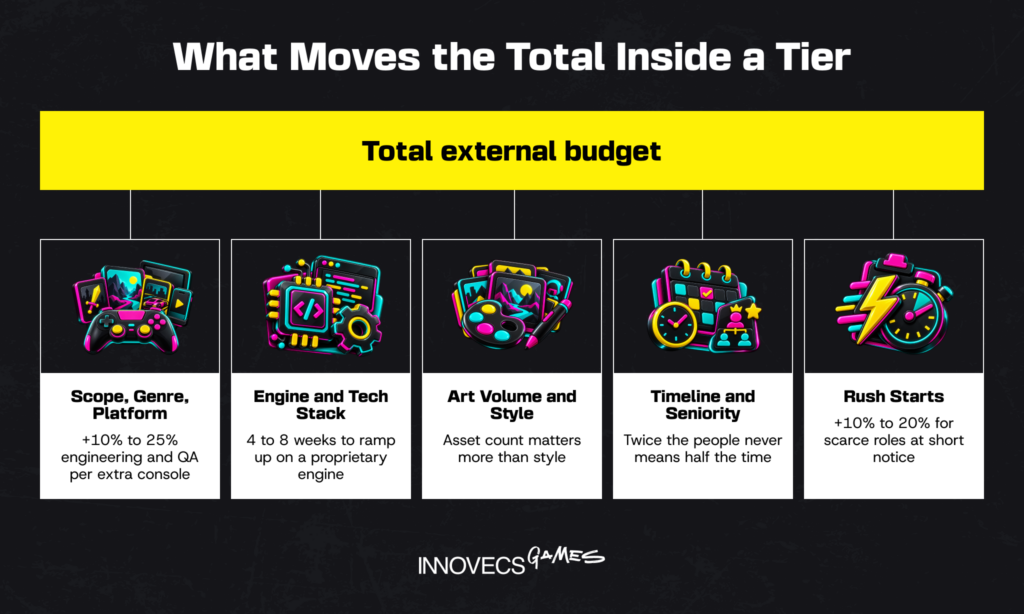
Inside any tier, five variables move the total, and not by equal amounts. In our estimates, scope and platform count account for more of the swing than the other three combined, and the start date matters most when it’s close.
Scope, Genre, and Platform
More content costs more in a nearly straight line. Double the levels and you’ve roughly doubled level design, art and QA with them. Every feature list looks shorter in a pitch deck than it does in a task tracker. Genre decides where the floor is: build an online shooter and you’re paying for netcode, anti-cheat and servers that a single-player puzzle game never needs. In our estimates, each additional console platform adds 10% to 25% to engineering and QA, covering a certification cycle, a performance pass and a new set of hardware for the test matrix. Online multiplayer adds a third or more to engineering, and it keeps costing after launch.
Engine and Tech Stack
Unity and Unreal projects are the cheapest to staff from outside because the talent pool is wide and onboarding is quick. A proprietary game engine changes that. Now the vendor learns your tools while you pay, and it’s usually four to eight weeks before their output looks normal. When someone leaves, fewer people can replace them. Middleware plays the same game. Hand over a backend on PlayFab or Firebase and everyone knows it already. Hand over a server stack you built yourselves and you’ll want whoever wrote it on the first few calls.
How Much Art, and in What Style
Per asset, stylized art tends to cost less than photoreal. Per game, not always, because a strong style takes more rounds to find and a stricter art bible to hold. The number of assets matters more than the style. Forty rooms built from one modular kit cost less than forty rooms built from scratch, and they ship sooner, which is why we think the best money in an art budget is the week a technical artist spends planning reuse before anybody models anything.
Keeping a style consistent costs money too, and each extra vendor adds to the bill. A style guide people can actually use, with turnarounds, palette callouts and approved reference assets, eats two to four weeks of an art lead’s time. If a partner writes it for you, expect roughly $10,000 to $25,000. A paid style test, one asset per vendor matched to your shipped work, costs $1,000 to $5,000 and is the cheapest way to find out whether a team can hit your look. Teams in a different region from your players need that test most, because art taste travels less well than code.
Timeline and Team Seniority
Squeeze the schedule and the bill grows faster than the calendar shrinks. Twice the people almost never means half the time, though somebody’s roadmap asks for exactly that every year. Against a fixed date you mainly get twice the burn. Each new person adds conversations quicker than output, and spends their first month learning what the rest already know. Seniors cost more an hour and, in our experience, less per milestone. The exception is bulk asset production, where a mid-level team with a good lead watching it is the smarter buy.
Rush Starts and Burst Capacity
Most of the calls we get come in when a milestone is already wobbling, and at that point the start date matters as much as the rate. A partner with people on the bench can put a small pod on your build in one to two weeks, and for common roles that speed usually costs nothing extra. Scarce roles at short notice, a senior graphics programmer or a technical artist who knows your engine, often carry a 10% to 20% premium, or a minimum term of two to three months. Budget a week of overlap at the start, when the new team is reading code and your leads are answering questions, and don’t expect a burst team to save a milestone that is less than three weeks away. We’d rather say that on the first call than take the work and explain it in the retro.
Outsourcing vs In-House: What Each Option Really Costs
Every price so far compares one vendor with another. For most studios the real alternative is hiring, and that comparison is where outside teams get oversold and undersold in equal measure. Everybody negotiates the salary. It’s nowhere near the whole cost. In June 2026 a US private employer paid $73.69 for every hour a professional actually worked, by the Bureau of Labor Statistics’ count, and $22.71 of it went on benefits instead of wages. Senior game engineers earn more than the average professional, so read that as the floor. Recruiting itself is surprisingly cheap. SHRM’s 2025 survey put a non-executive hire at $1,200, and the 2026 edition says it barely moved. The expensive part is time. SHRM’s 2026 median for filling a non-executive role is 39 days, and then a new hire spends weeks learning your codebase while the milestone date stays exactly where it was.
| Cost line | In-house hire (US) | Outsourced team (Eastern Europe) |
|---|---|---|
| Pay | Salary set by your local market | Hourly or monthly rate, all-inclusive |
| Taxes and benefits | About 45% on top of wages for professional roles | Included in the rate |
| Recruiting and ramp-up | A median 39 days to fill a role, then onboarding | 2 to 5 weeks to a working team |
| Equipment, software seats, dev kits | Bought per seat | Usually included; dev kits case by case |
| Downtime between projects | You pay for the bench | You pay only while the team works for you |
| Management | Your leads, full time | Vendor’s lead and producer, plus a share of yours |
| Scaling down | Notice, severance, morale | Contract notice, typically 30 days |
| Knowledge | Stays in the building | Leaves at contract end unless handed over |
Sources: BLS Employer Costs for Employee Compensation, June 2026 ($22.71 of benefits on $50.98 of wages per hour); SHRM Recruiting Benchmarking, 2026 edition; outsourced column from Innovecs Games delivery data, 2023 to 2026.
The last row is the one that should keep the in-house column honest. Every other line favors an outside team for temporary work, and that one doesn’t.
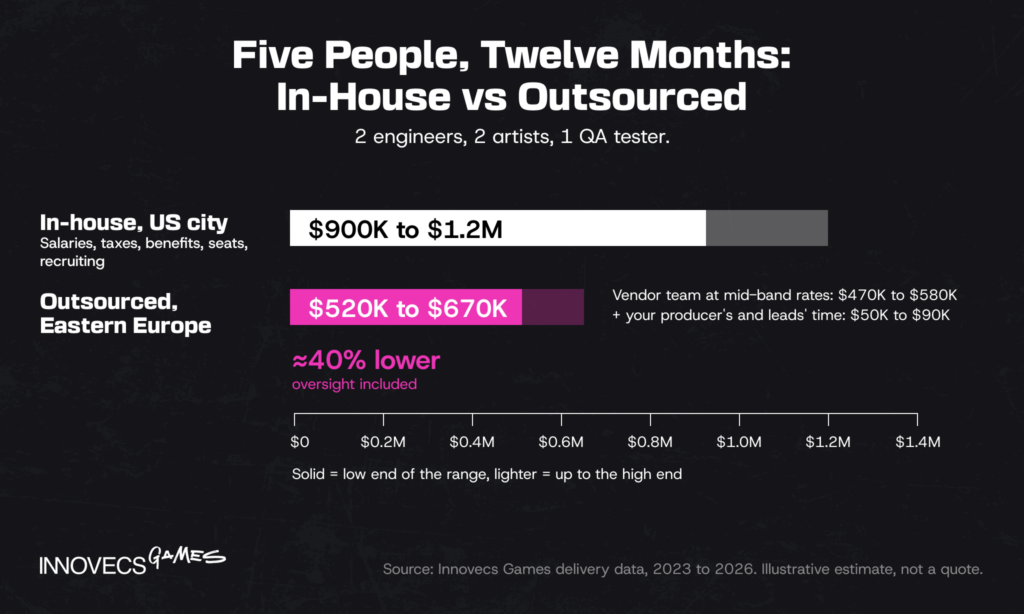
Now run both columns on one team. Take five people for twelve months, two engineers, two artists and a QA tester, priced from our own delivery data. Hire them in a US city, count taxes, benefits, seats and recruiting, and you’re spending roughly $900,000 to $1.2 million a year. Get the same five from an Eastern European partner at mid-band rates and it’s about $470,000 to $580,000. Add $50,000 to $90,000 for the share of your own producer’s and leads’ time it takes to run, and the saving lands at around 40%. That’s a real number. It’s also smaller than the gap in the regional rate table, because your own oversight time doesn’t get cheaper when the team does.
Having an in-house team doesn’t remove the case for an external one, and parallel prototyping shows why. A three- or four-person external pod can build a playable prototype of one core loop in four to eight weeks for roughly $25,000 to $60,000 at Eastern European rates, while your own team stays on the live game. Run four and kill three, and you’ve spent $100,000 to $240,000 to find one concept worth funding, without pulling a single person off the title that pays the bills. Most prototypes fail, so the cheaper each failure is, the more of them you can afford. The occasional one doesn’t: PEAK started as a one-month jam by seven developers from Aggro Crab and Landfall in Seoul in February 2025, and passed 10 million copies by mid-August.
The case for outsourcing game development is strongest for spikes and fixed scopes: a port, a content push before alpha, a technical art pass, a LiveOps season. It weakens for your core loop, for proprietary tech you’ll iterate on weekly for years, and for any team you’d keep busy for three years straight. Past that point the vendor’s margin compounds, and handover stops being optional. For work that’s permanent, our guide on how to hire a game development team covers the in-house route. Here’s where we land, after years on the vendor side of this table: keep your core loop and your art direction in-house, and buy capacity for nearly everything else. Studios that do it the other way round end up paying a partner to make decisions only they should make.
Not Sure Which Model Fits Your Budget? Let’s Talk
Got a scope, even a messy one, and a date it can’t miss? Send both over. You’ll hear which model we’d pick, what the team would look like and what it costs a month, and if hiring your own people makes more sense, we’ll tell you that instead.
Hidden Costs Studios Often Miss
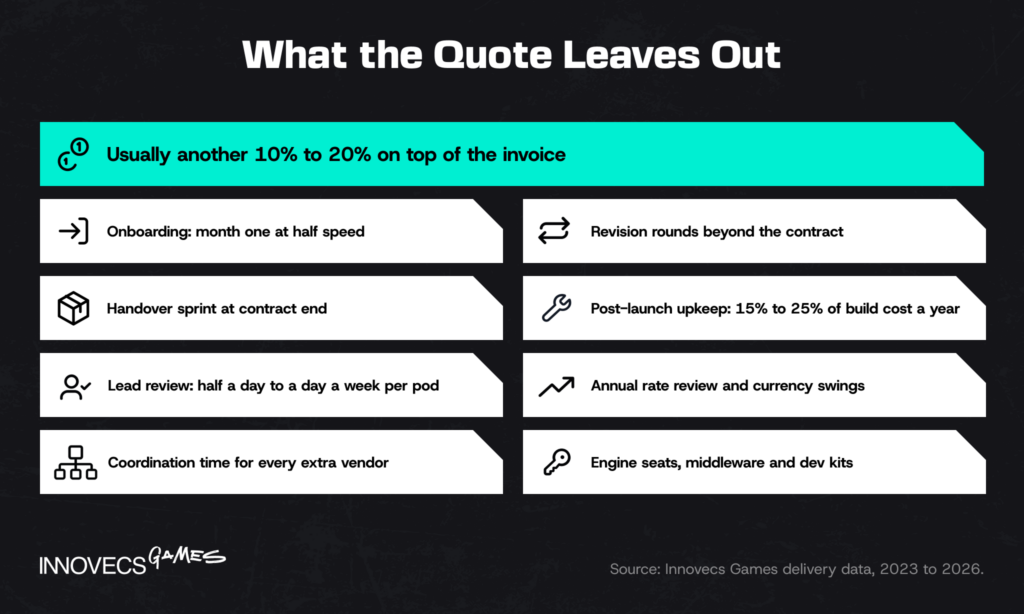
A quote covers what the vendor does. It rarely covers what the arrangement costs you, and on the projects we’ve seen, that second number adds 10% to 20% on top of the invoice. None of it is hidden on purpose. It lives in other budgets, mostly the time of people you already pay.
Onboarding and Knowledge Transfer
No outside team is at full speed in its first two to five weeks, whatever the plan says. Before anything useful lands, people need repo access, a build that runs, the art bible, your coding standards and a dev environment that works, and on a proprietary engine all of that drags on longer. We tell clients to budget month one at half speed. Nobody has ever complained that it went better. You pay a similar bill on the way out, too, when documentation and a handover sprint decide whether your own people can keep what the vendor built running.
Management and Communication Overhead
Somebody at your end has to review the work, field the questions and sign off milestones. With an embedded pod, that’s half a day to a full day of a lead’s week, more in the first month. Across a time-zone gap, every unclear requirement costs a day of calendar, so writing requirements properly is part of the overhead rather than a way around it. If nobody on your side is named as the team’s contact, everybody is, which works out the same as nobody. What fixes it costs almost nothing: one accountable person on each side, a weekly look at the build against acceptance criteria, and a single tracker that both teams actually live in.
The Cost of Running Several Vendors
Each partner costs you something before it ships a single file. There’s the contract and the legal review, a security check, onboarding into your tools, a weekly review slot, and one more build integration. In our experience that adds up to a few days of combined producer, lead and legal time per vendor each month, so four partners can quietly cost you most of a coordinator you never hired. It shows up in quality too, as four studios’ readings of one style guide. Fewer partners usually win that arithmetic. On a title that pays the rent, keeping two is a fair hedge. Just book the second one as insurance, not as spare hands that come free.
Revisions and Rework
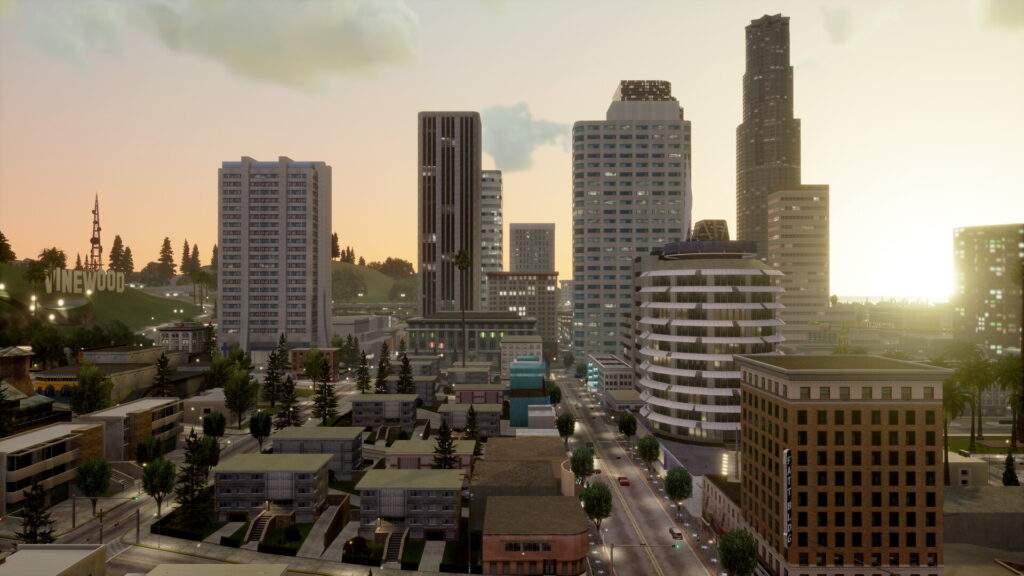
Revisions are where fixed quotes leak. Rockstar handed the 2021 remaster of its three classic Grand Theft Auto games to an outside studio. The trilogy shipped with visual problems, including AI-upscaled textures that put typos into in-game signs. Eight days after the November 2021 launch, Rockstar apologized publicly and offered the classic PC versions to buyers at no extra cost. Three years later a major patch, which VGC reported was based on a different team’s mobile version, removed the original developer’s credit from the games. Your project will have smaller stakes, but the defense works at any size. Write acceptance criteria per deliverable and attach reference images to every style decision. Then fix the number of revision rounds in the contract, with the price of extra rounds stated in advance.
Post-Launch Support and LiveOps
Shipping doesn’t stop the spending. New platform SDKs, OS releases, store policy changes and crash fixes all want engineers, even if you never add another feature. For the live games we look after, that upkeep comes to roughly 15% to 25% of what the build cost, every year. LiveOps sits on top as its own monthly line. An Eastern European core of four people for LiveOps is about $28,000 to $55,000 a month; bring in seasonal events, backend on-call and analytics, and a mid-size live game is spending $45,000 to $120,000 a month before anybody talks about user acquisition. Put a date in the calendar for questioning that number. Supercell did. Squad Busters went global in May 2024, got reworked several times, and still goes dark on December 14, 2026, because the studio couldn’t see a clear path forward. Keep the same people on a live game where you can. A live economy has a memory, and the person who tuned last season’s drop rates is the cheapest person to tune the next ones.
Rate Reviews, Currency, and Licenses
Most multi-year agreements include an annual rate review. In Eastern Europe that review has lately meant increases of several percent a year, in line with the labor costs Eurostat tracks. Price the contract in euros or zloty and the exchange rate becomes your problem as well. Licenses are the last quiet line. Engine seats, middleware, plugins, test devices and console dev kits all cost someone money. Agree in writing who pays for each before the first invoice, since “we assumed you had that” costs more after kickoff than before it.
How to Save Money Without Cutting Quality
The hour you never spend redoing something is the cheapest hour on the project, and most of those hours get saved or lost before production begins. Haggling over the rate is the weakest lever, since a vendor squeezed below its normal margin recovers it through who it staffs on your project.
Lock Scope Before Production
Before anyone estimates the project scope, decide what “done” means and write it down. In practice that’s a game design document people really open, a vertical slice that sets the bar, and acceptance criteria for each milestone. Not every feature has to be frozen, only the ones you want priced. When studios prototype at home and then outsource production against a slice that already works, the estimates come back tighter and the change requests mostly don’t come at all. The opposite case is expensive in public. Warcraft III: Reforged paired an outside art studio with a Blizzard team that, according to Bloomberg’s later reporting, never had the budget its scope required. The game shipped in January 2020 before that team felt it was ready, and within a week Blizzard was offering full refunds to anyone who asked.
Start With a Paid Trial Task
A trial task is the cheapest relationship you’ll ever end, which is the point of it. Before a long contract, pay for one or two weeks of real work: one character at shipping quality, one feature in your repository, one test pass on your build. It’s the most useful step in vendor vetting, and it’s worth signing the NDA and the IP ownership terms first, so the trial work is yours. Score three things. How far the actual hours landed from their own estimate, since that’s the error bar you’ll live with for a year. How many of their questions your brief already answered, which shows how carefully they read it. And whether the delivered file dropped into your build without your team rebuilding it.
Mix Engagement Models by Phase
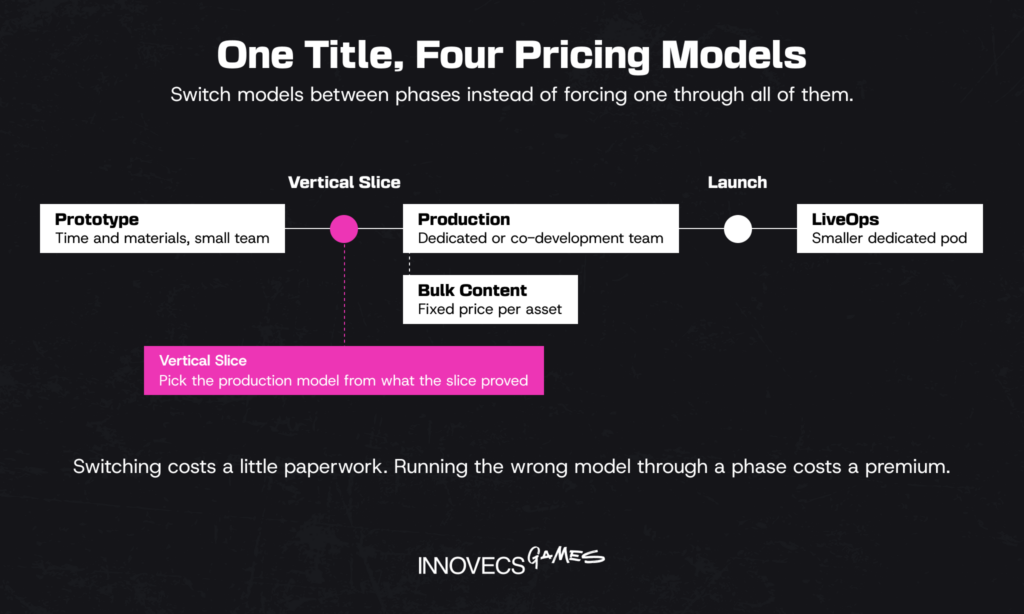
Nothing in a contract says you must keep one model from kickoff to launch, and we’d argue against it. Prototyping, with the design still shifting under everyone’s feet, goes best with a small time-and-materials team. A dedicated or co-development team suits production, fixed price per asset suits bulk content, and a smaller dedicated pod suits LiveOps after launch. Switching models between phases costs a little paperwork and saves the premium you’d pay for running the wrong model through a phase it doesn’t fit. Our default advice for a new title is time and materials until the vertical slice, then whatever the slice proved. A slice settles more budget arguments than any spreadsheet we’ve built.
Track Cost per Accepted Milestone
Budget holders want to see the return, and the hourly rate can’t show it. Cost per accepted milestone does a much better job. Take everything you paid for a piece of work that passed your acceptance criteria, rounds of fixes included, and set it against what your own team would have spent on it, with those 39 days of hiring counted in. On a live mobile game, go one step further and line the work up with the number it was supposed to move: store conversion after new art, retention after an event, CPI after a fresh batch of creatives. A partner whose cost per accepted milestone falls over the first three months is learning your game. One whose cost rises is learning on your budget.
How AI Is Changing Outsourced Game Development Costs
Every saving above comes from hours you can see on a plan. AI changes hours inside the vendor’s own pipeline, which you mostly can’t. The tools are now standard in external studios, and they’ve moved where the hours go more than how many there are. Google’s 2025 DORA report, published in September 2025 and still the latest edition, found about 90% of software professionals using AI, with 30% saying they trust its output little or not at all. Its researchers linked AI adoption to higher delivery throughput and to rising delivery instability. Their word for AI is an amplifier. We’d translate that as: tidy teams get tidier, and messy ones make their mess at twice the speed.
Inside games the picture looks similar. Staff at Electronic Arts told Business Insider that internal AI tools produced flawed code that had to be fixed by hand, as VGC reported in October 2025. The GTA trilogy’s typo-filled signs are the art version of the same lesson. The generated draft was cheap, and the review that should have caught it was the part nobody paid for.
So where does it show on the bill? Our engineers spend less time on editor scripts, build pipeline tweaks, save-data migrations and test scaffolding, which AI-assisted coding now drafts for them. Automated QA has taken over a lot of the clicking (the same menu, the same phone, attempt number one hundred), and nobody misses it. In art, AI art tools and procedural content generation spit out texture variants, LOD chains and background props, and an artist fixes them up instead of starting from nothing. Then the review bill goes up, because a person still reads every generated function, asks where a generated texture came from and, now and then, phones a lawyer. Net it out across the projects we’ve priced this year and engineering and QA hours drop a little, the pipeline runs a bit smoother, and art direction, design and performance work cost what they always did.
How Innovecs Games Keeps Project Spending Predictable
All of the numbers above describe the market, including us. We’ve spent 11+ years and 300+ game projects on external development for studios including Ubisoft, Xbox Game Studios, Warner Bros. Games, Jam City and King. Our 150+ specialists work from studios in Eastern Europe, Western Europe and North America, with a Vancouver office covering US hours. Around 90% of clients stay with us in long-term partnerships, and we think estimates that hold up are most of the reason.
Every estimate we send is a line-item document with the assumption written next to each number. You can see which figures are firm and which depend on decisions you haven’t made yet. During production you get a monthly burn report and a re-estimate at each milestone, both from the producer who runs your team day to day.
The models are flexible on purpose. We take feature-based work on specific mechanics or modules, support a single function such as art, QA, backend, LiveOps or porting, or run a full dedicated team inside your pipeline. Our game co-development services add shared responsibility for milestones. Full-cycle outsourcing is there when you need a whole production line. Our rates sit in the Eastern European band, with senior-heavy teams. For a simple 2D prototype, or high-volume asset work with no daily judgment calls, an Asian vendor will usually beat our price, and we’ll tell you so. Our portfolio shows the range of work behind these numbers.
FAQ
What is the average game development outsourcing cost?
We get asked this on almost every first call, and we always dodge the “average” part, because a hyper-casual prototype and a AAA workstream share little more than the word “game.” For mid and senior people, budget around $45 to $95 an hour in Eastern Europe or $85 to $170 in North America. Totals stretch from about $11,000 (a hyper-casual test build) to $1 million to $3 million a year (one AAA co-development pod). Once you know your tier and roughly who you need, the spread collapses fast.
How much does it cost to hire a game developer?
Depends who signs the paycheck. Through an Eastern European partner, a senior gameplay programmer is about $10,400 to $15,200 a month on our rate card, with the laptop, taxes and a manager already inside that figure. A freelancer will often look cheaper, until you count the recruiting, the paperwork and the week they’re off sick with nobody covering. If you hire directly in the US, BLS numbers for professional roles say to add something like 45% on top of the salary for benefits and employer taxes, and that’s before the recruiter or the ramp-up.
Is it cheaper to outsource a game than to build an in-house team?
For a job that ends, usually yes, and by more than people expect but less than vendors like to claim: our five-person, twelve-month example comes out about 40% cheaper from Eastern Europe than fully loaded in a US city. Stretch the same team over three years or more and the sums start leaning back toward hiring, because you keep paying the vendor’s margin and eventually you’ll want the knowledge in-house anyway. Most of the studios we work with end up doing both. They keep a core of their own and bring us in for the spikes and the skills they can’t justify on payroll.
Which region offers the best value for outsourcing video game development?
We’re based in Eastern Europe, so keep that in mind as you read our answer. For console, PC and co-development work we’d still pick it, for the depth of senior people at the price and a working day that matches London and Berlin almost hour for hour. If your team is in the US and hates waiting overnight for answers, look at Latin America; if the work is a big pile of well-specified art or test passes, Asia-Pacific will usually beat everyone on price.
Fixed price or time and materials: which pricing model suits a game project?
Ask yourself whether you could write down “done” right now, for an art pack, a port of a finished build or a feature with proper acceptance criteria. If yes, fixed price is fine. If players are going to reshape it in testing, which is true of most gameplay and co-development, time and materials is the honest choice. The vendor charges 10% to 20% extra for taking on fixed-price risk, more with a thin spec, so plenty of projects split it: fixed price for content, hourly for engineering.
What do studios charge for game art alone?
A character concept usually costs $200 to $1,500, and an environment piece $1,000 to $5,000. On our projects a stylized 3D character ready for the engine comes in at $3,000 to $10,000, while a realistic one with full texture sets is two or three times that. Need someone for months rather than one asset? A dedicated Eastern European artist is about $6,400 to $11,200 a month, depending on discipline and seniority.
What expenses usually sit outside a studio’s quote?
The biggest one is your own team’s time, typically half a day to a day of a lead’s week for every outside pod. Then there’s the slow first month of onboarding and any revision rounds past what the contract covers. Further down the list: upkeep after launch at 15% to 25% of the build cost each year, engine and middleware licenses, dev kits and the yearly rate increase. Across our projects, all of that tends to put another 10% to 20% on top of the invoice.
How do I get an accurate quote from an external game studio?
Send everyone exactly the same pack (design doc or feature list, reference images, target platforms and devices, dated milestones, your acceptance criteria), because three vendors answering three different briefs gives you three numbers you can’t compare. Insist on line items with the assumptions written beside them, so you can see who quietly left QA or the producer out. Then, before you sign anything big, pay one of them for a week or two of real work. It’s the only test where the estimate meets your actual codebase.
🤖 Does AI reduce what studios charge for game development?
A little, and mostly in engineering and QA. Generated code and tests save hours that review then partly takes back, while art direction, design and performance work cost about what they did before. On time and materials you see any saving as fewer hours. On fixed price you only see it if the contract asks for it.
🤖 How should AI-assisted work be priced in a studio contract?
We’d price the result and ignore the tool: a character either passes your acceptance criteria or it doesn’t, whoever or whatever drew the first sketch. On time and materials, the estimate ought to assume the team already uses AI, and each milestone’s real hours tell you if it did. Fixed price needs one extra clause saying which deliverables may contain generated content, since your store disclosure and your IP warranty both hang on it. And whichever model you pick, clearing a generated asset stays the vendor’s job, not yours.
Get a Clear Game Development Outsourcing Cost Estimate for Your Game
A one-page pitch is enough to start. Send it with your platforms and ship date, and we’ll reply with the team we’d staff, what it costs per month and each assumption behind that, in language your finance people won’t need us on a call to explain.