How Much Does Game Localization Cost? A 2026 Pricing Breakdown for Studios
What words, voices and testers cost in 2026, with our math showing.
Ask a producer how game localization cost gets worked out. Most will hand you a sticky note’s worth. Source words, times a per-word rate, times the number of languages. It isn’t wrong. It just describes the one part of the bill that’s easy to put in a spreadsheet, and that part is rarely where things go wrong.
Hollow Knight: Silksong is the clearest recent case. Team Cherry launched it on September 4, 2025, with Simplified Chinese on day one. That’s Steam’s most-used language, by Valve’s count, and the game peaked at almost 600,000 concurrent players. Players who switched to Chinese were less impressed. Reviews in that language slid to Mixed, with about 44% positive, and fans noticed the credits named two translators where the first game had six. The words had been translated, paid for and shipped. The tone hadn’t survived the trip. By November 10, Team Cherry’s Patch 4 had swapped the official Chinese text for a fan translation by a group called Team Cart Fix. No localization vendor wants that sentence in its portfolio.
So the per-word rate gets its full section below, language by language. Around it sit the lines that decide whether that money was well spent, and those get just as much room here: getting the build to show Cyrillic or Hangul at all, linguistic QA, voice-over, somebody keeping a dozen languages on one glossary, and the patch text that keeps arriving long after launch. We finish with three worked budgets and a break-even check. Steal the math.
What You’re Actually Paying For When You Localize a Game
Video game localization, in plain terms: the game has to read, sound and play like it was made in that market. There are really four jobs hiding in there. You translate the text and adapt whatever doesn’t travel. You engineer the build so it can show and switch languages. Then you test the result inside the running game. Translation is the most visible of the four, and on most projects it isn’t the slowest. The audience for that work is bigger than many English-first teams assume. Valve’s own GDC numbers this March put it bluntly: for 66% of Steam users in 2025, English wasn’t their main language. Steam itself speaks 29 of them officially.
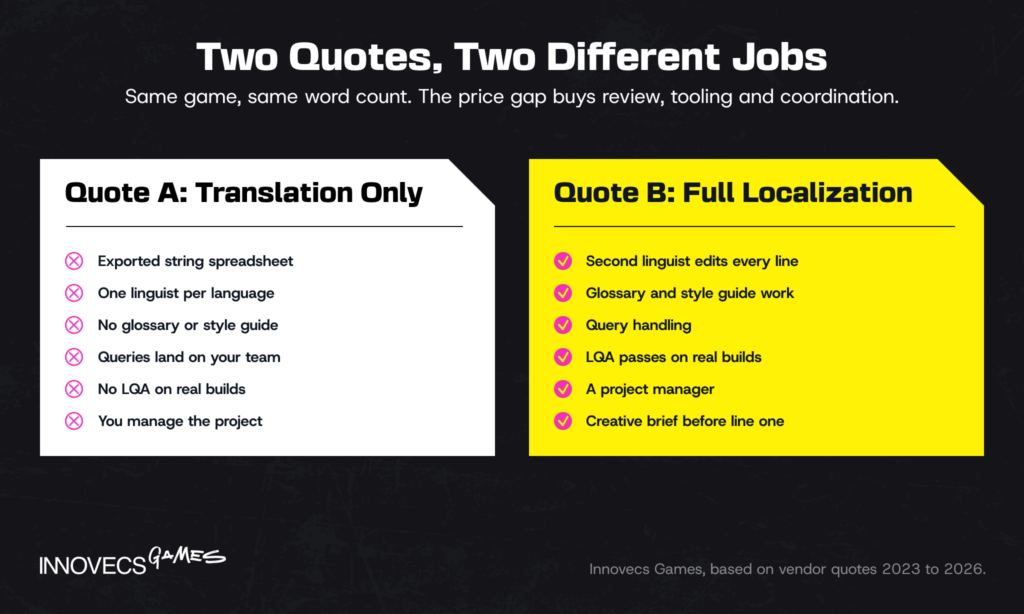
Ever had two quotes for the same game come back miles apart? Usually the vendors priced two different jobs and didn’t mention it. One quote covers translating an exported spreadsheet of strings, and nothing else. Another adds a second linguist to edit each translation, glossary and style-guide work, query handling, LQA passes on real builds and a project manager. The second costs more and takes work off your team that the first leaves on it. A Belgian survey of freelance translators (run in 2024, published in September 2025) shows where the difference goes. Agencies were paying them about €0.10 a word, which is exactly what they paid in 2018. Game studios are quoted noticeably more. The gap is buying review, tooling and coordination. Where it buys none of those, you’re paying for a forwarding service.
And then there’s the creative brief, which plenty of quotes skip. Black Myth: Wukong is a nice example. Game Science’s style guide asked linguists to keep the charm of Chinese culture, so the English version left yaoguai and jingubang alone and called the dragons “loong.” Someone had to make those calls, and pay for them, before anybody translated a line. A vendor that never asks for that kind of guidance is quoting a different job.
If you’re still sizing the whole production, our breakdown of the cost to make a video game shows where localization sits next to art, engineering and QA.
How Localization Cost Is Calculated
Almost every quote we’ve seen mixes four billing units, and words are still king. When Slator surveyed language service providers for its 2024 market report, 91% of them said they price translation per word, while 64% also bill some jobs by the hour (which is where it gets interesting).
| How you’re billed | What you get for it | Ballpark, 2026 | Where it bites |
|---|---|---|---|
| Per source word | Translation, plus a second linguist editing it | $0.07 to $0.20 | Ask how they discount repeats, and what the minimum per job is |
| Per hour | LQA testers, loc engineers, transcreation writers | $25 to $90 | Hours with no cap tend to grow |
| Per line, or per studio hour | Actors, a director, the recording engineer, editing | $3 to $20 a line, $250 to $700 a studio hour | Buyouts and union fees nobody mentioned on the first call |
| Monthly retainer | Patch notes, live-ops text, store page tweaks | $2,000 to $15,000 a month | Hours you didn’t use? Usually gone at month end |
We took these from vendor quotes on our own projects between 2023 and 2026 (Innovecs Games delivery data), so treat them as a ballpark rather than a rate card.
Funny thing is, the budget fights we’ve sat through were never about row one. They were about rows three and four, because nobody had bothered to write them down.
Per-Word Translation Rates
So how does a vendor get to a number? They count source words, meaning the words in your original, whatever language it’s in, and multiply by a rate for each target language. Chinese and Japanese sources get counted in characters instead, since neither language bothers with spaces. Pick the counting tool together before the first invoice, by the way; we’ve never seen anyone win the argument over whether a hyphenated word is one word or two. Think of the headline game localization price per word as where the math starts, because it’s nowhere near where it ends. Vendors run your text through translation memory (TM) software, which catches repeats and anything you’ve already paid to have translated, and they bill those bits on a sliding scale. It’s standard practice on their side too: in the Belgian survey, 72% of agencies cut what they paid translators the same way. A typical grid:
| Match type | In plain English | What you pay, as a share of the full rate |
|---|---|---|
| Context match (ICE) | Same sentence, and the lines around it match too | 0% to 10% |
| 100% match | Already sitting in your TM, word for word | 25% to 30% |
| Repetition | Pops up again somewhere in this same batch | 25% to 30% |
| Fuzzy 95% to 99% | Someone changed a number, a name or a comma | 40% to 50% |
| Fuzzy 85% to 94% | Same shape, a couple of words swapped | 60% to 70% |
| Fuzzy 75% to 84% | You’d recognize it, but a linguist still has to rework it | 80% to 90% |
| No match (under 75%) | Genuinely new text | 100% |
These grids come off vendor quotes on Innovecs Games projects, 2023 to 2026.
Get this grid in writing before job one. We’ve watched two vendors with identical headline rates end up 20% apart on a repetitive game, purely because one was more generous with fuzzy matches.
In our experience the small print bites more often than the big numbers do. You’ll usually see a minimum fee of $30 to $80 per language per job, which is how that 40-word Friday hotfix ends up costing more than a page of dialogue. Ask a linguist for more than about 2,000 words a day and you’re into rush pricing, 25% to 50% on top. Taglines, jokes, store copy and anything else that really has to be rewritten rather than translated is transcreation, and that’s billed by the hour at $50 to $100. And legal text like EULAs runs 10% to 20% higher, because you really do want someone who reads contracts for fun.
Hourly Rates for LQA and Engineering
Some of the work just doesn’t come in words, so it gets billed by the hour instead. LQA testers are the obvious case, since their whole job is to play the localized build and complain about it (a clipped line here, a joke that lost its context there, a variable that prints as {0}), and you’ll typically pay $25 to $45 an hour for that. The localization engineers who own string extraction, file formats, fonts and the import pipeline are pricier, somewhere around $40 to $90 depending on where they sit and how senior they are. The catch with hourly lines? The estimate is only as good as the build you give them. Hand over something unstable and LQA hours double, and no vendor can fix that from their end. Our rule: if the localized build crashes more than the English one, stop LQA and fix the build. Otherwise you’re paying linguists to file engineering bugs.
Voice-Over Pricing by Line or Studio Hour
Voice is where a localization budget quietly becomes a production budget. Every producer has heard “it’s only a few barks” in a planning meeting, and it’s usually the most expensive thing anyone says all day. Barks and UI voice sometimes get a per-line price. Proper dubbing doesn’t; it’s booked by the studio hour, and actors, a director, an engineer and editing all sit on top. Union rates show you the floor. Under SAG-AFTRA’s Independent Interactive Localization Agreement, a performer’s 2025 day rate (the latest on the union’s published sheet) was $1,102 for four hours and up to 12 voices, plus a mandatory 50% buyout for reuse. The union’s main 2025 game agreement also built in 3% raises every November through 2027, so read the 2025 number as a floor, not a quote. After that, it’s all throughput, and throughput depends on how closely the new line has to match the original:
| Recording type | What the actor has to do | Lines you’ll get per studio hour | Per finished line, Europe or Asia (non-union) | Per finished line, US union |
|---|---|---|---|---|
| Wild | Shout the barks, combat calls and NPC chatter, with no timing to hit | 80 to 100 | $3 to $4 | $6 to $8 |
| Time-constrained | Land the line in roughly the original’s length | 50 to 70 | $4 to $6 | $8 to $12 |
| Lip-sync | Match the mouth movements in a cutscene | 30 to 40 | $7 to $10 | $14 to $20 |
From Innovecs Games delivery data, 2023 to 2026. We’ve assumed an all-in studio hour of $250 to $350 in Europe and Asia, or $500 to $700 on US union terms once buyout plus health and retirement are in, and casting, prep and editing usually tack on another 15% to 25%.
Your game will almost certainly need all three kinds. So ask every vendor what share of your script they’ve assumed is lip-sync, because that one guess can swing a dubbing budget by half. And voice doesn’t have to ship on day one. ZA/UM put out Disco Elysium in 2019 and only added voice acting for every character with The Final Cut in 2021, after the game had shown it could pay for it.
Fixed-Price and Retainer Models for Live Games
A game that ships once can live happily on per-word pricing. A live game can’t, because it ships text every few weeks. When the scope is known, like a DLC with a locked script, a fixed project fee works, though you’re paying the vendor’s risk margin whether or not anything goes wrong. The alternative is a retainer. You pay a monthly fee and get reserved linguists plus a turnaround, often 48 to 72 hours on patch text. We’re fans when updates are small and frequent, because the per-job minimums disappear. We’re not fans when the release calendar comes in bursts; unused hours almost never roll over, and you’ll pay for a quiet March anyway. Check that clause. It’s two lines, and it matters more than the rate does. Whichever model you pick, it still multiplies a per-word rate, and that rate mostly comes down to the language.
Game Translation Rates by Language
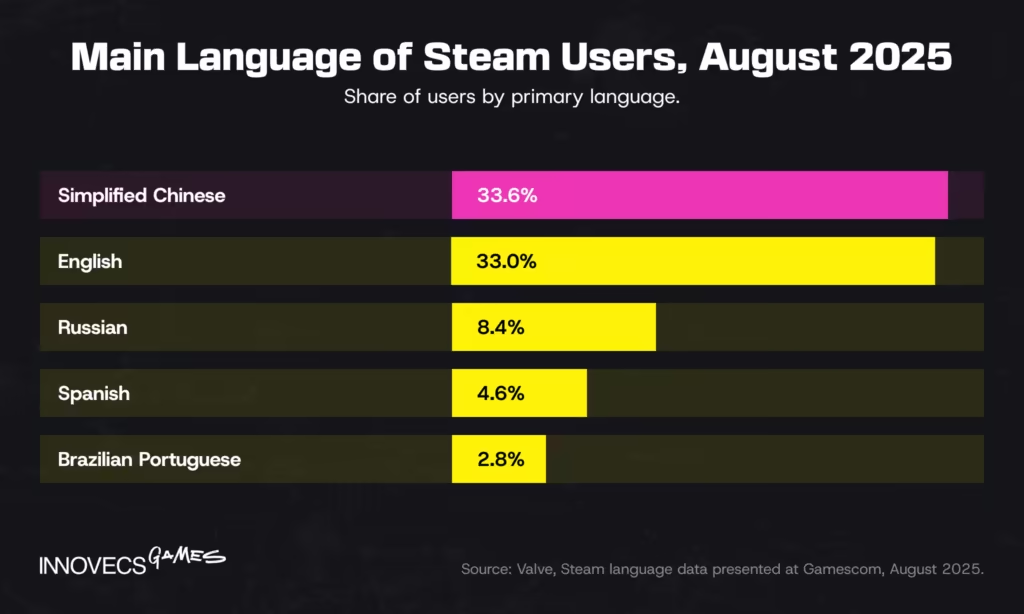
Steam’s language numbers come with a built-in contradiction. Valve’s latest breakdown, from Gamescom in August 2025, had Simplified Chinese as the main language for 33.6% of Steam users. English came second at 33%, then Russian (8.4%), Spanish (4.6%) and Brazilian Portuguese (2.8%). And yet most English-first studios still budget FIGS (French, Italian, German, Spanish) first and file Chinese under “maybe later.” Valve’s own advice says the opposite: the less a language looks like English, the better the expected return, simply because fewer of those players will put up with an English build.
We’ve split the rates into three groups below, and in each table we’d honestly read the last column first. The rate tells you what a word costs, but that column tells you what the language is going to cost your engineers, and that’s the number first-time buyers tend to forget. Real life is messier than three groups, too: Dutch costs roughly what German does, and the Nordic languages come close to Japanese, mostly because so few linguists up there specialize in games.
Western European Languages (FIGS)
FIGS is still the default starter pack, and for decent reasons: the talent pool is deep, review processes are mature, and every engine and TMS handles Latin script without a fuss. It’s also where your English build already sells, since plenty of players in Northern and Western Europe read English comfortably, which makes FIGS as much a quality call as a reach call. German comes with an engineering footnote. Compound nouns don’t wrap, so a button that fit “Inventory” in English now has to fit “Ausrüstung” or something longer, and while German players will forgive a lot, a button reading “Ausrüs” isn’t on the list. In French and Spanish it’s cheaper to get it right the first time, because players there can smell machine-flavored text in about two seconds. Dutch and the Nordic languages flip the logic: pricey per word, and bought by players who mostly read English anyway. We’d do them for a kids’ game or a cozy title with a broad audience, and rarely at launch for a hardcore PC game.
| Language | Per source word, from English | What actually moves the price |
|---|---|---|
| French | $0.10 to $0.14 | Easy to staff. The catch is length: expect text 15% to 20% longer than your English |
| Italian | $0.10 to $0.14 | Same story as French, plus you’ll want to settle “tu” versus “Lei” before anyone starts |
| German | $0.11 to $0.15 | Somebody has to pick “Sie” or “du”, and the long compounds will test every narrow button you’ve got |
| Spanish (Spain) | $0.10 to $0.13 | Budget it apart from Latin American Spanish; the slang, jokes and pronouns don’t travel |
| Dutch | $0.11 to $0.15 | Fewer linguists, and a lot of Dutch players happily play in English, so check demand before you buy |
| Swedish, Danish, Norwegian, Finnish | $0.14 to $0.20 | Specialists are thin on the ground (and Finnish words get very long) |
All three tables in this section use Innovecs Games delivery data: vendor quotes from projects we staffed in 2023 to 2026, game text, editing included.
Asian and Right-to-Left Languages
Here’s the annoying truth about this group: it costs more per word, costs more again in engineering, and still tends to pay back better than FIGS. Most of the extra engineering is about fonts. A Chinese, Japanese or Korean font carries thousands of glyphs, your font atlases swell, and somebody ends up in a meeting about the memory budget. Line breaks get weird too; Japanese, for instance, has a whole list of characters that aren’t allowed to start a line. Our advice is boring but it saves money: pick fonts with the localization team in the room, because it’s no fun discovering after launch that the gorgeous typeface everyone loved can’t render a character in some player’s name. Oh, and Simplified and Traditional Chinese really are two separate jobs for two separate audiences, whatever the conversion script promises. Then there’s Arabic, where the whole UI reads right to left, the letters join up, and every menu has to be mirrored. Unity didn’t give UI Toolkit full right-to-left support until Unity 6.0, and teams on TextMesh Pro are usually still bolting on something like RTLTMPro, which is why we’d tell your engineers about Arabic this quarter if it’s anywhere on the roadmap, rather than at content lock.
| Language | Per source word, from English | What actually moves the price |
|---|---|---|
| Simplified Chinese | $0.11 to $0.15 | Sort out fonts and line breaks, then write down how every name gets transliterated, or you’ll get three spellings of your hero |
| Traditional Chinese | $0.12 to $0.16 | It’s its own job for Taiwan and Hong Kong; don’t let anyone sell you a find-and-replace |
| Japanese | $0.14 to $0.20 | You’re paying for senior people who get register and honorifics right, and there are never quite enough of them |
| Korean | $0.13 to $0.18 | More honorifics, and Hangul starts to look cramped the moment you shrink the font |
| Arabic | $0.12 to $0.18 | Don’t be surprised if right-to-left UI and letter shaping cost you more than the words did |
| Thai | $0.10 to $0.15 | Words come without spaces, so line breaking needs an actual dictionary |
| Vietnamese | $0.08 to $0.12 | Diacritics stack two high, which plenty of fonts quietly can’t do |
| Indonesian | $0.07 to $0.11 | Mobile is growing fast there, and handily, the text tends to come out shorter than English |
Same Innovecs Games delivery data as the FIGS table above.
Funnily enough, Arabic is also the language where the money and the tooling point in opposite directions. Niko Partners reckons the Saudi, Emirati and Egyptian markets were worth $2.0 billion in 2024 and will hit $2.8 billion by 2029, and the average player in the UAE spends $84.60 a year ($54.89 in Saudi Arabia), more than in most of Europe. Steam, on the other hand, still only lists Arabic as a limited language: your game can be in Arabic, the Steam client around it can’t. Which tells you most of that money goes through phones and consoles. If you’re PC-first, we’d usually hold Arabic for a second wave. If you’re building a mobile game for the Gulf, launch with it, right-to-left engineering included.
Southeast Asia is cheaper per word and, again, mostly a mobile question. Thai is the one that catches engineers out, because there are no spaces between words and your line breaking literally needs a dictionary. With Vietnamese and Indonesian you mainly need a font that copes and a translator who knows the genre.
Eastern European and Latin American Markets
This is where rates are lowest and the value is often highest. Polish, Ukrainian, Czech and Turkish all have strong game-localization communities, partly because studios like CD Projekt Red and 11 bit studios trained a whole generation of specialists at home, and they’re the languages small teams tend to reach for first once a game proves itself. Stardew Valley’s first big language update, version 1.2 in April 2017, landed about 14 months after launch and put Russian and Brazilian Portuguese right next to German, Spanish, Japanese and Simplified Chinese. Give Brazilian Portuguese and Latin American Spanish their own budgets, separate from Portugal and Spain, because players switch off fast when the slang comes from the wrong continent. The catch with this whole group is grammar. Slavic cases and Turkish suffixes break any string your code builds by gluing words together, and that’s an engineering fix, not a translation one. If you want our pick for the most underpriced language for a PC game in 2026, it’s Brazilian Portuguese: a big Steam audience, linguists who actually play games, and rates near the bottom of the table.
| Language | Per source word, from English | What actually moves the price |
|---|---|---|
| Polish | $0.08 to $0.12 | A strong local game-localization scene, and seven grammatical cases |
| Czech | $0.08 to $0.12 | Cases work much like Polish, with a smaller pool |
| Ukrainian | $0.07 to $0.11 | Lots of experienced game people; verbs change with gender in dialogue |
| Russian | $0.07 to $0.11 | A big Steam audience, though payment and distribution rules vary by platform |
| Turkish | $0.08 to $0.12 | Suffixes wreck glued-together strings, and there’s a dotted and a dotless i |
| Spanish (Latin America) | $0.08 to $0.12 | One neutral variant usually covers the region |
| Brazilian Portuguese | $0.08 to $0.13 | Big pool of linguists who play games; not the same locale as Portugal |
Again from our vendor quotes, 2023 to 2026 (Innovecs Games delivery data). Marketing transcreation is priced separately.
What Drives the Final Price Up or Down
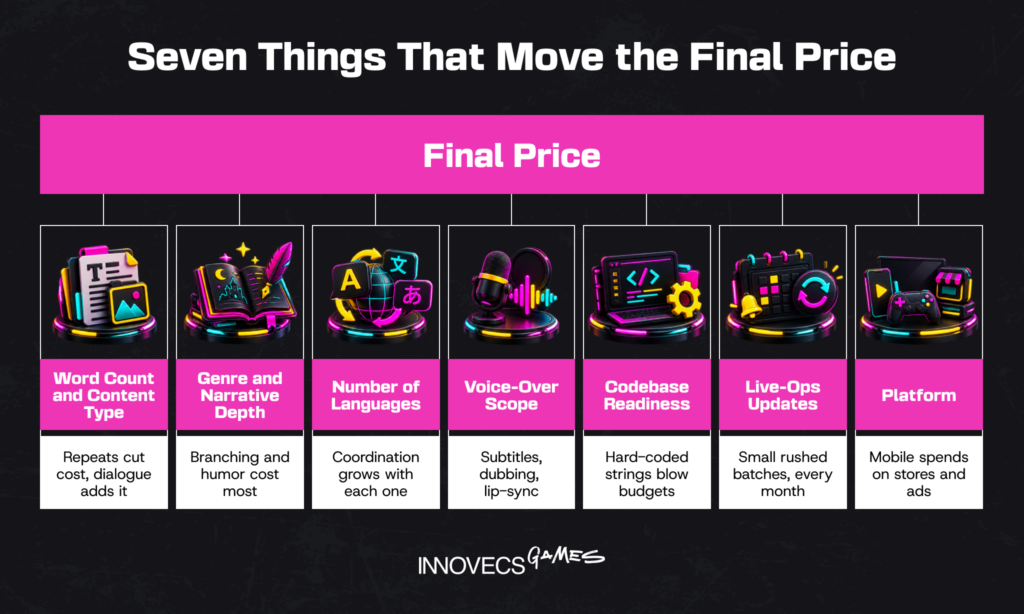
The rate tables give you the price of one word in one language. That’s it. What they can’t tell you is how many words you’ll end up buying, or what gets billed around them, and that’s where seven factors come in. It’s also why two games of roughly the same size can come back with quotes that look like they’re for different projects.
Word Count and Content Type
Word count sets the base. It doesn’t set the price, because some words are cheap to translate well and some aren’t. UI strings and item names are short and repetitive, so they come in cheap per word (each still needs context, mind you). Take “Back.” Is that a menu button, a body part or a direction? Ask any game linguist; they’ve had that argument with a spreadsheet. Dialogue, quest text and lore are slower going. Marketing copy? Often transcreation, billed by the hour. Repetition counts too, maybe more than people think. A card game at 30,000 words with 40% of it templated, versus a 30,000-word visual novel where nobody says the same thing twice: same count, and the novel’s invoice wins by a mile.
The text outside the game is small, cheap and easy to forget, and it’s also the very first thing a player in a new market reads.
| Content | Usual size, per language | How you’ll be charged | What it tends to cost per language |
|---|---|---|---|
| Steam store page (short and long description, tags) | 300 to 1,000 words | By the word | $40 to $150 |
| App Store or Google Play listing, keyword research included | 300 to 800 words | By the word, plus some hourly ASO work | $100 to $400 |
| Trailer subtitles | 100 to 300 words | By the word, plus someone timing them | $30 to $80 |
| Taglines and key art copy | A handful of lines | Transcreation, so by the hour | $50 to $300 |
| Achievements or trophies | 500 to 1,500 words (players read every one) | By the word | $60 to $200 |
| Patch notes, every update | 200 to 500 words, give or take | By the word, though the minimum fee usually kicks in | $30 to $80 |
We pulled those figures from vendor quotes on projects we staffed in 2023 to 2026 (Innovecs Games delivery data).
Here’s a trick worth knowing: Steam handles the store page and the game as two separate localizations, which means that first row can go live months before anybody translates a single line of dialogue. For under $150 a language, we honestly can’t think of a cheaper way to find out where your demand is.
Genre and Narrative Depth
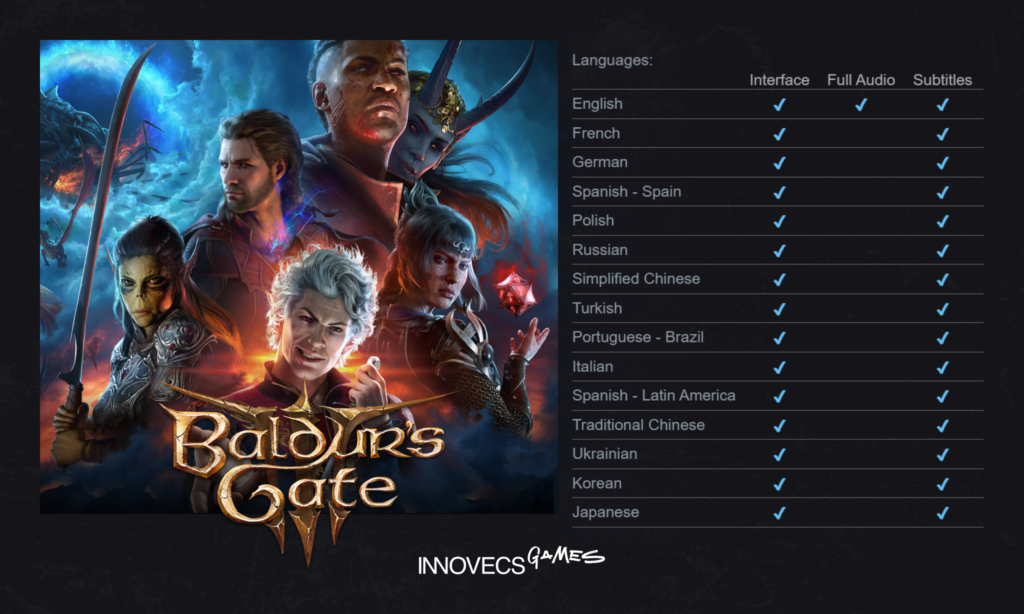
Genre decides how much thinking each word needs. A puzzle game might get by on 5,000 words of UI and tutorial. Baldur’s Gate 3 runs to 2,503,837 words by Guinness World Records’ count, and over two million of those are dialogue (yes, somebody counted). On top of sheer volume, RPGs drag in variables, branching paths and grammatical gender, and in a language like Polish, where the verb changes depending on who’s talking and to whom, one innocent English line can end up needing four versions. Humor’s worse still. Per word it’s the priciest thing in any genre, because a joke you translate word for word usually comes out the other side dead.
Number of Target Languages
Here’s the bit people underestimate. Translating into language two costs about what language one did, no surprises. The baggage is the surprise. Glossary. Linguists emailing “wait, is this a verb?” LQA round number whatever. Fonts. One more column in every patch until the servers go dark. Adding languages makes each one’s baggage a touch lighter and the whole pile harder to herd. By language eight or ten, you don’t have a PM line on the invoice anymore, you have a person. We’d take six languages done well over twelve done badly any day, and players’ reviews usually side with us.
Voice-Over and Audio Scope
You’ll find three checkboxes per language on a Steam store page (interface, subtitles, full audio), and the price jumps a lot as you move along them. Subtitles mostly ride along with the translation you’ve already paid for. Full dubbing is a different animal, though, since you’re now paying for casting, studio time, a director and editing before anyone even gets the files into the game. In a story-heavy game that’s usually the fattest single line in the localization budget, and lip-sync fattens it further. For Cyberpunk 2077, CD Projekt Red used JALI’s tools to generate facial animation so lips matched the dialogue in 10 languages. That’s how far a studio will go once dubbing is on the table.
Codebase Readiness for New Languages
Budget blown? Check the code before you blame the translators. Most builds that go over were written to speak English and nothing else, and somebody now gets to fix that. Dig out hard-coded strings. Untangle sentences glued together from little fragments (“You found ” + count + ” swords”). Hunt for fonts that actually have Cyrillic, Thai or Hangul in them. Then there’s length. IBM’s design guidelines, as summarized by the W3C, expect short English strings of up to ten characters to grow by 200% to 300% in European languages. Longer text grows by around 30%. Menus are built from exactly those short strings, which is why UI breaks first. Every localization project has the moment when someone discovers the settings menu was built for exactly eight English characters.
Live-Ops Updates and Ongoing Content
A live game’s localization is never done, and that’s fine, but it does change the math. Every season, event and patch brings its own little pile of strings, usually due “yesterday,” and buying translation in small rushed batches is about the most expensive way there is to pay per word. Patch notes are the classic case, since nobody remembers to budget for them and every single player reads them. Then you stack a minimum fee, maybe a rush rate and a quick LQA pass on each drop, and the total keeps creeping up without anyone in finance noticing. Give it a two-year roadmap and the ongoing text can quietly outspend what you paid at launch, which is why we’d book it as an operating cost and stop pretending it’s a one-off.
Platform: Mobile Versus PC and Console
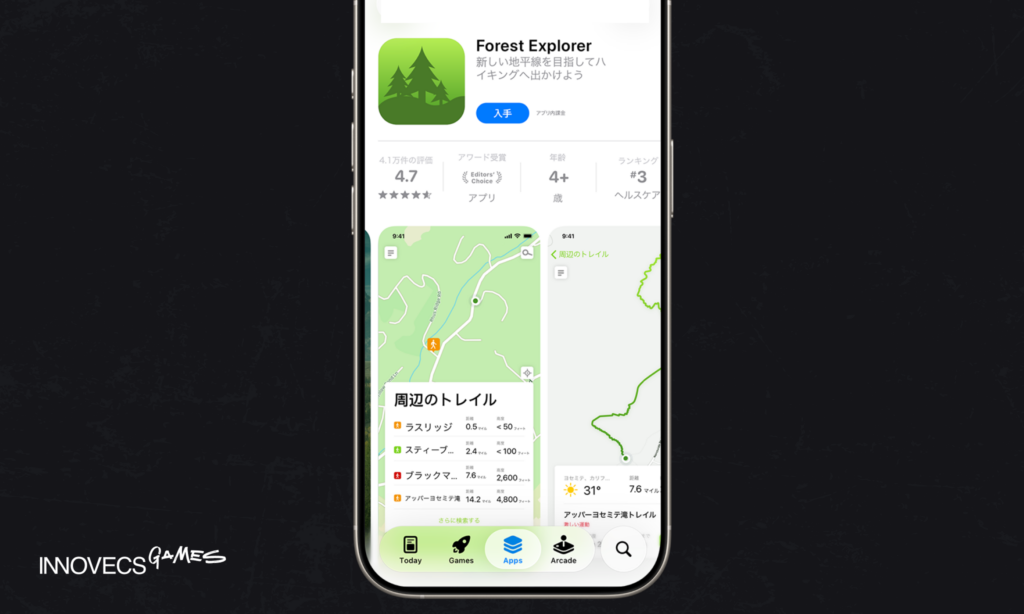
On mobile the script is honestly the cheap part, and the money goes into everything wrapped around it. The App Store alone spans 175 regions and 50 languages, and Apple would like your app name, keywords and screenshots localized for each market as well as the description. But if you ask a mobile publisher where their localization budget actually disappears, most will tell you it’s the ads. That UA video or playable that crushed it in Brazil now needs re-cutting for Poland, with a new text overlay and possibly a new voice line. We usually see $20 to $60 per language for a text swap on an existing creative and $150 to $400 when the video gets re-voiced or re-edited. A hybrid-casual team testing dozens of creatives every week has basically built a second, unplanned production line. Eight languages in the game, twenty in the ads, and good luck finding who signed off on that. Two other mobile habits shift the plan. Soft launches mostly happen in English first, with Canada and the Philippines as perennial favorites, so the big rollout can wait until the numbers come in. And then the weekly churn: events, offers, push notifications. That’s why we keep banging on about batching and retainers further down. On mobile it matters most.
Game Localization Cost Examples by Project Size
We built the three budgets below the slow way, from words and hours, rather than starting with a total and working backwards. All of them assume English source text, the middle of the rate bands above, and a vendor whose per-word price already includes editing. They’re estimates, obviously, and we’ve shown every line of math so you can argue with it. If you came here wanting one figure for video game localization cost, this is about as close as we can honestly get.
First, though, the back-of-a-napkin version, for when someone in a meeting just wants a number. It’s translation and editing into one language, mid-band rates, no translation memory discount yet:
| Your word count | Cheaper languages, around $0.09 (Eastern Europe, Latin America, Southeast Asia) | Middle of the pack, around $0.12 (FIGS, Chinese) | Pricey ones, around $0.16 (Japanese, Korean, Nordic, Arabic) |
|---|---|---|---|
| 5,000, say a puzzle or hyper-casual game | $450 | $600 | $800 |
| 20,000, a typical indie or mobile game | $1,800 | $2,400 | $3,200 |
| 50,000, think mid-size action or strategy | $4,500 | $6,000 | $8,000 |
| 150,000, where narrative games tend to sit | $13,500 | $18,000 | $24,000 |
| 500,000, big RPGs and live-service games | $45,000 | $60,000 | $80,000 |
That’s nothing fancier than our rate tables multiplied out. For the real thing you’d multiply by your number of languages, then put another 20% to 35% on top for LQA, engineering and the project manager (voice-over is its own beast and lives elsewhere).
So eight languages on a 20,000-word game is about twenty grand of translation. Sounds manageable, right? Wait until the other lines in the worked budgets show up.
Small Indie or Mobile Game
What we assumed: 20,000 source words covering UI, tutorial, items and the store page. Eight languages, which is FIGS plus Brazilian Portuguese, Simplified Chinese, Japanese and Korean. No voice-over at all, and 12 hours of LQA per language.
| Line | How we got there | Cost |
|---|---|---|
| Translating the five Western languages | 5 × 20,000 words × $0.11 | $11,000 |
| Translating the three CJK languages | 3 × 20,000 words × $0.15 | $9,000 |
| What translation memory saves you | Roughly 10% of translation | -$2,000 |
| LQA, testers playing the build | 8 languages × 12 hours × $35 | $3,360 |
| Engineering (string extraction, CJK fonts, fixing text that overflows) | 60 hours × $50 | $3,000 |
| Someone keeping it all on schedule | 10% of vendor spend | $2,140 |
| Total | About $26,500 |
Innovecs Games delivery data from projects we staffed in 2023 to 2026. It’s an illustration rather than a quote, and real projects like this have landed anywhere from $20,000 to $32,000.
For a mobile title this is a modest share of the overall build. Our guide to mobile game development cost shows the rest of that budget. The line most likely to move here is engineering. If the game was built with hard-coded strings, 60 hours becomes 200. The translation budget that looked comfortable now has an engineering budget sitting next to it.
Mid-Size Narrative Game
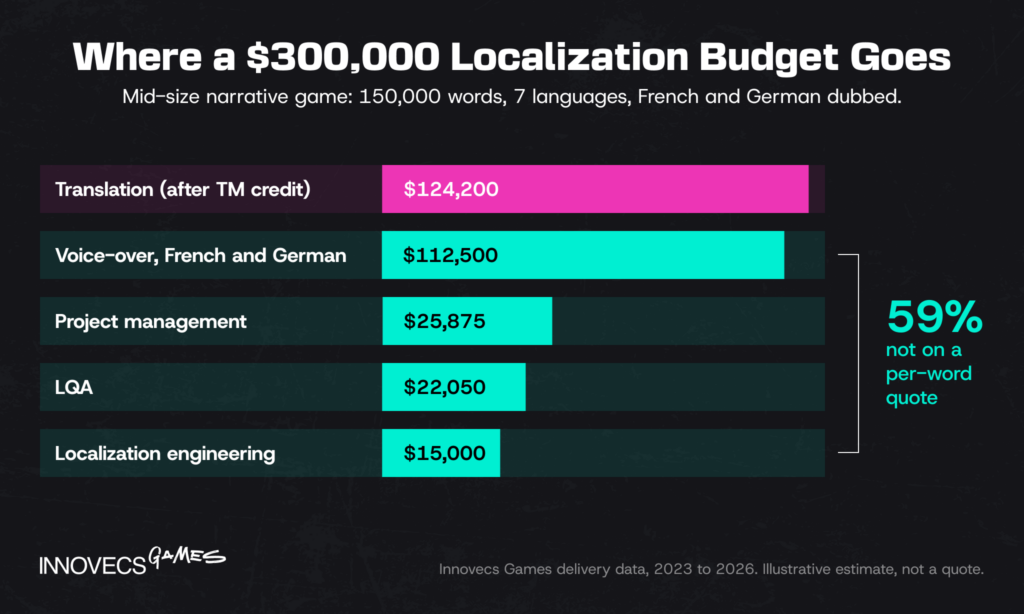
What we assumed: 150,000 source words, mostly dialogue, quests and lore. Seven languages (FIGS, Brazilian Portuguese, Simplified Chinese, Japanese). The English cast is already recorded, and French and German each get dubbed, 9,000 lines apiece. LQA runs 90 hours per language.
| Line | How we got there | Cost |
|---|---|---|
| Translating the five Western languages | 5 × 150,000 × $0.12 | $90,000 |
| Chinese and Japanese | 2 × 150,000 × $0.15 | $45,000 |
| What translation memory saves you | About 8% | -$10,800 |
| LQA, which on a script this size is real work | 7 languages × 90 hours × $35 | $22,050 |
| Dubbing French and German | 9,000 lines at about 60 an hour is 150 studio hours, × $300, plus 25% for casting, direction and editing, then × 2 | $112,500 |
| Engineering | 300 hours × $50 | $15,000 |
| Project management | 10% of vendor spend | $25,875 |
| Total | About $300,000 |
Same Innovecs Games delivery data. Again, an illustration and not a quote; on real projects of this shape we’d expect somewhere between $240,000 and $360,000.
Look at what just happened there: two casts, French and German, cost almost as much as translating every word into seven languages. Take dubbing out and the total drops to about $187,000, which is exactly why “subtitles first, voice in our biggest markets later” has become such a common compromise for narrative games. We’re not arguing against dubbing, to be clear. We’re arguing for deciding before the script locks, while changing your mind is still cheap.
AAA or Live-Service Title
What we assumed: 800,000 source words at launch, in 12 languages. That’s FIGS, Brazilian Portuguese, Latin American Spanish, Polish, Turkish, both Simplified and Traditional Chinese, Japanese and Korean. Five of them get full dubbing at 40,000 lines each, LQA eats 400 hours per language, and after launch another 25,000 words show up every month.
| Line | How we got there | Cost |
|---|---|---|
| Translating the eight non-CJK languages | 8 × 800,000 × $0.11 | $704,000 |
| The four CJK languages | 4 × 800,000 × $0.15 | $480,000 |
| What translation memory saves you (repetition adds up at this size) | About 15% | -$177,600 |
| LQA across every language | 12 languages × 400 hours × $35 | $168,000 |
| Dubbing five languages | 40,000 lines at about 50 an hour is 800 studio hours, × $350, plus 25%, then × 5 | $1,750,000 |
| Engineering and the pipeline (TMS integration, automated export, LQA builds) | 2,000 hours × $55 | $110,000 |
| Project management | 8% of vendor spend | $233,950 |
| Launch total | About $3.27 million | |
| And then, every month after launch | 25,000 new words × 12 languages × about $0.12, plus LQA and management | About $45,000 to $50,000 a month |
Innovecs Games delivery data once more, and once more an illustration, not a quote.
Big numbers, but the right comparison is the game around them; our breakdown of AAA game development cost gives the scale. For a sense of the ceiling, run Baldur’s Gate 3’s 2.5 million words through the same arithmetic. Its twelve non-English subtitle languages at $0.12 a word come to roughly $3.6 million in translation alone. Nobody has recorded a line yet. That’s our sum, not Larian’s invoice. And the last row, the live-ops one, is the one finance tends to miss: at about $550,000 a year, two years of updates come to a third of the launch cost, and none of it appears in the launch budget.
Does a New Language Pay for Itself?
Cost is only half of it. The other half: how many extra copies or players does a language have to bring in before it’s paid off? Fewer than most producers guess, in our experience. The sums below use the per-language cost from each worked example. They assume a premium game keeps about 60% of its list price after the store’s share, tax and refunds.
| Case | Cost of one more language | Net revenue per sale or install | Break-even |
|---|---|---|---|
| Indie game, text only, $19.99 | About $3,300 | About $12 per copy | About 280 extra copies |
| Mid-size narrative game, subtitles, $29.99 | About $24,000 | About $18 per copy | About 1,330 extra copies |
| Same game with a full dub in that language | About $86,000 | About $18 per copy | About 4,800 extra copies |
| Free-to-play mobile game, text only | About $3,300 | Lifetime value of $0.80 per install (assumption) | About 4,100 extra installs |
Source: Innovecs Games arithmetic from the worked examples above; the 60% net share and the $0.80 lifetime value are assumptions to replace with your own figures. The template below calculates this for any language.
The catch is the word “extra.” A sale only counts if that player wouldn’t have bought the English version. That’s why German pays back more slowly than its market size suggests, while Simplified Chinese and Japanese pay back faster. Where we land: can’t hit break-even even on a gloomy forecast? Then just do the store page and let wishlists make the case.
Grab the free localization budget template: Excel (.xlsx)
It’s got seven tabs. One is an estimate that redoes itself when you change word count, translation memory split, languages or voice-over scope.
Another holds every rate and grid from this article, and you can edit all of them.
The three budgets above come with working formulas. There’s a calculator that pits batched live-ops updates against one-at-a-time ones, a per-language break-even calculator, and a checklist so three vendor quotes can actually be compared side by side.
Hidden Costs Studios Often Miss
Go back to the mid-size example for a second. Translation was $124,200 of a $300,000 budget, which means close to 60% of the money went on stuff a per-word quote doesn’t even mention. We’ve listed those seven lines below, roughly in the order first-time buyers bump into them.
Localization Engineering and String Extraction
Start with what your engineers will be doing, because somebody has to get every visible string out of the code, ship it to a linguist with enough context that they don’t have to guess, and then get the translation back in without the build falling over. Unreal’s Localization Dashboard and Unity’s Localization package (with Smart Strings for plurals) do a fair share of that, and we’re happy to use either. What they won’t do is fix the line a programmer wrote three years ago, “You have ” + count + ” items”, which reads fine in English and turns into a grammar crime in Polish, since Polish has three plural forms and that code only knows one. Cleaning up that kind of thing is a big chunk of what our game engineering services team does before any vendor sees a string: extraction, plural and gender rules, font fallback chains, and a pipeline that pulls finished translations back into the nightly build.
Linguistic Quality Assurance (LQA)
Here’s something every producer learns once: a line can look perfect in the spreadsheet and still be wrong on screen. LQA is how you find out before players do, with testers sitting in the localized build and hunting for labels chopped off mid-word, two lines of text stacked on top of each other, and the little empty “tofu” boxes a font draws when it’s missing a glyph. Then there are context fails. “Fire!” comes out as a weapon command in a scene where somebody’s just been sacked. A variable lands in the wrong spot. This isn’t functional game testing, though it helps when the two share a bug tracker and a build schedule. Valve’s documentation even suggests you consider a different company for LQA than the one that translated. Costs a bit more. Also means nobody’s grading their own homework. In our experience, LQA is the line studios cut most often to hit a date, and it’s the purest way to save 10% now and pay for it in reviews later. Ask Game Science. Black Myth: Wukong’s director, Feng Ji, said openly that the team had underestimated how long 11 languages would take, and early players found journal entries still in Chinese inside the localized builds.
Cultural Adaptation and Age-Rating Compliance
Then there’s content that has to change, not just get translated. A hand gesture, a symbol, a loot box that looks a bit too much like gambling, blood, religious imagery: any of them can affect how a market takes a game, and once in a while whether you’re allowed to sell it there. Age ratings follow suit. Europe has PEGI and Germany’s USK, Japan has CERO, and most other regions have a board of their own. Change the wording in translation and the build can end up in a different category. The German Wolfenstein releases are the case people still bring up. For years they swapped every reference to the Nazi regime for an anonymous fascist one, so the studio was maintaining a parallel build with its own art, text and voice. The USK’s 2018 shift on Nazi symbols ended most of that, yet Bethesda still made a censored German version of Youngblood next to the uncensored one. Since November 15, 2024, Steam has also hidden unrated games from customers in Germany. Our advice is plain: put a cultural review per market before LQA, while changes are still cheap.
Text Baked Into Art, UI and Marketing
Here’s a simple rule nobody follows until it hurts: a word the translator never saw ships in English. And games hide a lot of those. The tavern sign painted onto a wall texture. The “VICTORY” splash someone drew straight into the UI art. Logos, comic panels, icons, loading screens, the screenshots on your store page. Your extraction script walks right past all of them. So a person has to find each one, send it off for translation, then hand it to an artist to re-export in every language, and now you’re paying art hours on top of translation. Cheap fix, if you do it on day one: text goes in its own layer or a live text field, never flattened into a texture. Expensive fix: the same rule after 300 assets are already out the door. We’d bet money there’s an English shop sign in your game that will survive twelve languages of LQA, and players will screenshot it. Mobile feels this line most, since localized screenshots and ad creatives are art assets too.
Platform Certification in Every Language
Console certification doesn’t stop at the English build. Microsoft, the one platform holder that publishes its rules, sets no minimum amount of localization, but says any localized text must stay legible whatever the display setup. Sony’s and Nintendo’s requirements, by contrast, are visible only to registered developers. What testers check in practice goes beyond that: system messages and platform-specific terms, in every language your game says it supports. Fail, and you lose a resubmission cycle on that platform. So it’s worth running a certification-focused LQA pass for each console language before you submit. Our article on game porting cost covers what a resubmission costs in team weeks.
Late Strings and Schedule Slips
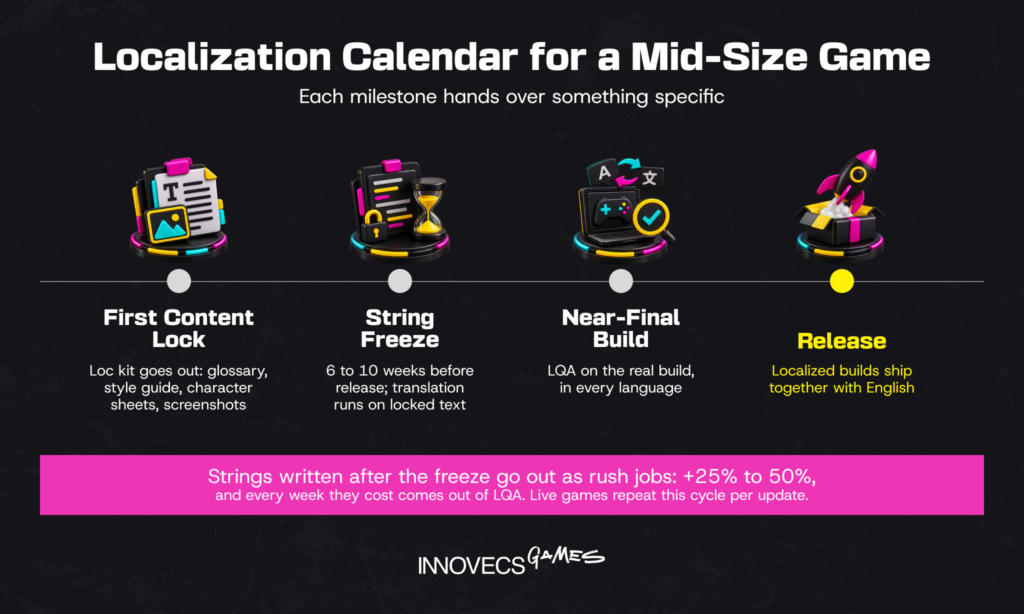
Localization lives on the production calendar, so when the calendar slips, so does it. On a healthy project, you send a localization kit at first content lock (glossary, style guide, character sheets, screenshots), freeze strings six to ten weeks before release on a mid-size game, and run LQA on a build that’s nearly final. Anything written after the freeze goes out as a rush job, 25% to 50% on top. Worse, every week you lose here gets taken out of LQA, which is exactly the step that would’ve caught the rush mistakes. Teams that ship a lot hook their repo up to a translation management system so new strings hit linguists daily, and the freeze stops being a cliff. It’s more of a ramp. (String freezes are like diets, by the way. Everybody agrees on the start date. The writers still have a stash.) Live games run the same playbook per update: text locks before content does, and on console it also has to get through patch certification.
Project Management and Vendor Coordination
Twelve languages means questions coming at you from twelve directions. Who’s talking in line 4,018? Is “Shard” money or a sword? Can we lose this pun? Nobody answers fast, the linguists guess, and you find out in LQA. Vendors usually tack on 8% to 15% for their own PM, which pays for their half of the conversation and not a minute of yours. Somebody on your side, a localization producer or whichever narrative designer drew the short straw, burns real hours on queries, glossary edits and sign-offs. You won’t see that on any invoice. It still shapes quality more than anything else here. In our projects, eight languages take roughly half a day a week of a producer’s or writer’s time during translation. During LQA that rises to two or three days a week, because testers file bugs that need someone who knows the game to judge them. If that person is also your lead designer, the localization schedule is now competing with the game for the same hours.
Freelancers, Agencies, or a Full-Service Partner: Which Fits Your Budget?
The per-word number on a quote gets all the attention, but in our experience who’s doing the work matters at least as much. Game localization services come in three broad shapes, and the real difference between them is whether the cost shows up on your invoice or quietly on your team’s calendar.
| Freelance translators | Specialized localization agencies | Full-service development partners | |
|---|---|---|---|
| What a word usually costs | $0.05 to $0.12, and often that’s translation with no editor | $0.08 to $0.20 with editing in | Agency rates through a partner vendor, plus engineers at $40 to $90 an hour |
| Typical extras | None, or you hire an editor separately | PM fee of 8% to 15%, LQA billed hourly | Engineering, UI and functional QA billed as a team or by milestone |
| Quality control | Yours to organize | Built in: editing, LQA, glossaries | Built in, plus engineering and functional QA on the build |
| Scalability | One person per language | Many languages, fast | Many languages plus engineering capacity |
| Management effort on your side | High | Medium | Low to medium |
| The honest catch | Holidays, illness and no second pair of eyes | Engineering problems in your build stay yours | You pay for breadth you may not need |
We’d read the bottom row of that table first, since every option is cheap at something and that row tells you what it’s expensive at.
Freelance Translators
Freelancers make sense for a small game in two or three languages, as long as someone on your team has the time to manage them, and for that one language where you’ve found a specialist no agency can touch. You won’t find a lower rate anywhere; it’s close to what agencies themselves pay their linguists. What you give up is everything around the translation, so there’s no editor, nobody to cover when your Japanese translator gets the flu the week before launch, and guess who’s the project manager now. Plenty of studios mix and match. After launch, ZA/UM gave Disco Elysium’s Spanish, Korean, Russian and Brazilian Portuguese to hand-picked teams of fans while Testronic handled French and German, and Silksong got to a fan translation by a very different road. Both show dedicated amateurs can be very good, and neither is a plan you can put a date on.
Specialized Localization Agencies
Got more than a handful of languages? Then an agency is probably where you’ll end up, and for good reason: editing, glossary upkeep, LQA testers and a single person to email about all of it come bundled in, and there’s room to grow when the script doubles somewhere around alpha. Do ask which games they’ve worked on and what they actually did on each one, because a credit for store-page copy and a credit for 200,000 words of branching dialogue look identical on a logo wall. What they won’t do is go into your build, so if the strings are hard-coded or the UI chokes on German, you’ll get a very polite bug report and then a lot of waiting.
Full-Service Development Partners
Between the agency and your codebase there’s a gap, and a development partner is the one who fills it with localization-ready engineering, UI that doesn’t fall apart when German makes everything 30% longer, build automation and functional QA. A good partner works next to your localization vendor rather than instead of them, which is the model behind game development outsourcing when the gap is in the build, not the language. It costs more than a translation-only contract, of course, and if your game has barely any text, you probably don’t need it.
What to Put in the Localization Contract
When we hear a bad vendor story, it usually comes back to a contract that put a price on words and pinned down nothing else. These seven clauses would have headed off most of them:
- Quality acceptance. We like an error-based score for every batch, more or less how the MQM framework does it, where each error gets a category (accuracy, terminology, style and so on) and a severity weight, plus a pass mark below which rework is on the vendor’s dime.
- Query turnaround, and yes, both ways. You want to know how fast the vendor gets back to you, and they’ll want to know how long your team gets to sit on their questions before the deadline is allowed to slide.
- The translation memory and glossary are yours. Ask for TMX and TBX files after every job, so that if you ever switch vendors you aren’t buying the same words a second time.
- Machine translation and AI. Nothing from MT or an LLM goes in without your written OK, and if it’s used, they tell you per batch. 11 bit studios’ AI-translated films in The Alters, covered in the AI section below, are the reason this clause exists.
- Named linguists, with notice before anyone is swapped out mid-project.
- LQA fix rounds included in the price, with a number attached.
- Credits. The full list of translators for the game’s credits. Larian had to push its vendor to add the freelancers missing from Baldur’s Gate 3’s Brazilian Portuguese credits after launch.
None of these cost the vendor much to agree to. A vendor that refuses most of them is telling you how the project will go.
Planning a Global Launch? Make Sure Your Build Is Ready First
Before your strings go anywhere, get someone to check the build can actually take them. Send us the project and we’ll go looking for internationalization gaps, see how much room your UI has for longer text and whether the fonts cover your target scripts, and then tell you what we’d fix first.
How to Cut Localization Spend Without Hurting Quality
Here’s the good news, and it’s a little boring: most of the money you’ll save gets saved months before translation starts, and you won’t need to haggle with a single vendor to get it.
Build for Internationalization From Day One
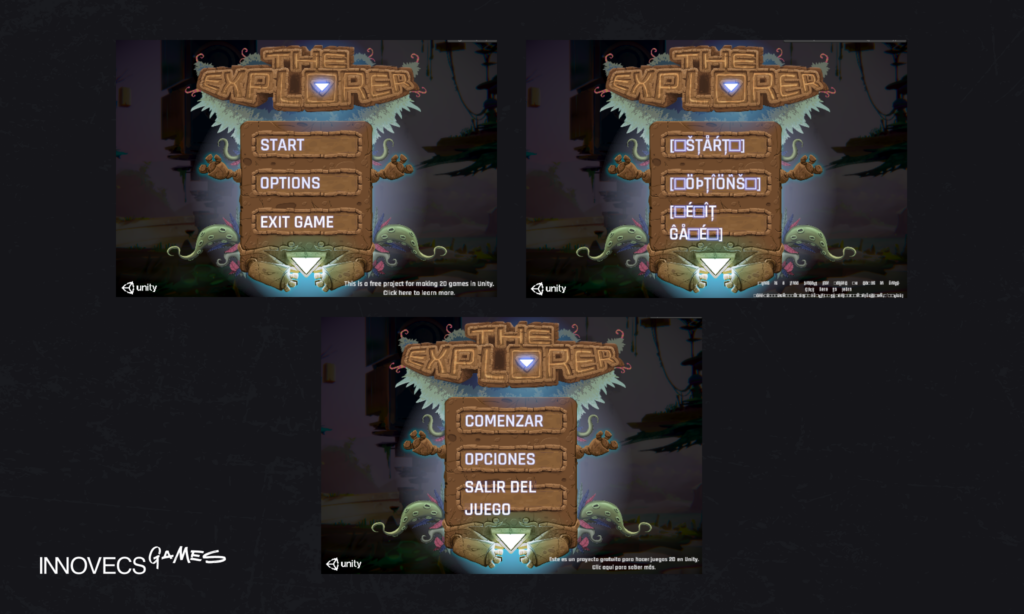
Internationalization (i18n, if you’re tired of typing it) has a textbook definition we’ll skip, because what it means on a real project is pretty concrete: strings sit in a table rather than in code, plurals and grammatical gender don’t break, fonts fall back to something sensible, and UI boxes stretch rather than clip. It’s cheap to do while you’re building and painful after content lock. Run pseudo-localization early, which swaps English for padded, accented gibberish so overflow and hard-coded strings show up in the very first build. We’d put it in the first playable of every project, localization planned or not, because it takes an afternoon and “not planned” has a way of changing the day a publisher signs. Leave about 30% spare width in UI elements and most expansion just fits. A designer who plans for that from the start, the way our game UI/UX design team does, saves you a second pass on every screen.
Pick Target Markets Based on Player Data
How many Steam users read a language tells you something, but not how much they’ll spend, and certainly not whether they buy your kind of game. We’d look at your own numbers first. Stardew Valley is a nice example here, since its six new languages only arrived after the English version had already found its audience. If you don’t have numbers yet, Valve’s documentation suggests translating just the store page and watching which regions start wishlisting, the $40-to-$150 test from the content table earlier. And a weak language costs more than it used to, because since 2025 Steam weights review scores by the reader’s language, so a poor translation earns its own score in exactly the market you paid to enter.
Lock the Glossary and Style Guide Early
Every term that changes after translation starts gets paid for twice, and in every language. If you want the single most expensive word in localization, it’s a character’s name that gets changed in beta. A glossary of names, items, abilities and UI terms takes a few days to put together, and so does a style guide covering each character’s voice and the game’s overall tone, and both of them pay you back on every patch afterwards. Remember Silksong? Underneath, that was a tone problem. Players were less upset about wrong words than about a register that just didn’t fit Pharloom, and a style guide is where that call gets made on purpose instead of by accident.
Reuse Translation Memory and Batch Your Updates
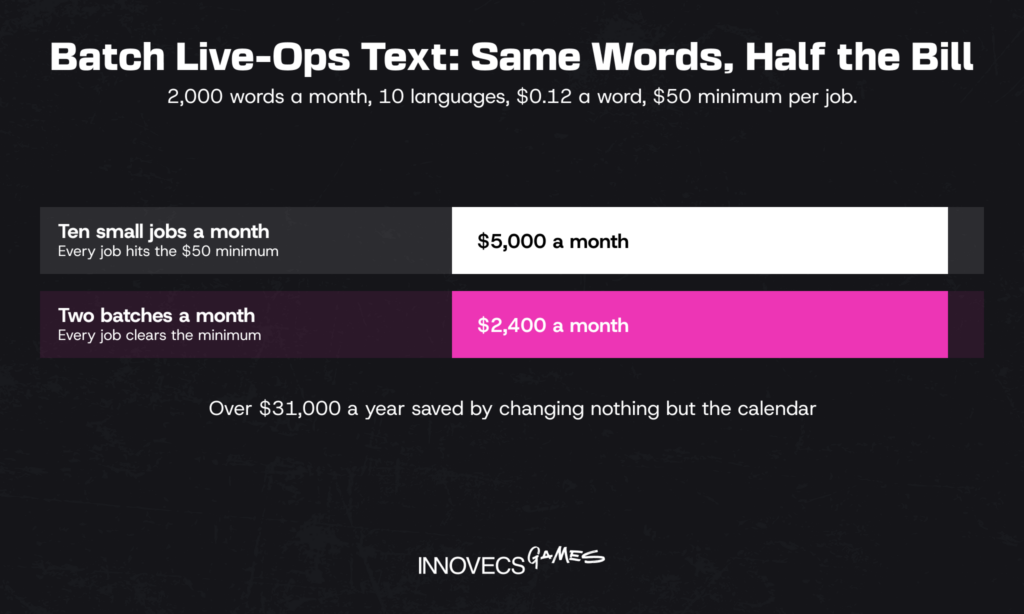
With TM ownership written into the contract, collect the files after every delivery. Then batch live-ops text. Take 2,000 words of monthly update text in ten languages at $0.12, with a $50 minimum. Sent as ten small jobs, it costs about $5,000 a month, because every job hits the minimum. Two batches cost $2,400. That’s over $31,000 a year for changing nothing but the calendar. The same goes for LQA: one pass on a content drop beats five passes on hotfixes. It’s not glamorous advice, and it reliably saves more than haggling over the rate does.
How AI Is Changing Localization Budgets
AI has made a first draft much cheaper, and a finished translation only a bit cheaper. Whether that’s good news for you comes down to which line of the budget you aim it at.
Machine translation with post-editing (MTPE). A machine or a large language model drafts the translation and a human linguist edits it to standard. On the supply side the discount is real: in the Belgian survey, agency post-editing rates averaged about 40% below translation rates. For UI strings, item descriptions, system messages and patch notes, MTPE with a strong glossary is now a reasonable default. For dialogue, it’s a draft that a writer has to rework, and the saving narrows quickly. Machine translation is very good at producing a line that’s correct, confident and spoken by the wrong character.
LLM glossary checks and automated LQA. This is the part we’re most enthusiastic about, because models are great at the dull consistency stuff people miss after hour six, like one term translated three different ways, a dropped placeholder, or a string that’s now 40% wider than its UI box. Pair automated screenshot capture with model-based checks and you can sweep every language overnight, which leaves your human testers free to argue about context and tone, the part they’re actually good at. On a big project that saves real hours. On a 10,000-word game, you’ll barely notice.
AI and synthetic voice. Synthetic voices can now turn out passable lines in a lot of languages, and it’s tempting to use them to dub markets you could never have afforded before. Read your contracts before you do. SAG-AFTRA’s 2025 video game agreement requires consent and disclosure before a performer’s digital replica is used. Performers can also withdraw consent for new material during a strike. Steam still asks developers to declare AI-generated content in their content survey. Valve rewrote those rules in January 2026. Tools used during development no longer need declaring. Content generated for the game, its store page or its marketing still does. CD Projekt Red’s Cyberpunk 2077 shows the more durable pattern: AI handled the lip-sync animation across ten languages, while human actors handled the voices.
How Innovecs Games Helps Studios Prepare Games for Global Markets
Let’s get one thing straight before the pitch, because it surprises people: we don’t translate games and we don’t record voice. Our part is getting the build ready before the translators and actors show up, and then working alongside whichever localization vendor you’ve already picked, which over ten-plus years and 300+ shipped games has turned out to be the bit studios most often get stuck on. Our 200+ developers and artists do that for studios and publishers in the US, UK, EU, Israel and Australia, and yes, some of them have strong opinions about string tables.
Most of what we do here is plumbing, and we’re fine with that. Strings that were hiding in code end up in tables where a translator can reach them, the plural and gender logic gets rewritten (ICU message format, usually) so Polish stops complaining, and somebody finally deals with font fallbacks and right-to-left layout. Then we hook it all up so finished translations drop straight into the nightly build, rather than turning up as a zip file that one unlucky person has to unpack on a Friday. We make the UI stretch so German doesn’t force a redesign, and we run functional tests on localized builds so your LQA people get to spend their hours on language, not on crash reports. A lot of studios plug us in through game co-development, where our engineers just join their sprints. If you’d rather keep it contained, we’ll do it as a fixed-scope project instead (audit strings, fonts and UI, then refactor), you don’t add headcount, and your leads keep working on the actual game. Pair that with a strong localization vendor and you’ve got the engineering half of the game localization services a global launch needs.
The same goes for the art side of localization. Our UI artists and marketing art team rebuild interface art, store screenshots and ad creatives with text in editable layers. Every new language becomes an export, not a redraw.
We’re not the right call for a text-light game in three languages; a good agency will do that alone. We make sense when the build, not the translation, is what stands between you and a release in twelve markets.
FAQ
What should a localization quote include?
Word counts per language, at minimum, with new words, fuzzy matches and repetitions broken out and a rate next to each. We’d also want it in writing whether a second linguist edits the work, how many LQA hours they’ve planned, and what happens with minimums, rush jobs and PM fees, plus who walks away with the translation memory and glossary at the end (that should be you, by the way). If there’s voice-over, the quote has to spell out studio hours, lines per hour and any talent buyouts, or you’ll meet those numbers later.
What is the average game localization cost per word?
Translating from English, most game text in 2026 costs somewhere around $0.08 to $0.20 per source word with editing included. FIGS tends to land at $0.10 to $0.15, Eastern European languages come in under that, and Japanese, Korean and Arabic go over it. On repetitive content, translation memory can pull the effective rate down quite a bit. Just don’t mistake the rate for the budget; in our experience engineering, LQA and management often add about as much again.
Which languages are the most expensive to localize into?
Japanese and Korean tend to top the per-word price list, and Arabic and Chinese aren’t far off. With Arabic, and right-to-left languages in general, the bigger bill is often engineering rather than translation, since your whole UI has to flip and the text renderer has to join letters properly. The Nordics are pricey too, roughly $0.14 to $0.20 a word for Swedish, Danish, Norwegian and Finnish, simply because there aren’t many game specialists to go around. At the cheap end you’ll usually find Indonesian, Ukrainian, Russian, Polish and Latin American Spanish, at about $0.07 to $0.12.
How much should I budget for voice-over localization?
Think in studio hours rather than words. In our projects, a fully cast, directed and edited studio hour runs $250 to $350 in Europe and Asia. US union work is roughly double, since SAG-AFTRA’s 2025 localization minimum was $1,102 for four hours, plus a 50% buyout. For a mid-size narrative game with 9,000 lines, one dubbed language can come to around $55,000, and lip-syncing to existing animation slows the sessions down and pushes that higher.
Is LQA testing worth the extra budget?
Almost always, yes, and we’d fight for it in most budget meetings. It typically adds 10% to 15% to the localization budget and catches exactly what players write reviews about, things like cut-off text, lines translated out of context, broken variables and missing characters. Fixing those before launch is cheap. After launch they show up as negative reviews, in the very market you just paid to get into. About the only time we’d skip it is a tiny UI-only game with native-speaking fans willing to test a beta.
How long does video game localization take?
The rule of thumb we plan with is 2,000 to 2,500 words a day per linguist, translated and checked, with a vendor putting several people on each language at once. On that basis a 20,000-word indie game needs two or three weeks of translation and roughly one more for testing. A 150,000-word narrative game? More like six to ten weeks, and that’s before LQA. Add one to three months if there’s voice-over, for casting and recording. Funny thing is, the translators are rarely what’s slow; it’s usually waiting on a build that’s stable enough to test.
Should indie studios localize at launch or after release?
Launch with the languages your data backs up and add the rest in updates, which is what both Stardew Valley and Disco Elysium did. Valve explicitly recommends releasing extra languages as updates and announcing them, since each one gives the game another shot at visibility. Not sure about a market? A translated store page costs very little and tells you a lot about who’s actually interested. Whatever you pick, have the build localization-ready by launch day, because retrofitting that later is where the real money goes.
How many languages should a game launch with?
For most PC games, somewhere between five and ten languages covers most of Steam’s audience. We’d start with English and Simplified Chinese, then add FIGS, Brazilian Portuguese, Russian, Japanese and Korean in whatever order your wishlist data points to. Mobile games tend to go wider, because store discovery happens locally. Honestly, we’d rather see a few languages done properly than a long list done badly, because a poor translation can lose you more reviews than having none, and there’s nothing stopping you from adding more once the data’s in.
🤖 Can machine translation and AI lower the cost of game localization?
It can, if you point it at the right text. On the projects we’ve seen, machine translation plus a human post-editor holds up well on UI strings, item descriptions, system messages and the steady drip of live-ops patches, and it comes in well under full human translation per word. AI is handy for glossary checks and a chunk of LQA grunt work too. Where it stops paying off is dialogue, jokes and lore, since someone ends up rewriting most of the machine’s draft and you’re back near full price.
🤖 Where does AI still fall short when localizing games?
Tone, humor, character voice, the cultural stuff: basically everything that makes a game feel like a person wrote it. We’ve seen model output that was technically right and still put the line in the wrong character’s mouth, sailed straight past a pun, or picked a register nobody in that world would use, and players spot that kind of thing within minutes and post it. Synthetic voice has its own strings attached, from union contracts to Steam’s AI content survey. Then there’s trust. 11 bit studios found out with The Alters that undisclosed AI translation can turn into a PR problem all by itself.
Ready to Take Your Game Global? Let’s Talk
Tell us your engine, roughly how many words you’ve got and which markets are on the list. We’ll come back with what your build needs first and an honest read on game localization cost for your scope, including the lines a per-word quote tends to leave out.