Roblox Game Developers for Hire and How to Choose the Right Team in 2026
A practical walkthrough of where to source Roblox talent, how to vet it, and which engagement model fits your project.
You post one Roblox role on a Friday. By Monday there are two hundred replies, half of them linking to a game with forty million visits, and a few from people who can’t legally sign your contract yet. That last part isn’t a joke about the platform. Grow a Garden, which pulled nearly 22 million concurrent players in July 2025, started as a project by a sixteen-year-old and still beat Fortnite’s record. Finding Roblox game developers for hire has never been the hard part. Finding the ones who can work inside a game studio is.
The numbers explain why. Roblox paid its creators more than $1.5 billion in 2025, yet the median DevEx participant earned about $1,500 in the twelve months to June 2026. In the same report, 83% of the U.S. creators Roblox surveyed said they work as individuals rather than as established studios. So the market is crowded with gifted individuals and thin on people who have shipped to a milestone plan, passed a code review, or taken tickets from someone else’s Jira board. When you hire a Roblox developer for a funded project, that’s the gap you’re really screening for.
What follows is built around it: the roles a serious Roblox project needs, where each kind of talent actually lives, a vetting process aimed at the platform’s own failure points, the three hiring models side by side with what to sign and how to run the first weeks, what it all costs, and what AI has changed in the job description this year.
What Does a Roblox Game Developer Actually Do, and Why Hiring Right Matters
A Roblox game developer builds, scripts and runs a live game inside Roblox Studio, the platform’s own editor, in Luau, Roblox’s typed descendant of Lua. The day job splits logic between server scripts and client scripts, wires the two together with RemoteEvents, saves player progress through DataStores, and tunes everything for a phone first, because the company’s annual report for 2024 put 80% of its users on mobile, and a map that runs smoothly on a developer’s gaming PC is not the map most players will load.
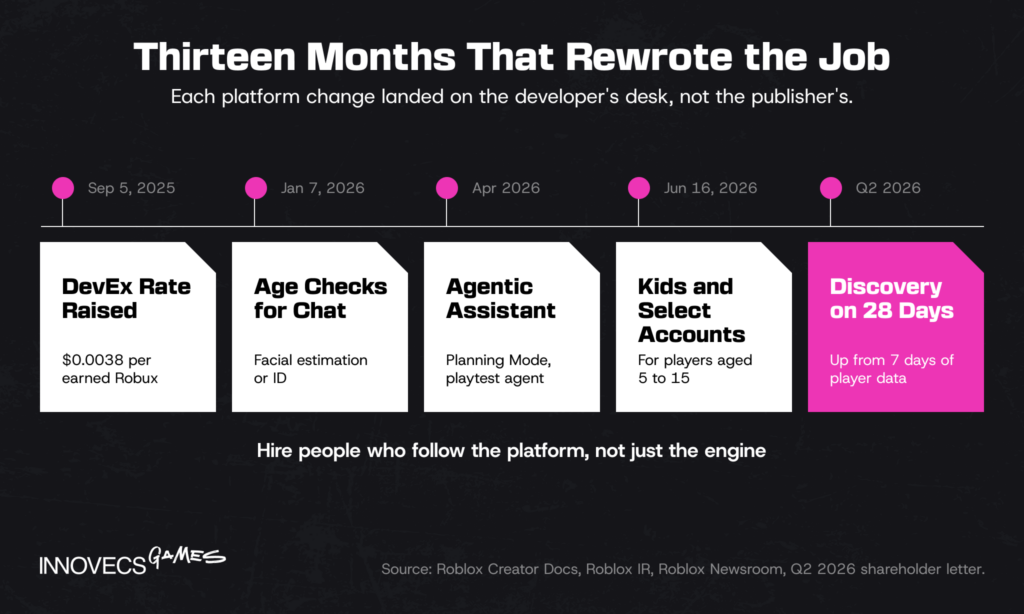
The job also doesn’t end at launch. Roblox’s discovery now judges a game on 28 days of player behavior, up from seven, including play-through and first-play bounce rates, so the teams that stay visible ship content every week or two and live by their retention numbers in Creator Analytics. The job is part engineering, part LiveOps and part economy design, whatever the title says.
What makes the platform unusual is that it’s a game engine and a storefront at once. Servers, matchmaking, payments and hosting come included, which is why six people can ship a hit. It also means the rules change under you. In the last thirteen months alone, Roblox raised its DevEx rate on September 5, 2025, made age checks mandatory for chat from January 7, 2026, and launched separate Roblox Kids and Select accounts for players under 16 in June. The audience shifted as well: the platform ended Q2 2026 with 123 million daily users, up 10% on the year but well below the 151.5 million it averaged during the viral peak of Q3 2025.
That’s why the hiring decision carries real production risk, and why the same failures show up again and again when the wrong person is in the chair:
- Security. Roblox’s security guide warns that exploiters can fire RemoteEvents “at any frequency with arbitrary arguments.” A shop that trusts the client is a shop that gives items away.
- Data. A save system without session locking loses progress when players jump between servers, and lost progress is the one bug players never forgive.
- Compliance. To reach Kids and Select players, a game now needs an ID-verified publisher with two-factor authentication and a subscription or refundable fee, and games with social hangout features can’t appear in those catalogs at all.
Each of these can be fixed later, at several times the cost. Those risks also decide whether you build the team yourself or bring in game development outsourcing, a choice the hiring-models section compares in full.
Core Roblox Development Roles You Need to Hire For
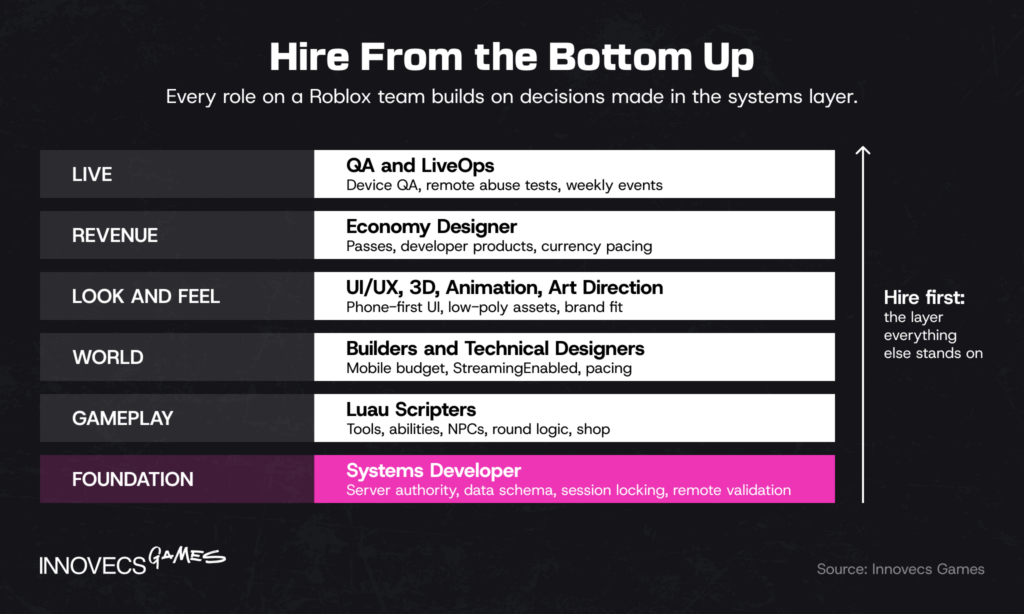
The team behind 99 Nights in the Forest is a useful template. Three co-creators from New Zealand split game design and art direction, programming, and building and modeling between them, then added another artist and an animator. That’s about six people, and the game hit a peak of 14 million concurrent players after launching in June 2025. It’s close to the minimum viable team for a competitive Roblox game, and a fair checklist for what any Roblox game development services offer should cover, in-house or not. Studios that arrive with an existing IP or a revenue target usually add two roles the 99 Nights founders covered between themselves: an art lead who guards the brand and an economy designer who owns the numbers.
Luau Scripters and Systems Developers
A Luau scripter writes the gameplay: tools, abilities, NPC behavior, round logic, the shop. A systems developer owns the layer underneath: multiplayer architecture, server authority, the data schema, anti-exploit checks on every RemoteEvent, and how player data survives a crash. Most experienced teams store that data through a session-locking library such as ProfileService or its successor ProfileStore, which its author has said Grow a Garden uses. If you can only afford one senior hire, make it the systems developer, because every other role builds on decisions they make in the first month. We’d take that order every time: studios that hire the second scripter first tend to rewrite their save system in the same week as their biggest update, which is nobody’s idea of a launch party. It’s the same discipline as multiplayer game engineering services on any other engine, just with Roblox running the servers.
Roblox Studio World Builders
World builders turn a design into a place players can move through: terrain, architecture, lighting, spawn flow and sightlines. The job has a technical edge that portfolios rarely show. A good builder keeps part counts and texture memory inside a mobile budget, sets up StreamingEnabled so large maps load in pieces, and works with a technical designer on pacing, whether that’s an obby’s difficulty curve or the walk from spawn to the first shop. Ask to see a build running on a mid-range phone with the frame rate on screen. A map that has only ever been tested on a gaming PC is, strictly speaking, a very nice screenshot.
UI/UX Designers and 3D Artists
On a platform played mostly on phones, the UI/UX designer decides whether your game is playable at all. Thumb reach, readable text on a six-inch screen, and a purchase prompt that makes the Robux price obvious all fall to this role, and it has a direct line to revenue. The 3D modeler builds low-poly meshes and avatar items that fit the platform’s visual language, which is a style of its own and not a downscaled console look. Animators work with R15 rigs and animation priorities, and a strong one can make a simple combat system feel twice as expensive as it was.
Art Direction for an Existing IP
Studios that bring a mobile or console IP to Roblox usually underestimate this role. Your characters will share every lobby with millions of player avatars, including someone dressed as a hot dog, so the look has to hold up next to the platform’s style rather than fight it. An art lead’s job here is to translate the style guide, not copy it: which silhouettes survive at low poly counts, which colors read on a small screen, how far the brand can bend before it stops being recognizable. Ask candidates for a before-and-after of an existing character they’ve adapted, and for a few test assets in your style before any contract is signed. The same lead should review anything generated with AI tools, because a map furnished from several generators looks like one by nobody.
Monetization and Economy Designers
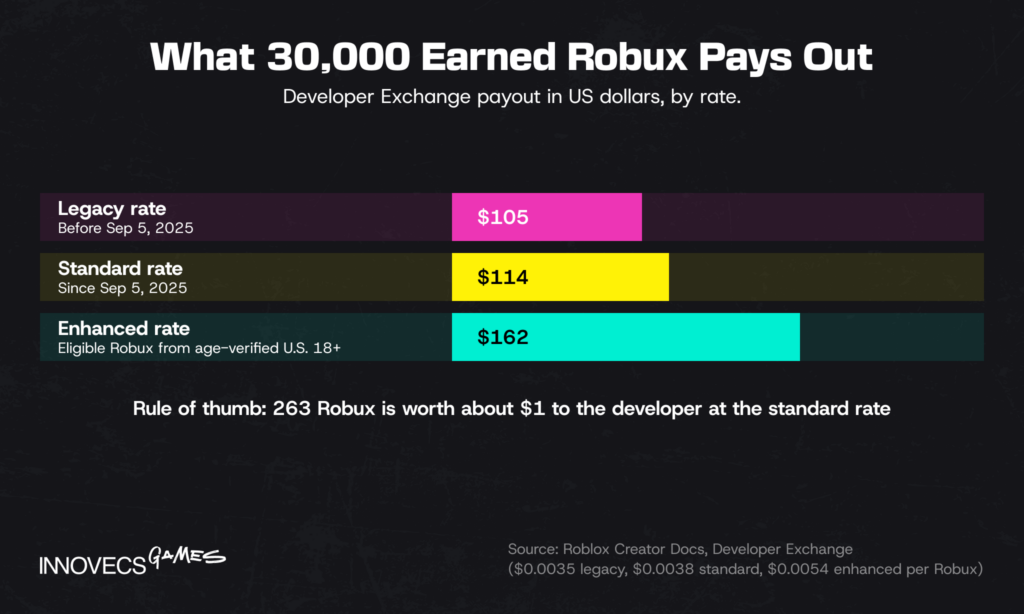
Roblox offers more ways to charge than most mobile games: one-time passes, repeatable developer products, subscriptions, private servers, paid access, immersive ads and Roblox Plus discounts. An economy designer decides which item belongs in which bucket, how the in-game currencies pace against each other, and what a limited event drop should cost so it sells without making last month’s buyers feel cheated. Then there’s the conversion. At the standard DevEx rate, 30,000 earned Robux pays out $114, so every price is worth checking in dollars before it ships, and a gamepass that looks generous at 263 Robux is really worth a dollar to you. The platform also pays a higher rate of $0.0054 on certain Robux spent by age-verified U.S. players aged 18 and over in eligible games, which means your audience mix now changes your revenue per sale. If nobody in your studio has designed a free-to-play economy before, this is the role to rent first.
QA and LiveOps Specialists
QA on Roblox covers phones, tablets, PC, console and VR from a single build, plus the testing most teams forget: firing remotes with bad data to see what breaks, and checking that old save files load after every update. LiveOps specialists run the calendar of events, limited items and balance changes that keep a game in the charts. Done well, it moves the whole platform. On August 23, 2025, the creators of Grow a Garden and Steal a Brainrot ran their limited-drop events at the same time as a declared “Admin Abuse war”, and Roblox passed 45 million concurrent users that day. Few studios plan a feud into their roadmap, but the lesson about update cadence holds either way.
Where to Find Roblox Game Developers for Hire
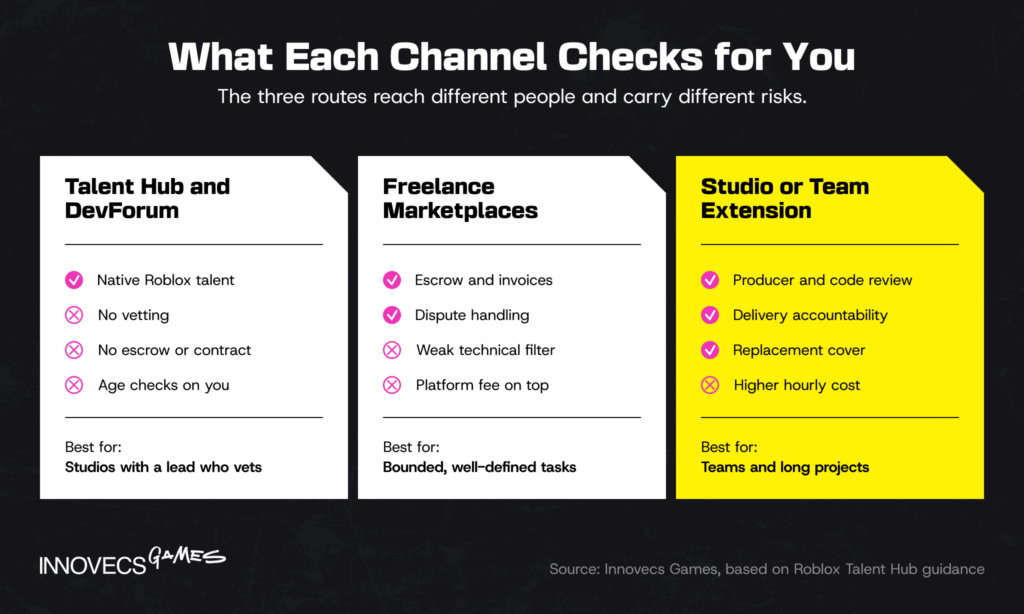
Those roles rarely sit in one place. Most of the talent isn’t in agencies, so the best Luau programmer for your project is more likely to be a solo creator with a DevForum profile than an employee somewhere. The channels below differ less in who they reach than in what they check for you.
Roblox Talent Hub and the DevForum
Talent Hub is the platform’s official jobs board: creators list their skills, availability and portfolio, and studios post roles. The Roblox DevForum runs a parallel Find and Hire Talent category, where job posts sit next to the technical threads candidates already read. Both reach native talent faster than any general job site, and neither vets anyone. The Talent Hub help page says Roblox isn’t responsible for disputes, and Talent Hub is open to users from age 13, so contracts, payment terms and age checks are entirely on you. This channel suits studios with an in-house lead who can run the technical vetting themselves. The DevForum has one advantage no job board can buy: a candidate’s old threads are public, and how someone argued about DataStore throttling three years ago tells you more than any CV.
Freelance Marketplaces
General marketplaces such as Fiverr, Upwork, Freelancer and Arc.dev add what those two channels lack: escrow, dispute handling, invoices and a contract template. They’re a reasonable place for bounded work, such as a set of UI screens, a batch of props or a single system with clear acceptance criteria. The weakness is the filter, since marketplace reviews measure responsiveness and politeness, not whether a DataStore call handles throttling, and plenty of profiles list Roblox next to twelve other engines. Expect to run the same technical checks you’d run on the DevForum, plus a platform fee on top.
Outsourced Roblox Studios and Team Extension
A Roblox game development company delivers a team with a producer, a code review process and someone accountable for the date. It also gives you a way around a tightening talent market, because the buyers of that talent keep getting bigger: Voldex, which runs games across Roblox and Fortnite Creative, bought Brookhaven, the most visited game on the platform with 60 billion visits, in February 2025, and the best Luau engineers now field offers from operators with publisher-sized budgets. The other form is team extension, sometimes sold as staff augmentation, where a partner adds Luau engineers, artists or QA to your existing team and works in your repository and your sprint rhythm. Both cost more per hour than a freelancer, and what the premium buys is someone else carrying the delivery risk. We sell this model, so weigh our enthusiasm accordingly, but we’d still tell a studio with a strong lead and a two-week task to hire a freelancer.
How to Evaluate and Hire the Right Roblox Developer
Whichever channel a candidate comes through, their work is unusually easy to check. Every published game has a public page with visits, favorites, live player counts and a last-updated date, and a good candidate can show you the code behind it in minutes. The steps below, from portfolio review to the technical interview, are about using that transparency without being fooled by it, and the last one covers the harder case of a team taking over a game that already has players.
What to Look for in a Portfolio
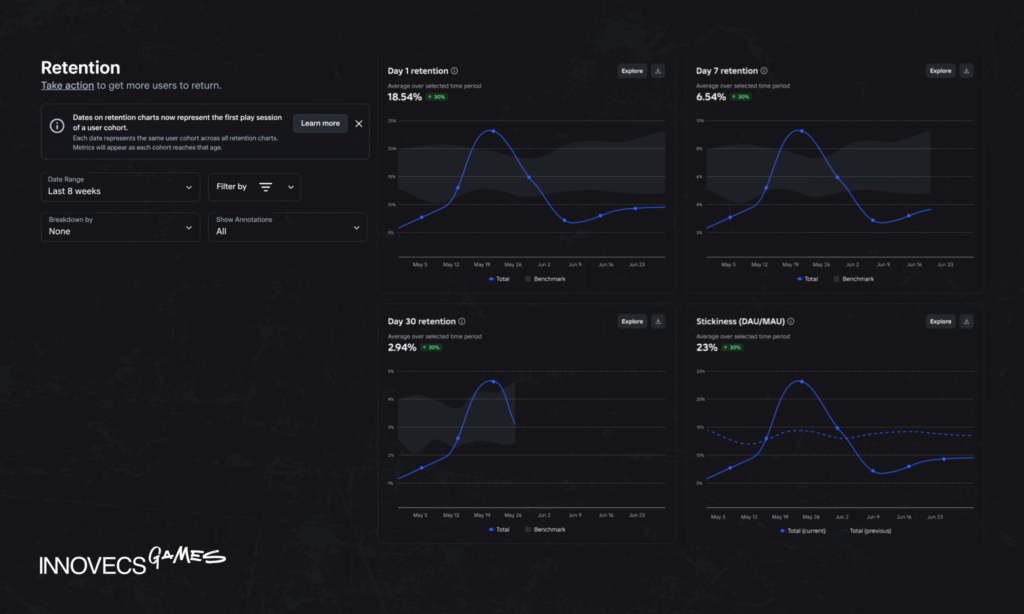
Every Roblox developer for hire will send links to live game pages, and they’re the right place to start, as long as you read them skeptically. Visit counts are the Roblox version of a follower count: impressive, cumulative and not very informative. They pile up over years, so a game with tens of millions of visits and nobody playing today says less than one with 2 million visits and a steady few thousand online. Many games are owned by a Roblox group rather than a person, which means the candidate’s contribution isn’t visible from the page, so ask what exactly they built and whether they can show it in a Studio file or a screen share. The best portfolios include a Creator Analytics screen with day-one and day-seven retention for a game they worked on. Look for something shipped or updated in the last six months, because the platform changed a great deal in that time.
Key Interview and Technical Test Questions
Good questions make a candidate explain decisions, not recite features. These separate studio-ready developers from talented hobbyists:
- “A player buys an item in your shop. Walk me through what the client sends and what the server checks.”
- “How do you stop a player losing data when they hop to a new server mid-session?”
- “What happens to your save calls when DataStore request limits are hit, and how would players notice?”
- “How do you structure a codebase that four people touch every day? Do you work in Studio’s Team Create, or in Rojo with Git?”
- “What did you change the last time a game ran badly on phones?”
- “Show me a piece of AI-generated code you threw away, and tell me why.”
Then run a paid test task of one to three days, a small trial project rather than a take-home puzzle. A shop with one gamepass and one developer product, validated on the server, with purchases saved safely across sessions, tests almost everything above in a single deliverable. Pay for it at the candidate’s normal rate, because unpaid tests put off exactly the senior people you’re trying to reach, and the good ones have other offers by Thursday.
Red Flags to Watch For
Some warning signs are specific to this platform, and they’re worth checking before anyone gets access to your group:
- Vague answers on validation. If a candidate can’t say where purchase and damage checks run, assume they run wherever was easiest to write.
- Heavy use of free Toolbox models. Roblox itself warns that third-party assets can hide backdoors that grant server-side access, sometimes in obfuscated code pushed off-screen with whitespace.
- A portfolio built from kits. Reskinned open-source templates look finished and fall apart under the first real feature request.
- Payment only in Robux, or revenue share for work-for-hire. Both blur who owns the work and create tax questions your finance team will not enjoy.
- No version control or handover plan. Code that lives only in one person’s Studio session leaves with that person.
- Reluctance to confirm age or sign a contract. In many jurisdictions a contract with a minor can be voided or needs a guardian’s consent, so resolve this before any work starts.
- Promises of a viral hit. Nobody controls discovery, and Roblox rewrote how it ranks games only this year.
If You’re Inheriting a Live Game
Sometimes the hire isn’t for a new game but for one that already has players: a freelancer left, a studio bought a title, or saves started disappearing. The first week should go on an audit, not on features. These are the checks we’d run before touching the roadmap:
- Data. How player data is saved, whether sessions are locked, whether the schema has a version field, and whether a backup exists anywhere.
- Remotes. Every RemoteEvent and RemoteFunction listed, with the server-side checks each one runs, or doesn’t.
- Third-party assets. Every model and module from outside the team, searched for obfuscated code and unexpected require() calls.
- Ownership and access. Who holds which roles in the Roblox group, and whose personal account still owns assets the game depends on.
- Performance. Frame rate and memory on the cheapest phone in your analytics, not the newest.
- Baseline. Current retention, session length and revenue, so every later change can be measured against something.
Expect at least one surprise, usually a script called something like AdminCommands_FINAL2 that nobody on the current team admits to writing. A candidate who asks for this audit before promising a delivery date is usually the one to hire.
Not Sure Which Hiring Model Fits Your Roblox Project? Let’s Talk
Share your concept, your current team and the date the first playable needs to exist. We’ll suggest which roles to hire directly, which to extend through a partner, and where a freelancer is the cheaper and better answer.
Hiring Models Compared: Freelance vs In-House vs Outsourced Roblox Studio
Most studios end up mixing models, keeping the core in-house and renting the rest. If you’re weighing the wider question of how to hire a game development team across engines, that guide covers it. Here’s how the options compare on a Roblox project specifically, followed by the parts that apply whichever you choose: starting small, the contract, and the first weeks of work.
| Freelance Roblox developer | In-house Roblox team | Outsourced studio or team extension | |
|---|---|---|---|
| Time to start | 1 to 2 weeks | 2 to 4 months per senior hire | 2 to 6 weeks |
| Cost structure | Hourly or per task | Fixed salaries, benefits, equipment | Monthly, scales by agreement |
| Control | High on scope, low on availability | Full | High in team extension, shared in full outsourcing |
| Continuity | Depends on one person | Strongest | Contractual, with replacement cover |
| IP and compliance | Your responsibility, contract by contract | Covered by employment terms | Covered by one master agreement |
| Best for | Bounded tasks, prototypes, one missing skill | A long-running game that is your main business | New entrants, fast scale-up, peaks around big updates |
| Main risk | Disappears mid-milestone | Slow to hire, idle between projects | Needs a clear owner on your side |
Source: Innovecs Games delivery data, projects staffed 2023 to 2026
The continuity row decides more projects than the cost row, because a game that updates weekly needs the same people next month who built it this month, and a freelancer who has moved on to a better-paying simulator can’t be invoiced back.
Freelance Roblox Developers
A freelance Roblox developer for hire is the fastest way to add one missing skill, and on small scopes the cheapest. Freelancers work well for a UI pass, a batch of avatar items, or a proof-of-concept that answers one design question in two weeks. The trouble starts when freelancers become the whole team, because nobody owns the architecture and the handoffs between them become your full-time job. Three excellent freelancers are not a team, any more than three excellent guitarists are a band.
In-House Roblox Team
An in-house team makes sense when the game is your main revenue line and will be for years. You keep the knowledge, set the culture, and can move fast without renegotiating anything. The drawbacks are speed and elasticity: senior Luau engineers with studio experience are scarce, so expect months per hire, and a team sized for a big update sits partly idle in the weeks after it ships. Keep at least a lead engineer and a producer in-house even if everything else is external. And if Roblox really is your core business for the next five years, our honest advice is to build the team yourself, even though it shrinks the market for companies like ours.
Outsourced Studio or Team Extension
Full outsourcing hands a partner the whole build against a scope and milestones, which suits brands and publishers without Roblox experience. Team extension adds people to your team instead, and it’s the better fit when you already have a lead and a direction but not enough hands. Either way the partner handles onboarding into your tools and staffing continuity, so a sick day or a resignation isn’t your problem. The honest cost is management attention: an external team without access to your analytics, your backlog and a decision-maker on your side will build the wrong thing quickly.
Prototype Sprints Before a Full Team
None of these models has to start at full size. Most Roblox games fail, and the platform owner plans for it: in its 2026 guidance Roblox did not assume another viral hit the size of Grow a Garden or Steal a Brainrot. The cheaper way to buy a hit is to test several ideas before staffing any of them.
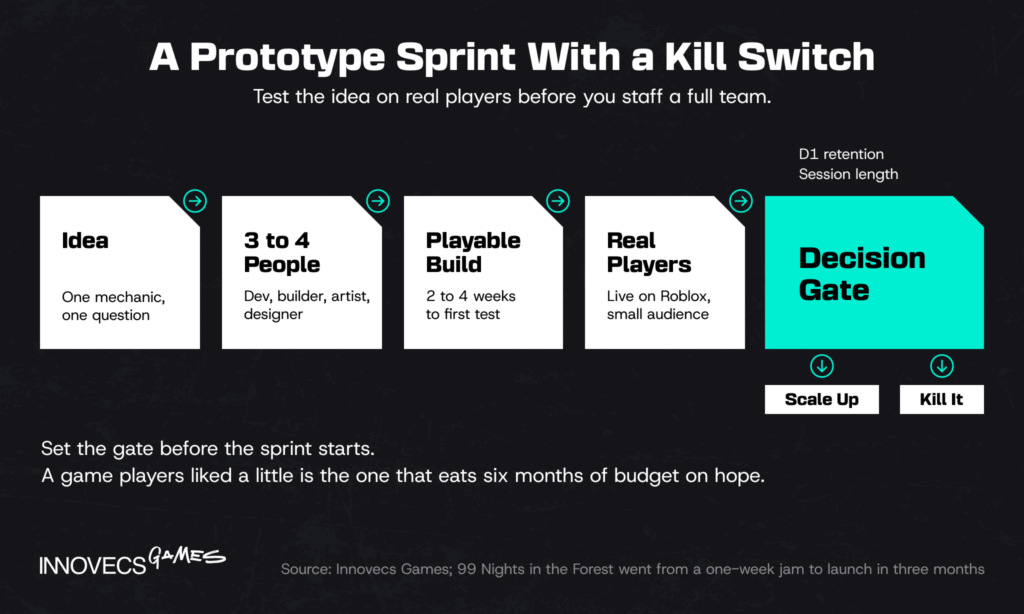
99 Nights in the Forest started as a week-long game jam and shipped three months later, which is about the right shape for a first test. A sprint team of three or four people, typically a Luau developer, a builder, an artist and a part-time designer, can get a playable version in front of real players in two to four weeks. Agree the decision gate before the sprint starts, such as day-one retention and average session length, and be willing to kill the idea if it misses. In our view that’s the hardest call on this page: a prototype nobody plays is easy to drop, while one that players liked a little can eat six months of budget on hope.
What to Put in the Contract
Roblox adds a few clauses most game contracts don’t need. Settle these before the first task:
- Group ownership. The game should be published under your studio’s Roblox group, never under a contractor’s personal account or group.
- IP assignment covering code, place files, meshes, animations and any assets uploaded to Roblox on your behalf.
- Access and exit. Group roles and permissions, and how they’re removed on the last day.
- Payment in your currency against milestones with written acceptance criteria, not in Robux.
- Third-party assets. A list of any external modules or models used, with their licenses.
- Age and legal capacity confirmed in writing, with a guardian’s signature where local law requires one.
How to Onboard and Run an External Roblox Team
Most failed partnerships go wrong in the first two weeks, when nobody has the right access and everyone is too polite to say so. A short setup avoids most of it:
- Access on day one. Roblox group roles with only the permissions each person needs, plus your analytics, task tracker and chat.
- One codebase, under review. Every change goes through version control and review, and nobody edits the live place directly.
- A definition of done per task, written as acceptance criteria your team can test in a build.
- A weekly playable build, shown in a short demo rather than described in a status report.
- One decision-maker on your side who can say yes or no within a day.
- Agreed overlap hours for calls and urgent fixes, set out before the first sprint.
The payoff for your leads is the difference between reviewing outcomes and managing tasks. A partner pod with its own lead reports on what shipped and what’s blocked, so your lead doesn’t have to track twelve tickets across three freelancers’ time zones.
How Much Does It Cost to Hire a Roblox Game Developer?
Management time is the line most budgets forget, and the worked example below prices it in. Rates themselves vary more by seniority and region than by role, and the gap between the cheapest and the most expensive option is wider on Roblox than on most engines, because the talent pool runs from teenagers to former AAA engineers. In the US, ZipRecruiter puts the average Roblox developer at $52.84 an hour, or about $110,000 a year, before benefits and taxes. The snapshot below covers hourly ranges by role and model.
| Role | Freelance (global) | Outsourced studio or team extension (Eastern Europe) | US in-house (salary as hourly) |
|---|---|---|---|
| Luau scripter / systems developer | $25 to $90 | $35 to $60 | $45 to $75 |
| World builder / technical designer | $15 to $50 | $25 to $45 | $35 to $55 |
| UI/UX designer | $20 to $60 | $30 to $50 | $40 to $65 |
| 3D modeler / animator | $20 to $60 | $30 to $50 | $35 to $60 |
| QA tester | $12 to $30 | $20 to $30 | $25 to $40 |
Source: Innovecs Games delivery data and rate checks, 2025 to 2026; US figures anchored to ZipRecruiter’s September 2026 average
A dedicated team of four to six people from Eastern Europe, with a producer, typically lands between $25,000 and $55,000 a month, depending on seniority. Whether a Ukrainian or Polish team counts as nearshore or offshore development depends on where you sit, and mostly decides how many of your working hours overlap with theirs.
Here’s how that plays out on one month of work. The first setup hires three full-time freelancers directly. The second rents a pod of the same three roles from Eastern Europe, plus a half-time QA tester and a half-time producer. The rates sit inside the ranges above, and your own lead’s time is priced at $75 an hour.
| Line item | Three freelancers | Partner pod |
|---|---|---|
| Luau developer, 160 hours | $9,600 at $60 | $7,200 at $45 |
| World builder, 160 hours | $5,600 at $35 | $5,600 at $35 |
| 3D artist, 160 hours | $6,400 at $40 | $6,400 at $40 |
| QA tester, 80 hours | Not included | $2,000 at $25 |
| Producer, 80 hours | Not included | $3,600 at $45 |
| Your lead’s time on coordination and review | 30%, about $3,600 | 10%, about $1,200 |
| Total per month | About $25,200 | About $26,000 |
Source: Innovecs Games estimate using rates from the table above; illustrative, not a quote
On paper the freelancers win by about $800. In practice the pod column includes testing and production management that the freelance column leaves to you, and it gives your lead back roughly a day a week. The comparison flips the other way on very small scopes, where one freelancer for three weeks beats any team.
For a full budget by project size, from a small experience to a live-service game, see our breakdown of the cost to make a Roblox game.
How AI Is Changing Roblox Game Development Hiring
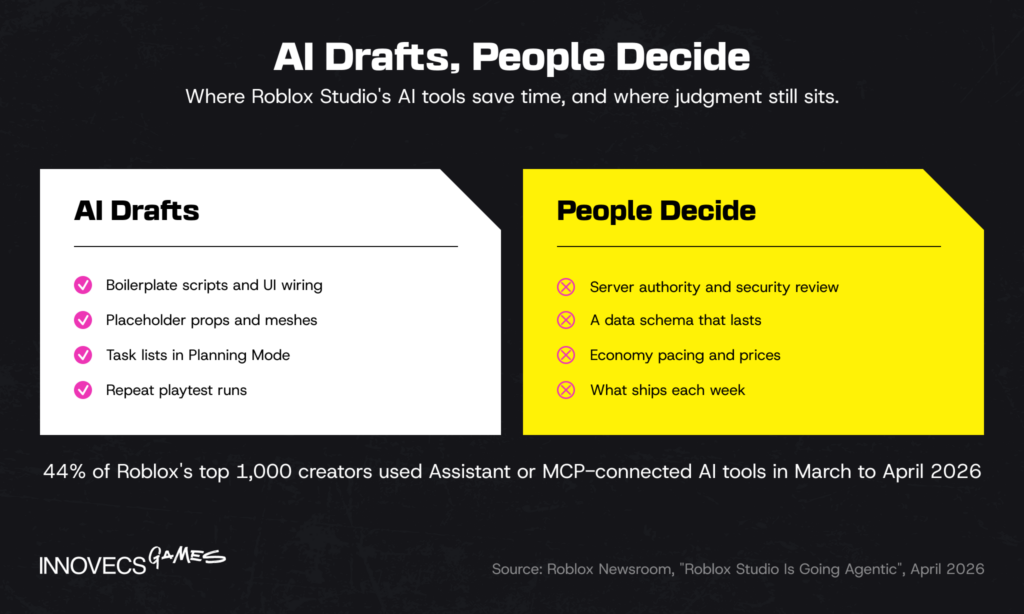
Rates are only half of what sets the price of a team. The other half is how much each person can now produce, and few engine makers have pushed AI into their editor as hard as Roblox has this year. In April 2026 it made its Studio Assistant agentic, adding a Planning Mode that turns a request into a task list before writing code, mesh generation, and a playtesting agent in beta that runs the game against the plan and reads the logs. Studio also has a built-in MCP server, so developers can work with Claude, Cursor or Codex against their own place. Roblox says 44% of its top 1,000 creators were already using Assistant or third-party AI tools through that server by early April. The company’s Q2 2026 letter adds that creators were generating over 60,000 3D assets a day with Roblox’s Cube model, and nearly 1,400 games used Cube content daily.
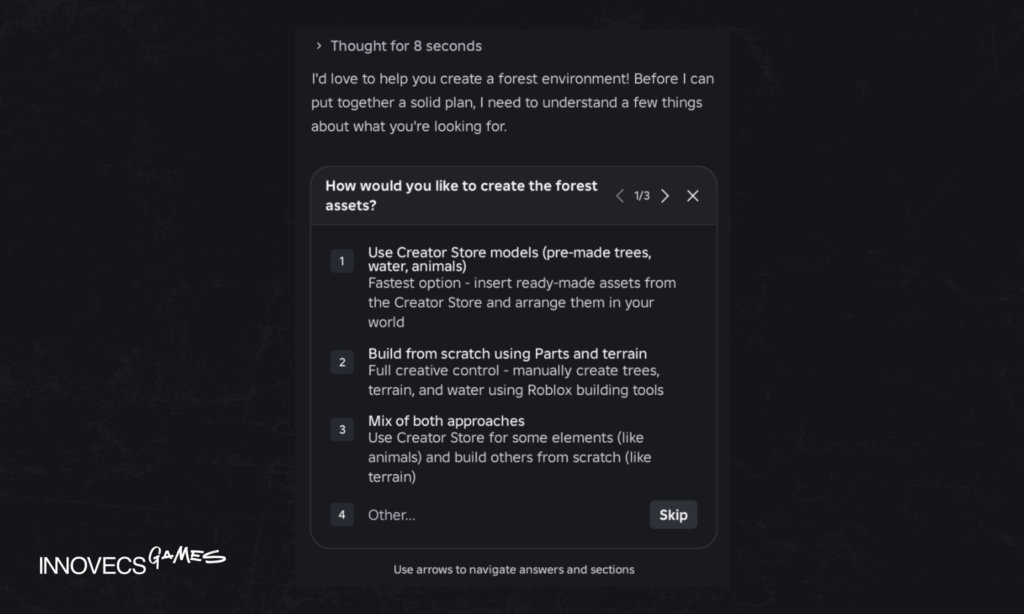
That changes the first weeks of a project most. AI-assisted scripting drafts the boilerplate: UI wiring, tool scripts, simple NPC behavior. Procedural building tools fill a map with placeholder props in an afternoon, and automated QA can replay a flow after every change instead of waiting for someone to click through it. A prototype that used to take a small team a month can now reach a playtest in roughly half that time, in our experience, which moves the bottleneck from building to deciding.
What AI doesn’t supply is systems thinking. It will write a shop script that works in a solo playtest and fails the moment an exploiter fires the remote with a negative price. It won’t design a data schema that survives two years of updates, or an economy where the premium currency still means something in season six. Developers seem to know this: in Stack Overflow’s 2025 survey, 84% used or planned to use AI tools, while 46% said they didn’t trust the accuracy of the output. We think that’s the healthy ratio.
So what AI literacy should you expect from candidates in 2026? At minimum, a working habit with Assistant or an MCP-connected tool, and the judgment to review what it writes for server authority and data safety. Senior candidates should be able to explain how they give an agent enough context to be useful, and when they turn it off. The strongest answer to our interview question six usually involves a generated script that ran perfectly and would have handed exploiters the shop.
How Innovecs Games Helps You Build the Right Roblox Team
Most of the risks in this guide, from lost saves to exploitable shops to a lead buried in tickets, are engineering and production problems rather than Roblox trivia, and that’s the work we do. Innovecs Games has delivered 300+ games over 11+ years, with 200+ developers, artists and designers and R&D hubs in Poland, Ukraine, Romania and Hungary. The skills that break these projects, such as server-authoritative multiplayer code, data systems that survive live updates, mobile performance, QA and LiveOps production, are the ones our teams use on every engine we work in. Most studios bring us in through game co-development: a vetted pod with its own lead that works in your repository, your Roblox group and your sprint cadence, while the design decisions stay with you.
On a Roblox project that usually takes one of a few shapes. A studio with its own Roblox team adds a systems developer and a QA engineer ahead of a big update. A studio entering Roblox for the first time takes a full pod with a producer and keeps a creative lead in-house. Or a live game that has started losing saves or leaking items gets the audit described above before anything else is built. Studios with a full in-house team often use us for overflow, or for a parallel prototype sprint, so their core people stay on the live game. And publishers trying to cut the number of vendors they manage can run this work through the same partner as their Unity, Unreal and mobile projects. Every team comes with a dedicated producer and European working hours that overlap with the US East Coast, and named clients include live mobile operators such as Zynga and JamCity. If you’re looking for a creator who has personally shipped a viral simulator, a Roblox-native specialist is a better bet, and we’ll say so. The titles in our portfolio show the range of work this model has shipped.
FAQ
How do I hire a Roblox game developer?
Start by writing down which role you’re missing, because a scripter, a builder and a systems developer are different hires with different rates. A job post that names the genre, the systems involved and the update cadence attracts far better applicants than one that just says “Roblox dev wanted.” From there the order is simple: shortlist, technical conversation, a small paid task, contract.
How much does it cost to hire a Roblox developer?
Seniority moves the price more than the job title does, so a senior systems developer can cost six or seven times a junior tester. Freelancers usually bill by the hour or by the task, while studios and team-extension partners bill a monthly retainer per person or per pod. Whatever the model, ask every quote to list what’s included, since code review, QA and production management are the lines most often missing.
Where can I find Roblox developers for hire?
Beyond the job boards, look at the credits of games you admire: many experienced developers list their past titles on their Roblox profile or in the game’s description. Roblox-focused Discord communities and game jams are another source of people who already ship. For a team rather than individuals, a partner can usually present candidates within days.
What’s the difference between hiring a freelancer and an outsourced Roblox studio?
It comes down to who owns the outcome. A freelancer owns their task, while a studio owns delivery of a milestone and answers to you for the whole of it. Freelancers cost less per hour, but on projects longer than a couple of months the coordination work they leave you often closes that gap.
How long does it take to hire a Roblox development team?
Anything from a week for one freelancer to several months for an in-house team, with partners in between. Sourcing is rarely the slow part. Most of the time goes on vetting, contracts and getting new people access to your group, repository and analytics, so prepare those before the first interview.
What skills should I look for in a Roblox game developer?
Fluency in Luau and Roblox Studio is the baseline, not the differentiator. The stronger signal is time on a live game that other people depended on, because weekly updates teach habits no solo project does. After that, look for experience on a team with code review, and a working knowledge of Roblox monetization tools such as gamepasses and developer products.
Should I hire an in-house team or outsource Roblox development?
Let the length of the need decide. Work that will last years and sits at the center of your business belongs in-house, while a platform launch, a seasonal content push or a skill you need for one quarter is cheaper to rent. If you’re unsure, start external and hire permanently once you know which roles the game really needs.
What questions should I ask before hiring a Roblox developer?
Beyond the technical round, ask about the working relationship. Who else was on their last team, and what did they own versus borrow? How many hours a week can they commit through your whole timeline, and what else are they working on? Finally, confirm age and legal capacity, and agree in writing that the game lives in your Roblox group.
🤖 How is AI changing how studios hire Roblox developers?
The biggest shift is in what a junior developer is for. Work that used to train newcomers, such as simple UI scripts and prop placement, is increasingly drafted by tools, so studios hire fewer pure juniors and expect faster ramp-up from those they do. Senior demand holds, because someone still has to own the architecture.
🤖 Can AI tools replace parts of a Roblox development team?
Some tasks, yes, but not whole roles. A small team can now cover more ground, so a project that once needed a dedicated prop artist might manage with a modeler who directs generated assets. Nobody has automated the decision about what the game should be, or accountability when an update goes wrong.
Ready to Hire a Roblox Game Development Team? Let’s Talk
Send us the concept, the platform rules you’re unsure about and the date your first playable has to exist. We’ll reply with the Roblox game developers for hire we’d put on it and how fast they can start.