2D Animation Cost: A Complete 2026 Pricing Guide for Game Studios
See what actually drives the price of 2D character and asset animation for games, and how to budget for it in 2026.
The quote comes back at $47,000. You budgeted $12,000, the brief has not changed, and the vendor is not trying to rob you. Both numbers are honest answers to the same request, and that is what catches producers out about 2D animation cost: one word is covering two different products, sold by the unit and sold by the minute, and nobody said which one the brief meant.
Ask five studios what they paid for the same set of character animations and you will get five answers between $3,000 and $60,000. A six-frame idle loop on a sprite sheet and a hand-drawn attack sequence that has to read cleanly at 60fps are both “one character animation” on a spreadsheet. They are not the same purchase, and the number in your pitch deck rarely survives the first art review.
Underneath that is a labor market stretched further than almost any other in games. A journey animator working under The Animation Guild’s 2024-27 wage scales has a contractual minimum of $64.94 an hour from August 2026, on escalators of 7%, 4% and 3.5% published three years ahead, so a studio paying scale already knows its 2027 rate. The other end has no schedule at all. A freelance animator in Tokyo, interviewed by Anime News Network in February, was paid ¥2,500 a cut, about $15.70, and got through ten cuts in a month. JAniCA’s survey work puts the mean income for animators aged 20 to 24 in Japan at ¥1.55 million, roughly $10,000 a year, and most of that work is contracted freelance rather than employed, which is how an hourly equivalent well under Tokyo’s ¥1,226 minimum wage stays legal. Both of those people draw for a living. Both sit somewhere in the chain your vendor quotes from, and every rate you are ever offered is calibrated between them.
This guide covers what you actually pay for in 2D game animation, the four factors that move the price most, per-asset and per-minute pricing with real ranges, how freelance, in-house, and outsourced models compare on total cost, where AI has genuinely changed the math, and where it hasn’t.
Understanding 2D Animation Pricing in Game Development
“2D animation” on a game budget line usually hides four different products. There’s in-game character animation: idle, walk, run, jump, hit, death, and whatever your combat designer added last sprint. There’s UI and feedback animation, the button states, transitions, reward pops, and loading loops that nobody notices until they’re missing. There’s effects work, hit sparks and explosions and status auras, usually built in Adobe After Effects or straight in-engine. And there’s linear content, cutscenes and trailers, animation made for a camera instead of a player input.
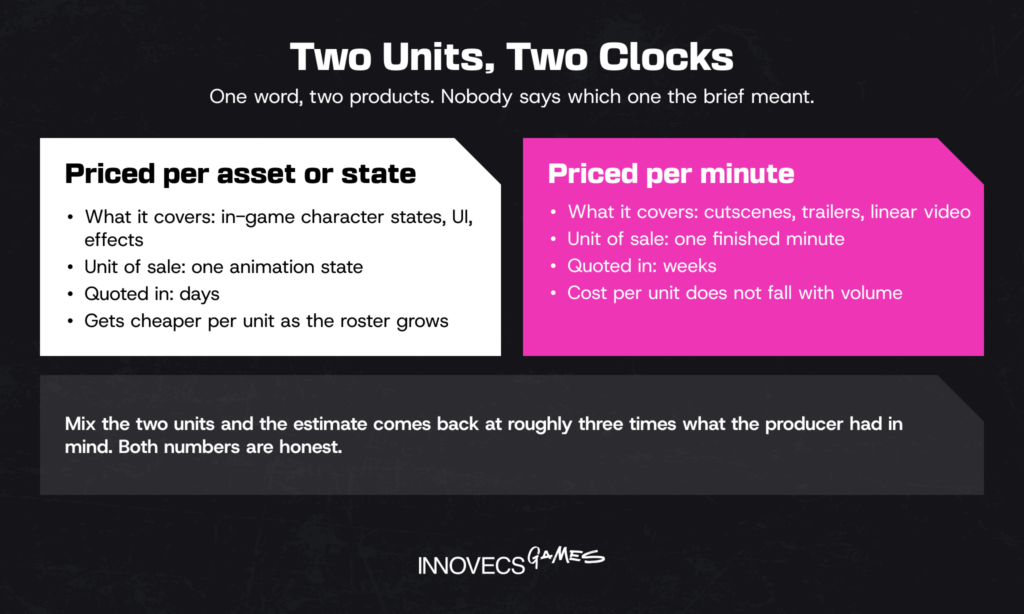
Those four are priced on different clocks. In-game work is priced per asset or per animation state, because that’s how it’s produced and how it ships. Cutscenes and trailers are priced per minute, because that’s how the studio’s staffing math works. Mixing the two units is the single most common reason a quote comes back at triple what the producer expected. Asking a vendor for “two minutes of animation” when you meant a combat-ready character set is asking for a different product entirely.
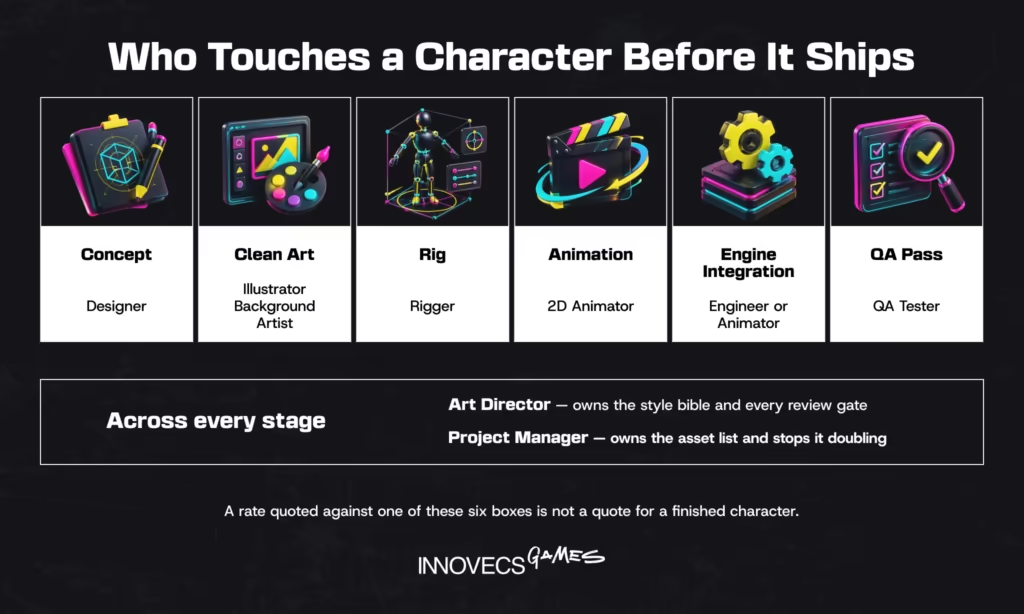
The production chain behind either one runs through more people than the job title suggests. A character passes through concept, then an illustrator or background artist producing clean art in Adobe Photoshop, then a rigger if the pipeline is rig-based, then the 2D animator, then engine integration, then a QA tester who finds the frame where the weapon detaches from the hand. An art director sets the style bible and reviews, and a project manager keeps the asset list from quietly doubling. When a quote looks high relative to an hourly rate you saw somewhere, this chain is usually the reason. You can see how those upstream stages price out in our breakdown of the cost of concept art creation, and how the art side fits together in our guide to how to make 2D game art.
If you want the full production scope in one place, our 2D art and animation services page lays out which of these stages we staff and how they hand off.
What Affects the Price of 2D Animation
Four variables explain most of the spread between a $4,000 quote and a $40,000 one for what looks like the same brief. None of them is the vendor’s margin. Three are decisions you make before anyone opens Spine, and the fourth is a decision you make repeatedly, usually without noticing the cost. All four are cheaper to fix upstream, at the point where game concept art services settle the style, than at the point where an animator is already working to it.
Animation Style and Level of Detail
Technique sets the floor. Cutout and rigged animation, the Spine or Toon Boom Harmony approach, reuses a single piece of art across every motion: you pay once for the art, once for the rig, and then per animation. Frame-by-frame animation redraws the character for every keyframe, and tweening only partly fills the gap, so cost scales with frame rate in a way rigged work does not. A rigged walk cycle at 24fps and a hand-drawn one at 24fps can differ by a factor of six. Same brief, same result on screen, six times the invoice. Frame-by-frame is worth that multiple in exactly one place, on the two or three moments a player will describe to someone else, and almost nowhere else. Spending it on a background NPC’s idle is the most common expensive mistake in 2D game art, and it is always made with the best intentions.
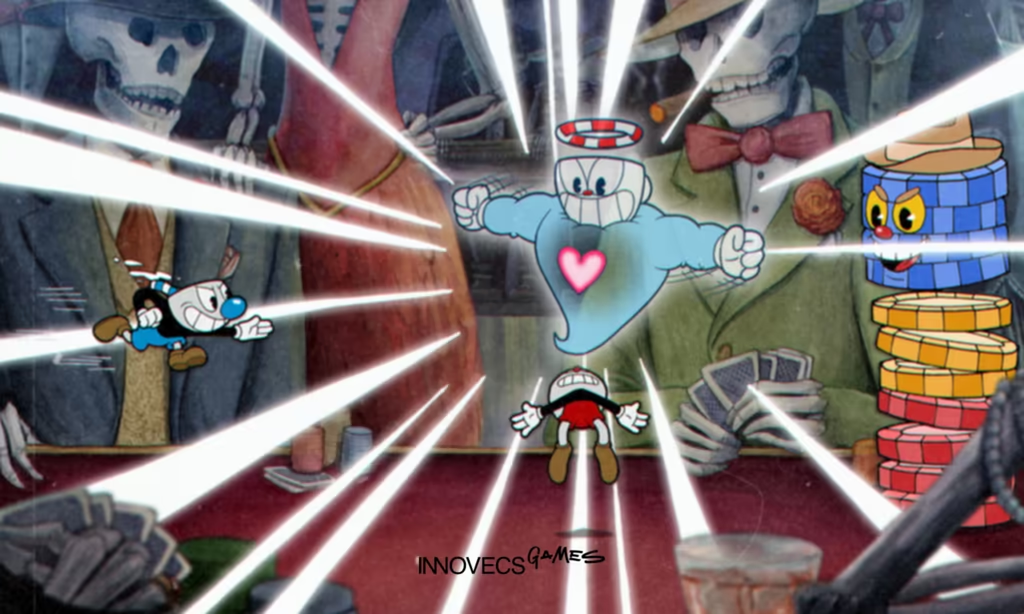
Detail multiplies on top of that. Flowing hair, cloth, layered armor, and secondary motion each add passes, and an art style with thick outlines forgives inconsistency far better than a painterly one. Sprite animation for a match-3 title is a different cost class from a hand-drawn 2D fighter, and the gap widens with every additional character.
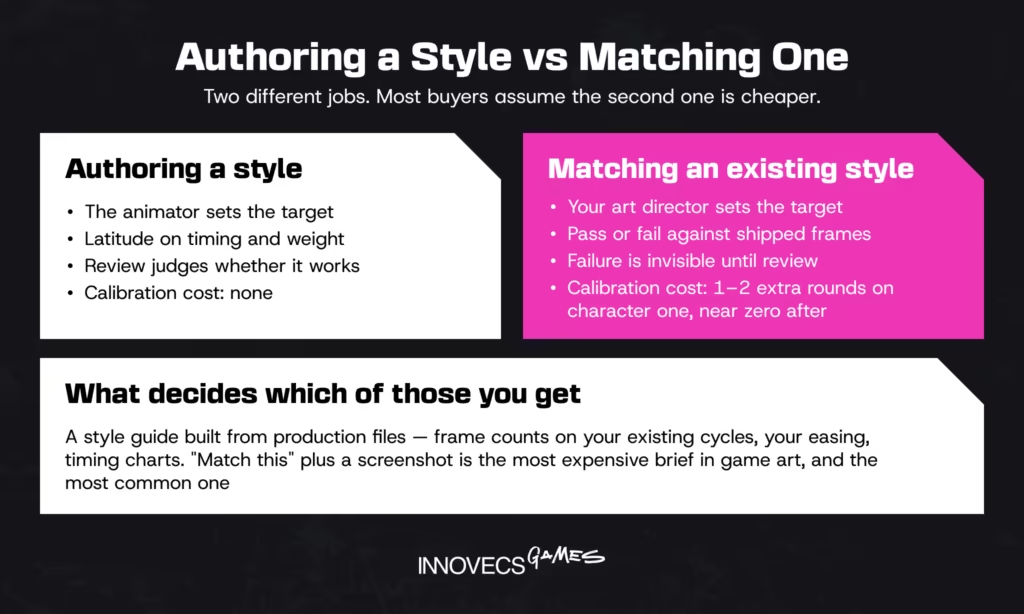
There’s a second question hiding inside style, and it is the one studios with a live title are actually asking: are you buying a style or matching one? Those are different jobs. Authoring gives an animator latitude, and latitude is fast. Matching replaces it with a pass-or-fail test set by somebody else’s eye, usually your art director’s, and the failure is invisible until they see it. Most buyers assume matching is the cheaper of the two. On the first character it rarely is. Expect one or two extra review rounds while the team calibrates, and close to none after that, because calibration transfers across the roster.
What makes the difference is what you hand over. A style guide built from production files, with the frame counts on your existing cycles, the easing you use, and the timing charts, gets a team calibrated in one pass. “Match this” attached to a screenshot is the most expensive brief in game art, and it is also the most common one. Worth knowing too: style reads differently by market, and a look that signals premium to a US audience can signal budget in Korea or Japan. If your roster ships across regions, that is a conversation to have with the art director before the state list, not during QA.
Number of Animation States per Character
This is the variable that breaks budgets, and it breaks them quietly, because the miscount happens in a spreadsheet weeks before anyone animates anything. A studio prices “one character” and means the hero; production prices the same character and means eleven animation states. A casual mobile character might need four: idle, move, action, reaction. A combat character in a mid-core RPG routinely needs twelve to twenty once you count directional variants, two attacks, a skill, a hit reaction, a death, a victory pose, and the UI portrait animation someone asked for in week nine.
Multiply that by the number of characters and the arithmetic gets ugly fast. Six characters at fourteen states each is eighty-four animations, not six. That is the whole problem, in one line. The fix is boring and effective: write the state list into the brief before you request a quote. Vendors who see the full list quote tighter, because they can plan rig reuse across the roster instead of pricing each character as an unknown.
Studio Location and Team Structure
Where the team sits still sets the hourly rate, though the spread has narrowed since 2020. What has not narrowed is the second number, the art-direction hours it takes to get an asset accepted, and on most projects those two move in opposite directions.
| Region | Mid-level 2D animator, hourly | What you’re trading |
|---|---|---|
| North America | $55–$95 | Same time zone, highest rate, thinnest available pool |
| Western Europe | $50–$85 | Strong art schools, long notice periods, August is a real problem |
| Eastern Europe (Poland, Ukraine, Romania) | $28–$48 | Deep game-art talent pool, 1–3h overlap with EU, 6–8h with US West |
| Latin America | $25–$45 | Good US overlap, smaller pool for stylized game animation specifically |
| South and Southeast Asia | $15–$30 | Lowest hourly developer rate, highest management overhead per shipped asset |
Source: Innovecs Games delivery data, projects staffed 2023 to 2026.
Read the right-hand column first. It’s the part people skip and then rediscover in month four, when the cheapest hourly rate turns out to need twice the art-direction time. And note how narrow that table is against the real global spread: the Guild minimum in Los Angeles and the per-cut rate in Tokyo sit outside both ends of it, because neither market sells the kind of embedded game-animation team this table prices. Offshore development at $18 an hour that needs three revision rounds is more expensive than nearshore work at $40 that needs one, and the difference shows up in your schedule before it shows up in your invoice.
Team structure matters as much as geography. A solo animator working from a style guide costs less per hour and more per asset than a pod with a rigger, an animator, and an art director who catches problems at the blocking stage instead of at delivery.
Production Timeline and Revision Rounds
Rush work carries a premium of roughly 20% to 40%, and the premium is not arbitrary. Compressing a six-week animation pass into three means running two animators in parallel on one character set, which adds a consistency pass that wouldn’t otherwise exist.
Revisions are the quieter line. Most studios quote two rounds, and round three is where the relationship is either fine or not, though it’s almost never the animator who caused it. Anyone who has opened a folder containing final_v2, final_v3 and final_APPROVED_use_this already knows how round three announces itself. An art style that was never locked is. Every style decision you leave open at kickoff converts directly into revision hours in month two, at a rate you did not agree to. That assumption, that style can be settled during animation, has blown more art budgets than any rate card.
2D Animation Pricing: A Practical Cost Breakdown
Game studios run into two pricing models, and the confusion between them is expensive. Per-asset pricing covers everything that ships inside the build, where animation length is measured in frames. Per-minute pricing covers everything that plays as linear video. Any useful 2D animation cost estimate names which of the two it’s quoting, and prices complexity per unit instead of handing you one figure for the whole project. The ranges below come from projects we’ve staffed and priced between 2023 and 2026, and they assume a locked art style and a written animation state list. Without those two things, treat every number here as the bottom of its range.
Cost Per Animation Asset or State
Anything that ships inside the build is quoted per state rather than per character, and the reason is production order: the character is drawn once, and every state after that is new motion on art that already exists. So a roster gets cheaper per unit as it gets longer, up to the point where a new archetype forces a new rig. Every figure below assumes engine-ready delivery, not a folder of frames.
| Animation asset | What it includes | Typical price | Typical lead time |
|---|---|---|---|
| UI micro-animation (button, transition, reward pop) | 1 element, 2 states | $60–$200 | 1–2 days |
| Simple sprite idle loop, 4–8 frames | Sprite sheet export | $80–$250 | 1–2 days |
| Walk or run cycle, rigged | Cycle plus engine-ready export | $150–$450 | 2–4 days |
| Effects animation (hit spark, explosion, aura) | Looping or one-shot VFX | $150–$600 | 2–4 days |
| Character rig for Spine or Harmony | Per character, mesh and bones | $300–$1,200 | 2–5 days |
| Attack or skill animation, rigged | Per state, with anticipation and recovery | $250–$800 | 2–4 days |
| Attack animation, frame-by-frame | Per state, 12–24 drawn frames | $600–$2,000 | 4–8 days |
| Full character set, 8–12 states, rigged | Rig, states, sprite sheet, integration files | $2,500–$7,000 | 3–5 weeks |
| Full character set, frame-by-frame, premium 2D | Rig-free, hand-drawn, 12+ states | $8,000–$25,000 | 8–14 weeks |
Source: Innovecs Games delivery data, projects staffed 2023 to 2026.
The right-hand column is elapsed time, not worked hours, and the difference between the two is where soft-launch dates go missing. A character set that represents nine working days of animation occupies four to five weeks of calendar once you count two review rounds and the wait for your art director to be free on a Thursday. Producers plan against the nine and then explain the five weeks to a publisher. Animation is also usually the last discipline in before a build locks, so it inherits every slip upstream of it and absorbs none of the slack.
One cost sits outside every row in that table. Tool licensing is metered by your revenue, not your headcount: Spine, the default rig-based tool for game animation, sells at $69 or $379 per seat, but any company or individual taking more than $500,000 from revenue, investment or financing is required to move to Enterprise at $2,499 a year plus $379 per additional user. A studio that crosses that threshold mid-project inherits a four-figure annual line it never budgeted, and the trigger has nothing to do with animation, it’s the funding round.
Most disagreements we have with a client’s budget happen on the boundary between two of these rows, not inside one of them. The line between “rigged attack” and “frame-by-frame attack” is a style decision worth roughly three times the money, and it’s usually made by an art director who was never shown the price of each option side by side.
2D Animation Cost Per Minute for Cutscenes and Trailers
So how much does 2D animation cost per minute when the deliverable is linear video rather than a game asset? Per-minute rates bundle storyboard, style frames, background art, animation, compositing, and sound, and the tier you land in is decided almost entirely by technique.
| Tier | What it covers | Per-minute rate |
|---|---|---|
| Motion graphics and limited cutout | Simple shapes, minimal character acting | $3,000–$8,000 |
| Standard game cutscene | Rigged characters, custom background art, basic comp | $8,000–$18,000 |
| High-end stylized | Partial frame-by-frame, full effects and sound design | $18,000–$45,000 |
| Premium frame-by-frame | Anime-grade drawn animation, 12–24fps, full crew | $45,000–$120,000+ |
Source: Innovecs Games delivery data, projects staffed 2023 to 2026.
One minute is a great deal of animation. A 24fps minute is 1,440 frames, and even with tweening and holds, a drawn sequence needs several hundred original drawings. This is why studios who budget a three-minute opening cinematic at indie prices end up shipping a two-minute one, or a stills-and-pan sequence that works better than either. Trailers are the exception worth knowing: 60 to 90 seconds of high-tier animation, reused across every store page and ad network, usually returns more than the same money spent on in-game polish.
Our position on cinematics, and we have lost work by saying it out loud: below roughly $5 million of total budget, most studios should not commission one. An opening cinematic is watched once, skipped forever after, and competes for money with the combat feel that decides whether anyone reaches minute ten. Put it in the trailer, where the same minute of animation gets shown to every person who sees your store page. The exception is a narrative game whose whole pitch is the storytelling, and those studios already know who they are.
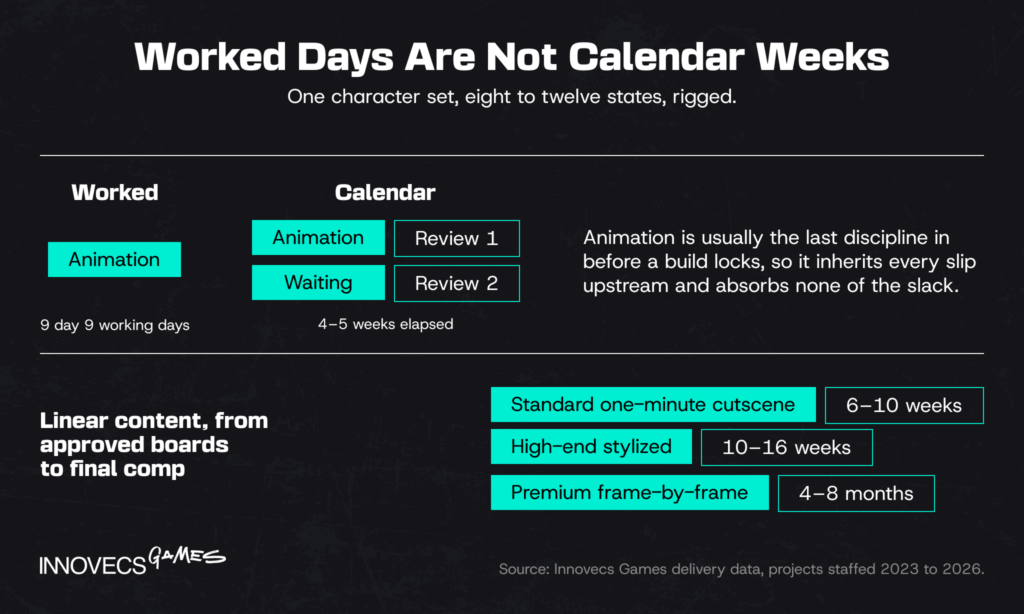
Schedule the same way you budget. A standard one-minute cutscene runs six to ten weeks from approved storyboard to final comp, high-end stylized work ten to sixteen, and premium frame-by-frame four to eight months, because at that tier the crew has to be assembled before anything can start. A 60 to 90 second trailer lands in the six to ten week band. Those figures assume the script and boards are locked. They are not, on most projects, which is why a cinematic commissioned in January for a June beat so often ships in August.
2D Animation Pricing for Mobile and Casual Games
Mobile game animation is priced against a hard technical ceiling. Texture memory, draw calls, and battery all cap what ships, so mobile work skews to rigged and cutout animation with aggressive sprite sheet reuse. That lowers cost per state and raises the value of a good rig.
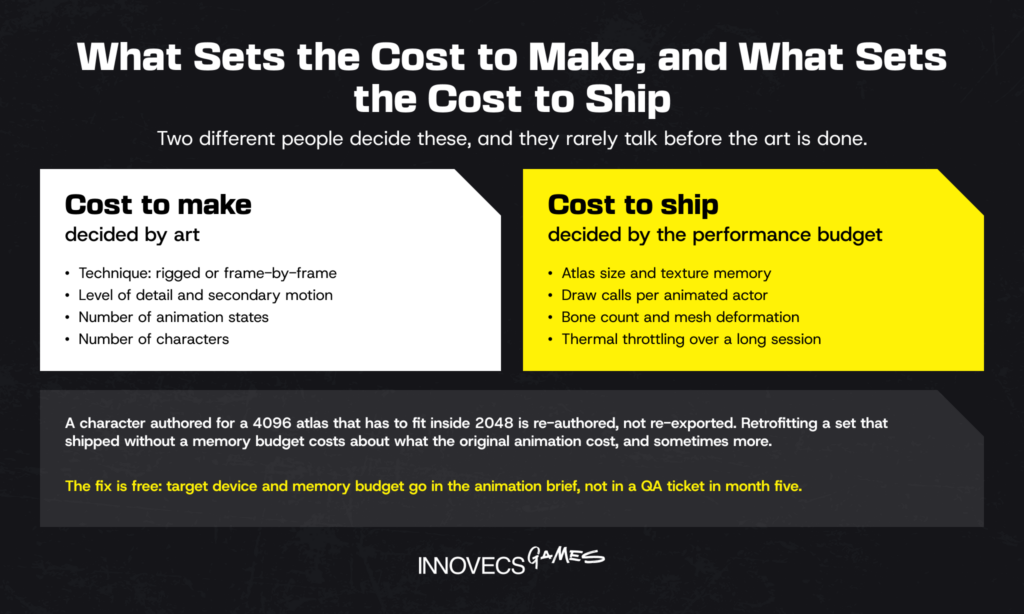
The ceiling is worth spelling out, because it is a cost driver and almost nobody quotes it. What an animation costs to make is set by the art. What it costs to ship is set by atlas size, draw calls, bone count and mesh deformation, and those are decided by whoever owns the performance budget, not by the animator. A character authored for a 4096 atlas that has to fit inside 2048 is re-authored rather than re-exported, and the re-authoring is a second pass nobody put in the estimate. A rig with generous mesh deformation looks identical in the editor and drops frames in the build. Sustained animation load also heats a phone, so the frame rate you measure in the first minute is not the one a player gets in the twentieth. None of this is exclusive to mobile: AA console teams hit the same wall from the other direction, with great artists and no technical artist to hold the budget.
The bill for skipping it is specific. Retrofitting an animation set that shipped without a memory budget costs roughly what the original animation cost, and sometimes more, because by then content has been built on top of it and you are changing load-bearing art. The visible always beats the invisible in a planning meeting, which is how a studio ends up paying twice for the same character. The fix is free: put the target device and the memory budget in the animation brief, not in a QA ticket in month five.
A casual mobile title with a small cast typically lands between $6,000 and $20,000 for its full animation package: four to six characters, UI and reward feedback, and a handful of effects. Mid-core titles with combat and a growing roster run $25,000 to $90,000 in the first year, and then keep spending, because live-ops seasons need new skins and new states forever. The recurring number is the one to plan for. Studios budget the launch set carefully and then discover that season three costs 40% of the original animation budget every quarter.
Pricing for Indie and Mid-Size Titles
An indie game budget with $10,000 for animation can ship a good-looking game, as long as the scope decision is made at the style stage rather than the production stage. That money buys a tight rigged pipeline with three to five characters and shared skeletons. It does not buy frame-by-frame combat, and a team that tries anyway spends it all on two characters and ships with placeholder art for the rest.
Mid-size titles, the $2M to $15M productions that make up most co-development work, typically allocate 8% to 15% of total budget to 2D art and animation combined. That covers a longer roster, environment and background art, a full UI motion pass, and one or two cinematics. The useful question at this scale isn’t the rate, it’s how many people you need at once and for how long, because the animation team is rarely the constraint. The illustrator feeding them usually is.
Before any of that, there is a decision about prototypes that quietly costs more than the rate card ever will. Most prototypes don’t graduate, and that is the system working rather than failing. Animation money spent before a prototype is validated is the most common way a studio arrives at production with a third of its art budget already gone. What a prototype actually needs is one character, three states, rigged, and honest placeholders everywhere else. That is $600 to $1,500 of work, not $6,000. Polish does not make a weak loop test well, and playtesters do not report back that the idle animation was underwhelming. The exception is a game whose hook is the art itself, where you need one hero asset at final quality and nothing else at all. We have had clients spend real money on prototype animation and be right to, but every one of them knew they were buying a pitch asset for a publisher meeting, not a test.
A Worked Estimate for a Mid-Core Mobile Roster
Ranges are only useful once somebody does the multiplication, so here is one done in full. The brief: a mid-core mobile RPG, six playable characters at twelve animation states each, a UI and reward pass, combat effects, and a 60-second trailer for the store page. Rigged pipeline, Spine, locked art style, Eastern European team. Every unit price below comes straight from the table earlier in this section.
| Line item | Quantity | Unit price | Subtotal |
|---|---|---|---|
| Character rigs | 6 | $600 | $3,600 |
| Core states: idle, move, hit, death | 24 | $250 | $6,000 |
| Attack and skill states | 36 | $450 | $16,200 |
| Combat and status effects | 18 | $300 | $5,400 |
| UI and reward animation | 30 | $120 | $3,600 |
| Engine integration and export setup | n/a | n/a | $2,800 |
| Art direction and review, 12% | n/a | n/a | $4,500 |
| In-game total | $42,100 | ||
| Trailer, 60 seconds, standard tier | 1 | $12,000 | $12,000 |
| Total | $54,100 |
Source: Innovecs Games delivery data, projects staffed 2023 to 2026.
Notice that the trailer sits on its own line, in its own unit, for one minute of screen time that costs 28% of what the entire playable roster cost. That is the $47,000 quote from the top of this article, and it is also why the producer who budgeted $12,000 was not being unreasonable. He was pricing one of those two products.
Three levers move that total more than any negotiation will. Switch the thirty-six attack and skill states to frame-by-frame and the in-game figure roughly doubles, to somewhere between $67,000 and $87,000. Build the same roster at the top of the North American rate band and you are close to $95,000 for identical output. Cut to three characters sharing two body rigs, which most players will never consciously notice, and the in-game total lands near $24,000. Elapsed time for the version above is ten to fourteen weeks with two animators and a rigger at part time.
What that estimate does not include is the part worth reading twice, because these lines land on the same budget and almost never appear in the same document:
- Tool licensing, and its revenue trigger. Crossing $500,000 moves a five-seat team from a few hundred dollars to roughly $4,000 a year.
- Your own art direction hours. Two review rounds on eighty-four animations is real time from the most expensive person on your art team, and it is never in the vendor’s number because it is not the vendor’s cost.
- The performance pass, if the memory budget shows up after the art does.
- Revision rounds beyond the two that almost every quote silently assumes.
- Live-ops content from the first season onward, which is a recurring line dressed up as a one-off.
- Source file handover and archival. Free if you ask at kickoff. Awkward and occasionally expensive if you ask at the end.
Our position, after pricing a lot of these: estimates are not usually wrong about the rate. They are wrong about the count, in one direction, every time.
Hiring Models Compared: Freelancer vs In-House vs Outsourcing Studio
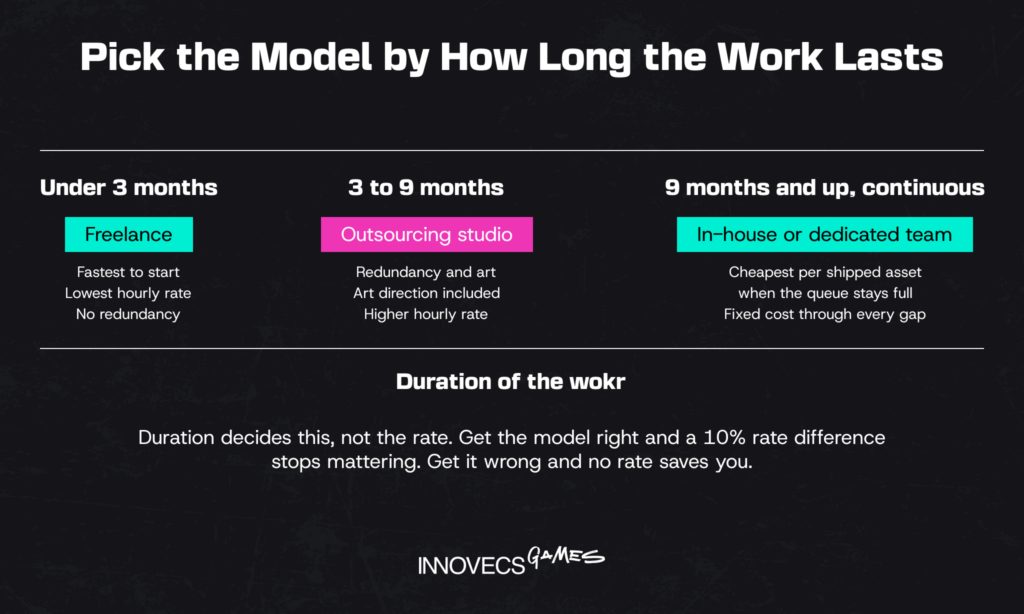
2D animation hire cost looks like an hourly rate and behaves like a total cost of ownership. The rate is the smallest variable in the comparison below; recruiting time, management load, and what happens when one person leaves mid-milestone matter more over a twelve-month production.
| Model | Effective cost | Time to start | Best for | Honest downside |
|---|---|---|---|---|
| Freelance | $25–$90/hr, project-based pricing common | 1–3 weeks | Defined asset batches, overflow | Availability disappears when a bigger client calls |
| In-house team | $61k–$103k salary plus 25–35% overhead | 2–4 months | Long-running live titles | Fixed cost through every gap between milestones |
| Outsourcing studio | $28–$65/hr blended, dedicated team or staff augmentation | 2–4 weeks | Full pipelines, sustained volume | Costs more per hour than a solo freelancer |
Source: Innovecs Games delivery data and public salary data, 2026.
The row that surprises producers is the middle one. An in-house animator is the cheapest option per shipped asset when the pipeline is full, and the most expensive by a wide margin when it isn’t.
Freelance 2D Animators
Freelancers are the right call for bounded, well-specified work: a batch of UI animations, one character set, a trailer. Glassdoor puts average total pay for a US 2D animator at $61,086, and Payscale shows an experienced 2D animation specialist averaging $58,550 base. Freelance hourly rates anchor roughly there, before the specialist premium.
What you’re buying is speed to start and no commitment. What you’re not buying is redundancy. A freelancer who goes quiet in week six of a ten-week milestone leaves you with half a character set in a project file you may not be able to open, and the replacement will quote for rework, not continuation. Ask for the working files at every delivery, not at the end. This is the cheapest insurance in game art.
In-House Animation Team
Hiring in-house makes sense when animation is continuous. A live mobile title shipping seasonal content has a permanent queue, and an in-house 2D animator who knows the rig library and the engine integration quirks gets faster every quarter in a way a rotating vendor never does.
In our experience studios hire their first animator about six months after the queue justified it and roughly a year before they have anyone who can review the work. That second gap is the expensive one. The math turns on utilization. At the Glassdoor average of $103,033 for a senior 2D animator, plus payroll taxes, software, and hardware, you’re at roughly $135,000 a year before the person animates anything. Spread across a full year of continuous work, that’s competitive with any vendor. Spread across seven months of work and five months of waiting for design to decide, it isn’t. There is also a published floor to negotiate against, which most game studios never look at. The Animation Guild’s minimum for a journey animator is $2,509.60 a week through August 2026, and an inbetweener’s is $1,816.80. Those are film and television scales, not games, but candidates read them, and a salary offer that lands under scale for the same craft gets treated as one.
Outsourcing to a Game Art Studio
Studios sit between the other two on price and above both on continuity, and continuity is what the premium actually buys. The rigger, the animator, and the art director sit in the same pipeline, so style drift gets caught internally instead of in your review. If someone leaves, the studio absorbs it.
Eastern Europe has been the center of gravity for game art outsourcing for a decade, and Ukraine in particular has an unusually deep bench in stylized 2D and sprite work, built on a domestic industry that’s been shipping for international publishers since the mid-2000s. A dedicated team of three to five artists on a nearshore model typically runs $18,000 to $40,000 a month. That’s a real number and worth saying plainly. Staff augmentation, where individual artists plug into your pipeline and your Jira, prices lower per head and gives you less of the studio’s internal QA. Both models work. They fail in different ways, and the failure mode of staff augmentation is that your art director quietly becomes the only integration layer in the project, which is a job nobody hired them to do.
How you buy the first batch matters more than which model you pick. Two steps de-risk almost everything. First a paid style test: one character, two states, produced against your existing reference art and priced like any other asset. Then a four to six week paid pilot on real backlog, not a sample brief. The style test answers the question that actually keeps art directors awake, which is whether a team can match the look already shipping in your game rather than produce something good in its own style. The pilot answers whether they can work inside your review cycle. Be wary of unlimited free test work, incidentally. A studio offering it is either short of work or amortizing the cost into your rate, and the second is more common.
Whichever model you land on, the quote itself tells you most of what you need to know about the team behind it. Six things that should slow you down:
- A single number with no unit attached. If it doesn’t say per state, per minute, or per month, nobody has counted anything.
- “Unlimited revisions.” This is priced in. It is always priced in. The only question is whether you can see where.
- No mention of engine integration. Someone is planning to hand you a folder and call it delivery.
- A per-minute rate offered for in-game assets. They have quoted the wrong product, which means they did not read the brief.
- Deliverables described as “final files” without naming formats and export settings. The word final has never once survived contact with a game project.
- A quote that arrives within the hour. For a roster of any size, that is a rate card with your project’s name pasted on top.
Not Sure What Your Project Will Cost? Let’s Scope It Together
Send us your character roster, your state list, and the reference art you need matched, and we’ll come back with a scoped estimate and a staffing plan rather than a rate card. If you’d rather see the work before the numbers, we’ll run a paid style test on one character first. And if the state list doesn’t exist yet, that’s the thing to fix before anyone quotes you, and it’s free to ask.
How to Reduce What You Pay for 2D Animation
Every genuine saving in 2D animation comes from a decision made before production, not from negotiating the rate down. In the projects we have re-scoped for clients, the recoverable waste sits almost entirely in two places: revision rounds caused by an unlocked style, and animation states nobody wrote down. Neither is a rate problem.
- Lock the art style before animation starts. A style guide with turnarounds, a color palette, and two finished reference animations eliminates most revision rounds. This one decision is worth more than any rate negotiation you’ll ever run.
- Write the animation state list into the brief. Every state discovered mid-production is priced as an addition, at a worse rate than it would have had in the original batch.
- Design for rig and sprite sheet reuse. Characters that share a skeleton share animations. A roster built on three body archetypes instead of eight unique silhouettes can cut the animation bill in half without the player noticing.
- Batch similar assets. Twenty UI animations quoted together cost meaningfully less than the same twenty ordered in five batches across four months, because setup and review overhead is paid once.
- Separate what needs frame-by-frame from what doesn’t. Hero moments earn hand-drawn work. Walk cycles for background NPCs do not. Most budgets are blown by applying one quality bar uniformly.
- Match the hiring model to the duration. Under three months of work is freelance or project-based territory. Over nine months of continuous work argues for a dedicated team or in-house hire. The middle is where outsourcing wins.
- Get engine integration into the scope. Animation delivered as a folder of PNGs is not a finished asset, whatever the invoice calls it. Game engine integration, naming conventions, and export settings belong in the vendor’s scope, or they become your programmer’s problem at the worst possible moment.
One habit underpins all seven. Budget planning for animation works better as a per-state unit cost multiplied by a locked state count than as a lump sum, because a lump sum hides the price of the next request until somebody has already made it. Producers who track a unit cost say no roughly twice as often, and mean it. The pipeline side of this is covered in our walkthrough of how to make game assets.
How AI Is Changing 2D Animation Pricing
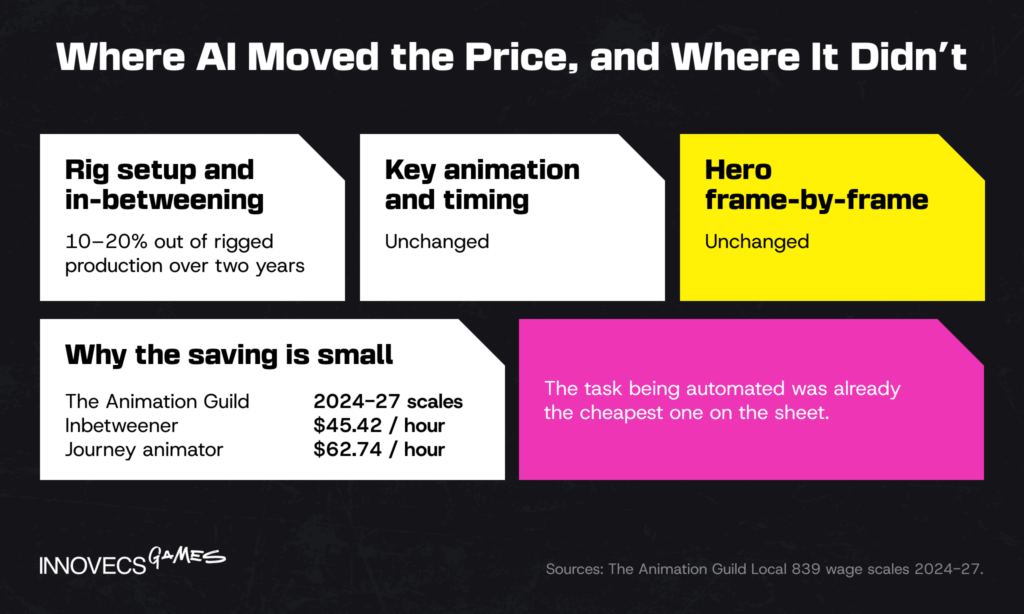
Start with what a contract actually prices, because it explains the ceiling on these savings better than any adoption statistic. On the Guild’s scales, a journey animator’s minimum is $62.74 an hour and an inbetweener’s is $45.42. In-betweening, the frames drawn between two keys, is exactly the task machine learning does well, and it was already the cheapest craft on the sheet. Automating the bottom of a rate card does not produce the savings people expect from it.
What has genuinely moved: AI-assisted in-betweening on clean line art, now built into Adobe Animate and Toon Boom Harmony. Auto-rigging, where a setup that took a day takes an hour or two and the animator fixes weights instead of building from scratch. Procedural and physics-driven secondary motion, which absorbs the cloth and hair passes that used to be billed separately. Rigged pipelines have taken roughly a 10% to 20% efficiency gain from that over two years, concentrated in rigging and cleanup. Frame-by-frame work has barely moved, because the value there is in the drawing decisions. If a vendor tells you AI has halved their character animation prices, ask which assets. The answer is almost always the ones nobody looks at.
The other thing worth knowing is what the people doing this work have managed to negotiate about it, because that is the closest thing to a settled industry position. When the Guild ratified its current contract in December 2024 on a 76.1% yes vote, what it won on generative AI was written notice when the tools are used on a production and the right to propose a non-generative alternative. Not a prohibition, and two of the guild’s own board members campaigned against the deal over precisely that gap. Disclosure and consultation, with the displacement question left open. Anyone planning a 2027 animation budget around a bigger promise than that is planning against a document nobody has signed.
For hiring in 2026, the AI literacy worth testing for isn’t prompt skill. It’s whether a candidate or a vendor can tell you which parts of their pipeline are AI-assisted and which aren’t, what their cleanup pass looks like, and what they do about the legal provenance of training data when the client is a publisher with a compliance department. Our position, for what it’s worth: the price of a first pass has dropped a long way and the price of judgment hasn’t moved at all. Budget accordingly, and don’t expect the savings to show up in the assets your players will actually remember.
How Innovecs Games Delivers 2D Animation at a Predictable Price
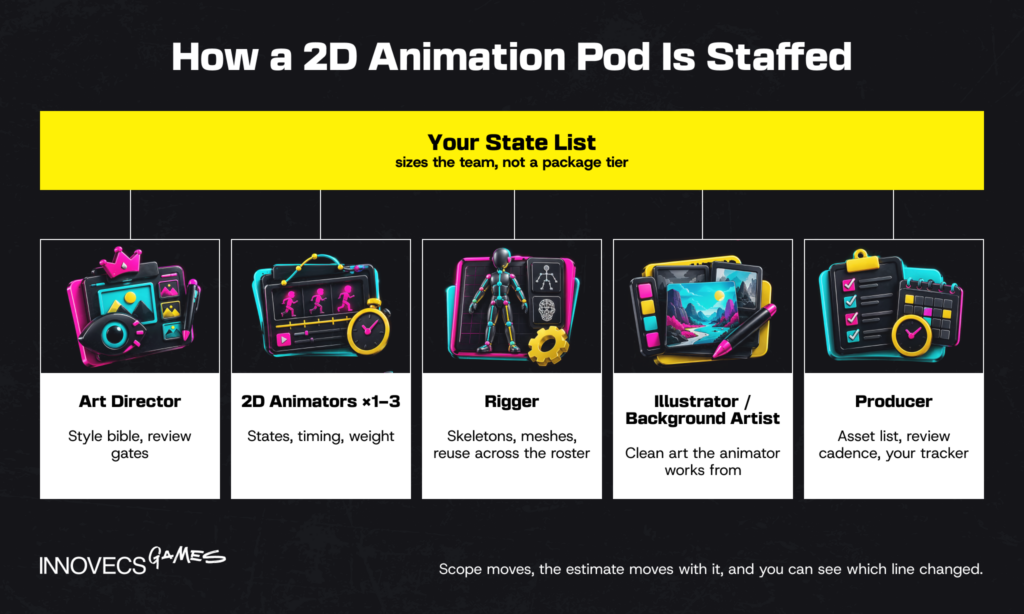
Which leaves staffing as the variable that actually sets your number, and staffing is where we come in. We work as a co-development partner rather than a task vendor, which in practice means our animators plug into your pipeline, your naming conventions, and your milestone reviews instead of delivering into a shared folder and waiting for notes. A typical 2D engagement staffs an art director, one to three animators, a rigger, and an illustrator or background artist, sized to your state list, not to a package tier.
Estimates come as a per-state and per-minute breakdown with the assumptions written out, so when scope changes you can see exactly which line moved and by how much. That’s the part studios tell us they were missing: not a lower rate, but an estimate that stays legible when the design changes in month three.
Innovecs Games has delivered 300+ titles with a team of 200+ developers and artists across the US, UK, EU, Israel, Australia, and Ukraine. You can see the range of art styles we’ve shipped in our portfolio.
FAQ
Ten questions from real scoping calls. About half of them turn out to be the same question underneath: which unit is being quoted, and what the quote assumes has already been decided.
How much does 2D animation typically cost?
For game work, per-asset pricing runs from about $80 for a simple sprite loop to $25,000 for a premium frame-by-frame character set. Linear content like cutscenes and trailers is priced per minute, from around $3,000 for motion graphics to $120,000 and up for anime-grade drawn animation. Most mid-size game projects land somewhere between $15,000 and $90,000 for a full animation package. The variable that moves your number most is technique, not vendor.
What’s the average cost of one minute of 2D animation?
Between $8,000 and $18,000 for a standard game cutscene with rigged characters and custom backgrounds. That band covers most studio work. Motion graphics and limited cutout animation run $3,000 to $8,000; high-end stylized work $18,000 to $45,000; premium hand-drawn animation starts around $45,000 and has no real ceiling. Most quotes you receive will not say which tier they are, so the check is what the number includes. Anyone comparing vendors on how much does 2D animation cost per minute should confirm that storyboard, background art, compositing and sound are inside the figure, because a quote missing two of those looks 40% cheaper and is not.
What factors most affect the price of 2D animation?
Four things, in order: animation technique (rigged versus frame-by-frame), the number of animation states per character, the location and structure of the team doing the work, and how many revision rounds the project runs. Frame rate and level of detail sit underneath the first one. Notably, the vendor’s hourly rate is rarely the biggest lever, which is why negotiating it produces smaller savings than locking the art style does.
How much does 2D game animation cost?
Year one is the number everyone asks for and the wrong one to plan against. It lands at $6,000 to $20,000 for a casual title and $25,000 to $90,000 for mid-core with combat, and a rig-based indie project ships well at $10,000. Then the live-ops seasons start, and a studio running events discovers it is spending a significant fraction of that launch figure again every quarter, forever. Most 2D game animation cost estimates stop at the launch set, which is why the second-year budget arrives as a surprise rather than a plan.
Is 2D animation cheaper than 3D animation?
Usually, but not always, and the gap is narrower than it was. 2D avoids modeling, texturing, and lighting entirely, and that is real savings up front. But 3D assets are reusable across unlimited animations once built, while frame-by-frame 2D pays again for every new motion. For a game with 40 characters and heavy animation reuse, 3D can finish cheaper. For a short project with a distinctive hand-drawn look, 2D wins comfortably.
How much does it cost to hire a 2D animator?
Freelance rates run $25 to $90 an hour depending on specialization, which is the fastest route and the least durable one. Salaried, the Glassdoor averages are $61,086 for a 2D animator and $103,033 for a senior, and fully loaded cost lands roughly 25% to 35% above whichever figure you offer. Through an outsourcing studio in Eastern Europe, blended rates sit between $28 and $65 an hour, with the art direction and QA layers included. Budget for a two-to-four-month hiring timeline if you go in-house, and remember that 2D animation hire cost includes the months you pay for before the first asset ships.
Should I hire a freelancer or an outsourcing studio for 2D animation?
Duration and volume decide this. A freelancer is right for a bounded batch under three months with a clear spec, and costs less per hour. A studio is right when the work is continuous, spans multiple disciplines, or has to survive someone leaving mid-milestone. The studio premium buys redundancy and internal art direction, which is worth nothing on a two-week job and worth a great deal on a nine-month one.
How can I lower what I pay for 2D animation without losing quality?
Two decisions do most of the work, and both happen before an animator opens a file: settle the art style, and count the states. Between them they remove the revision rounds where budgets quietly leak. After that, design characters to share rigs and sprite sheets, batch similar assets into single orders, and reserve frame-by-frame work for hero moments only. Cutting the vendor’s hourly rate is the least effective lever on this list.
How is AI changing 2D animation pricing?
Less than the marketing suggests, and the reason is visible in any union rate card. Auto-rigging, AI-assisted in-betweening and procedural secondary motion have taken roughly 10% to 20% out of rigged production costs over two years. But the Guild prices in-betweening at $45.42 an hour against $62.74 for a journey animator, so the task being automated was the cheapest one on the sheet to begin with. Frame-by-frame and hero animation pricing has barely changed at all.
Can AI tools replace a professional 2D animation team for games?
Not as of 2026, and the gap isn’t closing evenly. AI handles in-betweens, rig setup, and variations on existing motion well. It does not make the timing and weight decisions that separate animation a player feels from animation a player tolerates, and it does not solve engine integration, memory budgets, or consistency across a roster of twenty characters. It also introduces provenance questions that publishers increasingly ask about in contracts, and the industry’s own answer so far is disclosure rather than restriction: the Animation Guild’s 2024-27 agreement requires written notice when generative tools are used and gives artists the right to propose an alternative, with no ban attached. Treat AI as a tool that makes a good team faster, not as a replacement for one.
Ready to Get an Accurate 2D Animation Cost Estimate?
You now have the two units this work is sold in and the questions that decide which one applies to you. We’ll run the arithmetic against your actual roster and hand back something you can defend in a budget meeting line by line, with every assumption on the page instead of in someone’s head. Tell us the gap and the date, and we’ll put a team against it.