Unity Game Development Cost in 2026: Full Price Breakdown
What Unity game development cost actually looks like in 2026: real price ranges by game type, developer rates by region, the costs that surface after the build is locked, and where the budget is genuinely controllable.
The most expensive line in a Unity budget is never the engine. Unity Pro lists at $2,310 per seat per year. A senior Unity developer in Los Angeles costs more than that every four working days, and a team of twelve spends more on payroll in a week than on a full year of seats. Studios still open the conversation by asking what Unity charges, then get a proposal back at three times the number they had in mind.
The talent market underneath that proposal has moved. GDC surveyed more than 2,300 developers for its 2026 State of the Game Industry report. Unreal came out ahead as the primary engine at 42%, Unity at 30%, Godot at 11%. Five years ago that table read the other way round, and none of it has made Unity engineers cheaper. Mobile, casual, VR, and most cross-platform commercial work still runs on Unity. Demand for people who know it properly sits about where it always did, while new graduates now spread themselves across three engines. Video game development cost has always come down to people multiplied by months, and the people half is where the pressure is.
Budgets for Unity projects in 2026 run from roughly $30,000 for a hyper-casual mobile title to well past $3 million for a live-service game with an ongoing content pipeline. That spread is wide enough to be useless on its own. This piece breaks it into the parts you can actually price: what drives the number, what each game type costs, what developers charge by region and by engagement model, which costs surface late, and where AI has genuinely moved the math.
What Determines Unity Game Development Cost?
Three numbers set the total, and licensing isn’t one of them. Cost sits close to team size multiplied by blended hourly rate multiplied by months on the calendar, and every line in a proposal moves one of those three. A second platform adds months. A stylized art direction changes the artist-to-engineer ratio. A design that touches server-authoritative multiplayer changes who you need on the team at all, and those people cost more than the rest of the roster. For the licensing tiers and terms on their own, the Unity engine explainer has them.
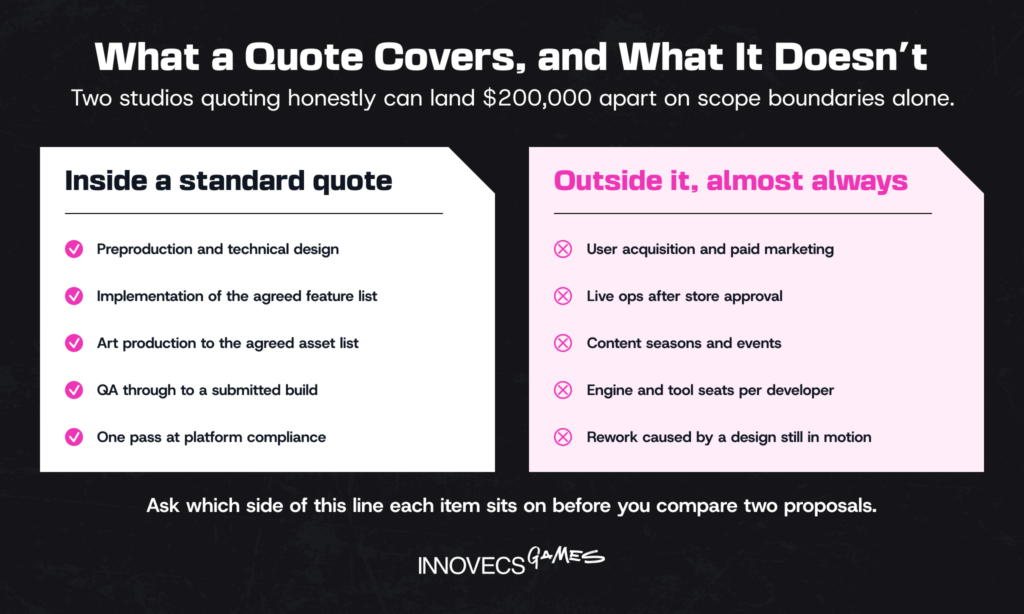
A quote also covers a narrower slice than most people read into it. Standard scope runs from preproduction to a submitted build: design, implementation, art, QA, and one pass at platform compliance. It usually excludes user acquisition, live ops, and everything after store approval. Ask which of those sit inside the number before you compare two proposals, because two studios quoting honestly can land $200,000 apart on scope boundaries alone.
One variable sits outside that equation and rarely gets priced: how much of the design is still undecided when production starts. A studio that arrives with a locked vertical slice and a tested core loop pays for execution. A studio still testing whether the loop is fun pays for execution plus the reworks, and the reworks are where a game development cost estimate usually breaks. That’s our read after a decade of scoping these projects, and the pattern hasn’t changed with engine versions or tooling.
For the full picture on engagement, rates, and the team behind the number, our Unity game development services page covers how we scope and staff these builds.
Key Factors That Drive Unity Development Costs
Four variables account for most of the variance between two game development cost quotes for what sounds like the same game. Rate differences between regions matter, but they’re rarely the biggest line: a project with the wrong scope in a cheap region still costs more than a tightly scoped one at Western European rates. Complexity compounds. Rates only multiply.
Game Complexity and Scope
Scope is measured in systems, not features. A match-three game with one board type, one currency, and a linear level ladder is a four-month build. Add a meta layer, an events calendar, a second currency, and a social component, and you’ve added three subsystems that each need design, implementation, balancing, and their own analytics. Every system also needs to survive contact with the other systems, which is where the schedule stretches. As a rule of thumb from our own scoping, each additional interlocking system adds 15% to 25% to build time, and the increments stack rather than average out. In fifteen years of scoping we have never watched a team add a second currency and still hit the original date.
Platform and Device Targets
Unity’s cross-platform build pipeline makes shipping to a second platform look like a checkbox in a kickoff deck. It behaves like a second project in month five. Input schemes, resolution and aspect handling, memory ceilings, store compliance, and platform certification each carry their own work and their own QA pass. Mobile adds device fragmentation. Unity’s 2026 Game Development Report has 73% of respondents naming India and 68% naming Southeast Asia as the most attractive emerging markets, and serving the low end in either one means performance work on hardware your team probably doesn’t own. GDC’s 2026 survey found 39% of developers interested in Nintendo Switch 2 and 28% already building or optimizing for Steam Deck. Each is a separate performance and compliance target, not a build flag. Budget 15% to 30% of the original build cost per additional platform, more if console certification is in scope.
Art Style and Asset Volume
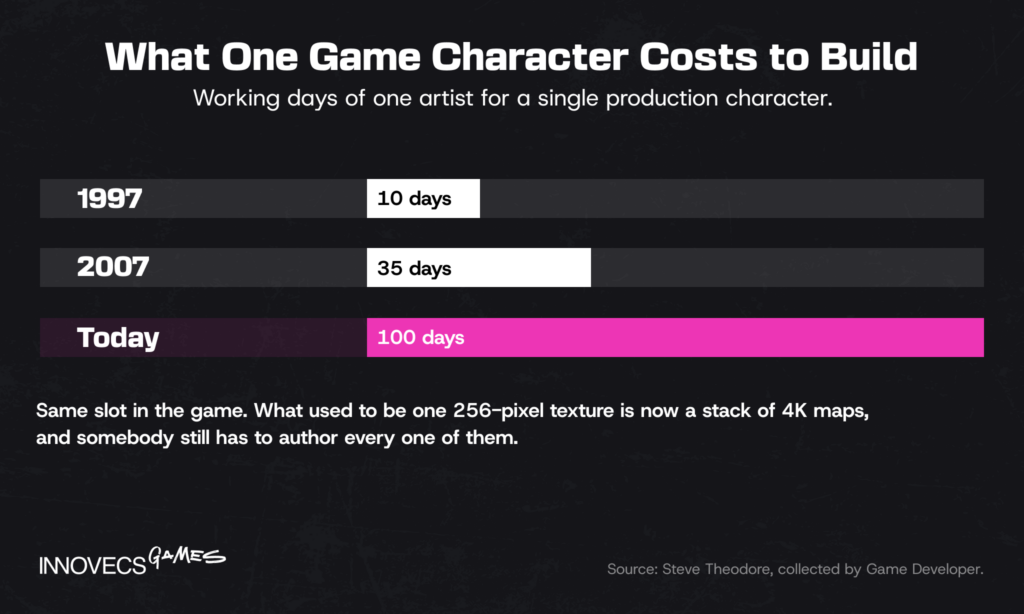
Art is usually the largest single cost center in a 3D Unity project, and it’s driven by volume and consistency rather than by taste. Two hundred unique props, each needing concept, model, texture, LODs, and integration, is a pipeline problem before it’s an art problem. The per-asset cost has also been climbing for thirty years. Steve Theodore’s estimate, collected by Game Developer, puts one game character at ten working days in 1997, thirty-five a decade later, and roughly a hundred today. None of that curve is Unity’s doing. What used to be a single 256-pixel texture is now a stack of 4K maps, and somebody still has to author every one of them. Stylized direction generally costs less than photoreal, because it forgives texture resolution and lighting fidelity, but it forgives nothing on silhouette and palette discipline. A shared style guide, naming conventions, and an asset review gate cost a few days up front and save weeks of rework in the back half of production.
Team Composition and Location
The same feature list costs different amounts depending on who builds it, and seniority moves the number more than headcount does. One senior Unity developer who’s shipped three titles will often out-deliver two mid-level engineers on architecture decisions that compound: save systems, addressables, netcode boundaries. Location sets the rate, seniority sets how many hours the work actually takes, and the two interact. A five-person team of seniors and a nine-person mixed team can quote within 10% of each other and then deliver on schedules three months apart.
Where the Budget Actually Goes
Those four factors decide the size of the number. This is how the number splits once it exists, which is the part most estimates never show the client.
| Discipline | 2D or casual mobile | 3D action or live-service |
|---|---|---|
| Engineering | 35% to 45% | 25% to 35% |
| Art and animation | 20% to 30% | 45% to 60% |
| Game design and balancing | 10% to 15% | 8% to 12% |
| QA | 10% to 15% | 10% to 15% |
| Production and management | 8% to 12% | 8% to 12% |
| Audio | 3% to 5% | 3% to 6% |
Source: Innovecs Games delivery data, projects staffed 2023 to 2026.
The swing between those two columns is the single most useful thing on this page. Moving from 2D to 3D doesn’t scale a budget evenly; it moves the center of gravity from engineering to art, which changes who you hire first and which discipline sets your schedule.
Phases split the same budget a different way. Preproduction and prototyping take 10% to 15% and one to three months. Production takes 55% to 65% and the bulk of the calendar. Getting from content complete to beta takes another 15% to 20%, and hardening, certification, and submission take 8% to 12% on top. That last slice is the one cut first when a project runs late, and it’s the one that decides what your review scores look like.
Unity Game Development Cost by Game Type
Here’s the game development cost breakdown most producers actually want: a dollar range, a team size, and a timeline, per category. The ranges below reflect full-cycle production from a locked concept to a shipped build, excluding user acquisition and post-launch content. They assume a competent team working to a defined scope, not a discovery phase disguised as production.
| Game type | Typical budget | Team size | Timeline |
|---|---|---|---|
| Hyper-casual and casual mobile | $30,000 to $120,000 | 2 to 5 | 2 to 4 months |
| 2D indie and puzzle | $60,000 to $250,000 | 3 to 7 | 4 to 9 months |
| 3D action and adventure | $250,000 to $1.5 million | 8 to 25 | 9 to 18 months |
| VR and AR | $150,000 to $900,000 | 5 to 15 | 6 to 14 months |
| Multiplayer and live-service | $500,000 to $3 million+ | 15 to 40 | 12 to 24 months, then ongoing |
Source: Innovecs Games delivery data, projects staffed 2023 to 2026.
Most disagreements about a budget happen on the boundary between two of those rows, not inside one of them. A “simple 3D mobile game” that turns out to need a live events system belongs in row five, and finding that out in month four is expensive.
Hyper-Casual and Casual Mobile Games
These are the cheapest Unity builds and the least forgiving commercially. A hyper-casual prototype can be built in three to six weeks by two people, and studios routinely soft launch several to find one that holds retention. Merge, idle, match-3, and arcade titles sit in the same band, though merge and match-3 climb toward the top of it once a meta layer and an events calendar are in scope. The engineering is straightforward; the cost concentrates in iteration, SDK integration for ads and analytics, and the store build pipeline. Casual titles with meta progression sit at the top of the range and behave more like the 2D category. Worth remembering that the same storefront carries both ends of this article: Game Developer’s cost survey puts recent top-of-the-line mobile titles at $5 million to $20 million, well over a hundred times the cheap end of this row, on the same hardware, in front of the same audience. If mobile is your primary target, our breakdown of mobile game development cost goes deeper on monetization and UA math than this piece does.
2D Indie and Puzzle Games
A polished 2D title is where small teams get the best return on Unity’s tooling. Sprite workflows, tilemaps, and the 2D physics stack are mature, and a lot of the level content can be authored by designers rather than engineers. Budgets climb with animation volume and level count: a hand-animated character with twelve states costs multiples of one with four. Puzzle games specifically carry a hidden line in level design and balancing, which reads as cheap on a schedule and consumes designer months in practice.
There’s a useful reality check on what games in this band actually cost to fund. Innersloth, the three-person team that built Among Us in Unity, now runs a fund called Outersloth and has put nearly $20 million into 24 games, writing individual checks between $50,000 and $2 million. That spread tells you more than any rate card does, because it’s what people spending their own money decided was enough.
3D Action and Adventure Games
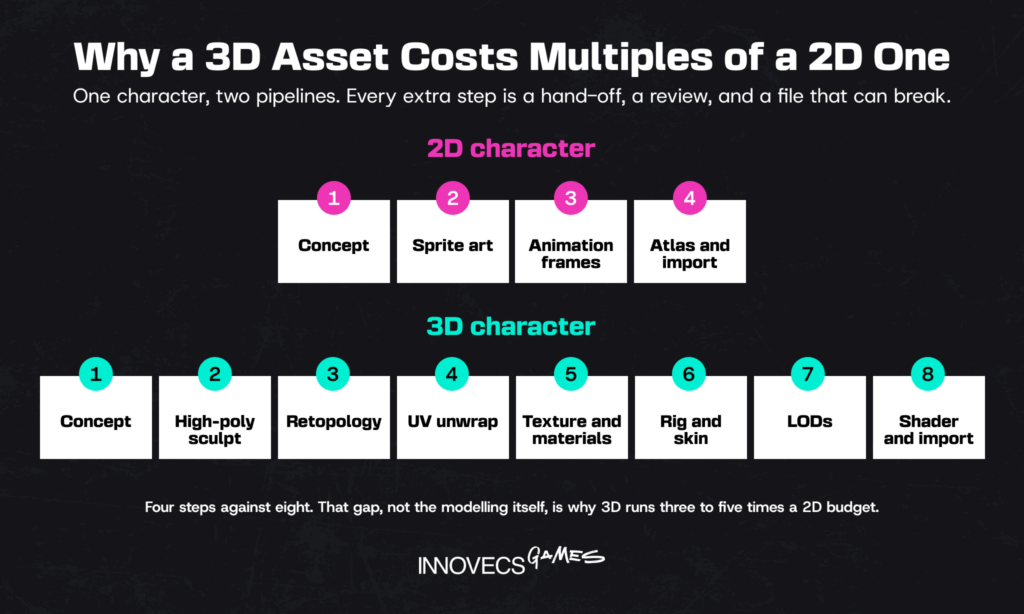
This is the category where art volume takes over the budget. Character rigs, environment kits, VFX, animation blending, and the technical art work that keeps all of it inside a frame budget will typically account for 45% to 60% of total spend. Engineering costs cluster around gameplay systems, save and progression, and performance on the weakest target device. Console targets pull the top of the range up sharply once certification QA enters the picture. The art budget on a 3D project is also the one that quietly eats the others, and our view is that producers who ring-fence it in month one spend a lot less time defending it in month ten. For projects with genuine AAA production values, the economics change again and our note on AAA game development cost is the closer comparison.
VR and AR Games
VR budgets look moderate and then get complicated. Content volume is usually smaller than in a comparable flat 3D game, which pulls cost down. The performance ceiling is what pushes it back up. Sustained frame rates on standalone headsets leave very little headroom, and comfort testing is a real production phase rather than a QA line item. Interaction design also costs more than teams expect, because there’s no established grammar to copy. Expect roughly 20% of the schedule to go to iteration on interactions that read fine on paper and feel wrong in the headset.
Multiplayer and Live-Service Games
Unity’s own survey found 83% of polled studios supporting online multiplayer features and 72% prioritizing cross-play, and both of those decisions reshape a budget. Hybrid-casual and mid-core titles land here too the moment they add live events and a season pass, even when the core loop looks casual. Netcode, server infrastructure, matchmaking, anti-cheat, and account systems add engineering roles you don’t need in a single-player game. Studios that budget the build and not the year after it are the ones who quietly shut the servers down at month nine.
What a Live Title Costs to Run
A shipped live game stops having a project cost and starts having a monthly one, which is a different conversation and a different line in the P&L. The shape below is what a mid-size live mobile title, hybrid-casual or mid-core, typically needs from month one after launch.
| Live operation | Monthly cost | Cadence |
|---|---|---|
| Core LiveOps pod: producer, designer, artist, engineer | $28,000 to $55,000 | Continuous |
| Seasonal event with new art, balancing, and store assets | $15,000 to $40,000 per event | Every 4 to 6 weeks |
| Backend, analytics, and on-call | $8,000 to $20,000 | Continuous |
| A/B test variants and offer tuning | $4,000 to $12,000 | Continuous |
Source: Innovecs Games delivery data, projects staffed 2023 to 2026.
Run those together and a live title costs $45,000 to $120,000 a month before user acquisition. The number people underestimate is not any single row, it’s what happens when the cadence slips. Miss two event windows and retention drops, the catch-up content costs more than staying on schedule would have, and the team spends a quarter paying back content debt instead of building the next season. This is also the one workstream where we push clients toward a stable team rather than a flexible one. Rotating people through a live economy is how you end up with a balance patch nobody can explain six months later.
Get an Accurate Cost Estimate for Your Unity Project
You’ve now got the ranges. Turning one into a real Unity game development cost estimate takes about an hour: your feature list, your platforms, your ship date, and an honest answer about which parts of the design are still moving. We will tell you which parts of the number we think are fragile before you take it to a board.
Unity Developer Rates and Team Costs by Region
Rates vary by a factor of four across the regions studios actually hire from, and the spread is not primarily about skill. Eurostat put average hourly labour costs across the EU at €34.9 in 2025, ranging from €12.0 in Bulgaria to €56.8 in Luxembourg, and game development sits on top of that same underlying cost base. What follows is the blended commercial rate you’d pay an outsourcing partner, which includes management, benefits, and overhead that a salary figure doesn’t.
| Region | Junior | Mid-level | Senior | Notes |
|---|---|---|---|---|
| United States and Canada | $60 to $85 | $85 to $120 | $120 to $170 | Highest total cost, easiest time zone alignment for US publishers |
| Western Europe | $50 to $70 | $70 to $100 | $100 to $140 | Strong technical art depth, longer notice periods |
| Eastern Europe and Ukraine | $30 to $45 | $45 to $65 | $65 to $95 | Deep Unity talent pool, 5 to 7 hour US overlap |
| Latin America | $30 to $45 | $45 to $65 | $65 to $90 | Best real-time overlap with US teams |
| South and Southeast Asia | $20 to $30 | $30 to $45 | $45 to $65 | Lowest rates, highest management overhead |
Source: Innovecs Games delivery data, projects staffed 2023 to 2026.
Read the notes column first. It’s the part of that table people skip and then rediscover in month four, usually at 2am on a milestone handover.
Seniority bands only get you so far, because a Unity team is not made of Unity developers. Here is the same market broken out by role, using Eastern Europe as the reference region and 160 billable hours a month.
| Role | Hourly | Monthly, full time |
|---|---|---|
| Unity developer, mid | $45 to $65 | $7,200 to $10,400 |
| Unity developer, senior | $65 to $95 | $10,400 to $15,200 |
| Technical artist | $55 to $80 | $8,800 to $12,800 |
| 3D artist | $40 to $60 | $6,400 to $9,600 |
| 2D and UI artist | $35 to $55 | $5,600 to $8,800 |
| Game designer | $40 to $60 | $6,400 to $9,600 |
| QA engineer | $25 to $40 | $4,000 to $6,400 |
| Producer | $50 to $70 | $8,000 to $11,200 |
Source: Innovecs Games delivery data, projects staffed 2023 to 2026.
Put those rows together and the two tables in this article start talking to each other. A mid-scope 3D team of eight, one senior and two mid Unity developers, a technical artist, a 3D artist, a designer, a QA engineer, and a producer at half time, runs roughly $65,000 to $70,000 a month at mid-band rates. Twelve months of that is about $800,000, which is where a 3D action title lands in the game-type table above. Nothing in that arithmetic is hidden. It just rarely gets written down.
In-House Team Costs
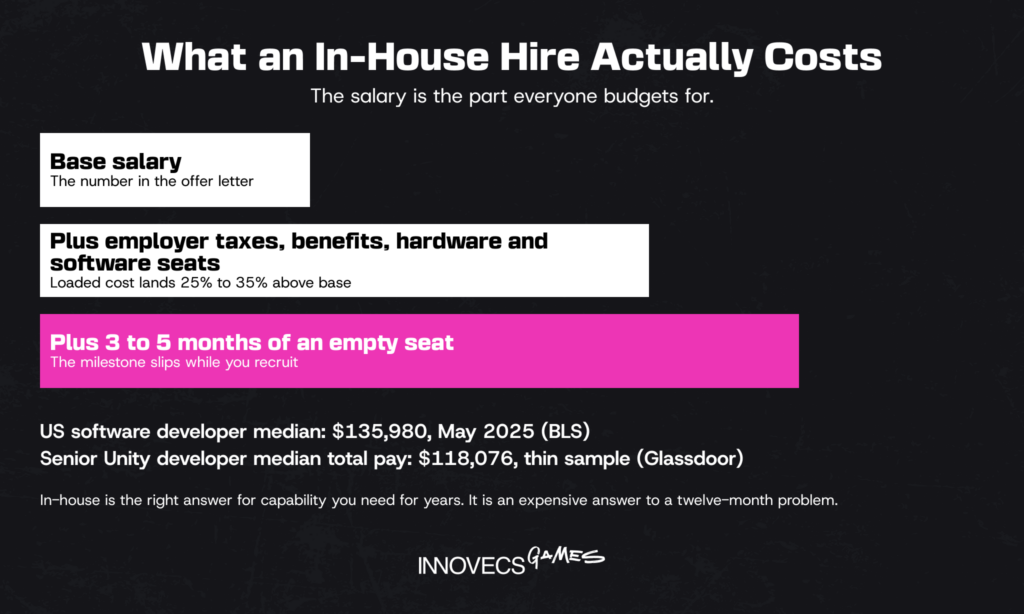
Salary is roughly two-thirds of what an in-house developer costs you. The US Bureau of Labor Statistics puts the median wage for software developers at $135,980 as of May 2025, which is the broader market a studio bids against for the same people. Glassdoor’s Unity-specific number sits lower, at $118,076 median total pay for a senior Unity developer, on a thin sample, with Los Angeles and New York submissions running $137,000 to $178,000. Add employer taxes, benefits, hardware, software seats, and office or remote stipend, and the loaded cost lands 25% to 35% above base. Then add the part that doesn’t appear on any spreadsheet: three to five months to hire a senior Unity engineer in a competitive market, and the milestone that slips while the seat is empty. In-house is the right answer when the capability is core to your studio for years. It’s an expensive answer to a twelve-month problem. If you’re weighing it up, our guide to hire Unity developers covers the sourcing side.
Freelance Unity Developer Rates
Freelancers price between the regional bands above and roughly 20% over them, depending on scarcity. A specialist shader or netcode contractor in Western Europe commonly bills $80 to $130 an hour and is worth it for a bounded problem. The economics turn against you at scale. Five freelancers on one codebase is a coordination job somebody has to do, and that somebody is usually your producer, who then isn’t producing. Freelance works cleanly for defined deliverables with a clear acceptance test: a port, a set of VFX, a performance pass. As a substitute for a team, it doesn’t.
Outsourcing to Eastern Europe and Ukraine
Eastern Europe stays the default for Unity work at scale, for structural reasons rather than promotional ones. There’s a large pool of engineers who’ve shipped commercial titles, rates run roughly half of Western Europe, and the working-hours overlap with both US coasts and the UK is wide enough for a daily standup that isn’t at dawn. Ukraine in particular has depth in Unity and technical art, built over fifteen years of outsourced production for Western studios. The honest counterweight: partner selection matters more here than in any other region, because the variance between the top studios and the bottom is enormous, and a cheap rate from a team that has never shipped your genre will cost you the savings back in rework.
Which Engagement Model Fits Your Budget?
The model you choose sets your cost per month, but it also sets two things producers care about more by month six: how fast you can change the team, and who owns the delivery risk. It also decides whether you have any burst capacity at all when something breaks eight weeks before a milestone, which is when the question stops being theoretical. The table compares the four models on all three, plus the trade-off each one asks you to accept.
| Model | Typical monthly cost | Ramp-up | Control | Trade-off |
|---|---|---|---|---|
| In-house | Highest per head | 3 to 5 months per hire | Full | Slow to build, painful to unwind |
| Freelance | Lowest per head | Days to weeks | Low | Coordination cost lands on you |
| Dedicated team | Mid | 2 to 4 weeks | High | You still drive production |
| Co-development | Mid to high | 2 to 6 weeks | Shared | Costs more per month than freelancers |
The trade-off column is the one worth arguing about internally before you sign anything, because every model in that table can be made to work and each one fails in a different, entirely predictable way once the roadmap moves.
In-House Development
Building the team yourself gives you permanent capability, culture, and institutional memory that survives the project. It also gives you a fixed cost base that doesn’t flex when the roadmap does. That’s the position a lot of studios spent last year unwinding: 28% of the developers in GDC’s survey had been through layoffs in the past two years, and 33% of those based in the US. In-house makes sense for the systems that define your studio: your engine layer, your core gameplay, your live ops if you run a live title. Everything else can be rented, and in our experience studios rent too late far more often than too early.
Freelance and Dedicated Teams
A dedicated team is the middle path most studios settle on: a partner-employed group working only on your project, embedded in your pipeline, scaled up or down with notice measured in weeks. You pay a blended rate that includes management and replacement risk, and you keep direction. Compared with assembling the same group from freelancers, you’re paying maybe 15% more per head and buying out the coordination problem, plus continuity when somebody leaves. That trade is usually worth it above three people and usually isn’t below two.
Outsourcing and Co-Development
Co-development is the model for a studio that has a team and a gap in it. The partner takes a defined slice of the game, technical art, a platform port, a feature area, QA before ship, and shares responsibility for the milestone rather than executing a spec handed over the wall. It costs more per month than freelance and more than a pure dedicated team, because you’re buying senior production judgment alongside the hands. It earns that back when the slice is genuinely hard and your internal team is already committed elsewhere. Our game co-development services page has the engagement detail.
What a Single Workstream Costs
Most studios reading a cost article don’t need a whole game priced. They have a team, a roadmap, and one gap: a port with a date on it, a performance problem on Android, a season of content, a set of characters, or no burst capacity to absorb the thing that went wrong in month seven. Those get priced individually.
| Workstream | Typical cost | Duration |
|---|---|---|
| Playable prototype, one core loop | $25,000 to $60,000 | 4 to 8 weeks |
| Feature area in co-development | $60,000 to $150,000 | 2 to 4 months |
| Console port from mobile or PC | $80,000 to $250,000 | 3 to 6 months |
| Performance pass for mid-range Android | $25,000 to $70,000 | 4 to 10 weeks |
| Certification QA and submission support | $20,000 to $60,000 | 3 to 8 weeks |
| Art package: one character set or environment kit | $30,000 to $120,000 | 6 to 14 weeks |
| LiveOps content pack, one season | $40,000 to $110,000 | 6 to 10 weeks |
Source: Innovecs Games delivery data, projects staffed 2023 to 2026.
The port row has the widest spread on this page and the least reliable estimate before somebody has read your code. Console targets also need devkit access and an approved developer account, and a partner without either adds weeks before a single line gets written, so ask about that in the first call rather than the third. A four to six week paid pilot on a real piece of the backlog is the normal way to start, and it prices better than any proposal document, for both sides.
Hidden Costs to Budget For
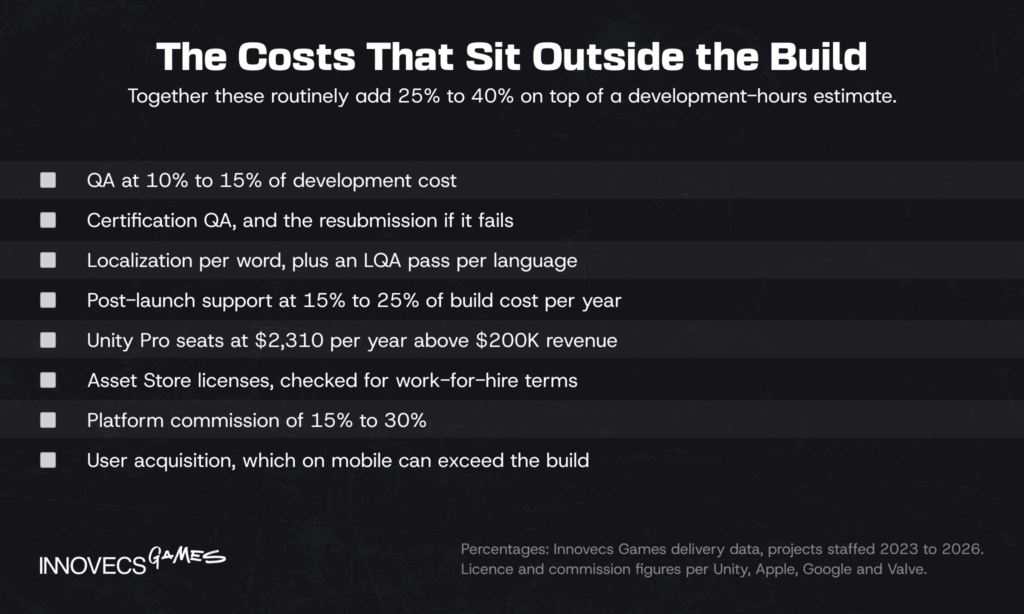
The engine license is the line item everyone budgets for and almost nobody gets wrong. The rest of this section is where the misses live, and they’re rarely small: across the projects we’ve scoped, the costs below routinely add 25% to 40% on top of a build estimate that only counted development hours.
Unity Licensing and Asset Store Purchases
Unity’s licensing is a separate line from your development cost, and it’s cheap by comparison. Unity Personal stays free below $200,000 in revenue or funding over the prior twelve months. Above that, Unity Pro is required. The listed price is $2,310 per seat per year, though Unity announced a 5% increase on Pro and Enterprise applying at renewals from January 12, 2026, so check the renewal quote rather than the pricing page. Above $25 million in annual revenue you’re on Enterprise, which is quoted rather than listed. Unity also confirmed that Pro, Enterprise, and Industry plans on 6.0 LTS stop including Havok Physics from version 6.3, which is the kind of change worth checking against your physics stack before you plan an upgrade.
Asset Store purchases are the smaller but stranger line. A $60 asset that saves two weeks is the best money in your budget. The trap is licensing terms: some assets are per-seat, some restrict use in a work-for-hire context, and buying an asset that your client’s legal team later rejects means rebuilding the feature at full cost. Check the license before the sprint, not after.
QA, Localization, and Post-Launch Support
QA typically runs 10% to 15% of development cost for a single-platform title and higher with console certification in scope, where a failed submission costs both the resubmission cycle and the slot in your release calendar. It is not a cheap discipline to staff either: BLS puts the median wage for QA analysts and testers at $104,300, inside the same occupational group as developers and on the same 10% growth track. Localization is priced per word for text and per hour for LQA, and the LQA half is the part teams forget: every language needs a pass on truncated strings, layout breaks, and cultural review. Post-launch support is the largest of the three. A live title runs 15% to 25% of build cost annually for content, backend, and community, and that spend starts the week you ship, not the quarter after.
Store Fees and Marketing
Platform cuts change what your revenue model has to clear, and 2026 has been an unusually busy year for changes. Apple takes 30% on paid apps and in-app purchases, or 15% under the Small Business Program if your proceeds were below $1 million in the prior calendar year. Google restructured entirely: from June 30, 2026 in the US, UK, and EEA, the service fee separates from a 5% billing fee, with auto-renewing subscriptions at 10% plus billing and other transactions at 20% for new installs and 25% for existing ones. Steam charges $100 per title through Steam Direct, recouped once the game clears $1,000 in revenue, and Valve’s standard share is 30%, stepping down at high lifetime revenue per title under the terms of its distribution agreement.
Marketing is the line that dwarfs all of them on mobile. A user acquisition budget for a casual title regularly matches or exceeds the entire development cost, and no amount of engine efficiency changes that arithmetic.
Change Orders and a Moving Scope
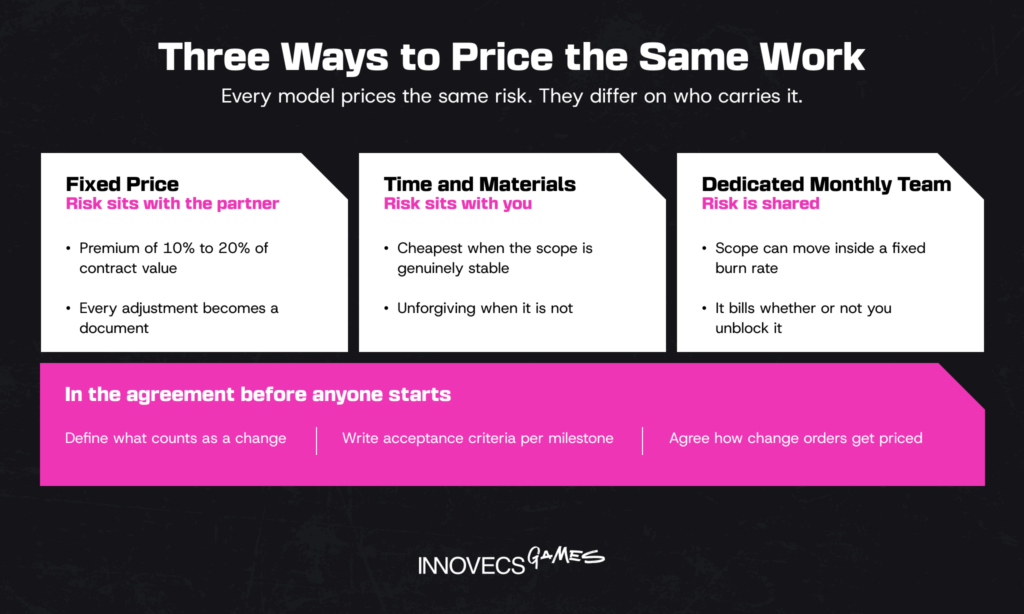
The overrun most studios actually experience isn’t a rate surprise. It’s a scope argument in month five that nobody wrote down in month one. How the contract prices that risk decides who pays for it.
Fixed price moves the risk to the partner, and the partner charges for it: expect a premium of roughly 10% to 20% of contract value, more when the spec is thin. Time and materials is cheaper when scope is genuinely stable and brutal when it isn’t. A dedicated monthly team sits in between and is where most long engagements land, because scope can move inside a fixed burn rate. Its honest downside: the team bills whether or not your side unblocks them, so a week lost waiting on your art director costs you the same as a week of production.
Whatever the model, three things belong in the agreement before anyone starts. Define what counts as a change, because almost every dispute we’ve seen was about whether something was in scope rather than about the rate. Write acceptance criteria per milestone while the work is still hypothetical and both sides are still reasonable. And agree how change orders get priced, so a mid-project request becomes a number in two days instead of a negotiation in two weeks. None of this is glamorous. It is the difference between a fixed budget that holds and one that quietly doesn’t.
Technical Debt and the Work Nobody Sees
Every studio we work with has strong artists. A lot of them have thin technical art, and that gap has a price with a delay on it. Memory budgets, draw call counts, addressables and asset bundle strategy, shader variant counts, LOD discipline, build times: none of it shows in a build review, all of it decides what the game costs to finish.
The visible always beats the invisible in a prioritization meeting, which isn’t a process failure so much as an incentive problem. The bill arrives later. A performance pass run late in production costs two to four times the same work done during it, because by then you’re operating on systems that already shipped to a soft launch, with content built on top of the assumptions you now need to change.
Build time is the clearest example, and the easiest to check tomorrow. A project where a full build takes forty minutes instead of eight is costing a fifteen-person team something like twenty developer-hours a day at three builds each, which is close to three full-time engineers you’re paying and not receiving. Nobody ever files that as a budget line. Our position is to fund technical art from month one at roughly 8% to 12% of engineering spend, and to treat it as a fixed cost rather than a rescue, because the rescue version is the expensive one and it always arrives when you have the least room.
How to Reduce Your Unity Development Budget Without Cutting Quality
Most budget savings come from decisions made before production starts, not from cutting corners during it. Three tactics account for the bulk of what we’ve seen work across client projects, and none of them involves hiring cheaper people.
Prototype Before Full Production
Unity’s report found 67% of developers spending three months or less in prototyping, and that discipline is where the money is. A six-week prototype that answers whether the core loop holds costs perhaps 5% of a full build and prevents the most expensive outcome in game development: eighteen months of production on a game nobody wants to play twice. Keep the prototype ugly on purpose. Grey boxes and placeholder art keep the team honest about whether the mechanic is working, they stop anyone falling in love with a direction before it’s earned, and they make the cancel decision cheap enough that somebody is willing to make it. The prototype that gets cancelled is the cheapest thing you’ll build all year.
Reuse Assets and Templates
There’s no prize for building your own inventory system. Marketplace assets, internal template projects, and reusable systems from previous titles cover a large share of what a new project needs: character controllers, save and settings frameworks, UI kits, localization pipelines, analytics wrappers. The discipline is knowing where reuse stops. Anything that touches your game’s identity, the core loop, the feel of movement, the art direction, gets built. Everything else is plumbing, and plumbing should be bought or inherited.
Choose the Right Engagement Model
Matching the model to the shape of the work is worth more than negotiating the rate. A three-month port is a freelance or fixed-scope job. An eighteen-month production is a dedicated team. A capability gap on a project you’re already running is co-development. Studios lose money mostly by mismatching: hiring full-time for temporary needs, or trying to run a two-year build on contractors who rotate off every quarter. Get the model right and a 10% rate difference stops mattering.
How AI Is Changing Unity Game Development Budgets
The data on this points in two directions at once, and any article claiming otherwise is selling something. Unity’s 2026 report has 62% of developers using AI for coding tasks and 44% for writing and narrative, with 73% citing efficiency gains. Unity’s own telemetry puts median project development time down 77% between January 2022 and December 2025. GDC’s survey, run across a broader population, has 36% using AI tools at all, 52% saying generative AI has a negative effect on the industry, up from 30% a year earlier, and 59% of programmers holding unfavorable views.
The budget effect is real but narrower than the headlines. AI coding assistants measurably speed up boilerplate: editor tooling, data plumbing, test scaffolding, shader variants you’d otherwise write by hand. Procedural and generative asset tools shorten the distance from concept to a usable placeholder, which compresses prototyping. Automated QA catches regression classes cheaply. Half the developers Unity surveyed now run MCP servers, 90% of them wired into the engine or editor. That’s the plumbing that turns an assistant from a chat window into something that can read the actual project. Together those cut perhaps 10% to 20% off engineering hours on a typical Unity project, concentrated in the early and middle phases.
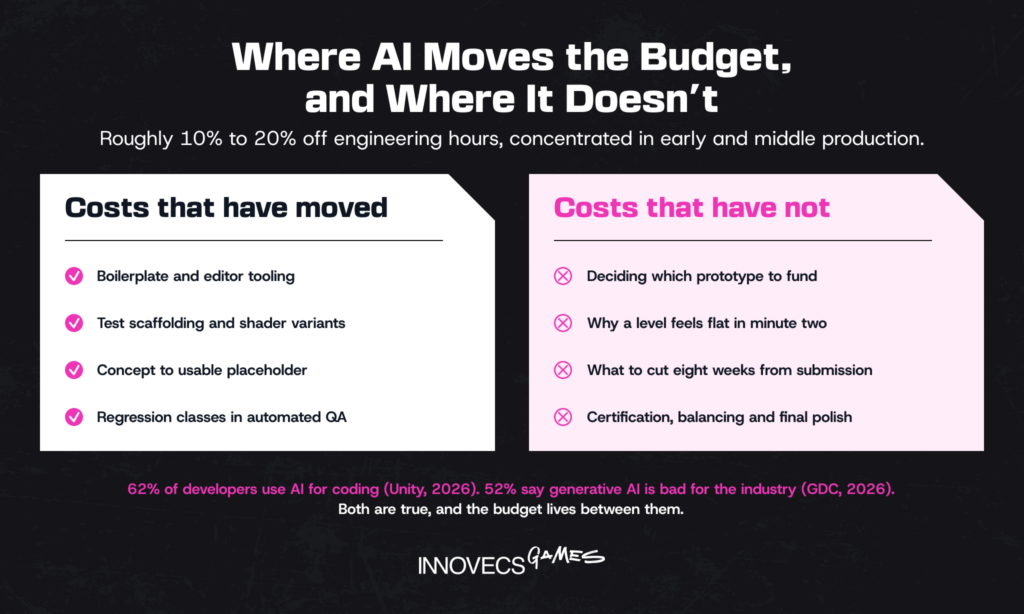
Where it hasn’t moved is anything requiring judgment. Nobody has automated deciding which of three prototypes to fund, why a level feels flat in its second minute, or what to cut when you’re eight weeks from submission. The US Bureau of Labor Statistics projects software developers growing 10% from 2025 to 2035. Over the same decade, special effects artists and animators sit at zero growth, with BLS explicitly naming AI as a reason demand may soften. That divergence is the clearest signal available about which costs are falling.
Our position, for what it’s worth: the price of a first draft has dropped close to zero and the price of judgment hasn’t moved at all. Budget accordingly. Studios that cut senior headcount because AI made juniors faster tend to discover the gap around the first milestone that requires somebody to say no.
How Innovecs Games’ Unity Game Development Services Help You Control Cost
Predictable cost comes from two things: a team that’s already assembled, and a scope somebody senior has stress-tested before the contract is signed. Innovecs Games has delivered 300+ games over more than a decade, with 200+ developers and artists across the US, UK, EU, Israel, and Ukraine, and a place on IAOP’s Global Outsourcing 100. A Unity team comes off that bench in weeks.
How that becomes a number: most engagements here start as one workstream with a defined edge, priced off a paid pilot on real backlog rather than off a proposal document, with acceptance criteria written per milestone before anyone opens the editor. A Unity game development company earns its keep on that unglamorous half of the work, and we would rather argue about scope boundaries in week one than invoice for them in month five. We are also not the cheapest bid you will receive, and we lose the ones decided on rate alone. Shipped Unity titles are in our portfolio; if the engine choice is still open, our Unity vs Unreal comparison covers the cost implications of each.
FAQ
How much does it cost to develop a game in Unity?
Between roughly $30,000 and $3 million, depending almost entirely on scope. A hyper-casual mobile title with two people and a three-month schedule sits at the bottom; a live-service game with server infrastructure and an ongoing content pipeline sits at the top and keeps spending after launch. Most commercial projects we scope land between $150,000 and $800,000. The engine license is a negligible part of any of those figures.
What is the average cost of a mobile Unity game?
Casual and hyper-casual mobile titles typically run $30,000 to $120,000 for a full production cycle with a team of two to five. Mid-core mobile games with meta progression, live events, and social features start around $250,000 and climb from there. Neither figure includes user acquisition, which on mobile frequently exceeds the entire development budget and should be planned as a separate line from day one.
Does Unity charge to use its engine?
Not below $200,000 in revenue or funding over the prior twelve months, where Unity Personal is free. Above that threshold Unity Pro is required, listed at $2,310 per seat per year with a 5% increase applying at renewals from January 12, 2026. Studios above $25 million in annual revenue move to custom-quoted Enterprise terms. The Runtime Fee announced in 2023 was cancelled in 2024, so licensing is back to straightforward per-seat subscriptions.
How much do Unity developers charge per hour?
Commercial rates run about $20 an hour for a junior in South Asia to $170 for a senior in the US. Eastern Europe and Ukraine sit at $45 to $65 for mid-level and $65 to $95 for senior, which is where most Western studios outsourcing Unity work end up. Freelance specialists in scarce disciplines like netcode or shader work bill above their regional band, sometimes by 20%.
Is outsourcing Unity game development cheaper than an in-house team?
Usually, though the saving is smaller than the rate gap suggests. An in-house developer costs 25% to 35% above base salary once taxes, benefits, hardware, and software are counted, plus three to five months of hiring time during which the milestone slips. Outsourcing removes both. What it doesn’t remove is management: you still need somebody senior on your side owning acceptance criteria, and a partner chosen on price alone will cost you the difference in rework.
How long does it take to build a Unity game, and how does that affect cost?
Two to four months for hyper-casual, four to nine for a polished 2D title, nine to eighteen for a 3D action game, and twelve to twenty-four for a multiplayer or live-service build. Because cost is roughly team size times rate times months, a schedule slip is a budget overrun with a different name. Fixed-team projects that run two months long cost two months of full burn, which is why scope discipline in preproduction does more for a budget than any negotiation later on.
What hidden costs should I plan for in a Unity game development budget?
QA at 10% to 15% of development, higher with console certification. Localization, including the LQA pass most teams forget. Post-launch support at 15% to 25% of build cost per year for a live title. Platform cuts of 15% to 30%. Asset Store licenses with terms that may not permit work-for-hire use. Together these routinely add 25% to 40% on top of a development-hours-only estimate.
How much does a 3D Unity game cost compared to a 2D game?
Roughly three to five times more at comparable polish. The gap is art volume: 3D assets need modeling, texturing, rigging, LODs, and technical art work to hold a frame budget, and that pipeline accounts for 45% to 60% of a 3D project’s spend. A 2D title with the same design ambition can put more of its content in the hands of designers rather than a specialist art pipeline, which is why small teams get further in 2D.
How is AI reducing the cost of Unity game development?
Mainly in engineering hours, by roughly 10% to 20% on a typical project. AI assistants handle boilerplate, editor tooling, test scaffolding, and shader variants faster than a person writes them, and 62% of developers in Unity’s 2026 report use them for coding. Generative tools shorten the concept-to-placeholder loop, which compresses prototyping. The savings concentrate in early and middle production; late-stage work like balancing, certification, and polish has barely moved.
Can AI tools replace parts of a Unity development team to cut costs?
Parts, not roles. AI has absorbed a meaningful share of the routine output that juniors used to produce, which is exactly why the BLS projects zero growth for animators through 2035 while software developers grow 10%. What it hasn’t replaced is the judgment that decides what to build, what to cut, and when a build is shippable. Studios that trim senior headcount on the assumption that tooling covers the gap usually meet that assumption again at the first milestone review.
Ready to Plan Your Unity Game Development Budget? Let’s Talk
Tell us the gap and the date it has to close by. We’ll come back with a team composition, a monthly number, and a four to six week pilot you can walk away from. One call is usually enough to know whether the Unity game development cost you’re budgeting for is the real one.