How Much Does Mobile Game Development Cost in 2026?
What each tier actually costs, where the money goes phase by phase, and what shipped titles cost the studios that published their numbers.
InnerSloth built Among Us for under $50,000. miHoYo spent $100 million on Genshin Impact and now spends roughly twice that again every year keeping it running. Same store, same two operating systems, a gap of about two thousand times, and nearly all of it was decided before either team was fully staffed.
So how much does mobile game development cost when your project sits nowhere near either extreme? Somewhere between $50,000 and $1,000,000 for most commercial titles in 2026, which is a useless answer until you know which decisions narrow it. Those get made early, and mostly by people who are not engineers.
What Determines the Cost of Mobile Game Development
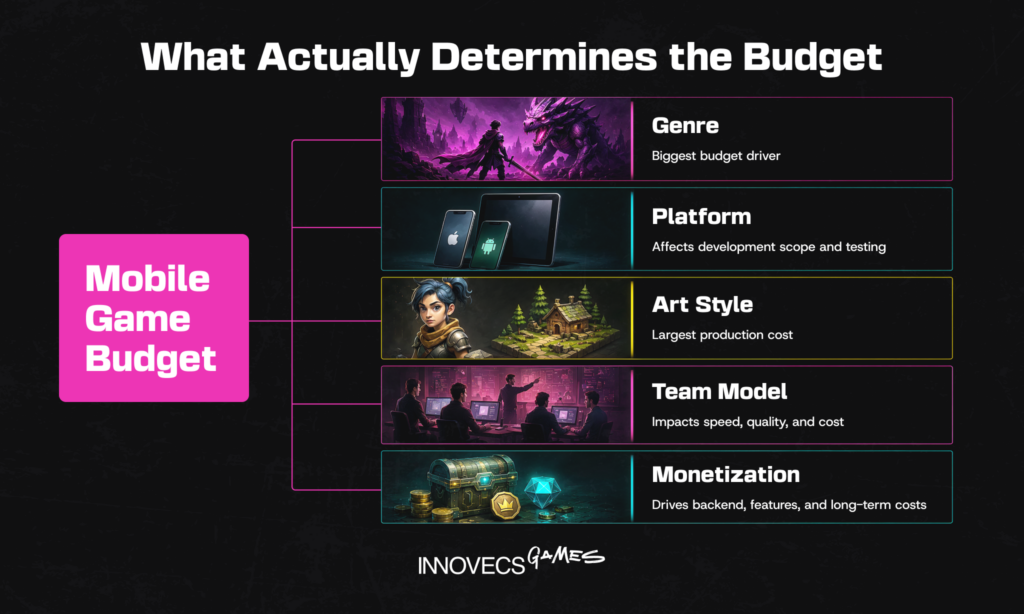
The rate card is the last thing that matters. Genre sets the budget, then platform, then art style, then how the team is assembled, then how the game intends to make money. Change one of those and the number moves. Change three and you are pricing a different project.
Put a one-mechanic hyper-casual game next to a live-service RPG and on a cost basis they have nothing in common, even shipping from the same office to the same two stores. What separates them is content volume, systems depth, and how long the thing has to keep working after release. A hyper-casual build is done when it ships. A live-service game is barely started.
Which makes this four questions rather than one: what you are building, who is building it, how the contract is shaped, and what happens once it ships. Only the first tends to get a proper answer, and the other three arrive as a guess with a decimal point on it. Our mobile game development services page covers the delivery models behind the numbers below.
Key Factors That Affect Mobile Game Development Cost
Most budgets go wrong before a line of code gets written. Genre, platform, art pipeline, and whether the game keeps running after launch: those four do the damage, and not one of them is a technical call in the narrow sense. They get settled in a room with no engineers in it, then handed to a team to price.
Game Complexity and Genre
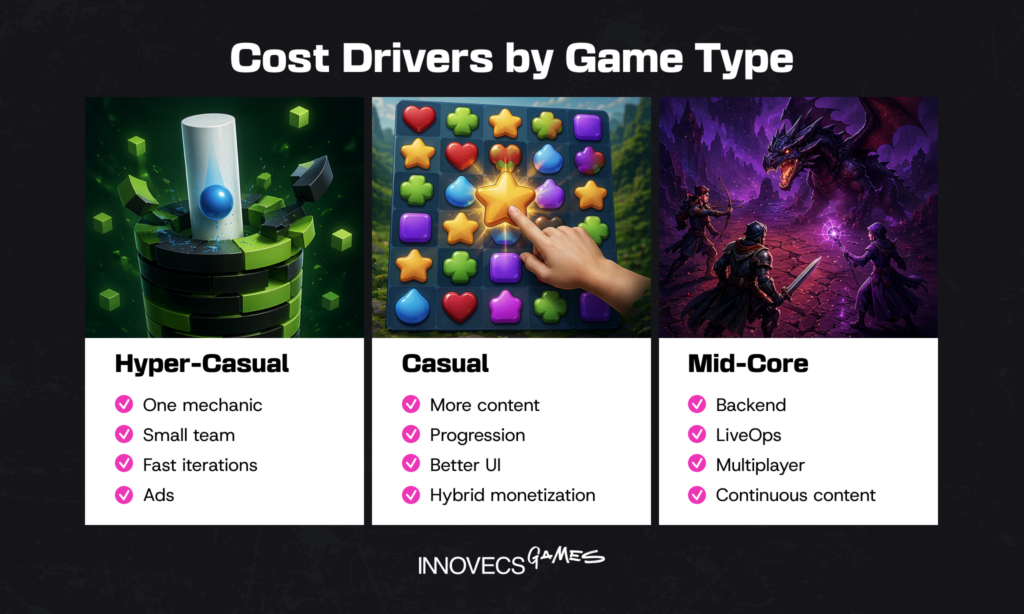
Of everything on that list, genre predicts the budget best. It decides how much content you need, how deep the systems run, and how much polish players want before they will pay you anything. Hyper-casual is cheap for exactly one reason: the game is a single mechanic. The real spend there isn’t development, it’s the iteration loop, since publishers expect CPI-testable builds fast. We have watched a publisher kill four concepts in six weeks and call it a productive quarter, which tells you what you are actually buying in that category. Casual games look simple and carry heavy content costs anyway. A live-service RPG or a 4X strategy title is somewhere else entirely, with backend and content obligations that never stop.
Platform, iOS, Android, or Cross-Platform
iOS work runs somewhat above Android on most of our projects, thanks to App Store compliance, payment integration, and Apple’s rules about what an approved application may do. A cross-platform game engine like Unity or Unreal takes out most of the duplicated work. It does not take out per-platform optimization or QA, and Android fragmentation adds a testing load a single-platform project never carries. The low-end handsets are where your performance budget really gets set, whatever the design document says.
Art Style and Visual Fidelity
Art is usually the largest line item and the hardest to scope honestly. Two games can run on the same engine with art budgets an order of magnitude apart, and the difference is mostly whether the style has rules. Stylized work with a defined rule set scales. Realism does not, because consistency across a large team is easy to enforce when the rules are written down and impossible when they live in one art director’s head. If we get one opinion in this article, it is that: pick a style a new artist can match from a document. Taste does not scale to eleven people. Pinning down concept art cost early saves revision cycles later.
Monetization and Backend Features
Free-to-play with in-app purchases needs economy design, a balancing pass, and backend a premium title simply never has to build. Add real-time multiplayer and you are also paying for dedicated servers, matchmaking, and latency management. Server costs start small, often a few hundred dollars a month. Then they climb with concurrent players, they recur every month, and they scale with success, which is the part that blindsides studios who budgeted the build and nothing else.
Mobile Game Development Cost by Project Stage
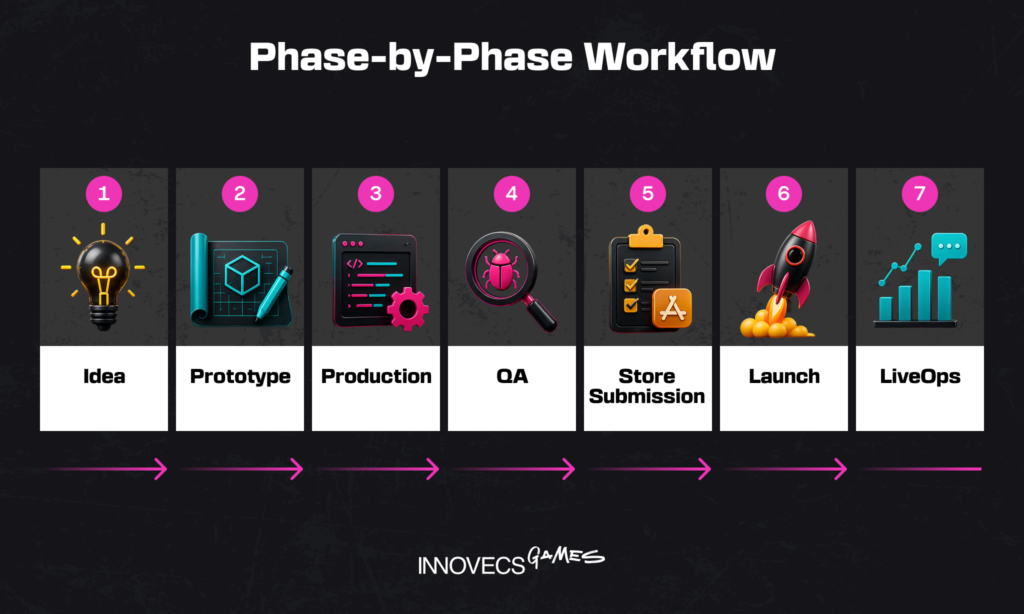
Budgets rarely fail on the rate card. They fail because nobody mapped the spend by phase before work started, so a slip in month two quietly gets paid for by cutting QA in month eight. A mobile game development cost breakdown by stage shows where the money actually goes, and the proportions hold up better across tiers than the totals would suggest.
| Phase | Hyper-casual | Casual | Mid-core |
|---|---|---|---|
| Pre-production and prototyping | 15% | 13% | 10% |
| Production: code, art, audio, UI | 60% | 57% | 57% |
| QA and platform certification | 10% | 15% | 16% |
| Production management | 15% | 15% | 17% |
| Typical build total | $11,000–$35,000 | $30,000–$150,000 | $300,000–$1,000,000 |
| Time to first store build | 4–8 weeks | 4–7 months | 12–18 months |
The QA row is the one worth arguing about. The general rule in games, as Lachance puts it, is that the bigger the project the smaller QA’s share of the total, because everything else grows faster. Mobile pushes back, because the device matrix does not shrink when your budget does. The figures above are ours and they are mobile-specific.
Pre-Production and Prototyping
Pre-production is the cheapest phase and the one most studios underinvest in. Prototyping tests the core mechanic before the full team assembles and the real spend begins, which is why compressing it to hit a start date reliably generates expensive rework in month five. Budget 10 to 15% of total project cost here. Scope gets decided in this phase. Nobody has ever thanked us for a longer pre-production while it was happening.
Production and Core Development
Most of the mobile game app development cost lands here. Programming, art production, audio, UI, systems integration, all of it running at once. Through this phase a casual title might spend $30,000 to $80,000, while a mid-core game carrying live-service infrastructure will take $150,000 to $500,000. Composition drives that spread as much as headcount. A lean casual build is a game designer, two programmers, a 2D artist, and a shared QA tester; mid-core adds 3D artists, a technical artist, a producer, and a project manager stitching the disciplines together.
QA and Testing
Writing in Game Developer, QA lead Mathieu Lachance puts the working rule at roughly 10% of the engineering budget on a mid-sized project, rising toward 20% on indie and B-tier titles where teams are small and roles blur. His own worked example came in at 22.3% of a $278,000 dev-and-QA budget. And QA is still the first line cut when money gets tight. Exactly backwards. Fragmentation is what makes mobile QA harder than console or PC: an Android build wants dozens of handsets across OS versions, the failures cluster on the cheap devices nobody on the team owns, and store certification adds compliance testing on top of all of it.
Post-Launch Support and Live-Ops
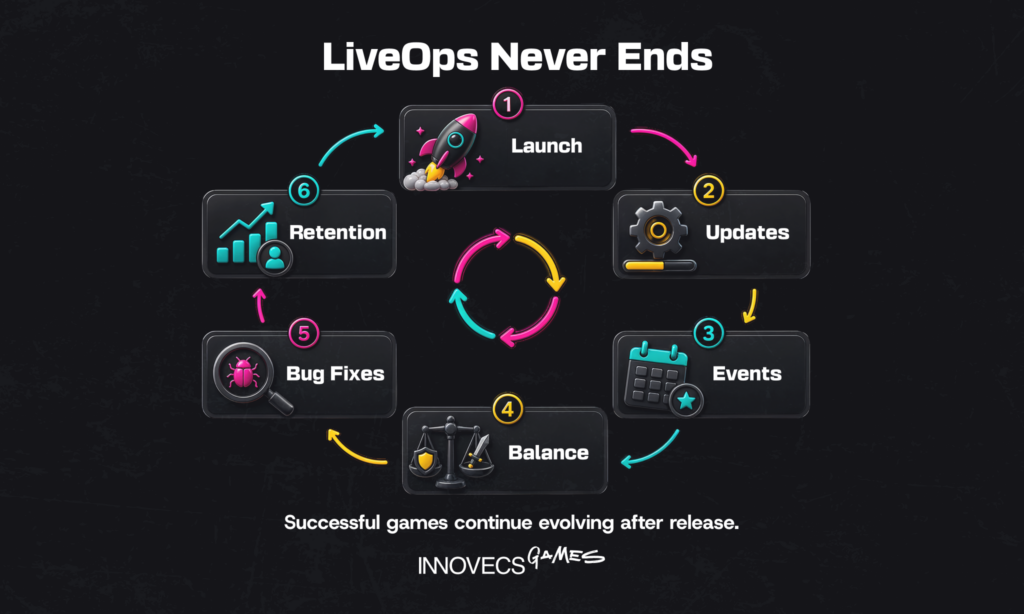
For any game meant to hold an audience, post-launch isn’t optional. Content updates, seasonal events, balance patches, bug fixes: it all feeds player retention, and it all belongs in the budget as maintenance cost at roughly 20% of initial development spend a year. Server infrastructure scales with the player base, so success raises this line rather than lowering it, which is not how anyone’s spreadsheet is built the first time.
How Much Does It Cost by Game Type?
Game type sets the floor. Features move it from there, which is why the fastest way to sanity-check a quote is to find your tier first and argue about the deltas second. Everything below assumes the same three things: a dedicated team in Eastern Europe at $50 to $100 an hour, cross-platform Unity, iOS and Android at launch. Change any of them and every figure changes with it.
| Game type | Build cost | Timeline | Core team | Typical monetization |
|---|---|---|---|---|
| Hyper-casual MVP | $4,000–$12,000 | 4 weeks | 2–3 | Ads only |
| Hyper-casual, production-ready | $15,000–$35,000 | 6–10 weeks | 3–4 | Ads, occasional IAP |
| Casual with progression | $30,000–$150,000 | 4–7 months | 4–7 | Hybrid ads and IAP |
| Puzzle with light live-ops | $80,000–$250,000 | 6–10 months | 6–10 | IAP led |
| Mid-core RPG or strategy | $300,000–$1,000,000+ | 12–18 months | 12–30 | IAP, battle pass, events |
| AAA mobile, live-operated | $3M–$20M+ | 24–48 months | 60–700+ | Gacha, IAP, seasonal |
Most disagreements we have with a client’s budget happen on the boundary between two of those rows, not inside one of them.
Hyper-Casual and Casual Games
Hyper-casual sits at the bottom. One core mechanic, minimal art, ads, and a team small enough to ship in weeks rather than quarters. Expect $4,000 to $12,000 for a playable MVP inside about four weeks, and $15,000 to $35,000 for something production-ready. Casual is where the first surprise usually lands. The UI has to be cleaner, the content deeper, the monetization more deliberate, and the number moves to $30,000 to $150,000 depending on feature set and art quality.
Broken into hours rather than quoted as a lump sum, a four-week hyper-casual MVP looks like this.
| Workstream | Hours | Blended rate | Cost |
|---|---|---|---|
| Concept and mechanic prototype | 50 | $60 | $3,000 |
| Gameplay implementation | 80 | $55 | $4,400 |
| Art, UI, and juice pass | 40 | $45 | $1,800 |
| Ad network and analytics SDK integration | 20 | $60 | $1,200 |
| QA and store build | 18 | $35 | $630 |
| Total | 208 | $11,030 |
Two hundred hours is not a lot of game. That is the point of the category, and it is also why the build cost is the small half of a hyper-casual budget.
Mid-Core and Puzzle Games
Mid-core is where the number starts climbing seriously. RPGs, strategy titles, and puzzle games carrying progression and live-ops behind them typically run $300,000 to $1,000,000 and up, and backend is what pushes them there. Matchmaking, persistent player data, economy systems: none of it shows on the surface of the game, all of it shows on the invoice. Puzzle game development cost lands lower when progression is light, often $80,000 to $250,000, and leaves that band the moment real-time social features arrive. An indie mobile game on a tight scope undercuts everything above, minus whatever live-ops would have given it.
A casual-to-lower-mid-core puzzle build over five months prices out roughly like this.
| Workstream | Hours | Blended rate | Cost |
|---|---|---|---|
| Pre-production and playable prototype | 260 | $60 | $15,600 |
| Core gameplay programming | 620 | $65 | $40,300 |
| Backend, economy, live-ops hooks | 180 | $70 | $12,600 |
| 2D art, UI, animation | 480 | $45 | $21,600 |
| Audio and SFX | 60 | $50 | $3,000 |
| QA across iOS and Android devices | 240 | $35 | $8,400 |
| Production and project management | 200 | $55 | $11,000 |
| Store submission and compliance | 40 | $55 | $2,200 |
| Total | 2,080 | $114,700 |
Strip the backend and live-ops hooks out and $12,600 comes off directly, closer to $20,000 once the UI and QA work they drag along goes with them. That is why the same-looking puzzle game quotes at $95,000 from one studio and $115,000 from another. The difference isn’t the rate. It’s whether the estimate assumed you would want events later.
AAA and Premium Mobile Games
The most expensive mobile game development cost sits here. A large, live-operated AAA mobile game runs $3 million to $20 million and beyond, with titles like Genshin Impact well outside even that. What almost nobody at this scale does is start from zero, which puts most of the money somewhere the tier table doesn’t reach. For the wider picture, our cost to make a video game guide goes into detail.
Porting and Co-Development on an Existing Title
Bringing a shipped PC or console title to phones, adding a platform to something already live, joining a production that is three months behind: this is a large share of commissioned mobile work and none of it prices like a new build.
The reason is that you are not paying for design. You are paying for platform engineering: input rework, UI reflow for handheld, performance passes on hardware two generations behind the original target, store compliance, and a build pipeline that produces both targets from one branch. A straightforward port of a small premium title runs a fraction of building the same game twice. A port that also has to add live-ops and free-to-play monetization is a new project wearing the old game’s art, and it should be budgeted as one.
Co-development prices per discipline rather than per project. A studio short on technical art buys technical art. The estimate looks like a team roster and a duration instead of a feature list, which is also why it is harder to pad.
What Shipped Games Actually Cost
Ranges are useful for planning and useless for arguing with a board. Very few studios publish what a title actually cost them. The four below did.
| Title | Studio | Disclosed cost | Context |
|---|---|---|---|
| Angry Birds | Rovio | About €100,000, roughly $140,000 | Built in 2009 by a small team, after 51 games that didn’t land. Read the figure in 2009 money |
| Among Us | InnerSloth | Under $50,000 | Three-person studio, 2018. Went on to pass $100 million in revenue two years after release |
| Monument Valley | ustwo games | $852,000 over 55 weeks, plus $549,000 over 29 weeks for the Forgotten Shores expansion | Premium title, published by ustwo itself in a public post-mortem |
| Genshin Impact | miHoYo | $100 million to build, then about $200 million a year to operate | Stated by miHoYo president Cai Haoyu in 2021. Over 700 staff on the game |
Three caveats before anyone anchors on these. They skew old, because studios stopped publishing budgets once mobile got competitive. They are survivors, and nobody publishes the budget of a game that failed, which is where the honest average lives. And Angry Birds at $140,000 in 2009 would not buy the same game today, since the polish bar, the SDK integrations, and the device matrix have all moved. Note also that the most recent disclosure on that list is five years old. Draw your own conclusion about what the industry is comfortable sharing.
In-House vs Outsourcing vs Dedicated Team: Cost Comparison
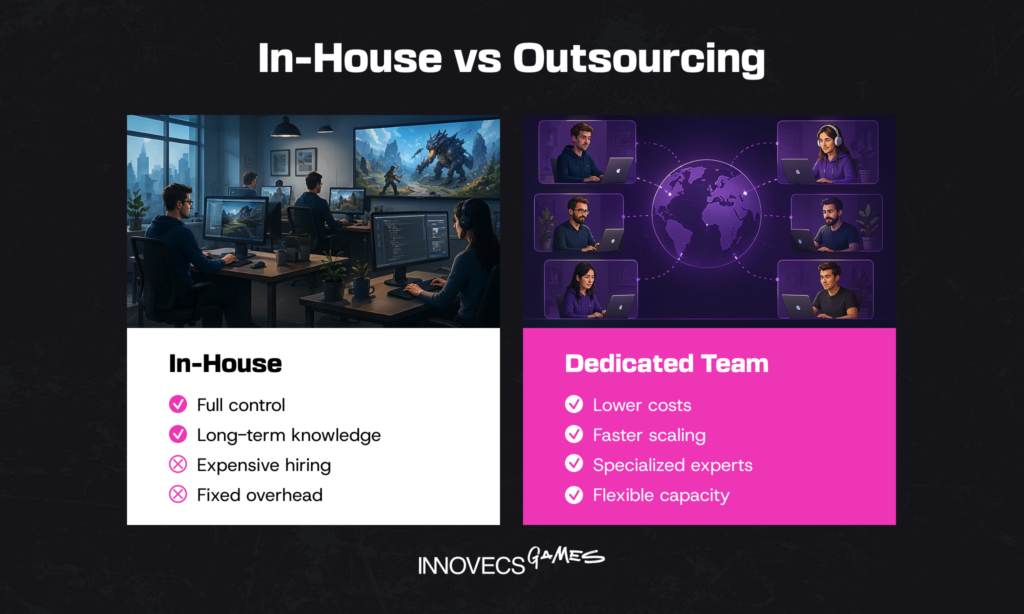
Everything above prices what you are building. This prices who builds it, and the engagement model moves the total about as much as location does. It moves risk more. An in-house team is a fixed cost that survives a cancelled project; a dedicated team is a variable one that doesn’t, which is an advantage right up until the project is going well and you want the knowledge to stay in the building.
The tell is what sits on the roadmap after this title. Studios shipping continuously build in-house and outsource the peaks; studios shipping one thing at a time do the reverse.
| Model | Typical hourly range | Best for | Trade-off |
|---|---|---|---|
| In-house team (US) | $62–$150 | Long roadmaps, permanent product | Hiring lead time, fixed overhead |
| Freelance developers | $30–$90 | Filling one specific gap | Coordination lands on you |
| Staff augmentation | $40–$90 | Reinforcing an existing team | Little shared production context |
| Dedicated team (Eastern Europe) | $50–$100 | Full-cycle or co-development builds | Needs scope defined upfront |
| Offshore studio (Asia) | $25–$50 | High-volume art and QA | More management overhead |
Read the trade-off column first. It is the part of that table people skip and then rediscover in month four.
In-House Development
Full control, a stable team, institutional knowledge that compounds. The cost is real. The US Bureau of Labor Statistics put the median software developer wage at $133,080 in May 2024, top decile above $211,450, and games sit inside that distribution. On a contract basis, across the teams we have staffed, a mid-level US game programmer runs $62 to $90 an hour and seniors $120 to $150. Add benefits, equipment, office space, and the months it takes to close a senior hire, and the true cost sits well above the headline developer hourly rate. It works for studios with long production roadmaps. Less so for everyone else.
Freelancers and Staff Augmentation
Freelance developers are faster to engage and easier to scale down, the coordination overhead moves onto you, and quality varies more than inside a vetted dedicated team. Staff augmentation sits nearby: specialists placed into your structure rather than an external unit with its own lead. Both fill a gap. Neither is a foundation for a twelve-month production, whatever the day rate suggests.
Outsourcing and Dedicated Teams by Region
Offshore development in Asia, including India, Vietnam, and the Philippines, offers deep talent pools at $25 to $50 an hour and suits high-volume art and QA. Cheapest on paper, most management overhead in practice. Eastern Europe runs $50 to $100 with stronger specialized expertise and a working day overlapping European and North American schedules, while nearshore Latin America lands slightly above and wins on US timezone alignment. Ukraine is worth separating out, because the pay data is public: DOU’s winter 2026 survey of 734 Ukrainian game developers put the median senior software engineer at $4,450 a month net against an industry median of $2,300. Employee pay is not a client rate, and the gap is where overhead and margin live. On our contracts Ukrainian seniors bill toward the $43 to $50 end, and game development outsourcing on a dedicated team model has come in 40 to 60% under equivalent in-house US cost.
The honest downside of our own model, since every comparison should have one: a dedicated team is cheap only while the scope holds. Hand it a brief that changes monthly and you are paying Eastern European rates for Western European churn, which is a saving nobody puts in a case study.
Fixed Price, Time and Materials, or Milestones
Two studios quoting the same scope can land 30% apart on contract shape alone, because the shape decides who carries the unknowns.
Fixed price moves all of them to the vendor, and the vendor prices that risk. On our quotes the premium runs 20 to 40% over the same work on time and materials, and what it buys is a number you can take to a board. It also turns every change request into a negotiation, which is fine on a locked scope and painful on anything exploratory.
Time and materials is cheaper per hour and leaves the risk with you, which suits pre-production, mechanics that still need R&D, and any project where the design is genuinely still moving. The wrong instrument entirely if nobody on your side is going to read the weekly burn.
Milestone contracts split the difference: fixed price per milestone, scope renegotiated between them. Most of our full-cycle work runs this way, because it gives the client an exit point every six to eight weeks and gives the team a scope that holds for the length of a sprint block.
Whichever shape you sign, set aside 10 to 20% as contingency and keep it off the team’s plan. Every project spends it. The ones that budgeted for it ship anyway.
Hidden Costs to Budget For
Every number so far prices a submittable binary. The full mobile game app development cost includes shipping it and keeping it alive, a separate and larger figure resting on five lines that rarely survive a first-draft estimate.
App Store Fees and Compliance
Apple takes 30%, or 15% under the Small Business Program for developers under $1 million in annual proceeds. Google changed shape this year, which means the figure in most cost articles is now wrong. Since June 30, in the US, UK, and EEA, Google Play separates a 10% service fee on your first $1 million of annual earnings from a 5% billing fee charged only if you use Google Play Billing, with other transactions at 20% for new installs and 25% for existing ones. Budget against your actual revenue tier, not the headline 30%. Submission is cheap: $99 a year from Apple, $25 once from Google. Review is the expensive part, because every update generates compliance QA.
Age Ratings and Regulatory Compliance
This one moved in 2026 and most budgets have not caught up. PEGI announced in March the biggest change to European age ratings in over a decade, and from June it classifies games on monetization and engagement design rather than content alone. Any game selling paid random items, meaning loot boxes, card packs, gacha, or prize wheels, gets a minimum PEGI 16. Time-limited or quantity-limited offers pull a minimum 12. Daily quests and login streaks trigger a new descriptor at 7, rising to 12 where skipping a day costs the player progress. Unrestricted chat with no blocking or reporting gets a flat 18.
The cost is not the submission fee. It is that a rating increase shrinks your addressable audience and pushes your CPI up, and that block, mute, and report functionality is engineering work nobody scoped. Germany’s USK introduced comparable categories back in 2023 and reported that roughly 30% of games submitted in 2024 triggered at least one, with about a third of those landing a higher rating as a result.
Regulation is converging from several directions at once. The UK Online Safety Act carries fines up to 10% of qualifying worldwide revenue or £18 million and overlaps almost exactly with PEGI’s communication category. The European Commission is expected to table a Digital Fairness Act proposal in the second half of 2026 that could restrict loot box mechanics in games accessible to minors. In the US, the New York attorney general has sued Valve on the theory that loot boxes constitute illegal gambling. Design the economy before checking any of this and you may be repricing the game in year two.
Engine, Tooling, and Middleware Licenses
Every estimate above assumes the toolchain is already paid for, which for a new studio it isn’t. Unity Personal is free up to $200,000 in combined annual revenue and funding. Above that, Unity Pro is mandatory at $2,310 per seat per year from January 12, 2026, or $210 monthly, with Unity Enterprise taking over above $25 million. Six seats is roughly $14,000 a year before anyone commits a line of code.
Unreal works the other way. Free until the title passes $1 million in lifetime gross, then 5% of gross above that threshold, dropping to 3.5% under Epic’s launch program and to nothing on Epic Games Store sales. Neither model is cheaper in the abstract. Seats cost money you have; royalties cost money you might earn, which is a real distinction when you are the one funding the build.
Then there is the stack around the engine: attribution, ad mediation, analytics, crash reporting, and a backend service, each with its own monthly bill. On a live casual title they add up to a line item rather than a rounding error.
Marketing and User Acquisition
This is the line most pre-launch budgets undercount, and by the widest margin. Cost per install depends almost entirely on where you buy: Statista put global casual CPI at $1.41 on iOS against $0.14 on Android over the year to February 2025, averages carrying a lot of cheap emerging-market traffic that will never monetize like a US install. Buy tier-one users and casual CPI runs several dollars, mid-core more again. Across our clients’ launches, user acquisition in competitive categories has run 30 to 100% of development spend, so a $150,000 build needs another $45,000 to $150,000 to find an audience. Fund the build and not the launch and you get a finished game with no players.
Ongoing Maintenance and Live-Ops
Roughly 20% of initial development spend a year, covering bug fixes, OS compatibility work as iOS and Android ship new versions, balance passes, and the seasonal game updates that hold an audience. Hosting runs $500 to $2,000 a month on modest traffic. Viral traffic pushes it past $20,000, and that bill arrives the same week as the good news.
How AI Is Changing Mobile Game Development Costs
Every budget conversation in 2026 now includes a question about what AI takes off the number, usually asked with an expectation already attached. The survey data does not support the expectation.
GDC’s 2026 State of the Game Industry, surveying over 2,300 professionals, found 36% using generative tools at work, dropping to 30% inside game studios against 58% at publishing and marketing companies. The uses cluster at the cheap end: research and brainstorming at 81%, code assistance at 47%, prototyping at 35%.
Sentiment moved the other way. In the same survey 52% called generative AI’s impact negative, up from 30% a year earlier and 18% before that, with the harshest views from visual and technical art at 64%. Worth weighing, since art is the line item AI is most often claimed to shrink.
Where we have seen it move a number is the volume end: background variation, regression passes, boilerplate implementation. It does not touch game feel, economy balancing, retention design, or creative direction, and those decide whether the game earns its budget back. The clearest saving we can attribute to AI so far is on the parts of the job nobody enjoyed anyway. Take it. Just don’t spend it twice.
How Innovecs Games Helps You Build a Mobile Game Within Budget
Most budget surprises trace back to scope that was never defined tightly enough before production started. Our mobile game development services cover iOS, Android, and cross-platform builds across hyper-casual, casual, and mid-core titles, under dedicated team, co-development, or full-cycle models.
For studios still working out numbers, we go through game type, platform, art style, and team model and come back with a range plus the assumptions behind it, in the same line-item form as the estimates above. Where a figure depends on something undecided, we say so rather than averaging it away.
Send us the concept and the ship date you are working toward. We’ll come back with a phased estimate and the three decisions that would move it most.
FAQ
How much does it cost to develop a mobile game in 2026?
Simple 2D hyper-casual titles start around $15,000 to $35,000, casual games with progression run $30,000 to $150,000, mid-core titles with live-service infrastructure $300,000 to $1,000,000. AAA mobile productions begin at $3 million. Where a project sits depends on scope decisions made in pre-production, not the headline rate of whoever builds it.
What factors affect the cost of mobile game development?
Genre and complexity set the floor. Platform, art style, monetization model, and backend requirements adjust it, while team location and engagement model determine what you pay for a given output level. Hidden costs, meaning QA, app store fees, user acquisition, and maintenance, typically add 30 to 50% on top when unplanned.
How much does a hyper-casual mobile game cost to build?
A playable MVP runs $4,000 to $12,000 and takes roughly four weeks, or about 200 hours of work across concept, implementation, art, SDK integration, and a store build. Production-ready, the range is $15,000 to $35,000. The build cost is rarely the main expense here, though. User acquisition is, and the iteration loop toward a CPI-testable build is where the time goes.
How much does it cost to develop a mid-core or puzzle mobile game?
Mid-core RPGs and strategy titles with live-ops behind them typically run $300,000 to $1,000,000 and up. Puzzle titles with light progression come in lower, often $80,000 to $250,000, since content repeats and the systems layer is thinner. Add matchmaking or a live economy and a puzzle build costs like a mid-core one. Backend depth is the variable to watch, not visual complexity.
What is the cost difference between an in-house team and outsourcing?
In-house engineering in the US runs $62 to $150 an hour before benefits, equipment, and hiring time, while Eastern Europe runs $50 to $100 with comparable senior depth, and a dedicated team model typically saves 40 to 60% against the equivalent build. That saving holds only when scope is defined and the partner properly vetted. Underspecified work outsourced cheaply gets expensive on the second pass.
How much do mobile game developers charge per hour by region?
North America sits highest at $62 to $150 depending on seniority, Western Europe $60 to $110, Eastern Europe $50 to $100, with Ukrainian seniors toward the $43 to $50 end. Asia is lowest at $25 to $50, best suited to high-volume art and QA rather than systems ownership. Latin America sits just above Eastern Europe and buys US timezone overlap.
What hidden costs should I budget for after launch?
Four line items catch teams out: platform commission, which since June 2026 means 30% or 15% from Apple and a split 10% service plus 5% billing fee from Google in the US, UK, and EEA; server costs that scale with your player count; user acquisition at 30 to 100% of development spend; and maintenance at roughly 20% of the initial budget per year. OS-update compliance is the fifth, and it never appears on a launch plan.
How does development timeline affect the total cost?
Longer isn’t automatically more expensive. Compressed usually is. Squeezing a nine-month build into six means adding people, and added people cost more than their rate once onboarding and coordination are counted. Rushed pre-production is the worse version of the same problem: it moves discovery into production, where changes cost several times more.
How is AI reducing mobile game development costs?
Less than the pitch decks suggest. GDC’s 2026 survey found 36% of industry professionals using generative tools, dropping to 30% inside game studios, mostly for research, code assistance, and prototyping rather than shipped assets. Where we have seen real savings is volume work: background variation, regression passes, boilerplate. Judgment stays expensive: game feel, economy design, creative direction.
Can AI tools replace human developers in mobile game production?
Not across a production, though in narrow tasks it has reduced headcount: high-volume background art, regression testing, boilerplate code. The work that decides whether a mobile game succeeds, meaning retention design, performance optimization, and live-ops calls, isn’t being automated by anything shipping today. AI has made developers faster, not optional.
Ready to Plan Your Mobile Game’s Budget? Let’s Talk
Tell us the game type, the platforms, and the date you need to ship, and we’ll come back with a scoped team and a mobile game development cost range with the assumptions written out. If the brief is still moving, we’ll scope the pre-production phase first.