How to Hire a Game Development Team: A Step-by-Step Guide for 2026
Everything you need to know before you sign a contract, from defining roles to evaluating teams and choosing the right hiring model.
The games market will turn over $577.91 billion this year on Statista’s forecast, and one in four developers has been laid off inside the past two years according to GDC’s 2026 State of the Game Industry, a survey of more than 2,300 professionals. Those two numbers sit badly together until you look at how studios are actually staffing now.
The answer is smaller and more deliberate. Unity’s 2026 Game Development Report found 52% of developers deliberately choosing smaller-scale projects as their main way of reducing risk. Fewer permanent hires, tighter scopes, more of the work assembled per project rather than carried year-round. Team assembly has quietly become a recurring decision rather than a one-time act of company building.
Which raises the practical question this guide answers. Knowing how to hire a game development team in that environment means understanding which roles you genuinely need, where the people are, how to tell a real track record from a polished deck, and what each engagement model costs once the invisible overhead is counted.
What Is a Game Development Team and Why Hiring Right Matters
A game development team is the group of specialists who take a concept through production to a shipped build: design, engineering, art, audio, QA, and the production layer holding it together. That definition is the easy part. Working out which slice your project needs, and in what order, is what decides whether the schedule survives.
Composition varies more than the org charts suggest. A lean mobile project at an indie studio might run six or seven people: two programmers, a designer, an artist, part-time QA, a producer split across products. Add multiplayer, a persistent backend, and a live roadmap, and the same game genre needs three times that plus specialists who appeared nowhere in the plan. Multiplayer is no longer the exception, either. Unity found 83% of studios supporting online multiplayer and 72% treating cross-play as standard, which pulls backend work into projects that would have shipped single-player five years ago.
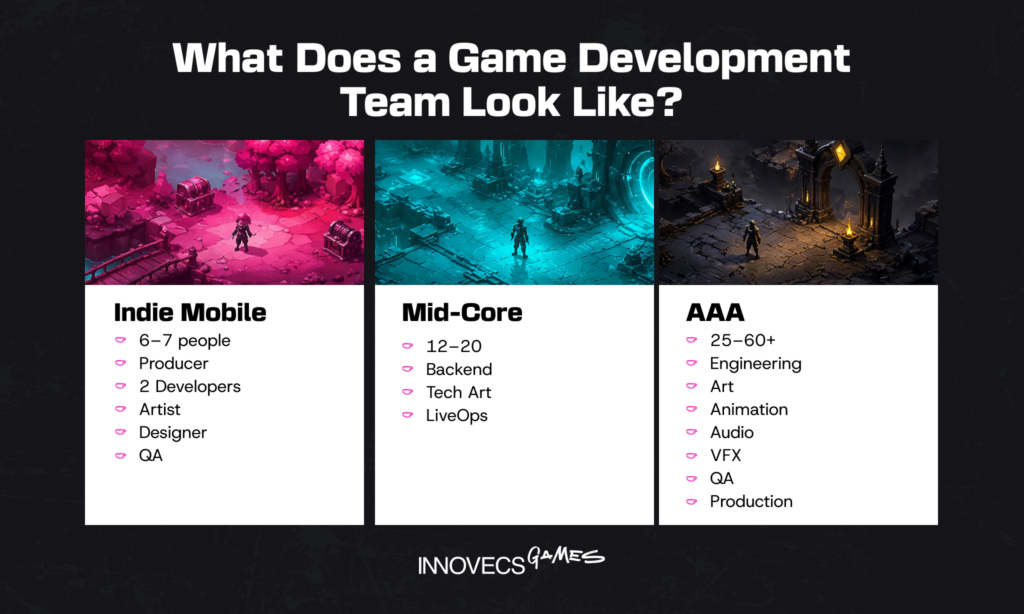
The team you assemble in the first quarter sets a ceiling on everything after it, and get it wrong and you spend the back half of production paying for the front half, usually as rework nobody budgeted. So the sensible starting point is not a job posting. It is an honest list of the disciplines the build actually requires.
Core Roles You Need on a Game Development Team
Not every project needs every discipline from day one. These show up on almost every production, and they are worth treating as separate hiring markets rather than one talent pool. US Bureau of Labor Statistics projections through 2034 have software developers, QA analysts, and testers growing 15% with about 129,200 openings a year, while special effects artists and animators grow 2% against roughly 5,000. Engineering is a competitive market you compete inside. Senior art is a narrow one you search for.
Game Designers and Producers
A game designer owns how the game works: mechanics, systems, economy, the moment-to-moment player experience. Level designers translate that into space, pacing, and encounter flow, and on anything with authored content they are a separate hire rather than a designer with spare time. The producer or project manager holds the schedule together across disciplines. Small game studios collapse these roles into one person. Larger ones do not, and the seams show fast when either is gone.
Programmers and Engineers
Game programmer roles split the moment you look past the job description. Gameplay, engine, backend, tools. Which game engine you pick decides the talent pool: C# and Unity pull from one market, C++ and Unreal Engine from another, and the two overlap less than recruiters assume. Networking is the commonly underestimated line, given how many projects now ship with sessions for groups of two to nine players. Ask for a GitHub history either way, and put a senior engineer on before the architecture is set, because decisions made in month one are cheap and the same decisions in month eight are not.
Artists and Animators
Concept artists, 2D artists, 3D artists, animators, technical artists, and on most productions a sound designer who arrives later than they should. The BLS puts the median wage for special effects artists and animators at $99,800, which surprises studios budgeting art as the cheap half of the build. If you need to hire a 2D game artist, weight pipeline experience over portfolio polish. Art is usually the largest team by headcount and it scales badly: variance across eight artists shows in the build in a way variance across two programmers does not.
QA and Testing Specialists
QA is the discipline most reliably under-resourced until fixing it costs the most. A dedicated QA tester is not there to find bugs at the end of production; the job is building the process that stops bugs compounding through it, which is a different skill and a different hire. Platform certification is specialist work, and a trial project on real content tells you more than any interview.
Once the role list is honest, the question becomes where those people actually are.
Where to Find a Game Development Team
Three channels cover almost all of it, and they trade against each other on two axes: how fast you can start, and how much vetting lands on you. Pick based on which one you have slack in.
Freelance Platforms and Marketplaces
Freelance marketplaces put a large pool of contractors in front of you within a day, useful when the gap is narrow and well defined. The cost is vetting. Volume is high, quality is uneven, and marketplaces optimize for time-to-market rather than for whether the people you hire can work together. Assembling a full remote team this way means taking on the integration work yourself.
Job Boards and Developer Communities
LinkedIn, Indeed, and games-specific communities remain the standard route for in-house hiring, and the talent there is real. The timeline is the problem. Senior hires routinely take three to five months from job description to start date, onboarding on top. If your project scope is fixed and the milestone is six months out, this channel cannot solve it alone.
Game Development Studios and Outsourcing Partners
Studios and outsourcing partners change the nature of the evaluation. You are vetting an organization now: its process, its track record, and whether the people in the sales call are the people on your project. Game development outsourcing works when the team already knows how to work together before your brief arrives, because the coordination overhead that sinks freelance arrangements is absorbed on their side. The trade-off is that you inherit their process, and that friction surfaces around milestone three.
How to Evaluate and Hire the Right Team
Sourcing gets most of the attention and causes almost none of the failures. Evaluation is where hiring decisions go wrong, usually because the questions asked are the ones a competent salesperson has already prepared for. Run the whole thing in this order and the expensive mistakes get caught early:
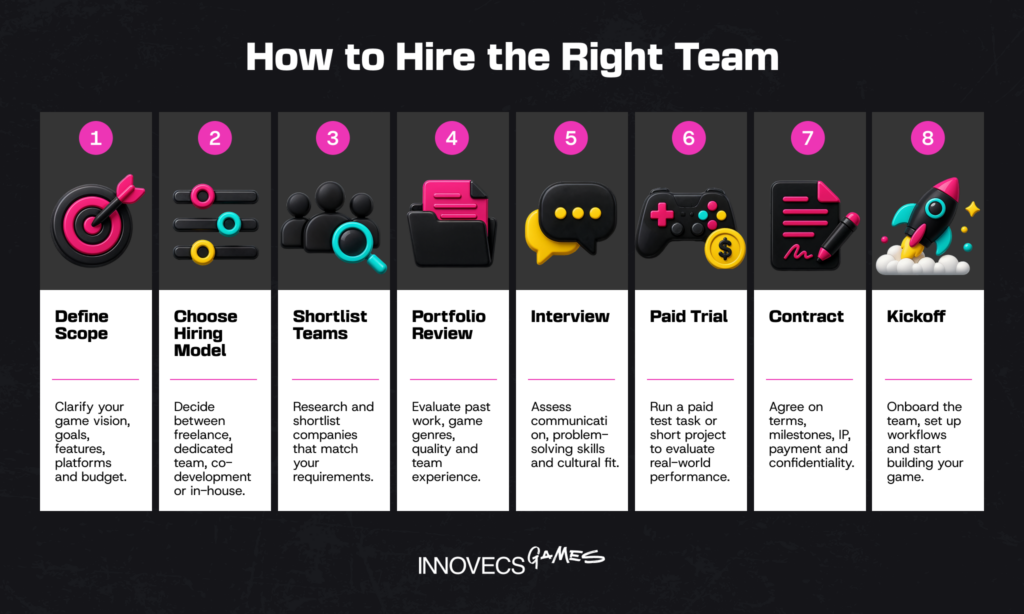
- Write the scope down. Platforms, disciplines, milestone dates, and which of those are fixed against which are negotiable.
- Pick the engagement model first. It decides your shortlist, your lead time, and your budget line, so choosing it after you meet a team you like is backwards.
- Source against that model. A studio shortlist and a freelance shortlist are different searches, run differently.
- Review portfolios for shipped work, then verify attribution on the two titles that matter most.
- Interview for behavior under pressure, not for capability.
- Run a paid trial on real content from your build, not on a made-up brief.
- Close the contract around acceptance criteria and IP, then onboard against a dated first milestone rather than a start date.
Steps four through seven carry most of the risk, so they get the rest of this section.
What to Look for in a Portfolio
Shipped titles. That filter removes more candidates than any other, because demos and early-access builds that never launched only prove somebody can start things, while one finished game that reached players and held under load tells you about the last mile, where projects die. Then push on attribution, since portfolio work is collaborative and “we made this” covers everything from owning the render pipeline to producing four icons.
Key Interview Questions to Ask
Skip the capability questions. Every studio will confirm they can do what you need, so the answers carry no information. Ask instead about a project that went sideways and what happened next, how a scope change six weeks before a milestone gets handled, who makes the call, and what gets cut. Those answers describe how a team behaves under pressure, where most of game development happens.
Red Flags to Watch For
Some of these are worth a follow-up question. Others should end the conversation:
- Vague answers to process questions. Two in a row usually means there is no process to describe.
- Reference requests deflected twice. Once is scheduling. Twice is an answer.
- A portfolio built entirely on unshipped work. Prototypes prove capability, not delivery.
- No clear decision ownership. If a team cannot say who makes which calls, neither will you when a milestone slips.
- Missing NDAs or loose IP assignment. The cheapest problem to fix now, the most expensive one later.
- Payment schedules front-loading your risk. Money out before delivery puts the pressure on the wrong side.
A studio with no answer for how it handles a missed milestone has just answered the question.
Clearing all of that tells you a team can do the work. It says nothing about what happens if they stop, which is what the paperwork is for.
What to Check in the Contract
Most disputes trace back to something that was never written down, so six clauses are worth reading closely before signing. IP assignment needs a trigger: on delivery or on payment, stated explicitly, because “work for hire” alone means different things in different jurisdictions. Source files and project tooling should transfer with the deliverable, since a studio that keeps the rig, the shader graph, or the internal tool it built on your budget has kept the expensive part. Acceptance criteria belong in the milestone schedule in writing, agreed before work starts rather than negotiated when something arrives that you did not expect. Exit terms matter more than anyone wants to discuss at signing: notice period, what happens to work in progress, and who pays for the handover. NDAs should cover platform holders and unannounced content, not just your company name. And payment should attach to accepted milestones rather than to elapsed time.
None of that is exotic, and any partner worth engaging will already have positions on all six. The reason to raise them early is that the conversation itself is diagnostic. A studio that gets uncomfortable discussing exit terms is telling you how the exit will go.
The First Thirty Days
Signing is not starting. Onboarding is where a good hire becomes a working one, and where the schedule quietly slips if nobody is watching. In week one the team needs accesses, the repository, and a build running locally on their own machines. If the build is not running by day three, the problem is usually on your side, and it is worth fixing before it gets attributed to them. Week two should produce a small piece of real work merged into the main branch, chosen precisely because it is small. Weeks three and four run the first milestone slice and the first review cycle, which is the first honest signal about velocity.
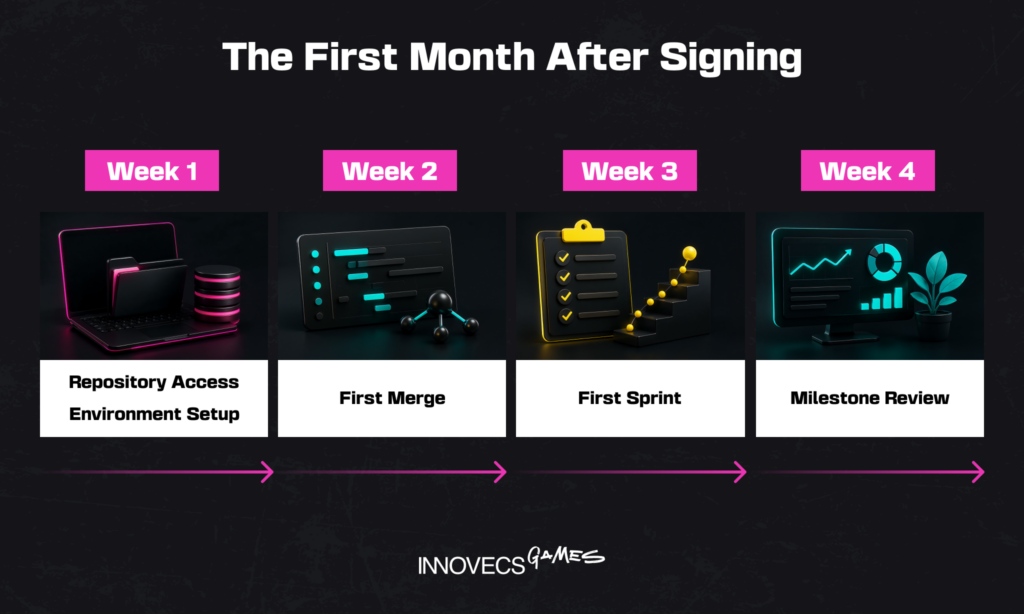
Two things are worth watching in that window. Silence is the bad sign, not questions: a team asking a lot in week one is reading the codebase, and a team asking nothing has either found it trivial or has not started. Check also that the people on the calls are the people who were named in the proposal. And plan for the first month to run slower than the quote implies, because ramp is real and pretending otherwise just moves the overrun to milestone two.
All of this assumes a decision taken further upstream: the structure you engage the team under. It sits second on the list above for a reason, and it is the one choice worth working through in detail.
Hiring Models Compared: In-House vs Freelance vs Dedicated Team vs Outsourcing
The model you choose decides your cost structure, your speed, and how much management lands on your side. None of the four wins in the abstract, and most studios that ship consistently run two or three at once.
| Model | Time to start | Management on you | Best fit | Main downside |
|---|---|---|---|---|
| In-house | 3 to 5 months per senior hire | Full | Stable roadmap, long runway | Headcount is hard to unwind |
| Freelance | Days | High | One narrow skill gap | You do the integration |
| Dedicated team | Weeks | Moderate | Defined workstream, months of runway | Needs a clear scope up front |
| Outsourcing or co-development | Weeks | Low to moderate | Full-cycle development or a whole discipline | You inherit their process |
In-House Hiring
Control, institutional knowledge, and a team whose value compounds across titles. All of that is real, and so is the bill. Senior hires take three to five months to land, do not come cheap, and headcount is sticky in exactly the ways that hurt when production needs change direction. On a long runway with a stable roadmap this works; anything more volatile and the fixed cost starts driving the schedule.
Freelance and Dedicated Teams
Freelancers start fast, and for a single well-bounded task nothing beats them on speed. Coordination is the tax, and assembling a coherent group from five independent contractors is harder than the day rates make it look. A dedicated team sits in the more useful middle: a stable group assigned to your production for a defined period, wiring already done. Staff augmentation is the same idea at individual granularity, named specialists reporting through your leads. Studios looking for a game development team for hire without permanent headcount land here, and the reason is scalability rather than price.
Outsourcing and Co-Development
Outsourcing hands a defined workstream to an external studio that runs it and delivers back. Co-development puts that team inside your process instead of parallel to it, sharing your board, your build, and responsibility for the milestone. Both need written scope and a partner who can operate without daily supervision, and the failure mode is identical either way: a team that needs constant oversight has not solved your management problem, it has relocated it.
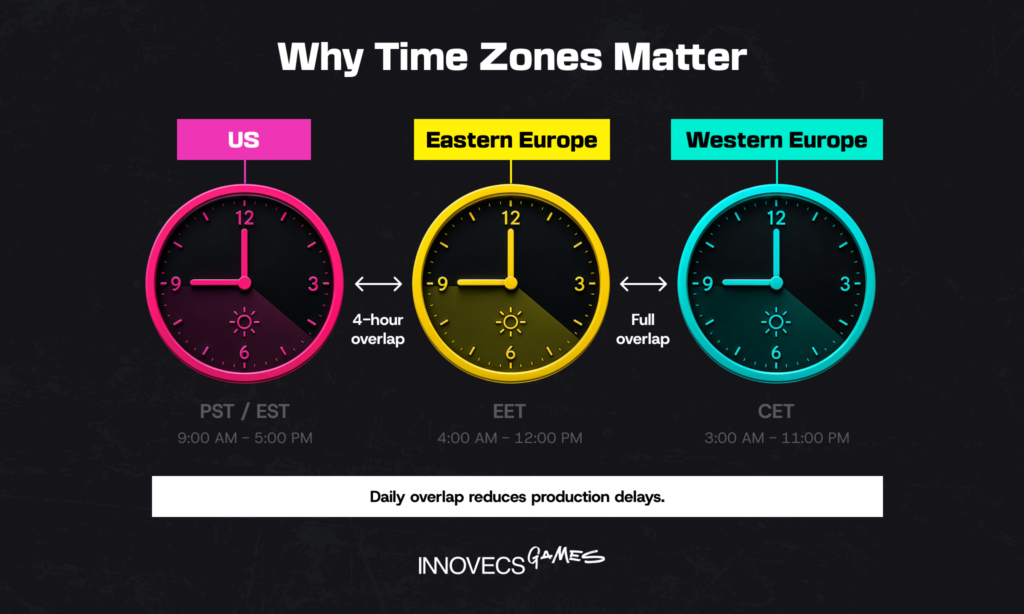
Timezone overlap is the practical variable inside both models and it gets decided by accident far too often. Four overlapping hours a day is enough for a co-development setup where leads talk daily; two is workable for a defined workstream reviewed twice a week; anything less pushes everything into async, which is fine for art production and painful for gameplay iteration. Eastern Europe gives European teams a full working day and US East Coast teams a usable morning. Agree the overlap window and who attends which standup before the first sprint, not after the first missed handoff.
How Much Does It Cost to Hire a Game Development Team?
Whichever model you pick, the budget conversation starts from one baseline: what the people cost as employees. Everything else is a markup or a discount against that number.
Glassdoor’s 2026 US data puts the average game developer at $96,589 a year, 25th percentile $72,535, 75th at $129,619, with seniors at $126,290. The same source has game designers at $97,826, leads at $114,162, producers at $74,508, and QA testers at $66,080. The BLS runs higher across all software roles, with a median of $133,080 for developers generally, which is the gap between games and the wider software market showing up in the data.
Convert the Glassdoor figures across 2,080 working hours and a US mid-level programmer costs roughly $46 an hour in base salary, a senior around $61, a QA tester about $32. Monthly that is $8,000 for the mid-level engineer and $10,500 for the senior, before benefits, hardware, tool licenses, or a manager’s time. Contractor rates always read higher because they carry the load an employer absorbs, which is why comparing an agency quote against a salary figure misleads.
Team size is the other half of the equation, and it moves the total far more than any hourly rate. Across the teams we have staffed over the past three years, the shapes repeat:
| Project type | Typical team | Duration | Usually outsourced first |
|---|---|---|---|
| Hyper-casual mobile | 5 to 7 | 3 to 6 months | Art, QA |
| Mid-core mobile | 12 to 20 | 9 to 18 months | Art production, LiveOps, QA |
| PC or console premium | 25 to 60+ | 18 to 36 months | Environment art, animation, porting, certification QA |
| Live-service | 20 to 40 core, plus a standing LiveOps group | Ongoing | Backend, content pipeline, QA automation |
Region moves the rest more than seniority does. North America and Western Europe sit at the top. Nearshore Eastern Europe, Ukraine included, comes in well below with senior engineering depth that has closed most of the quality gap, and Latin America lands close by with better timezone overlap for US teams. Offshore development in South and Southeast Asia is cheaper again and carries more management overhead, a cost that never appears on a rate card.
The line item nobody forecasts is rework. Hiring cost is visible and budgeted; a mishandled vetting process that produces three months of unusable work is neither, and it dwarfs the rate gap between any two regions. One more variable is now moving these numbers, and it is not geography.
How AI Is Changing Game Development Team Hiring
Adoption is real but narrower than the discourse suggests. GDC found 36% of respondents using generative AI as part of the job, and the split by employer is the interesting part: 30% at game studios against 58% at publishing, support, and marketing. Sentiment has not followed adoption, with 52% calling the effect on the industry negative.
Where it gets used matters more for hiring than how much. Research and brainstorming account for most usage, everyday tasks including code assistance for just under half, while creative production trails badly. The BLS is more direct about the direction of travel, listing artists and animators among occupations with high automation potential as video generation tools improve, which is part of why that 2% projection looks the way it does.
For studios that hire game development teams in 2026, the practical read is narrow. Treat AI tooling familiarity as a modifier on the skills assessment rather than a filter, because neither answer tells you whether a candidate can architect a system. AI changed the speed of execution. It has not changed what good execution looks like.
How Innovecs Games Helps You Build the Right Team
Everything above takes time to run properly, and most schedules do not have it. That is the specific problem we solve.
Innovecs Games has staffed game projects for eleven years out of a 300-plus engineering and art organization, so the programming, art, QA, and design layers are assembled and have shipped together across PC, console, and mobile before your brief lands. Engagement shape follows the project: a discrete workstream to own, an embedded team sharing your board and your milestone, or full-cycle development. What we are not is a fit for studios that want to hand the project over and check back at alpha, because the model assumes your leads make the calls. Unity is where our deepest capacity sits, built around mobile, cross-platform, and live service titles, and our breakdown of how to hire unity developers in Eastern Europe covers that market from the inside.
If a discipline on your build is currently unstaffed, send us the scope and the milestone date. We will come back with a named team and a rate inside two working days.
FAQ
How do I hire a game development team?
Start by writing down scope, target platforms, disciplines, and the milestone date, then pick the model, because in-house, freelance, and studio engagements carry very different lead times. From there it is a shortlist, a portfolio review focused on shipped work, technical interviews or a paid trial project, and reference checks. Vetting is where mistakes happen, so it is the last place to save time.
What is the average cost to hire a game development team?
Roughly $46 an hour if you convert Glassdoor’s 2026 US average game developer salary of $96,589 across a 2,080-hour year, closer to $61 for a senior. Monthly that is $8,000 to $10,500 per engineer in base salary alone, before benefits, tooling, and management time. Contractor rates read higher because they absorb those costs, and nearshore markets sit well below North American levels.
Where can I find a game development team for hire?
Freelance marketplaces, LinkedIn and Indeed, games-specific communities, and outsourcing studios cover the field, and which fits depends on whether you need a specialist or a working unit. A game development team for hire through an established studio arrives pre-assembled with its own workflows, the fastest route when a milestone is close. Building the same group from freelancers costs less per hour and much more of your time.
What is the difference between hiring freelancers and a dedicated team?
Freelancers are individual contractors engaged per task, with no obligation to each other and no shared context. A dedicated team is a fixed group assigned to your project for a defined period, usually through a studio, with accountability already established. Engagement speed favors freelancers, anything past a few weeks favors the dedicated model, and the gap shows up in coordination overhead rather than the hourly rate.
How long does it take to hire a game development team?
Three to five months for a senior in-house hire, from job posting to first day, onboarding after that. Freelancers can be engaged within days, though assembling a working group takes far longer than hiring the first one. Outsourcing and co-development partners are fastest, with a scoped team on the project inside weeks, and a vague brief slows all three equally.
What skills should I look for when hiring game developers?
Shipped work first, because everything else is easier to fake. Beyond that, clear written communication and the ability to operate inside somebody else’s production process without daily supervision. For programmers, engine familiarity and systems thinking outweigh language preference; for artists, pipeline literacy matters as much as craft.
Should I hire an in-house team or outsource game development?
Neither answer is universal, and studios that ship consistently usually run both. In-house buys control and institutional knowledge that compounds across titles; outsourcing buys speed and specialist skills without permanent headcount. The common hybrid is a lean internal team holding creative direction and IP, with partners covering art production, QA, and porting.
How do I hire a Unity game development team specifically?
Unity depth varies far more than a CV suggests, so the question is never whether a team has used it. Ask about engine-level work, performance profiling on your target hardware, and pipeline integration with an existing project. Shipped Unity titles on your platform are the proof, prototypes are not, and Eastern Europe has cross-platform depth at rates well below Western equivalents.
How is AI changing how studios hire game developers?
Less dramatically than the headlines imply. GDC’s 2026 survey found roughly a third of professionals using generative AI at work, mostly for research and code assistance rather than asset creation, and a majority still think the industry effect is negative. AI literacy is now a reasonable expectation without being a differentiator, and production experience still separates candidates.
Can AI replace parts of a game development team?
In narrow, well-defined tasks, yes. Code assistance is the widest adoption case, and automated regression testing absorbs work that used to need manual passes. Art is under the most pressure, which the BLS reflects in a 2% growth projection for animators through 2034. Creative judgment, architecture, and production management are nowhere near automated.
Ready to Build Your Game Development Team? Let’s Talk
Tell us the gap, the platform, and the milestone date. We will come back with a scoped team and a plan for how to hire a game development team that fits your production. Nothing needed on your side beyond the brief you already have.