Game VFX Outsourcing: When and How to Hire an External Studio
Your VFX backlog is growing, your one shader artist is buried, and the launch date isn’t moving. Here’s when outsourcing actually solves that, how to vet a studio without getting burned, and what it really costs in 2026.
Most studios don’t plan this decision. They back into it after a few too many nights patching an effect that should’ve shipped weeks ago. Or they realize nobody on the team knows how to keep a shader from tanking frame rate on mid-range hardware. By the time it’s official, it’s already a fire drill instead of a plan, and fire drills always cost more than plans.
The studios that get real value out of an outside VFX team make the call earlier, on their own terms. This guide breaks down when the timing actually makes sense, what a fair contract looks like, and where the costs come from.
What Is Game VFX Outsourcing and Why Studios Use It
Game VFX outsourcing means bringing in an external studio or freelance specialists to build the particle effects, shaders, and animated visuals your game needs, instead of hiring and managing that work in-house. Studios use video game VFX outsourcing to cover everything from a single explosion effect to a full pipeline of spell effects, weather systems, and UI VFX built to their engine’s spec. For a lot of teams, it’s less about cost-cutting and more about getting senior-level VFX talent on a project without a multi-month hiring cycle.
Most studios turn to outsourcing at a specific moment. Production has picked up speed, but VFX capacity hasn’t caught up with it. Maybe the team has strong gameplay and art departments but no dedicated VFX artist, or a launch date is approaching and staff is already stretched across combat, environments, and UI. Bringing in outside VFX support fills that gap without adding permanent headcount.
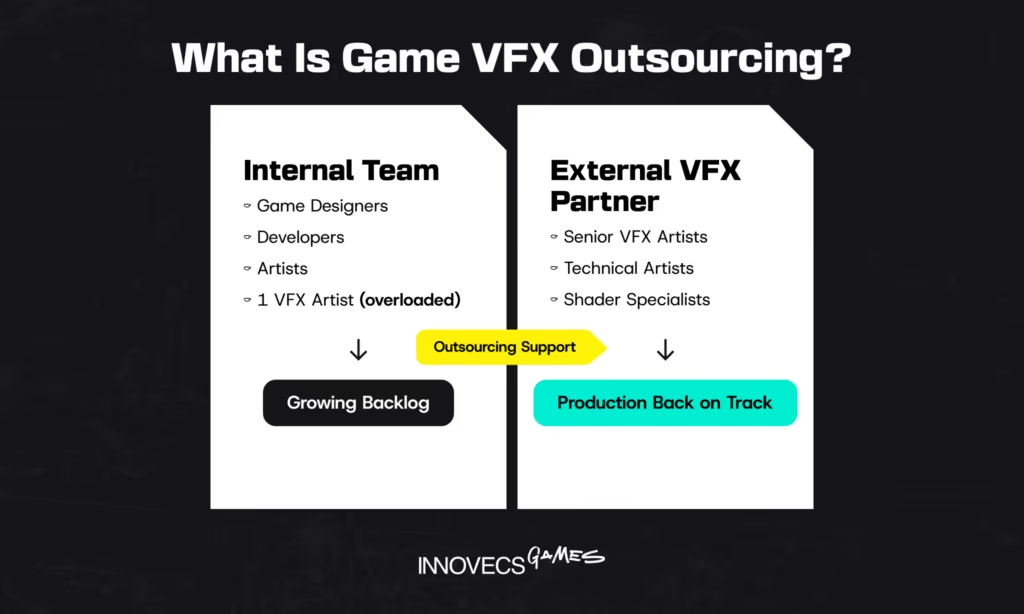
The other draw is specialization. VFX sits at the intersection of art and engineering. It takes someone who understands shaders, particle systems, and performance budgets, not just someone who can make something look cool in a vacuum. Studios that don’t have that role in-house often find it faster to partner with a team that already does this work daily. Building that skill set from scratch takes longer.
The data backs this up. Unreal Engine is now the primary engine for 42% of developers, ahead of Unity at 30%, according to GDC’s 2026 State of the Game Industry report, based on responses from more than 2,300 industry professionals. It’s also the engine behind most real-time VFX work shipped today. That specialization gap isn’t unique to any single studio; it’s showing up across the industry. Small teams feel it too: the indie game segment alone is on track to grow from $5.54 billion in 2026 to $10.83 billion by 2031, per Mordor Intelligence. Even indie studios increasingly treat outside VFX help as a standard budget line, not a luxury purchase.
What Game VFX Services Can You Outsource?
Game VFX services span a wide range. Most outsourcing studios structure their offering around four things: types of effects, build techniques, specialist roles, and tools. Some studios want a single artist for one recurring effect category, like weekly UI polish for a live-service title. Others need an outsourced team that owns the whole VFX layer, from spell effects to environmental hazards to the trailer that ships with launch. Knowing which of those you actually need, a skill, a tool, or just raw capacity, makes scoping much easier. It beats asking a vendor for “VFX help” and hoping the estimate lines up.
What Types of VFX Do Game Studios Usually Outsource?
The most commonly outsourced categories are:
- Particle effects: explosions, muzzle flashes, weather
- Shader-based effects: magic, energy, environmental hazards
- UI VFX: button feedback, transitions, notifications
- Cinematic VFX: trailers and cutscenes, especially around a launch window
- Environmental effects: rain, fog, shifting light, for open-world or live-service titles
Some studios outsource one category, like spell effects for an RPG, while others hand off the entire VFX layer of the game. Teams running a live-service title often need ongoing real time VFX outsourcing just to keep seasonal content and events on schedule. For those titles, VFX outsourcing frequently turns into a standing arrangement, not a one-off project. New event effects, monetization-driving visual flourishes for limited-time drops, and quick iterations keep content fresh without pulling the in-house team off core development. Nothing exotic about that pattern; outsourcing just follows wherever the ongoing workload actually sits.
What Techniques Do VFX Artists Actually Use?
Watch a spell effect in Diablo IV, and particle systems are doing most of the work: distinct shapes and colors per element, tuned so players can tell damage types apart in the middle of a crowded fight. That’s the same technique behind most things that move across a screen in bulk, sparks, smoke, rain, magic trails, anything built from lots of small moving pieces rather than one solid shape. Getting it to read as fire or dust instead of noise comes down to how artists tune emission rate, movement, color shift over a particle’s life, and how it bounces off the world around it.
Simulation is the expensive end of the spectrum, and the hardest to fake convincingly. Water, smoke, cloth, soft-body physics, full destruction, all of it usually gets built in Houdini first, then baked down or simplified so it’ll actually run in real time, since a true physical simulation is rarely cheap enough to run live. Forza Horizon is a good example of what it looks like layered together: rain, wind that visibly pushes on the car, procedural lightning, reading as one weather system instead of separate effects stacked on top of each other.
Which VFX Roles Are Most Commonly Outsourced?
Studios typically outsource VFX artists first, because that role is most directly tied to output. Right behind that is the technical artist, who bridges VFX and engine performance, followed by shader artists for anything involving custom material work. Compositors and VFX animators come up for projects with heavier cinematic needs. Environment or lighting artists sometimes get pulled into VFX-adjacent work too, particularly when effects need to read correctly against a scene’s lighting.
What Tools Do Outsourced VFX Studios Use?
Most outsourced VFX teams work across a handful of core tools, each doing a different job in the pipeline:
- Unreal Niagara: node-based, event-driven; artists trigger particle behavior off gameplay events and run simulations on the GPU for large-scale effects
- Unity Visual Effect Graph: the Unity equivalent, handling similar GPU-heavy particle work
- Unity Shader Graph: builds material-level effects (distortion, glow, surface animation) that particles alone can’t do
- Houdini: sits earlier in the pipeline for anything procedural, covering destruction systems, fluid and fire simulation, and reusable effect templates
- After Effects / Blender: cinematic work that doesn’t need to run in real time, including trailers, cutscenes, and compositing render passes
A studio’s tool stack should match yours. Say your project runs on Unreal. You want a team fluent in Niagara, not one that’s only ever touched Unity’s Visual Effect Graph. Ask about this directly before signing anything, and press on which tools they actually use day to day versus which ones just look good on a résumé.
When Should You Outsource Game VFX?
Outsourcing VFX isn’t the right call for every studio at every stage, and treating it as a default, rather than a decision, is how budgets get wasted. The signs tend to show up gradually, not all at once: a backlog that keeps growing no matter how priorities get reshuffled, a skill gap nobody’s addressing, a deadline that isn’t moving. Recognizing which of those actually apply to your situation is the difference between outsourcing as a strategic call and outsourcing as a panic response two weeks before a milestone. None of these signs show up on a dashboard. Someone actually has to notice them.
What Are the Signs Your Studio Needs an External VFX Team?
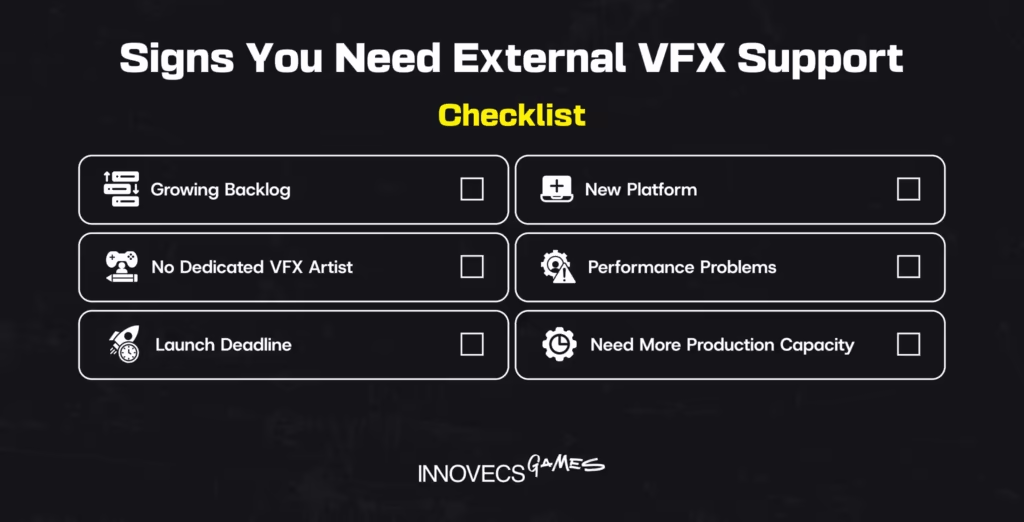
The clearest sign is a growing backlog, with effects requests piling up faster than your team can ship them. Another is a skills gap: your artists are strong generalists, but nobody on staff specializes in shaders or particle systems. A looming deadline with VFX still unbuilt is a third sign, and so is scaling into a new platform or engine that needs VFX rebuilt from scratch. None of this means your in-house team is failing. It means the workload has outgrown the current headcount.
In-House vs Outsourced VFX: Which Fits Your Project?
Keep VFX in-house if the work never really stops: it’s tightly coupled to gameplay systems, and someone needs to sit in daily standups with the rest of the team. You get full control over pace and priorities that way, though staffing up takes time, and scaling back down is awkward once a project winds down.
Outsourcing fits a different shape of problem, one with an edge to it. Think a launch push, a new biome, a marketing trailer, something with a clear start and end. It doesn’t much matter whether you’re an indie studio counting every dollar or a publisher racing a fixed date. A project-based engagement or a dedicated outside team gets senior talent on the work fast, and you’re not paying for it once it’s done.
There’s a middle option too: outstaffing, where individual specialists slot into your existing pipeline instead of a whole project changing hands. Honestly, most studios don’t pick one model and stick with it. A small in-house core handles the ongoing work, and an outsourcing partner absorbs the spikes. That mix, not either extreme, is what actually runs in practice.
| In-House VFX | Outsourced VFX | |
| Control | Full, day-to-day, embedded in standups | Set through the brief and milestones |
| Ramp-up speed | Slow (tied to your hiring cycle) | Fast (days to weeks) |
| Cost structure | Fixed salary, benefits, tooling | Project, retainer, or per-effect |
| Best for | Ongoing, gameplay-coupled work | Defined scope: launch push, new biome, trailer |
| Technical debt risk | Can build up quietly without a dedicated technical artist | A specialist partner absorbs the performance and pipeline gaps |
Already Know You Need Outside VFX Help?
If you’ve read this far, you’re probably already sure game VFX outsourcing is the right move for your project. You don’t need another ten sections to convince you. Tell us what you’re building and where the gap is, and we’ll walk you through what working with our team would actually look like.
How Do You Choose the Right VFX Outsourcing Studio?
Picking a games VFX outsourcing studio is where most of the real risk in this process sits. A bad hire on a single effect is annoying and easy to fix; a bad hire on your entire VFX layer, discovered three weeks before launch, is a production crisis with your name on it. Most red flags show up early, though, in the portfolio, in how a studio answers technical questions, and in how specific their pricing gets before you’ve signed anything, if you know where to look.
What Should You Look for in a VFX Studio’s Portfolio?
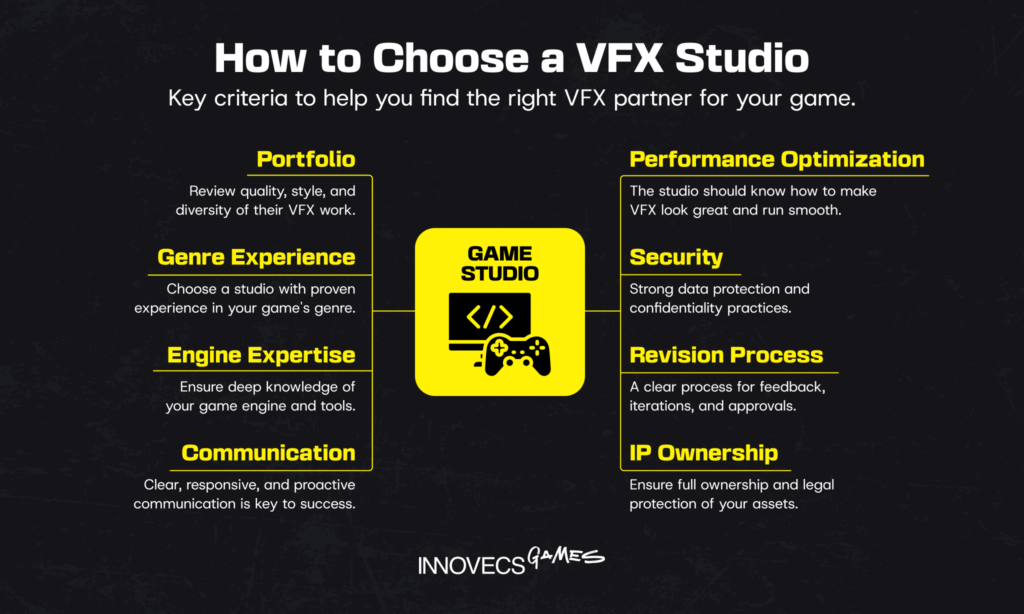
Look past the highlight reel and check for range, real-time effects next to cinematic work, stylized pieces next to realistic ones. A strong portfolio also shows effects working inside an actual game engine, not as isolated renders. Pay attention to whether past projects resemble yours in scope and genre, since a studio that’s only done mobile puzzle VFX may not be the right fit for a AAA shooter’s combat effects. Engine-captured footage tells you more than a polished demo reel, because it’s closer to what you’ll actually get. Demo reels are marketing. Footage from an actual build tells you what you’re really getting.
What Questions Should You Ask Before Hiring a VFX Studio?
Before signing anything, ask about:
- Which engines and tools their team uses day to day, not just what they’ve touched once
- How they handle revision cycles, and how many rounds are included before extra costs kick in
- Who you’ll actually be working with, a named point of contact or a rotating pool of freelancers
- Performance budgets, since a beautiful effect that tanks your frame rate isn’t a finished effect
- Who owns the IP on custom shaders and effect assets once the project wraps
- NDAs and build security, especially if you’re sharing pre-announcement content or repository access
A studio without a clear answer on the last two is a liability before the work has even started.
What Red Flags Signal a Bad VFX Outsourcing Fit?
Watch for vague pricing that only gets specific after you’ve signed something, and for a portfolio full of renders with no in-engine captures at all. Slow or evasive communication during the sales process is a preview of what production will feel like, so take it seriously, and be cautious of any studio that won’t name specific artists or show you their actual pipeline. That usually means the work gets subcontracted out further than you’d expect. But this isn’t a minor detail. Communication, not delivery quality, is now the single biggest challenge cited in external development partnerships, according to the 2026 XDS Insights Report, based on input from 250+ industry professionals. It has overtaken security and delivery risk for the first time, and if a studio can’t communicate clearly before you’ve signed anything, that pattern rarely improves once the invoice is in.
How Does the Game VFX Outsourcing Process Work?
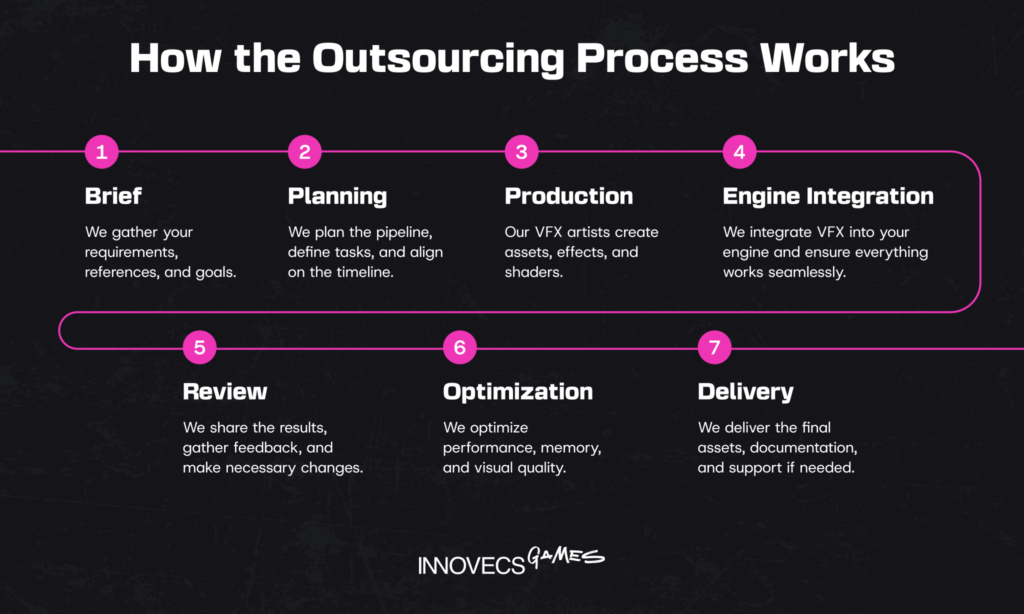
Video game VFX outsourcing tends to follow a consistent shape from studio to studio, even when the specifics vary by team size or engagement model. It starts with a brief, moves through building and engine integration, and lands in a revision cycle that either goes smoothly or turns into a slog, depending entirely on how clearly expectations got set at the start. Here’s what a well-run engagement typically looks like, step by step.
How Do You Brief an Outsourced VFX Team?
A solid brief is sometimes formalized as a short technical specification. It includes reference footage or images, a description of the effect’s role in gameplay (does it need to signal damage, mark a cooldown, flag a hazard?), your target engine and performance budget, and any existing style guide. The more specific the creative brief, the fewer revision rounds you’ll need later. Studios that ask a lot of clarifying questions upfront are usually the ones that get it right the first time.
How Is VFX Integrated Into Your Game Engine?
Once effects are built, they get imported and wired into your engine, connected to gameplay triggers, tested against your target hardware, and adjusted for performance. This is where technical artists earn their keep. An effect that looks perfect in isolation can behave very differently once it’s running alongside everything else in a live scene. Testing has to account for the actual hardware spread your players use, not a single high-end dev machine. Frame rate and battery draw on mid-range Android phones factor in, along with certification requirements if you’re porting to console, and QA across however many device configurations your game actually ships on. Good outsourcing partners test in a real build, not a blank test scene, and flag performance problems before those turn into a bug your own QA team has to chase down.
How Do You Manage Communication and Revisions?
Most engagements run on a mix of async updates (Slack, shared boards) and scheduled check-ins, with revision rounds built into the timeline rather than treated as an afterthought. Clear milestones (first pass, revision, final polish) keep both sides aligned on what “done” means. Studios that batch feedback into structured rounds, instead of trickling in one-off notes, tend to hit deadlines more consistently.
How Much Does Game VFX Outsourcing Cost?
So what’s actually driving the number on your invoice? Three things: team size, region, and complexity.
A typical engagement runs anywhere from a single specialist working part-time to a small pod of three or four people, usually a VFX artist, a technical artist, and a lead, scaled to the size of the ask. Region is the biggest lever on hourly rate:
- Asia (India, Philippines): $15–35/hour
- Eastern Europe: $25–45/hour
- Latin America: $20–50/hour
- Western Europe, UK, North America: $60–120+/hour for senior-level specialists
Treat those ranges as a conversation starter, not a quote. Actual numbers shift with seniority, contract length, and how much of the pipeline a studio owns.
Complexity moves the total from there. A simple UI flourish or muzzle flash might take a few hours. By contrast, a fully simulated environmental effect, like dynamic weather or destructible terrain, can take days of iteration. Real-time VFX built for in-engine performance generally costs less than cinematic VFX rendered for trailers, because cinematic work isn’t constrained by frame-rate budgets and often involves more iteration to get camera-ready.
Beyond those three, a few more things move the total. The engine matters: Niagara and VFX Graph both have learning curves that affect speed, and so does the number of revision rounds included, and whether the work needs performance optimization or gets built from a clean slate. Studios that offer a fixed quote upfront should be able to explain what’s driving that number, and if they can’t, that’s worth a second look. If a launch date is fixed, it’s also worth factoring in that outsourcing usually protects time-to-market better than a rushed in-house hire.
How Is AI Changing Game VFX Production?
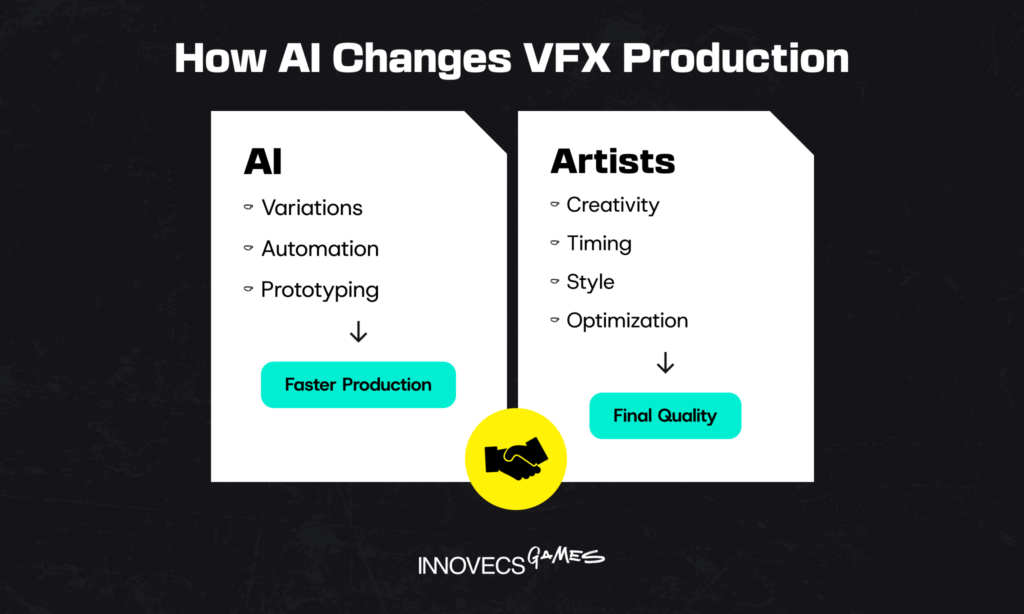
AI tools are showing up across the VFX pipeline, mostly as accelerators rather than replacements. Procedural generation tools, many of them AI-assisted, can now rough out particle systems and shader variations faster than building each one by hand, which speeds up early iteration significantly. Houdini’s node-based workflows increasingly incorporate machine-assisted scattering and simulation setup, cutting down the manual labor of populating large environments with variation.
AI genuinely helps with a few things right now. Rapid prototyping, generating effect variations for testing, and automating repetitive technical tasks like tuning particle counts against performance budgets. It still falls short on the creative calls that separate a good effect from a forgettable one. Timing is one: how an explosion reads at the exact moment of impact. Tone is another: how a spell effect should feel tied to a character’s personality. And restraint matters too, like how much an environmental effect needs so it doesn’t overwhelm the scene. That judgment still comes from experienced VFX artists.
The data backs up that caution. Just over a third (36%) of game industry professionals use generative AI tools in their job at all, and the most common use by far is research and brainstorming (81%), well ahead of asset generation (19%) or procedural content generation (10%), according to GDC’s 2026 State of the Game Industry report. Visual and technical artists are also the most skeptical group in the industry, with 64% saying generative AI is having a negative impact on their field, more than any other discipline surveyed. On the outsourcing side specifically, fewer than 10% of clients currently allow AI use in contracted work at all, according to the 2026 XDS Insights Report. Most studios, in other words, are still writing the policy before they figure out the workflow.
So how do you tell a studio that’s ahead of the curve from one that’s guessing? For a 2026 outsourcing partner, AI literacy is worth asking about directly. A studio that uses AI tools to speed up early iteration, without leaning on them for final creative decisions, is generally in a good position. One that can’t explain where AI fits into their workflow, or what their disclosure policy is, is probably behind.
Why Partner With Innovecs Games for VFX Outsourcing?
Innovecs Games works as a game VFX studio extension of your existing team, not a separate vendor you have to manage from a distance. Our technical artists build and integrate effects directly inside Unity and Unreal, working alongside your engineers to make sure everything performs the way it should once it’s actually running in your game, under real player conditions instead of in a demo scene. That includes Houdini-driven procedural VFX, shader development, and the game technical art outsourcing work that connects visual effects to engine performance.
Beyond VFX specifically, our broader game art services cover the full art pipeline, so effects stay visually consistent with your characters, environments, and UI, instead of looking bolted on. We’ve written before about how VFX and player experience connect. The short version: effects that communicate gameplay clearly do more for retention than effects that just look impressive. If you’re weighing outsourcing beyond VFX too, our game development outsourcing services scale from a single discipline to full co-development and full-cycle production, whether you’re an indie studio or a publisher managing multiple titles at once.
None of that matters, though, if the work doesn’t end up looking like it belongs in your game. A lot of outsourcing hesitation comes down to fit: will a team unfamiliar with your world actually match your existing art style, especially when you’re working across regions with different visual traditions? We start from your references and existing style guide, not a generic showreel, and typically deliver test samples before you commit to anything bigger. Engagements can start as a short pilot or a single effect, then scale into an overflow team you plug in whenever your internal artists are stretched, without asking you to restructure production around us.
FAQ
What is game VFX outsourcing?
Hiring an outside studio or specialists to make your game’s visual effects instead of building that team yourself. Could be particle systems, shaders, cinematic work, UI VFX, a single effect, or the whole VFX layer of a project, scope is flexible. Most studios reach for it for one reason: senior talent, fast, without running a full hiring process.
When should a game studio outsource VFX work?
Short version: when the backlog outpaces the team, when nobody in-house really knows shaders or particle systems, or when a deadline’s closing in with VFX still unbuilt. It also just makes sense for one-off work, a launch trailer, say, where a permanent hire would be overkill. Ongoing work tied closely to daily gameplay decisions is really the one case where in-house tends to win out.
How much does game VFX outsourcing cost?
It really comes down to region and complexity. Hourly rates run roughly $15–35 in Asia, $20–50 in Latin America, $25–45 in Eastern Europe, and $60–120 or more in Western Europe, the UK, and North America for senior specialists. Per-effect cost swings a lot too: a simple UI flourish is a matter of hours, while a fully simulated environmental system can eat several days. Real-time VFX tends to cost less than cinematic work built for trailers, since nobody’s scrutinizing it frame by frame at high resolution the way a trailer gets watched.
What is the difference between in-house and outsourced VFX teams?
Depends what you’re optimizing for. In-house buys you control, embedded in daily production, at the cost of a slower ramp-up and less flexibility once things wind down. Outsourced buys you speed: senior expertise for a defined scope, gone once the work’s done. A lot of studios stop choosing and just run both.
What should I look for in a VFX outsourcing studio’s portfolio?
Check for range first, real-time work next to cinematic, and whether any of it resembles your project’s genre. In-engine footage beats a polished demo reel every time, since it’s the only honest look at how effects perform under real conditions. Nothing but isolated renders in sight? Push for more before you commit to anything.
How long does a typical VFX outsourcing project take?
Depends on scope, really. A single effect might take a few days, while a full VFX pass across a game could run months. Ask for a project-specific estimate once a studio has your brief, since asset count, revision rounds, and engine complexity all move the number, and build in room for at least one revision round no matter what they quote you.
Can an outsourced VFX team work directly inside Unity or Unreal Engine?
Yes, and this is worth confirming upfront rather than assuming. Most established studios work natively inside Unity’s VFX Graph or Unreal’s Niagara, so what you get back is already engine-ready instead of files someone still has to rebuild. Smaller or less experienced teams sometimes only deliver pre-rendered assets, which means your own team ends up doing that integration work anyway.
What information should I include in a VFX outsourcing brief?
Reference footage or images are a good starting point, along with what the effect actually needs to communicate to the player in gameplay terms. Add your target engine, any performance constraints, and an existing style guide if you have one. Studios that come back asking clarifying questions before they start are usually the ones worth hiring.
How is AI changing game VFX production and outsourcing?
Mostly, it’s speeding up the early, repetitive parts, procedural particle generation, shader variation, automated performance tuning, all faster than a couple of years ago. What it hasn’t touched is the judgment call behind a genuinely good effect: how it reads in the moment, how it fits the game’s tone, how much restraint it needs before it starts fighting the rest of the scene. A partner worth hiring in 2026 uses AI to move faster on the technical grind and still leaves the creative decisions to people who’ve done this long enough to know when something’s wrong.
Can AI tools replace an outsourced VFX artist?
Not for the part that actually matters. It can rough out variations and take repetitive technical work off someone’s plate, sure, but it still can’t make the calls that separate a forgettable effect from one that actually lands, timing, restraint, how well it supports the moment it’s tied to. Studios getting the most out of AI treat it as a starting point, not a finished product. What’s really shifting is the artist’s role, more toward direction and refinement than disappearing altogether.
Ready to Build Your Game VFX Team? Let’s Talk
If your project needs VFX support and you’re ready to talk specifics, we’re ready to listen. Tell us about your game, your engine, and where the gap is. Innovecs Games has spent years helping studios solve exactly this kind of game VFX outsourcing challenge.