How to Hire Unity Developers: The Complete 2026 Guide
Start with the number: 70%+ of the top 1,000 mobile games run on Unity. Not some, not most — 70%. And the global mobile gaming market crossed $98.7 billion in 2024 (Newzoo). That’s the playing field. Over 1.5 million creators build on Unity every month (Unity), and the studios competing to hire them are not letting up.
So supply hasn’t kept up. That’s the short version.
The longer version: a bad hire in this space doesn’t just cost you the salary. It costs you the three months you spent waiting, the feature that missed the milestone, the senior engineer who had to babysit instead of ship. Getting this right matters more than most hiring decisions, and this guide is a practical attempt to help you do that: where to find people, what to pay, how to tell who’s real during interviews, and which model fits your situation.
What Is a Unity Developer — and Do You Need One?
Short version: someone who builds things with the Unity engine. Games, simulations, AR/VR experiences, interactive apps. But “Unity developer” is a wider category than it looks.
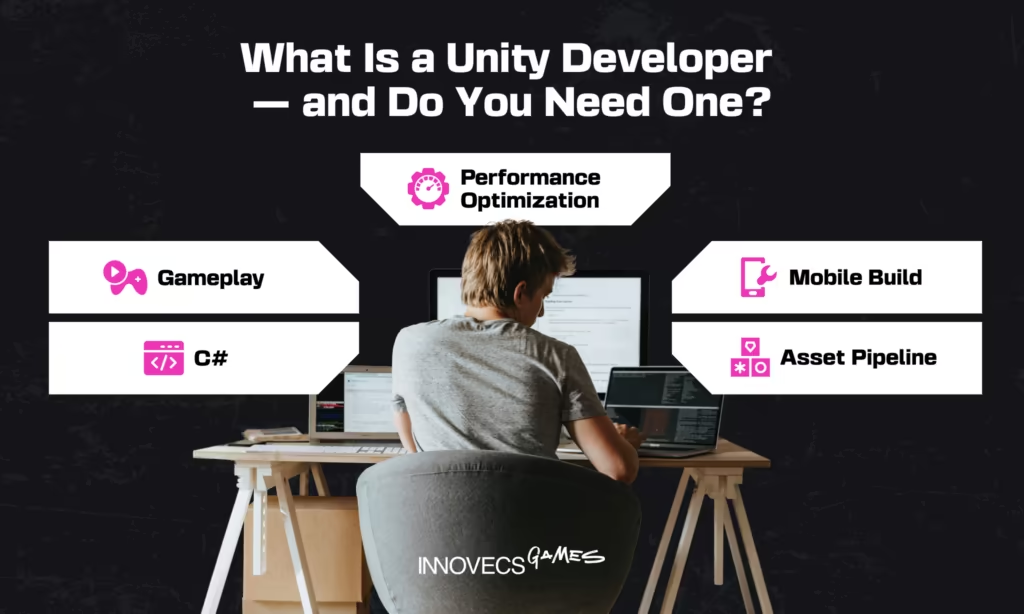
Depending on the project, a Unity developer might spend their week on multiplayer networking. Or shader work. Or debugging why the iOS build is 200MB heavier than it should be. The engine is the constant. What they actually do varies a lot.
Here’s the question worth asking before you post a job: do you need someone who knows Unity specifically, or just someone who can code games?
For small projects, a generalist game programmer sometimes covers it. But once you’re building something with live service features, a real VR component, or a pipeline with more than a handful of artists feeding into it, a generalist who “knows some Unity” is going to hit a wall eventually. You want someone who knows where the editor breaks, which C# patterns actually hold up inside the engine under load, and what the asset pipeline does when you ignore the import settings.
That knowledge comes from shipping things. Not from tutorials.
The Stack Overflow Developer Survey 2024 puts C# in the global top 10 among professional developers. Plenty of people know the language. Far fewer have production Unity experience at the level most studios actually need.
If you’re still deciding whether Unity is even the right engine, Unity vs Unreal: How to Choose the Best Game Engine and 5 Things to Know About Unity are worth reading first.
Types of Unity Developers You Can Hire
The person you need for a mobile casual game and the person you need for a multiplayer shooter with custom physics are not interchangeable. Worth being specific about what you’re actually looking for before you start talking to candidates.
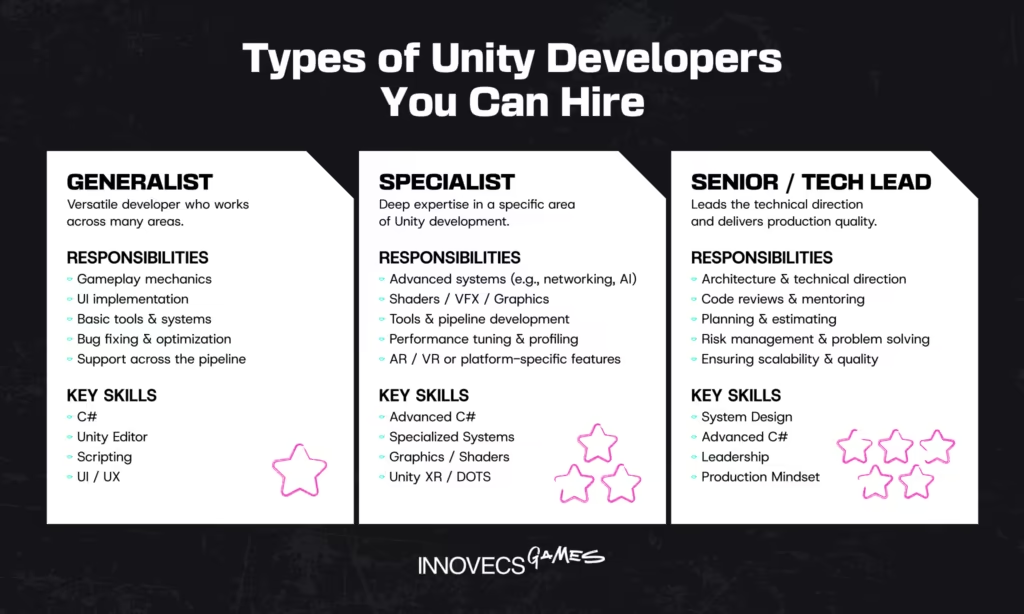
Generalist vs. Specialist Unity Developers
Generalists are built for flexibility. Gameplay systems, UI, basic physics, shipping a full feature solo. That’s your person on a small team or an early-stage project where the scope is still shifting.
Specialists are a different bet entirely. If you need to hire Unity 3D developers for a pipeline-heavy project, or bring in someone whose whole professional focus is AR/VR development or multiplayer networking, a generalist won’t cover it. You bring a specialist in when there’s a hard technical requirement that just has to be done right. Not “figured out as we go.”
Most productions of any real scale end up needing both. Generalists to move fast in the early phase, specialists once the hard technical problems start showing up. Getting the mix wrong in either direction is expensive.
Junior, Mid-Level, and Senior Unity Developers
Junior developers: good for well-defined, lower-risk work. Bug fixes, smaller features, asset pipeline tasks. Cheaper. But they need someone watching.
Mid-level developers own a system without hand-holding. Senior developers and tech leads are the ones whose decisions either save you a month or cost you one. That’s the real value. Not the code they write, but the mistakes they prevent.
The math on stacking your team too junior almost never works out the way it looks on the spreadsheet. Timeline pain shows up later. And it compounds.
Full-Time, Contract, and Freelance Unity Developers
Full-time is for long-running projects where embedded ownership matters. Years, not months.
Contract fits defined scope with a real end date. Freelance Unity developers make sense for short sprints, one-off skill gaps, or anything where you don’t want ongoing overhead.
No model is better than the others. Each one makes sense under the right conditions. The conditions are: project length, budget, and honestly — how much you want on your own plate.
How Much Does It Cost to Hire Unity Developers?
Wider than most people budget for. That’s the honest answer.
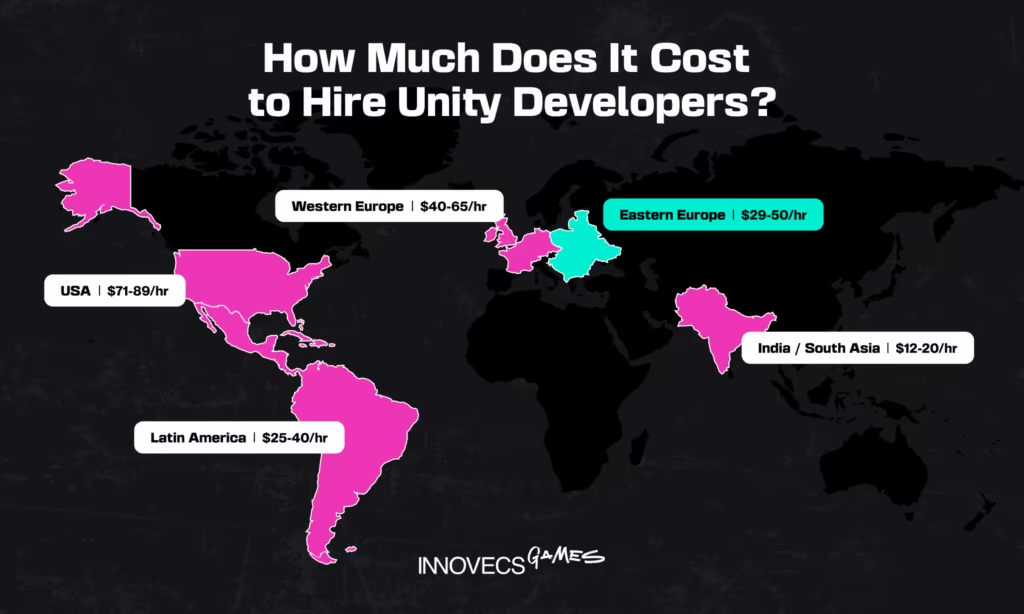
Unity Developer Hourly Rates by Region (2026)
Here’s the honest breakdown, based on Lemon.io‘s 2026 contractor data and Qubit Labs market research:
| Region | Junior | Middle | Senior |
|---|---|---|---|
| USA | $30–45/hr | $50–65/hr | $71–89/hr |
| Western Europe | $20–30/hr | $30–45/hr | $40–65/hr |
| Eastern Europe | $10–18/hr | $17–30/hr | $29–50/hr |
| Latin America | $10–15/hr | $15–25/hr | $25–40/hr |
| India / South Asia | $5–8/hr | $8–15/hr | $12–20/hr |
A few things worth knowing about these numbers.
USA: San Francisco seniors hit the top of that range ($71–89/hr). Outside of major tech hubs — Austin, Atlanta — you’re looking at $50–60/hr for solid mid-level work. Still expensive, but the talent density in those markets is real.
Western Europe: Germany and the Netherlands sit at the higher end; Spain and Portugal closer to the floor. London is its own market and tracks closer to US rates for senior Unity talent.
Eastern Europe: Poland, Ukraine, Romania are the most established Unity hubs here. The 50–70% rate gap vs. the US reflects cost of living, not skill level. Senior developers from Warsaw or Kyiv shipping on AAA co-development contracts are not a tier below US counterparts.
Latin America: Brazil and Colombia are the most active markets. Rates land between Eastern Europe and India, and the time zone overlap with North American teams is a real operational advantage — something that doesn’t show up in the hourly rate but matters at 10am standup.
India / South Asia: Cheapest by a wide margin. The tradeoff is more overhead on communication, async coordination, and quality reviews. Works well when structured correctly; requires more management bandwidth than the other regions.
And none of these numbers include the coordination layer: project management, QA, the overhead that happens around the actual coding. These are raw developer hours only.
Cost by Engagement Model
Freelance is the cheapest per hour and the most expensive in your time. You’re the PM, you’re QA, and you’re the contingency plan.
A dedicated team costs more per hour, but project management and quality oversight come included. Still cheaper than building the same capacity in-house once you factor in benefits, equipment, and recruiting. Staff augmentation is the middle option: a vetted developer in your workflow, no permanent-hire overhead attached.
Worth knowing: SHRM’s benchmarking research puts the average cost-per-hire across industries at around $4,700, and technical roles take 45+ days to fill. Specialized game dev positions routinely run higher on both counts.
Where to Hire Unity Developers
Three main channels. Pick based on timeline and how much vetting you want to own.
Freelance Platforms
Upwork, Toptal. Unity developers for hire are findable within a few days. That speed matters when something falls through and you need to move fast.
The tradeoff is that all the vetting is yours. A polished portfolio with thin reviews tells you almost nothing about how someone holds up under actual production pressure. You won’t find out until you’re already in it. Keep scope tight on the first engagement — treat it as a trial run — and these platforms work fine. Let scope drift and you’ll regret it.
Job Boards and Talent Communities
We Work Remotely, Unity Connect, the game dev communities scattered across Discord and LinkedIn. Right channel for longer-term hires and full-time searches. Bigger pool, slower process: post, screen, interview, negotiate, onboard, repeat.
Good if you’re building out an internal team over months. Not useful if you need someone this week.
Game Development Studios and Co-Development Partners
The option for studios that don’t want to own the vetting themselves.
A co-development partner shows up with a pre-screened team, handles the project management, and scales with you as the project’s needs change. You pay more per hour than you would sourcing a freelancer. But you stop spending your own hours on sourcing, interviewing, and day-to-day managing.
For teams that don’t have deep Unity expertise in-house already, it’s usually the fastest path to actually shipping. More on how it works at Game Co-Development.
How to Evaluate and Hire Unity Developers
Getting people into the pipeline is easy. Figuring out which of them can actually do the work is where it gets harder.
What Technical Skills to Look For
| Skill area | What to actually look for |
|---|---|
| C# programming | Clean, readable code, not just “it compiles” |
| Unity editor | Builds custom tools, not just drag-and-drop |
| Asset pipeline | Knows import settings, optimization, build size tradeoffs |
| Physics engine | Can debug collision edge cases and profile real performance issues |
| Version control | Actual Git workflow: branching, merge conflicts, code reviews |
| Platform builds | Has shipped to the real target platform, not just tested in editor |
Don’t take any of this at face value from a CV. Ask about specifics. Someone who’s actually shipped a build can tell you what broke and exactly what they did about it. Someone who hasn’t gives you general statements about best practices. The difference surfaces fast if you ask the right questions.
Key Interview Questions
- “Walk me through a Unity project you shipped. What went wrong?”
- “How do you handle performance problems on mobile — walk me through your process.”
- “How do you structure a Unity project so it’s still maintainable six months in?”
- “Have you worked with [whatever your project needs — AR/VR, multiplayer networking, Unity Cloud Build]?”
Short, specific answers backed by real examples: experience. Vague answers about “following best practices”: not. That distinction usually becomes clear by the second follow-up question, which is why you ask them.
Red Flags to Watch For
Portfolio with nothing shipped and playable. Technical decisions they can’t explain beyond “that’s just how I do it.” Developers who won’t discuss bugs or failures (which is a tell, because everyone ships broken things eventually). The ones who won’t talk about it haven’t been through a real production cycle yet.
Also: confident timeline estimates with zero qualifications. If someone tells you a complex multiplayer feature “should take about a week,” that’s optimism, not experience.
Hiring Models Compared: Which One Fits Your Project?
No universal winner here. Depends almost entirely on your specific situation.
Freelance. Best for short, defined work. Lowest cost per hour, highest overhead on your end. You’re the PM, the QA lead, and the fallback if it goes wrong.
Full-Time. Best for products that need someone embedded for years. High total cost once you count everything, but you get deep product knowledge and direct control over priorities.
Dedicated Team. An outsourced team managed by a partner, running as an extension of yours. More structure than freelance, less overhead than building in-house from scratch. Works well for studios scaling a project without committing to permanent headcount. You can also hire remote Unity developers this way, with all the logistics handled by the partner.
Outsourcing Studio. You define the scope, they own delivery. Right option when you need a full feature or system built and don’t have internal capacity to manage it day to day.
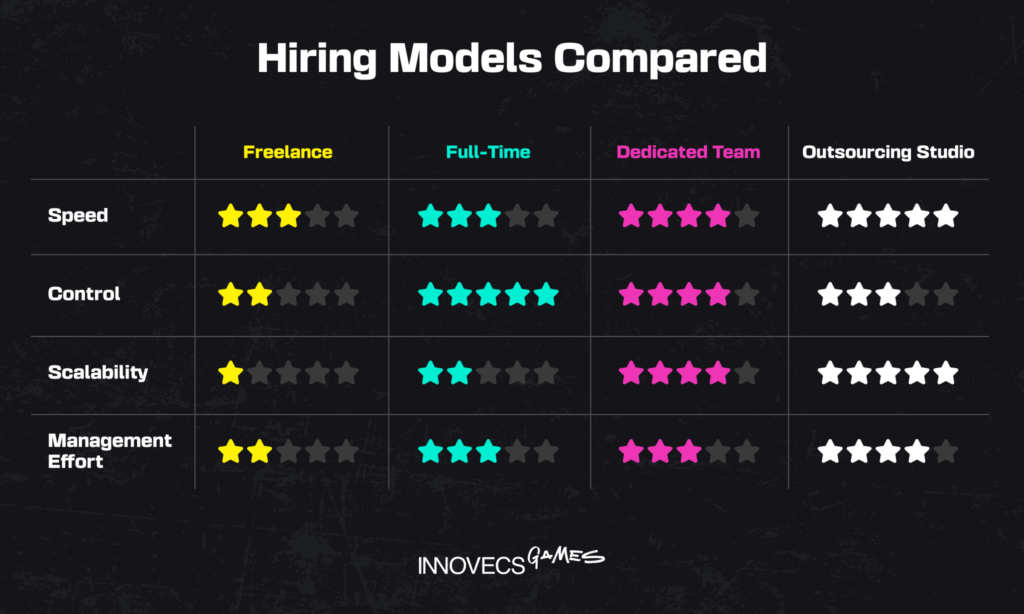
Quick heuristic: the less Unity expertise in-house, the more a dedicated team or studio partner makes sense. The more control matters to you, the more a direct hire fits. Game Development Outsourcing covers how studios typically navigate that tradeoff.
How AI Is Changing Unity Developer Hiring in 2026
Honestly, this section matters more in 2026 than it would have two years ago. Studios that ignored it then are catching up now, often the hard way.
Tools like GitHub Copilot and Cursor have changed the floor. GitHub’s own research puts the productivity gain at up to 55% on certain task types. Boilerplate is faster. Repetitive systems, basic debugging — quicker. AI-assisted asset pipelines are maturing too, which shifts what studios expect from developers on asset-heavy projects.
So interviews have changed. Plenty of studios now probe whether candidates can use these tools effectively, not just whether they can code without them. Being good at reviewing and correcting AI output is a real, filterable skill now. Some studios test for it explicitly.
What hasn’t changed: AI still can’t make architecture decisions. It doesn’t tune performance against actual hardware. It doesn’t have the judgment that comes from having shipped something that real players touched. Studios aren’t hiring fewer Unity game developers because of AI. They’re just expecting more output per person, because the baseline moved.
Why Outsourcing Can Be Faster Than Hiring In-House
In-house hiring is slow. Sourcing, screening, interviewing, negotiating, onboarding. Each step waiting on the last. LinkedIn’s Talent Trends research shows senior software engineering roles taking an average of 49 days to fill. For specialized game dev positions, it often goes longer.
An outsourcing partner can have a vetted Unity developer or full team working within days. Because the vetting already happened.
The other thing: scale. If you need four more people for crunch and two fewer after launch, a dedicated team adjusts. A permanent hire doesn’t — and neither does your payroll. For studios running on milestone-based budgets, that flexibility is worth real money.
Innovecs Games works this way with studios that need Unity expertise without building it internally, through Unity Game Development Services and ongoing co-development partnerships. If you want to see what that engagement looks like in practice, Making Co-Development Work for Your Next Game gets specific about it. And if you’re thinking about iOS game development via Unity, worth reading before you finalize team structure.
Final Thoughts on How to Hire Unity Developers in 2026
Options aren’t the problem. Freelance platforms, job boards, co-development partners, outsourcing studios. All of them work, for the right project and the right situation.
The harder part is being honest about what your project actually is. How long does it run? What does the scope look like? How much do you want to manage? These aren’t rhetorical. They’re the inputs that should determine your model before you talk to a single candidate.
Budget for what this actually costs, not the best-case version. Vet properly, especially the things that don’t show up in a portfolio. And don’t assume the cheapest option upfront stays cheap once you’re three months in.
It usually doesn’t.
If outsourcing or co-development is on the table, it’s worth a conversation with someone who’s done it, including finding out what a partner like Innovecs Games could actually take off your hands.