AAA Game Development Cost: What It Really Takes to Build a Blockbuster
Nobody publishes their real budget. But the numbers that do leak out are hard to ignore.
- Cyberpunk 2077 reportedly cost somewhere around $300–450 million all in.
- Red Dead Redemption 2 estimates put it between $300 million and $540 million depending on what you include.
- GTA 6 is in a category of its own, with analyst estimates ranging from $1 billion to well over $3 billion depending on how you count.
AAA games cost more than almost any other form of entertainment to produce, and that number keeps climbing.
So what actually goes into a budget like that? And what does it mean for studios that aren’t Rockstar? That’s what this post breaks down. From pre-production through post-launch, every cost category, what drives it up, and where teams actually have options.
One thing to clarify upfront: “AAA” isn’t a technical term. It’s shorthand for a tier of game with a large production budget, a sizable team, and marketing spend to match. The range is wide. Not every AAA game costs $300 million. But the floor has risen considerably, and the ceiling keeps going up.
What Is a AAA Game?
The term started as industry slang. A-rated credit in finance, applied to games with serious financial backing behind them. It stuck. Now it’s the shorthand for any title that competes at the top end of the market: large teams, long development cycles, high production values, and a marketing push big enough to match.
What separates AAA from everything else isn’t really genre or platform. It’s scale. A mid-core indie game might have a team of 20 and a two-year runway. A AAA title typically runs 200 to 1,000+ people across multiple disciplines, three to six years minimum, and a budget that assumes a blockbuster game-level return. The risk profile is completely different.
Publishers and analysts use $100 million as a rough floor for modern AAA development, not counting marketing. Some titles sit just above that. Others, as we’ve seen, go much further. The production values players now expect from a top-tier release, open worlds, motion-captured performances, photorealistic environments, full orchestral scores, push dev cost higher with every console generation.
That’s the bracket we’re talking about when we break down the numbers below.
How Much Does It Cost to Make a AAA Game?
Somewhere between $80 million and $300 million for most modern releases. That’s the honest answer for average AAA development cost in 2026. The spread is wide because AAA isn’t one thing. A focused single-platform title with a defined scope sits at the lower end. A multi-platform open world with years of post-launch content planned from day one sits somewhere else entirely.
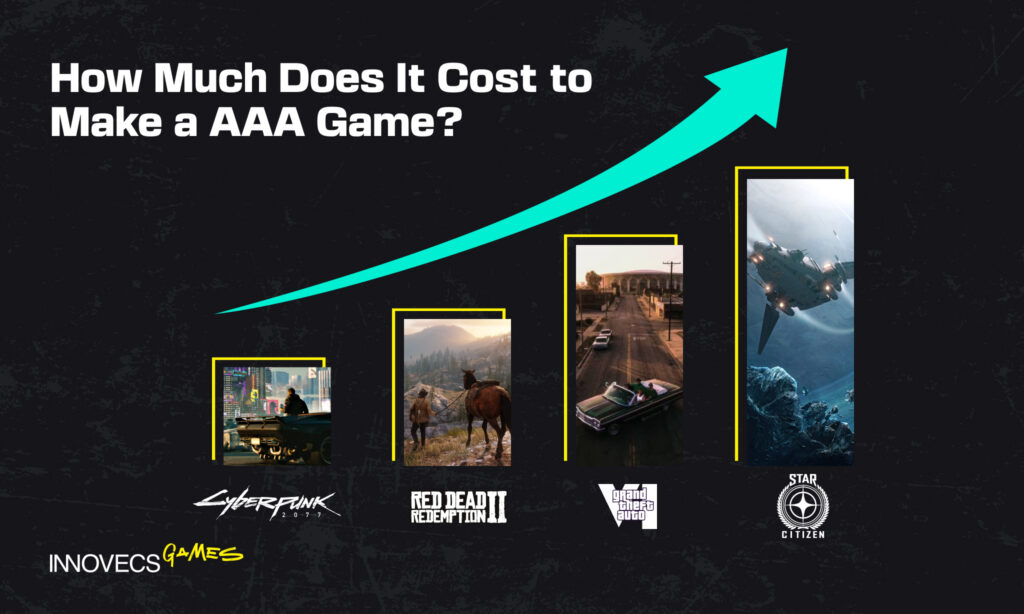
Marketing complicates the number further. It often matches or exceeds development spend. A game that costs $150 million to build might carry another $100–150 million on top just to launch it. Studios that treat marketing as an afterthought find that out the hard way.
AAA Game Development Cost Breakdown
No two budgets look the same, but the cost categories are pretty consistent across the industry. So how much does a AAA game cost to make, really? Here’s where the money goes.
Pre-Production and Concept
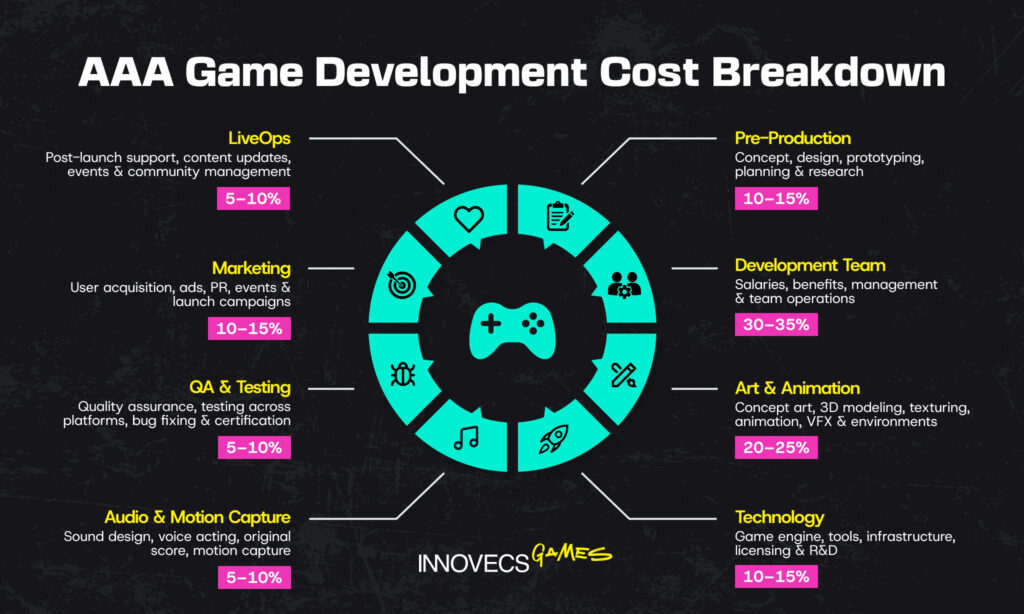
This is the production stage most studios underestimate. Concept development, prototyping, tech research, early design documentation. None of it ships, but all of it determines whether the rest of the project runs clean or sideways. Pre-production on a AAA title can run 12 to 24 months and eat 10–15% of the total budget before a single asset goes into production.
Team Salaries and Staffing
The biggest line item by far. A mid-sized AAA team of 300 people, paid over four years, at average developer salaries, runs into the hundreds of millions before you add benefits, contractors, or leadership compensation. Senior engineers and technical directors in North America and Western Europe command $150,000–$250,000+ annually. Scale that across a team and a multi-year development timeline and you see where the budget goes.
Art, Animation, and Assets
AAA games are asset-heavy by definition. Environments, characters, vehicles, weapons, UI elements, cinematics. Each one requires concept work, modeling, texturing, rigging, and animation. A single detailed character can take weeks. A large open world needs thousands of unique assets. Art and animation typically account for 25–30% of total production budget.
Game Engine and Technology
Game engine licensing is one of the costs studios sometimes underestimate early in production. Licensing Unreal Engine costs a royalty on gross revenue, historically around 5%, though terms vary. Unity operates on a different model but carries its own pricing considerations. Building a proprietary engine costs more upfront but avoids that ongoing cut. Either way, engine work, tools development, and technical infrastructure are significant. Studios building on next-gen consoles add platform certification costs on top.
Audio, Voice Acting, and Motion Capture
Often underbudgeted. A full voice cast for a narrative AAA game, with multiple languages, can run into the tens of millions. Motion capture adds on top of that. Original scores recorded with live orchestras are standard at the top end of the market. Audio is one of the areas where cutting budget shows immediately to players.
QA, Testing, and Certification
QA and testing at AAA scale requires large dedicated teams running continuously through the back half of production. Platform certification, getting approved for PlayStation, Xbox, and PC storefronts, adds time and cost that can’t be compressed past a certain point. Skipping corners here tends to result in launch-day disasters that cost more to fix than the testing would have.
Marketing and Launch
The marketing budget for a major AAA release often rivals development spend entirely. Trailers, influencer campaigns, events, paid media, retailer relationships, platform promotions. For a title chasing a global launch, $100 million in marketing is not unusual. Some go higher.
Post-Launch Support and Live Ops
The budget doesn’t stop at launch. Patches, updates, DLC, and live service infrastructure all carry ongoing cost. For games with a live component, post-launch support can stretch for years and rival the original development budget over time.
What Pushes AAA Budgets So High?
Scope is the obvious answer, but it’s more specific than that. A few things consistently separate a $100 million project from a $300 million one.
Team size and location matter enormously. A AAA studio in North America or Western Europe pays significantly more per seat than one operating across multiple regions. Same skills, different payroll. Studios working across time zones with co-development partners can stretch a budget further without sacrificing output.
Platform count adds up fast. Building for PC alone is one thing. Adding PlayStation and Xbox certification, optimizing for different hardware profiles, running separate QA passes for each. That’s not a small delta. Cross-platform launches can add tens of millions to a AAA game production cost.
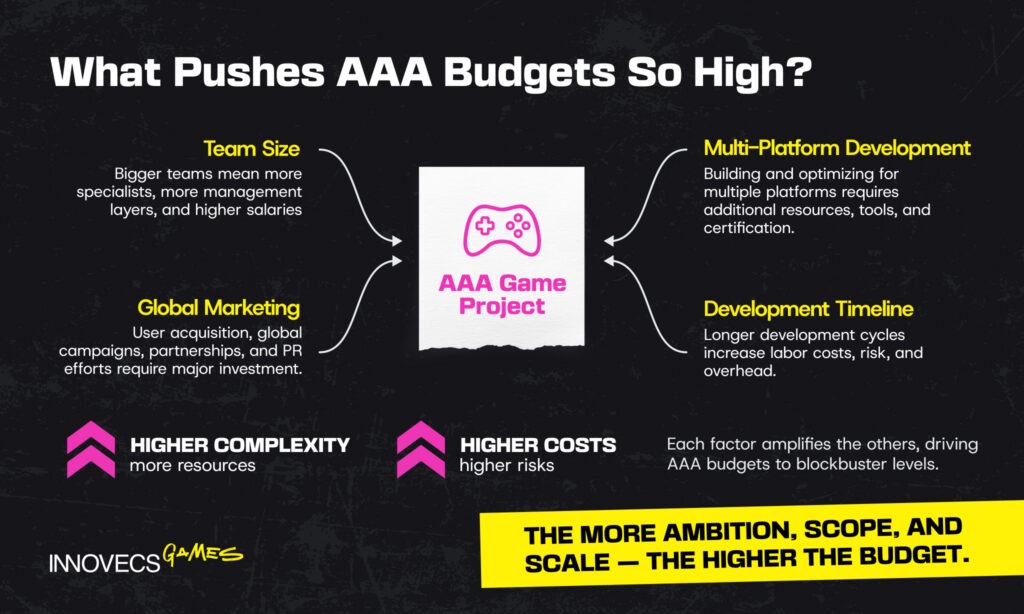
Then there’s time. Every extra month of development is another month of salaries, infrastructure, and licensing fees. A project that runs six years instead of four doesn’t cost 50% more. It often costs double once you factor in team growth, scope creep, and the rework that accumulates when a game spends too long in production.
Publisher funding adds another layer of complexity. Studios relying on external investment operate under milestone structures that can compress timelines in ways that cost more in the long run. Those constraints shape decisions throughout full-cycle development in ways that aren’t always visible in the final budget breakdown.
Engine choice plays a role too. Unreal Engine 5 is the default for many studios right now. Powerful, well-supported, speeds up certain parts of production. But royalty structures mean a successful game pays a percentage of revenue back to Epic. Proprietary engines flip that equation. Higher upfront cost, no ongoing cut.
None of these are surprises to experienced producers. Underestimating any one of them, especially development timeline, is where budgets most often go sideways.
What Real AAA Budgets Actually Look Like
Public budget figures are rare. Most studios don’t disclose them, and the ones that leak out are usually estimates built from financial filings, analyst reports, or anonymous sources. Take them as directional, not definitive.
That said, the numbers that are out there tell a clear story about where the industry sits.
Cyberpunk 2077 is one of the more cited examples. CD Projekt Red’s total spend, including marketing and the Phantom Liberty expansion, is estimated at around $450 million. The base game alone came in somewhere around $300 million by most accounts.
Red Dead Redemption 2 sits in a similar range. Estimates put Rockstar’s investment between $300 million and $540 million depending on what’s included. Eight years of development with a team reportedly exceeding 1,600 people at peak. The numbers follow from that.
GTA 6 is in a different conversation entirely. Analyst estimates based on Take-Two’s financial disclosures range from $1 billion on the conservative end to $3 billion or more when you factor in staff costs across all Rockstar studios since 2019. Whatever the final number is, it will likely be the most expensive entertainment product ever made.
Star Citizen sits in a category of its own. Funded almost entirely through crowdfunding, it has raised over $1.1 billion from backers as of 2026 and is still in alpha. It’s an outlier by any measure, but it illustrates how costs compound when a project has no fixed ship date.
On the lower end, a well-scoped AAA title from a mid-sized studio can come in at $80 to $150 million. Less headline-grabbing, but still a serious production with a serious team behind it.
The range exists because the ambition varies. Budget follows scope, not the other way around.
How AI Is Shifting the Numbers
AI isn’t going to cut AAA budgets in half overnight, though Morgan Stanley analysts think it could get close. A 2026 report estimated AI tooling could reduce game development costs by nearly half industry-wide, potentially unlocking $22 billion in annual profits for studios globally. That’s the optimistic projection. The reality on the ground is more incremental, but the direction is clear.
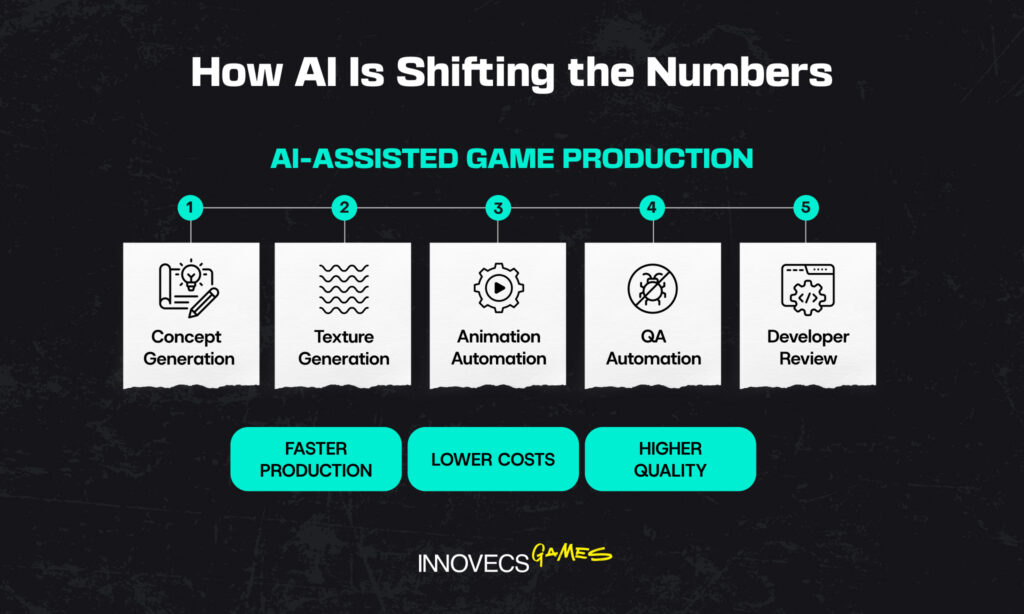
The biggest impact right now is on asset production. AI-assisted tools are cutting early-stage concept work and texture generation costs by 30–40% at studios that have integrated them properly. That doesn’t replace artists. It changes what artists spend their time on. Less repetitive generation work, more creative direction and refinement.
Animation pipelines are seeing similar gains. Tools like Move.AI and DeepMotion generate movement from video input or text prompts, reducing manual keyframing time significantly. Automated QA is another area getting traction, particularly for bug detection across large open worlds where manual passes are slow and expensive.
Where AI doesn’t help much yet is anywhere requiring high-level creative judgment. Narrative design, art direction, systems design. Those still need experienced people and real time. And any content going through an AI pipeline still needs review and sign-off. The cost doesn’t disappear, it shifts.
Net effect on AAA game development cost right now: real but modest. Scope keeps expanding to absorb whatever efficiency gains appear. That’s unlikely to change soon.
Bringing the Cost Down
There’s no magic lever. But studios that manage AAA budgets well tend to make similar decisions early, before the money is committed.
Scope discipline is the most important one. The games that blow past budget almost always started with a realistic plan that expanded incrementally until cutting anything felt impossible. Defining what the game is not, early and firmly, is genuinely hard on large teams. It’s also where the most money gets saved.
Beyond that, the decisions that move the needle most:
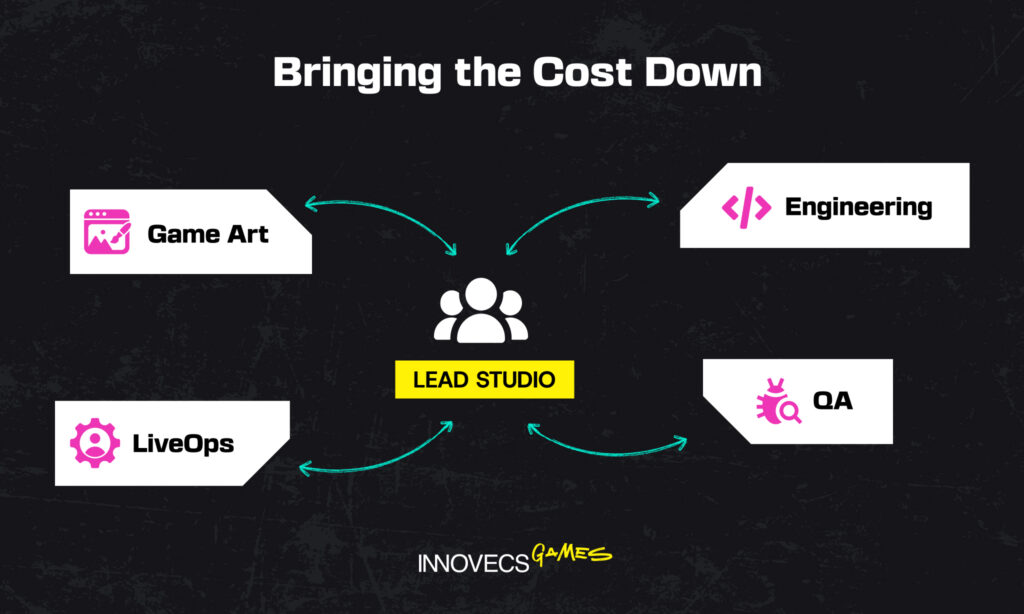
- Studio location and team structure. Co-development and outsourcing partnerships give studios access to skilled teams in regions where costs run 30–40% lower than North America or Western Europe. Art production, QA, and certain engineering workstreams are particularly well-suited to this model. It’s how mid-sized studios compete on production values they couldn’t otherwise afford.
- Choosing the right development partner. A full-cycle co-development studio with AAA experience brings production infrastructure and pipeline knowledge that doesn’t need building from scratch. That matters when development timeline pressure is already a cost risk.
- Engine decisions made early. Royalty structures, tooling costs, and the availability of experienced developers for a given engine all feed into the final number in ways that compound over a multi-year production.
- Monetization and ROI planning from day one. Studios that model their break-even point early make better scoping decisions. Knowing what the game needs to earn, and by when, shapes everything from feature cuts to time-to-market targets.
None of this eliminates the fundamental cost of building a AAA game. But it changes what you get for the budget you have.
Final Thoughts on AAA Production Cost
AAA development cost has never been higher, and the pressure isn’t letting up. Bigger worlds, more platforms, higher player expectations, longer productions. Every generation raises the floor.
But the studios navigating it well aren’t necessarily the ones with the biggest budgets. They’re the ones that make hard scope decisions early, build smart team structures, and treat time as the cost driver it actually is. The budget follows those choices, not the other way around.
If you’re scoping a project and trying to figure out where co-development or outsourcing fits into that picture, it’s worth talking to a studio that’s worked at this scale before.