How to Make Concept Art for Games
Every video game starts as an idea. The problem is ideas aren’t buildable. You can’t hand a programmer a vibe or ask a level designer to work from a feeling. Something has to bridge that gap.
That’s concept art. Not finished artwork. Not polished illustrations. Early visual work that turns initial ideas into images other people can actually use.
A concept artist takes a game vision and makes it visible. What do the game’s characters look like? What does the game world feel like to be in? Which art styles fit the tone? These questions get answered through sketching, experimenting with different elements, and sometimes scrapping a week of work because it wasn’t working.
Video game concept art isn’t decorative. It’s functional. It exists to help teams make decisions faster and create immersive worlds before a single asset gets built.
What Is Game Concept Art
Game concept art is visual work created before production starts. Its job is to define what a video game looks like so the people building it aren’t guessing.
That covers a lot of ground. Character concept art works out the appearance, personality, and proportions of the game’s characters. Environment art establishes architecture, atmosphere and materials. Prop art handles the objects players interact with. Vehicle art covers machinery and transportation. All of it falls under the broader umbrella of game art, and all of it serves the same purpose: giving everyone something concrete to work from.
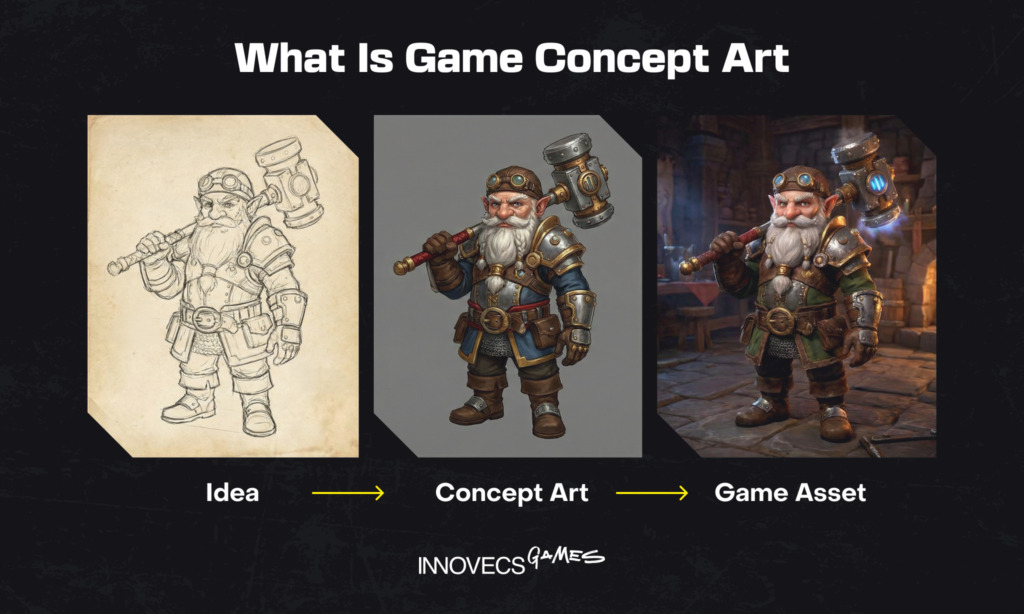
Most of this work never gets framed. A lot of it is initial sketches, quick color studies, and rough visual elements that exist to answer a specific question and move on. Artists test different art styles, gather references, and develop ideas through iteration rather than a single polished image. All of these elements work together to build a complete picture of the game. The creative process in concept art is messy by design.
What matters is that the game concept art communicates clearly. Whether it’s a rough thumbnail or developed artwork, anyone who picks it up needs to look at it and understand.
Why Concept Art Matters in Game Development
Without concept art, game development gets expensive fast.
Teams start building assets before anyone agrees on what the video game should look like. Revisions pile up. Characters get rebuilt multiple times because the final design kept shifting. Environment artists work in different directions because nobody locked down a visual style early enough.
Concept art moves the decision-making earlier, when changes cost hours instead of weeks. Art directors, designers, and developers look at the same images and align. Getting these elements right early is what keeps production on track. The game takes shape on paper before anyone writes a line of code.
Good game concept art also does something harder to measure. It makes the project feel real to the team. There’s a difference between describing a game world and showing someone a piece of artwork that puts them inside it. That matters for communication, for focus, and for keeping everyone pointed in the same direction.
Where It Fits in the Development Process
Concept art lives mostly in pre-production. Characters, environments, key locations, the game’s setting, overall visual design. These get explored while the team is still working through gameplay mechanics and core systems.
That’s not a hard rule. On larger projects, concept artists sometimes work through full production, creating art for new areas as the game grows. But the heaviest lifting happens early, before the development process locks in too many decisions.
Types of Concept Art for Games
Some video game concept art defines characters. Some shapes environments. Some covers the objects, creatures, and vehicles that give a game its identity. These different kinds of game art work together to build a stronger sense of the world and support a more cohesive player’s experience. 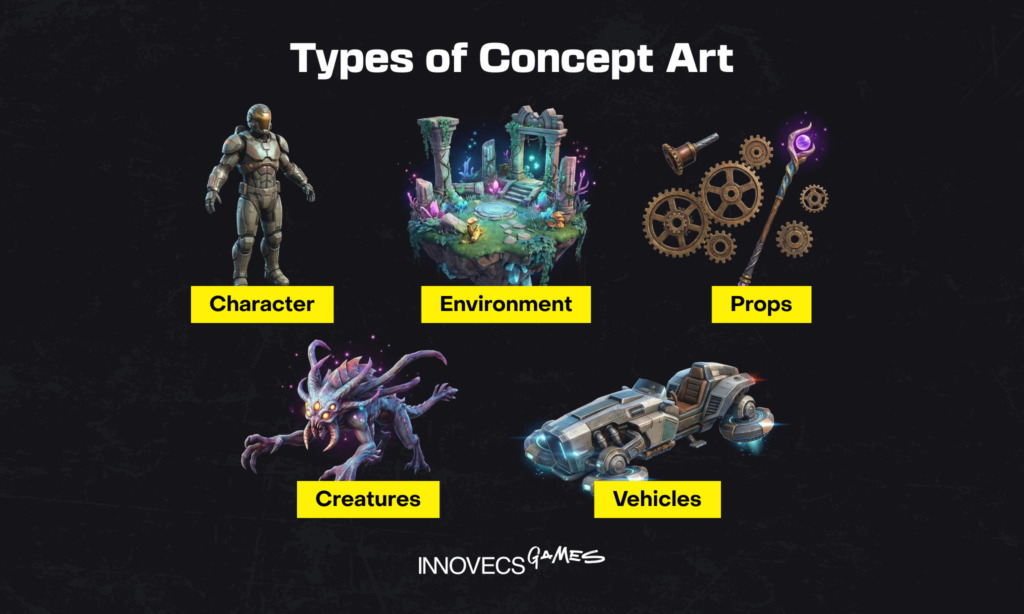
Character Concept Art
Character concept art defines the game’s characters before anyone models them. Silhouettes, proportions, expressions, costumes, equipment. Artists pay close attention to how a character reads on screen and study how the body moves to make sure proportions feel believable even in stylized designs.
Character concept art is more than just appearance. The way a character stands, what they carry, how their costume fits the world around them. All of it communicates personality and helps evoke emotions before a single line of dialogue appears. A well-designed character reads instantly.
Character sheets typically include front, side, and back views with callouts for materials, accessories, and construction details. Modelers and animators need that level of detail to build something accurate.
Creature Concept Art
Creature artists create things that don’t exist, which usually means combining reference material from real life, biology, and animal forms into something new.
The design process involves exploring different types of limb structures, head variations, and body proportion studies before one gets selected. This stage figures out how the creature moves, how threatening it looks, and how it fits into the world around it.
Prop Concept Art
Props are the objects that fill a video game world. Weapons, tools, furniture, containers, signage. Small stuff mostly, but it adds up fast.
Prop concept art usually includes orthographic views showing shape, materials, and construction from multiple angles. Even minor objects carry visual design information. A worn chair in a tavern tells players something about the world. A weapon communicates technology level and culture. These details matter for storytelling even when players aren’t consciously paying attention.
Environment Concept Art
This type of concept art creates the game’s setting. Landscapes, architecture, interior spaces, atmosphere, materials, and mood. It gives visual representation to places the team needs to build and helps level designers understand how a space should feel, not just how it should look.
Bold colors for something heightened and stylized. Muted tones and heavy shadow for something threatening. The color schemes established at this stage carry through into the final product.
A single environment painting might go through a dozen variations before the approach locks. That’s normal. That’s the point.
Vehicle Concept Art
Vehicle designs balance appearance with function. Artists work out mechanical structure, proportions, and materials while thinking about how players interact with the vehicle during gameplay mechanics.
Designs typically include cutaway sketches, multiple perspective views, and functional notes that give 3D teams what they need to build accurate models.
The Game Concept Art Creation Process
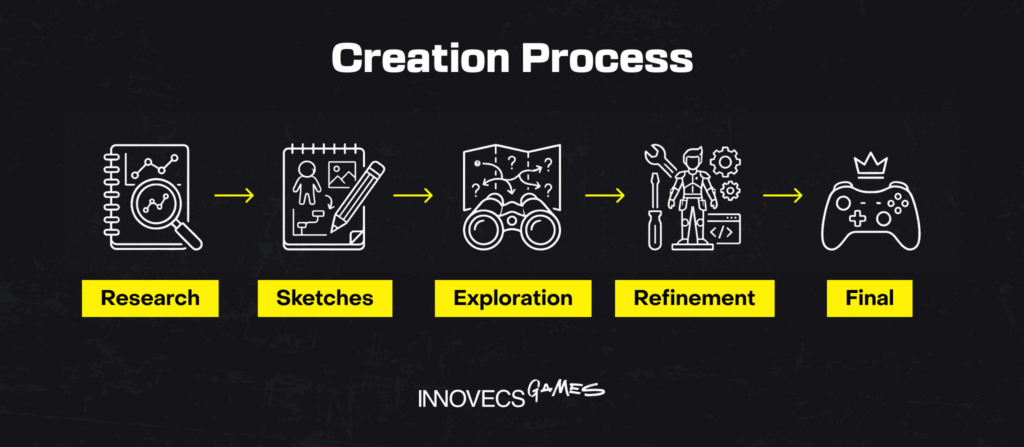
Most studios approach concept art through a clear series of stages, gradually refining early ideas into designs that can move forward into production.
Before any sketching starts, everyone needs context. Genre, tone, camera perspective, target audience, core gameplay mechanics. That information shapes every decision that follows. A character designed for a gritty realistic video game looks completely different from one built for a stylized mobile title. Getting this brief wrong wastes a lot of time.
Research and Reference Boards
Artists gather inspiration from film, photography, fashion, industrial design, architecture, nature, and real life. Reference boards aren’t vague mood collections. They’re specific. This texture. That silhouette. This lighting approach. Good boards give developers a focused visual language to work from and help the team create work with a stronger, more consistent identity.
Initial Sketches and Ideation
Volume first, detail later. Silhouette variations, proportion studies, quick lighting passes, composition thumbnails. The goal at this stage isn’t a great drawing. It’s figuring out which approach is worth pursuing. Exploring ideas freely here costs almost nothing compared to changing course later in production.
Developing the Final Design
Once an approach is selected the work gets more deliberate. Concept artists refine structure, lock in materials and color, and work through the details. Designs get checked against technical requirements too. Something that looks great might not be feasible to build, and catching that during concept is far better than catching it during asset production.
Final Concept Art Presentation
The final stage is preparing designs so other teams can use them. Clean views, callouts explaining materials and construction, supporting images that answer questions before they get asked. The goal is ensuring consistency across the whole team. A designer picking up an environment brief or a modeler starting on a character should have everything they need to move forward without guessing.
Key Skills for Concept Artists in Game Development
Strong concept work takes more than imagination. A concept artist needs technical drawing ability, design awareness, and the ability to communicate a concept art style clearly enough that other departments can build from it.
Drawing Fundamentals
Perspective, proportion, structure, clear shapes. These fundamentals let artists communicate form quickly without relying on heavy rendering. A readable sketch is more useful to a development team than beautiful artwork that doesn’t answer the right questions. Everything else builds on top of this foundation.
Color and Lighting
Color and lighting do a lot of work in concept art. They establish mood, define materials, guide attention, and create a sense of place. Artists use them deliberately. Even rough color studies tell you whether a location feels dangerous, warm, desolate, or alive. A single change in tone can completely shift how a space reads.
Composition
Composition controls how viewers read an image. Scale, framing, focal points, depth. Strong composition gives images visual interest and makes complex elements and character designs easier to read at a glance. A concept artist who understands composition can communicate a lot with very little detail.
Human Anatomy
Even in heavily stylized games, understanding how bodies move and carry weight matters. It underpins natural poses and proportions that feel intentional. Artists who understand this can break the rules on purpose. Artists who don’t tend to produce characters that look slightly wrong without anyone being able to say exactly why.
Visual Storytelling
The best concept art tells you something about the world without explaining it. Worn materials on a weapon suggest heavy use. Overgrown architecture suggests abandonment. Furniture and small objects placed within a scene suggest who lives there and how.
These details shape the player’s experience before gameplay even starts. Artists who think in terms of storytelling produce artwork that makes a game world feel lived in rather than assembled from parts.
Concept Art Styles in Modern Games
The art style a game commits to affects more than surface appearance. It shapes mood, readability, technical demands, and how players interpret the world on screen. Here’s a look at the different types of styles most common in modern game projects.
Realistic
A realistic art style aims for believable textures, surfaces, scale, and lighting. The inspiration comes from real life. Photography, film, historical sources, actual locations. Games like Red Dead Redemption use this kind of visual representation because small details are what sell the setting. Nothing can look too clean or convenient.
Stylized
A stylized art style moves away from realism deliberately. Exaggerated proportions, simplified forms, sharper silhouettes, bold colors, stronger graphic choices. This concept art style works well when readability matters more than accuracy, or when a studio wants a visual identity strong enough to be recognizable from a distance.
Semi-Realistic
Semi-realistic sits between the two and honestly covers a lot of modern game projects. Believable structure and proportion with more freedom in shape language, mood, and rendering. It lets developers create immersive environments with real atmospheric depth without demanding that every asset match real life accuracy.
Tools Used for Game Concept Art
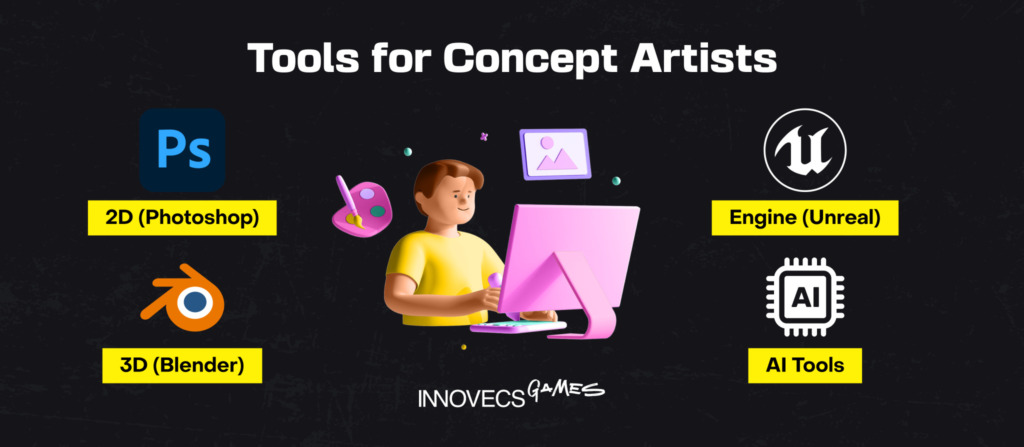
Studios rely on a mix of digital painting software and 3D tools to support modern concept workflows. These tools help artists test form, lighting, and composition quickly while keeping designs flexible during early production.
Digital Painting Software
Photoshop, Procreate, Clip Studio Paint. Most concept artists work primarily in one of these. Layers, brushes, fast iteration. Artists adjust materials, surfaces, and colors without rebuilding images from scratch, which makes these tools well suited to the early stages of the creative process when ideas are still shifting.
3D Tools
Blender, ZBrush, Unreal Engine. Studios use these to block out scenes and objects before painting over them. Useful for establishing scale, depth, and camera angles, especially for vehicles and complex architectural elements where getting structure right matters before surface detail gets added.
Using AI in Game Concept Art
AI has worked its way into the concept workflow at a growing number of studios. Not as a replacement for a concept artist, but as a tool for early exploration.
Teams use it to generate quick visual prompts, mood references, and variations based on descriptions. The output is rarely usable as final artwork. But it can surface approaches worth exploring or help a team react to something visual earlier in the creative process than they otherwise would.
Human judgment still drives everything that matters. Overall look, narrative tone, ensuring consistency across the project. AI handles some of the legwork during early idea generation. Artists handle the rest.
Why Choose Innovecs Games for Video Game Concept Art
Innovecs Games works with studios at multiple stages of a Game Development Company lifecycle. Early visual exploration, production-ready designs, and everything between.
Our artists create concept art across characters, environments, props, vehicles, and creatures. Projects come in with different visual requirements, different art styles, different timelines. We focus on adapting to what a project actually needs rather than pushing a fixed process onto every client.
Some partners need support during early concept phases while the visual approach is still being figured out. Others need capacity mid-production when the pipeline gets stretched. Either way the work is the same: concept art that helps teams create momentum and move forward without second-guessing every decision.