Playable Ads Development Guide for Mobile Marketing
Most mobile ads ask people to watch. Playable ads ask them to play.
Mobile game marketing has moved beyond static banners and short video spots. Many studios depend on playable ads that let players try a small part of a game before installing it.
These experiences run directly in a mobile browser. They need to load quickly and communicate the core idea of the game within seconds. A successful playable ad gives players a sense of how the game works and guides them toward installing the full app.
This guide looks at the playable ads development process and explains how these interactive formats help improve player engagement and campaign performance.
What Are Playable Ads?
Instead of passively watching a video ad, users can interact with a mini version of the game directly in their mobile browser or inside a third-party app.
Most playable ads focus on a single mechanic or idea of the game. One common type is the match-3 format used in Royal Match campaigns. These ads present a simple puzzle where players swap tiles and complete one move before the install prompt appears, usually guided by a short tutorial.
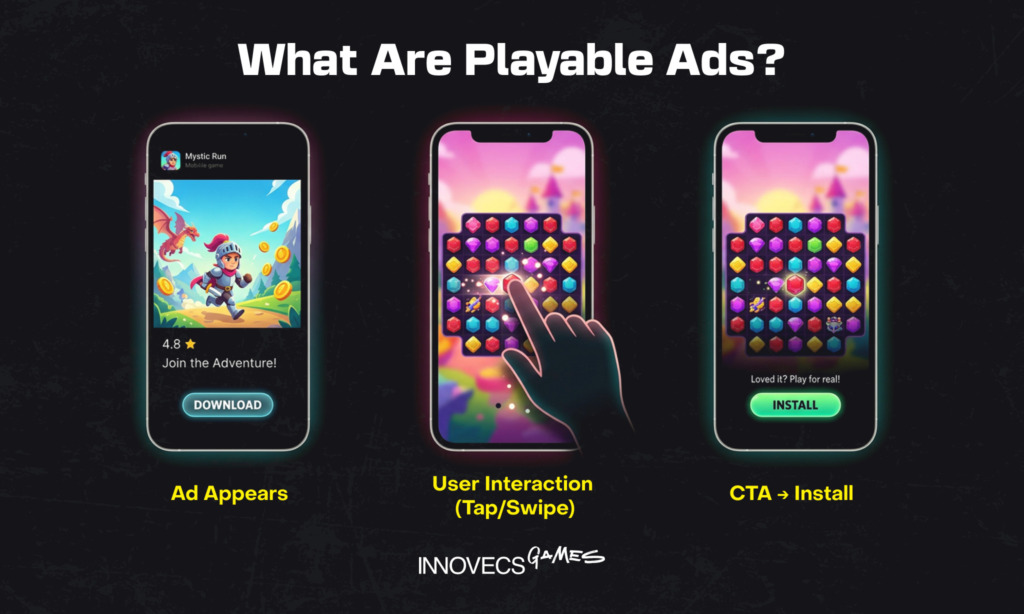
When someone taps the screen, swipes, or completes a small task, they quickly understand how the game works. Within seconds, the ad introduces the feature and presents a call-to-action encouraging players to download the game and continue playing.
Why Playable Ads Matter for User Acquisition
Interactive formats give marketing teams a way to ‘show’ instead of ‘tell’. When players engage with a demo before installing, apps see stronger retention and more qualified installs.
Playable ads influence several key user acquisition metrics:
- Engagement and session time – Traditional ads ask users to watch and decide quickly. Interactive elements invite them to engage. Even a short moment of gameplay can hold attention longer than a passive video or banner.
- Click-through rate (CTR) – Because players already understand the mechanic, playable formats frequently generate 2–3× higher click-through rate (CTR) than standard video or display ads.
- Conversion quality and retention – When players try the mechanic before installing, expectations are clearer. Successful interactive campaigns usually highlight a single high-engagement gameplay loop. When players understand the mechanic quickly, they are more likely to continue and install the full app. This can lead to 30–40% higher post-install retention compared with non-interactive ad formats.
- Cost efficiency – Higher engagement means campaigns often produce more installs per impression and lower overall acquisition costs. User acquisition teams often monitor metrics such as installs per mille (IPM), engagement rate, and time to first interaction to evaluate campaign performance and identify which creative concepts drive installs most efficiently.
Playable ads let the experience speak for itself instead of trying to convince users with screenshots or trailers.
Common Playable Ads Used in Mobile Game Development Campaigns
Interactive ads are created to highlight a single game mechanic while remaining simple enough to run smoothly in a mobile browser.
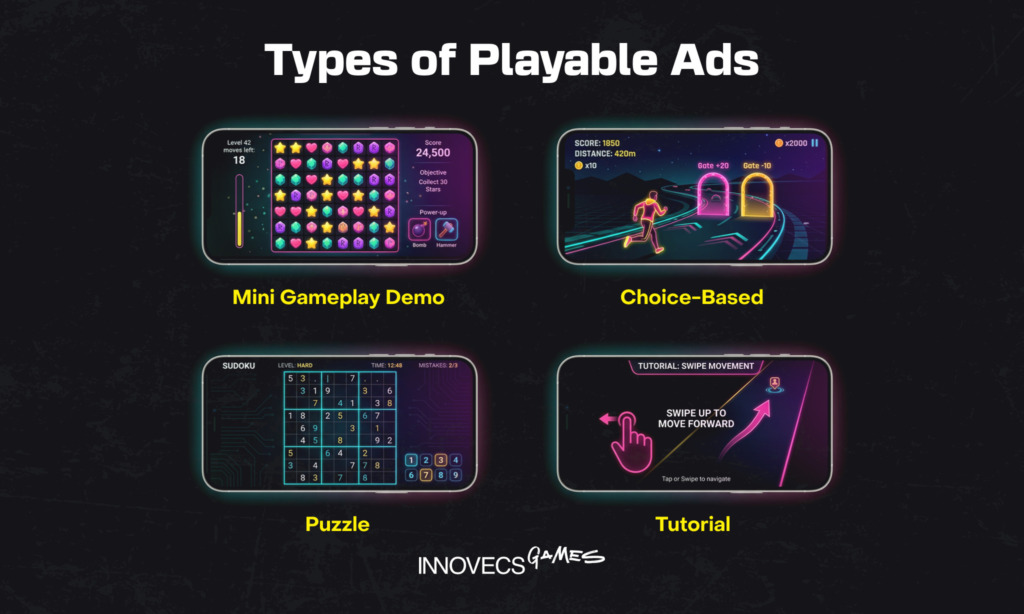
Mini Gameplay Demo
- Recreates a short moment from the real game experience.
- Players complete a quick challenge before the install prompt appears.
- Example: War Machines simplified its hybrid action-strategy mechanics into a straightforward “Aim & Shoot” demo. By focusing on a single shooting mechanic, the campaign introduced the core gameplay quickly and the full game has surpassed 100 million downloads.
Choice-Based Interaction
- Presents a quick decision or strategy moment.
- Players choose an option and immediately see the outcome.
- Strategy campaigns for Evony: The King’s Return often use a gate-runner challenge where players guide a character through gates that increase or decrease their army size. The mechanic is simple to understand but creates tension when the player chooses the wrong path.
Puzzle Challenge Format
- Shows a short puzzle that can be solved in a few taps or swipes.
- Works well for match-3 or logic mechanics.
- Sudoku.com invites players to solve a quick puzzle between game levels. Turning the ad into a fun challenge encourages people to engage immediately and see if they can complete it.
Tutorial-Style Demo
- Mirrors the early tutorial stage of a game.
- Guides players through one or two actions before prompting them to install the app.
- Many puzzle and casual titles use onboarding-style interactive elements that replicate the first tutorial moment of the full game. In these creatives, players receive a quick prompt showing how to swipe, tap, or drag objects before completing a simple objective. A breakdown of these formats shows how short tutorial prompts followed by a quick gameplay interaction and an end card are now standard structure for these experiences.
Strong advertising generally relies more on visuals than written instructions. Clear branding, animations, and movement help players understand the game immediately without reading long text prompts.
Playable Ads Development Process
A strong interactive campaign doesn’t start in production. It starts with a narrower question: what is the one part of the game that people will understand fast and still want more of afterward?
Ad development then moves through a short, structured process from concept to launch.
1. Define KPIs and choose the core mechanic
Before anything is created, the team will set KPIs tied to click-through rate, install rate, retention, or cost efficiency, then choose the on-screen features most likely to support those goals.
The strongest concepts tend to focus on one high-engagement loop. A drag, swipe, tap, merge, or quick decision can often deliver the idea faster than a more complex sequence.
2. Develop several concepts, then narrow the field
Rather than starting with production right away, studios usually test a few concept directions first. They compare those ideas against their KPI goals and choose the one most likely to engage players quickly.
At this stage, it helps to ask:
- Is the mechanic easy to understand on the first screen?
- Can the concept hook the user in under 20 seconds?
- Does it suggest there is more depth in the full app?
A good concept should feel satisfying, but it should also leave something unresolved.
3. Shape the flow
Once the concept is approved, the structure usually becomes very simple:
- a short tutorial prompt
- one focused mechanic
- an end card with a download CTA
This is also where pacing is defined. The experience should move quickly from the tutorial prompt into the main mechanic, with no unnecessary steps in between. Most successful concepts aim to hook the player within the first 15–20 seconds before introducing the end card.
4. Build with lightweight tech
Because these experiences run in constrained environments, file size and performance matter from the start. Teams reduce images, simplify animation, and cut anything that does not help the concept land.
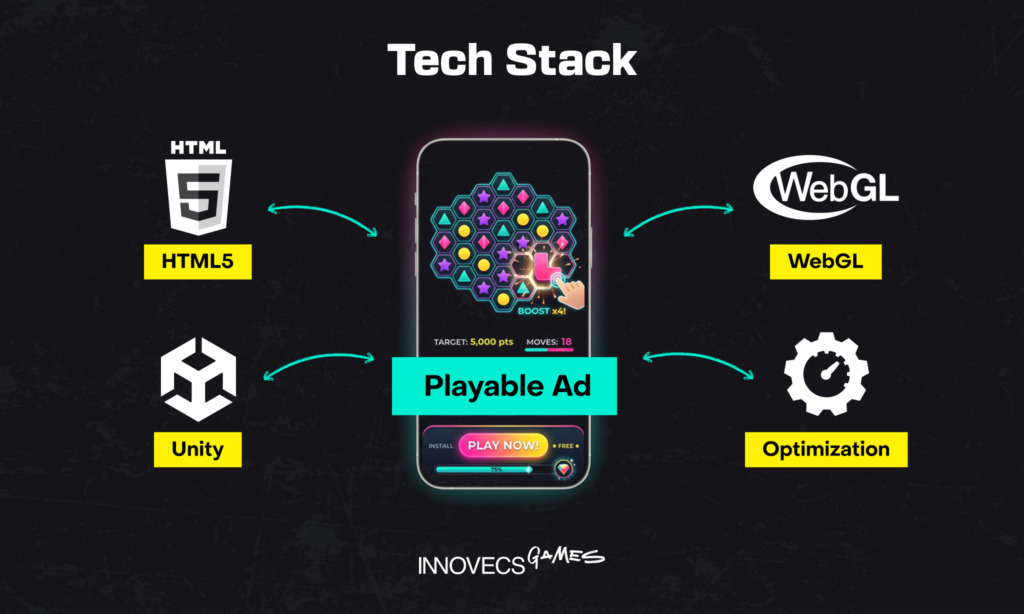
Most modern builds rely on lightweight tools and web-based tech, often using HTML5, WebGL, or a Unity workflow depending on the concept and channel. The goal is not to recreate the entire game, but to build something stable, responsive, and small enough to run smoothly.
5. Review and prepare for launch
After the build is ready, teams review it across devices, placements, and orientations, then refine the final version before launch. That can include adjusting pacing, swapping art, tightening the end card, or improving the CTA.
From concept to final build, the average timeline is often around three to five weeks, depending on complexity, art requirements, and how many versions are needed.
Best Practices for Playable Ads
Strong playable advertising experiences succeed when they respect the technical constraints of mobile campaigns while still delivering a satisfying gameplay moment to audiences.
Optimize Performance and Load Speed
These interactive experiences are created to run inside a mobile browser, so performance matters. Heavy assets, large images, or complex animation can slow loading and cause players to exit before interacting.
Studios typically optimize builds by:
- compressing images and animation assets
- simplifying systems from the original game
- keeping file size and processing demands low
This way the experience loads quickly and runs smoothly across devices and screen sizes.
Hook Players Quickly
Playable ads aim to capture attention within the first 15–20 seconds. A short tutorial followed by a quick gameplay moment helps players understand what to do immediately.
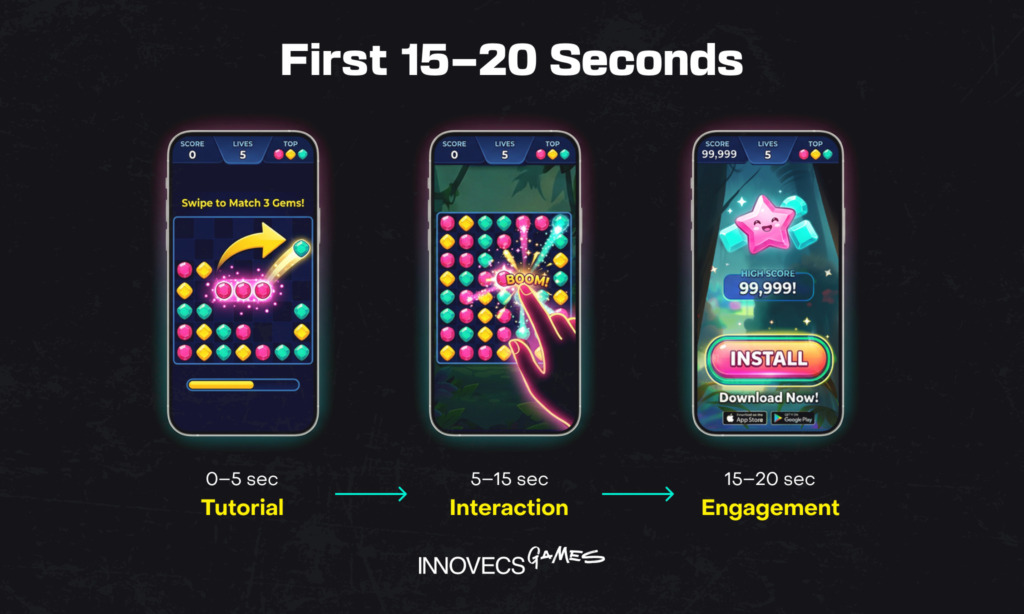
Effective concepts usually follow a simple structure:
- a brief visual tutorial
- one core gameplay interaction
- an end card encouraging players to download the app
This approach lets players try the mechanic quickly while keeping the experience under about a minute.
Use Visual Language Over Text
Clear visual cues help players understand the mechanic faster than written instructions. Movement, animation, and intuitive interactions should guide the experience, while text remains minimal.
When the interaction is obvious, players can begin playing almost instantly without reading detailed instructions.
Leave Players Wanting More
The goal is not to recreate the entire game. Strong concepts show one satisfying mechanic while hinting that there’s more to discover.
For example, an unfinished puzzle, a partially completed challenge, or a cliffhanger moment can encourage players to continue in the full app.
Test and Refine Concepts
Development rarely stops after launch. Marketing and game development teams typically run A/B tests to evaluate different tutorials, mechanics, layouts, and end cards.
Through testing and performance data, teams identify which concepts produce stronger engagement, installs, and retention.
Producing these experiences can also be technically demanding. Building a stable version often requires specialized tools, careful production workflows, and multiple testing rounds before the final version is ready to launch.
Why Work with Innovecs Games
Playable ads ask for a lot more than surface-level creative. They need sharp planning, disciplined building, and people who understand both mobile marketing and game development.
Innovecs Games brings that mix. Our portfolio includes mobile work built for performance, and our specialists are versed in the production demands that come with interactive campaigns. Using modern tools, Unity, and optimized tech, the team manages the full production process from concept to launch. With the essential resources and workflow in place, Innovecs Games helps partners scale campaigns and deliver reliable results.
Conclusion
At the end of the day, playable ads work because they give players quick access to the core experience before they download the full app. When created well, they can enhance advertising performance, support better retention, and answer a simple question: is this game worth trying?
There is no average formula and no easy template. Often, a couple of smart choices around text, sound, and player control do more to draw attention and keep the experience close to the real product than a heavier build ever could.