Mastering Isometric Perspective: A Step-by-Step Guide for Creatives
Isometric projection has become a key tool for designers, architects, game developers, and digital artists, particularly in creating architectural drawings. Its blend of simplicity, and precision allows creators to illustrate three-dimensional objects on a flat surface while maintaining uniform angles, and proportions, fulfilling a vital function in design.
By relying on parallel projection and orthographic projection, isometric designs preserve true dimensions and provide great value, making them ideal for architectural layouts, stylized digital art, and detailed isometric game worlds. For beginners, mastering the basics of isometric projection provides a strong foundation for producing accurate, consistent, and visually compelling designs.
Since 2024 until this year, the release of PC video games featuring bird’s-eye and isometric viewpoints had grown steadily, reflecting the ongoing popularity of these visual styles in game design. This trend underscores the enduring appeal of isometric and top-down views for creating immersive and strategically engaging gaming experiences, highlighting their function in modern game design.
Working with an Isometric Grid
An isometric grid provides the backbone for the creation of precise cube drawings and visually consistent isometric drawings. Composed of lines usually angled at 30 degrees, it allows artists and designers to convey depth, and three-dimensionality on a flat surface with ease.
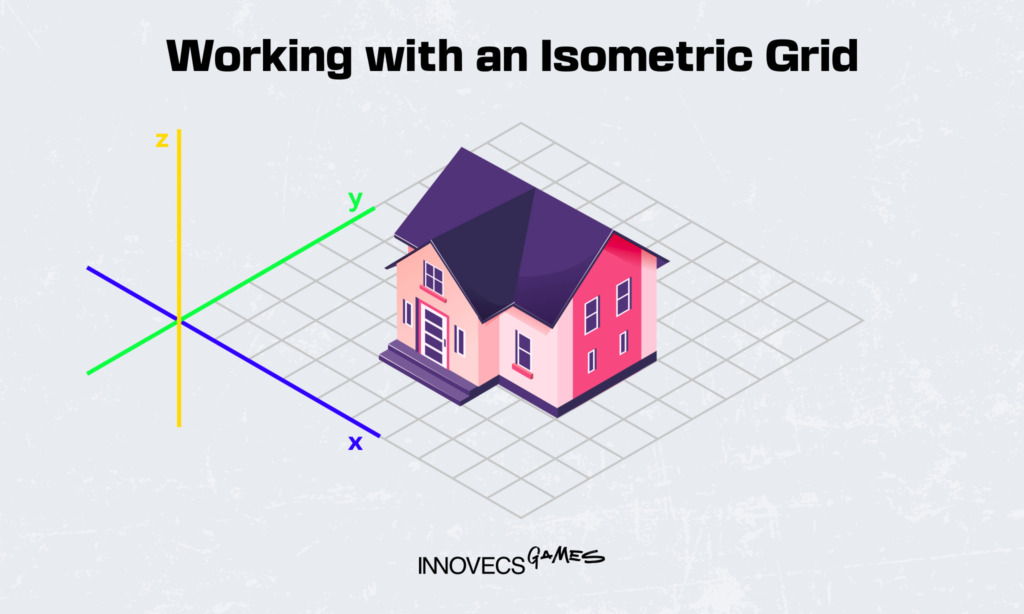
To use the grid effectively, one must understand the basics of how the x, y, and z axes relate to each other, how to position, scale, and manipulate shapes within this framework, and how to work with two dimensions. Mastering this tool ensures that every element in a drawing maintains proper proportion and alignment, adding significant value to the final product. Its versatility makes it indispensable not only in game development but also in architecture, graphic design, and other creative fields where accuracy and clarity are essential.
Isometric Drawing vs. One-Point Perspective
Both isometric artwork and one-point perspective are methods for representing three-dimensional objects on a flat surface, but they approach depth in very different ways. One-point perspective mimics human vision, with objects shrinking as they recede toward a single vanishing point, creating a natural, realistic sense of space. In contrast, isometric drawing relies on parallel lines and angled lines, keeping all objects uniformly sized regardless of distance.
This makes isometric drawings especially suited for technical and functional visuals, where clarity, precision, and consistent scaling are crucial. One-point perspective, on the other hand, excels at producing immersive, lifelike environments. While isometric designs allow for easy adjustments and accurate replication of objects, it is extremely important to note that their lack of true perspective can sometimes make elements appear slightly offset compared to how they would look in reality, which may create horizontal limitations.
Understanding the Difference Between Isometric Drawing and Isometric Projection
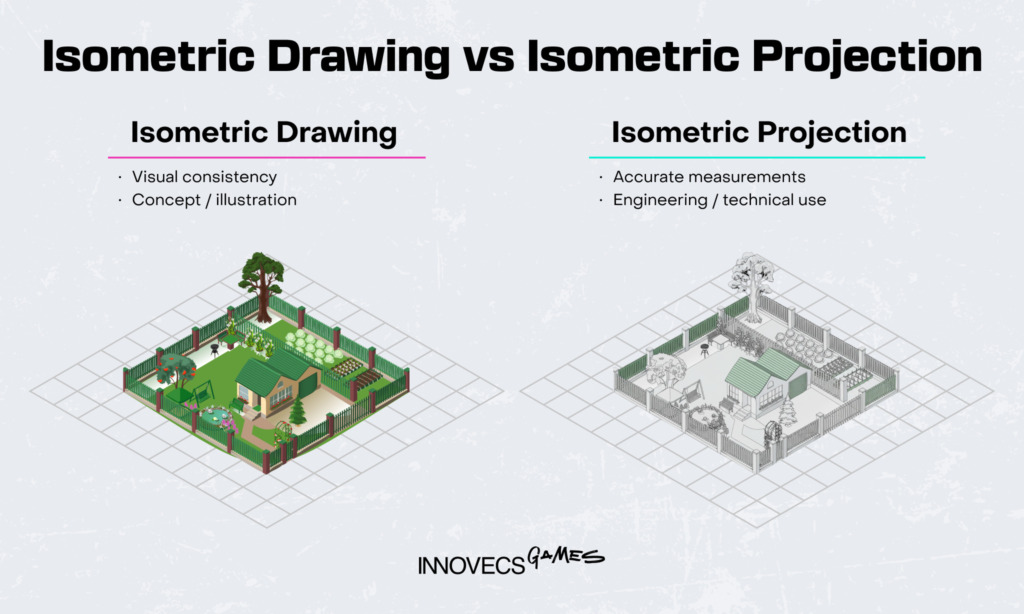
Grasping the distinction between isometric drawing and isometric projection is crucial for designers, engineers, visual communicators, and many artists. Both techniques depict three-dimensional objects on a flat surface, but they serve different purposes and vary in precision. While isometric drawing focuses on creating visually consistent representations, isometric projection emphasizes accurate measurements and true proportions, making each method suited to specific applications in design and technical visualization.
Isometric Drawing vs. Isometric Projection
Isometric Drawing
Isometric drawing is a visual technique that represents objects in three dimensions without relying on perspective, making it a useful illustration method. By maintaining equal angles of 120° between the axes, it allows objects to appear three-dimensional while keeping proportions visually consistent. This method is ideal for quick sketches, concept visualization, and presenting simplified designs in a clear and understandable way.
Isometric Projection
Isometric projection takes a more technical approach, focusing on precision, and accurate scaling. It reduces dimensions along each axis to preserve true proportions, making it especially useful for engineering drawings, detailed design documentation, and axonometric drawing scenarios where exact measurements are critical.
Where Isometric Techniques Are Used
Isometric techniques have found a wide range of applications across design, architecture, and visual communication, enhancing the experience of the viewer. By presenting three-dimensional objects in a clear and proportionate way, these methods allow creators to convey complete complex structures, layouts, and concepts effectively.
From planning architectural spaces, to guiding visitors through public areas, enhancing infographics and branding, or revealing the inner workings of a product, isometric techniques provide a versatile and visually engaging tool set for both technical, and creative fields.
Design and Architecture
Isometric designs are especially valuable for architects, industrial designers, interior designers, and engineers. They make it easy to visualize rooms, products, and structures from a single view using an isometric grid, helping designers test ideas quickly and communicate concepts clearly.
Wayfinding and Public Spaces
Museums, galleries, and large buildings often use isometric wall maps to help visitors understand where they are, what’s happening in different areas, and how to navigate the space.
Infographics and Branding
Many of the most effective infographics rely on isometric projection because it allows designers to show more information than a flat 2D drawing can. Some logos also use isometric styles to create a bold, dimensional look.
Exploded Isometric Designs
Exploded isometric views break an object apart to show its internal components, and how they fit together. These are useful for product manuals, technical presentations, and client pitches especially when demonstrating complex inner workings.
Advantages and Disadvantages of Isometric Projections
Isometric projections offer several benefits that make them a popular choice in design, and technical visualization. One of the main advantages is that only a single view is needed, providing a clear representation along the z axis eliminating the need for multiple perspectives.
They clearly show the three-dimensional nature of an object, allowing measurements to be scaled accurately along the principal axes. This approach provides strong dimensional accuracy while remaining easy to create, measure, and interpret, making it highly practical for designers, engineers, and architects.
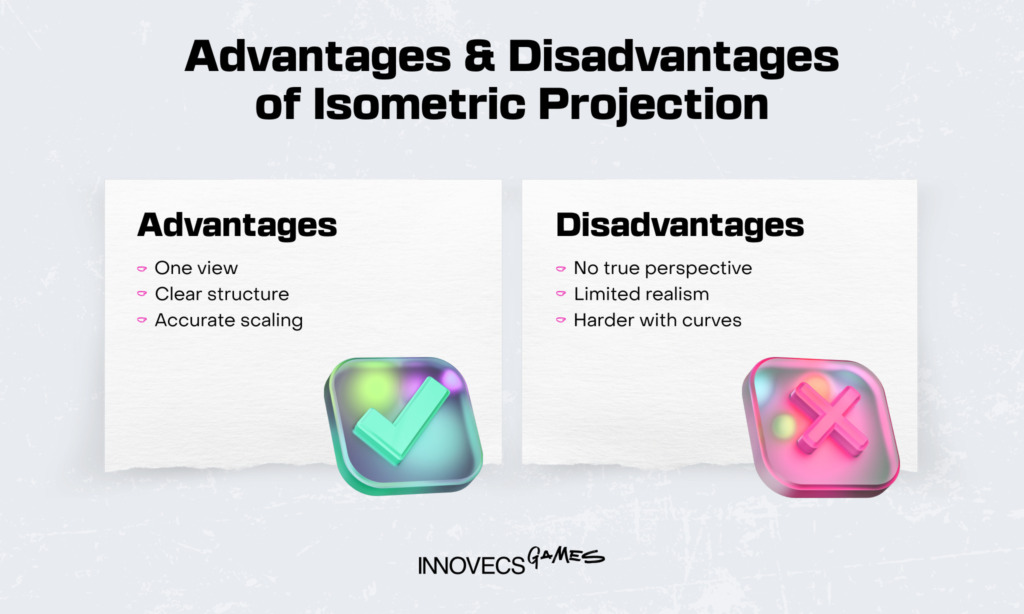
However, isometric projections also come with certain horizontal limitations in geometry. Because they lack true foreshortening, objects can appear slightly distorted, and the technique is generally better suited for simple geometric shapes rather than curved surfaces.
Depth, and spatial relationships may not always look fully realistic, which makes isometric projections less ideal for presentations, or designs that require a lifelike perspective. Despite these drawbacks, their clarity, and precision keep them widely used in many creative, and technical fields.
Isometric Illustration: More Than Just Line Art
Isometric illustration is far more versatile than simple black-and-white line drawings. In video games, the isometric perspective allows designers to create the illusion of 3D without relying on complex calculations, foreshortening, or multiple camera angles. This approach was especially important in early eight-bit and sixteen-bit games, where hardware limitations demanded efficient design. Classic titles like The Sims, and Age of Empires used isometric views to give players a clear, overall view of the game space.
As consoles evolved and processing power increased, traditional isometric views became less common in high-end games. However, the style has experienced a resurgence in mobile gaming, with titles like FarmVille leveraging isometric design for its efficiency and lower power demands. Even some modern console games, such as Shadowrun, and Invisible, Inc., use pseudo-isometric perspectives to achieve a distinct visual style. Beyond gaming, many artists now embrace isometric techniques to create innovative, contemporary artwork, moving beyond rigid lines to craft dynamic, visually engaging designs.
Mastering Isometric Art and Game Design
Creating isometric drawings starts with understanding how to create isometric art and lines, shapes, and angles interact to give the illusion of three-dimensionality on a flat surface. Artists can work from scratch or use grids and templates to guide their designs, ensuring accurate proportions and depth. This technique is widely used in game development, architecture, and graphic design to produce detailed and immersive visuals.
Tools like Adobe Illustrator make bringing these designs to life easier, offering features to create, edit, and manipulate shapes, layers, and paths with precision. Artists can craft intricate isometric patterns, and maintain perfect alignment, producing polished illustrations ready for professional use.
Turning these drawings into games involves building entire worlds, characters, and interactive objects with isometric projection that serve a specific function. Every element; from the layout of environments to the design of characters must convey depth and dimension, creating immersive experiences that draw players into the game through careful rendering.
Designing isometric games successfully requires both technical skill and creative vision. Developers work within grids, apply parallel projection, and carefully manage spatial relationships to ensure that objects move and interact realistically. By combining precise visuals with thoughtful gameplay, isometric games offer a unique blend of beauty, clarity, and engagement that keeps players coming back.
Top 6 Games With Isometric Perspective
Isometric perspective adds depth and clarity to game worlds, making them visually engaging and easy to navigate. Here are six popular examples:
1. Clash of Clans – Build and upgrade your village, train troops, and join clans to battle other players in this multiplayer strategy game.
2. Plants vs. Zombies – Defend your lawn with 49 unique plants, each with special abilities, in this addictive tower defense series.
3. Hay Day – Manage a farm by growing crops, raising animals, and trading goods with other players in this fun simulation game.
4. Legends of Kingdom Rush – Place all the tiles strategically to stop waves of enemies in this fantasy medieval tower defense game.
5. Diablo III – Explore dungeons, fight enemies, and collect loot in this action RPG with immersive video game art isometric combat views.
6. SimCity (2013) – Plan and manage your city using isometric views to easily visualize infrastructure, zoning, and traffic flow.
Why it Works: Isometric perspective remains popular because it combines visual clarity with dynamic gameplay, giving players a clear sense of space while keeping worlds engaging and immersive in equal measure .
Isometry and Game Art
Isometric graphics, also called pseudo-3D or 2.5D, are defined by their distinctive perspective created through parallel projection. Essentially, isometric graphics adjust the view angle in a game to simulate three-dimensional space using 2D assets and tiles. This approach is popular in game development and programming because it allows designers to depict 3D environments without the heavy processing demands of full 3D. Compared to traditional 3D graphics, isometric views can deliver higher visual fidelity while using fewer resources, making them accessible for smaller teams or lower-spec devices.
However, isometric graphics are not without drawbacks. Pre-rendered 2D sprites can encounter display issues, particularly as screen resolutions, and aspect ratios evolve. Maintaining high-quality visuals often requires re-rendering, and adjusting assets to match modern display standards, which can be time-consuming.
Despite these limitations, games that use isometric perspectives make the most of the format. By combining technical efficiency, appealing game art, and thoughtful gameplay design, isometric games create visually engaging worlds that offer a unique and enduring player experience, projecting an image that resonates with players .
Strategies for Designing Isometric Environments
A popular method for creating isometric worlds is the tile-based approach. Each tile represents a fixed unit of the game environment, allowing developers to build visually appealing and interactive landscapes.
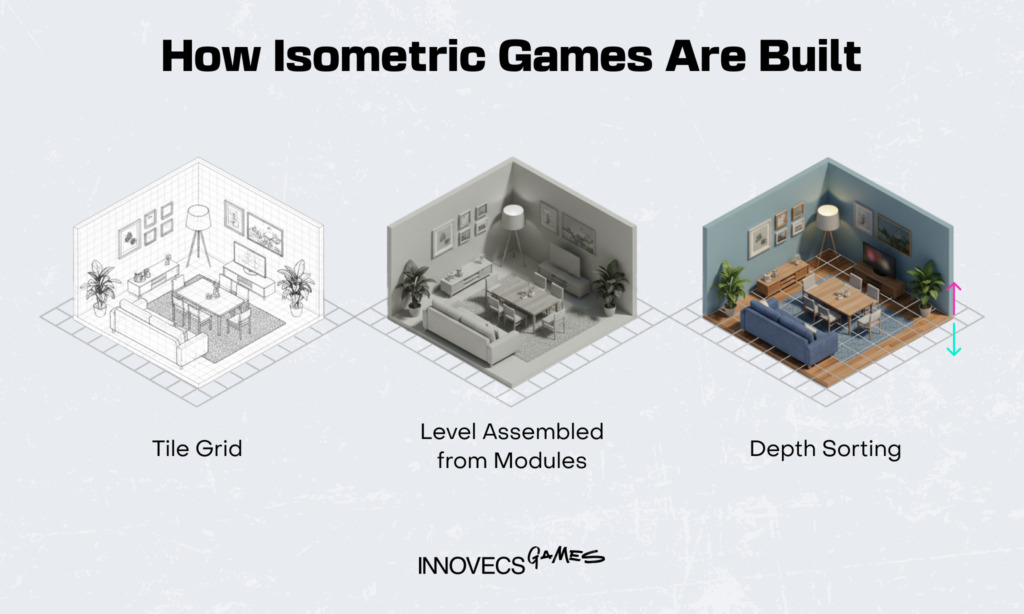
Proper depth sorting is essential; objects higher up in the scene should be rendered first, while those lower down appear last. By mastering tiles and their arrangement, designers can craft immersive environments that feel dynamic and engaging to players.
Crafting Isometric Characters and Objects
When designing characters and in-game objects, developers aim to create a seamless and immersive experience. Characters often require multiple animations that flow smoothly in eight directions. Collision detection must be carefully optimized by checking whether a specific tile is walkable, ensuring movement feels realistic.
Converting Cartesian coordinates into isometric ones allows precise positioning and motion, making gameplay intuitive and visually coherent. Attention to these details ensures that players remain engaged and enjoy consistent, polished interactions within the game world.
Animation Techniques for Isometric Characters
Animating characters in isometric games relies on sprites and registration points. Sprites represent different frames of motion, while registration points act as the origin for each sprite, enabling smooth movement across the isometric grid.
Proper use of these techniques allows developers to create fluid, lifelike animations, adding depth and excitement to gameplay. Mastery of sprite animation and movement mechanics is key to producing visually captivating isometric games that keep players invested.
Strategies for Upholding Art Quality in Isometric Games
Maintaining high programming art quality, such as the vertical line of design, is essential in isometric games to create immersive and visually rewarding experiences. The isometric perspective, blending 2D and 3D elements, gives players a unique view of game worlds, making careful design and attention to detail especially important.
Adjust Lighting
Lighting is a key factor in building appealing isometric environments. Techniques such as vertex attenuation, dynamic lights, and gradient tints or shades help create realistic depth and atmosphere.
Developers must carefully adjust light positions and offsets to ensure objects and scenes feel consistent and visually engaging. Proper lighting adds richness and mood, enhancing the overall player experience.
Optimize Textures
Texture optimization forms is crucial for both performance and visual fidelity. By refining texture details, adding variations, and managing resolution levels effectively, developers can create environments that feel rich and immersive without overloading system resources.
Optimized textures help maintain smooth gameplay while ensuring the game world remains visually compelling.
Add Variations to the Environment
Visual variety keeps an isometric game world exciting and realistic. Developers can scale, rotate, or skew objects, adjust transparency, and experiment with different materials to give each item a unique appearance.
By mixing these techniques throughout the environment, designers create dynamic, visually stimulating landscapes that captivate players and encourage exploration, providing helpful tips to enhance gameplay .
How to Learn Isometry
Creating isometric games on a computer starts with a solid understanding of isometry, which combines experience, study, practice, and working from a blank canvas. Learning the principles of isometric drawing and projection is essential for crafting visually appealing and engaging game worlds.
To improve your skills, start by practicing drawing objects in isometric view, paying attention to the angles, proportions, and depth that make these designs convincing. Using reference visuals, following tutorials, or taking structured courses can accelerate your learning.
With consistent practice and a focus on applying isometric principles, aspiring game developers can create immersive environments that captivate players and bring their games to life.
Conclusion
Isometry is a powerful technique that gives games a distinctive visual style while maintaining clarity and depth. From designing immersive environments to animating characters and objects, mastering isometric principles allows developers to create engaging and visually appealing worlds.
By combining careful planning, optimized assets, and thoughtful use of perspective in game development, isometric games can captivate players and provide unique, memorable experiences across platforms.