This article recaps Innovecs Games’ industry talk on the current state of AAA game development, unpacking why the traditional model has become so fragile and where it’s headed next. Drawing on real data and first-hand experience, the speakers explored layoffs, rising costs, shifting player behavior, and the growing risk of all-or-nothing releases. The discussion highlighted why scale alone no longer guarantees success and how studios are rethinking team structures, external collaboration, and production models to stay creative without burning out teams or budgets.
What Comes Next for AAA Games: Highlights from Innovecs Games’ Industry Talk
January 12, 2026
|
5 min read
Over the past few years, building big games has started to feel very different. Teams have grown larger, budgets have climbed higher, and expectations have become harder to meet, while confidence in the traditional AAA model has quietly eroded across the industry.
On November 19, Innovecs Games hosted a live online webinar, “From Crisis to Clarity: A New Blueprint for AAA Game Development”, bringing together industry leaders to talk openly about where AAA stands today and how it might evolve into something more sustainable.
The session was hosted by Chris Rowe, Business Development Director at Innovecs Games, and featured speakers with experience across publishing, development, and external production:
- Nader Alikhani, VP of Games at Innovecs Games
- Amir Satvat, Business Development Director at Tencent Games and founder of Amir Satvat’s Games Community
- Sam Carlisle, Co-Founder of XDS Spark and former Director of External Partners at Xbox
The audience included innovecsers alongside developers, producers, and industry professionals from across the games ecosystem, all tuning in with the same question in mind: how do we keep making ambitious, high-quality games without burning teams out or betting entire studios on a single release.
Rather than revisiting headlines, the discussion focused on lived experience, real data, and practical shifts already taking place, from leaner team structures and external collaboration to more realistic expectations around scale, scope, and risk.
The State of AAA Today: What Actually Happened
The session opened by acknowledging how difficult the last few years have been for AAA studios. Rather than relying on headlines or anecdotes, the panel set out to ground that feeling in data and lived industry experience.
A Rough Few Years, Seen Clearly
Amir Satvat helped frame the scale of the situation with concrete numbers. Globally, the games industry employs around 500,000 people. Over the past three years, roughly 45,000 layoffs have occurred. On its own, that figure does not point to collapse, but it becomes far more meaningful when viewed through the lens of where those cuts happened.
Where the Impact Was Felt Most
Around 60–70% of layoffs took place in North America, with California accounting for roughly 40–50% of the total. In regions where AAA development is heavily concentrated, that translated into something closer to a 20% local workforce reduction, making the disruption far more visible than the global numbers suggest.
Why It Felt Relentless
The situation was intensified by frequency. Amir noted that there have been more than 500 separate layoff events, creating a steady cycle of bad news. Even developers who were not directly affected felt the instability, as announcements became a near-constant backdrop.
Chris Rowe pointed out how easy it is to become desensitized when layoffs and studio closures blur together. Seeing the data laid out helped clarify what actually happened: AAA did not implode across the board, but it absorbed a disproportionate share of the shock, particularly in high-cost regions and large-scale production environments.
Why the Model Broke
Once the scale of the disruption was clear, the conversation turned to why the AAA model became so fragile in the first place. The panel agreed this was not the result of a single misstep, but of pressure building up over many years.
Growth Without a Ceiling
Nader Alikhani described an industry that grew accustomed to constant expansion. Revenues continued to rise, new audiences kept appearing, and budgets stretched further each cycle without ever encountering a clear limit. When several large publisher bets failed in close succession, the system had no buffer left. As he noted during the discussion, the industry suddenly found itself trying to backtrack and “find a new equilibrium” after a long period of growth.
The Cost of Playing It Safe
Rising development costs played a central role in narrowing creative choices. As budgets increased, publishers leaned more heavily on established franchises and familiar mechanics to reduce risk. The more money involved, the greater the pressure to guarantee outcomes, which naturally pushed teams toward iteration rather than experimentation.
A Market That Moved On
From the player side, Amir Satvat highlighted a shift that undercut many traditional AAA assumptions. In repeated surveys within his community, half of respondents said they had not bought a single full-price AAA game in the past year, while 80% said they bought two or fewer. With subscriptions, discounts, free-to-play titles, and large backlogs, players have become far more selective and far less rushed to buy at launch.
The Discoverability Problem
Amir also pointed to discoverability as a growing challenge. Outside of the biggest tentpole releases, even strong games can struggle to be noticed. Media influence has weakened, retail is no longer a primary driver, and attention is now split across games, social platforms, and other forms of entertainment. The result is a model where costs continue to rise, demand is harder to predict, and missing sales targets carries increasingly severe consequences.
When Scale Stopped Helping Creativity
As the discussion moved on, the panel agreed that scale itself is not the enemy. The problem lies in how AAA has chased it. Over time, bigger teams, longer games, and higher fidelity became shorthand for quality, even as costs and complexity continued to rise.
Fidelity, Cost, and Iteration
Nader Alikhani pointed to visual fidelity as one of the biggest pressure points. Pipelines have improved, but not enough to justify how expensive realism has become. As more budget gets locked into polish and immersion, studios increasingly default to iteration rather than risk, often building on what already exists instead of trying something fundamentally new.
Ambition Without Control
Sam Carlisle emphasized that ambition still matters. In his view, AAA should remain aspirational and continue pushing boundaries. The issue is not aiming high, but allowing scope to grow without production models that can realistically support it.
A Shift in Player Values
Amir Satvat added that the value equation has changed, particularly for younger players. Social connection, accessibility, and fun now often outweigh technical spectacle. Many of the experiences that once made AAA feel special are delivered elsewhere, and frequently at much lower cost.
The result is a tension AAA has yet to fully resolve: how to stay ambitious without overbuilding, and how to make games feel exciting again without assuming that bigger automatically means better.
What a Healthier AAA Model Could Look Like
When the conversation moved from diagnosis to solutions, the panel focused on how AAA teams are structured and how production scales over time. Rather than calling for smaller ambitions, the discussion centered on building games in a way that allows studios to stay flexible without carrying unsustainable risk.
Nader Alikhani argued that the issue is not the need for scale, but the assumption that scale must be permanent. Ambition still requires large teams, but not necessarily all at once or in the same form throughout development.
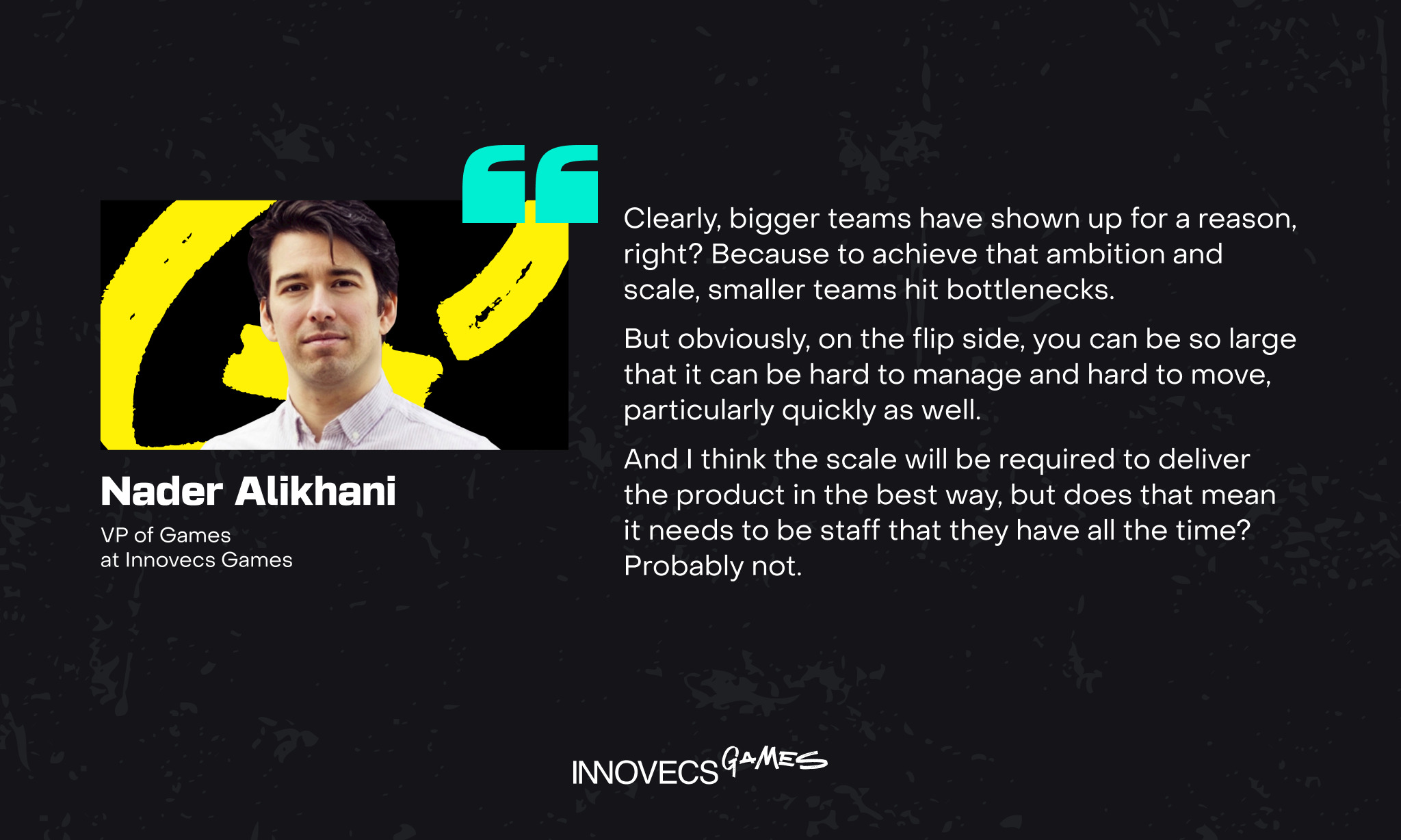
That thinking is tied directly to risk and long-term sustainability. Amir Satvat was more skeptical that recent belt-tightening across the AAA represents a real strategic shift. In his view, many studios are still operating under the same high-cost, all-or-nothing assumptions that led to the current situation.
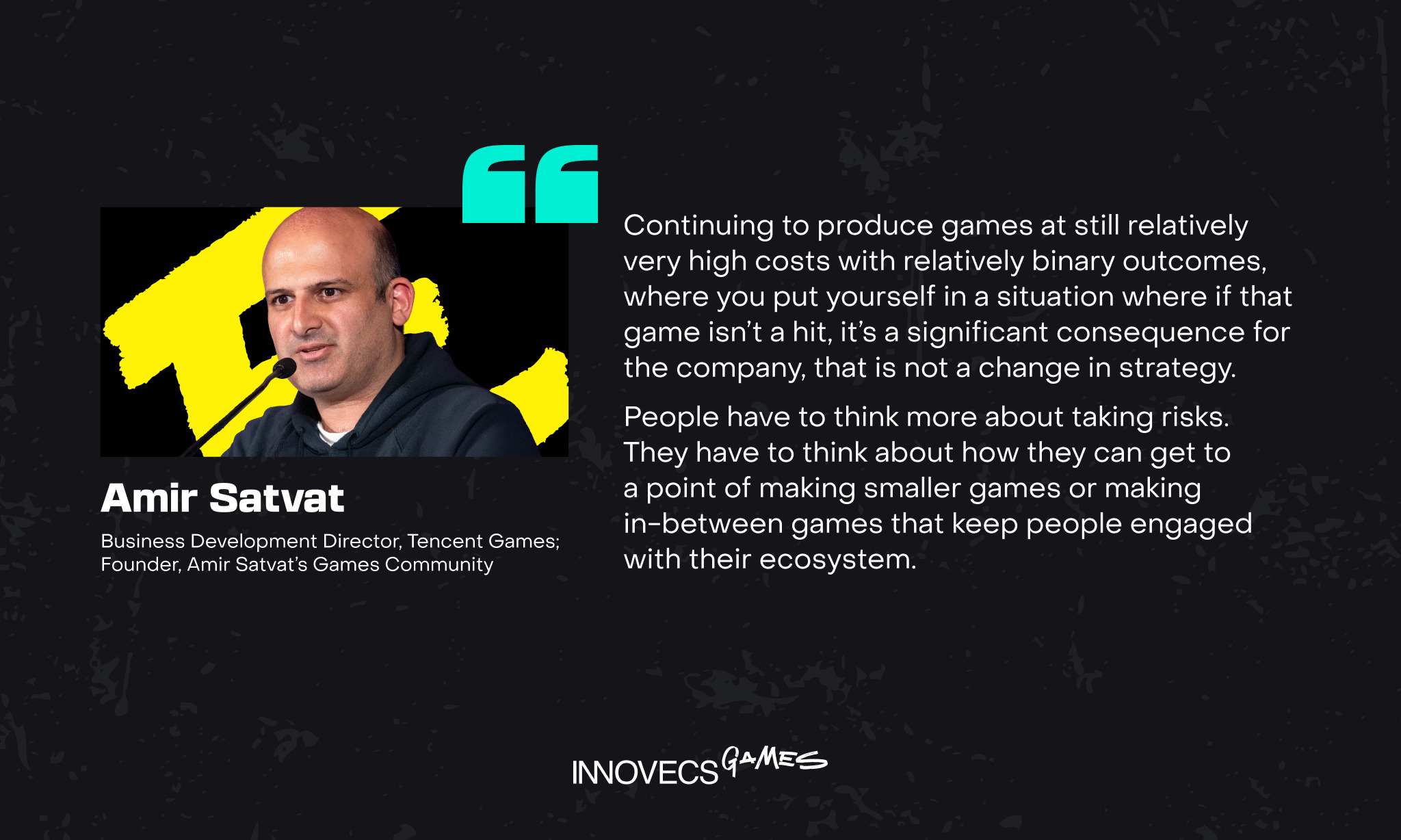
Rather than treating external development as a short-term fix, the panel framed it as a structural part of a healthier AAA model. Used intentionally, it allows studios to scale expertise up and down, reduce binary risk, and build production pipelines that can adapt to reality instead of fighting it.
Q&A Session
After the main discussion, attendees were invited to ask questions. Many of them reflected concerns developers hear daily from players.
Question 1: Many AAA games today feel rushed and launch with technical issues. Why is that happening, and how can studios get back to delivering a strong day-one experience?
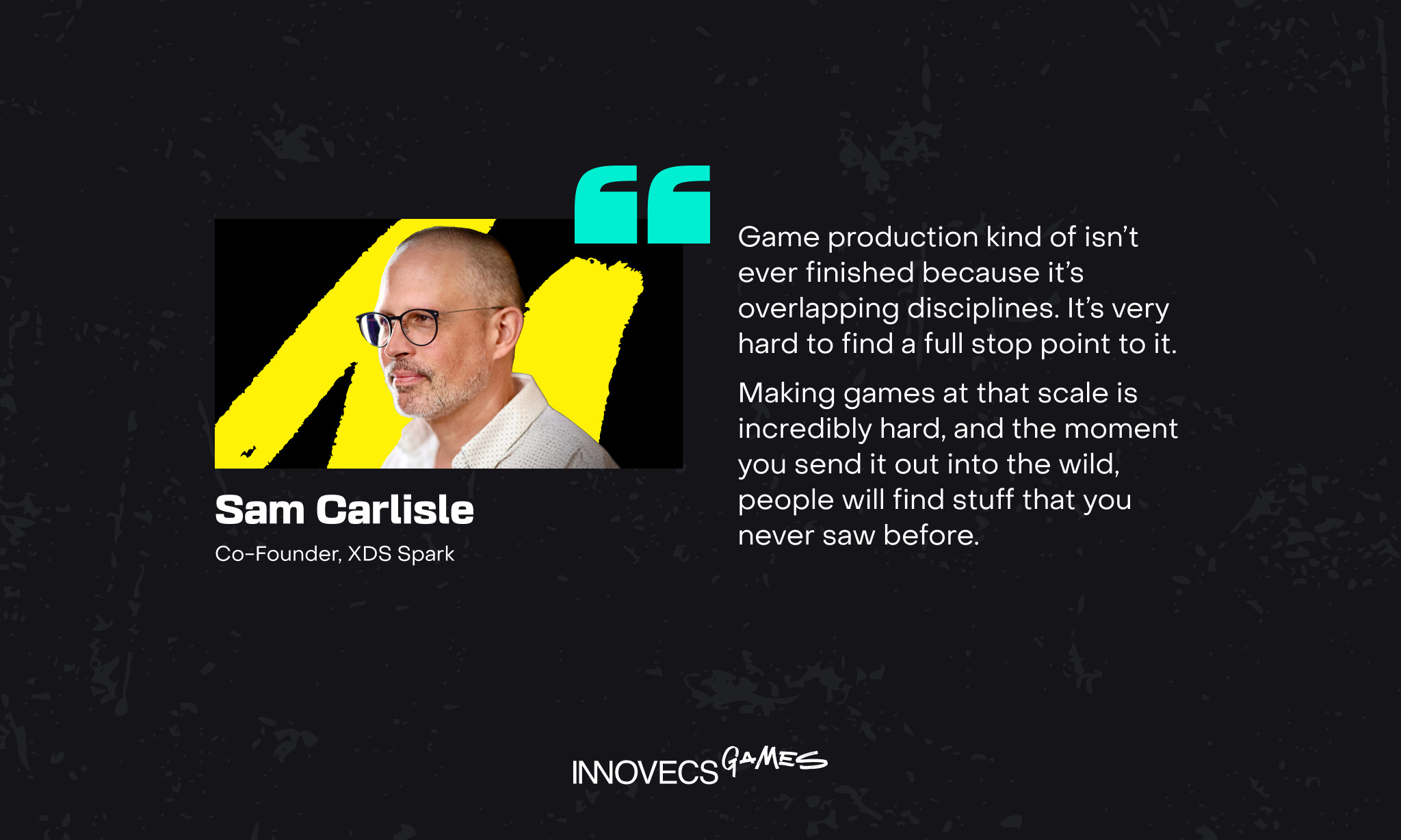
Sam Carlisle addressed this directly, pointing to the reality of modern AAA production. Large-scale games are built through overlapping disciplines, with no clean endpoint, and even extensive testing cannot fully replicate how millions of players will interact with a game at launch.
Question 2: Are subscription services and aggressive discounting destroying the value of AAA games?
This was primarily addressed by Amir Satvat and Nader Alikhani, who discussed how pricing expectations for games have barely changed over decades, despite production costs increasing dramatically. While subscriptions and sales are highly pro-consumer, they make it harder to build sustainable businesses around high-budget games.
Question 3: Will GTA 6 be the last truly massive AAA game, marking the end of an era?
Amir Satvat responded that GTA exists at a scale of its own and should not be seen as representative of AAA as a whole. The panel agreed that AAA will not disappear, but will likely narrow to a smaller set of long-running franchises, while the broader market continues to diversify.
The Q&A reinforced a central theme of the webinar: many of today’s frustrations are not caused by lack of care or talent, but by production and business models that have not yet caught up with the scale and complexity of modern AAA development.
Closing the Conversation
We’d like to thank our speakers and everyone who joined live for contributing thoughtful questions and perspectives. The discussion reinforced how valuable it is to share experience openly, especially during periods of change.
Innovecs Games will continue to create space for these conversations and share insights from across the industry. More to come.
You may also like:
READY TO START YOUR PROJECT?
If you need assistance in building a product from scratch or supporting the existing one, drop us a line to discuss details, and we will reply within 24 hours.