Like Ernest Adam, different game designers have approached this definition from various angles.
Katie Salen and Eric Zimmerman, in their work “Rules of Play,” describe mechanics as “the actions, behaviors, and control mechanisms afforded to the player in a game context.”
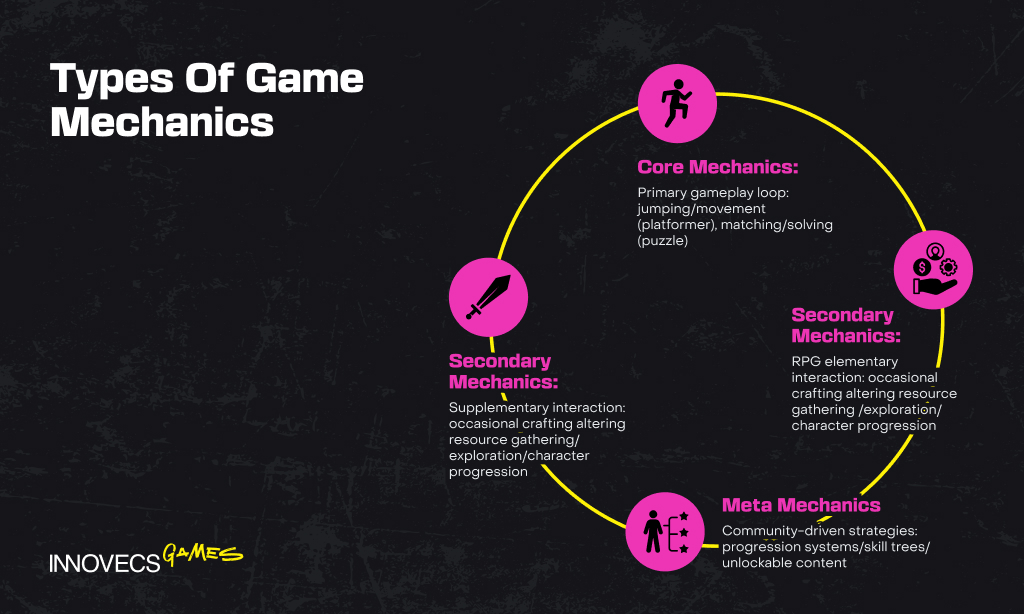
In the most granular definition, game mechanics are the methods and rules that define how players interact with a game and how the game responds to those interactions. Mechanics are thought to be abstract or invisible because, in many video games, players don’t have to understand what the game’s rules are when they begin. The video game teaches them as they progress.
Mechanics also have multiple levels of abstraction. At the micro level, individual button presses trigger immediate responses. A response could be shooting a weapon, picking up an item, or opening a door.
At the macro level, interconnected mechanical systems create emergent gameplay possibilities. A macro-level interaction would be actions such as combining movement, combat, and inventory mechanics to enable complex decisions.
Things That Game Mechanics Are Not
Our next job is to single out game mechanics from similar concepts that get confused with them.
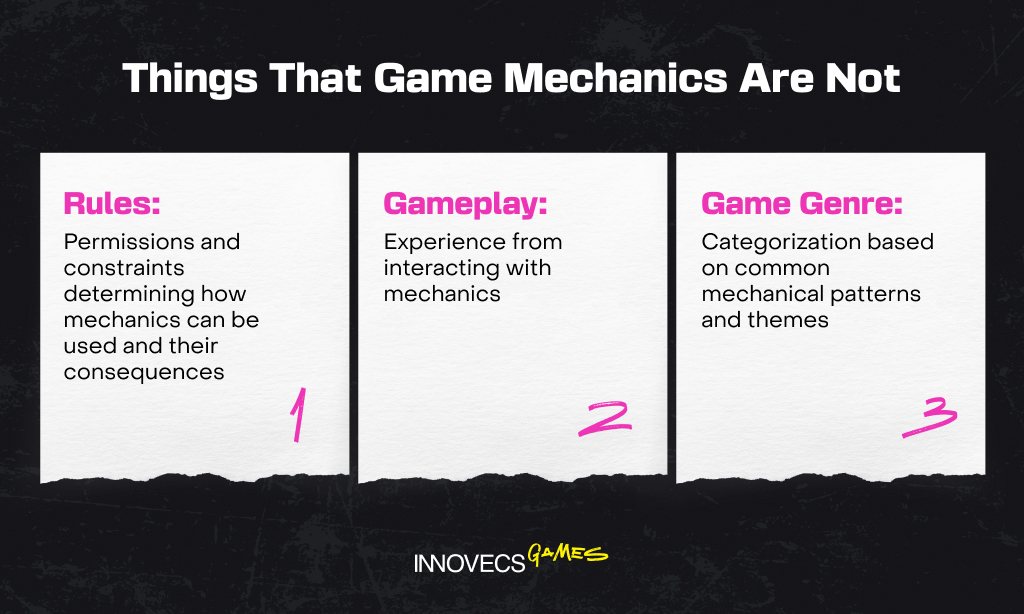
Rules
Rules are the permissions and constraints that determine how mechanics can be used and what their consequences are. The video game design community prefers using game mechanics to game rules because rules are considered printed instructions that the player is aware of.
For example, a stop sign at a crossroads. The rule (written on the sign) could be “you must stop here”, whereas the mechanic (what you actually do) is the interactive action that lets you obey or break that instruction. It could be pressing the brake pedal to bring the car to a halt.
Gameplay
Gameplay is the experience that comes from mechanics. Someone could describe a game as having fast-paced gameplay or strategic gameplay. And by that, they mean the player’s experience, which results from interacting with the mechanics.
You can design mechanics, but players create gameplay through their choices and actions in the game you’ve built.
Game Genre
Genre is a categorization based on common mechanical patterns and themes. Saying your game is a first-person shooter tells us about the expected mechanical framework and perspective, but it doesn’t say much about specific mechanics that make your FPS different from hundreds of others.
So two games in the same genre can have vastly different mechanical implementations.
Read also: The Ultimate Guide to Game Genres: Explore and Discover Your Favorites
The MDA Framework
The MDA Framework provides a structured way to think about how game design cues into player experience. Developed by Robin Hunicke, Marc LeBlanc, and Robert Zubek in 2004, this framework cropped up from discussions at the Game Developers Conference about the need for a common vocabulary and conceptual structure in game design. Before MDA, designers had no shared language for conversing about how design decisions lead to player experiences.
MDA means Mechanics, Dynamics, and Aesthetics.
Mechanics, as we’ve discussed, are the rules and systems at the game’s foundation. Dynamics are the runtime behaviors introduced when players engage with those mechanics.
You don’t design dynamics directly; they spawn from how mechanics interact over time. Aesthetics are the emotional responses and experiences players have as a result of the dynamics they encounter.
Why the MDA Framework Is Important
The crucial insight of the MDA framework is that designers and players navigate games from opposite directions. Designers start with mechanics, which bring about dynamics, which produce aesthetic experiences.
Players begin with aesthetic experiences, which they understand through dynamics, which are enabled by mechanics. This explains why players and designers sometimes talk past each other, and why playtesting with a second pair of eyes is so valuable.
The MDA framework also helps you trace problems backward. If players aren’t feeling the tension you want them to experience (Aesthetic problem), you can examine what dynamics come off during play.
The framework equally matters because it reminds us that we can’t control player experience. We can only create the mechanical base and hope it generates the dynamics that lead to our intended aesthetic goals. Mechanics are the one part of the chain we control.