AI in Game Development Is Changing Everything You Know About Gameplay
What AI actually does inside a production pipeline right now, which tools studios have standardized on, and where the legal and creative limits sit.
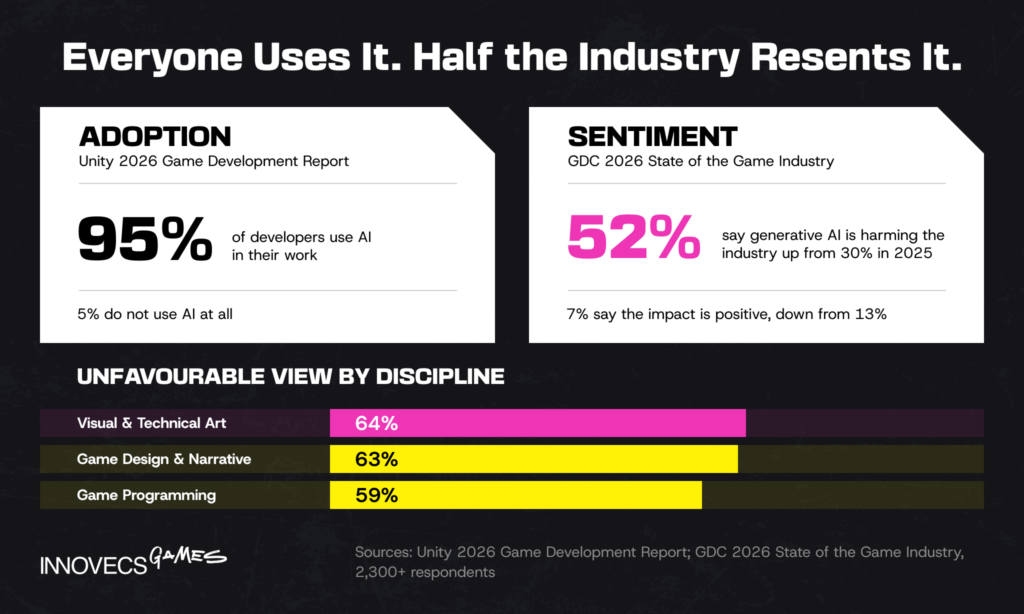
Unity surveyed its developer base for the 2026 Game Development Report and found that 95% of respondents already use AI in their work. Only one in twenty said they don’t. Then GDC surveyed more than 2,300 industry professionals for its 2026 State of the Game Industry and found that 52% believe generative AI is having a negative impact on the industry, up from 30% a year earlier. Seven percent called the impact positive. Both numbers describe the same twelve months, and both are worth taking seriously, because AI in game development is now something almost everyone touches and roughly half the industry resents.
The gap makes sense once you look at where the tools landed. Unity’s respondents put coding assistance at 62%, narrative and writing support at 44%, and NPC behavior at 40%. Those are back-end and mid-pipeline jobs. GDC’s most hostile disciplines were visual and technical art at 64% unfavorable, followed by design and narrative at 63%. The tools moved fastest into the parts of production nobody was precious about, and they hit hardest in the parts where the work is the craft.
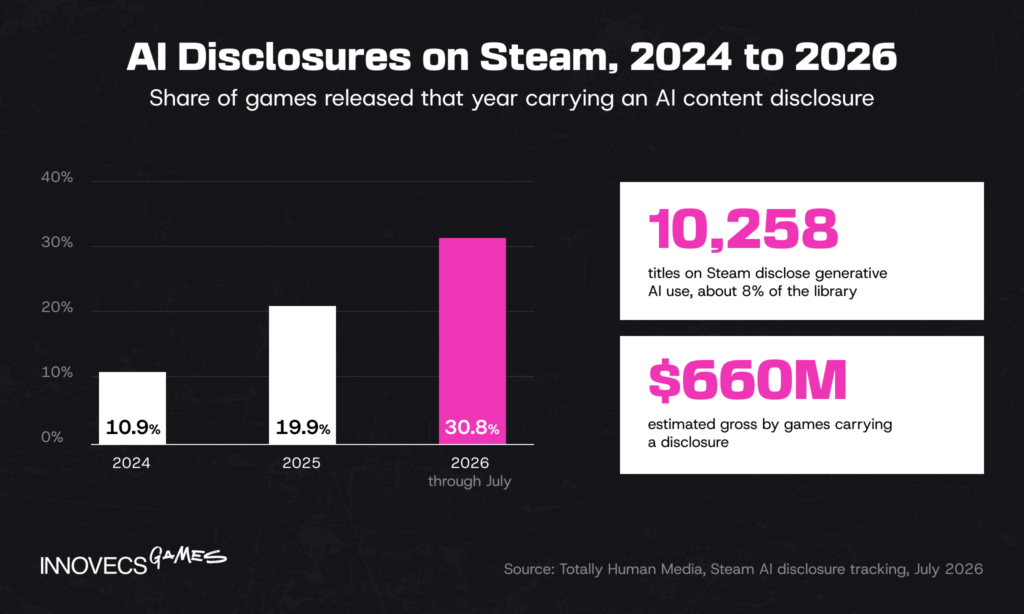
Meanwhile the output is visible in the storefront. 30.8% of games released on Steam in 2026 through July carried an AI content disclosure, against 19.9% in 2025 and 10.9% in 2024, per Totally Human Media’s tracking of Valve’s mandatory content survey.
This article covers what AI in video game development does in each stage of a real pipeline, the tools studios have standardized on, four shipped games that prove the point, and the legal and quality traps that come with all of it.
Why AI in Video Game Development Is More Than a Trend
The useful question is no longer whether studios use AI. It’s which jobs they hand over and which ones they guard. Unity’s report gives a clean read on that, because it asked about applications rather than attitudes.
| Application | Share of developers using it | Where it lands in the pipeline |
|---|---|---|
| Coding assistance | 62% | Engineering, tooling, refactors |
| Narrative and writing design | 44% | Preproduction and content passes |
| NPC behavior | 40% | Gameplay systems |
| Market research | 37% | Publishing and live ops |
| Automated playtesting | 35% | QA and balance |
Read that table as a map of trust. Every high-adoption row is a place where a wrong output gets caught by a compiler, a test, or a designer’s eye before a player ever sees it.
Three of those five rows sit behind the player-facing surface, which is exactly the pattern Unity flagged: developers are chasing productivity in back-end work while avoiding the front-end generative workflows that draw fire. The same report puts the median Unity project development time at 21 hours in December 2025, down from 91 in January 2022. A 77% drop over four years is not a tooling anecdote. It’s a change in what a small team can attempt.
Microsoft’s Muse model remains the cleanest illustration of what changes when a model watches gameplay rather than reads a design doc. The company showed that Muse could ingest footage from Bleeding Edge and generate playable variations directly in the engine editor, letting a designer prototype a mechanic against real recorded playstyles instead of a whiteboard assumption. What took a sprint can take an afternoon.
The money has followed. Krafton declared itself an “AI-first” company, committing $70 million to a GPU cluster and about $21 million a year from 2026 onward to put AI tooling in employees’ hands, with the full workflow rebuild targeted at the second half of 2026. EA went a different route and partnered with Stability AI on co-developed models, starting with physically based rendering materials that hold color and light accuracy across environments, and moving toward pre-visualizing 3D environments from directed prompts. One is a company betting on agents; the other is a company betting on artist-directed tooling. Neither is buying a subscription and calling it a strategy.
Our read, for what it’s worth: the studios that look smart in three years will be the ones who treated this as a tooling problem with an owner, a budget line, and someone whose job it is when the output is wrong. We’ve sat in enough kickoffs where AI was a slide rather than a role to be fairly confident which half of that ages badly.
AI Tools Are Taking Over the Heavy Lifting
Four areas absorbed most of the adoption, and they map onto the four most expensive line items in a mid-size production: environment build-out, art volume, NPC believability, and QA coverage. Here’s what each one looks like when it’s working.
How Does AI Power Procedural Generation and World Building?
Procedural generation is the oldest form of AI in game dev and still the one with the clearest return: a designer sets the rules, and the system fills in roads, buildings, lighting, biome transitions, and NPC placement across a map no one could hand-author on schedule. For open-world titles and large RPGs, that’s the difference between a shippable map and a map that eats two years of an environment team.
Monaco 2, released in April 2025, pushed the idea into the core loop, and how it did that is the part worth copying. The campaign ships on locked seeds the team picked by hand, so every player’s first run through a heist is identical and the leaderboard means something. Beat a mission and you can replay it in Unreliable Narrator mode, where a procedural director restitches the level from chunks against a fresh seed. Generation is opt-in rather than default, and what decided that was competitive fairness, not the technology. Either way the environment team stops hand-authoring level thirty-seven.
Oasis took the experiment further. It’s a Minecraft-style sandbox launched in late 2024 where the entire world is generated by a model, frame by frame, with no traditional engine underneath. It’s not a production technique yet and it isn’t pretending to be, but it does answer the question of how far the approach goes if you remove every guardrail.
Generation doesn’t stop at terrain. Ecosystems built on the same systems let non-player characters shift behavior by time of day or by what the player did an hour ago, which is what separates a world that feels inhabited from a world that feels dressed.
How Is AI Used to Create Game Art and Assets?
Art is the most expensive volume problem in games. It’s also the most contested place to apply generative AI in game development, and any studio pretending those two facts cancel out is going to have an uncomfortable meeting eventually. AI-generated art is where the community looks first and where the legal exposure is highest.
The practical case is straightforward. Generative tools produce credible first drafts of props, textures, and 3D models that artists then redirect, fix, and finish, and during preproduction that collapses the distance between an idea and something a designer can walk around in and argue about. Our own art teams have been working this way for a while, and we wrote up how neural networks changed the day-to-day in AI-generated game art, including where the tools stop being useful. Where the constraint is capacity rather than method, our game art services team plugs into an existing art pipeline and works to your acceptance criteria instead of proposing new ones.
Activision confirmed in early 2025 that generative tools assisted with in-game asset creation for Call of Duty: Black Ops 6. The disclosure followed community backlash over visible artifacts in a loading screen, which is the version of this story most studios would rather avoid. EA’s Stability partnership is the other model: build the tool with the artists, aim it at PBR materials and pre-vis, and keep authorship in the pipeline rather than at the prompt.
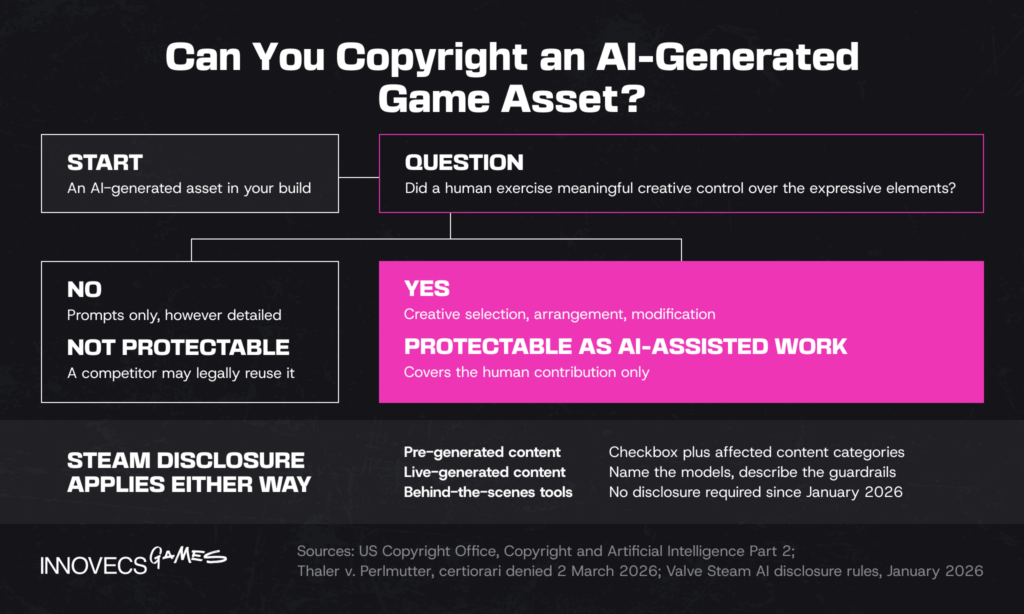
There’s a legal constraint here that too many teams discover late. The US Copyright Office held in part two of its AI report that copyright does not extend to purely AI-generated material, and that prompts alone, however detailed, do not give the prompter sufficient control over the expressive elements of the output. On March 2, 2026 the Supreme Court denied certiorari in Thaler v. Perlmutter, leaving the human-authorship requirement standing. AI-assisted work is protectable when a human exercised meaningful creative control. An asset that came out of a prompt and went straight into the build may not be.
How Does AI Make NPCs and Dialogue Smarter?
The three-lines-of-barks era is closing. Natural language processing lets NPC dialogue adapt to player actions, story branches, and emotional context, and smarter NPCs now retain state across a session instead of resetting at every conversation node.
The most concrete evidence is shipping. NVIDIA’s ACE stack moved past conversational NPCs into autonomous characters that perceive, plan, and act, and it’s live in PUBG: BATTLEGROUNDS, inZOI, NARAKA: BLADEPOINT, and MIR5. PUBG Ally, Krafton’s co-playable teammate, runs on a Mistral-Nemo-Minitron-8B model small enough to sit on the player’s own GPU, where it calls loot, drives, fights, and talks in game-specific slang. Note the model size. An eight-billion-parameter model holding up its end of a duo queue is a useful corrective to the assumption that anything interesting in this space needs a datacenter behind it and a per-token bill that scales with your concurrents.
The guardrails caught up in the same window. SAG-AFTRA members ratified the 2025 Interactive Media Agreement by 95.04%, ending an eleven-month strike. The contract requires separate, written, clearly presented and reasonably specific consent before a performer’s digital replica is created or used, and it lets performers suspend that consent during a strike. If your dialogue system is going to speak in a recognizable voice, consent is now a production requirement with a paper trail, not a courtesy.
How Is AI Changing Game Testing and Optimization?
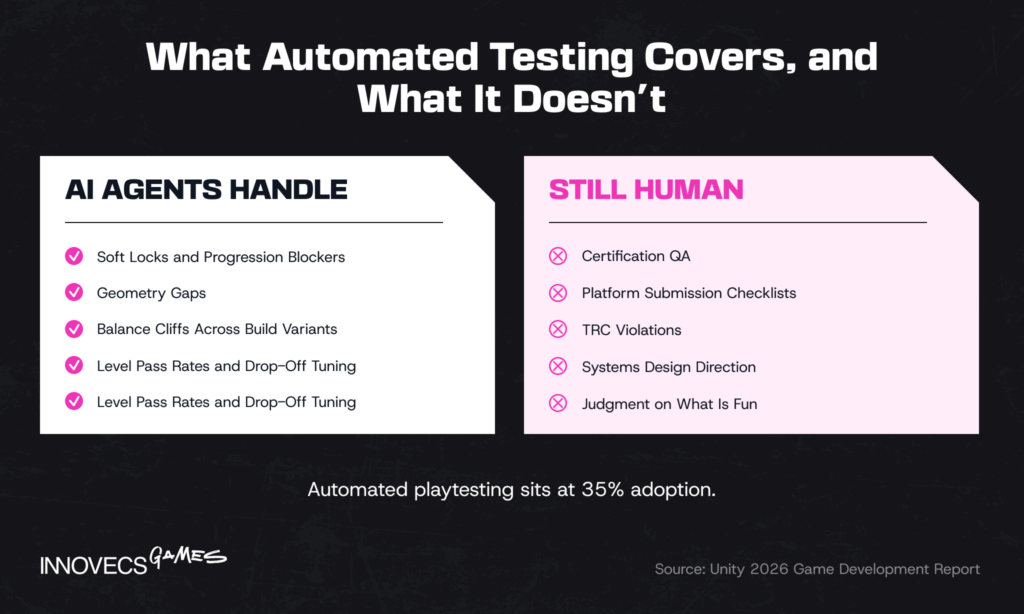
QA is where the technology has the least controversy and some of the best numbers. Automated game testing sends agents through thousands of build variants, surfacing soft locks, geometry gaps, and balance cliffs that a human pass would need weeks to reach. Unity puts automated playtesting at 35% adoption, which makes it the fastest-growing use case nobody argues about on social media. What it does not cover is certification QA. Platform submission still needs people who know the checklists, and no agent is going to catch a TRC violation on your behalf.
King runs the clearest example at scale. The Candy Crush studio uses AI to auto-generate and balance more than 18,700 levels, tuning puzzles against real pass rates and drop-off data so difficulty tracks player capability rather than a designer’s intuition. On a live-ops title with that much content, the alternative is a balance team that never sleeps.
The same telemetry loop tells you which mechanics lose players and which tutorial beats aren’t landing. Studios that already run continuous integration usually find this the cheapest AI project to justify, because the infrastructure is half built. It’s also where an embedded partner slots in without disruption, which is why most of our game co-development services engagements start on the test and tooling side before touching gameplay code.
Ready to Bring AI Into Your Game Dev Pipeline?
You’ve seen where AI in game development pays off and where it creates new problems. If you want a team that has already made those choices on shipped titles, tell us the gap and the timeline and we’ll scope one. Start with game development outsourcing or ask us directly.
The Best AI Tools in Game Dev Right Now
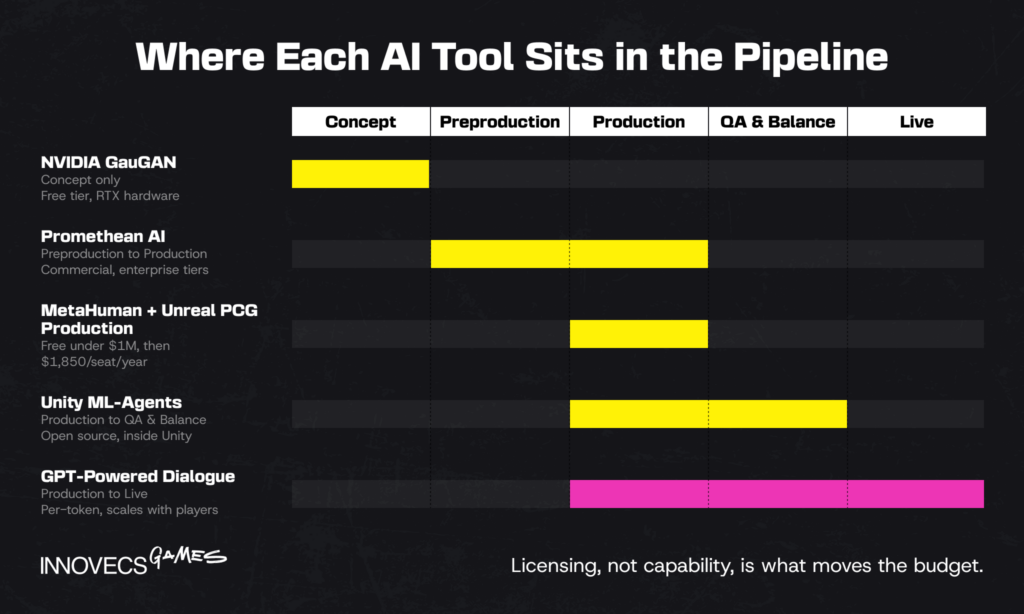
Tool choice matters less than most vendor pages suggest. Licensing and pipeline fit matter more, and they are where AI game development budgets go wrong. These five cover the ground that most AI tools in game development conversations end up circling, and their commercial terms differ enough to change a quarter.
| Tool | What it does | Where it fits | Licensing note |
|---|---|---|---|
| Unity ML-Agents | Trains agents through reinforcement and imitation learning | Gameplay systems, playtest bots | Open source, inside Unity |
| MetaHuman + Unreal PCG | Character creation and rule-driven environment generation | Character art, world building | Free under $1M revenue, then $1,850/seat/year |
| Promethean AI | Populates 3D scenes from natural-language direction | Environment art, set dressing | Commercial, enterprise tiers |
| NVIDIA GauGAN, Omniverse, ACE | Sketch-to-image, collaborative scene building, autonomous NPCs | Concept, previs, runtime NPCs | Free tiers, RTX hardware dependent |
| GPT-powered dialogue systems | Branching and reactive dialogue generation | Narrative, live NPC conversation | Per-token API cost, scales with players |
The last column is the one people skip and then rediscover in month four. A per-token dialogue system that costs nothing in a demo becomes a variable cost tied to your daily active users, which is the single most common budgeting mistake we see in AI in video game development projects.
What Does Unity ML-Agents Do for Game AI?
Unity’s machine learning toolkit trains NPCs, tunes gameplay, and simulates player behavior inside the engine rather than beside it. Agents learn through reinforcement or imitation, which makes it as useful for generating a QA bot that plays like a novice as for shipping a competent opponent. It’s open source, it lives in the Unity project, and it’s the shortest path from curiosity to a working prototype for a Unity team. Budget for the part nobody warns you about: your agent will find the hole in your level geometry long before your players do, and it will exploit it with real enthusiasm. That’s a free level-design audit wearing an unconvincing disguise.
How Do MetaHuman and Unreal’s Procedural Tools Work?
MetaHuman left early access and now sits inside Unreal Engine 5.6 as a native feature set rather than a cloud app. Two things changed with that release and both affect budgets. Epic expanded the license so MetaHuman characters can ship in any engine or DCC application, including Unity and Godot, and added free plugins for Maya and Houdini. And MetaHuman Animator now drives the facial rig from a mono camera, which in practice means most webcams and a lot of phones. Budget for cleanup anyway. The solve is good enough to skip a capture stage, not good enough to skip an animator.
Pair that with Unreal’s procedural content generation framework and a small team can rule-generate forests, city blocks, and dungeon layouts, then art-direct the result instead of placing it. The licensing is free for individuals and studios under $1 million in annual revenue, and $1,850 per seat per year above that line. If you’re still deciding which engine that pipeline lives in, we compared them in Unity vs Unreal: How to Choose the Best Game Engine.
What Is Promethean AI Used For?
Promethean AI is aimed squarely at environment artists and level designers. Describe the space, a medieval tavern, a sci-fi outpost, a flooded parking garage, and it populates the scene from your own asset library with contextually plausible props, lighting, and layout. The important detail is “your own library.” It’s not generating new meshes; it’s making decisions about the ones you already paid for, which sidesteps most of the ownership questions that hang over generative art. Of the five tools here, this is the one we’d put in front of a sceptical environment lead first. Nothing it produces is new, so the argument about authorship never gets started, and you can have the conversation about whether it’s actually good instead.
How Do NVIDIA GauGAN and Omniverse Help Developers?
GauGAN turns rough sketches into photorealistic environments using generative models, which makes it a mood and previs tool rather than a production asset source. Treat the output as a conversation opener with your art director, not an asset. It is exceptionally good at producing something that feels right and cannot be modelled. Omniverse handles the other half of the problem, letting distributed teams build and review scenes in a shared real-time environment. NVIDIA has since layered on the ACE Game Agent SDK with Unreal Engine 5 plugins, which pushes companion AI onto the player’s own hardware and takes the inference bill off your P&L.
What Are GPT-Powered Dialogue Systems?
Language-model dialogue is the fastest-moving category and the one with the most unresolved production questions. The tools write branching, reactive lines that respond to player choices, which is a real gain in narrative-heavy RPGs and open-world games where authored coverage always runs out before player curiosity does. The open questions are cost per session, latency, tone drift, and how you stop a model from promising a quest the game cannot deliver. Every studio shipping this today has built a constraint layer on top, and that layer is the actual engineering work. Our position: the model is the cheap part now and the constraint layer is the product. Anyone pitching you the reverse has not shipped one.
Real-World Examples of AI in Games
None of the following games market themselves on AI, which is the useful part. Read them as staffing decisions rather than as tech demos. In each case a system replaced a specific headcount or a specific milestone, and the question worth carrying back to your own schedule is what the team did with the capacity it freed.
How Does Grand Theft Auto V Use AI for Traffic and NPCs?
Rockstar built Los Santos on layered behavioral systems that govern pedestrian movement, traffic flow, and police escalation. The production argument is in what those systems are not: ambient city life is never authored content, so it doesn’t eat level-design milestones and its cost doesn’t scale with map size. It’s rule-based rather than learned, which means no training data, no inference budget, and no model to revalidate every time you patch. A lot of what players call game AI predates the current wave entirely, and most of it is still the cheaper answer.
How Many Planets Does AI Generate in No Man’s Sky?
Over 18 quintillion. Hello Games shipped a universe of that size by generating planets, flora, fauna, and atmospheres from procedural content generation seeded by deterministic algorithms rather than storing them, which is why the whole thing fits in a build you can ship. The trade-off is the one every procedural project pays. Variety without authored intent starts reading as sameness somewhere around hour twenty, and the studio spent years layering hand-built content on top to fix it. Scope the generator and the pass that fixes what it produces, not just the generator.
How Does Left 4 Dead’s AI Director Work?
Valve’s Director watches player health, ammo, position, and pace, then adjusts zombie spawns, item placement, weather, and pathing to hold a target intensity curve. The system is documented in Valve’s own materials and is still the reference implementation for dynamic difficulty. If you’re scoping one, the useful lesson is where the cost sat: not in the code, which a gameplay engineer can stand up in a milestone, but in the months of tuning that turned a working system into a fair one. It shipped in 2008.
How Are Indie Developers Using AI in Game Dev?
Smaller teams are using AI game development tools to cover roles they cannot hire for: terrain generation, placeholder art, localization passes, first-draft dialogue, and QA bots. The results are visible in Steam’s release volume, where AI-flagged launches went from a rounding error before Valve’s disclosure requirement to roughly 530 a month, while non-AI launches barely moved. Games with disclosures have grossed an estimated $660 million on the platform.
The downside arrived with the volume. A storefront absorbing several hundred extra releases a month is a storefront where discoverability gets harder for everyone, including the indies using the tools. Cheaper production and easier distribution are not the same thing, and the second one didn’t improve.
Benefits and Challenges of AI in Game Development
Enough studios have run this for two or three production cycles that the pattern is legible. The benefits are real and land in schedule and coverage. The challenges land in ownership, quality control, and team trust.
What Are the Benefits of AI in Game Development?
- Faster prototyping, with playable variants in hours instead of sprints
- Lower development costs in preproduction, where drafts get thrown away anyway
- QA coverage across build variants no human pass would reach
- Adaptive storytelling and dynamic difficulty that respond to actual player behavior
- Personalization that tunes the player experience without a dedicated live-ops team
- Smaller teams attempting scope that used to need a publisher
Unity’s respondents ranked the payoffs in the same order they’d rank them in a postmortem: improved efficiency at 73%, better decision-making at 62%, reduced resource requirements at 51%.
Worth sitting with what isn’t on that list. Nobody’s top answer was better games.
What Are the Challenges of AI in Game Development?
- Ownership. Purely generated assets may carry no copyright protection, which means a competitor can legally reuse them.
- Disclosure. Valve requires a content survey before launch. It rewrote the rules in January 2026, narrowing them to content players actually encounter and splitting pre-generated assets from content generated live during play, which now needs the models and guardrails named.
- Quality control. Generated output needs a human pass, and the review time is a real line item that studios routinely underestimate.
- Bias. Models reflect their training data, and a character generator trained on a narrow corpus produces a narrow cast.
- Team trust. GDC recorded 64% unfavorable sentiment among visual and technical artists. Rolling out a tool your art department believes is aimed at their jobs is a change-management problem before it’s a technical one.
- Cost drift. Per-token and per-inference pricing scales with players, not with your development budget.
The honest read on our own experience: the savings are real, and they’re smaller than the first quarter suggests, because review and integration work migrates rather than disappears. Teams that budgeted for the review time got the gains. Teams that budgeted for the headcount reduction got a backlog.
Tips for Game Developers Embracing AI
The teams that got AI game development right did not start with a platform decision. They started with one bottleneck and a way to measure whether it moved.
- Pick one use case with a measurable baseline, like NPC behavior or environment blockout, and instrument it before you start.
- Use AI for iteration, not final polish. The first draft is nearly free now; judgment still costs exactly what it did.
- Bring artists and designers in at the tool selection stage. A pipeline imposed on a discipline that distrusts it will be quietly routed around.
- Analyze player telemetry for personalization, and write down your retention and consent policy before the data starts accumulating.
- Build modular pipelines so any generated asset can be opened, edited, and replaced by a human without a rebuild.
Add one more that isn’t on most lists: keep provenance records. Which tool, which version, which prompt, which human edits. When a publisher, a platform holder, or a legal team asks about an asset in year three, that log is the only answer that holds.
What’s Next for AI in Game Design?
The direction of travel is away from AI as a content factory and toward AI as a systems layer that reacts at runtime. That shift changes what a designer’s job looks like more than any asset tool has.
Near-term, expect systems that can:
- Shape storylines from real-time player behavior, not just branch on scripted choices. A stealth game might rewrite a mission for a player who has never fired a shot, offering a negotiated exit instead of a firefight.
- Generate facial performance and gesture from character bios and dialogue tone, which MetaHuman Animator has already made a phone-camera job rather than a mocap-stage one.
- Build playable spaces from a single prompt, turning a sketch or a description into a functioning level layout for review.
- Adjust systems live, tuning puzzle difficulty, enemy tactics, and resource scarcity against how a specific player is playing.
- Train companions that learn from you, mirroring or complementing your playstyle, which is the road PUBG Ally is already on.
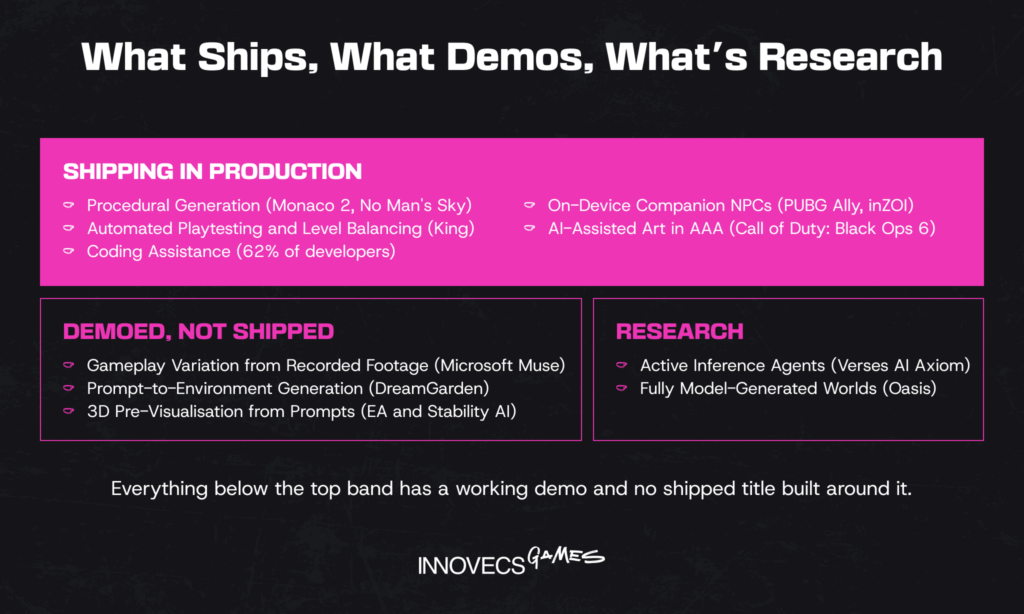
Every item on that list has a working demo and not one of them has a shipped title built around it, which is where procedural generation sat around 2012. Read it as a direction, not a roadmap, and be suspicious of anyone who reads it as a delivery date.
Research keeps widening the surface. ACM’s DreamGarden work grows game environments inside Unreal from simple prompts, treating level creation as cultivation rather than authorship. Others are building AI brushes that let an artist paint a landscape while the system preserves visual cohesion across the whole scene.
The larger shift is that generative capability is moving into the engines themselves rather than sitting beside them as plugins. Once it’s a default rather than an integration project, the interesting question stops being which tool you bought and becomes what your team is willing to let it decide. That’s a design question, and it’s the right time to start answering it in your own pipeline rather than in a conference talk.
Frequently Asked Questions
What is AI in game development?
Two different things share the name. The first is classic game AI: pathfinding, finite state machines, behavior trees, and director systems that control how the game reacts to a player. The second is machine learning and generative models applied to production itself, generating art, code, dialogue, levels, and test coverage. Most studios run both, and the second is what has changed since 2023.
How is AI used in game development in 2026?
Coding assistance leads at 62% adoption in Unity’s 2026 survey, followed by narrative and writing at 44%, NPC behavior at 40%, market research at 37%, and automated playtesting at 35%. The pattern favors back-end work where a wrong output gets caught internally. Player-facing generated art remains the most contested application and the one most likely to trigger a disclosure requirement or a community reaction.
What are the best AI tools for game development?
For a Unity team, ML-Agents is the shortest path to trained agents and playtest bots. For Unreal, MetaHuman and the PCG framework cover characters and rule-driven environments. Promethean AI handles set dressing from your existing asset library, NVIDIA’s ACE stack runs companion NPCs on the player’s own hardware, and language-model dialogue systems handle reactive conversation. Pick by pipeline fit and licensing terms rather than by feature list.
Can AI replace game developers?
Not on current evidence, though it is changing what the job is. Unity recorded a 77% drop in median project development time between 2022 and 2025, which shows up as smaller teams attempting larger scope rather than as an industry that stopped hiring. What generative tools compress is the cost of a first draft. Direction, systems design, and the judgment about what is actually fun have not moved, and those are the parts of the work that decide whether a game ships. The sharper version of the worry isn’t replacement anyway. It’s compression: fewer junior seats doing the repetitive work that used to teach people the craft. Nobody has a good answer to that one yet, including us.
How does AI help with procedural content generation?
Procedural systems take designer-authored rules and expand them into terrain, layouts, item placement, and NPC distribution at a scale no team could hand-place. No Man’s Sky generates over 18 quintillion planets from deterministic seeds rather than storing them. Monaco 2 restitches its heist maps from chunks when you replay them with a fresh seed. Machine learning extends this by tuning generation against real telemetry, so the output tracks what players do rather than what the ruleset assumed.
Is AI-generated game art safe to use commercially?
It depends on how much human direction went into it, and the risk is not evenly distributed. The US Copyright Office holds that purely AI-generated material is not protectable and that prompts alone do not establish sufficient human control, a position the Supreme Court left standing on March 2, 2026 when it declined to hear Thaler v. Perlmutter. AI-assisted work with meaningful human authorship can be protected. Separately, Valve requires disclosure of generated content that players see, so the storefront question is procedural rather than legal.
What is the difference between AI and machine learning in game dev?
AI is the umbrella term for any system that makes decisions that look intelligent, including hand-written rules. Machine learning is the subset where behavior is learned from data instead of authored. Two systems developers already know show the difference: Left 4 Dead‘s Director is AI without machine learning, because a designer wrote every rule, while Unity ML-Agents is machine learning, because nobody wrote the policy and the agent found it. Deep learning and neural networks sit one level further in, and generative AI is one application of those.
How do studios like Rockstar and King use AI in their games?
Rockstar’s approach in Grand Theft Auto V is behavioral and rule-based, governing pedestrian movement, traffic, and police escalation so the city responds coherently to whatever the player does. King’s is data-driven and production-facing: AI generates and balances more than 18,700 Candy Crush levels against live pass-rate and drop-off data. One is AI as a runtime illusion, the other is AI as a content factory with a feedback loop. Most studios need some of both.
What are the risks and ethical concerns of AI in game development?
Copyright exposure comes first, because an unprotectable asset in a shipped title is a commercial problem, not just a legal one. Then consent: SAG-AFTRA’s 2025 agreement requires separate written permission before a performer’s digital replica is created or used. Training-data bias narrows the range of characters a generator will produce unless someone checks. And the labor question is unresolved, with 52% of GDC’s respondents calling generative AI’s impact on the industry negative and hostility highest among artists. A studio that treats any of these as a communications problem rather than a policy one tends to find out publicly.
How can a game studio start using AI in its development pipeline?
Start where a mistake is cheap and measurable, which usually means QA automation or internal tooling rather than shipped art. Set a baseline first, whether that’s test coverage, hours per level, or bugs found per build, so you can tell whether anything improved. Bring the affected discipline into tool selection rather than announcing the rollout to them. Write the disclosure, provenance, and consent policy before the first asset ships, because retrofitting that record is far harder than keeping it.
Ready to Build AI-Smart Games? Let’s Talk
We staff embedded teams that already run AI in game development day to day, on art, tooling, gameplay systems, and QA. Tell us where the pipeline is bottlenecked and when you need it fixed. We’ll come back with a team composition and a timeline.