Hyper-Casual Games: A Practical Guide to Building, Monetizing, and Scaling a Hit in 2026
What hyper casual games still earn in 2026, which mechanics survive rising install costs, and how to run a prototype pipeline that finds a hit instead of burning a year.
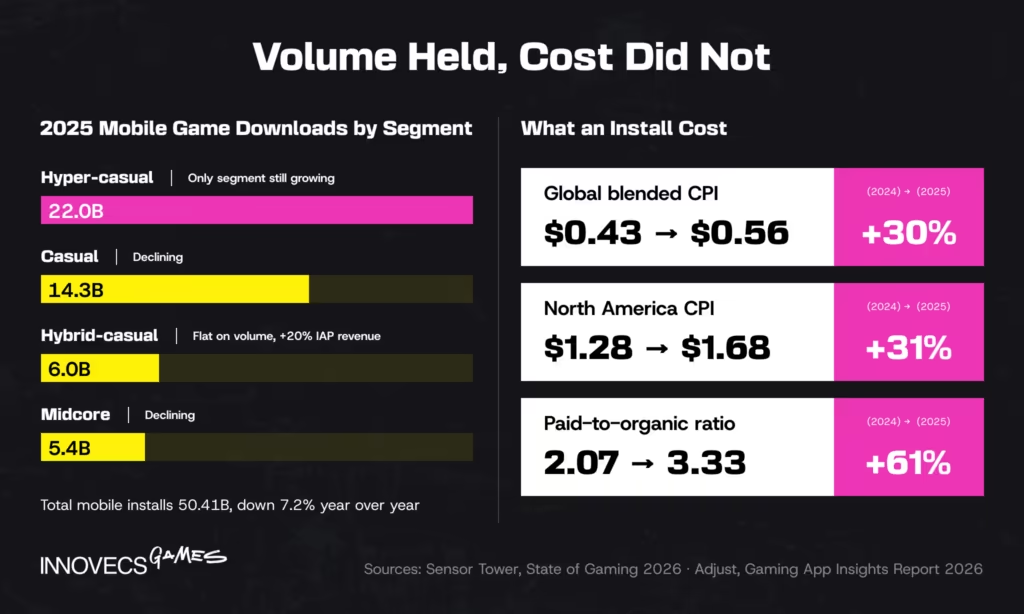
Mobile players installed 50.41 billion games last year, a number that sounds enormous right up until you notice it’s down 7.2%. Inside that decline Sensor Tower’s State of Gaming 2026 found exactly one segment still growing, and it was hyper casual games. Then you look at what those installs cost. Blended gaming CPI hit $0.56 in Adjust’s Gaming App Insights Report 2026, a 30% jump inside a year, with North America up at $1.68. Which leaves a genre that earns cents per player buying those players in the most expensive market it has ever faced.
That squeeze split the genre in two. Voodoo, the publisher that turned simple mechanics into a factory, moved its teams off hypercasual entirely; CEO Alexandre Yazdi wrote in March 2026 that the old model of launching new games to offset the decline of old ones, a decline he puts at up to 40% a year, “now belongs to the past.” In the same mobile gaming market, Hungry Studio’s Block Blast! took 368 million downloads in 2025 on AppMagic’s count, the most of any mobile game, monetized almost entirely through advertising. So the reach never went anywhere. The fire-and-forget business model around it did.
All of which means the short answer to what are hyper casual games has quietly changed since 2020, even though the games themselves look the same. What follows: the mechanics that still hold up, what each monetization model actually returns rather than what the deck claims, the prototype process behind a hit, and where AI helps as against where it just produces mediocrity faster. Every figure comes from 2025 or 2026 reporting, and every source is linked so you can go argue with it.
What Are Hyper-Casual Games?
A hyper-casual game is a light-weight app built around one mechanic a player understands within three seconds. No tutorial, no account, no meta layer to learn. Sessions run short, failure arrives fast, and the loop restarts before anyone has time to decide whether to stop. Written down it’s a one-sentence design brief, and that’s the trap: everybody can write the sentence, almost nobody can build the three seconds. Ad-supported monetization does the rest of the work, since in-app purchases contribute very little here, so the genre lives or dies on volume and on how many impressions a session carries before the experience starts to grate.
Who actually plays these games is the part most pitch decks get wrong. Sensor Tower’s US profile puts 60% of casual and hypercasual players over the age of 35, while PC and console skew the other way, with 75% of players under 35. The person tapping through a block puzzle on the commute is more likely to be forty-five than fifteen.
Two numbers set the commercial reality, and neither is comfortable. Roughly half of every hypercasual install is bought rather than earned: 50.6% paid traffic, higher than any other mobile segment. The genre also holds the biggest install share in Adjust’s dataset, 29.1% and climbing from 27% in 2024, with session share up from 11% to 15%. Volume, in other words, is not the problem here. Margin is, and most of the work in hyper-casual game development now goes into that gap rather than into inventing another mechanic.
Where the Genre Came From and How It Works
Very little about the mechanics themselves has moved in fifteen years. What moved is how many of them are now competing for the same thumb: Google Play carried over 150,000 games in 2025, a 45.9% jump in twelve months on Sensor Tower’s count. The genre’s history is short and its working vocabulary is smaller still, which is exactly why both are worth getting right before you brief anybody.
How Did Hyper-Casual Gaming Get Its Start?
The design language predates mobile by four decades. A coin-operated cabinet in 1975 had about the same job a hyper-casual store listing has now, which was to teach a stranger the game before he decided whether to spend another quarter, and Pong had solved it three years earlier using two paddles and no instructions at all. Atari’s home version carried the same constraint into the living room.
Mobile picked the pattern back up in 2014, when Ketchapp started shipping single-mechanic titles at speed. Voodoo, Gram Games and BitMango industrialized it from there. Numbers from that era still land: Ketchapp, now part of Ubisoft, reports more than 200 published games and over 2 billion downloads, and by 2023 Voodoo’s five biggest titles had reached 1.7 billion installs between them, led by Helix Jump at 499 million and Aquapark.io at 364 million on AppMagic figures reported by mobilegamer.biz. None of them took longer than a few weeks to build, which is the entire economic argument the genre was founded on and the reason so much capital chased it between 2018 and 2021.
Then Apple’s App Tracking Transparency arrived in 2021 and the arbitrage stopped working. “Apple’s new rules regarding IDFA make the business model much less interesting,” Voodoo casual games VP Alvaro Duarte said in 2023, announcing the studio’s exit from the genre. “So that’s why we’ve said that it’s dead for us. There are a lot of companies that are still trying, but we feel that this is not where the future is anymore.”
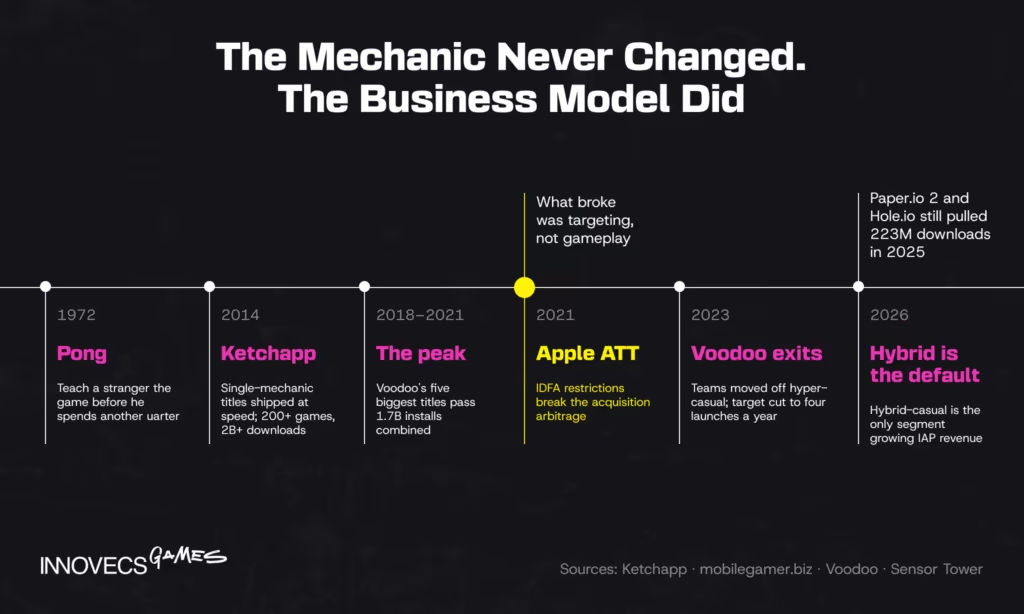
Worth noting what survived, though, because the obituaries tend to skip it. Paper.io 2 and Hole.io are both Voodoo titles from the peak years, and between them they still pulled 223 million downloads in 2025. Old hyper-casual games don’t stop working. It just stopped being worth building new ones.
What Game Mechanics Define Hyper-Casual Titles?
Five families cover almost everything that ships: timing, agility, puzzle, swerve and merge mechanics. You’ll see other write-ups slice this into nine or ten by promoting stacking, growing and turning to categories of their own, which is fine as taxonomy and useless as a brief, since each of them shares a control scheme and a failure mode with the family it belongs to. The column worth reading below is the last one. Mechanics almost never fail on the drawing board; they fail in week three of soft launch, in a way most of the team saw coming and nobody wrote down anywhere.
| Mechanic | Variants you’ll see named separately | What the player does | Familiar example | Where it usually breaks |
|---|---|---|---|---|
| Timing | Tap, stacking | Acts inside a narrow window | Stack-style tower builders | The window tightens faster than the hand adapts, and session one ends in a rage quit |
| Agility | Growing, absorption, runner | Reacts and dodges at speed | Endless runners, .io absorption games, Pac-Man before both | Difficulty ramps on a curve tuned by someone who has played it four hundred times |
| Puzzle | Sorting, matching, tile-clear | Fits, clears or completes a shape | Block Blast! | Generated boards stop producing surprise somewhere around the fortieth level |
| Swerve | Turning, rising and falling | Steers to avoid obstacles | Helix Jump, Aquapark.io | One control axis goes flat without a proper hazard variety pass |
| Merge | Combining, crafting chains | Turns like items into better ones | Match and merge hybrids | Economy inflation, until a merge stops feeling like a reward |
That last column is the cheapest quality gate you’ll ever own, since asking the question costs nothing. Put any hyper-casual pitch in front of someone and have them ask which of those five failure modes this build is heading for and whose name is against fixing it. The answer separates a real concept from a nice GIF within about a minute. Our longer breakdown of how these loops fit together sits in game mechanics.
Ready to Build Your Hyper-Casual Hit? Let’s Talk
Most teams don’t need another mechanic. What they need is a pipeline capable of killing twenty ideas in six weeks without burning out the people running it. Tell us the concept and the soft-launch date you’re aiming at, and we’ll scope a hyper casual games development team around both.
How Do Studios Build a Hyper-Casual Hit?
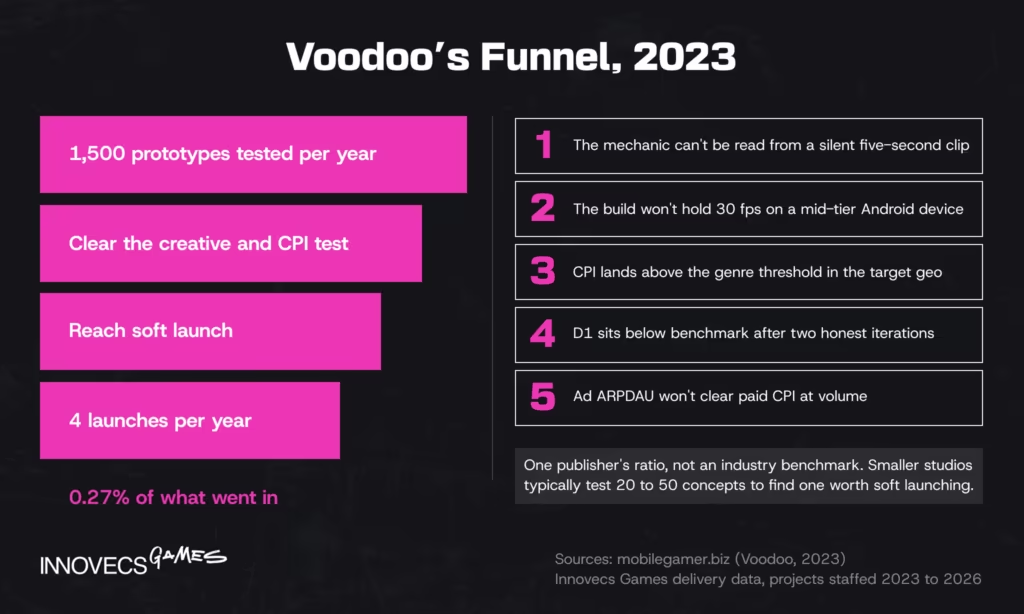
When Voodoo restructured around hybridcasual in 2023, its teams were testing as many as 1,500 prototypes a year across hybrid, casual and core gameplay, against a target of roughly four launches. The old “10,000 prototypes” figure that still circulates in genre write-ups belongs to a different era, and it’s worth retiring; so, for that matter, is treating any single publisher’s ratio as a benchmark. The ratio is the lesson. Rapid prototyping isn’t there to generate game concepts, it’s there to kill them cheaply, and the studios that struggle are almost never the ones short of ideas. They’re the ones who can’t bring themselves to shelve one. That’s how you spend eleven months learning something the market would have told you in ten days.
The strategy did work, for what it’s worth. Voodoo reported $778 million in revenue for 2025, up 16%, with $653 million of that from games and 90% of the gaming business now casual rather than hyper-casual. Its existing portfolio grew 6% instead of decaying.
What Does a Prototype-to-Hit Process Look Like?
Every gate below has a number attached to it and a named person who is allowed to say no, and it is the second half of that sentence, rather than the first, that gets quietly dropped once a calendar starts slipping. This is the shape our own game prototyping services run to.
| Phase | Typical duration | Team | What ends it here |
|---|---|---|---|
| Concept sort and mechanic pick | 3 to 5 days | 1 designer, 1 developer | The mechanic can’t be read from a silent five-second clip |
| Playable prototype in the game engine | 5 to 10 working days | 2 to 3 people | The build won’t hold 30 fps on a mid-tier Android device |
| Creative and CPI test | 3 to 7 days | Add 1 marketing artist | CPI lands above the genre threshold in the target geo |
| Soft launch and retention read | 2 to 4 weeks | 4 to 6 people, plus game testing | D1 sits below benchmark after two honest iterations |
| Scale or shelve | Ongoing | 6 to 20 people | Ad ARPDAU won’t clear paid CPI at volume |
Source: Innovecs Games delivery data, projects staffed 2023 to 2026.
Voodoo runs a comparable shape at a different scale, roughly six people on a game at launch and up to twenty once it grows meta features. Read that last row first. It’s the one nobody argues about in week one and everybody argues about in month four.
There’s an honest cost to running a pipeline this aggressive, and it isn’t financial. Your designers spend most of the year watching things they made get shelved on the strength of a number, which wears people down in a way nobody puts on the org chart. Studios that don’t plan for it lose their best prototypers to teams shipping fewer, bigger things.
How Do Hyper-Casual Games Make Money?
Revenue is where the genre’s 2026 split shows up most clearly, and where a lot of business plans quietly stop working. Hybrid casual was the only mobile segment to grow in-app purchase revenue meaningfully last year, up 20% per Sensor Tower, while hypercasual grew downloads and time spent instead. If you’re building on pure advertising, you’re competing in a category with rising costs and flat per-user revenue, and you need the volume side of the equation to be genuinely large.
What Are the Main Hyper-Casual Monetization Models?
| Model | Where the money comes from | The trade-off you’re accepting |
|---|---|---|
| Interstitial and banner advertising | Impressions between and during sessions | Every additional placement buys revenue today and costs retention tomorrow |
| Rewarded video ads | The player opts in for a continue, a hint or a multiplier | Requires a failure state the player actually wants to undo, which is a design job, not an ad job |
| In-app purchases | Ad removal, soft currency, cosmetics, continues | In pure hyper-casual the paying share stays small, so IAP rarely carries a title on its own |
| Cross-promotion | Moving players to another title you own | Only works if you have a portfolio, which most first-time publishers don’t |
| Premium app strategy | An upfront price on the App Store or Google Play | Removes the install volume the whole model depends on |
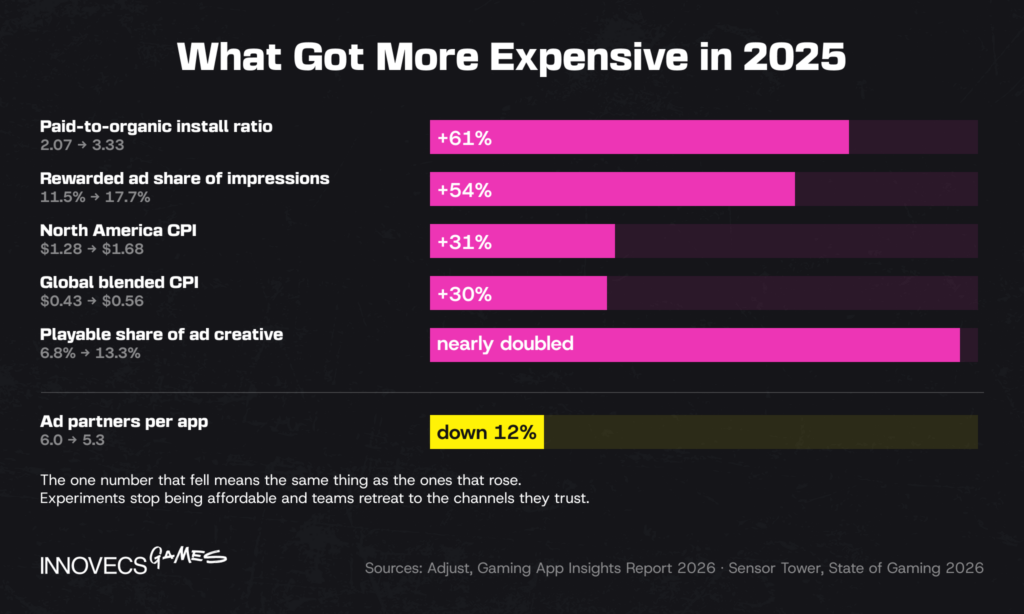
Of everything in that table, rewarded formats are the row with actual momentum behind them: Sensor Tower has rewarded ads at 17.7% of all impressions in 2025, up almost 54% in a year, and playable creatives close to doubling their share to 13.3%. Whether any of it works comes down to two numbers. LTV, what one player returns across their entire life in the game, has to survive contact with ARPU, the average across everybody including the enormous majority who never spend anything. Design, in this genre, is mostly a negotiation between those two figures and the player’s patience.
What Makes a Hyper-Casual Game ‘Snackable’?
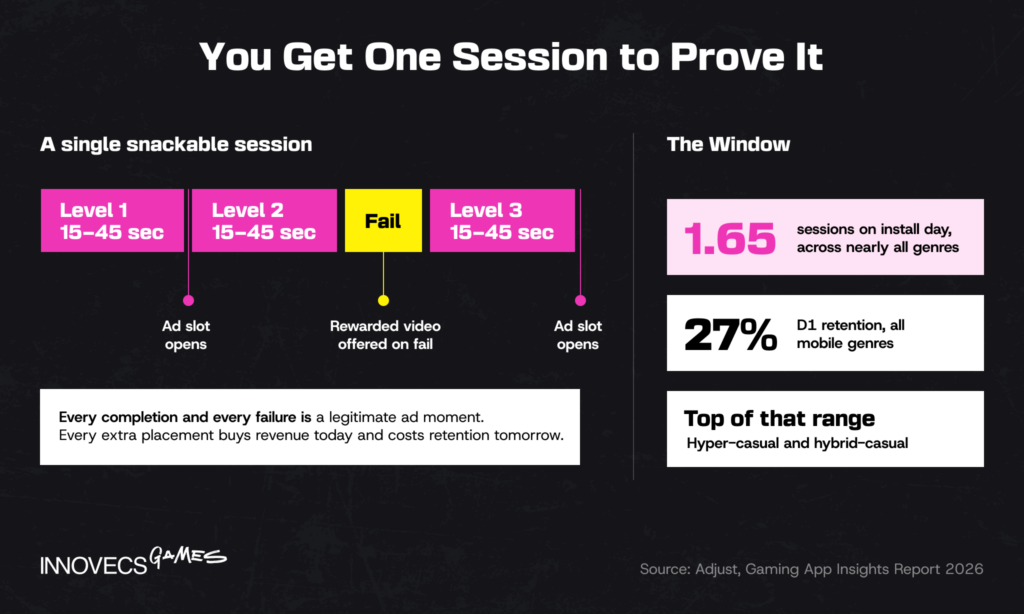
Snackable means the game never asks the player to commit to anything. Levels run fifteen to forty-five seconds, progress is visible without being studied, and nothing has to be remembered between sessions. That constraint shapes the level design far more than art direction ever does, and it happens to be commercially convenient, because every completion and every failure is a legitimate moment to show an ad without ambushing anyone.
Block Blast! is the textbook case at the moment, and the reason is almost annoyingly simple. The sessions are short, the near-misses are frequent, and there’s a rewarded-ad safety net waiting at precisely the second a player starts to mind losing. That got it to 70 million daily active users and the top of the global download chart, on a mechanic that has been sitting in the public domain since the 1980s.
Your window for proving any of it is unforgivingly short. Adjust puts day-zero sessions at 1.65 across nearly every genre, which is a polite way of saying the average player opens your game once on the day they install it and then decides. D1 retention sits at 27% across mobile in the same dataset, with hypercasual and hybrid casual at the top end of it. Miss that first session and there generally isn’t a second one to fix it in.
What Are the Hyper-Casual Trends to Watch in 2026?
The hybrid-casual shift is now the default assumption. Keep the hyper-casual hook and the low CPI, bolt on progression and an economy and enough meta to give somebody a reason to open the app on day seven: that’s the whole trade. It’s working. Top hybrid casual titles have already overtaken the top 25 casual games on D7 player retention in Sensor Tower’s numbers, while casual D7 has been sliding since early 2022. Most studios pitching us hyper casual mobile games in 2026 are pitching hybrid without quite saying so, sometimes without quite knowing it.
User acquisition is the binding constraint now, not development. The 30% CPI rise is only half of it. Adjust has the median paid-to-organic install ratio climbing from 2.07 to 3.33 in a single year, meaning studios are renting a far larger share of their audience than they used to. Ad partners per app dropped from 6 to 5.3 over the same period, which is what happens when money gets tight enough that experiments stop being affordable and everyone retreats to the two channels they trust.
Ad tech got quietly better at the creative layer. Sensor Tower has video creatives at 53.7% of all mobile game advertising in 2025, up from 44.9%, with playables close to doubling. Here’s what nobody flags about that: a playable ad is a working slice of your game, so the creative team and the game team are now building the same artifact whether or not anyone has told them. Organized well, the ad becomes a second prototype test you were going to pay for anyway. Organized badly, marketing ships a version of your game that the studio never signed off on.
Prototyping got faster without getting any smarter. AI has flattened the cost of a first playable and every studio in the genre has noticed, which mostly means the same number of gates now have twice as much arriving at them. The judgment call about whether a thing is actually fun hasn’t moved at all. That’s the next section, and it’s why a 1,500-prototype pipeline still needs expensive people standing at the end of it.
How Is AI Changing Hyper-Casual Game Development?
The adoption data is a good deal more ambivalent than the marketing around it. GDC’s 2026 State of the Game Industry surveyed more than 2,300 professionals and found 36% using generative AI in their job. Split it by employer and the picture gets more interesting: 30% at game studios against 58% at publishing, support and marketing firms, which tells you something about who is making games and who is making decks about games. Research and brainstorming leads the use cases at 81%, with code assistance and everyday admin tied at 47% and prototyping trailing on 35%.
In this genre specifically, AI game development tooling earns its keep in four places. Code assistance closes the gap between a mechanic on a whiteboard and a build on somebody’s phone, and when the entire point of your pipeline is speed of elimination, that gap is the product. Generative AI art solves a volume problem rather than a quality one, because a CPI test wants thirty versions of the same fifteen seconds and has no use whatsoever for one beautiful piece. AI playtesting agents will grind through UI regression and edge-case paths across a device matrix for as long as you let them, which is precisely the work human testers should never have been doing. Procedural generation handles level variants, though only after a designer has set the rules and the difficulty curve, and the ordering there is not negotiable.
Sentiment is the part worth sitting with, mostly because it turns up in hiring conversations whether you raise it or not. Of the same GDC respondents, 52% think generative AI is doing the industry harm, against 30% a year earlier and 18% the year before that. Among visual and technical artists it reaches 64%. Those aren’t rounding errors, and if you’re staffing an art pipeline in 2026 this is a recruitment and retention problem sitting on your desk rather than a debate happening somewhere else.
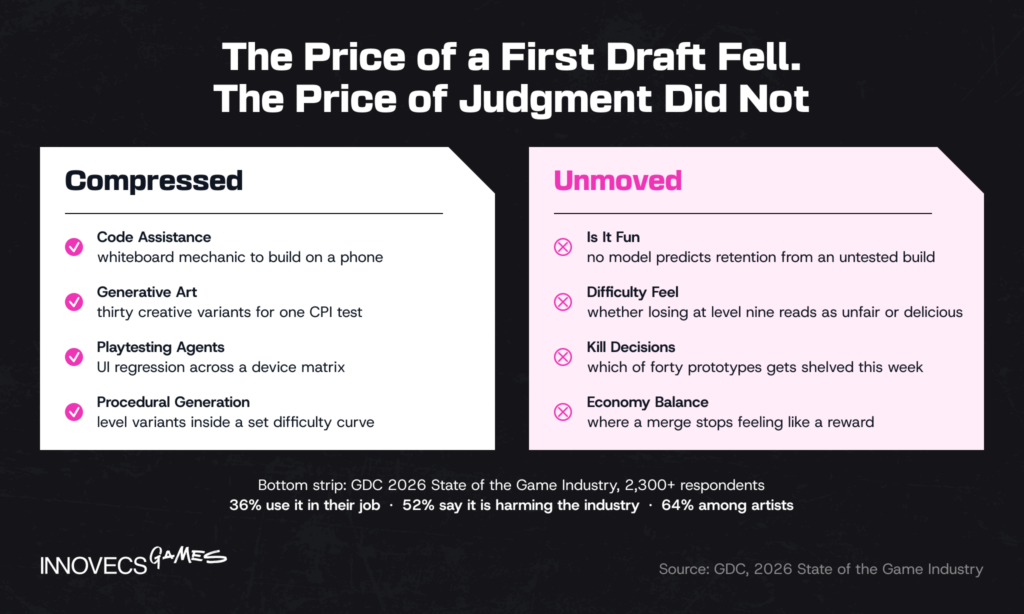
Our position, for whatever it’s worth: the price of a first draft has fallen to roughly nothing and the price of judgment hasn’t shifted a cent. An agent will happily confirm that your build doesn’t crash and that the button is reachable with a thumb on a 6.1-inch screen. What it can’t tell you is whether losing at level nine feels unfair or delicious, and the whole genre lives inside that distinction. We’ve written more on where the line currently sits in AI in game development.
How Innovecs Games Helps You Build the Right Hyper-Casual Team
The call usually comes at the same moment. A live title is absorbing the whole team, the prototyping pod hasn’t run in four months, and the roadmap still has three concepts on it that someone promised the board. Nobody in that situation needs another studio offering to take care of everything. They need a team that plugs into an existing pipeline, holds the prototype cadence while the live game keeps eating capacity, and says out loud when a build is dead before another month of art goes into it.
We staff a dedicated team for hyper casual games development and hybrid-casual builds: Unity engineers, technical artists, marketing artists for creative testing, and QA that runs against a real device matrix rather than a simulator. Those teams share milestone responsibility with yours and work inside your tooling and your build pipeline, not alongside it. For studios extending a live portfolio of hyper casual mobile games, this usually starts with one prototyping pod and grows only when the metrics justify it. Our wider game development outsourcing and mobile game development services pages cover the engagement models in detail.
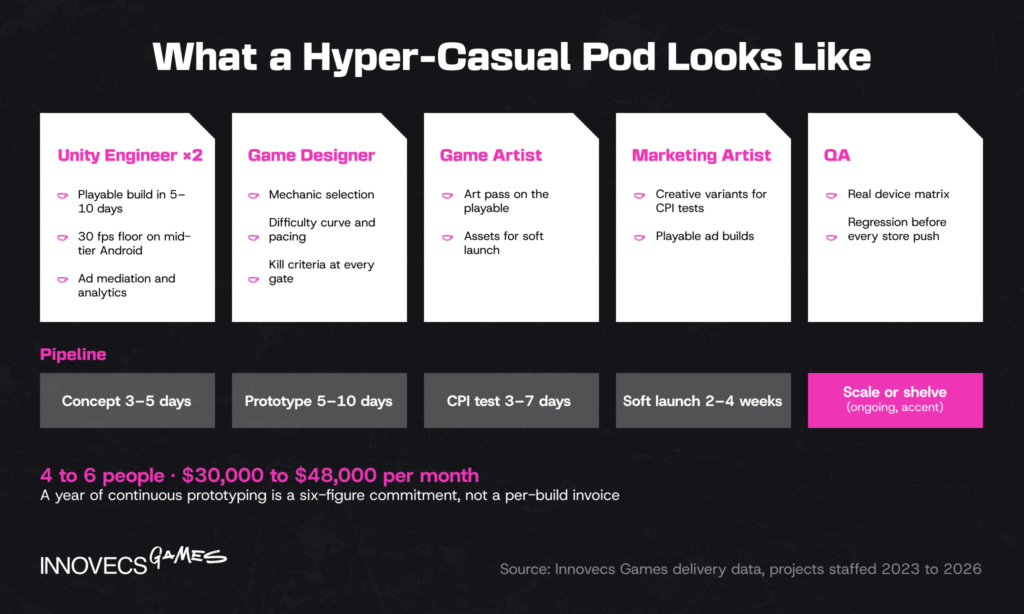
Sized for this genre, a pod of four to six people, two Unity engineers plus a designer, an artist and shared QA, runs somewhere between $30,000 and $48,000 a month depending on the seniority mix. Do the arithmetic and a year of continuous prototyping is a six-figure commitment, not a per-build invoice, which is the honest shape of what you’d be deciding. Measured per prototype it’s dearer than freelancers, and it’s flatly the wrong call if what you need is one build delivered to spec.
Source: Innovecs Games delivery data, projects staffed 2023 to 2026.
What you get for it is throughput you can actually plan against, and a hyper casual games studio partner who will argue with you about a D1 number rather than quietly building whatever the ticket said.
FAQ
What are hyper-casual games?
They’re mobile games built around a single mechanic that needs no tutorial and no onboarding: tap, swerve, merge, clear. Sessions last seconds, not minutes. Monetization runs almost entirely on advertising rather than purchases, which is what separates them from casual titles that look identical on the store page and earn their money somewhere else entirely. The whole category rests on a stranger understanding your game before he decides whether to keep it, which is a harsher brief than the simple art style makes it sound. It still leads mobile in install share at 29.1%, on Adjust’s 2026 numbers.
How do hyper-casual games make money?
Advertising carries most of it. Interstitials run between sessions, banners run during play, and rewarded video lets the player opt in for a continue or a bonus. In-app purchases usually show up as ad removal or small convenience items and rarely carry a title alone, while publishers with a portfolio add cross-promotion and move players between their own games instead of paying to reacquire them. Every team eventually discovers the same law: you can always fit one more placement in, and the player can always uninstall. The economics work only when ad ARPDAU clears the cost of a paid install, which rose 30% in 2025 to a $0.56 blended global average, per Adjust.
What game mechanics work best for hyper-casual titles?
Timing, agility, puzzle, swerve and merge cover nearly all of the genre, and none of them is inherently better than the others. Picking by trend is how studios end up eleventh in a crowded subgenre, six months after the first mover bought all the cheap traffic and left. The real test is whether your mechanic reads instantly in a five-second silent clip, because that clip is your ad creative, your store preview and your CPI test at once. Our read: puzzle and merge have aged best, since they extend naturally into the progression layers hybrid-casual needs and the others mostly don’t. Watching people try to bolt a meta onto a swerve game hasn’t changed our minds about that.
How long does it take to develop a hyper-casual game?
Five to ten working days with two or three people gets you a playable prototype. Getting from there through creative testing to a soft-launch-ready build typically runs six to twelve weeks, depending on how many iterations the retention data demands. Everything after that is open-ended, because scaling is a live-ops job rather than a development one and nobody can put a date on finding out whether people like your game. Studios that promise four weeks end to end are quoting you the prototype and hoping.
What makes a hyper-casual game ‘snackable’?
Short levels, fifteen to forty-five seconds each, with visible progress and nothing to remember between sessions. A snackable game survives being picked up in a queue and dropped mid-level without penalty or guilt. There’s a commercially convenient side effect: frequent level boundaries create ad breaks that don’t feel like an ambush. Err too far toward short, though, and the thing stops reading as a game and starts reading as a slot machine. Players work that out considerably faster than product managers do.
How much does it cost to build a hyper-casual game?
Budget $8,000 to $20,000 for a tested prototype, and $30,000 to $70,000 for a soft-launch-ready build with art, analytics and ad mediation wired in, based on projects we staffed between 2023 and 2026. Per-build pricing is the wrong frame for anyone running a portfolio, though: a standing pod of four to six costs $30,000 to $48,000 a month and is what studios actually buy once they need more than one shot at a hit. Both figures exclude user acquisition, which is the larger line by a wide margin once you’re buying installs at $0.56 blended or $1.68 in North America. Anyone quoting a fixed price before seeing the mechanic is quoting a template.
What is the difference between hyper-casual and hybrid-casual games?
Hyper-casual monetizes through ads and optimizes for install volume. Hybrid-casual keeps the same accessible hook and adds progression, an economy and meta systems, so players stay long enough to spend something. For the first thirty seconds of play the two are usually indistinguishable, which is deliberate, because the hook was always the part that worked. The difference arrives on day seven, where hybrid titles now out-retain the top 25 casual games according to Sensor Tower, and in the revenue mix, where hybrid casual was the only mobile segment to grow IAP revenue meaningfully in 2025. If you’re starting something new in 2026 and calling it hyper-casual, it’s worth checking whether you actually mean hybrid.
How many prototypes does a studio typically test before finding a hit?
At the top of the market the ratio is brutal. When Voodoo restructured around hybridcasual in 2023, its teams were testing as many as 1,500 prototypes a year against a target of four launches. Smaller studios work at a smaller scale on the same principle, usually testing twenty to fifty concepts to find one worth soft launching. What decides the outcome isn’t the count but whether anyone is actually allowed to kill things inside a fixed window, and that turns out to be a cultural problem wearing a process costume. A pipeline that tests forty prototypes and can’t shelve any of them is worse than one that tests ten.
How is AI changing hyper-casual game development?
Mostly by compressing the front of the pipeline. GDC’s 2026 survey found 36% of industry professionals using generative AI, most often for research and brainstorming, code assistance and prototyping. In this genre the practical wins are faster first playables, high-volume ad creative variants for CPI testing, and agents grinding through UI regression across a device matrix while humans handle the parts that need an opinion. Sentiment is the complication nobody puts in the sales deck: 52% of respondents in the same survey said generative AI is having a negative impact on the industry, rising to 64% among visual and technical artists. If you’re staffing an art pipeline, that’s a hiring problem rather than a philosophical one.
Can AI help predict whether a hyper-casual game will succeed?
Partially, and a good deal less than the tooling implies. Models trained on historical performance can flag which creative concepts will test well on CPI, and ad networks have been optimizing bidding this way at scale for years. What no current model does reliably is predict retention from a build it hasn’t put in front of real players, because retention depends on how one specific difficulty curve feels to one specific audience. Predicting fun is the most valuable unsolved problem in mobile games, and it has been for about fifteen years running. Use AI to narrow which prototypes earn a paid test, not to skip the test.
Ready to Outsource Your Hyper-Casual Game Development? Let’s Talk
You’ve got a mechanic, a date, and a CPI you need to come in under. We’ll put an embedded team on hyper casual games and carry the milestone risk with you, rather than handing back a build and an invoice. Send us the gap and the timeline and we’ll come back with a scoped team.